I’m not blind to its shortcomings, but The Impostors is one of my most favorite movie comfort foods. That I find it so funny and purely enjoyable is really saying something, considering its milieu is the joblessness, desperation, and looming international conflict of The Great Depression.
The pitch: a loving homage to old-school Hollywood screwball comedies, with an all-star cast of 90s New York City indie personalities. It has the feel of a filmed stage play (like Peter Bogdanovich’s Noises Off) crossed with the loosey-goosey, making-it-up-as-they-go-along feel of a Marks Brothers or Laurel & Hardy romp. The stagey production values become a virtue as the same few sets are redressed over and over to amusing effect. Finally, the entire soundstage-bound facade is unveiled during a celebratory dance number that breaks the fourth wall. The Impostors is a refreshingly affectionate pastiche, and not satiric or ironic in the least.
“To life… and its many deaths.”
The freewheeling farce is above all a love letter to the craft of acting. Arthur (Stanley Tucci) and Maurice (Oliver Platt) are two perpetually out-of-work actors so enamored of their chosen profession that they will not consider pursuing any other line of work even when faced with starvation. Their daily routine consists of staging acting exercises for themselves in public, duping passersby into serving as their participatory audience, like a prototype for the modern-day pranksters Improv Everywhere.
An escalating series of misadventures finally delivers them into a scenario in which their acting skills for once become useful: the opportunity to portray fabulously rich cruise ship passengers, to save the day, and of course to die magnificently heartbreaking deaths while doing so. What Arthur and Maurice yearn for, even more than to eat, is the opportunity to die in front of an audience. Not for nothing is their toast “To life… and its many deaths.”
It’s worth noting that most of the legitimate passengers are anything but; most have either lost fortunes during the Depression, are conspiring to steal new ones, or plot to wreak terrorist havoc in the name of fascism. Almost everyone’s an impostor.
“The danger of the chase has made you perspire. It has made me also… moist.”
Tucci’s paean to acting attracted an ensemble cast to die for, including a dream team of 1990s indie superstars including Lily Taylor, Steve Buscemi, Hope Davis, Isabella Rossellini, Tony Shalhoub, Alison Janney, Alfred Molina, Richard Jenkins, and Campbell Scott (who shamelessly steals and runs away with the movie with a sublimely odd character that answers the unasked question: what if Marvin the Martian were a lovestruck Nazi?). And there’s still room in the souffle for wildcards like a pre-Lost Michael Emmerson, Scottish comedian Billy Connolly, and a cameo by a manic Woody Allen in a superfluous skit that could easily have been cut.
The Impostors apparently landed with a bit of a thud after the critical and commercial success of Tucci and Scott’s justly acclaimed Big Night (which I also love, not least for containing cinema’s all-time greatest omelette-making scene).
Nicole Kidman must be one of the unluckiest stars in Hollywood, having recently starred in at least two big-budget catastrophes. Frank Oz’s The Stepford Wives (2004) was sabotaged by cast members dropping out, extensive reshoots, and competing script revisions that left significant logical plot holes in the finished film. Next, Invasion is best described as quite simply a broken movie.
One full year after the completion of principal photography under director Oliver Hirschbiegel (Downfall), producer Joel Silver contracted The Wachowskis (The Matrix, Speed Racer) to write new scenes to be directed by their protege James McTeigue (V for Vendetta). Warner Bros. expended $10 million on 17 extra days of shooting in an attempt to reshape what was reportedly a more internal, psychological suspense piece into more commercial thriller.
Do you ever get the feeling that you’re in a terrible movie…?
After a brief, promising opening scene (a flash-forward, we later learn, to a world almost fallen to an alien attack), Invasion quickly descends into full-on sci-fi action cliché. A space shuttle disintegrates on re-entry, carrying a payload of virulent spores bent on world domination. After the real-life loss of the crews of the shuttles Challenger (1986) and Columbia (2003), this spectacular special effects sequence is about as tasteful as watching CGI skyscrapers crumble.
One of the Wachowskis’ late additions was a ridiculously long car chase through the streets of Washington DC (filmed in Baltimore), with psychiatrist Carol (Kidman) behind the wheel of a literally burning Mustang. It’s beyond implausible that a shrink would have the driving skills of a modern-day Bullet (Steve McQueen) or Popeye O’Doyle (Gene Hackman in The French Connection). In fact, Kidman damaged more than her career: she broke several ribs during an accident incurred while shooting the sequence.
The biggest problem is not the clumsily grafted-on action spectacle but the choppy screenplay. It’s painfully obvious to spot the seams between Dave Kajganich’s original script, which one can infer would have made for a more subtle horror story about an alien invasion accomplished without bullets or the exploding of infrastructure, and the Wachowskis’ reduction to the lowest common denominator.
The movie is at its best when Carol senses the subtle changes of her city’s daily routine as the invasion spreads. It’s also interesting as she encounters other uninfected survivors that have learned to hide in plain sight. Veronica Cartwright, who appeared in Philip Kaufman’s 1978 version, appears as one of Carol’s patients who is apparently naturally immune. She counsels her to pretend to be a Stepford Wife in order to avoid detection by the dispassionate alien intelligences that have taken over most of the population. But these moody sequences are all too brief in-between the car chases and explosions.
“Our world is a better world”
A huge chunk feels missing from the middle; the second act should be a slow discovery of the details of the invasion and a gradual escalation of the conflict. But Carol and her doctor paramour Ben (Daniel Craig) leap to the accurate conclusion of an alien invasion based on only a few observed cases of mild weirdness around them, clearing the rest of the movie’s running time for a series of chase sequences.
Worst of all is yet another criminal misuse of poor Jeffrey Wright (reunited with 007 co-star Daniel Craig), a brilliant actor saddled with most of the script’s laughable technobabble that leaves no room to the imagination (the original 1956 Invasion of the Body Snatchers was arguably not specific enough, but the 1978 version found just the right level of gory detail without getting bogged down in tedious pseudoscience).
Jack Finney’s classic sci-fi novel The Body Snatchers has been adapted over and over into movies that illuminate the concerns of the times. Don Siegel’s 1956 original was a thinly-veiled critique of McCarthyism. Philip Kaufman’s 1978 remake also made sense in a post-Vietnam and Watergate era. Abel Ferrara applied the metaphor to blind obedience and conformity in the military in his 1993 Body Snatchers. Robert Rodriguez found the most perfect setting yet, as he satirized teen peer pressure in high school in The Faculty (1998). What does the oft-told Body Snatchers tale mean today?
Invasion is the fourth version of novel, and the second to ditch the notion of replacement bodies. As in The Faculty: the aliens are puppetmaster-like parasites that take over human bodies without permanently harming them. Invasion makes a fleeting reference to other nations publicly combating the alien insurgents. The US is the only one to hide behind a cover story that has the opposite intended effect, only further enabling the invasion to succeed. Invasion might have been a better film if it had focused more on this glimmer of political satire than on Shuttle disasters and burning Mustangs.
Welcome to The Pod People Film Festival, our third mini movie retrospective. After catching up with Ridley Scott and George A. Romero, we now take a look at four adaptations of Jack Finney’s novel The Body Snatchers, plus one unofficial homage / satire.
We interrupt this retrospective look at the four official feature film adaptations of Jack Finney’s novel The Body Snatchers with a kind of bonus track, a remake in all but name, Robert Rodriguez’s The Faculty.
It may be a touch campy, but hugely entertaining. All four official versions are deadly serious, so it’s refreshing for The Faculty to play the concept for laughs. Rodriguez isn’t known for restraint, but most of the fun is likely attributable to Kevin Williamson, the writer of Scream, one of the most influential movies of the 1990s. Yes, I’m prepared to back that claim up: it was one of the first mainstream movies to be overtly Postmodern, and not in a stuffy college literature seminar sense, but one that found lowbrow thrills & chills from a highbrow intellectual perspective over the horror genre.
That is, Scream was both a knowing satire of the horror movie genre, in which its own characters knowingly commented upon the events that befell them with all the knowledge that comes from being movie geeks well-versed in horror movie cliches, but was also simultaneously an actual functioning horror movie itself. Other 1990s movies along those lines were Wild Things (one of the sexiest, twistiest noirs ever made), Starship Troopers (a hilariously bleak vision of a fascistic world inherited by children), and even Shakespeare in Love‘s playful plays-within-plays-within-a-movie.
There’s be no more tears… in gym class
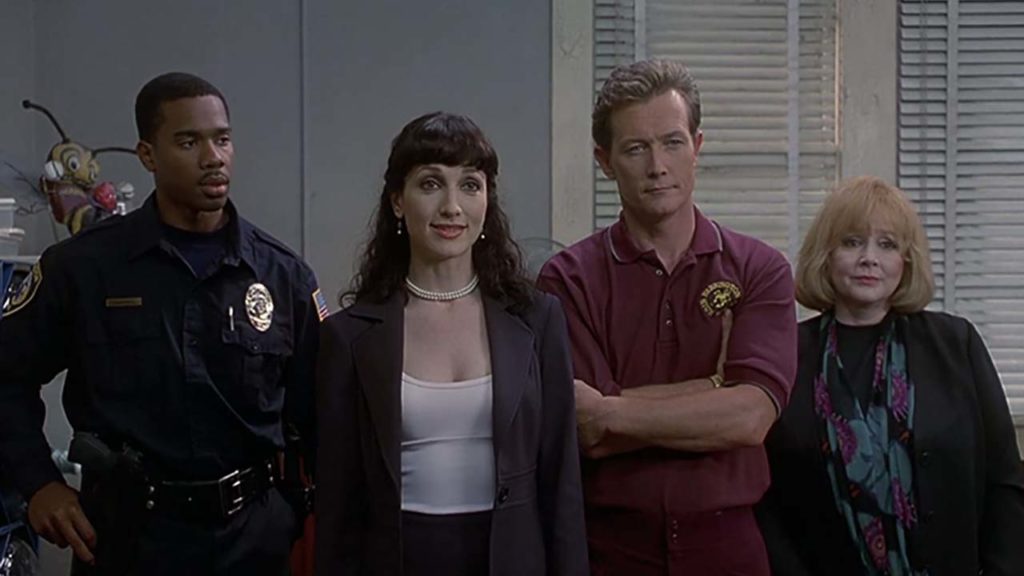
A prologue introduces us to the namesake faculty, from which the great (and sexy) Bebe Neuwirth checks out early, or at least seems to. The adult cast is wonderful overall, even though some parts are little more than cameos. Robert Patrick brings all of his ruthless Terminator T-1000 steeliness to Coach Willis (like Dr. David Kibner – Leonard Nimoy – in Philip Kaufman’s 1978 Invasion of the Body Snatchers, a villain both before and after the invasion), the glamorous Famke Janssen is an improbably mousy loner, Jon Stewart as a sympathetic science teacher, and Salma Hayek is hilarious in her brief appearance as Nurse Rosa Harper. On the downside, Harry Knowles of AintItCoolNews.com notoriety also haunts the faculty room (this was 1998, after all).
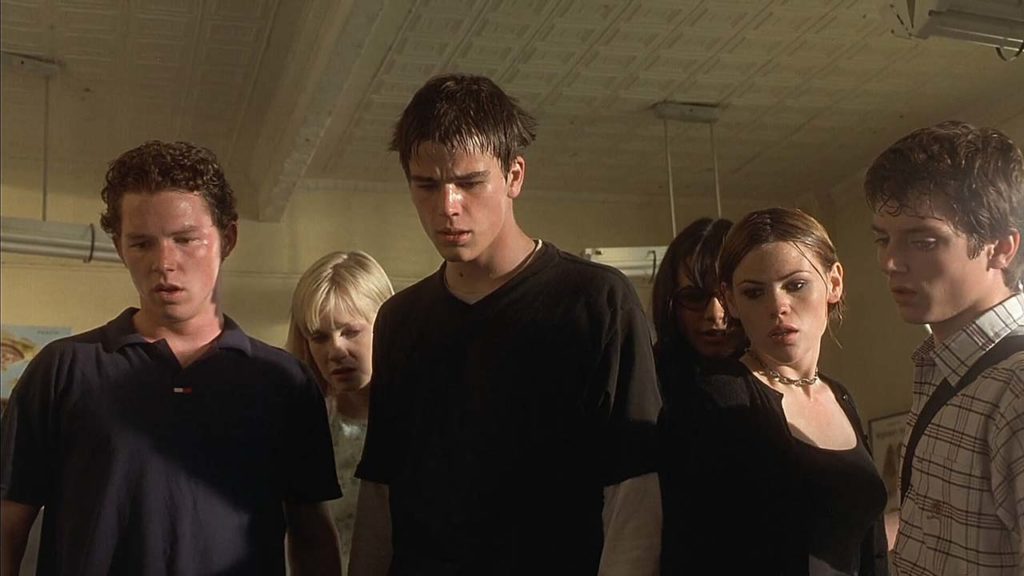
We finally meet the kids in a montage set to a cover version of Pink Floyd’s infamous antiauthoritarian anthem “Another Brick in the Wall Part II”, with onscreen text resembling Gerald Scarfe’s scrawled lettering on the original The Wall album sleeve. They’re a next-generation Breakfast Club comprised of every key high school demographic: goth loner Stokely (Clea DuVall), hot ice queen Delilah (Jordana Brewster), meathead athlete Stan (Shawn Hatosy), bad boy Zeke (Josh Hartnett), meek nerd Casey (Elijah Wood), and sweetness-and-light Southern belle Marybeth (Laura Harris).
This meeting of The Breakfast Club II is called to order
Zeke is a slacker genius with an awful haircut that hasn’t dated well. He has deliberately failed out in order to relive the glory of his senior year within the safe bubble of being Big Man on Campus. He peddles a powdered narcotic (actually mostly caffeine), drives a fast car, and makes the girls swoon. But underneath it all is an intellect missing an aim or purpose. Good for him, then, that an alien invasion gives him the opportunity he needs to grow up.
Troubled goth girl Stokely disguises herself as a lesbian to avoid human contact. One wonders why, then, she’s not hassled by the school’s other lesbians. Like cuddly misfit Allison (Ally Sheedy) in The Breakfast Club , Stokely eventually conforms to straight-girl norms by dressing in pink and dating the jock. DuVall is said to be gay or bisexual, so I wonder how she felt about playing such a cop-out character. But this oddly conservative moment aside, the character is the key to the Postmodern, metafictional nature of the movie.
Stokely is a science fiction fan that explicitly references Jack Finney’s novel The Body Snatchers (but not any of the movies). In fact, she disparages the book, claiming it’s a poor ripoff of Robert A. Heinlein’s The Puppet Masters.
All Body Snatcher movies to date featured sentient brussels sprouts that create evil duplicates of humans, destroyed the originals, all with the aim of bringing a form of peace and harmony: a uniform society in lockstep synchronicity. But these pod aliens are more overtly evil. These aquatic parasites that temporarily take over bodies are no emotionless drones, but are actually remarkably lusty. They clearly relish the sublimation of the students, and stage a football game like a Nazi Party rally.
All of which begs the question, if the aliens are like unleashed, uninhibited versions of our own ids, what’s the difference between them and, say, a high school kid hopped up on hormones? As one of them aptly puts it, “I’m not an alien, I’m just discontent.”
Welcome to The Pod People Film Festival, our third mini movie retrospective. After catching up with Ridley Scott and George A. Romero, we now take a look at four adaptations of Jack Finney’s novel The Body Snatchers, plus one unofficial homage / satire.
Yet another remake of Invasion of the Body Snatchers might seem an odd project for iconoclast director Abel Ferrara, known for gritty urban crime sagas centered around profoundly compromised protagonists. In stark contrast, the lead in Ferrara’s most conventional movie is a good-natured teenage girl, a world apart from the crazed Harvey Keitel of Bad Lieutenant or Christopher Walken of King of New York. Marti’s (Gabrielle Anwar) biggest problems are a nomadic lifestyle, a moody little brother, and a new stepmother.
This version of the bodysnatchers story sheds “Invasion” from the title, which is strange considering it ought to be the key word for a movie focused on the U.S. military, at home not long after the first Gulf War — a conflict thought to be resolved at the time. With America at peace and a Democrat in office, Body Snatchers was probably one of the first mainstream feature films to directly mention the conflict, along with Courage Under Fire (1996) — David O. Russell’s ruthless satire Three Kings being still some ways off.
Abbreviating the title was a missed opportunity to play with the ambiguity between a military confirmed as professional, government-sanctioned invaders, and an extraterrestrial force that easily infiltrates them. But don’t worry, the word “Invasion” would be picked up again for Oliver Hirschbiegel’s 2007 abomination starring Nicole Kidman.
Gabrielle, sweetie, you should know better than to take a bath during a horror movie…
On home soil, an Alabama army base under the command of General Platt (who else but R. Lee Ermey?) must suffer the indignity of bending over for The Environmental Protection Agency as it investigates the army’s storage of chemical weapons. The sympathetic Major Collins (Forest Whitaker) reports increasing cases of mental illness in his infirmary (paranoia, fear of sleep, etc.). He suspects the toxic chemicals, making it impossible to miss the allusion to the controversial Gulf War Syndrome.
Marti falls in love with helicopter pilot Tim (Billy Wirth), so bland and flat that it’s hard to tell if he’s a pod person (to be charitable, maybe this was a deliberate casting call, meant to keep the audience guessing). She is befriended by Platt’s punk daughter Jenn (Christine Elise), a refreshing dose of nonconformism among the rank and file – indeed her rebelliousness serves as a canary in the coal mine to measure the progress of the invasion. We genuinely feel for Marti’s little brother Andy (Reilly Murphy, a rare child actor that does not annoy) as he senses his school playmates are “bad” and witnesses his stepmother (Meg Tilly) die firsthand. Incidentally, Tilly’s performance as the pod-stepmother is excellently weird.
“Where you gonna go, where you gonna run, where you gonna hide? Nowhere… ’cause there’s no one like you left.”
Like Philip Kaufman’s 1978 version of the same material, Ferrara indulges in the gore and female nudity de rigueur to the horror genre. Marti disrobes for a very close encounter with groping alien tendrils in a bathtub, and later runs through an infirmary full of gross, half-formed pod people. The very pretty Anwar is so convincingly young-looking that her unexpected nude scenes make one feel decidedly uncomfortable.
In all three versions of the story so far, a pod person delivers some variation of the following warning to human resistors: there’s nowhere to run, nowhere to hide, and there’s no one else left like you. So why do the pod people always work so hard to chase down the few remaining humans? On the evidence of Body Snatchers, they’re still very easily defeated, and the climactic ending is something of a dud.
The infected army base plots to distributes pods to other bases, and eventually amass an armed force capable to taking over the world. But Marti and Tim manage to blow up the base and as entire convoy with just one helicopter. Why was it fully armed during peacetime, anyway?
The first film ended with humans just beginning to mobilize against the invaders. The second ended with humanity totally overswept. Now the third ends with us winning. How will Nicole Kidman fare in Invasion? Tune in after our next review, an interlude to look at Robert Rodriguez’ enjoyable homage The Faculty, to find out…
Welcome to The Pod People Film Festival, our third mini movie retrospective. After catching up with Ridley Scott and George A. Romero, we now take a look at four adaptations of Jack Finney’s novel The Body Snatchers, plus one unofficial homage / satire.
Philip Kaufman’s re-imagining of Don Siegel’s 1956 classic paranoid nightmare Invasion of the Body Snatchers immediately signals its uniqueness with a strange and beautifully abstract opening sequence. Psychedelic spores float off the surface of an alien planet, traverse through outer space, and fall to Earth as gelatinous rain. A glimpse of a newspaper headline describes a simultaneous epidemic of “spider webbing,” an ominous portent of what turns out to be the desiccated remains of the invaders’ victims.
Matthew Bennell (Donald Sutherland) is a pitiless health inspector pining after his excitable colleague Elizabeth Driscoll (Brooke Adams). When her slob dentist boyfriend suddenly starts wearing suits and loses interest in televised sports, she becomes convinced a little too quickly that he’s an impostor, and leaps from there to even grander notions of an alien conspiracy. But, being a lab worker at the Department of Health, and the type that keeps a greenhouse in her bedroom, perhaps she is after all eminently qualified to identify malevolent walking and talking plants bent on world domination.
Leonard Nimoy would like to encourage you to stop sleeping around. There will be no more tears.
The original film imagined a subversive alien invasion of suburbia. In conservative small-town America, or at least the fantasy thereof seen in movies, everybody knows everybody else’s business. This remake takes place in the liberal urban setting of San Francisco, where relationship networks are fractured into neighborhoods, socioeconomic classes, and cliques.
As our current fears of avian and swine flus attest, infections spread faster where humans congregate in tight spaces: schools, slums, public transportation, etc. The aliens in the original plotted a slow takeover of American’s already homogenous heartland, while their cousins here target our population centers for maximum shock and awe. Still, some secrecy is required at first, and the creatures prove themselves adept at subterfuge.
The greatest deceiver is self-help pop shrink Dr. David Kibner (Leonard Nimoy). It’s a crying shame we haven’t gotten to see Nimoy play more roles like this in his career – by which I mean anything other than Spock. Far from a San Fran free-love liberal, Dr. Kibner is actually a conservative reactionary, decrying the ease with which modern couples mate and part. He believes modern society as a whole is suffering from a fear of responsibility and commitment.
We never find out for sure when he his body was snatched, or even if it was. Out of everyone we meet, he was arguably already a pod person all along. The most interesting facet of the film for me is the irrelevance of whether Kibner was a type of alien advance guard writing books espousing pod philosophy. He represents a human viewpoint already sympathetic to the invading veggies: one that longs for a return to conservative values and like behavior. But why is Kibner wearing an archery guard on one hand? That’s just a weird affectation.
OMG! Look out for the trolley!
Easter eggs include cameos by Don Siegel as a sinister taxi driver and the original’s star Kevin McCarthy reprising his crazed rant “They’re here already! You’re next!” A young Jeff Goldblum brings all his quirk to bear as neurotic poet Jack Bellicec. His wife Nancy is played by Veronica Cartwright, reprising essentially the same shrieky, panicky performance she delivered in Ridley Scott’s Alien.
The original film was a a thinly veiled metaphor for the McCarthyism of the period. In the late 1970s, the same story works just as well at the tail end of a dying sexual and cultural revolution that began in the 1960s. After the disillusionment of The Vietnam War and Watergate, people may have sensed the coming conservatism and conformity (in other words, Tom Wolfe’s masters of the universe and bonfires of the vanities) of the 1980s.
This Invasion of the Body Snatchers is largely a psychological horror film, but features at least one true gross-out sequence in which the alien growth process is explicitly depicted. Matthew aborts his own budding duplicate with a garden hoe (a wholly appropriate weapon for sentient vegetables). The original film avoided detailing the process, possibly to elude questions that couldn’t be addressed without violating standards of decency (What happens to the original bodies? Why aren’t newborn pod people naked? Now we know – hey, look! Brooke Adams’ breasts!). Gore aside, the one truly unsettling image is a glimpse of a body snatching gone awry: a dog with a human face, an accidental hybrid being created when Matthew interrupts the process of an alien taking over a hobo with a pet doggie.
But what Kaufman’s version is chiefly known for is its bleak, bleak ending, in total contrast with the hint of hope that closes the original. The baton wouldn’t be picked up again for another 15 years, when Abel Ferrara transposed the action to the obedient, conformist, oppressive world of the military in the tersely titled Body Snatchers.
Welcome to The Pod People Film Festival, our third mini movie retrospective. After catching up with Ridley Scott and George A. Romero, we now take a look at four adaptations of Jack Finney’s novel The Body Snatchers, plus one unofficial homage / satire.
For a pulpy 1950s horror flick relating the strange tale of an invasion of giant brussels sprouts, Don Siegel’s Invasion of the Body Snatchers is a startlingly gory, paranoid nightmare positively loaded with political subtext.
Its themes of identity, mistrust, and subversion have remained relevant and influential for decades, inspiring three official remakes and even left-field homages like Robert Rodriguez’ high school melodrama The Faculty. Not only has “pod people” entered the lexicon, its screenplay is highly quotable (“They’re here already! You’re next!”) and sometimes even rather poetic: “There’ll be no more tears.”
The movie can be a bit frustrating to modern science fiction aficionados used to high levels of pseudo-scientific detail. The aliens’ life cycle seems illogical and not fully thought-through, to the extent that it harms the plot. It seems a victim simply must be in proximity to an alien pod for it to begin to grow into your shape. We also learn that a pod absorbs its host’s memories when it sleeps, but we see Becky Driscoll (Dana Wynter) duplicated after falling asleep alone in a cave devoid of any visible pods. What happens to the original bodies? How do the pod-born duplicates wind up wearing the host’s clothes?
Philip Kaufman’s 1978 remake is more clear on the process, with the added benefit of allowing for more explicit gore and female nudity to tart things up a bit. The 2007 remake Invasion solves these problems by sidestepping the issue entirely, featuring a breed of aliens that literally invade your body – a mild condition which is, it turns out, curable. Ask your doctor, or better yet, date one!
Eat your brussels sprouts! Or you’re next!
As Matthew Dessem points out in his analysis of The Blob for the Criterion Contraption, certain 1950s horror and sci-fi movies beg to be interpreted as metaphors for key atomic age issues: Godzilla, The Day the Earth Stood Still, and The Blob among them. But these monsters look just like us. So let’s give it a shot:
Interpretation one: the movie manifests a generalized fear of a homogenized American culture. A pod person is discovered in an intermediary state, totally devoid of individual characteristics, like a mannequin. Perhaps America’s fabled melting pot, brought to an absurd conclusion, could result in a dead-end monoculture of of uniform religion, politics, and behavior.
Interpretation two: the story is a thinly veiled metaphor for McCarthyism, the contemporary Red Scare that envisaged insidious Communist sleeper cells already among us, threatening to undo American churches, families, private wealth, and government.
In either interpretation, the invaders are convinced their systems of belief are correct, and honestly believe they are helping us by absorbing us into their ranks.
Pod person in the corner pocket.
The premise may be deliciously cynical, but the movie does end on a possible note of hope. Our hero Dr. Miles Bennell (Kevin McCarthy) manages to reach some uninfected human authority figures, and corroborating evidence helps him convince them to mobilize against the threat. But does this call to action come too late?
From the perspective of 2009, America looks increasingly polarized and partisan. If the pod people are already here, which side are they on? As Sarah Palin might say, the Real America? I’m sure they only want to help.
Welcome to The Pod People Film Festival, our third mini movie retrospective. After catching up with Ridley Scott and George A. Romero, we now take a look at four adaptations of Jack Finney’s novel The Body Snatchers, plus one unofficial homage / satire.
Paradoxically for one of the freshest James Bond films ever made, Martin Campbell’s Casino Royale (2006) is actually the third adaptation of the character’s debut in Ian Fleming’s 1953 novel. After a largely forgotten 1954 TV movie in which “Jimmy” Bond was awkwardly Americanized, the same premise was parodied in a 1967 farce bearing the same name, a expensive all-star disaster featuring good sports David Niven, Peter Sellers, Orson Welles, and Woody Allen. Meanwhile, the parallel and ongoing flood of proper Bond films abandoned the tainted Casino Royale, leaving it never satisfactorily presented on film. For most, Bond seemed born fully-formed as Sean Connery’s supremely suave secret agent in 1962’s Dr. No. But where did Her Majesty’s most ruthless servant come from?
By 2006, the James Bond franchise had endured 20 movies and five lead actors (and that’s just counting the canonical installments), testament enough that it has been no stranger to innovation. The most recent overhaul was Goldeneye (1995), which introduced Pierce Brosnan alongside an incrementally more progressive attitude towards women. New-style “Bond Girls” like Michelle Yeoh were still dangerously sexy, but as adept with salty dialogue, grappling hooks, and AK-47s as the title character himself. Bond could no longer cheerfully ignore his stuffy bureaucratic boss M when played by the imperious Judy Dench, and Miss Moneypenny (Samantha Bond) was no longer a frump longing for Bond from afar, but rather a sassy foil rocking the sexy secretary look. Significantly, the one thing that didn’t change much at all was Bond himself. The many women in his life may have gained greater leeway to sass and kick ass, but he himself was still the same old sexist dinosaur. In retrospect, the Brosnan films now look like just more of the same.
Say hello to my little friend
Proper Bond films enjoyed many high points over the years, but the franchise was very nearly rendered obsolete by two very different spy trilogies: Austin Powers (whose satire was wholly redundant after the 1967 Casino Royale) and Jason Bourne. Starting in 2002, the latter did Bond one better, permanently supercharging the secret-agent genre with visceral urgency, persistent action, moderately realistic psychology, and most crucially, granting the main character a capacity for love. Bourne (Matt Damon) was a man of conscience, wracked by crippling self-doubt and guilt. He may have been capable of spectacular feats of killing, but resented the circumstances that forced him to use those skills in order to survive, or more importantly, to protect or avenge his loved ones. He didn’t manipulate women for intelligence and sexual gratification as Bond routinely would, but rather formed an emotional attachment with one in particular that would motivate his actions for an entire trilogy.
Once the definition of high-gloss action thrillers, Bond was now on the defensive. The time was right in 2006 for its most radical reboot yet. The producers retired Brosnan (The Man With the Golden Parachute?) and underwent an extensive retooling of not just the series’ visual style but its core characters and mythos. But how much can you tweak Bond until he’s no longer the spy we love?
The traditional pre-credit action sequence still exists, but Casino Royale discards candy-coated Technicolor for a grainy, stylized black-and-white noir style. Starting chronologically at the beginning, we see Bond execute his first two kills, fulfilling his final qualification for “double-oh” MI-6 status. Longtime Bond fans were also mollified by another grand tradition that immediate followed: a motion graphics title sequence featuring a bevy of semi-nude female silhouettes. This particular animation, with its stark red and black vector graphics, may have provided inspiration for the opening titles of the 2007 television series Mad Men. Unfortunately, Chris Cornell’s lame, tuneless song “You Know My Name” nearly ruins it.
“You noticed…”
Further comforting continuity with the previous installations comes via ridiculous amounts of high-end product placement (cars, watches, sunglasses, etc.) and a globe-trotting series of locations (Uganda, Madagascar, Bahamas, Miami, Montenegro, and Venice). Casino Royale also doesn’t fail to over-egg the pudding in terms of its villain. Le Chiffre (Mads Mikkelsen) is scarred and asthmatic, with chronically irritated tear ducts that seep blood. It was enough to signify evil in the old days that the baddie merely have metal teeth or a fluffy kitty cat.
But that’s where the concessions to Bond tradition end. To discuss what’s new, let’s start with Bond himself. No matter how much testosterone fan-favorite Sean Connery exuded, he could still be slightly effete, fussing over vanities and creature comforts like a well-prepared martini. The Roger Moore era played up the tongue-in-cheek aspect of the series, but gorgeous women falling into bed with the frankly rather old, limp Moore was implausible at best. The suave Brosnan was born to play the classic version of Bond, but he wasn’t getting any younger as his films became as overblown and science-fictiony as the worst excesses of the Moore period. (I haven’t seen any of the Timothy Dalton or George Lazenby films, so I can’t comment on them.) Daniel Craig may not be the most macho Bond (Connery remains fandom’s favorite, for good reason), but he is clearly the most brutish and masculine. Younger, furious, and buff, he’s a giant slab of man. In a hilariously clever inversion of tradition, Bond now bares more flesh than any of his female companions, especially in an instantly iconic shot of him striding out of the ocean just barely wearing a scanty swimsuit. This Bond is almost absurdly physically fit, a parkour expert, and gets painfully bruised and scarred in fights. The days of Bond walking away from fisticuffs and fireballs with nary a hair or bowtie astray are over.
Wait… there was another Bond Girl besides Eva Green?
21st Century Bond Girls are smarter and more proactive than ever, but not at the expense of being drop-dead gorgeous and at least half the age of the current lead actor. In this blogger’s estimation, Eva Green as Vesper Lynd ought to go down in history as one of the greatest yet. She may not be as physically adept at action as Michelle Yeoh, but she is one of the most beautiful. Best of all, she’s enjoyably conceived by writers Neal Purvis, Robert Wade, and Paul Haggis as a true foil for the naughty double-entendres that still roll off this Bond’s tongue. She made such a strong impression on me, that when rewatching the film on DVD, I realized I had forgotten all about the other Bond Girl, Caterina Murino as Solange Dimitrios. Her character provides for a quick throwback to retro Bond; he flirts with her solely for information and then cruelly abandons her to certain death.
The thrilling film downshifts for a long poker sequence, with no mercy shown for anyone who doesn’t understand the game (like, say, me). There does seem to have been a miscalibration however, during one scene where even I could sense Le Chiffre was double-bluffing an oblivious Bond.
Dench is the only returning player from the Brosnan era, but her character is now part ruthless boss and part tough-love mother figure. The one convention of the classic, sillier Bond stories that I do miss is Q (Desmond Llewelyn) and his wonderful inventions. The highlight of every Connery, Moore, or Brosnan film for me was always the customary stroll through Q’s lab as his latest prototypes malfunction in amusingly lethal manners. I would cheerfully recite along with Q’s scolding catchphrase “Oh Bond, do pay attention.”
Whenever I see any Bond film, I’m always surprised at how enthusiastically he lives up to his “license to kill” reputation. The body count is always high, but Casino Royale is even more violent than most. What differentiates it is the time spent dwelling on the aftermath, including Bond having to hide bodies instead of simply strolling away from the carnage without repercussions. There’s also a fleeting dash of crude morality rarely if ever seen in the series; Bond must awkwardly comfort Vesper, traumatized by her culpability in one of Bond’s kills. And whereas old-school Bond villains would merely threaten bodily harm with laser beams and tarantulas, Bond must now must face ugly, raw torture (which is A-OK with the hypocritical MPAA’s notion of PG-13 movies, apparently – but that’s a rant for another time).
Tokyo! is a portmanteau film comprised of three shorts set in the eponymous city, all by directors not themselves from Japan: Michel Gondry and Leos Carax from France, and Bong Joon-ho from South Korea.
Gondry’s “Interior Design” is based on the comic book Cecil and Jordan in New York by Gabrielle Bell, with the action transposed to Tokyo. At first, her low-key love story doesn’t seem to bear Gondry’s characteristic whimsical surreality, but by the end her collaboration with Gondry makes perfect sense. Young couple Hiroko (Ayako Fujitani, daughter of Steven Seagal) and Akira (Ryo Kase) move to Tokyo, with the hope of finding audiences for Akira’s pretentious films. Without prospects, they crash on the floor of a childhood friend’s miniscule flat and quickly outstay their welcome.
Their optimism to find jobs and an apartment is quickly dashed – only Akira is suited to menial work, and they can’t even afford the city’s dingiest rat traps. Like April (Kate Winslet) in Revolutionary Road, Hiroko doesn’t have much ambition of her own beyond supporting her artist partner. After going to extraordinary lengths on Akira’s behalf without feeling appreciated, Hiroko undergoes a fantastical transformation and winds up literally supporting a different artist. The significance of title comes clear as she literally becomes part of the scenery.
Hiroko and Akira in Tokyo
In Carax’s scatological “Merde,” Tokyo is terrorized by a madman with a twisty ginger beard and a rigorous diet of flowers, yen, and cigarettes. The “sewer creature” (so named by the media) is relatively harmless until he discovers a cache of grenades in a forgotten World War II-era bunker buried beneath the city. Only after he uses Imperial Japan’s own weapons against them in a terrible massacre is he tracked down in his sewer lair and apprehended. At this point, Carax’s short film becomes a courtroom drama, in which eccentric French magistrate Maître Voland (Jean-François Balmer) claims to be able to interpret the terrorist’s ravings, not least including his name: Merde (“shit”).
His scandalous speeches incite Japanese self-loathing and racism, but the populace curiously fails to question whether Voland is some kind of mad ventriloquist voicing his own prejudices through the mouth of an idiot. Merde becomes a pop icon; dueling gangs of picketers chant “FREE MERDE” versus “HANG MERDE.” Merde is sentenced to a Christ-like execution (which also very much resembles a similar sequence in Lars Von Trier’s Dancer in the Dark), followed by a caption that threatens a sequel set in New York.
“Free Merde!”
Bong Joon-ho’s “Shaking Tokyo” is the tale of a unnamed hikikomori (shut-in) living alone in a totally ivy-covered house, financially supported by a father he hasn’t seen in years. The agoraphobe (Teruyuki Kagawa) has become accustomed to a life of loneliness and rigorous routine. One day he meets a cute pizza delivery girl (Yu Aoi), out of his league, but apparently with her own share of crippling emotional issues.
She passes out in his foyer during an earthquake (not uncommon in the volcanic islands of Japan), and the hikikomori reboots her using her self-tattooed buttons on her body that appear to literally control her mood and health. The smitten loner escapes his self-created prison to seek her out again. He finds a city full of shut-ins, for whom even another earthquake isn’t enough to keep them out of their own homes for long.
The HBO miniseries Generation Kill comes from David Simon and Ed Burns, the masterminds behind the superlative series The Wire. Simon himself is a former journalist, the state of the industry thereof being a primary preoccupation of the fifth season of the The Wire. So it makes sense that he would be drawn to a war story seen through the eyes of a fellow writer.
Generation Kill is based on the nonfiction book by Evan Wright, a Rolling Stone reporter embedded in the US Marine Corps 1st Reconnaissance Battalion, the first boots on the ground during the 2003 invasion of Iraq. Actor Lee Tergesen plays Wright as a wide-eyed innocent among perverse killers, delightedly scribbling the marines’ colorful boastings in his notebook, when not dodging sniper fire. The most quotable is the manic driver Corporal Josh Ray Person, well-cast as James Ransone, basically reprising his character Ziggy Sobotka from The Wire season two.
The marines’ lingo flashes back to pop culture circa 2003, which already seems so very far away. A rumor spreads that J-Lo is dead, reminding us of the brief period when Jennifer Lopez was the most famous woman on the planet. Everyone’s a “dog” or “bra” (not as in the undergarment but as in “bro”). In between harrowing battles (which the warriors long for but hate when they arrive), much of their experience is comprised of long stretches of boredom. They supply their own soundtrack, recollecting what lyrics they can and recreating every part of a song a cappella with great enthusiasm.
Cpl. Josh Ray Person: “When my band opened up for Limp Bizkit in Kansas City, we fucking sucked. But then again, so did they. The only difference is that they became famous and I became a marine.”
After exhausting the conversational value of their bowel movements and each other’s alleged sexual orientations, there’s nothing but time to talk about the origins and motivations of the war. One popular theory is that it is a nothing but another race war. As one soldier puts it, it’s “White man’s destiny to rule the world” and “White man won’t be denied.” Or is it to clear the ground for more Starbucks franchises? Or maybe it’s a war over the scarcest resource of all: virgins.
Marines are trained to depersonalize and vilify the enemy, all with the aim of being effective killers. So they are essentially ill-equipped for a 21st century war in which they are expected to request permission before engaging any target, and for situations in which they must deal diplomatically with the civilian population — some of which may be threats in disguise, but most often are just people who either need their help or would rather they just leave. When the marines do wish to offer compassion, they are thwarted by their command or by cold hard reality — oftentimes there’s nothing they can do.
They’re also fatally underequipped in a literal sense: they’re issued less body armor than Wright was able to purchase on eBay, they have state-of-the-art nightvision goggles but no batteries, and as if they didn’t stand out enough, they’re clad in the wrong camouflage style. They subsist on only one M.R.E. (Meal, Ready to Eat) each day, supplemented with copious caffeine pills, Skittles, Hustler, and Skoal. But as one marine quips, “Semper Gumby – always flexible.” As characterized here, these Marines never miss an opportunity to bitch, but pride themselves on being able to “make do.”
Lt. Col. Stephen ‘Godfather’ Ferrando: “What’s foremost in Godfather’s mind? We’re still very much in the game, gentlemen.”
Aside from the frustratingly elusive Iraqi army or suicide bombers, there are few antagonists marines hate more than Reservists, the Army, and their own incompetent command. But they gradually learn that their superiors are often far wiser than they realized. Lieutenant Colonel Stephen “Godfather” Ferrando (Chance Kelly) (so nicknamed because of a hoarse voice derived from lung cancer) nearly causes a mutiny by refusing to aid a fatally injured Iraqi boy. In a rare deference from a man that has no need to explain himself to his subordinates, he explains in detail why he made his decision: it was literally impossible to save the boy.
Later, he reveals to the reporter that he is always fully conscious of ineffective commanders like the grossly incompetent Captain Dave McGraw (Eric Nenninger), known to his detractors as “Captain America.” Godfather can’t always act on every single infraction, lest policing his people become his entire role in the military machine. Even the reprehensible Sergeant Major John Sixta (Neal Jones) turns out to be more canny than anyone suspected; he knows his job is to make himself into a cartoon villain against which the men can direct their frustrations. His role is part of the time-tested marine tradition: a morale-building figure. And for audiences of this series, a bit of comic relief (“That helmet is the proppity of the Yoo-Ess-of-Ay!”).
I found the series to be disappointingly fractured, no rival at all to Simon and Burns’ masterpiece The Wire. Only the sublime final scene rises to the vaulted heights The Wire regularly reached. One marine had spent weeks shooting and editing a home movie of the invasion. When the company finally reaches Baghdad, they find they literally cannot watch the completed movie. Each walks away, in silence, one by one. In the tradition of The Wire, this closing montage is set to a perfectly chosen piece of music (Johnny Cash’s apocalyptic “When the Man Comes Around”) and sends shivers down the spine.
Ari Folman’s Waltz With Bashir could easily be filed away under any or all of the following genres: documentary, autobiography, memoir, journalism, and nonfiction. If there’s one thing all of these have in common, it’s that none make for natural cartoons. The exception that proves the rule is Marjane Satrapi’s Persepolis, which began life as a pair of graphic novels before being adapted into an animated feature film. Waltz With Bashir takes the opposite route, starting as a film and ending up as a book. Could animated versions of Joe Sacco’s Palestine and Art Spiegelman’s Maus: A Survivor’s Tale be far behind?
Folman has lost his memories of a key experience during his service in the Israel Defense Forces during the 1982 war in Lebanon. A conversation with a friend sparks a fragment of memory involving the Sabra and Shatila massacre. The Israeli Defense Force surrounded Palestinian refugee camps in Beirut, but stood by as the Phalangists, a Christian Lebanese militia, entered and massacred a still unknown number of Palestinian civilians. Was he really there, as he now seems to recollect? Did he have anything to do with it?
Folman speaks of memory as “something stored in my system,” as if his brain were merely a computer, disassociated from any culpability in the massacre. He merely witnessed it, but it was enough for him to subconsciously erase his memories over the intervening years. He seeks out old comrades in the search of someone else who served with him and may help fill in the blanks in his memory. Like a detective story, the search for clues provides a useful storytelling device while providing an episodic narrative structure.
The title refers to a fellow soldier that madly waltzed with a machine gun while surrounded on all sides by Lebanese fighters. “Bashir” is Bashir Gemayel, the assassinated Phalangist commander lionized by Lebanese, and a celebrity on a scale that one Israeli likens to how he felt about David Bowie.
Folman is an artist as well as a filmmaker; at one point he asks one of his old friends if it’s OK to sketch his family during their interview. His visual sense manifests in Waltz With Bashir‘s stunning images, composition, and color. Like Star Wars: The Clone Wars and Ghost in the Shell: Stand Alone Complex, it features stiff, simplified characters atop fully-rendered 3D environments. Human faces are crudely rendered with small looped expressions, when not totally still (note that the 2D vector animation is not the same technique used in Waking Life or A Scanner Darkly). They contrast sharply with the fluid movement of the detailed, complexly lit vehicles, backgrounds, and weapons. If such stylized human figures were a deliberate artistic choice, what is to be gained? A few possible explanations:
As recent CGI movies like Final Fantasy: The Spirits Within, The Polar Express, and Beowulf have proven to their detriment, the uncanny valley (the point at which a simulation of a human becomes almost, but not quite, realistic and thus creeps audiences out) is a very real problem facing animators as technology progresses. All three of these are technological marvels, but the human characters are still just one step away from dead-eyed zombies.
In the most practical sense, animation is useful to create images of historical events where no cameras were present. Folman does recount seeing journalist Ron Ben-Yishai boldly film the aforementioned firefight in which his friend had his machine-gun-waltz with Bashir, so perhaps some actual footage existed for reference.
The dreamlike unreality of animation plays into Folman’s theme of the mutability of memory.
Like Isao Takahata’s stunning Grave of Fireflies, animation makes it slightly easier to watch painful events. Takahata’s emotionally draining film involved a little girl slowly starving to death after the World War II firebombing of Japan, and Waltz With Bashir features such images as a field full of dying horses and the corpse of a child buried in rubble. The end of the film snatches away this distancing technique; we finally see archival footage of the massacre’s aftermath.
Is it fair to criticize the film for taking the Israeli point of view in a story about the Sabra and Shatila massacre? Save for one woman that appears in the actual footage seen at the end, Palestinians literally don’t have a voice in the film. But neither, for that matter, do the Phalangists. In the case of this historical event, Israelis were passive bystanders, neither victims nor oppressors. If to bluntly ask what Waltz With Bashir is for, it does three things: First, it’s a meditation upon the complexity and unreliability of human memory. Second, it’s an act of journalism; returning the Sabra and Shatila Massacre to the public consciousness. Third, it’s one man’s personal coming to terms with his past.