Author: Chad Ossman

  • Todd Haynes deconstructs Bob Dylan in I’m Not There

    Todd Haynes deconstructs Bob Dylan in I’m Not There

    I always find it interesting to ponder my preconceived notions of a movie after I’ve actually seen it. The marketing and buzz on I’m Not There mostly centered on two talking points: the quirky device of multiple actors all playing incarnations of Bob Dylan, and Cate Blanchett being just plain amazing as usual (what else is new?). The first point is what gave me pause: how much sense would this film make to someone who is not a Dylan fan and scholar?

    All I really know about Dylan comes from the Martin Scorsese documentary No Direction Home, and even that paints a sketchy picture of the man. Dylan has been an enigma throughout his long history in the public eye, often speaking in riddles, and (at least in his early years) inventing a fictional backstory. The press and even his own paying audiences were often openly antagonistic, so it’s no wonder he was so famously combative and evasive. Prefiguring the modern-day chameleons David Bowie and Madonna, Dylan presented a series of personas: American roots folkie, political agitator, rock ‘n’ roller, born-again Christian, Hollywood actor, and so on. The question being: how much of this evolution was sincere growth and change, and how much was performance art? Who is “Bob Dylan”?

    Cate Blanchett in I'm Not There
    An Oscar nomination’s a-gonna fall

    Director and co-screenwriter Todd Haynes, having already deconstructed David Bowie in Velvet Goldmine, tackles the many aspects of Dylan perhaps the only way possible: fracture his key facets into multiple characters. As with the Bowie analogue Brian Slade in Velvet Goldmine, none of the Dylan figures are actually named Dylan, but then again neither is Dylan himself, whose actual surname is Zimmerman. Christian Bale plays Jack Rollins, interpreting Dylan’s Christian period, and Richard Gere plays Billy the Kid, a pretty literal interpretation of Dylan’s years in the wilderness after his fame peaked for the first time. Adding an extra layer of postmodern complexity, the late Heath Ledger plays Robbie Clark, a film actor famous for playing one of the fictional Dylans in a biopic. And of course, Cate Blanchett is amazing. As Jude Quinn, a reluctant celebrity fending off the attacks of the press, she triumphs by avoiding mere impression. Sure, she’s wearing a fright wig and shades, but her expressions and body language capture Dylan’s paradoxically wordy elusiveness.

    The result is part faux documentary, part fiction, but provides a truer overall picture of Dylan’s complicated character than a mere biopic ever could. Perhaps at some point after his death (may that be a long time from now), we will see a conventional musical biopic made of his life story (a la Bird, Ray, or Walk the Line), but I certainly hope critics and audiences will remember I’m Not There.

    Heath Ledger in I'm Not There
    Hey mr. guitar man

    The DVD edition is the only I can think of that incorporates long on-screen text introductions (more than one, in fact). Does this reflect a lack of confidence on the part of the filmmakers or distributors in the home viewers being able to comprehend the film, or is it more in the vein of the scholarly introductions that preface Penguin Classics volumes? Either way, it only reinforces the impression that you have to be a Dylan scholar to appreciate the film (which, incidentally, turned out to not be the case).

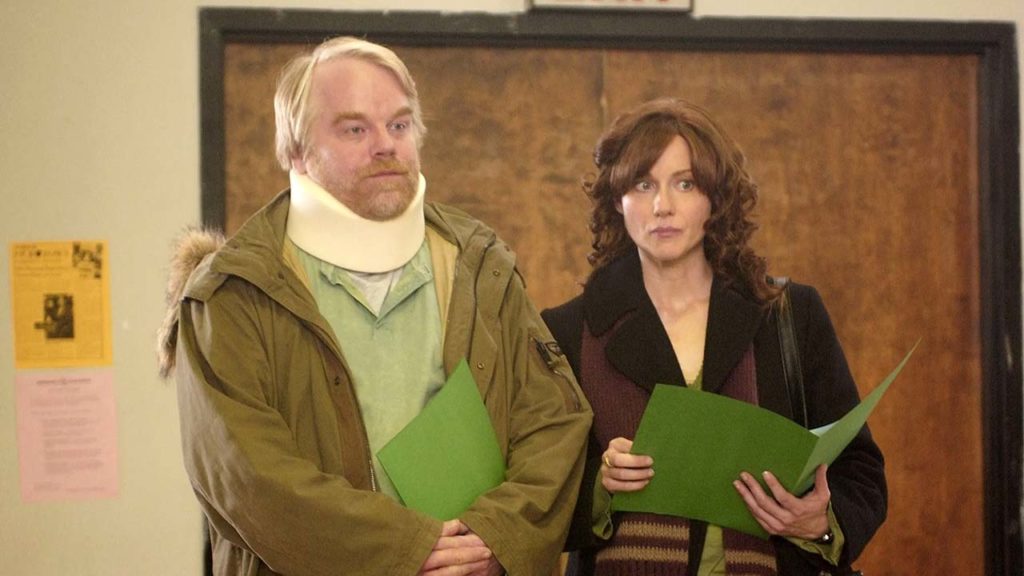
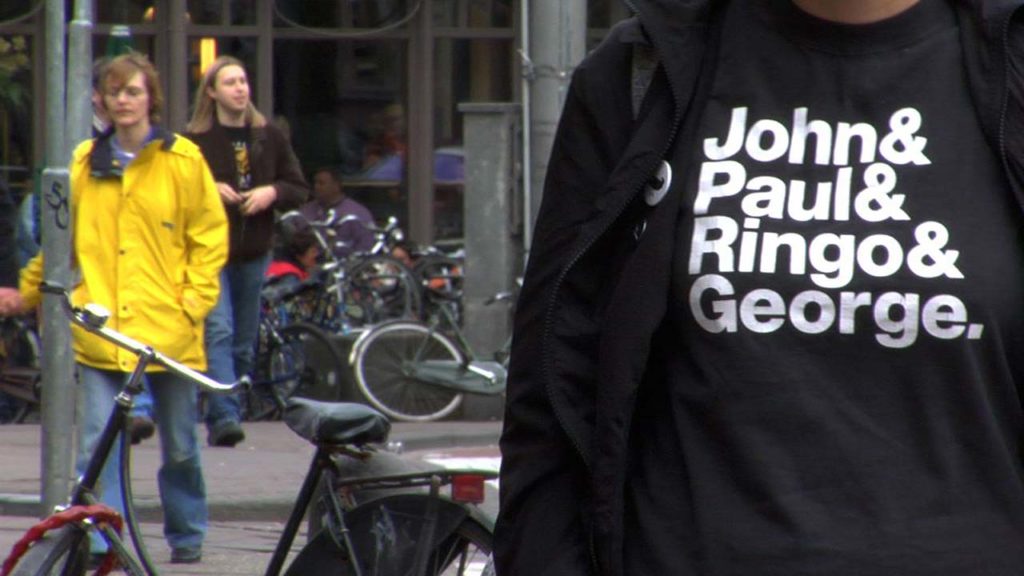
    And finally, I detected a few references to director Richard Lester: Robbie Clark (Ledger) walks through the set of the 1968 film Petulia, during an early scene in which women in neck braces leave a freight elevator before a party to promote highway safety (attended by the likes of George C. Scott, Julie Christie, and the Grateful Dead, so it’s not at all unlikely Dylan could have been there too). But even better is the best Beatles tribute I’ve ever seen: the Fab Four breeze through as the epitome of carefree fun, literally speaking and moving in fast-motion. They tempt Jude Quinn’s (Blanchett) desire to escape, until they are chased away by A Hard Day’s Night‘s screaming sycophants.

  • The camera is an eye, in Julian Schnabel’s The Diving Bell and the Butterfly

    The camera is an eye, in Julian Schnabel’s The Diving Bell and the Butterfly

    Julian Schnabel is an artist-turned-filmmaker, evidently preoccupied with the lives of other artists and writers: Jean-Michel Basquiat in Basquiat, Reinaldo Arenas in Before Night Falls, and now Jean-Dominique Bauby in The Diving Bell and the Butterfly.

    Several years ago, this blogger designed Fine Line Features’ official website for Before Night Falls. But frankly, I had trouble working up the enthusiasm to watch a biopic (absolutely not one of my favorite genres) about a tetraplegic. But please do not be dissuaded by the admittedly depressing subject matter. The Diving Bell and the Butterfly is utterly beautiful in every way, and moved this hardened movie blogger nearly to tears in the end.

    The Diving Bell and the Butterfly

    Mathieu Amalric (who resembles a more symmetrical Thom Yorke) plays the real-life Bauby, a fashion magazine editor who suffers a stroke. He survives with “locked-in syndrome,” the proverbial fate worse than death: near-total physical paralysis but with full mental faculties intact. In the true spirit of a French film, Bauby is surrounded by beautiful women. No less than Emanuelle Seigner plays Celine, the estranged mother of his children. In a moment of bittersweet humor, the despondent post-stroke Bauby is partially consoled when he first meets his two utterly gorgeous physical and speech therapists (Marie-Josée Croze and Anne Consigny).

    The Diving Bell and the Butterfly

    According to the DVD bonus features, screenwriter Ronald Harwood conceived of the powerful visual device of using the camera as Bauby’s point of view, simulating his sole means of communication: blinking. He is, blessedly, able to move one eye, and painstakingly dictates his autobiography letter by letter.

    The soundtrack is excellent, including Tom Waits, Joe Strummer (a really great song, new to me, called “Ramshackle Day Parade”), and the best possible use of U2’s “Ultraviolet.”

  • Sebastian Schrade’s tour documentary Low in Europe

    Sebastian Schrade’s tour documentary Low in Europe

    I came late to appreciating Low, but they have since become one of my favorite bands. I was vaguely aware that trainspotting music critics had christened a genre to categorize bands like Low: slowcore, the distinguishing characteristics of which being playing very quietly and slowly. An overgeneralization, it turns out, but it never hurts to be famous for something unique. “Venus,” a free promotional MP3 from their expansive compilation box set A Lifetime of Temporary Relief given away on Amazon.com, lived in rotation on my iPod for some time, and finally convinced me to buy the 2005 album The Great Destroyer. I first saw them live in Brooklyn’s McCarren Park Pool in 2006, supporting Iron & Wine (whom I like well enough, but if you ask me it should have been the other way around). Even in direct sunlight, their music is beautiful and engrossingly enigmatic.

    Director Sebastian Schrade’s documentary Low in Europe was filmed on their 2002-2003 tour of Europe, before they wrote and recorded my two favorite albums of theirs: The Great Destroyer and Drums and Guns. It’s part concert film and part documentary, but not enough of each. There are no complete musical performances included, and although the principals are all intelligent and interesting, the fact is the interviews are sometimes a little less than gripping.

    Low in Europe

    The band first expresses their ambivalence about operating within the commercial music industry. They address their reputation for slow tempos and low volume with good humor; in their early days, they played really slow, in the fuck-you avant-garde spirit but not the loud ‘n’ sloppy letter of punk, to antagonize and challenge the audience. Their contrary nature extends to their personal lives: principal members Alan Sparhawk and Mimi Parker, practicing Mormons and a longtime married couple, tour with their children and view it as a simplified and focused way of life. This came as something of a surprise to me, who feels perhaps he had a heretofore undiscovered prejudice that Mormons couldn’t be rock stars.

    The heavily-documented Low can be further investigated on the three documentary shorts included with the A Lifetime of Temporary Relief boxed set, and on the forthcoming You May Need a Murderer, a new doc coming out June 3.

  • Purity, Ubiquity & Legibility: Gary Hustwit’s Helvetica

    Purity, Ubiquity & Legibility: Gary Hustwit’s Helvetica

    Helvetica (the documentary film) is not about Helvetica (the typeface), per se. Rather, it’s about the arts of graphic design and typography, their practitioners, and how they affect our daily lives.

    Each luminary talking head has a different explanation of Helvetica’s appeal and longevity: neutrality, legibility, perfection (unlike more ornate typefaces, it is arguably comprised of the purest state of letterforms and can’t be improved), cleansing renewal (transitioning the tacky design of the 1950s to the bold and to-the-point 60s), problem-solving, soothingness, and just plain beauty.

    Helvetica

    Its detractors see its ubiquity as self-perpetuating, due to designers’ momentum, habit, and bad taste. The enthusiasm of the enthusiasts is infectious, but the movie doesn’t mock them or hold them up as objects of curiosity culled from a nerdy subculture (as does, arguably, The King of Kong).

    Thankfully for its subject matter of graphic design, director Gary Hustwit presents a highly polished work full of excellent typography, motion graphics, and editing. This blogger bemoans the tendency of many documentaries (like Spellbound and Wordplay) to use their non-fiction badge as a press pass to excuse grain, sloppy framing, and poor sound.

    Helvetica New York City subway map
    We’d be lost without Helvetica… literally

    I am a mostly self-educated web designer, not properly trained in the art and/or craft of graphic design. But I know enough to applaud the film for touching upon two of the biggest aspects of typography that every layperson should internalize:

    • Know your terms: Typefaces are designs. Fonts are particular implementations of those designs. There are multiple fonts based on the typeface Helvetica.
    • Arial is a poor Helvetica knock-off commissioned by Microsoft to side-step the expensive licensing fees. It is an abomination, a blight upon this planet earth, and should be summarily deleted from humanity’s hard drives. (q.v. The Scourge of Arial)

    Finally, I must note a major disappointment: I rented Helvetica from Netflix, and the disc arrived emblazoned with a “Red Envelope Entertainment” label. Bizarrely, there were no signs of the extensive bonus features promised on the movie’s official website. Has Netflix begun releasing “not-so-special” editions of DVDs omitting the bonus features available on retail editions? I, long relying on Netflix to help keep my DVD shelves from groaning into a black hole of overconsumption, stamp my feet in frustration.

  • The Musical Box recreates Genesis’ Black Show at Highline Ballroom, New York

    The Musical Box recreates Genesis’ Black Show at Highline Ballroom, New York

    The Musical Box is a Canadian group that stages elaborate recreations of entire concerts given by the English progressive rock band Genesis in the early 1970s. They perform closely-observed note-for-note cover versions of the original songs, in the original set list order, with full recreations of the set design, props, costumes, vintage instruments, and even the mannerisms of the original Genesis. So while it is technically true that they are essentially a cover band, how many of those tour the world several times over and land gigs at significant venues like The Highline Ballroom? It speaks to both the integrity of the original Genesis music and to The Musical Box’s own skills that they are not a mere tribute band gigging through bars and frat houses.

    At the Highline Ballroom, The Musical Box performed Genesis’ famed “Black Show,” originally in support of the 1973 album Selling England By the Pound, and widely bootlegged as the “Rainbow Show”. Genesis’ typical “White Show” was more elaborately staged, but due to venue requirements and the troubles of shipping their gear internationally, they would sometimes play the stripped-down Black Show, so known for its low stage lighting and simple black backdrop. The Musical Box’s performance had amazing sound fidelity, and was one of the best-sounding live concerts I’ve ever heard. No doubt the actual Genesis (many of whom have seen The Musical Box live and have even sat in with them on occasion) wish they had such modern audio technology at their disposal in the early 1970s.

    The Musical Box

    The members of The Musical Box are as much actors as they are crack musicians. Fittingly, Peter Gabriel himself was mostly acting onstage; the famously shy young man masked his discomfort with an outlandish stage persona full of costumes, masks, and mime. Denis Gagné is older than the stringbean-thin Gabriel at the time, but does an extraordinary job of capturing his vocals and stage presence, right down to the hilariously filthy stories Gabriel would tell between songs to entertain the audience as the rest of the band retuned their instruments.

    The only performer not in ’70s bell-bottom costume was Gregg Bendian as “Phil Collins.” He was, however, paradoxically one of the most authentic performers, recreating Collins’ unmistakably muscular and enthusiastic drumming. After becoming famous as a television actor and cheesy pop superstar in the ’80s, and Disney balladeer in the ’90s, it’s easy to forget that Collins is first and foremost one of rock’s best drummers.

    The Musical Box

    The rest of Genesis was very serious and reserved, and relied on Gabriel to engage the audience as they played. François Gagnon enlivens the bearded, serious Steve Hackett’s guitar embellishments (not one of Genesis’ core songwriters, Hackett was however a brilliant guitarist and one of the inventors of the two-handed tapping technique). Sébastien Lamothe straps on a genuine double-necked Rickenbocker to play Mike Rutherford, with the dedication to verisimilitude to grow a full beard and flowing locks. David Myers plays Tony Banks, the stoic and unsmiling anchor on stage right, but sadly relies on modern synthesizers (nothing compares to the raw sound of an actual Mellotron).

    And finally, a cheap shot: the audience was far from the usual sort seen at New York City venues. A noticeably older set, with a very strong dork flavor (with shirts tucked in over pot bellies), but there was a surprising number of women (not traditionally an audience for progressive rock).

    The Musical Box

    A few notes on the songs:

    • Cinema Show – it’s difficult to fully appreciate the very long (approx. 5 minutes!) instrumental power trio sequence featuring Collins, Banks, Rutherford until you witness it live. Wow! Genesis was a lot “heavier” than I ever realized from simply listening to the albums.
    • Firth of Fifth – Hackett’s hair-raising melody line must be one of the best guitar moments in rock, ever, and no doubt Lamothe relishes playing it live.
    • The Musical Box – the coda sequence (during which Gabriel famously wore a grotesque “old man” mask) drove the crowd bananas. Clearly the band is aware of the song’s power, for they took their name from it.
    • The Battle of Epping Forest is the rare classic Genesis song that I haven’t already memorized over the years. Gabriel affected lots of character voices in the original, and thus this is perhaps the one point when Gagné’s impersonation fails him.
    • Supper’s Ready – had The Musical Box not already provided a premature climax to the show, the closing “Apocalypse” sequence to Supper’s Ready would have been it.
    • The Knife (encore) – why aren’t Genesis credited more often for recording one of the earliest hard rock songs? The Knife is so dark, loud, and aggressive, it could possibly even be called metal.
  • Robert Downey Jr.’s got a bum ticker in Jon Favreau’s Iron Man

    Robert Downey Jr.’s got a bum ticker in Jon Favreau’s Iron Man

    Jon Favreau’s Iron Man finds just the right tone for a superhero movie, pitched somewhere in the sweet spot between Spider-Man’s emotional melodrama and Batman’s grim vengeance. This blogger, a former lover of comic books (that stopped keeping up with them partly out of frugality, and partly lack of brain bandwidth), sees two high water marks in the recent surge of superhero-themed Hollywood feature films:

    Sam Raimi’s first two Spider-Man movies captured the key themes that made Spider-Man such a popular and lasting character in the first place (seriously, find me a kid in the English-speaking world who couldn’t tell you all about Peter Parker). The comic book on its simplest level was a parable of the sometimes unwelcome changes that come with adolescence. Also key to Peter Parker’s teen psyche was his constant negotiation between his own happiness and responsibilities towards friends, family, and society. Please, let’s not discuss the painfully awful Spider-Man 3; those bitter wounds of disappointment are still raw, oozing, and infected.

    Robert Downey Jr. in Iron Man
    Talk to the… nah, that’s too easy

    The other comic book superhero franchise to translate well to the screen in recent years is, of course, Batman. Helmed by such mature, serious artists as director Christopher Nolan and actor Christian Bale, Batman Begins perhaps could not help but to turn out as well as it did. The comic book character was originally conceived as a lone vigilante avenger in the 1930s, descended into camp self-parody in the 60s, then reverted back to grim form in the 70s. The character followed a parallel arc in his movie incarnations: Tim Burton’s Batman films are dark and weirdly wonderful, Joel Schumacher’s are tacky and cheesy, and now Christopher Nolan has restored the franchise back to its gothic roots. Note that Heath Ledger as the Joker in the upcoming sequel The Dark Knight doesn’t actually smile!

    Iron Man was heavily marketed as Robert Downey Jr.’s redemption after decades of louche behavior led to him becoming unhirable (or more accurately, uninsurable). Was Downey perfectly cast, or was the role tailored to suit him? If anything, from what little I know of the comics, the filmmakers may have actually toned Iron Man’s alter-ego Tony Stark down. Physical disability is a long-established theme in Marvel Comics’ stable of characters, take for example the blind Daredevil. Stark’s distinguishing characteristic was his bum ticker, but he was also famously an alcoholic prick. Do you think, perhaps, there’s a metaphor to be found in the character of a soulless munitions dealer who loses his literal heart but finds his conscience? Hmmm…

    Terrance Howard, Gwyneth Paltrow, Robert Downey Jr., and Jeff Bridges in Iron Man
    Djay da Pimp, Viola De Lesseps, Charlie Chaplin, and The Dude star in Iron Man

    Jeff Bridges totally rocks a bald pate, and blessedly underplays his role as chief baddie Obadiah Stane. He’s the mellow voice of reason, sounding for all the world like The Dude with an M.B.A. That is, until he raises his voice for the first time, and the good times are over, man. Unfortunately, Gwyneth Paltrow (as the alliterative Pepper Potts) and Terrence Howard (Jim Rhodes) don’t fare as well. Paltrow, with little experience in the sci-fi effects blockbuster genre, is hysterically unconvincing at running away from fireballs in high heels (you can imagine her pouting “But Harvey said I don’t have to run from fireballs!”). Howard is just plain boring, with little to say or do.

    Iron Man is quite enjoyable, provided you try to ignore the rather conservative gung-ho attitude toward the war on terror. It only disappoints at the very end, when it devolves into a CGI rock ’em sock ’em robot battle. It was inevitable according to the genre, and the natural trajectory of the plot, but still…

  • Martin Scorsese remakes Internal Affairs as The Departed

    Martin Scorsese remakes Internal Affairs as The Departed

    Martin Scorsese works almost constantly, even keeping busy with documentaries between each higher-profile feature film. But the frequency of his fiction films is far enough apart for them to remain much more hotly anticipated, and every year that went by with him being passed over by the Academy Awards only more firmly established his status as a Great American Director.

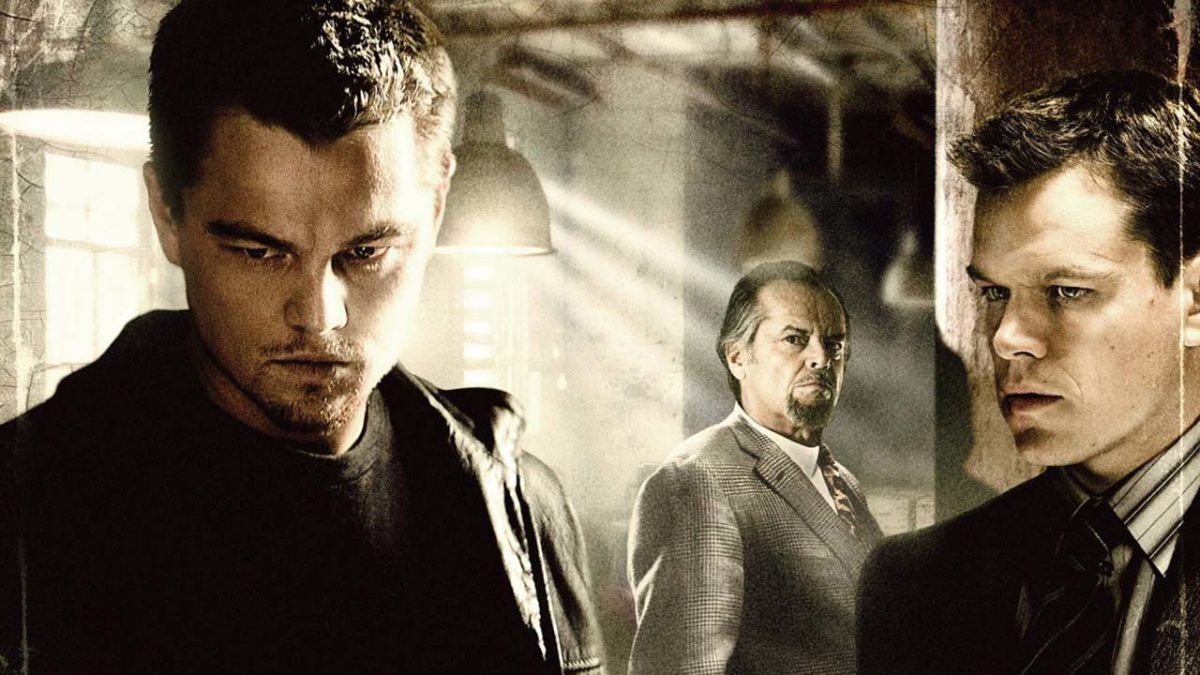
    Despite finally being the occasion of his long-overdue recognition by the Academy, The Departed probably won’t be ranked among his more idiosyncratic and personal films like Mean Streets, Raging Bull, and Goodfellas (not to mention his still-underappreciated films about religious faith: The Last Temptation of Christ and Kundun). The Departed is a remake of the 2002 Chinese thriller Infernal Affairs, and thus should actually be categorized alongside Scorsese’s other star-studded remake, Cape Fear. Both are undoubtedly stamped with Scorsese’s auteur touch, but still not among his most distinctively personal work.

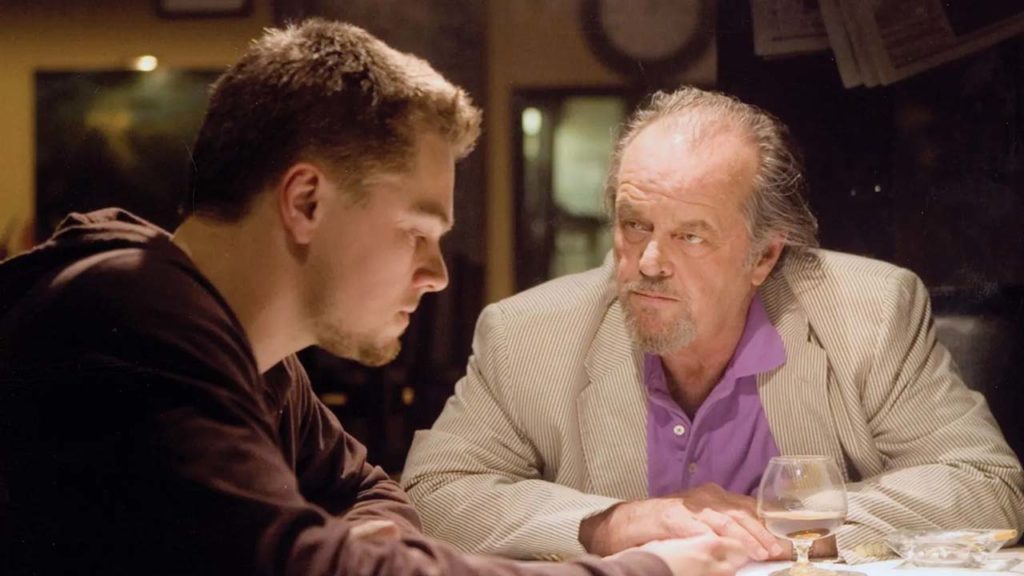
    Leonardo DiCaprio and Jack Nicholson in The Departed
    So, Jack, what was Polanski really like?

    Seeing the film for the second time, this time on the small screen, this blogger is struck by the extremely high energy and pace. Like Michael Mann’s Heat (itself an influence on Infernal Affairs), the story concerns the parallel narratives of a cop — or should I say “cwawp” — (Leonardo DiCaprio as Billy Costigan) and a criminal (Matt Damon as Colin Sullivan). But unlike Mann’s stately pacing, Scorsese keeps every scene remarkably short and frantically cross-cuts between the dual narratives. Were Marty and editor Thelma Schoonmaker chugging espressos in the editing suite?

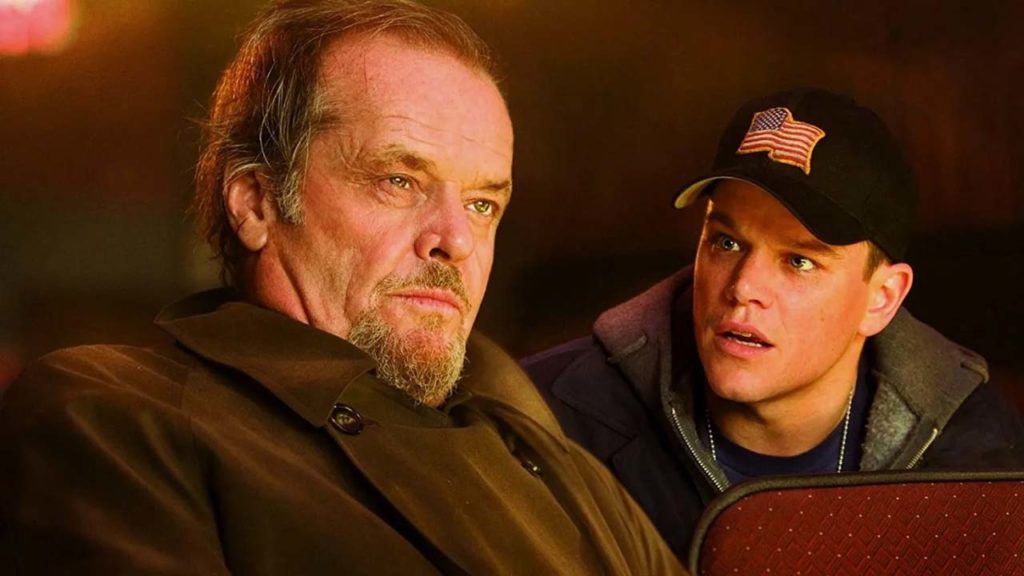
    Jack Nicholson and Matt Damon in The Departed
    So, Jack, what was Antonioni really like?

    One aspect of the plot I still don’t fully understand: what exactly does crime boss Frank Costello (Jack Nicholson) offer Colin to ensure such undying loyalty? It doesn’t seem enough that Frank provided minor charity to Colin’s struggling family in his youth. What does Colin really owe him?

  • Sidney Lumet shows us how it’s done in Before the Devil Knows You’re Dead

    Sidney Lumet shows us how it’s done in Before the Devil Knows You’re Dead

    Before the Devil Knows You’re Dead is a powerful, electric return to form for the 83 year-old Sidney Lumet, director of such canonical classics as 12 Angry Men, Serpico, Network, and, uh, The Wiz?

    Kelly Masterson’s screenplay tells the high-tension tale of a pair of wholly doomed brothers as a non-linear narrative from multiple points of view. Each jump in time and POV is accompanied by a thrilling editing technique I haven’t seen anywhere else but Dennis Hopper’s Easy Rider: the current and subsequent scene ricochet back and forth in increasing speed until we’re hurtled through time into another fragment of the narrative.

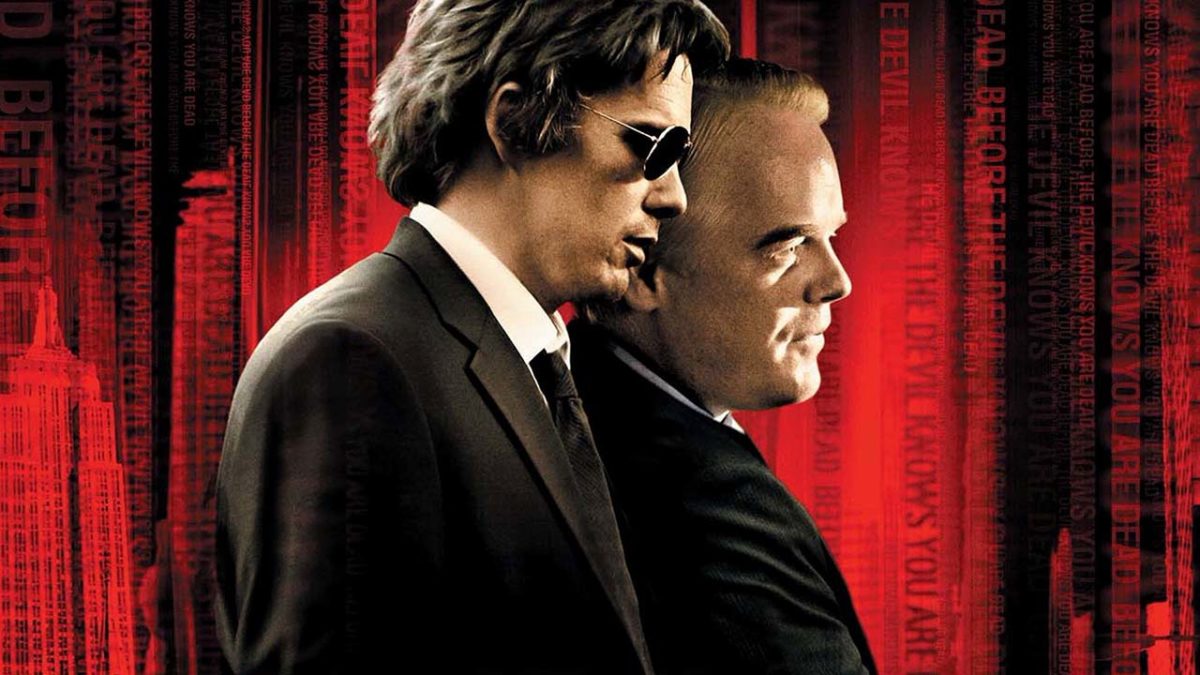
    Ethan Hawk and Philip Seymour Hoffman in Before the Devil Knows You're Dead
    A masterclass in blocking from Sidney Lumet

    The movie is full of examples of a fine director knowing how to use the form to the story’s advantage. For one example of how the composition of a shot reflects the subtext of the scene, note how that whenever Andy (Philip Seymour Hoffman) and Hank (Ethan Hawk) plot their scheme in the bar, Andy physically looms over Hank and dominates the frame with his bulk.

    The acting is great all around, including a devastating turn from Albert Finney as a bitterly disappointed father, and Marisa Tomei as a woman who cast her lot with two of the worst prospects on the planet. And in case you think Hawke and Hoffman are miscast as siblings, well… just watch.

  • Charlton Heston is the alpha and The Omega Man

    Charlton Heston is the alpha and The Omega Man

    Now that’s a good intro: Robert Neville (Charlton Heston) cruises through an empty city with the top down. It’s eerie, but he seems happy, grooving to jazz from his onboard 8-track cassette deck. But suddenly! Screech! Ka-pow! He brakes, produces a machine gun and fires at a fleeting humanoid silhouette. A striking montage follows of a desolated, deserted city.

    Heston was once known as a liberal, and here his character entertains an interracial romance (with afro-licious Rosalind Cash) no more common in movies now than it was in 1971. Unfortunately, it’s now impossible to take Heston seriously, thanks to Phil Hartman’s classic mockery on Saturday Night Live and to Heston’s own Alzheimer’s-fueled descent into right-wing senility.

    Interestingly, Heston’s oeuvre is dominated by dystopian sci-fi: Planet of the Apes, The Omega Man, and Soylent Green form a trilogy of apocalyptic despair. Remakes of Apes (by Tim Burton) and Omega (Wil Smith’s I Am Legend) made him nearly obsolete even before he died. Can a new Soylent Green (which is, incidentally, much better than its reputation suggests) be far behind?

    Charlton Heston in The Omega Man
    Shopping at the end of the world, like the zombies in Dawn of the Dead

    Compared to the bestial vampires that populate I Am Legend, the creatures in The Omega Man are an intelligent, religious cult. They don’t attack Neville with technology (like, say, shoot him) simply because they choose not to.

    As for entertainment in a time before VHS, the last man alive on earth is stuck with whatever happened to be in the theaters at the time; he screens the concert film Woodstock over and over. As for The Omega Man‘s own music, the orchestral jazz pop score is not just outdated, but bizarrely inappropriate.

    The crucifixion pose at the end is a bit much. I didn’t expect much subtlety, but that’s laying it on a bit thick.

  • Guess what’s coming to dinner in Lars and the Real Girl

    Guess what’s coming to dinner in Lars and the Real Girl

    Lars and the Real Girl is warm, funny, and moving, but felt a little “screenplay” to me. Aside from the indie film cliche of The Small Town (which affords an isolated community of eccentrics and an economically small cast), it seems to be a precisely workshopped exploration of a simple compelling premise: a man falls in love with a sex doll. And yes, these particular models are, uh… real… and to Lars, even better than the real thing.

    However, the fine script and performances really do sell the unlikely conceit. Ryan Gosling makes a potentially unappealing character very sympathetic, and indie queen Patricia Clarkson is so sublimely calm (watch her respond to each outrageous development in Lars’ life with a blink and a pause) that I suspect she would make a great shrink in real life.

    If I were in a screenwriting class workshopping this script, I think perhaps I might point out one missing aspect: we see the town pull together to support Lars, but would they do so for just any citizen? I’m not sure there’s a sense of why they’re especially protective of Lars in particular.