
The Scream franchise disappears even further up its own backside as the action moves to a Hollywood studio making a movie dramatizing a book relating the events seen in the original movie. We’re invited to take the moral point of view that the book-within-the-movie and the movie-of-the-book-within-the-movie are exploiting tragedy, but it’s not clear if Scream 3 is self-aware enough to apply those lessons to itself.
Category: Movies
Movie Reviews
-

Scream 2 is a self-fulfilling prophecy
There’s nowhere else the Scream franchise could have gone other than here: an ironic, self-aware sequel to an ironic, self-aware horror film.
When one the characters states “Sequels suck! Oh please, please! By definition alone, sequels are inferior films!”, it’s something of a self-fulfilling prophecy. There’s a fine line between winking at your audience and just throwing up your hands and admitting your new movie can’t measure up to the original.
-

Once revolutionary, Scream now feels quaint
It’s easy to forget how revolutionary Wes Craven’s Scream seemed in 1996, and how influential it’s been since. Rewatching it 17 years later, I’m struck by how… well, quaint it seems in retrospect. Now every post-Scream horror movie is required to be a postmodern deconstruction of the genre.
Maybe the trend reached its apotheosis with The Cabin in the Woods. But who knows, maybe in 17 more years another post-postmodern de-deconstruction will obsolete it as well.
-

Every line must rhyme in Les Misérables
Les Misérables left me cold
Nothing shown and everything toldAll that hollering and shrieking
Leaves my head achingEvery line must rhyme
Across its excessive running timeNo subtlety of emotion
The screen filled with commotionEddie Redmayne sings a song atop a pile of doors
My god what a boreHugh Jackman sheathes his claws
To grimace and overemote without pauseRussell Crowe huffs and puffs
Cashing his check to afford more foodstuffsIt’s Anne Hathaway’s big Oscar chance
Which she almost ruined by forgetting her underpantsEvery theater nerd knows all the words
Everyone else calls it a turd -

This is 40 was made by comedians, for comedians
Because you demanded it: a sequel to Knocked Up! Oh wait, you didn’t? Neither did I.
Even as an admitted “dramedy”, Judd Apatow’s This is 40 is a major bummer. Laugh and cry as you watch a couple deal with the same problems ordinary people can relate to: what to do with their rewarding jobs, giant house, and Paul Rudd and Leslie Mann’s uncommonly good looks.
This is 40 falls squarely into a certain subgenre of movie comedy made by comedians for comedians, forgetting that ordinary civilians might be in the audience. You could call it the “Yes, and…” genre, after the standup tenet of never cockblocking to your improv partner’s volley with a “No, actually…”
You know how many comedies append outtakes to the end credits (or DVD bonus features), as a kind of easter egg? One key giveaway of the “Yes, and…” comedy is that these discourses are actually left in the movie. This is 40 then serves up even more after the end, in the form of one extended improvisation in which Melissa McCarthy cracks up everyone else on the set, while remaining strictly in character.
Those of us who don’t take evening improv classes at the Upright Citizens Brigade will find this scene something of an indulgence, especially after 134 minutes of loosely strung-together improv bits in the supposedly narrative portion of the film.
-

Batman: Year One copies the comics but doesn’t capture what made the them classics
The film buffs at Criterion Cast recently took a break from their usual discussion of the likes of Ozu, Godard, and Cox for in their year-end podcast review of the 2012 year in movies. Rather surprisingly to me, they talked up Batman: Year One and Dredd as two underrated 2012 releases. I had been happily ignoring both, but checked them out on Netflix and was soundly disappointed by both.
I used to be a big comics fan, but haven’t followed them in years. It seems both Marvel and DC Comics have since started animation factories cranking out adaptations of some of their more famous stories.
I’m sorry to say that Batman: Year One is inferior in every way to the original comics from the 1980s (which I believe I still have copies of somewhere). It takes a number of liberties from the source material, about which I’m ambivalent. Movies are movies, and comics are comics, and any adaptation from one to the other ought to make as many changes as the artists/writers/filmmakers/whatever wish. But a necessary question that immediately follows is: what was it about the source material that made it worthwhile in the first place, and how can it be preserved? Or at least translated or transformed to be equally exciting in another medium?
The Batman: Year One movie failed to capture much about the comics that has made them classics. At one point in the movie, a character tosses a photograph onto a table, rendered in David Mazzucchelli’s art style from the original comics. Intended as an homage, it merely emphasizes the unimaginative and bland animation style.
Without the timelessly stylized artwork, all you have left is Frank Miller’s hardboiled writing and plotting, which looks a little thin in the cold light of day.
-

Planes, Trains and Automobiles is astonishingly unfunny
I’ve been catching up on my John Landis, for better or for worse. Trading Places and Coming to America are both much better than I remembered, and I’m glad I revisited them. But Planes, Trains and Automobiles is just astonishingly unfunny. A slapdash production, clearly banking solely on the presumed charm and appeal of its stars without a solid screenplay or sense of character to back them up.
Steve Martin’s character is fuzzily defined, wavering between misanthropic big city businessman and “gee, I guess I’ll give friendship and bonhomie a shot”. While John Candy is inherently likeable, the movie makes the imitative fallacy with regards to his character: he’s gross, blunt, and crude, designed to be everything a big city guy like Martin ignores as he goes about his day. But the problem is… he actually is annoying to the audience too, making it difficult to come around to find either of these two likable or endearing. That’s fine for a complex drama, but it’s fatal for a heartwarming comedy.
-

The Three Hour Avalanche: Cloud Atlas
Books are books, and movies are movies. I usually don’t want or expect any adaptation to copy its source — in fact, it’s usually in everyone’s best interests for a derivative work to strive to be its own thing, and not… well, derivative. But Tom Tykwer and the Wachowskis‘ Cloud Atlas turned out to be an astonishingly faithful adaptation of David Mitchell’s novel. For a book so sprawling and commonly assumed unadaptable, I fully expected more characters and incident to have been necessarily jettisoned. But almost everything is there, with most of the screenwriters’ additions coming in the form of structural, as opposed to material, changes.
Being so faithful to this particular book comes with a potential downside. One of the greatest pleasures to be had in the novel is its wide range of genres and tones. Sequences include a pulpy 70s thriller, a light-hearted old folks farce, a sci-fi dystopia, and a postapocalyptic wasteland. Each is familiar to a degree, but only insofar as Mitchell employs known genre tropes to his own ends. Each is written in a different voice, ranging from archaic historical vernacular to imaginary fractured and devolved languages of the far future.
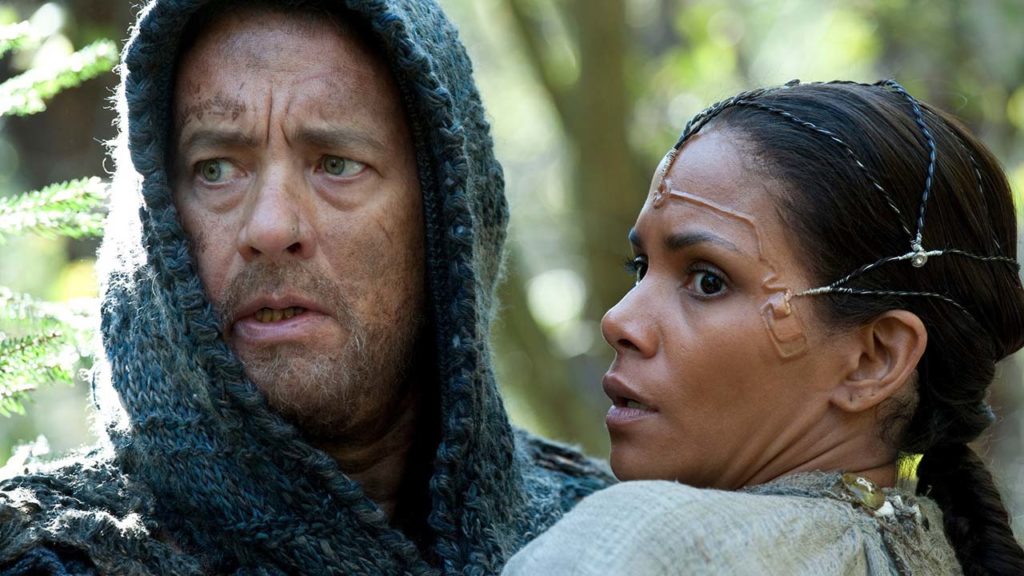
Tom Hanks and Halle Berry in Cloud Atlas. These devices may work better on the page than on the screen, for a reader is able to savor the lushly stylized language of each period. But subtract the novel’s devices of epistolary exchanges, internal monologues, fireside storytelling, and formal interviews, you’re only left with dialogue and visual depictions of action. What’s illustrated on screen comes across as a gumbo of The China Syndrome, The Matrix, The Road, and Best Exotic Marigold Hotel. For instance, when David Mitchell took on the tone of a conspiracy thriller, I found it impressive. But when it’s realized on screen, it feels like a Friedkin or Frankenheimer knockoff with extra corny dialog.
“Times are you say a person’s beliefs ain’t true, they think you’re saying’ their lives ain’t true and their truth ain’t true.”
Zachry (Tom Hanks) on the metaphysical conundrumThe aforementioned faithfulness extends to plot, tone, character, theme, incident… indeed almost everything except structure. The elegantly spiraling structure of David Mitchell’s novel is one of its most justly celebrated features, and it could have theoretically been adopted to cinema. Instead, the film scrambles the various story lines into one long montage that comes at you in a nearly three-hour-long avalanche. The obvious benefit is the highlighting of how recurring themes are interlinked and interwoven, how patterns of behavior repeat throughout history, and for the more metaphysically inclined, how souls are reincarnated, and how good and bad deeds echo forwards and backwards through time.
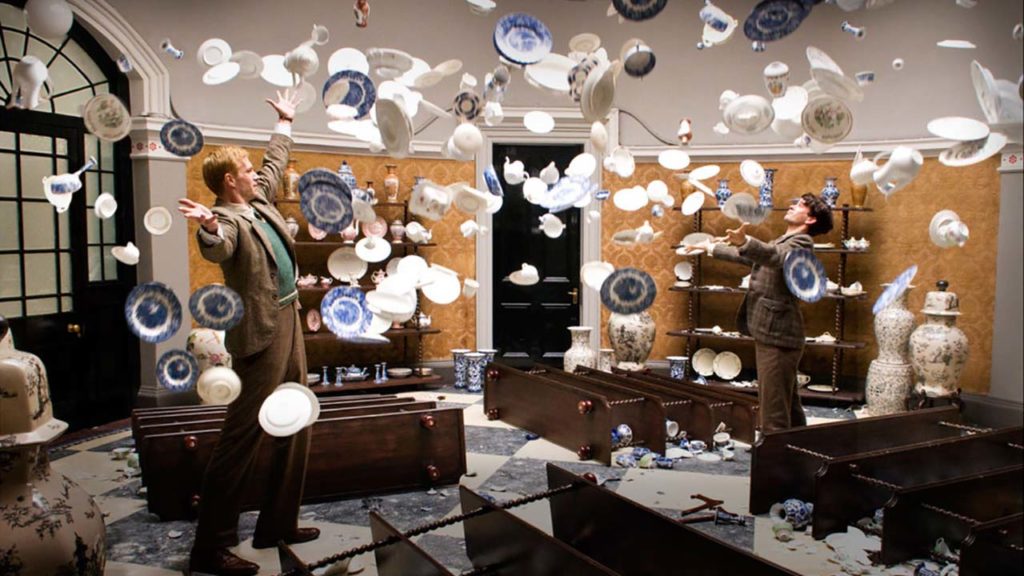
James Darcy and Ben Whishaw in Cloud Atlas. The three directors told the A.V. Club that they all worked simultaneously in close collaboration, but were required to be credited for specific sequences. For better or for worse, it seems pretty clear to me that the action sequences set in futuristic Korea have the Wachowski brand all over them. In this dystopia, corporations have replaced both government and religion, not that dissimilar to the world of the Wachowski-produced V for Vendetta). While intense and lengthy, these glorified chase sequences are not as extreme as their eyeball-spraining 2008 film Speed Racer. But Tykwer is a highly kinetic and visually oriented director as well, as he proved right away with Run Lola Run, so maybe I’m off base here.
“My life amounts to no more than one drop in a limitless ocean. Yet what is any ocean, but a multitude of drops?”
Adam (Jim Sturgess), Cloud AtlasOne of the primary selling points of the movie is its stunt casting of a relatively small troupe of actors into a multitude of roles. The sad truth is that some of the makeup effects for actors playing across gender or race boundaries just don’t work. Hugo Weaving suffers in particular, with no amount of latex able to disguise his permanent menace and leer (how much do you want to bet he’s a sweet family man in real life?). But there are a few triumphs. For instance, I didn’t recognize Hugh Grant in at least two of his roles. Tom Hanks runs up and down the hamminess scale in his various characters here, but I thought he was genuinely excellent in the role of Zachry, a humble but atypically thoughtful goat herder whose deepest religious beliefs are challenged.

Bae Doona in Cloud Atlas. Like many, I fell in love with the beautifully written, structured, and ingenious novel. But most interestingly of all, it’s the first thing I can remember reading in a long time that had anything approaching a message, or, for lack of a better term, a “moral of the story”. In short, resisting oppression of all sorts is always worth it, even if one person can’t fix the world. Mitchell shows us a world seemingly inevitably doomed to drastic decline via slavery, global warming, societal collapse, usury, and world war, but its heroes nevertheless act against political, corporate, or religious oppression. Many (but not all) of them suffer for it, but their acts resonate in ways both large and small.
“Wars do not combust without warning.”
Cloud AtlasIt is in this context that I must pinpoint one serious crime the movie commits against the book. I noticed only one significant deviation from the novel that, for me, almost negates everything I found most powerful in the book. I don’t object that something was added (in fact, I usually argue that most adaptations of books need to be more liberal in their interpretations), but rather that what was added betrayed a desire for sentiment — in essence, a happy ending. Anyone that has experienced the novel and the film will know exactly what I’m talking about. The movie ends on a positive note for humanity at its chronologically latest point, while the book ends with a moving internal monologue set near the beginning, as a character decides to dedicate his life to the abolitionist movement.
Despite serious reservations like this, I was totally swept up in the movie and have to rate it highly overall. As a movie, it’s a towering, almost unbelievable achievement. It was essentially an independent production, with a large portion of the financing coming directly from the filmmakers themselves. Cloud Atlas was not made as a corporate exercise; it exists because three filmmakers felt they had to do it. The message of resisting oppression of all sorts, including corporate, must not have been a good selling point when it came time for them to shop their movie around to potential distributors, giant corporations all. So go see Cloud Atlas, if for no reason other than its verve and audacity.
-

Exclusive! The Expendables 3 Poster

Coming summer 2014 — The Expendables 3! Starring Lynda Carter, Pam Grier, Linda Hamilton, Angelina Jolie, Milla Jovovich, Uma Thurman, Sigourney Weaver, and Michelle Yeoh.
This movie does not exist, but should. Hollywood, call me.
-

Sad Dinosaurs: Calling Bullshit on Terrence Malick’s The Tree of Life
As a public service, I will now summarize all 2 hours and 19 minutes of Terrence Malick’s The Tree of Life for you:
My mommy was pretty, my daddy was mean, sometimes kids die, I inhaled too much DDT, and it makes me so sad. Sad like the lonely birth of the lifeless universe. Sad like an anachronistic demonstration of animal altruism in the cruel dinosaur-eat-dinosaur prehistoric biosphere. Sad like the decay of all matter and energy as the universe inevitably collapses.
I call bullshit.
The degree of enjoyment I took from The Tree of Life was in inverse proportion to the sense of obligation I felt to see it, which is to say: very little vs. a whole lot. The very private auteur Malick had fallen silent for a number of years after he burst out of the gate in the 70s with Badlands and Days of Heaven, but has been on something of an uncharacteristic tear lately, producing three films in 10 years, with more in the pipeline. Since he chooses to not participate in publicity for his films, we may have to wait years until we find out what motivated him to return from this mysterious interregnum.

No one was there to watch as the planets form from stardust… except Terrence Malick’s computers Anticipation high, The Tree of Life was hotly discussed as his most beautiful, philosophical, and autobiographical film yet (the last point being especially tantalizing to film buffs looking for entry points into analyzing the man and his ouvre from a distance). The hook was further baited by the all-star cast (Brad Pitt, Sean Penn, and it-girl-who’s-in-everything-these-days Jessica Chastain) and an awards campaign branding it as one of the key prestige pictures of 2011. The willingness of top-drawer talent to work with Malick, even if they may very well wind up on the cutting room floor (as happened to George Clooney in The Thin Red Line), suggests he is revered as a director of actors. The perennially prickly Sean Penn, however, had none of this. He publicly derided the completed film:
While [Penn] considered the script “the most magnificent one that I’ve ever read,” he believes that “a clearer and more conventional narrative would have helped the film without, in my opinion, lessening its beauty and its impact.” Noting that Malick himself was little help when it came to explaining what he was going for, Penn adds, “Frankly, I’m still trying to figure out what I’m doing there and what I was supposed to add in that context.”
Sean Penn, to The A.V. ClubAll of Malick’s films are inarguably staggeringly beautiful, but their flimsy substance would get laughed out of a high school creative writing class. The Thin Red Line provided a much-needed meditative counterpoint at the time to the comparatively sentimental Saving Private Ryan, but too much of the film was taken up with the private thoughts of inarticulate grunts struggling to understand why they were killing each other when they’d all be much happier as cinematographers filming wildlife and sunlight filtering prettily through treetops. The New World approached outright silliness in its portrayal of Pocahontas as a pimply teenager in leather lingerie, caught in a love triangle over two of her European oppressors, and became truly absurd as the film contorted itself to avoid speaking her name.

I want to equate these two shots to the famous jump cut from prehistoric man to a spaceship in Stanley Kubrick’s 2001: A Space Odyssey, but I just don’t respect The Tree of Life enough. There’s something to be said about Malick deconstructing two of the most overused subjects in Hollywood history (the World War II picture and the Pocahontas myth) for his own personal statements, but critics must really strain for these to hold up to discussion in serious philosophical terms. The Niles Files makes a valiant attempt to tackle The Tree of Life, looping in Blake, Proust, Joyce, and many other big guns to extract some meaning from Malick’s pretty pictures.
The Tree of Life was part of a miniature trendlet in movies this past year, in which the painfully intimate was equated with the distantly cosmic. Sadly, two better films with similar concerns were unjustly crowded out of the award season — curiously, both featuring young women.
In Mike Cahill’s Another Earth, a girl whose carelessness ruined several lives finds hope for redemption when an exact duplicate of the entire planet inexplicably appears in the sky. Like everyone that has ever lived, she wonders if maybe there’s a better world where things turned out differently. For Cahill, it would have superfluous to concoct a pseudoscientific explanation for the phenomena, but another filmmaker that same year turned to physicists to properly substantiate his cosmic visions.
Lars Von Trier’s Melancholia is exactly that — a painful but stunningly beautiful examination of crippling depression. One young woman’s mental illness all but splinters her extended family, a destruction so cataclysmic it is reflected in the eradication of the world. Von Trier harnesses computer animation for images of profoundly moving beauty, rendering Malick’s mopey CGI dinos silly in comparison.