Category: Movies

Movie Reviews

  • The Only Child: Neil Gaiman and Henry Selick’s Coraline

    The Only Child: Neil Gaiman and Henry Selick’s Coraline

    I saw Henry Selick and Neil Gaiman’s Coraline on its opening day in my favorite movie theater, the best possible venue to see any remotely visually ambitious movie: the Clearview Ziegfeld in New York City. Fittingly, my tickets were misprinted “Caroline,” a misnomer that is a recurring plot point.

    Coraline was written and directed by stop-motion animation genius Henry Selick, whose patient and precise hands also created the utterly mad pleasure The Nightmare Before Christmas (often erroneously credited to Tim Burton, who produced). As if Coraline needed any finer pedigree, it was based on the fine novella by Neil Gaiman. Gaiman is a longtime favorite of this blogger, at least since my buying the very first issue of The Sandman new off the rack in 1989.

    Coraline and his later The Graveyard Book are both ostensibly aimed at “young adults,” which I guess means whomever is old enough to understand most of the words. Such a categorization is more about marketing and the convenience of knowing where to shelve titles in bookstores and libraries, anyway. As is also the case with his children’s books The Day I Swapped My Dad for Two Goldfish and The Wolves in the Walls (both illustrated by frequent collaborator Dave McKean), they’re all basically for anyone that likes to read.

    Dakota Fanning in Coraline
    Coraline traverses the portal into John Malkovich’s brain

    Gaiman, once famous for possibly having the record for most unproduced projects in Hollywood, has been tearing up the movie biz of late. Just to name a few highlights, he wrote the script for McKean’s sumptuous film Mirrormask, had his fantasy novel Stardust (originally illustrated by Charles Vess) adapted into a film by Matthew Vaughn, and co-wrote the brilliant script for Robert Zemekis’ Beowulf with Roger Avery. As is his custom now for all his pending projects, Gaiman has been blogging and Tweeting about the Coraline adaptation all along, a process rudely interrupted by his winning the Newbury Medal for The Graveyard Book. His mantle is now officially groaning under the weight of all his trophies, medals, Very Important Prizes, and suchlike.

    Gaiman was not directly involved with the making of Coraline (beyond being on good terms with the filmmakers and making the occasional consultation), but was pleased the finished product and especially with how well it was marketed by Weiden+Kennedy. Frequent readers of his blog will be familiar with how he blames Stardust’s relatively disappointing box office (in the US, anyway) with a marketing campaign that misrepresented what the film was actually like (the precise analogy he used went something like “more Princess Bride, less Ella Enchanted“). But I feel that this kind of heightened level of communication between artist and audience made possible by the internet might sometimes be too much information.

    Close to the release of Stardust, I recall Gaiman urging readers to see the film on opening weekend or even opening day if at all possible, the narrow window that in today’s movie industry determines the perception of success or failure. This time around, he made a point of mentioning that Coraline‘s production company Laika had basically bet the entire farm on the film. I have been working for movie companies for years and am familiar with perpetual job insecurity. I was happy to go see the film right away anyway, but I would have rather not worried about whether or not I was protecting someone’s job. Thankfully, Coraline appears to have performed above expectations on its opening weekend, and all is well.

    John Hodgman in Coraline
    The Other Father gives us our 3D money’s worth

    Apologies for the rambling preamble. On to the movie: Coraline (voiced by Dakota Fanning) and her family move into the ground-floor apartment of a crumbling rural house. Her parents are busy gardening writers without the time to actually garden, let alone to pay much attention to their only child. Coraline’s biggest problem is that she’s unhappy at being so often left alone. I suspect that most overprotected kids whose parents take them to see this movie will have trouble identifying with a kid who has too much freedom.

    The residents of the neighboring apartments are at least as eccentric as those of The Sandman‘s The Doll’s House. Russian acrobat Mr. Bobinsky (Ian McShane), may or may not be training rodentia to take part in a Mouse Circus. Coraline gets off on the wrong foot with unloved oddball Wybie (Robert Baily, Jr.), who takes his name from “Why be born.” British comedy duo Dawn French and Jennifer Saunders appear as Misses Spink & Forcible (two Gaiman-esque names if there ever were any), a pair of well-aged actresses living in the basement.

    Coraline discovers a long-forgotten doorway hidden behind furniture and layers of wallpaper. Not unlike the very similarly diminutive door in Being John Malkovich, it is a gateway to another world. Whereas the portal to Malkovich’s brain resembled the gross inside of a digestive tract, this one is part cobwebby cave and part glowing funhouse tunnel. On the other end of the door is another, better version of Coraline’s milieu.

    In the real world, no one gets Coraline’s name right, but in the Other World, everyone knows her. She is well fed, the garden is a luxurious Eden sculpted in her image, her bed is made, and her toys are new. But alas, her Other Mother (Teri Hatcher) has constructed this enticing simulacrum just to ensnare her. Coraline is about to abandon the real world for this coddled existence, when she is given the price: she must sew buttons over her eyes. This is point in the film when adults squirm and kids squeal with delight. Creepy, creepy, creepy!

    Teri Hatcher and Dakota Fanning in Coraline
    The Other Mother serves Other Omelettes for breakfast

    Roughly the first three-quarters of the film is genius-level setting of tone, character, and atmosphere. It falters only when a rigid plot structure appears out of nowhere and forces the narrative onto fixed rails. Cat (Keith David), the only other creature that can travel between worlds, tells Coraline that the Other Mother likes games. This key characteristic would have been better shown than told, for Coraline is able to turn the tables by simply challenging her to a game. The Other Mother immediately acquiesces, and is apparently unable to resist a game in the same way that the mythological Sphinx can’t resist a riddle (a plot point that also figures in Mirrormask).

    Coraline’s challenge is equal parts game and bet: if she can find the five souls The Other Mother has trapped before her (her parents and three other children), she must release them all. Finding three hidden objects hidden in different virtual worlds is a classic video game scenario. Coraline has no shortage of other MacGuffins to lose and recover, including a key and an Eye Stone (a magical jewel fortuitously provided by the actresses). Indeed, a tie-in videogame exists, which no doubt doesn’t have to stretch the story to structure its own narrative.

    Also disappointing are the three children the Other Mother has already captured. Their trio of cutesy voices that compliment and encourage Coraline are the most conventional aspect of the film, not in keeping with the rest of the film’s enjoyably macabre tone. But actually, maybe this all makes sense… the kids are definitely not as bright and spunky as her, for she alone has the brains to escape and defeat the creature.

    Dawn French and Jennifer Saunders in Coraline
    The comedy stylings (and alarmingly large bosoms) of French & Saunders

    Stop-motion animation is one of the oldest filmmaking techniques, but Laika (based in Portland, Oregon) and Aardman Animation (makers of Wallce & Gromit and Chicken Run) are still making films more dazzling than the most advanced CGI. The reason is quite simple: you’re looking at moving photographs of physical objects crafted by human hands. Like Beowulf, Coraline is being shown in many theaters in 3D. If possible, the technology seems to have improved even since U23D, let alone since the 1950s. But as animated movies such as The Incredibles and WALL-E have proved, all the technology in the world must play second fiddle to a good story.

    Gaiman has been saying in interviews lately that his books for kids are creepier than his novels for adults (including American Gods and Anansi Boys). In keeping, Coraline is wonderfully deranged, weird, and twisted. By far the eeriest sequence is the opening credits, featuring the hands of a creature we later learn is the Other Mother, ritually disemboweling a puppet and reconfiguring into a simulacra of Coraline. Watchdog site Kids-In-Mind nearly goes into meltdown counting the discrete instances of violence and disturbing imagery, and expect to read a great many reviews cautioning parents to keep sensitive kids away. But I suspect most kids will love this film, and will probably be better off for having their imaginations poked and prodded in ways that safer pap wouldn’t. One of the reasons I love movies is to experience the mad visual imaginations of directors like Selick (and Burton, McKean, Terry Gilliam, Michel Gondry, Tarsem, etc.), and it’s a good thing “kids’” movies like Coraline are here to warp youngsters minds early.

  • Competition is Weakening in David Mamet’s Redbelt

    Competition is Weakening in David Mamet’s Redbelt

    Redbelt is writer/director David Mamet‘s ode to jiu-jitsu, of which he himself is reportedly a purple belt. Mike Terry (Chiwetel Ejiofor) is a struggling black belt jiu-jitsu instructor, one of the few remaining practitioners of martial art in its authentic Japanese origins.

    The professional combat sport association MMA (Mixed Martial Arts) has tainted the martial art with commercialism and spectacle akin to professional wrestling. In contrast, Terry is a noble warrior with an absolute code of honor, like Robert Scott (Val Kilmer) in Mamet’s Spartan (2004). Terry is a former special forces soldier, with a past in one or both Gulf Wars he does not wish to discuss. One of his favorite aphorisms becomes something that he realizes he must live up to himself: “There is no situation from which you cannot escape.” He’s a fearsome fighter, able to win a bar fight without throwing a single punch. But another of his aphorisms, “competition is weakening,” reflects his choice to teach self-confidence and reliance, not aggressive combat.

    David Mamet directs Chiwetel Ejiofor in Redbelt
    “Competition is weakening”

    Like many of Mamet’s films, Redbelt features many of his regular stable of actors: Rebecca Pigeon (Mamet’s wife, who also performed the music), Ricky Jay, David Paymer, Joe Mantegna, and a cameo from Ed O’Neil. Anyone familiar with Mamet’s films would know to suspect a character played by any one of these actors is up to some mischief, especially if the latter two are seen to be in any kind of collusion. Significantly for a playwright/writer/director known for his characteristically dense dialog, the last long sequence is mostly wordless.

    Mamet states Redbelt is firmly in the fight film genre, singling out the two recent examples of Million Dollar Baby and Cinderella Man. Like the superb Spartan, it’s also something of a samurai movie. Just don’t call it a martial arts or action flick. It also includes healthy doses of two other Mamet obsessions: the long con and the corruption inherent in business. The most obvious advantage of the long con in storytelling terms is that it automatically provides a structure for a fiendishly complex plot, as it did for both House of Games (1987) and The Spanish Prisoner (1997).

    Emily Mortimer and Chiwetel Ejiofor in Redbelt
    “There is no situation from which you cannot escape”

    Mamet’s recurring theme of institutional corruption in the business world is probably best expressed in Glengarry Glen Ross. But in his book Bambi Vs. Godzilla (2007) and movie State & Main (2000), Mamet reveals the one particular business that fascinates him the most: Hollywood. As he states in the electronic press kit included in the Redbelt DVD, moviemaking is a business like any other, but the particulars of its moral bankruptcy fascinate him.

    This manifests in Redbelt as Terry is seduced by Hollywood as embodied by aging action star Chet Frank (Tim Allen). Frank first finds leverage in the fact that Terry is broke, but also recognizes that he is is secretly prideful, and seeks approval and recognition for the burden of honor he has been carrying for so long. These flaws make him manipulatable. Frank initially seems to provide the solutions to his problems, but turns out to be the precise inverse of his name: all empty promises, facades, scams, and pretense.

    The two corrupt worlds of Redbelt are both hungry for meat: professional sports need fighters to run through the grinder, and the movie business eats up ideas as raw material for its product. They find both in Mike, and neither wants to pay for what they try to take from him.

  • Death Has No Dominion in Steven Soderbergh’s Solaris

    Death Has No Dominion in Steven Soderbergh’s Solaris

    As a huge title card reads immediately at the end of the film, Solaris was “written for the screen and directed by Steven Soderbergh.” I am a big admirer, but that seemed a bit egotistical even to me. Perhaps an overenthusiastic end-credits designer is to blame? Or maybe the studio wanted to capture some more of that lucrative Ocean’s Eleven magic by playing up the Soderbergh/Clooney brand?

    But writing and directing credits, however many feet tall, barely begin to describe Soderbergh’s role. For this and many of his other films, he serves as his own Director of Photography (and even physical camera operator) under the pseudonym Peter Andrews and also as editor under the name Mary Ann Bernard. So, obviously, Soderbergh is one of the few mainstream filmmakers with the luxury of near-total control over his films. Like Kubrick, he produces, writes, directs, operates the camera, and edits. But while Kubrick was a control freak (in the best sense), the modest Soderbergh is lauded as being more collaborative and especially as a sensitive director of actors.

    George Clooney in Solaris
    “I was haunted by the idea that I remembered her wrong, and somehow I was wrong about everything.”

    The DVD edition includes an excellent commentary track of Soderbergh in conversation with co-producer James Cameron, the original director attached to the project. Soderbergh asks Cameron what he thought of how he approached the material. Cameron points out that Soderbergh took a more “internal” approach than he would have, and both agree in good humor that Cameron would have included more car chases. More than Soderbergh’s grand total of zero, anyway.

    Depending on how you count, Soderbergh has only directed two remakes: Ocean’s Eleven and Solaris (The Limey was a kind of homage or mash-up remix of the English crime classics Point Blank and Get Carter). The source material of the Polish novel Solaris by Stanislaw Lem has proven a rich mine for cinema. Russian filmmaker Andrei Tarkovsky directed the original adaptation in 1972 as the Eurasian answer to 2001: A Space Odyssey. The basic concept also drove films as diverse as Paul W.S. Anderson’s Event Horizon (which is horrible but has uncommonly spectacular special effects and art direction) and Danny Boyle’s Sunshine. Soderbergh’s version of Solaris is credited as being based more on the original novel the 1972 film, with barely a mention of Tarkovsky even in the DVD commentary track. In his essay for the 2002 Criterion Collection edition of the original Solaris, Phillip Lopate states that Lem was unhappy with Tarkovsky’s interpretation, and was looking forward to what he expected to be a more faithful translation by Soderbergh.

    Natascha McElhone in Solaris
    “And death shall have no dominion.”

    Solaris is set at an unspecified point in the future, distant enough for humanity to have perfected the technology to leave the solar system. Kelvin (George Clooney) is a shrink who is himself deeply emotionally damaged. Indeed, the theme of both this and the original film could be summed up as “physician heal thyself.” We first see him hosting a group therapy session for survivors of an unspecified tragedy. Since the movie was released in 2002, it’s possible this was intended as an analogy to a 9/11-like event. But judging by how every scene set on Earth is drenched in darkness and persistent rain, perhaps there was some kind of ecological catastrophe.

    Single and with no family, Kelvin is an ideal candidate for a solo trip to investigate mysterious goings-on in a space station orbiting the distant gas giant Solaris (pay attention for the brief cameo by John Cho as a governmental emissary). Unlike Tarkovski’s extremely leisurely pace, this version wastes no time; Kelvin’s boots are on the space station less than 10 minutes into the film. This is the point where any readers wary of spoilers ought to stop reading.

    Kelvin encounters Snow (Jeremy Davies, supremely well-cast), a man understandably gone stir-crazy from being cooped up on a haunted space station. But it becomes clear that he himself may be one of the forces doing the haunting. Evidently, the planet Solaris somehow draws upon the strongest emotional resonances in visitors’ brains and manifests them as living beings. These incarnations are most decidedly not a blessing for anyone. For Clooney, it’s an echo of his dead wife Rheya (Natascha McElhone); for the captain Gibarian (Ulrich Tukur), it’s a copy of the son he left behind on earth; for Snow, it’s… another version of himself. The “Snow” that Clooney meets is, in effect, his own ghost; he killed his own creator within seconds of his birth. The faux Snow’s weird behavior is not that of a man gone mad but of a not fully-formed human, bluffing his way through unfamiliar human interaction. One has to wonder what kind of man is so alone or self-obsessed that the most important person encoded in his emotional memories is himself.

    Jeremy Davis, Natascha McElhone, George Clooney, and Viola Davis in Solaris
    “I could tell you what’s happening, but I don’t know if it would really tell you what’s happening.”

    Kelvin and Rheya originally bonded over the Dylan Thomas verse “and death shall have no dominion,” but the emotionally fragile woman committed suicide after he left her. Tortured by the renewed presence of her in his life, and the perplexing puzzle of Snow’s doppelgänger, he begins to question his own existence: is he someone else’s ghost? But he doesn’t take the question to the next logical step: is there anyone in the world with enough emotional investment in him to cause him to haunt them?

    Solaris is both Soderbergh and Clooney’s first and only science fiction. It was marketed with a misleading poster suggesting a romance while obscuring any hint of science fiction. Even after Batman & Robin, it is admittedly kind of funny to see Clooney in a spacesuit, especially when he was relatively early in his career as a movie actor (after years in television sitcoms and dramas). One can’t imagine Clooney’s Hollywood ancestor Cary Grant appearing in a space opera.

    But Solaris tries to have it both ways: to be somehow above science fiction but still be overloaded with enough pseudo-scientific technobabble to fill several Star Trek epics. The sensitive, emotional tone of the film is shattered as soon as scientist Gordon (Viola Davis) starts lecturing the audience about proton beams breaking up fields of Higgs Particles (or something along those lines). Such technobabble cheapens the premise. Indeed, the talky screenplay makes everything too explicit and concrete, especially compared to 2001: A Space Odyssey, which says so much more with so many fewer words.

  • Andrei Tarkovsky’s Solyaris (Solaris) is Vertigo in Space

    Andrei Tarkovsky’s Solyaris (Solaris) is Vertigo in Space

    The opening credits of Andrei Tarkovsky’s 1972 film Solyaris state it is “based on the science fiction by Stanislaw Lem.” It’s perhaps telling that the term “science fiction” is used in place of simply “novel.” This faint hint of apology may hint at a lack of respect for the original Polish novel or the entire science fiction genre as serious literature. A similar ambivalence echoes decades later in the advertising campaign of director Steven Soderbergh’s 2002 remake, emphasizing the romantic melodrama over the fantastic, futuristic setting.

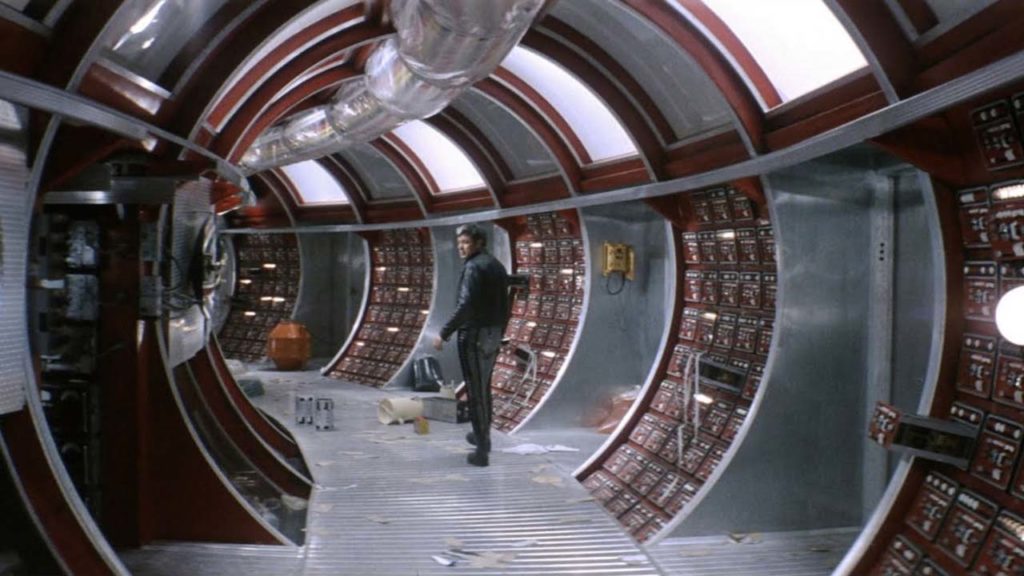
    Stanley Kubrick’s 2001: A Space Odyssey had arrived only a few years before Solaris, and was by a long shot the most serious stab at intellectual, literary science fiction cinema yet filmed. In his essay for the 2002 Criterion Collection DVD edition of Solaris, Phillip Lopate outlines three ways Tarkovky wished to distance his film from Kubrick’s. He found 2001: A Space Odyssey “cold and sterile,” and set out to infuse his own science fiction with “passionate human drama.” Unlike its predecessor’s gleaming high-technology, Tarkovsky built run-down and filthy sets for the space station, and found futuristic earthbound locations in the contemporary cars and architecture of Japan. Finally, Lopate points out that Solaris shares more themes with Alfred Hitchcock’s Vertigo than 2001, namely, “the inevitability of repeating past mistakes.”

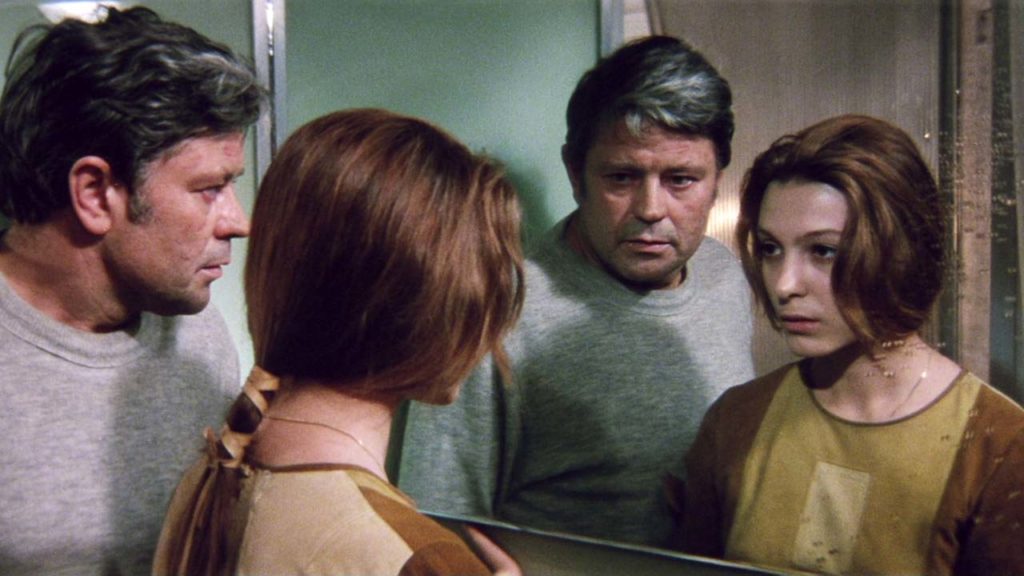
    Natalya Bondarchuk and Donatas Banionis in Solaris
    Kelvin sees dead people

    The links between the two films go beyond the thematic into the political; Solaris is frequently cited as the Soviet Union’s answer to 2001: A Space Odyssey, so it ought to be viewed in the context of the Cold War. 2001: A Space Odyssey preceded actual manned moon landings, the US’ most definitive victory in the space race. Kubrick’s visuals were so effective that they spawned the still-simmering rumor that the moon landings were falsified using footage directed by Kubrick. But before all this, 2001: A Space Odyssey must have seemed like a threat or promise made to the USSR: saying, in effect, that the US is going to be first in space and the first to make first contact with alien intelligence.

    So in this context, it’s hard not to interpret Solaris as at least partly a propaganda countershot. It too illustrates how the society of its makers and audience also have the brainpower and resources to extend their empire into space. But most unlike 2001: A Space Odyssey, Tarkovsky and co-writer Fridrikh Gorenshtein never allude to politics or even mention the names of other countries.

    Kubrick’s film envisions no end to the Cold War, even at least thirty years into the future. Kubrick’s vision of the future is actually a wicked satire, showing how little he expects humanity to evolve despite significant technological advances. His future humans still engage in petty squabbles and apocalyptic brinksmanship in the face of a potentially paradigm-shifting revelation: the discovery of definitive evidence of alien intelligence in a manufactured monolith buried on Earth’s moon. The US scientists and government officials investigating the monolith seem unmoved by the powerful notion of alien contact, and instead hold boring boardroom meetings and pose for photographs.

    In stark contrast, Tarkovsky’s Solaris has no sense of humor at all, about anything. Perhaps the most significant trait Solaris shares with Kubrick is a penchant for long takes. As Lopate also notes in his Criterion essay, atypically for a Russian filmmaker, Tarkovsky favored long takes over Eisensteinian montage.

    Donatas Banionis in Solaris
    Kelvin inspects the ductwork

    In this vision of the future, the Soviet Union operates a scientific research station in orbit over the ocean planet Solaris. An entire school of study called Solaristics has sprung up around the study of the ocean’s peculiar properties. Astronaut Berton (Vladislav Dvorzhetsky) returns to Earth with controversial claims that the Solaris ocean somehow creates physical manifestations of landscapes and monstrous creatures on the planet’s fluid surface. Dr. Gibarian (Sos Sargsyan), still stationed at Solaris, sends for his old friend, psychiatrist Chris Kelvin (Donatas Banionis). Berton, haunted and prematurely aged by his experiences, visits Kelvin at his father’s home in an attempt to warn him about what he is surely to experience, but Kelvin rudely dismisses him. We later learn the source of Kelvin’s misanthropy: his wife Hari (Natalya Bondarchuk) committed suicide after he left her some years before.

    Kelvin arrives at Solaris to discover that Gibarian has already committed suicide. The strange manifestations Berton reported on the Solaris oceans are also occurring on board. Every surviving scientist still aboard the space station is haunted by “guests,” their euphemism for the apparitions that, as best they can determine, are somehow culled from their most emotionally intense memories. In due course, Kelvin’s dead wife reincarnates in a confused, partially-formed state. She is dazed and doesn’t quite understand who she is or why she is there, and doesn’t “remember” that she is dead. When she tries to undress, she discovers her dress is completely sewn shut; Kelvin’s imperfect memories of her apparently don’t include buttons ‘n’ zips. Kelvin also experiences feverish nightmares in which he confuses Hari with his long-dead mother.

    Natalya Bondarchuk in Solaris
    The twice-doomed Hari (Natalya Bondarchuk)

    In a kind of filmed suicide note, Gibarian tells Kelvin the manifestations have “something to do with conscience,” indicating that the common origin of every guest is that they are each the primary object of guilt in an individual’s mind. Gibarian asks Kelvin “did you see her yet?” suggesting that he sent for him because he correctly predicted Kelvin’s guest would be his dead wife Hari. The presence of Gibarian’s guest (a little girl) was evidently for him an intolerable curse, but perhaps he imagines it would be a gift for Kelvin to have Hari back. But the whole situation begs the question: if the authorities know about the manifestations, why would they agree to send such a psychologically damaged man as Kelvin?

    When Kelvin attempts to leave Hari alone in his quarters, the not-quite-human creature manages to smash through the doorway in pursuit. She instinctively doesn’t want to be left alone, but can’t explain why. A suitable science fiction explanation might be that she somehow senses that she may literally dematerialize when Kelvin’s brain is not within proximity. Or her newly-formed mind may be suffering echoes of what the “real” Hari felt when she committed suicide after Kelvin left her. What if Kelvin becomes comfortable living with this reincarnation of Hari, and his guilt for the original woman’s death lessens… will her reincarnation then disappear?

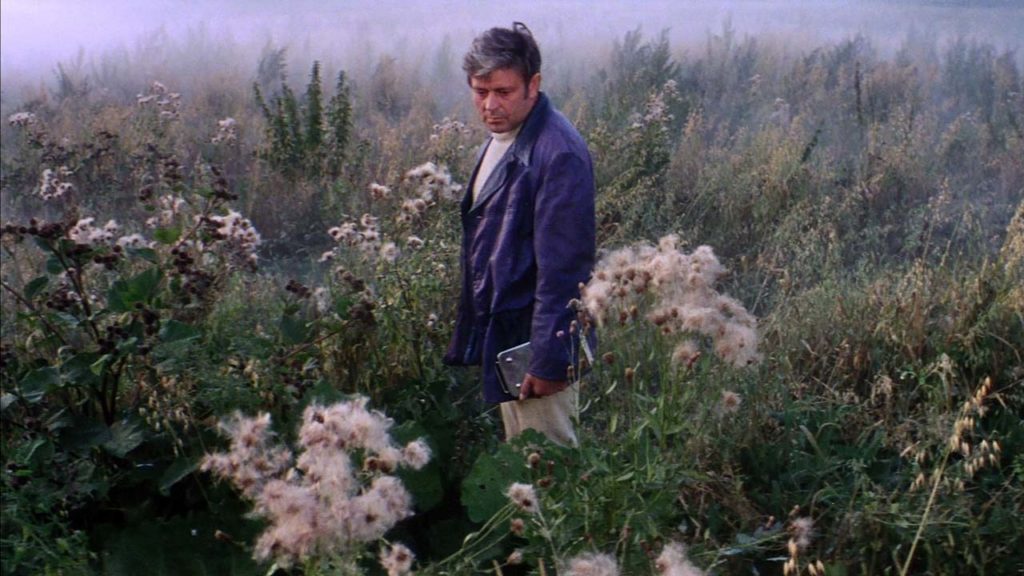
    Donatas Banionis in Solaris
    Kelvin at home in Mother Russia

    An observation: like Lindsay Anderson’s If…, Solaris uses a mixture of black & white and color film. For most of the first hour, black & white footage initially signifies either film clips or teleconferencing (note that the film correctly predicts widescreen HDTV monitors and webconferencing in the future). But later sequences appear in black and white, without internal justification: first as Berton drives dejectedly back into the city (filmed in the city landscapes of Japan), and later as Kelvin locks himself in his cabin on Solaris. To confuse the matter still further, Kelvin brings a home movie with him from Earth, which is in color! I don’t have a theory to explain these logical discrepancies; I’m just pointing them out.

    I’m surprised to find to find that I did not like the film as much as my first viewing almost a decade ago. Solaris is as talky and overwritten as its ostensible model 2001: A Space Odyssey is elegantly quiet. Totally self-serious and humorless, its three-hour running time is frankly a little trying on the patience. In his 1977 appreciation of the film reprinted in the Criterion edition booklet, Akira Kurosawa reports he was stunned by the expense when he visited the set, equivalent to 600,000,000 yen at the time.

    But he defends the significant length of the early scenes set on Earth, which he interprets to be intended to instill nostalgia for Kelvin leaving nature behind forever. Indeed, the time spent on Earth in the early parts of the film does prefigure a significant homecoming at the end, when Kelvin seems to return to a dreamlike vision of his father’s house. The formerly lush and moving natural scenery landscape is now wasted and frostbit. It rains inside as well as out, suggesting a kind of baptism or rebirth in the waters of Solaris.


    Must Read: Solaris by Phillip Lopate

    Must Read: the Organic Mechanic review by Adam Harvey

  • Lou Reed, Antony, and Julian Schnabel Dance the Rock Minuet in the Concert Film Berlin

    Lou Reed, Antony, and Julian Schnabel Dance the Rock Minuet in the Concert Film Berlin

    Lou Reed‘s 1973 album Berlin is a concept album relating the tale of a doomed woman named Caroline living in the eponymous city. The term “concept album,” then and now, invokes immediate condescension from fans and critics alike, calling to mind the progressive rock excesses of 1970s megabands The Who (Tommy and Quadrophenia), Genesis (The Lamb Lies Down on Broadway), and Yes (Tales from Topographic Oceans). The poet and arty downtown Manhattanite Reed might have better served himself by referring to Berlin as something more fancy-sounding, perhaps a “song cycle.”

    Reed’s previous album Transformer was a great commercial success, debuting the enduring hits “Satellite of Love”, “Perfect Day”, and “Walk on the Wild Side”. To follow it up with something like Berlin may have been loaded with artistic integrity, but was asking for trouble in terms of making a living. I recall reading that enough material was written and recorded for it to be a double-LP, but it was too much for a single LP, so the work was unsatisfactorily edited down to a single disc before release (I can’t find a source for this factoid online, but I believe it was related in the liner notes of his 1992 retrospective boxed set Between Thought and Expression). Produced by Bob Ezrin (whose concept album credentials also include Pink Floyd’s The Wall), it was a commercial disaster at the time. So, cursed from the beginning, the full studio version has apparently never been released.

    Emmanuelle Seigner in Lou Reed's Berlin
    Emmanuelle Seigner in Lou Reed’s Berlin

    In retrospect, Reed now seems to have been compelled to flee from commercial success, or at the very least was bound and determined not to repeat himself. Reed’s other infamous commercial disaster Metal Machine Music was another deliberate provocation: even the most open minded musicologist might charitably characterize it as earsplitting noise. But Berlin is different, hated more for its intensity and subject matter than its sound. Several of the songs are lovely, but wow is the complete work depressing, full of anger, venom, resentment, death, despair, and guilt. The song “The Kids” is especially harrowing, ending with a tape of children wailing.

    Lou Reed's Berlin
    “Caroline says / While biting her lip / Life is meant to be more than this”

    Over time, the album was eventually rediscovered. One of those reappraising Berlin was no less than artist and filmmaker Julian Schnabel. So it came to be, that 33 years after its release, Schnabel proposed to Reed that Berlin really ought to be a film. Schnabel is obviously attracted to artists dedicated to their work with utter conviction: revolutionary New York Artist Jean-Michel Basquiat in the eponymous biopic, the gay poet Reinaldo Arenas in Castro-era Cuba in Before Night Falls, and the paralyzed writer Jean-Dominique Bauby in The Diving Bell and the Butterfly. The Berlin DVD bonus features include a brief conversation with Reed and Schnabel on Elvis Costello’s show Spectacle, in which Schnabel describes his attraction to the cinema from the perspective of a painter: he reverently refers to the canvas-like movie screen as “The Rectangle.”

    Something best appreciated by seeing Reed perform live is that he is a great guitarist. He’s also visibly in surprisingly good shape for a former junkie (sorry, but it’s true). Does he practice yoga? Reed in performance is supremely cool and detached, but some startlingly real emotion comes through in his vocal delivery; he spits out the lines “they took her children away” from the song “The Kids” with real venom.

    Antony in Lou Reed's Berlin
    Antony dances the rock minuet

    Original guitarist Steve Hunter rejoined Reed for the Berlin tour, and can barely contain his pleasure, despite the grim subject matter. Bob Ezrin himself conducts with great enthusiasm, but oddly, he seems to be facing the drummer, away from the choir and woodwinds. One of my favorite bassists, Fernando Saunders, doesn’t really get to shine, but perhaps it was my sound system that couldn’t do him justice. Julian Schnabel’s daughter Lola directed film clips projected during the performance, starring Emmanuelle Seigner as Caroline.

    So Reed finally got a chance to present Berlin live, as a whole piece. Now the once-denigrated work has become a world tour, a theatrical feature film, a live album, and a DVD. Reed is now considered a New York deity, not the erratic addict he was back in the day. His career is far from over and there’s plenty of time for more drama, but could this be his ultimate revenge?

    The encore includes a special treat, a lovely version of “Rock Minuet” sung by Antony Hegarty (of Antony and the Johnsons) in his otherworldly voice. “Rock Minuet” was not from the original album, but a special request from Schnabel, who rightly felt it belonged. But it’s followed by a bummer: a desultory performance of the Velvet Underground standard “Sweet Jane”. It’s a letdown that after the emotionally intense proceedings, that Reed seems truly bored here and just walks through a song he’s probably performed hundreds if not thousands of times.

  • Sigur Rós Comes Home to Iceland in Heima

    Sigur Rós Comes Home to Iceland in Heima

    Dean DeBlois’ documentary film Heima (meaning “coming home” or “at home”) follows the band Sigur Rós on their summer 2006 tour of their home country Iceland. The tour consisted of mostly free, unannounced concerts, and with the band in three basic configurations spanning the continuum of the purely acoustic to the fully electric. The four core members Jónsi Birgisson, Georg Hólm, Kjartan “Kjarri” Sveinsson, and Orri Páll Dýrason perform several acoustic songs just for the camera. The extended band (including string ensemble Amiina) is also seen performing outdoors, fully Sigur Rósunplugged, at a concert protesting an environmentally destructive dam to be built by the Icelandic government. Finally, in contrast, we also see the full band in indoor concerts with dramatic lighting and video effects.

    Sigur Rós Heima
    Sigur Rós live in concert

    Many Sigur Rós songs are sung in an invented language called Vonlenska (“Hopelandic”), adding to the universality and international appeal of their music. For the uninitiated, Sigur Rós are a key representative of the musical genre “post-rock,” which generally refers to highly evocative, cinematic, largely instrumental music sometimes compared to movie soundtrack composition. Other notable bands working in roughly the same idiom include Mogwai, Explosions in the Sky, and Múm. In my opinion, you can trace the genre’s heritage back to the progressive rock of Yes and King Crimson.

    Sigur Rós Heima
    Sigur Rós live in concert

    Interview clips and stunning landscape images punctuate the film, making it almost as much about Iceland itself as the band. The most incongruous clip is from the avant-garde band’s unlikely appearance on the Late Late Show with Craig Kilborn. They discuss being unprepared for the business side of a career in music (lawyers, contracts, etc.), but understand that they have to think of the future.

    The second disc of the two DVD set features full uninterrupted performances, but with no two songs played in sequence, let alone a full concert. The fragmentation of both the main documentary film and the supplementary features is mildly disappointing. However, the band has plans for a full concert film directed by Vincent Morisset.

  • There’s Nothing Pretty: Grant Gee’s Joy Division

    There’s Nothing Pretty: Grant Gee’s Joy Division

    Grant Gee’s documentary Joy Division covers the all-too-brief history of the eponymous post-punk band from Manchester. Joy Division was tragically short-lived, only completing two albums before lead singer Ian Curtis’ suicide in 1980, but disproportionately influential. Their sound is all over the early U2 albums Boy and October, and Interpol has made a career of emulating Joy Division’s sound.

    Gee sets the scene of late 1970s Manchester as a grimy hellhole in which “there’s nothing pretty.” The core members of the band are perversely inspired by a Sex Pistols concert (their review: “shite, a car crash”) to form their own band. Photographer and filmmaker Anton Corbijn took some of the most memorable portraits of the band. Used to Holland’s health care system, he was shocked to see such poverty in England. He describes Joy Division as undernourished and shivering in their thin coats.

    Joy Division
    Joy Division

    Gee also interviews Peter Saville, the graphic designer that created the remarkably stark album sleeves that were almost as influential as the music itself. Tony Wilson (a colorful character who was the subject of Michael Winterbottom’s fantastic biopic 24 Hour Party People) was an early champion, in between his duties as host of the TV show “So It Goes” and Factory Records impresario. Curtis’ widow Deborah does not seem to have participated, but her side of the story appears in the excellent biopic Control, co-produced by her and directed by Corbijn.

    Ian Curtis of Joy Division
    Ian Curtis of Joy Division

    Curtis is described as a regular lad who frequently bought flowers for his wife. In other words, the opposite of punk. But he’s also characterized as “bipolar,” moody and unpredictable even before his epilepsy manifested itself in frequent, dramatic grand mal seizures. His singular stage presence was marked by a peculiar form of dance inspired by his seizures (that he sometimes actually did experience on stage). The necessary drug treatments caused huge mood swings, further compromising his already unsteady mental health. Curtis continued his day job assisting disabled people for the Civil Service even as the band was taking off. In a heartbreaking bit of synchronicity, his classic song “She’s Lost Control” is about an epileptic girl he met though his work.

    Grant Gee’s clear expertise is musical documentary. His 1998 film Meeting People is Easy famously captures Radiohead breaking through to mass popularity as their 1998 album OK Computer is universally declared the album of the year. The frank film shows emotionally fragile Thom Yorke almost physically recoiling from fame, but receiving wise counsel from mentor Michael Stipe of R.E.M. Gee also co-directed the excellent 2005 Gorillaz concert film Demon Days Live at the Manchester Opera House, better even than the studio album that preceded it. Both films have permanent spots on the DVD shelf.

  • Daniel Lanois Maximizes the Room in Here Is What Is

    Daniel Lanois Maximizes the Room in Here Is What Is

    Daniel Lanois is a unique musician, as gifted a singer-songwriter in his own right as he is a collaborator and producer. I originally came to recognize his name after finding it listed in the credits of many key items in my music collection, including Peter Gabriel’s So and Us, U2’s The Joshua Tree and Achtung Baby, and Bob Dylan’s Oh Mercy and Time Out of Mind. His 1993 solo album For the Beauty of Wynona remains an all-time personal favorite.

    The feature documentary Here Is What Is premiered at the Toronto Film Festival in 2007, directed by Lanois, Adam Samuels, and Adam Vollick. It captures the recording of the album of the same name, but also serves as a kind of retrospective and mission statement. Conversations between Lanois and early mentor (now equal) Brian Eno punctuate the film. Lanois states to Eno his intentions for the movie: to create a film about the beauty of music, not everything that surrounds it (which I took to mean hagiography, celebrity gossip, and the sometimes tedious behind-the-sceens documentation typical of the genre). Eno suggests that his film should try to show people that art often grows out of nothing, or from the simplest of seeds in the right situations, not from what outsiders might assume are the miraculous inspirations of allegedly brilliant or gifted artistes.

    Daniel Lanois and Brian Eno in Here Is What Is
    Daniel Lanois and Brian Eno recording their new ambient masterwork, “Music for Staircases”

    Lanois is Canadian by birth, but has a special affinity for the American South, especially New Orleans. He credits New Orleans for the original sensual groove that formed the basis of rock music. Perhaps intended as a visual echo of this theory, the stunningly beautiful Carolina Cerisola often appears dancing in her scanties.

    Lanois details his longtime, fruitful collaboration with drummer Brian Blade. Legendary keyboardist of The Band, Garth Hudson, also joins them in the studio for some truly awesome performances. One of my favorite sequences intercuts between “The Maker” performed by Lanois’ band live in studio, covered by Willie Nelson and Emmylou Harris, and Lanois’ band live on stage. Billy Bob Thornton, still friends from collaborating on the score to Sling Blade in 1996, drops in for a visit. We catch exciting glimpses of recording U2’s forthcoming album (since christened No Line on the Horizon, to be released in February 2009) with Eno and Steve Lillywhite.

    Daniel Lanois in Here Is What Is
    Which button dials down Bono’s ego?

    Lanois names a primarily influence to be the Jimi Hendrix Experience, which he describes as a fairly straightforward rock trio but with ambitious, experimental production. He describes how he himself approaches production, in just one word: “feel.” He reportedly had a contentious relationship with Dylan in the studio, but the resultant albums are classics, and Dylan affirmed that “you can’t buy ‘feel.’” Another Lanois aphorism, “maximize the room,” means to make the most of what you have, rather than invite guest musicians or order up more equipment.

    Here Is What Is features full performances of songs, which is especially welcome compared to two recent music documentaries recently screened by this blog: Low in Europe and You May Need a Murderer, which both shy away from actually showing Low perform. Here Is What Is‘s visuals are sometimes compromised with cheesy video effects. The film is at its best when simply following the hypnotic movements of Lanois’ hands on his pedal steel guitar.

  • Cinema Immortal: Tarsem Singh’s The Fall

    Cinema Immortal: Tarsem Singh’s The Fall

    Tarsem Singh’s The Cell (2000) was one of the best-looking bad movies I’ve ever seen. It certainly wasn’t helped by the routine serial killer plot possibly meant to capitalize on the success of David Fincher’s Se7en (from the same studio, New Line Cinema). But it was tragically obvious that Tarsem (as he is simply known) was a wildly talented visual stylist on a par with Terry Gilliam or Jean-Pierre Jeunet.

    So now, financed by his own money, in production for over four years in 20 countries, and presented by Fincher and Spike Jonze, Tarsem gets a chance to tell one of his own stories. The Fall achieves a high level of spectacle without an ostentatiously high budget. Apart from a scene in which tattoos ink themselves upon a man’s torso, there is little apparent CGI. If Tarsem used more computer effects, they’re good enough to be invisible. And one of the best sequences, a nightmarish surgery, is executed as stop motion animation like something by The Brothers Quay.

    Tarsem Singh's The Fall
    Inside the Grateful Dead t-shirt factory

    The Fall opens in the aftermath of a surreal accident: a horse is lifted by crane from a deep gully after having apparently fallen off a bridge. That we eventually learn that this strange scene is merely a Hollywood Western movie set does not lessen the enjoyably dreamlike weirdness of the imagery. The real theme of the movie is of the power of storytelling through the intense visualization of movies, or even better, the imagination.

    American stuntman Roy (Lee Pace) recuperates in a Southern Californian hospital. Alexandria (Catinca Untaru), a little girl mending a broken arm, attaches herself to the bedridden mope. She had fallen from a tree while picking fruit with her Indian immigrant family in nearby orange groves, and now finds herself alone in the strange hospital, isolated not only by her age but also by the language barrier. She has never seen a movie and doesn’t really understand Roy’s job. But she is drawn to him, perhaps partly out of an innocent crush and partly out of her realization he, like she, is unusually imaginative.

    Justine Waddell in The Fall
    Justine Waddell’s fashions in The Fall will put your eye out

    The slightly pudgy Untaru is a refreshing casting choice for a child character, endearing but not cloyingly cute or especially precocious. The physically and emotionally traumatized Roy is bemused by her at first, and shortly finds himself entertaining her with a serialized tale of epic derring-do. Roy’s fantastic adventure of the struggle between The Black Bandit against Governor Odious (Daniel Caltagirone) over the beautiful Evelyn (Justine Waddell) becomes a movie-within-the-movie, visualized through the filter of the girl’s meagre experience but rich imagination. When the American describes an “Indian,” she pictures a man from India, and his “squaw” is an Indian princess. She casts her version of the story with Roy and people from the hospital. In the most Gilliam-esque image, the enemy knights resemble the hospital’s crudely armored X-Ray technicians.

    Tarsem Singh's The Fall

    But it turns out Roy is a failed suicide case, heartbroken over losing the love of a beautiful starlet. The accident in the beginning of the film was his; both he and she are literally fallen people. Like Gilliam’s The Adventures of Baron Munchausen, the seemingly child-like tale he tells is shot through with dark undercurrents. Alexandria can just barely sense the pain embedded in the story, and is unequipped to truly grasp Roy’s deep anxieties that love and life are doomed. Is he being cruel by telling her this story, or is he trying to teach her his grim life lessons?

    Tarsem Singh's The Fall
    Whether this is a model, a set, or computer-generated, it is stunning.

    The conclusion has the feel of being transcendent and exciting, but lacks real punch. In a rapidly accelerating crescendo of cutting and music, Roy and Alexandria heal (physically and emotionally) and leave the hospital. As she grows up, she imagines Roy executing every stunt in every movie she sees for the rest of her life. It’s incredibly callous of me as a viewer to suggest that the story might have taken such a turn, but just imagine the impact this sequence would have had if Roy had killed himself after all… she would keep him alive forever in the movies in her head.

  • It’s All Too Much in the Wachowski’s Live-Action Cartoon Speed Racer

    It’s All Too Much in the Wachowski’s Live-Action Cartoon Speed Racer

    The good news is that the Wachowski’s Speed Racer is fun and eye-poppingly extraordinary to watch. As with their breakthrough The Matrix (1999), there’s the strong feeling that you’re seeing something new; not just emergent technologies but a whole new style of moviemaking. But the bad news is that it’s all… too much new. Why undertake such huge effort and expense just to replicate the essence of a poorly written and cheaply animated TV series that no one, not even the geekiest anime otaku (fanboy), really misses? This film might have been so much better if they had jettisoned the baggage of the intellectual property (a misnomer in this case) and told an original story in this radical new style.

    The movie incarnation of Speed Racer has inherited the visual quirks of the original 1960s cartoon, cross-bred with the information-rich computerized motion graphics of modern televised sports. The color scheme is dominated by bright, primary colors like Warren Beatty’s Dick Tracy (made in a era before computer graphics and digital color grading). Talking heads laterally pan across the screen, usually redundantly narrating the onscreen events for us. The effect is like watching ESPN; when two cars crash, an announcer promptly tells us that two cars have crashed.

    Christina Ricci in Speed Racer
    Christina Ricci can see for miles and miles.

    The film is also modeled after video games and anime in general. Huge sequences are entirely computer generated, with what little live action photography there is most likely shot against greenscreen soundstages. The Wachowskis’ resident special effects mad scientist John Gaeta meticulously stages the many incredible car chases like battles in a war movie from an alternate universe. Like Peter Jackson’s The Lord of the Rings and George Lucas’ Star Wars prequel trilogies, the movie practically is animated. Just watching it, it’s possible to imagine what the tie-in video game must be like.

    Every single line of dialog is a cliché, and so too is the plot. Speed (Emile Hirsch) is a young race car driver, a lone honest man in a corrupt industry. Yes, his name is actually Mr… Speed… Racer. His disgraced older brother Rex died a mystifying death years before, providing Speed with the motivation to prove himself both as a driver and as an honest man. Pops and Mom Racer (Susan Sarandon and John Goodman) sometimes appear in the same shot but hardly ever exchange words. Speed also has an insanely annoying little brother with a Brooklyn accent and, god help us all, a monkey. The oddball extended Racer family also includes the Australian mechanic Sparky and Speed’s helicopter pilot-slash-girlfriend Trixie (Christina Ricci, whom at some point has lost her endearing baby fat and now seems startlingly skinny). The whole gang apparently lives together in the same house, with Speed’s car parked in the living room like an extra sibling.

    Lest all the action be of the vehicular variety, the Wachowskis wisely scatter about a few awesome wire-fu fight sequences (apparently not designed by The Matrix‘s genius choreographer Woo-ping Yuen). The most exciting and visually impressive fight takes place on a snowy plain, with the falling snow providing manga-like motion lines (characteristic of manga). The fights are even more fun when John Goodman gets in on the act, and one understands why he might have signed on to such a project (if for reasons other than a big studio paycheck).

    Emile Hirsch in Speed Racer
    Like audiences worldwide, Emile Hirsch is a little overwhelmed by the visuals.

    If I were to single out one tragic flaw, I would say that Speed Racer suffers, like Richard Kelly’s Southland Tales, with too much backstory. Overlong for a kids movie, it’s almost one full hour before we get to the main plot: Speed Racer must join forces with adversaries Racer X (Matthew Fox) and Taejo Togokhan (Korean popstar Rain) to accomplish something-or-other and defeat some kind of injustice that I can’t quite recall, all of which has something to do with veteran racer Ben Burns (Richard “Shaft” Roundtree). Who can remember details after two-plus hours of sheer sensory overload? Speed Racer feels like a sequel to a movie we haven’t seen, with enough threads left dangling (mostly involving the true story of Speed’s brother) to set up a hypothetical third episode.

    For any number of possible reasons, this very expensive folly bombed and we almost certainly won’t see that trilogy. The Wachowskis were perceived to have fumbled the wildly popular Matrix franchise with two obtuse sequels (although this blogger would argue in favor of the minority opinion that the second, The Matrix Reloaded, is actually their masterpiece), and they produced the thickheaded V for Vendetta (muddying up and widely missing the point of the powerful anarchist graphic novel by Alan Moore and David Lloyd). With such a track record it’s not surprising that the moviegoing public, even the genre-loving fanboys that make up Chud.com and Ain’t It Cool News might have soured on them. Plus, the original Speed Racer cartoon is exceptionally cheap and lame, so much so that even myself as a child could tell it was crap.

    Warner Bros. revealed their embarrassment by issuing the DVD as a bare-bones single-disc release, at time when even the crappiest movie seems to merit a deluxe multi-disc package padded out with hours of self-congratulatory value-added material. There’s nothing at all on the DVD about the obviously groundbreaking special effects. Instead, the filmmakers decided that what audiences wanted was more monkey (the vile beastie stars in the closing credits sequence) and more annoying kid brother (who costars in a mockmentary feature with an embarrassingly poorly acted appearance by producer Joel Silver).