Ridley Scott’s Someone to Watch Over Me (1987) is more of a drama than a police thriller, refreshingly focused on its characters over suspense and action alone. Mike Keegan (Tom Berenger) is a salt-of-the-earth Queens detective assigned to protect material witness Claire (Mimi Rogers) from assassination. Keegan is a modest family man, recently promoted to the second rung of the police hierarchy. It’s no glamorous job; he spends most of his working hours just sitting around not finishing crosswords. He’s utterly unlike the over-the-top testosterone-laden cop character played by Michael Douglas in Scott’s other police thriller, Black Rain.
Keegan is more-or-less happily married (to Lorraine Bracco as Ellie), but a man like him would never otherwise come into contact with a beautiful uptown girl like Claire. Cooped up in close proximity to each other every night, they inevitably lapse into an affair. Her effeminate but wealthy and powerful husband senses that Keegan is a romantic rival, but he is an effectively impotent character and frequently disappears from the film altogether. Also notable is song-and-dance man Jerry Orbach already typecast as a detective in a small role as Keegan’s tough Lieutenant.
When Mimi Rogers heard Director Ridley Scott was big on visual spectacles, this isn’t what she had in mind
One of the guaranteed pleasures of any Ridley Scott film is the visuals. Someone to Watch Over Me‘s opening credits feature the namesake song by George Gershwin sung by Sting over beautifully sleek aerial shots of New York City at night. The final shootout is perfectly staged in a claustrophobically enclosed space, with huge mirrors placed for maximum dramatic impact. The principals stalk each other in near silence, punctuated by the wide dynamics of sound design. Perhaps Scott was competing with that other upstart master of cinematic shootouts, Michael Mann (in particular, the similarly explosive conclusion to the contemporary thriller Manhunter).
Ridley Scott’s 1986 fantasy experiment Legend features a very young Tom Cruise (before he was “Tom Cruise”), costarring opposite vats upon vats of glitter. Cruise’s performance is bizarre and high-pitched, composed of crouched poses and unfocused stares. But to be fair, how else would any actor portray an uncivilized wild-child with a weirdly mundane name like Jack? Mia Sara is unmemorable as Princess Lily, save for the spectacularly plunging neckline she sports in the second half of the film (during which many parents were no doubt covering the eyes of their innocents).
There is plenty of very pretty cinematography to be enjoyed, but this blogger regrets to report that Legend is awful and almost painful to sit through. I recall loving the roughly contemporary fantasy film The Dark Crystal (1982) as a child, but ruined the pleasant memory by watching it again as an adult and discovering it to be tedious and condescending (with, granted, some incredible puppetry and art direction). Perhaps if I had seen Legend as a kid I might feel similarly.
That nice Cruise boy
The entire plot hinges on the kinds of typically arbitrary rules that characterize the fantasy genre. Pay attention, kids: only a virgin can touch a unicorn, it seems, but alas, they should never do so, lest the sun set forever and the world be consumed by The Lord of Darkness (Tim Curry). What’s a virgin, you ask? Shush.
Not inconsiderable running time is taken up with awkward slapstick involving midgets, de rigueur in every movie fantasy since Terry Gilliam’s Time Bandits. Speaking of, Gilliam’s dark romp is by far the best of the 1980s heyday of fantasy movies — a genre not to return to prominence for almost two decades until the lucrative franchises Harry Potter, The Lord of the Rings, His Dark Materials, and The Chronicles of Narnia.
Girls and their unicorns! This can only end in tears.
Even the old-school optical special effects are crummy, for which it is no excuse to say the film came before the age of CGI. The unicorns’ rubber horns visibly wobble, and a fluttering Tinkerbell-like fairy creature is a painfully obvious little lightbulb mounted on a wire discernible even on a low-resolution TV screen. No inch of skin is left unpainted with glitter, and never have bubble machines worked so overtime since The Lawrence Welk Show. But perhaps the most puzzling detail of all is in the sound design: unicorns sing whalesong, evidently.
All sorts of questions arise as screenwriter William Hjortsbertg’s plot comes to its trainwreck conclusion: What happens to The Prince of Darkness’ evilly goading mother? In comparison, Roger Avary and Neil Gaiman’s brilliant Beowulf script did not fail to explore the vast Freudian story potential of a monster’s manipulative mother. And where did the last surviving unicorn find its mate at the end? Did the unicorn killed earlier in the film revive somehow, and if so, why? Even Disney’s Bambi didn’t chicken out by resuscitating the murdered mother.
Ridley Scott’s first feature film The Duellists (1977) is based on the Joseph Conrad short story “The Duel.” Feraud (Harvey Keitel) and D’Hubert (Keith Carradine), two French soldiers serving under Napoleon, become loyal enemies locked in a lifelong adversarial relationship. D’Hubert, eager to appease his superiors and advance his career, volunteers for a mission in which he obliviously humiliates Feraud. Both men are at fault: D’Hubert for his ambition, and Feraud for obsessively nursing his perpetual grievance. Their personal battles supersede French history, with even the reign and fall of Napoleon a mere backdrop to their personal feud.
Don’t let the frilly sleeves fool you, Feraud (Harvey Keitel) will frite your pommes and manger your croissant
The Duellists is respected for the historical authenticity of its French military uniforms and depictions of period wartime conduct, but Keitel and Carradine’s flat American accents threaten to undo its achievements in verisimilitude. Luckily, the important bits, the duels, are staged silently. Scott, with his background in advertising, films everything beautifully, although one does catch glimpses of the occasional lamp and smoke machine. The landscapes during the final duel are especially breathtaking.
Wild Bill Hickok is a comin’ ta getcha, Mr. White!
I’ve seen hardly any of Carradine’s movies, but I do have great respect for his brilliant portrayal of one of America’s first celebrities, Wild Bill Hickok, in the HBO series Deadwood. And Keitel gets to show off his serious muscles in a gratuitous arm-wrestling sequence.
Whether it actually is or not, Synecdoche, New York has the feel of a very, very personal work of art. I know next to nothing about writer/director Charlie Kaufman’s personal life, and don’t even necessarily feel like I do now. Then again, few people do know Kaufman, as he has famously managed to sidestep much publicity despite perpetrating a successful screenwriting career in an industry in which the cult of personality applies to everyone.
Synecdoche, New York is Kaufman’s first film as director, after a string of playful yet brainy screenplays. The best antecedents I can name would be the surreal satires of Lindsay Anderson (like O Lucky Man!) and the Postmodern deconstruction of Tom Stoppard (especially Rosencrantz and Guildenstern are Dead, which wreaks hilarious havok with no less a holy relic than Hamlet). Kaufman’s hit parade so far includes Being John Malkovich, Human Nature (underrated! see it!), Confessions of a Dangerous Mind, Adaptation, and one of our favorites, The Eternal Sunshine of the Spotless Mind.
Being John Malkovich and Eternal Sunshine are both pure pleasures to watch, but Adaptation showed the darker side of Kaufman’s brilliance. As I understood the film, the very life itself of screenwriter “Charlie Kaufman” (Nicolas Cage) slowly becomes the violent, sexed-up Hollywood melodrama he loathes to write. To describe Synecdoche, New York in shorthand, it’s as if the cynical, challenging narrative nature of Adaptation were crossed with the deep emotional impact of Eternal Sunshine.
Here’s a theory to explain Hazel’s enigmatic burning house: could it be an allusion to the Talking Heads song “Love -> Building on Fire”? I’m being serious here…
But what it’s actually “about” would take a lot of analysis to figure out, and my single viewing is not enough to unpack it (assuming my IQ would be up to the task anyway). Like Adaptation, it’s actually a little frustrating to watch, but in a good sense, in that the audience is constantly being challenged. I have to admit that I don’t fully “get” it, but I also think it’s clear there’s no single key to unlocking any one meaning of the film.
I’m giving it the full five-star rating because I have enormous respect for any such uncompromising, challenging, affecting, and frustrating work of art in cinema. That it was produced as a major motion picture starring numerous famous faces and released in multiplexes nationally alongside the more typical fare Saw V and High School Musical 3 is nothing less than a miracle, and gives one hope for the future of the film industry. At least four people walked out of the screening I attended, some during an uncomfortable nude scene featuring Emily Watson (not uncomfortable in that she isn’t beautiful, because she is, but because the sex scene is so utterly frank). It’s a pity they did, for they missed one of the most weirdly moving last moments of a film I’ve ever seen (although it did have precedent in Peter Weir’s The Truman Show, which also suggested the voice of God towards his supplicant is akin to that of a film/theater/television director’s towards his actor).
The closest thing I’ve seen to Synecdoche, New York is Spike Jonze’s Michel Gondry’s brilliant music video for Bjork’s “Bachelorette” (Jonze Gondry is a longtime collaborator of Kaufman’s, and co-produced Synecdoche, New York). (UPDATE: corrections thanks to commenter Greg. I can’t believe I mixed up two of my favorite directors!) Less a pop music promo than a short film that stands on its own merits, “Bachelorette” recounts the tale of a young country girl who writes her autobiography and moves to the big city, where she falls in love with her publisher. A hit, her book spawns a theatrical adaptation, in which a young country girl writes her autobiography, moves to the big city, and falls in love with her publisher. A hit, it too spawns a theatrical play. You get the idea: the tale is infinitely recursive. But each copy is a copy within a copy, each more distorted, flimsy, and sad than its source material. Entropy and decay set in, and the world(s) collapse in upon themselves. Her life basically ends at the point she finishes her autobiography and looks only backwards instead of living for the future. Watch the video here:
Synecdoche, New York is a pun on the New York city Schenectady (the location of Caden’s original theater company) and the literary term for a figure of speech in which a part stands in for the whole (for example, “The White House said today…” as used by newscasters rather than specifying the administration, or even more specifically, the Press Secretary). Theater director Caden Cotard’s (Philip Seymour Hoffman) artist wife Adele (Catherine Keener) divorces him and moves to Germany with their daughter and Maria (Jennifer Jason Leigh), who may be her lover (this is Keener’s second sexually ambiguous role in a Kaufman film, here and in Being John Malkovich). Caden worries for the rest of his life that Maria is a better replacement for himself as husband and father.
Caden wins a MacArthur Foundation Genius Grant, and uses the funds to move to Manhattan and craft an epic play housed in a disused theater illogically large enough to hold a scale model of New York City as his set. Outside, the real Manhattan descends into chaos and warfare. At one point, the characters leave the theater and walk past mysterious civil rights atrocities such as clown-costume-clad soldiers herding citizens onto armored busses at gunpoint.
Hope Davis, as the shrinkest with the mostest, offers to shrink Philip Seymour Hoffman’s head
Caden’s canvas is infinite, there is no script, and he hopes to find his story as he goes along. The play is in perpetual rehearsal for decades, and remains forever untitled. I hate to use this kind of cop-out phrase popular in college literature classes, but it truly is “a metaphor for life.” As Caden tries to find meaning for the traumatic events in his life, and to rationalize his decisions, he casts actors to play himself and the significant people in his life. Like memories being processed by the human brain, he is now able to replay recent painful events in his life over and over, giving direction to his actors on how to express their (his) pain, all with the emotional safety of knowing that it’s all just playacting.
Soon, he takes even another step back, and casts another set of actors to play the first. Reality itself begins to break down as in Bjork’s “Bachelorette”, also featuring a play within a play within a play, cast with several pairs of other actors playing herself and her lover as their affair, and entire world, disintegrates. A similar theme of copies and doubles also figures into Adaptation: writer “Charlie” may or may not have an identical twin brother, shamelessly able to make the kinds of compromises necessary for success in the movie biz and life itself that he is too weak or too ashamed to do himself. Is it significant, as Kaufman moves from writer to writer/director, that the central character of Adaptation is a writer, and that of Synecdoche, New York is a director?
A scene from Synecdoche, New York, starring Samantha Morton as Hazel, Emily Watson as Tammy as Hazel, Philip Seymour Hoffman as Caden, and Tom Noonan as Sammy as Caden. Got that?
Caden is beset throughout with a host of mystery illnesses that forever threaten to kill him but never carry through their promise. I caught at least two hints that he may in fact already be dead: his shrink Madeleine Gravis (Hope Davis) makes a seeming slip of the tongue and asks why he killed himself, and later, one of his doppelgangers (Tom Noonan) commits suicide.
The walls between Caden’s life and his play blur; which is real and which is the play? The dispassionate director watches from a distance as others do the dirty work of living his life for him, such as conduct his love affairs and breakups with Claire (Michele Williams), Hazel (Samantha Morton), and Tammy (Emily Watson), that he may not have the emotional strength or sexual potency to do himself.
Caden eventually replaces himself and takes the simpler, less demanding role of one of the most fleetingly minor background figures in his life. Is he an actor in his own play, following the script and direction from someone else, an invisible external force… God? He essentially abdicates responsibility for his own life, and dies on cue.
The 2008 HBO television movie Recount dramatizes the traumatic few weeks at the close of the 2000 Presidential election. That hectic time brings back three distinct feelings for this blogger: bewilderment at the founding fathers’ purpose for the Electoral College (as everyone no doubt remembers, it was never in doubt that Al Gore won the popular vote), nausea at the Supreme Court and Bush Campaign’s abrupt circumvention of our democracy, and finally, the sudden omnipresence of this blogger’s first name: chad (defined as “a piece of waste material created by punching cards or tape”). I’ve heard all the jokes, but Recount was able to teach me one new factoid: the “plural of chad is chad.”
Although a thriller involving presidential politics, its tone is nothing like that of All the President’s Men; not least, everything takes place in sunlight and no one smokes. Director Jay Roach (yes, of the Austin Powers movies) carries things along at a breakneck pace. This is how it probably felt to those on the inside of the Florida hurricane (involving even a little boy from Cuba you might recall was named Elian Gonzales). But for a viewer, it feels like a 2-hour barrage of facts, figures, and dramatic recreations of key events. Perhaps unavoidably, much of the story is told through reams of history and exposition placed into the characters’ mouths.
Laura Dern as Katherine Harris during her 15 minutes of fame
Like Oliver Stone’s W., this dramatization of real events provides ample opportunity for famous actors to exercise their skills as impersonators. Most notably, Laura Dern embodies Florida Secretary of State Katherine Harris in all her tacky glory. Harris is unflatteringly depicted as caught in over her head by circumstances. She is vain about her appearance, yet blind to how she is perceived. Baker orders the Republican lobbyist Mac Stipanovich (Bruce McGill) to attach himself to her, to circumvent laws that prohibit the administration from interfering in Florida state matters. It’s an easy task; using flattery, he implies Harris is in control while he’s actually feeding her directives directly from the Bush campaign.
The early part of the film concerns the fundamental difference of approach between Warren (“Chris”) Christopher (John Hurt) and James Baker (Tom Wilkinson) – both actors affecting convincing American accents. Christopher is a gentleman of the old school, obedient to propriety. Baker, on the other hand, is a ruthless shark willing to play dirty. Christopher is forced to leave the effort due to family matters, and the weight of responsibility falls upon protagonist Ron Klain (Kevin Spacey), General Counsel for the Gore Campaign.
If true, here’s something I didn’t know: one of the final nails in the coffin of the recount came from no less than Joe Lieberman. In the version of events presented by the film, Lieberman directly interfered in the matter of questionable absentee ballots filed by military service members. The Gore campaign argued that according to the Bush team’s own standards, any improperly submitted ballots shouldn’t be valid. Lieberman initially agreed with the tactic, then wimped out on national television and spoke out against his own campaign, making it seem as if his own people were the ones stooping to underhanded tactics to win.
Kevin Spacey and Denis Leary as Ron Klain and Michael Whouley
As a staunch Democrat still simmering over what happened eight years ago, Recount reads to me as very pro-Gore. But I’m curious as to what Bush supporters think of the film. Does it look fair to them? I suppose they might look at Bush Campaign National Counsel Ben Ginsberg (Bob Balaban) and Baker and see two men doing everything they can to support the candidate they believe legally won the election. But when Ginsberg is quoted sneering at Democrats being willing to cheat and steal elections, I wanted to find the real man and spit on his shoe.
Watching this film brings back all my disgust at the real villain, of course, The Supreme Court. The movie illustrates the heartbreaking catch-22: The Supreme Court paused the recount, causing most Florida counties to miss the deadline, and then saying the recount could not continue because the deadline had passed. And then to rub it in, The Court stated that this particular ruling applied to the current situation only, and could not be applied to any future scenario.
As Gore Campaign strategist Michael Whouley (Denis Leary) points out for the audience, this is something The Court had never done before in history. I recall from the time that one theory was that the Court perhaps fancied were saving the nation from a brutal blow to its foundations, in the same way that Ford did by pardoning Nixon in 1974. Regardless, the whole situation still smells eight years later.
The great tragedy is that the more the Gore campaign dug into the system, the more dirt they found. For instance, they uncover irrefutable evidence that thousands of legitimate African American voters were disenfranchised in Florida, but were powerless to do anything about it except weakly hope that it wouldn’t happen again next time. Now, in 2008, when racism matters more than ever, let’s certainly hope it doesn’t.
I had the same issues with Oliver Stone’s W. that I do with every biopic. As virtually every feature film biography attempts to do the job of a book, they inevitably fall into the same trap: they become highlights reels that merely illustrate key moments in a real-life figure’s life, spanning decades. With a few exceptions (American Splendor, Control), any narrative throughline is impossible; meaning, there is no story.
Stone attempts to tie together his fragmented examination of the life of George W. Bush with the theme of his relationship with his father, George H.W. Bush. In this view, Junior both loved and hated his father, and both wanted to impress him and to prevail where he perceived that he failed (it’s clear now even to this staunch pacifist and Democrat that Bush the elder was wise to not extend the first Gulf War into a nationbuilding exercise in Iraq).
Gentlemen! You can’t fight in here, this is the War Room!
Screenwriter Stanley Weiser chooses the conception of the phrase “Axis of Evil” as the starting point, and ends the film with the infamous press conference in which the arrogant Bush was unable to name any mistakes he may have made in office. Stone flashes back many times to Bush’s prior life as a trust fund wastrel, but skips over almost everything that I would define as defining moments: becoming a born again Christian, deciding to run for president, announcing to his staff that they are going to war in Iraq (it’s a matter of record Bush said “Fuck Saddam. We’re taking him out.”) and of course, September 11 itself.
I’m George W. Bush, bitches!
The most obvious failure of biopics is that they typically become opportunities for famous actors to do impressions of historical figures. In this case, the subjects are so fresh that many of them are still in office and on television every night now, so the danger is that W. could come too close to the easy satire of Saturday Night Live’s Weekend Update.
That said, Josh Brolin is excellent as George W. Bush, in a performance that captures many of the man’s peculiar tics but doesn’t come across as a forced caricature. Similarly, Richard Dreyfus is remarkably restrained as Dick Cheney, a role that many other actors would have been tempted to use as an excuse to chew the Oval Office scenery. But unfortunately, Thandiwe Newton (as Condoleezza Rice) struck me as the only cast member doing a forced impression.
The Happening is the latest in a long line of light entertainments that depict attacks of one sort (terrorist) or another (alien) upon New York City.
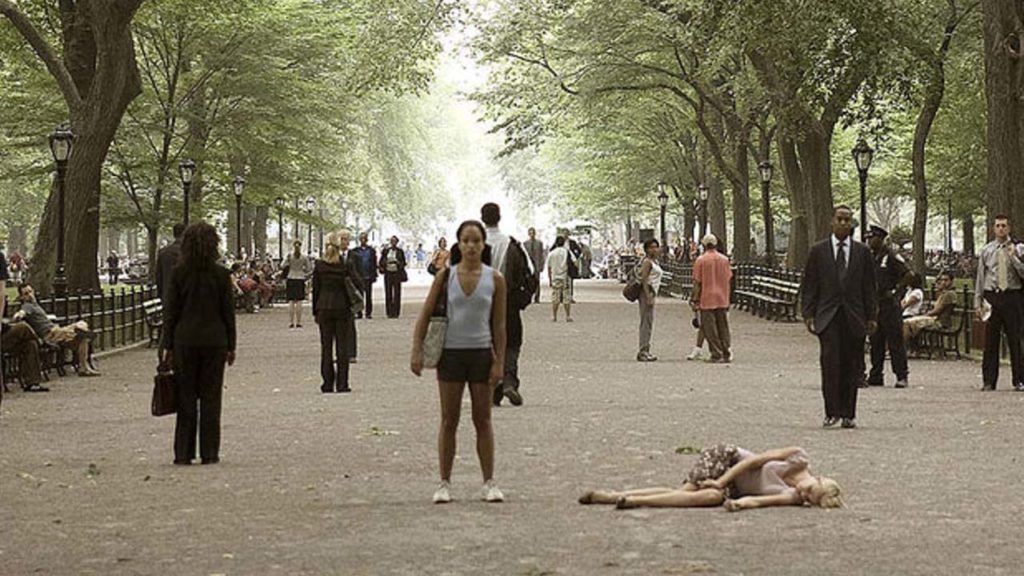
A mysterious mass hysteria strikes the idyllic Bethesda Terrace (a place I walk through several times a week) in Manhattan’s Central Park, and quickly fans out to the entire city. What is later referred to as “the event” or “the happening” (the latter a term originally popularized by hippies, I believe) appears to be some kind of airborne toxin that causes every human being within range to calmly and passively commit suicide.
Speaking as a New Yorker that lived through 9/11, this opening sequence pushes fewer emotional buttons than, say Cloverfield, which was explicitly analogous to post-9/11 New York as Godzilla was to post-Hiroshima and Nagasaki Japan. But it’s impossible to not be shaken by the charged image of office workers willingly jumping to their deaths from skyscrapers.
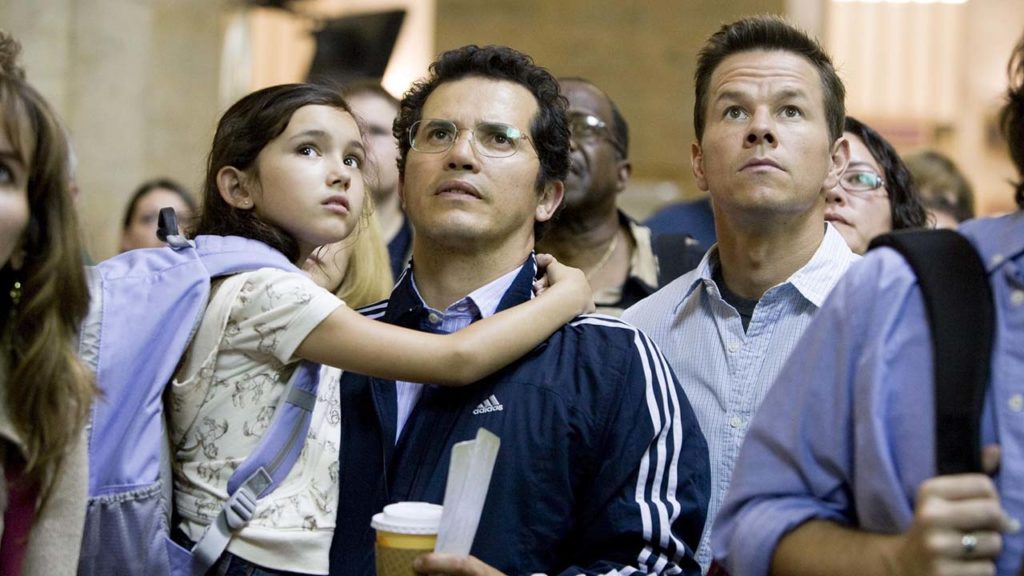
Having ticked the disaster movie genre box of “wholesale massacre in Manhattan,” writer/director/producer M. Night Shyamalan abandons New York for the remainder of the movie and transfers the action to his old stomping grounds of Philadelphia, PA. High school teachers Eliot (“Marky” Mark Wahlberg) and Julian (John Leguizamo) catch wind (so to speak) of the event, and presciently make plans to take the next Amtrak train out of 30th Street Station with their families. Eliot is experiencing some friction in his marriage with Alma (Zooey Deschanel), and warns Julian that she may be acting “weird.” It’s up to the viewer to decide if he’s talking about the character Alma or the actress Zooey, whose eyes and face were truly made for the movies but whose eccentric line readings are indeed “weird.”
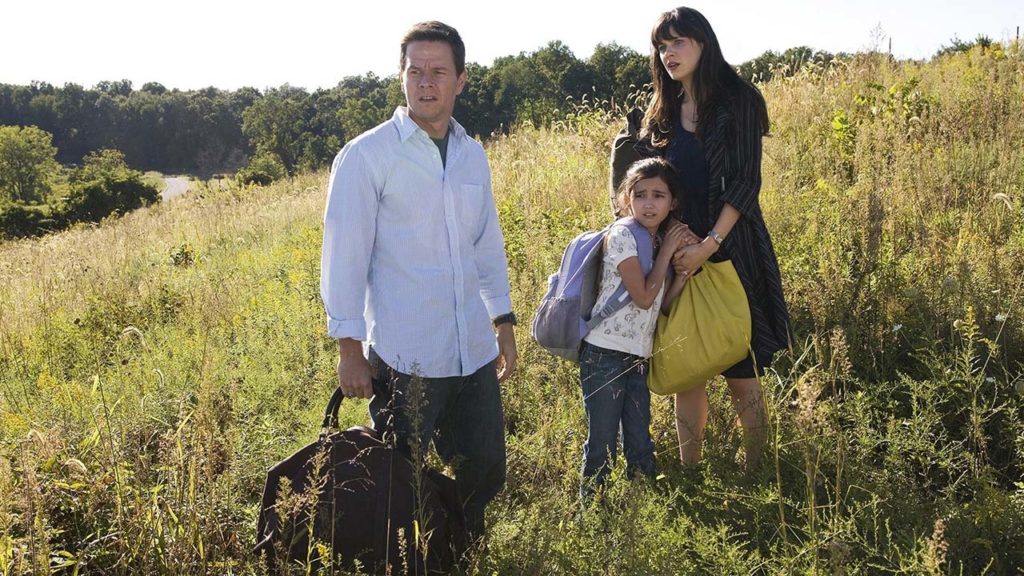
Mark Wahlberg and Zooey Dschanel go antiquing in beautiful downtown Filbert, PA
The train halts on the way from Philly to Harrisburg, stranding the occupants in the middle of nowhere — which is to say, the real-life small town Filbert, PA. Science teacher Eliot berates himself “be scientific, douchebag!” and uses logic to deduce the facts from the bits of evidence he’s picked up along the way: his hunch is that they are not experiencing a terrorist chemical attack, but rather that the earth’s biosphere is releasing a fatal toxin targeted to areas heavily populated by humans. They set off on foot in small groups into the kind of beautiful rolling fields where Shyamalan set his earlier parable The Village.
They come across a for-sale “Model Home”, a giant McMansion full of artificial goodies. The perfect dream home is actually in no way a refuge: there is no food or shelter, and it only serves as a lure to other groups less enlightened than they; the mere arrival of even one more fellow traveller could boost the local population to a point where the plants may attack.
Here the film’s first hint of humor appears: Eliot notices a giant indoor plant eerily looming in a corner. He attempts to negotiate with it for the future of humanity, until he realizes that it too is plastic. The artificial model home is a blunt metaphor for humanity’s disposable consumerism and impact upon the environment.
Manhattan is destroyed for the 4,937th time by Hollywood
At this point, The Happening becomes a different movie, a better one, receiving a much-needed injection of Shyamalan’s characteristic wit and masterful use of horror and suspense tropes: creepy shadows half glimpsed through window slats, batty old lady (Betty Buckley) with creepy dolls in her bed, etc. But overall it’s uncharacteristically clumsy. His best films (for my money: The Sixth Sense, Unbreakable, and Signs) are plotted so tight you couldn’t remove a single frame without harming them.
It’s unfortunately overwritten with pages and pages of poor dialogue, including this unintentional howler featured in the trailer: note Marky Mark’s impeccable grammar upon being told his Amtrak train has lost contact: “With whom?” Julian also states with odd formality that his wife is travelling separately to “the town of Princeton.” To be charitable, perhaps Shyamalan figured high school teachers might habitually speak clearly with correct grammar.
Do we have time for a cheesesteak and some Auntie Anne’s before our train to nowhere?
There’s too strong a reliance on fake television news broadcasts to convey exposition (a device only resorted to once or twice in Signs), even concluding the film with a talking head scientist explaining the takeaway message for the slower members of the audience: “we’re threatening the planet.” Watch The Sixth Sense and Unbreakable again and see how much Shyamalan at his best is able to communicate without dialogue. How much would Unbreakable have sucked if Bruce Willis’ character had openly mused about how he was turning into Superman?
Significantly for a director known for working in the horror & suspense genres (fantasy, too, if you count the execrable misstep The Lady in the Water), The Happening is Shyamalan’s first R-rated movie. As if to live up to its horror film billing, the narrative frequently pauses for conspicuously gory set-pieces: a woman stabs herself with a knitting needle, a man sets a lawn mower to run over himself, etc.
These brief episodes of gore contrast with what must have been the major challenge for his story: to visualize something inherently invisible: a wind-born toxin. Shyamalan signals an oncoming attack with gusts of wind. Which is, of course, preposterous because plants don’t cause wind. The characters outrunning wind is about as preposterous as the advancing killer frost in Roland Emmerich’s environmental disaster movie The Day After Tomorrow.
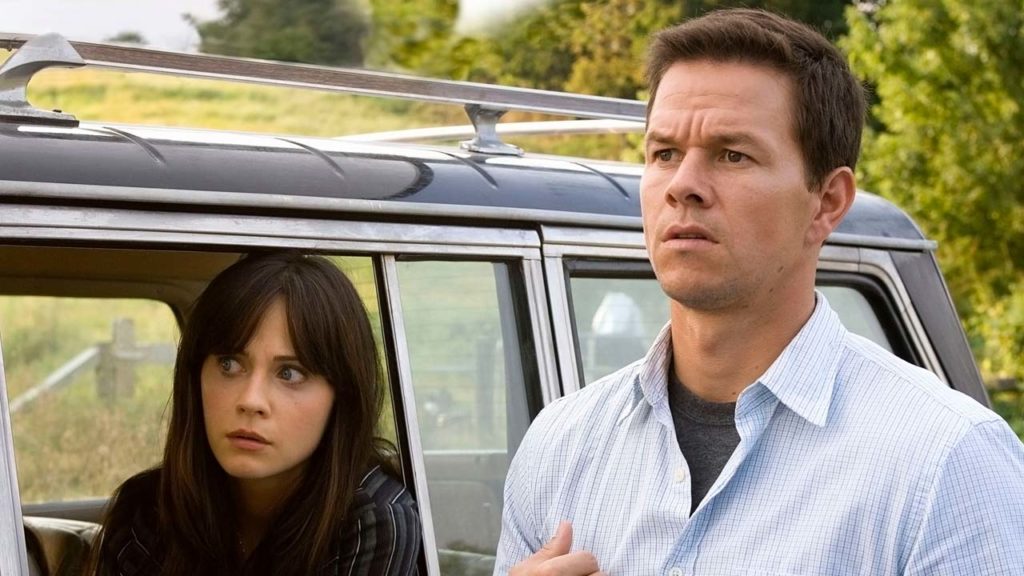
Zooey Deschanel and Marky Mark Wahlberg peek around the corner for the next plot twist
The film’s environmental issues first appear with a faint flavor of creationism in an early scene set in Eliot’s classroom. He believes there are aspects of nature we may never truly understand, although science may slap an explanation on them in retrospect. But “just a theory” is the language of anti-intellectual creationists who wish to discount evolution. In the hindu worldview, does an act of nature equal an act of god? Is the earth being malicious, defensive, or both? The planet may not be acting with conscious intelligence, but rather as a mere reaction to stimuli; a kind of thinning of the herds.
As was the case with the 2003 blackout in the northeastern U.S., Shyamalan was correct in observing that everyone’s first thought in any post-9/11 calamity would be that it’s a terrorist attack. But it’s pretty much established very early that the culprits are the plants. This pretty much drains the suspense out of the picture, and I actually wished for one of Shyamalan’s patented twist endings. It does seem hugely wimpy compared the ruthless and unsparing The Mist. If Shyamalan had had the guts to go for a bleak ending like writer/director Frank Darabont’s Stephen King adaptation, The Happening might have been better received and perhaps remembered as one of his best.
Has writer/director Frank Darabont been weighed down by the heavy legacy of his first feature film? The Shawshank Redemption remains one of the most popular movies ever made, if not quite (yet?) accepted into the canon. The Mist, after The Green Mile, is Darabont’s third Stephen King adaptation, so far only having made only one feature not derived from a King work. After two prison yarns (one set very much in the real world, the other with a dash of the supernatural), Darabont now turns to one of King’s more characteristically gruesome horror tales.
King writes at great length about classic horror movies in his nonfiction book Danse Macabre, and The Mist squarely fits into one kind of classic b-movie structure. We open in a seemingly bucolic lakeside town with simmering tensions between local residents and wealthier weekenders summering in lovely lakeside homes. A mysterious, mostly unseen, and definitely hostile alien force traps a random assortment of local personalities in a supermarket.
The horror works best before we actually see any evidence of the supernatural; for example, a character bolts into the store, full of nervous but not yet terrified citizens, crying the simultaneously eerie and hilarious line “There’s something in the mist!” For home viewers, a big reveal was spoiled right in the DVD menus: one of the adversaries is a very biblical swarm of giant beastly locusts.
They’re heeeeeeere…
Like virtually every zombie movie ever made, a cross-section of society is trapped in a confined location, under siege by unstoppable forces. The microcosm includes representatives of all the usual suspects, including a top New York City lawyer (because we all know NYC sharks are more venal than the regular kind) Brent Norton (Andre Braugher), a couple of good ol’ boys, the town cutie pie, a few handsome young lads from the nearby military base, and the resident looney fundamentalist Mrs. Carmody (Marcia Gay Harden).
The Mist is not above another classic horror movie cliche: the virginal good girl kisses a boy and immediately dies horribly in the very next scene. The heroes that arise are, of course, unlikely: a grocery bagger (an interesting character with a lot left up to us to fill in: he’s not a young man, and he’s got brains and skills, so how did he end up in such a dead-end job?) and a relatively wealthy artist David (an outsider to the town, viewed as elitist).
Cthulhu… gesundheit!
We first see “our hero” (more on that later) David (Thomas Jane) in the very first shot. He’s an illustrator of movie posters: I spotted three shout-outs to genre movies both actual and potential: Guillermo Del Toro’s Pan’s Labyrinth, John Carpenter’s remake of The Thing, and Stephen King’s own Dark Tower. He’s a macho, badass painter, using the back of his own hand as a palette, and bitching about studios cobbling together cheap posters in Photoshop.
Speaking of craven movie studios, sometimes studios whitewash action and horror movies to cater to more lucrative PG-13 audiences (like Blade III: Trinity, extraordinarily lame & tame compared to Guillermo Del Toro’s outrageously gory Blade II – vampire autopsy, anyone?). The Mist is one of the few R-rated horror movies I’ve seen that might have been better with less gore and profanity. Most especially the profanity – I’m certainly guilty of salty language in my own vocabulary, but the overall F-bomb count in The Mist is so absurdly high that it becomes eye-rolling; as if the filmmakers were deliberately striving for a record.
Play misty for me?
Overall, I’d have to say I really did not care for the movie, finding it overwritten. At numerous points, characters explicate the plot, elapsed time, and character arcs – to paraphrase an example: “It’s only been two days, and Mrs. Carmody has already turned everybody against us… in only two days!” It’s also too reliant on CG gore for a story than depends on the horror of the unseen (also where M. Night Shyamalan’s otherwise great Signs falls down). But the best bits of the movie are squeezed between the CG set pieces, and the entire affair is redeemed by an utterly astonishing ending.
Although I normally don’t concern myself with spoilers on this blog, it would be cruel of me to reveal the ending here. Suffice to say, it’s impossible to imagine how a script this bleak was financed and distributed (by Dimension Films). I also wish I had seen the movie in theaters so I could see firsthand how an average audience would react to such an ending. The big downer at the end of Cloverfield did not go over well with audiences, to say the least, and The Mist makes that one look positively wimpy.
Like Signs and Stephen Spielberg’s War of the Worlds, The Mist depicts a massive alien invasion from the perspective of regular folk, as opposed to the global view taken by movies such as The Day The Earth Stood Still and Independence Day. But The Mist has a truer ending than any of these examples. The core theme is of the roles people assume under extreme duress. Their illusions about themselves are amplified and they believe their own myth. Just as the fundamentalist Mrs. Carmody compensates for a lifetime of exile from healthy human interaction by elevating herself into a demagogue (I’m reminded of the characterization of the young Adolf Hitler in the movie Max, as he first finds the mass adulation he desires as he rallies a crowd into a racist frenzy), David falls all too well into the role of hero. He never complains when people turn to him for strength and leadership.
The so-called “hicks” that fight him in the beginning of the film were right; he does think he’s smarter than everybody else. In movies, he’s exactly the kind of guy other characters automatically defer to in dire situations: So-and-so’s dying of third degree burns? Tell David! What do we do next? Ask David!
The utter demolition of the stock hero character type is so surprisingly strong that it’s practically subversive. I had thought postmodern genre films had petered out after their late-90s golden age of Scream, Starship Troopers, and Wild Things. But The Mist is a new entry in the postmodern genre cycle, in the sense that it comments critically upon the horror movie genre, and yet still actually is a horror movie. The Mist may be a monster movie, but it’s not about a Thing, an Alien, or a Creature from a black lagoon; it reveals the standard hero character to be a kind of monster himself.
Although every Coen Brothers film is unmistakably theirs alone (can the Auteur Theory apply to more than one person at once?), Joel and Ethan have a reputation for rarely making the films audiences want or expect from them at any given time.
Clooney and McDormand give this movie two thumbs up.
After Fargo, when everybody wanted another snowy midwestern noir, Joel and Ethan gave the world The Big Lebowski instead. After a recent string of genre experiments like the Hepburn & Tracy-esque romantic comedy Intolerable Cruelty and a remake of Ealing comedy The Ladykillers, the Coens surprised everybody yet again with the dead-serious nailbiter No Country for Old Men. And, perhaps because they just can’t help themselves, they give us whiplash all over again with Burn After Reading.
John Malkovich being John Malkovich.
Ostensibly another caper comedy like The Big Lebowsi, Burn After Reading is actually more amusing than hilarious. The characters are a peculiar kind of stupid common in Coen films: unaware of their limitations, yet maniacally driven. But the mischievous Coens undermine the light entertainment value of the film by punctuating the convoluted noirish plot and seemingly light tone with scenes of extreme violence.
Brad Pitt is in possession of, as they say in movies like this, certain documents.
At the time, The Big Lebowski featured many of the Coens’ repertory players (John Goodman, Steve Buscemi, John Turturro). In contrast, Burn After Reading sports the marquee names Clooney and Pitt, perhaps giving it more attention than it can hold. But its biggest hindrance to joining the ranks of the best of the Coen Brothers is that it lacks a highly memorable (and quotable) character like H.I., Marge, or The Dude.
In 1998, when all the world wanted from Joel Coen and Ethan Coen was another Fargo, they got The Big Lebowski instead. The Coen Brothers recently repeated this trick by following up another masterpiece, No Country for Old Men, with the happy-go-lucky Burn After Reading. This blog wonders if this compulsion is by design or if the Coens just can’t help themselves.
Does the female form make you uncomfortable, Mr. Lebowski?
Received with some puzzlement upon release, The Big Lebowski is now the subject of pop art, annual conventions, and action figures. The farcical film noir is ultimately an extended “wrong man accused” pastiche in the spirit of Alfred Hitchcock and Raymond Chandler, but the Coens infuse it with their trademark anarchic spirit and populate it with characters with low (or otherwise chemically impaired) I.Q.
The film’s 10th anniversary was recently celebrated in a Rolling Stone feature article, The Decade of the Dude by Andy Greene. John Goodman, Julianne Moore, Steve Buscemi, and Sam Elliott reveal a wealth of anecdotes and all seem genuinely delighted at the film’s cult status. Goodman, however, alludes to having had a kind of falling out with the Coens after Oh Brother Where Art Thou. The article also states that the Coens decline to discuss the The Big Lebowski at all anymore, for unspecified reasons.
We don’t roll on Shabbos
However, the DVD edition screened by this blogger includes the original 1998 contemporary electronic press kit including an interview with the Coens in which they gamely discuss the production (Joel is credited as director and Ethan as writer, but in truth they have always shared the duties equally). The DVD also provides a peek at cinematographer Roger Deakins‘ spectacular fantasy sequences and unique bowling footage actualized with a motorized camera capable of running up to 20 M.P.H.
Bridges reveals the extent of his actorly craft in preparing for each scene: he would simply ask the Coens, “Did the Dude burn one on the way over?” Most often, the answer was yes, so he would rub his eyes to approximate the degree of redness appropriate, and proceed. The Dude copes with the trials and tribulations of life with the motto “The Dude abides,” but the circumstances in which he finds himself during this misadventure leave him less in a state of zen than one of paranoia. No doubt a lifetime of pot abuse has harshed his mellow somewhat.
You don’t &$%# with the Jesus!
Despite having only barely more than a cameo appearance, John Turturro nearly steals the movie with the unforgettable character Jesus Quintana (that’s “Jesus” with a hard “J”), a sexual predator and cocksure bowler. The Coens speak about wanting to write a Latino character for Turturro, but where did the rest of his outrageous characterization come from? Did they just wind Turturro up and let him go? Other notable cameos include David Thewlis (Naked, Harry Potter) as a giggling associate of Maude (Moore), and musicians Aimee Mann and Flea as hapless nihilists.