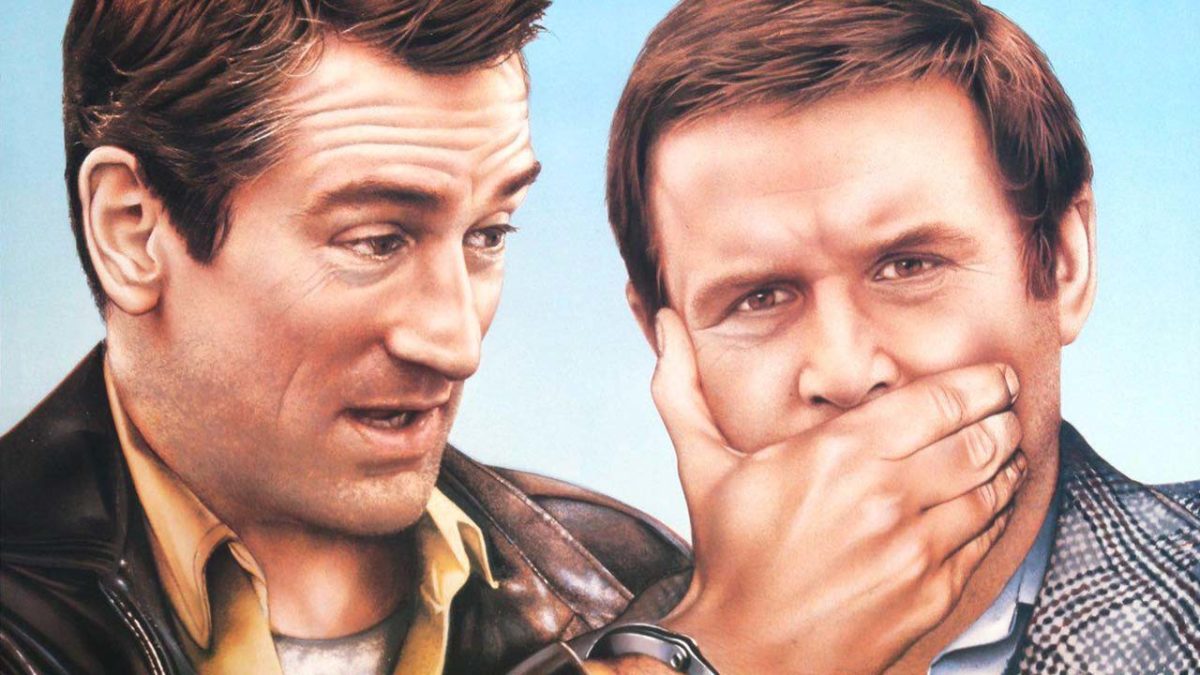
Martin Brest’s Midnight Run is an appealingly loose comedy built on a solid premise. It’s a classic, almost cliched Hollywood scenario: Jack Walsh (Robert De Niro) is one of the world’s last honest cops, rewarded for his integrity by divorce and demotion to the humiliating (and dangerous) level of bounty hunter. His handler Eddie Moscone (Joe “Joey Pants” Pantoliano) raises the lucrative prospect of One Last Job: to escort chief witness Jonathan Mardukas (Charles Grodin) in a federal mob case across the country, pursued both by the feds (led by the imposing and perpetually aggrieved Yaphet Kotto) and the mob (the ageless Dennis Farina) alike.
It’s for you
Walsh has personal business with mob boss Serrano, and so the task quickly becomes a journey of the soul for him. The template is 3:10 to Yuma: an intelligent, articulate “bad guy” travels with gruff and serious “good guy” with money problems and deep-seated resentment for being punished for his honesty. But all this is beside the point. The true pleasure of the movie, and the cause of its continued cult appeal, is all in the actors’ interplay. Grodin has all the hilarious dialog, much of it with the feel of improvisation. In contrast, De Niro seems only equipped to continually retort with “Shut the fuck up,” perhaps by choice to be true to his character as opposed to a failure of creativity. Why has Grodin been in so few movies?
Yaphet Kotto does not suffer fools lightly
Also of interest is an early score by Danny Elfman, later to gain a reputation for whimsical fantasy music for Tim Burton and The Simpsons. Brest, the director of Beverly Hills Cop, stages a massive multi-car chase approaching the absurdly funny levels of The Blues Brothers.
Midnight Run is actually not all that funny a comedy, not that thrilling a thriller, nor that penetrating a character study. But it is nevertheless great fun to watch, and crying out for a sequel.
John Sturges’ The Magnificent Seven is Hollywood’s answer to Akira Kurosawa’s hugely popular Seven Samurai. It suffers in comparison, especially if, like this blogger, one watches them in quick succession. The remake is quaint, chaste, and dated in ways the fairly frank original isn’t. To put it another way, Seven Samurai is a period piece of its 16th Century setting, while The Magnificent Seven is a period piece of its 1960 production.
A remake was inevitable considering the dizzying circle of influence. Kurosawa was a fan of the Hollywood western and especially of director John Ford, all of which directly informed Seven Samurai. Hollywood’s transposition of the story to the American West for The Magnificent Seven was fairly straightforward. Its great success led to three motion picture sequels, a television series, and is reportedly set to be remade again in 2009.
The original eponymous seven samurai were actually ronin, masterless mercenaries akin to the Western outlaw: morally ambivalent drifters, killers with a personal code of honor. The Western genre is usually about outlaws, for the simple reason that they’re more dramatically interesting than regular plain folk. In both versions of 3:10 to Yuma (1957 and 2007), for example, the villain Ben Wade (Glen Ford and Russell Crowe) is a far more appealing and seductive character than the good guy Dan Evans (Can Heflin and Christian Bale).
The meeting of the Badass Society is adjourned
An exception to the rule is the classic High Noon, in which Gary Cooper plays an honest lawman who prevails under extreme duress. The biggest clue the magnificent seven are not classic good guys: Yul Brynner appropriately sports his trademark black hat. Upping the badass quotient and testosterone levels are no less than Steve McQueen (here getting to drive a real mustang on screen), Charles Bronson, and the very lanky James Coburn.
The basic scenario is similar: seven American gunslingers accept a pittance in order to defend a Mexican village besieged by bandits. But the many alterations beyond this all reflect some very “Hollywood” thinking. In the original, it is enough for the samurai that there be an injustice they are capable of addressing. But in a Hollywood film, there must be individual motivations, which interestingly have the side effect of rendering some characters less heroic. Harry Luck (Brad Dexter) is convinced Chris (Brynner) has an ulterior motive, such as pilfering a non-existent gold mine. The dandy bounty hunter Lee (Robert Vaughn) is also along for selfish reasons; he’s on the lam for an unspecified transgression, and needs to disappear for a while.
The original Seven Samurai is actually technically comprised of only five actual samurai plus two pretenders. Kikuchiyo (Toshiro Mifune) is a peasant posing as a samurai, and Katsushiro (Isao Kimura) is an earnestly romantic young boy seeking samurai training and adventure. Perhaps to economize the story, The Magnificent Seven combines these two characters into one: Chico (Horst Buchholz), a former farmer that worships the outlaws and attaches himself to them in order to become one.
Go ahead and make our day
So that leaves Chris, Bernardo (Bronson), and Vin (McQueen). In this remake’s best sleight-of-hand, we’re in the dark as to their motivations until near the very end. None of them are young men, and what drives them turns out to be the fantasy of settling down into an agricultural lifestyle. The gruff Bernardo befriends a batch of scrappy kids, becoming a kind of protective older brother if not a father figure. Chris and Vin seal their friendship with the mutual confession that they both hanker for a simpler life (a sort of admission very difficult for two very macho men).
But many poor changes outweigh these aforementioned interesting ones. Being a product of Hollywood, it’s actually less violent, profane, and sexy than the original Japanese film. The Mexican villagers are wise and saintly, compared to the more realistically flawed farmers in Seven Samurai. The threat of sexual violence is whitewashed away; the bandits are not interested in the Mexican women. We see too much of the villains, and the chief bandit Calvera (Eli Wallach) is practically a featured character.
But just as I was beginning to dismiss the remake as inferior to the original in every way, and of historical interest only, the movie darkens and becomes interesting again. The Mexican villagers, like their ancient Japanese counterparts, do reveal a dark side after all. Despite their initial success in beating back the bandits with the outlaws’ help, they have a crisis of faith and betray the outlaws in order to return to the comfort zone of their parasitic relationship with the bandits.
In the old west, an outlaw may very well find a home in a frontier town where no one knows his past deeds (a core theme of the HBO series Deadwood and the situation in which Clint Eastwood’s The Unforgiven opens). But in ancient feudal Japan’s caste system, a ronin could never take a step down and live among farmers. This also proves to be the case in The Magnificent Seven: Chris and Vin mosey on out of town and Chico stays behind, rejecting his pretensions to being a rebel outlaw, and reverting to his destined life as a farmer.
Akira Kurosawa’s Seven Samurai is awesome and perfect, and this most recent viewing has affirmed its place among my all-time favorites. It’s a big movie, by which I mean it makes the best use of its generous running time with just the right amount of everything: romance, comedy, drama, suspense, and action. Nearly half the film is taken up by a massive, expertly choreographed battle rivaling anything put to film by famous Western directors of violent spectacle like Michael Mann or Steven Spielberg. Long as it is, it’s about 15 minutes shorter than Gone With the Wind but twice as epic, twice as substantial, twice as… well, twice as good.
It is, in some ways, a simple tale broadly told. A rice farming village in 16th century Japan is under constant siege by a band of parasitic bandits that abduct its young women and regularly steal most of its annual yield. With no government or military to protect them, the villagers pool their meager resources to hire seven ronin (masterless samurai reduced to surviving hand-to-mouth as mercenaries) to fight on their behalf.
You messed with the wrong ronin
The archetypal characters seem simplistic on the surface: villains to boo and heroes to cheer. In case the viewer have any doubt as to who the bad guy is, the chief bandit wears a black eyepatch, for crying out loud! Kambei (Takashi Shimura), the supremely capable and wise leader of the samurai, essentially lays down a universal definition of “hero” with his recruitment call: “There’s a tough battle ahead, leading to neither money nor rank. Will you join us?”
And yet, many subtleties gradually unfold. Kikuchiyo (Toshiro Mifune) is one of the great pleasures of the movie, but also one of its greatest mysteries. He’s clownish and childishly impulsive, yet passionately moral. He’s a commoner masquerading as a samurai, his only certification being his ridiculously long sword (presumably the liberated former possession of a very tall samurai).
Kambei, whom in another life could have been a good shrink, correctly deduces Kikuchiyo’s motivations for having attached himself to the venture; he himself is a peasant farmer with pretensions to more. He directly identifies with the farmers’ plight, yet his deep-seated class insecurities fuel his a love-hate relationship with them. As an essay by Kenneth Turan in the Criterion Collection edition booklet points out, medieval Japan was a fiercely delineated caste society, and the fact that a former farmer might presume to call himself a samurai is a huge transgression. For a very different, more subdued dramatic performance by Mifune, see Kurosawa’s Stray Dog.
Toshiro Mifune is a wild and crazy samurai
As we learn more about Kikuchiyo, we likewise slowly get a more and more complex portrait of the villagers. They are no doubt the victims of a serious crime. Yet they whine all the way and mythologize themselves as helpless, saintly, victimized salt of the earth that must resort to hiring disgraced samurai to protect them. But they harbor a dark secret; they have robbed many fallen samurai of their armor and weapons over the years Their veritable armory of pilfered gear of war is useless to them, and yet they shamefully hide it from the samurai protecting them (even though it would bolster their coming war). The seven samurai are deeply offended, and yet nevertheless do the right thing and defend the village. But the gulf between the two classes, samurai and farmer, is reaffirmed.
Seven Samurai is in the company of 2001: A Space Odyssey, Citizen Kane, and Vertigo, a special class of film so famously influential that even first-time viewers may very well feel they’ve seen it before. Just to name a few of Seven Samurai‘s first-generation offspring: The Magnificent Seven is an unapologetic transposition of the original from feudal Japan to the American West. The Dirty Dozen and Ocean’s Eleven both borrow the trope of recruiting a gang of misfits one-by-one, whom in concert become capable of strengths impossible as individuals. Another American-produced remake is scheduled for release in 2009, this time set in modern-day Thailand.
The 2006 Criterion Collection edition is a required library item, not one to merely rent. A magnificent restoration of the film itself is accompanied by a beautifully designed sleeve and booklet. A surprising amount of damage remains in the long battle sequence in the second half of the film, but Criterion’s reputation for quality ensures that these are almost certainly the best available materials. Perhaps those particular reels were more frequently subjected to torture over the years by scholars?
Why you need to read the booklet:
Kenneth Turan on the full year of production it took to make the film, mirroring the time that passes in the movie. On a practical level, the extended production allows for greater realism like Kambei’s hair realistically growing back after shaving his head in the beginning (the topknot is a prized symbol of the samurai; not just a fashion but a requirement of their caste). But also on a thematic level, one year = the farming cycle of life: planting through harvest.
Peter Cowie on the mutual admiration society between Kurosawa (a fan of the Hollywood Western) and John Ford.
Philip Kemp on 16th Century Japan. The feudal society had little distinction between ronin and bandits.
Peggy Chiao on Kurosawa’s influences. Kurosawa was a Marxist in his 20s, but later mellowed. His older brother turned him on to Dostoyevsky, but committed suicide.
Alain Silver on Kurosawa’s staging and composition.
Stuart Galbraith IV on the historical context of the contemporary Japanese cinema, which was flourishing at the time.
Appreciations by directors Sidney Lumet and Arthur Penn.
Toshiro Mifune’s quite funny and entertaining reminiscences. Mifune claims he devised his character, as nothing had been written yet when he was cast.
Supplemental features on the bonus discs:
“Akira Kurosawa: It is Wonderful to Create” – an almost excessively hagiographic biography, but with several amusing anecdotes. Shooting all year meant continuing through February’s freezing mud, while Mifune was almost naked. Kurosawa dutifully stood in the mud with his cast and crew, and was literally frostbitten.
“Seven Samurai: Origins & Influences” – “The Story of the 47 Ronin” was a popular puppet theater tale for hundreds of years, and was adapted into films several times a year in early Japanese cinema. One of those observations that sounds obvious in retrospect, but needs to be pointed out by somebody: Ronin (pronounced by some as “roh-ee-nin”) stories are more popular than samurai stories because they are inherently more dramatically interesting.
“My Life in Cinema: Akira Kurosawa” – a long interview by fellow director Nagisa Oshima.
I recall Dark City being one of my favorite films of 1998, and I would have rated it quite highly had I been keeping score at the time. It is a bold science fiction film noir most obviously indebted to Blade Runner, but also to favorites Brazil (especially the sequences of buildings sprouting up out of the ground), Metropolis, M, and City of Lost Children. In each of these, a protagonist survives in a hostile, often nameless dystopian city, often with the suspicion that his depressing existence is somehow not real. Alex Proyas, Lem Dobbs, and David S. Goyer’s screenplay explores the same flavor of paranoid schizophrenia that also figures in the literature of Franz Kafka and Philip K. Dick.
Dark City was overshadowed at the box office by Titanic — as was everything else released at the time, to be honest — but like its later oddball distant cousin Donnie Darko, its extended lifecycle included becoming a cult hit on DVD. In the meantime, director Alex Proyas further raised his bankability with later commercial success I, Robot. So for Dark City‘s tenth anniversary, New Line Cinema financed Proyas’ completion of a Director’s Cut for a special edition DVD.
Proyas describes his Director’s Cut as “more complete,” and blames the audience testing process for New Line Cinema pressuring him to add an explanatory voiceover. As he put it, the process undermined his confidence as a filmmaker and thus compromised the film. As was the case with the 2007 reissue of Ridley Scott’s Blade Runner, Proyas has now removed the opening narration, spit-polished the special effects, and extended some scenes. Watching it for the first time since 1998, it all nevertheless seemed familiar to this blogger, who found it difficult to spot anything new from memory.
The worst loo in The City
DVD bonus features are dryly referred to by movie studio home entertainment executives as “value-added content.” Repurposed electronic press kits typically feature filmmakers congratulating themselves on how wonderful a film they’ve made and how brilliant all their colleagues were. In contrast, the Dark City DVD squeezes in an interesting and fairly candid feature-length documentary on the making of the film and its impact upon numerous philosophers and film critics. No less a marquee booster than St. Roger Ebert praises the film and contributes an entire commentary track. Ebert has long championed the film, even including it among his series of Great Movies. Among other excellent insights, he points out it predated the similarly-themed The Matrix by over a year.
Happy Birthday, Mr. Murdoch
The filmmakers relate their amusing struggles with the MPAA. Shown a relatively inoffensive cut of the film, they nevertheless wanted to give it an “R” rating, the best rationale they could give being its overall weirdness. So, faced with receiving an R no matter what, the filmmakers actually decided to add more nudity and violence. But there is still no profanity in this antiseptic universe. Dark City is a film noir of the sort where even hookers say things like “Aw, shoot.”
Of the cast, only Rufus Sewell participates in the documentary. He’s nothing like I would have expected; actually kind of goofy and animated, in direct contrast to his moody seriousness in the role. Kiefer Sutherland overeggs his performance with a limp, facial deformity, and speech defect. His character is a remorseful collaborator that turns on his masters, interesting enough without all the actorly accouterments. A striking shot of Jennifer Connelly standing on the end of a pier matches my memory of a similar shot in Requiem for a Dream.
David Koepp’s Ghost Town pulls at the heartstrings without being too nauseating. With a tagline that implies The Sixth Sense as a romantic comedy, its tone and subject matter are roughly comparable to As Good As It Gets: the thawing of a misanthrope with some good qualities. It mostly earns it, but the last 2-3 lines of dialog don’t feel natural — the sort of thing a screenwriter might jot down first, and then later write an entire screenplay around. It’s a real bittersweet irony for Bertram’s (Ricky Gervais) first real friend (Greg Kinnear) to literally disappear.
Poor Téa Leoni is once again saddled with an age-inappropriate love interest, as she was with Ben Kingsley in You Kill Me. I can’t picture Gwen and Bertram as lovers, but I can see them as forging a real friendship, amidst their unique situation. Their characters are well-drawn enough that I can buy his ironic wit appealing to her while her supposedly perfect fiancé may be a good human being but is utterly humorless.
Alfonso Cuarón’s Children of Men is, simply, one of the best movies I’ve ever seen. Repeat viewings never fail to overwhelm me with some of the strongest gut-level emotional reactions I’ve ever had to a movie. I can only talk about it in superlatives: it’s a near-religious experience. One of the movies that makes me love movies.
Children of Men is set in a near-future dystopia, two decades after the last human birth. The sci-fi premise of mass infertility has only become more terrifyingly plausible in recent years, with looming climate catastrophe, increased rates of autism and allergies, and the imminent threat of globally contagious diseases like SARS and Zika. A few lines of dialogue allude to a flu pandemic, but the screenplay wisely doesn’t get lost in the weeds over the origins of the crisis.
Clive Owens and author P.D. James in Children of Men
Even the best science fiction sometimes can’t avoid fanciful pseudo-science that tends not to date well (q.v. the notorious “enhance” scene in Blade Runner). The most detail we learn is that women are infertile, and while other reproductive technologies like cloning and artificial insemination aren’t mentioned, we can assume all avenues have failed. It’s evidence of great restraint and respect for the audience’s intelligence that the origin remains unexplained. It’s beside the point.
So by the time the film opens, the harsh fact that the human race is doomed to slowly die out is a given, and has reduced the world’s societies into chaos. Great Britain remains nominally functional, but only under the harshest totalitarian methods. In propaganda glimpsed throughout, Britain congratulates itself for the fascism that makes it possible to carry on; but is mere survival worth the price?
European refugees seeking asylum in the fascistic United Kingdom
Immigrants flood the only country with some semblance of stability, fleeing unspecified atrocities abroad. All we learn of the United States is of a vague catastrophe in New York City alarmingly referred to only as “it.” Immigrants are demonized as “fugis” (for “fugitives,” perhaps punning on the derogatory British slang “paki” for any and all Middle Easterners) and penned in ghettos and concentration camps. Many shots explicitly allude to infamous images of captive enemy combatants in Guantanamo Bay. I doubt it’s incidental that several of the fugitive voices we hear are German, causing one to wonder just what exactly may have happened in Germany, and if it may have been something we have seen before in living human memory. My German is non-existent, but if I’m not mistaken, we overhear one captive German woman bitterly complain to her guard for being locked up in a detention cell with black people. It’s not a pretty picture of human nature; at the worst of times, the worst of us comes out.
It’s not usually a good sign for a movie to have five credited screenwriters, but these do extraordinary job of adapting the original novel by P.D. James (who, according to IMDB, has an uncredited cameo in the cafe bombed in the opening moments of the film). I don’t know if I would go so far as to say the movie is “better” than its source material, but it is certainly more visceral and emotionally affecting to a post 9/11 audience. As an adaptation, the many changes are justified and benefit the translation to a different medium and time. Most significantly, the chronology is condensed from months to days, and the relatively polite insurrectionist group The Five Fish has become a full-fledged terrorist organization called simply The Fish.
Danny Huston as the guardian of the Ark of the Arts in Children of Men. Among the artistic achievements of humanity selected for eternal preservation: Pink Floyd’s inflatable pig
Theo (Clive Owen) is younger, without the life of wealthy ease his novel counterpart enjoys. He’s a gambler and alcoholic, and his initial motivation to collaborate with The Fish is raw money. His cousin Nigel (Danny Huston) is not the all-powerful Warden of England as in the book, but rather merely the effete guardian of the Ark of the Arts. The Ark is a pointless quest to archive the world’s great works of art, including everything from Michelangelo’s David, Picasso’s Guernica, to Pink Floyd’s inflatable pig. King Crimson’s dramatic Mellotron dirge “In the Court of the Crimson King” fittingly accompanies Theo as he visits Nigel, passing into a walled city that separates the privileged elite from the working masses outside. Naomi Klein predicts the future dominance of such places in Cuarón’s short documentary “The Possibility of Hope”, apprehensive of the very near and very real future of countries closing themselves off to refugees.
Julianne Moore as Julian in Children of Men: “What do the police know about justice?”
Several mind-bendingly impossible tracking shots grace the film, so fluid and justified by the action that the mind barely registers a lack of cutting. There is an incredible level of detail in the art direction, but as Cuarón declares in the DVD bonus features, the goal to was be the “anti-Blade Runner.” Technology has barely progressed in the decades since humanity began dying out. What’s the point of innovation in fashion, automobiles, and consumer electronics when the human race is doomed to extinction? Eerie sights include fields of burning cattle corpses (possibly due to mad cow disease, or more likely the simple fact that the agriculture system has collapsed), abandoned and crumbling schools, and the prominence of dog racing as the sport of choice in a world with fewer and fewer healthy young people every day.
Clare-Hope Ashitey and Clive Owen in the ruins of a school
Children of Men may be a punishingly bleak vision of the future, but there is hope to be had. Theo is a broken man resolved to a slow death, both his own and of his species. But there is something special within him; his former lover Julian (Julianne Moore) trusts him over everyone else to do the right thing when presented with a gift of hope: the first human child in two decades. Even animals are drawn to him, including dogs, kittens, and deer. His friend Jasper (Michael Caine) praises the Hindu Peace Mantra, which also appears as an epigram after the credits (over the sound of children playing), and bears repeating here: “Shantih Shantih Shantih”
Guillaume Canet’s Ne le dis à personne (Tell No One) enjoyed a surprisingly wide US theatrical release for a French film without huge English-speaking stars (except for Englishwoman Kristin Scott Thomas, perfectly fluent in French). Roger Ebert rightly compared the tightly crafted thriller with The Fugitive, placing it squarely in Hitchcockian wrong-man-accused territory.
Pediatrician Alex Beck (François Cluzet) finds himself the prime suspect of his wife’s murder, eight years prior. This being a French film, the fortysomething Beck was married to the utterly gorgeous younger Margot (Marie-Josee Croze, great in Julien Schnabel’s The Diving Bell and the Butterfly). One might accept this as a given premise of the story, for sometimes old coots really do bag hot young wives, had the film not ruined it by demonstrating via flashback that the characters are supposed to be the same age.
Run Beck Run
I found Tell No One more focused and engaging before the conspiracy widens to an almost absurd degree, enveloping even a Senator in a vast cover-up. I will admit to being confused at times; to grasp the details and convoluted timeline, viewers will have to remember character names, not faces, as the chronology of some key plot points are conveyed via exposition (that is, told, not shown).
Funny how bad things happen to people who skinny dip in movies.
Hints of the recent race/class tensions in France are built into the plot: Beck’s equanimity as a pediatrician earned the trust of some less privileged thugs on the wrong side of the law. That they will aid him when no one else will ironically demonstrates his essential goodness.
Control is one of the very few rare musical biopics to ever appeal to me, even though I am only passingly familiar with the music of Joy Division, and even less so of the history of its tragically doomed lead singer Ian Curtis.
To testify to the film’s power, I immediately purchased The Best of Joy Division compilation. Listening more deeply to them for the first time, I’m struck by how much influence they obviously had, most obviously Interpol but also no less than U2 (especially their first three albums, and in Adam Clayton’s bass playing particularly).
Transmission
Control begins with Curtis (Sam Riley) as a young lad in 1970s Manchester, absorbing all the rock star lessons that are there to be heard in David Bowie’s Aladdin Sane. He applies androgynous glam-rock makeup modeled after Bowie and Brian Eno, pops pills (ironic, considering the wide cocktail of drugs he’s later legitimately prescribed when his epilepsy manifests), writes anguished poetry, and sees the Sex Pistols live in their prime: “they were crap.”
They were crap.
Ian Curtis, on Joy Division, in Control
But his own band Joy Division creates a genuine new sound, a world apart from glam or punk. They seize the attention of Manchester music scene maven Tony Wilson (Craig Parkinson) with a hand-scrawled note reading “JOY DIVISION YOU CUNT,” hand-delivered immediately before a scorchingly intense live set. Wilson, himself immortalized by Steve Coogan in Michael Winterbottom’s brilliant biopic 24 Hour Party People, becomes their greatest advocate, literally signing their contract to Factory Records in his own blood (there I go, praising two music biopics at once; I guess they’re not all bad).
Love Will Tear Us Apart
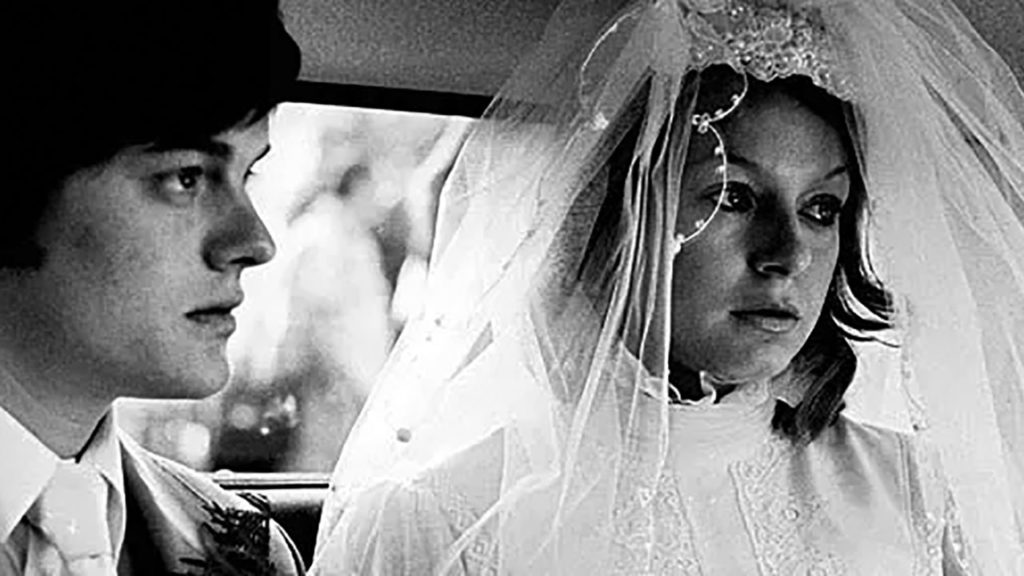
Curtis’ fame came before the comforts of money. He found himself on the covers of magazines, offered a tour of America, and desired by exotic women while still reliant on a depressing desk job and tortured by his own ambivalence towards his young family. Samantha Morton plays his wife Deborah as a shy, overly trusting girl. The real Deborah was later to write her autobiography and co-produce this film with Tony Wilson.
Director Anton Corbijn is most famous for his music videos and portraits, including the iconic The Joshua Tree sleeve for U2. Even though this is his first feature film, he is intimately experienced with the art of capturing rock (and rock stars) on film.
Named after the ancient Persian city, Marjane Satrapi’s graphic novel Persepolis is a memoir of her life in Europe and Iran after the Iranian revolution. This animated feature joins the growing ranks of comic book adaptations that prove that comics are not only about superheroes that dress up in animal-themed costumes to battle crime. Hopefully it, along with other good comics-to-film triumphs Ghost World and A History of Violence, will broaden moviegoers’ awareness of the many alternative genres already explored in comics.
The spirit of punk invades Iran
In a rare privilege perhaps only ever shared by Frank Miller in making Sin City with Robert Rodriguez, Satrapi served as co-director and writer of the film (with Vincent Paronnaud). She sings music to my ears in the DVD bonus features; to paraphrase, she states that it is a fool’s errand to make a literal, strict adaptation of any graphic novel to film. As comics writer Alan Moore once brilliantly and succinctly put it, comics are wholly unlike movies because, simply, “movies move.”
The recent trend in Hollywood is to perform fan service (as it’s known) and make the most literally faithful adaptations possible. Sin City, 300, and the upcoming Watchmen all procede from the flawed presumption that the source materials’ fanbase (the nerdy, genre-convention-attending strawmen in studios’ equations that they expect to be buying the tickets and DVDs) want nothing less than perfect transitions from page to screen. But such a thing is never possible, let alone desirable.
Politically conscious at a young age
That said, Persepolis the film does share the strikingly stark look of Satrapi’s characteristic pen and ink illustrations. A mostly black & white animated French memoir about a young Iranian woman could never be mistaken for blockbuster material, but it is funny, illuminating, and moving.
Wong Kar-wai’s first English-language film My Blueberry Nights is mostly set in bars and diners across America. His characters all indulge in the four great American pastimes: eating, drinking, gambling, and driving.
Nobody films beautiful women, or should I say, nobody films women beautifully, like Wong Kar-wai. In Blueberry Nights, he has no less than four famous female faces to worship with his camera:
Norah Jones – Perhaps not the most natural of actors, but her speaking voice is as emotionally expressive as it is in her famously languid, evocative music.
Chan Marshall (aka Cat Power) – Like Jones, Marshall is a musician and not an experienced actor, but her cameo is bittersweet and effective.
Rachel Weisz – The New York Times one described Weisz as “the thinking man’s sex symbol,” but here she portrays a seemingly dim character with a cruel streak.
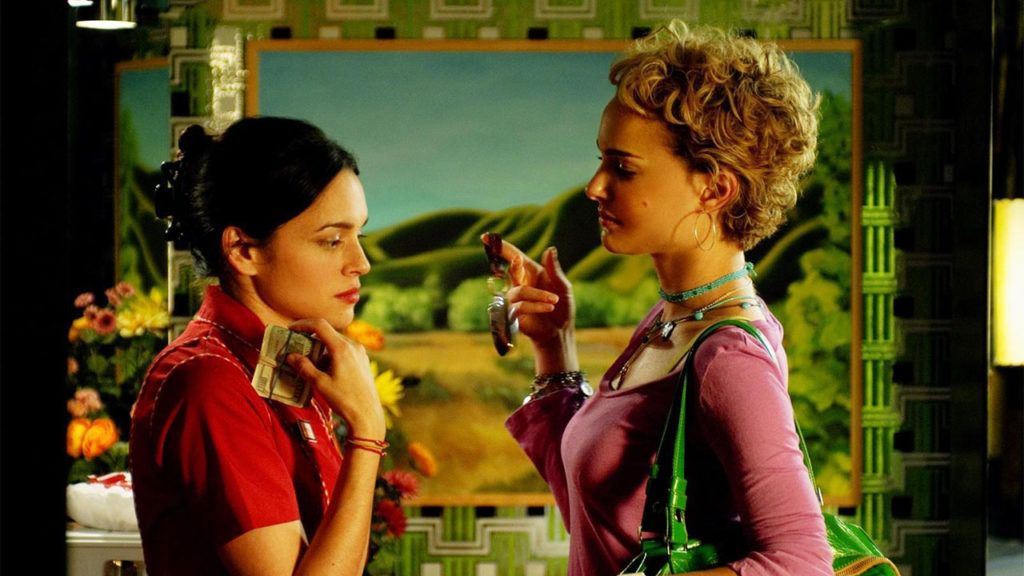
Natalie Portman – Like Weisz, Portman plays against type as a troubled young gambling addict with an Electra complex.
Natalie Portman offers Norah Jones an offer she can’t refuse
It’s impossible to miss the central metaphor: every morning, diner proprietor Jeremy (Jude Law) ritually bakes a blueberry pie. Never eaten, it is thrown out whole every night. It may be undesired for the time being, but every day there is a fresh chance for it to find someone who hungers for it.