In this blog’s opinion, Ang Lee’s Sense and Sensibility is the best-of-breed within Jane Austen film adaptations. Please note, however, there are two very good reasons to discredit my opinion on this subject:
I. Despite my English major, I am ashamed to admit I have read only one Jane Austen novel: Emma. Yeah, I know, I’ve got to get working on that.
II.Sense and Sensibility features two of this blog’s all-time favorite movie crushes: Emma Thompson and Kate Winslet. Any film featuring just one of these English roses automatically earns extra credit. Any film featuring Emma and Kate, together, equals porn (especially if they hop into bed together, as they do here… granted, as sisters keeping their toes warm, but still!). Any film featuring Emma and Kate, plus a screenplay by Emma, equals bliss.
“Always resignation and acceptance. Always prudence and honor and duty. Elinor, where is your heart?”
A few extra notes:
Guest commentator (and first-class Austen aficionado) Snarkbait has coined the best phrase for this genre: “Regency Era froth”.
Actor Greg Wise (John Willoughby) later became Mr. Emma Thompson, after Kenneth Branaugh foolishly let her get away.
Hugh Grant’s trademark stammer, persistent interest in the carpet, and out-of-control hair are still charming even in 18th Century surroundings. But it is difficult to stifle a snicker when the devilish Grant, as Edward Ferrars, expresses an interest in joining the Church.
I wish I had Alan Rickman’s (Col. Brandon) vocal cords.
Hey, look! It’s Tom Wilkinson in a cameo as the soon-to-be-late Mr. Dashwood! This blog thinks Wilkinson is one of the finest and most versatile actors working today.
Required viewing: Emma Thompson’s 1996 Best Adapted Screenplay Oscar acceptance speech (not on YouTube as of this writing, but here is the text).
In the Valley of Elah is a dark story about the psychological damage of war, certainly not a recipe for an entertaining night at the movies. This blogger will cop to finding it difficult to work up the enthusiasm to sit down for a movie on such a troubling topic, fearing the resultant depression (despite my love and respect for cinema as an art form, and staunch sympathy for the anti-war movement, sometimes a person just needs a little light entertainment). But writer/director Paul Haggis structured the plot as a murder mystery, with a few pinches of wry humor, to craft an excellent film that is not punishingly sad.
Hank Deerfield (Tommy Lee Jones) is a pious, patriotic, and disciplined man. But he is also emotionally detached; he dispassionately investigates the mysterious death of his own son. Drawing upon his skills as both a former army soldier and police sergeant, he outwits both the army’s own investigators and the resident local police smartypants Det. Emily Sanders (Charlize Theron). Impressively for an old coot, he is even able to locate a back-alley cell phone phreaker, in an unfamiliar town, using only a diner’s phone book. But the seemingly cold man does reveal his pain and weakness before the end, and even a buried unsavory side involving racism.
(Don’t Go Back To Sgt.) Rockville
The title derives from the Biblical parable of David and Goliath, a macho mano-a-manu beatdown that occurred during the battle of the Israelites vs. the Palestinians. Aside from the obvious parallels to the locale and participants of the ancient and never-ending Middle East conflicts, the tale is also a metaphor for how Deerfield views manhood and how he raised his son: to stand tall against any odds. But as Deerfield learns unpleasant truths about his son (drugs, torture, prostitutes) and his country (unjustified war, institutional corruption), he must, late in life, come to reevaluate his most core beliefs. So what makes this clearly liberal anti-war film special is its respect for exactly the type of person it might indict: the god-fearing patriot.
Whitman’s Sampler, my favorite!
Finally, I’d like to highlight one excellent scene (in every way: writing, acting, and directing): as Deerfield phones his wife Joan (Susan Sarandon) to tell her their son is dead, the scene begins in the middle, and in the end the camera pulls back to show Joan has torn apart the room. A lesser film would have shown the whole thing, for the sake of melodrama.
Like many young men cursed with a privileged life of education and time to think for themselves, Chris McCandless (Emile Hirsch) wanted only a vaguely defined “truth” and to not have to rely on anyone. Synthesizing his reading of Henry Thoreau and Jack London, he imagined for himself a life of self-sufficiency in the wilderness. So McCandless dropped out of society in the summer of 1990, leaving behind all connections whatsoever, including his legal name and identity. Despite his absolutely clean break, he never seemed to view this transformation as permanent; he mentions more than once that he may write a book when he “comes back.”
Interestingly for a young man, he also seems to make a point of avoiding even temporary female companionship. He rejects the friendship of Jan (Katherine Keener), and abandons his younger sister Carine (Jena Malone), the person with whom he apparently had the closest bond. Carine narrates the film, with total sympathy for his beliefs and actions. But even she points out that he acted with “characteristic immoderation.”
The rough guide to self-actualization
McCandless died alone in August 1992. He remains a controversial figure (should his asceticism be admired, or was he a fool?), and his solitary death the subject of an intriguing mystery (was he really trapped with food poisoning, or did he allow himself to die slowly as a form of passive suicide?). This film interpretation of his story does make it clear that he was a privileged kid who hadn’t truly suffered. While drinking with new buddy Wayne (Vince Vaughn), he lets slip his adolescent belief that one of the worst forms of tyranny in the world is “parents.” As we see, his parents (Marcia Gay Harden and William Hurt) are all too human and not half as monstrous as he imagines. So perhaps his adventure was more than an idealistic reaction to mere money, society, and materialism. He was also running away from the “free” things that living in society affords, what everyone craves in life: family, friends, and lovers.
Hence the title
A note on the music: just as McCandless looks backwards for literary inspiration, he also has antiquated taste in music for a kid living in the early 90s. His new name for himself, “Supertramp” puns on the classic rock band and his new lifestyle. He christens his new and final home, an abandoned bus, after The Who’s “Magic Bus.” For the music of the film itself, director Sean Penn drew upon two musicians that made names for themselves in the early 90s: Pearl Jam’s Eddie Vedder (who contributed songs to Dead Man Walking), and guitarist/composer Michael Brook. Vedder’s songs for the film were released as an album, but Brook’s excellent score is also available digitally.
Into the Wild is yet another in a long series of films I’ve seen recently that are based on books I haven’t read (The Kite Runner, No Country for Old Men, The Namesake, The Assassination of Jesse James, etc.). But even so, I believe I can detect a few remnants of the film’s prose origins as John Krakauer’s book:
the film is broken into chapters with onscreen titles
voiceover narration
the visual device of superimposed text from McCandless’ own journals provides a second voice
episodic feel – but that’s justified by the events/phases of his journey – he keeps making clean breaks every time he comes close to settling in somewhere
Anyone who’s ever had the misfortune of a conversation about movies with this blogger is no doubt aware that I like musicals about as much as I like biopics. That is to say, not at all.
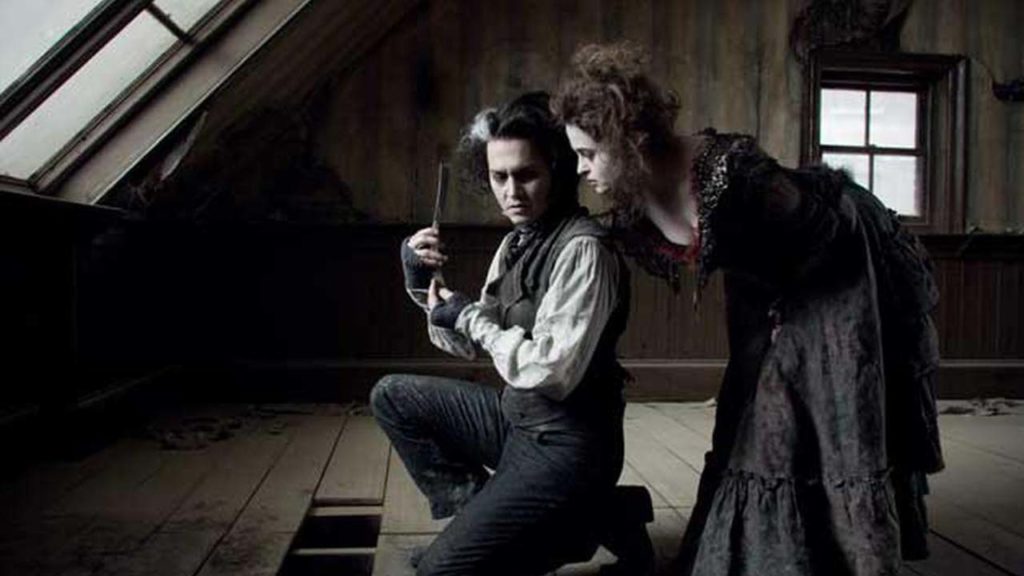
I do, however, love Tim Burton, and count Ed Wood among my personal favorite films. So if he could make a biopic I can love, I didn’t think it unrealistic to hope that he might melt my cranky moviewatcher’s heart with a musical. But it’s been a long time since Burton has directed a personal project, instead working on existing franchises and remakes like Planet of the Apes and Charlie and the Chocolate Factory. He did add a healthy dose of the trademark Burton flavor to each, not to mention key members of his troupe (Helena Bonham Carter in Apes and Johnny Depp in Charlie), but fans like myself are still waiting for the next burst of pure Burton madness in the spirit of Edward Scissorhands.
Oi t’ink he’s up to summat
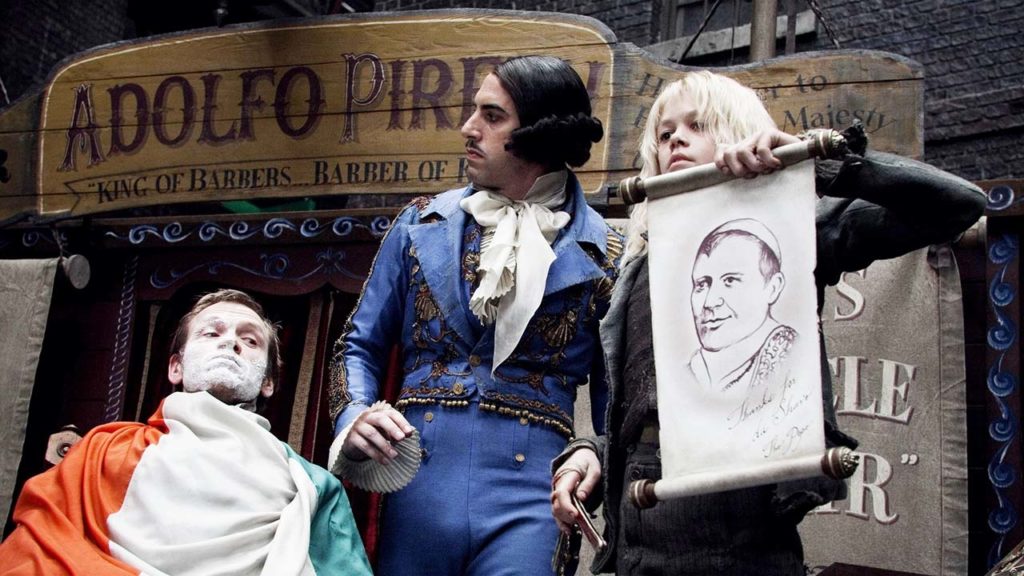
The Sweeny Todd tale originated in a prose serial form in 1846, and after several permutations, eventually became a stage musical by Stephen Sondheim in 1979. Burton’s 2007 film adaptation doesn’t quite manage to break free of its stagebound, er, staging. Despite the opportunity a film has to expand a play’s world, the action is limited to just a few locations. The rich art direction doesn’t defeat the impression that the whole thing was shot on a small soundstage. Speaking of art direction, Burton’s vision of late 19th century London is very colorful, provided that that color is blue. That said, it isn’t long before a few generous gallons of red are splashed about the place.
And now, the chewing of scenery, for your delight & edification
Timothy Spall, once of Mike Leigh’s British kitchen sink dramas, continues to indulge in the new scenery-chewing persona he developed as Peter Pettigrew in the Harry Potter films. Helena Bonham Carter looks like she just stepped out of The Nightmare Before Christmas, and Sascha Baron Cohen sports no less than two outrageous accents.
Sweeney Todd: The Demon Barber of Fleet Street has joined Waitress in the most unlikely mini genre of 2007: movies about pie shops. But while Waitress was a largely cutesy concoction, Sweeney Todd adds to the recipe a preoccupation with vengeful cannibalism a la The Cook The Thief His Wife & Her Lover.
And finally, a technical note: the DVD edition suffers from an unusually uneven audio mix. The music is far, far louder than dialogue sequences, so be prepared to drive your remote control volume switch throughout.
As a public service, this blog would like to issue a warning to anyone that under the impression that Se, jie (Lust, Caution) is an NC-17 erotic thriller. Judging from the marketing campaign alone, one might understandably imagine that the latest film from the director of Sense & Sensibility and Eat Drink Man Woman would be a sexy drama suitable for viewing with a significant other, but be warned that most of it is quite far from titillating. In fact, the first of three sex scenes can only be classified as a rape (albeit one complicated by the characters’ complex relationship).
Se, jie is set in 1942 Japanese-occupied Shanghai, with flashbacks to the few years preceding. A naive but sincerely dedicated bunch of Chinese student activists form a terrorist cell, with the aim to assassinate collaborator Mr. Yee (Tony Leung). Theater student Wong Chia Chi (Wei Tang) discovers she is a natural actress and gifted improviser, which unfortunately also makes her a superbly qualified as a undercover spy.
To fully inhabit her cover story as a married woman, she must first lose her virginity. This happens almost simultaneously with her cell losing their metaphorical virginity as they messily execute their first righteous assassination. As Paul Newman discovers in Alfred Hitchcock’s Torn Curtain, murder is hard work, and takes time.
Se, jie was released in the same year as Paul Verhoeven’s Black Book and concerns many of the same themes: wartime occupation, violent resistance, and the use of sex as undercover ingratiation. But while Verhoeven couldn’t resist front-loading his film with plenty of cheesecake, Ang Lee and James Schamus take the high road and don’t pretend that the morally empty Mr. Yee isn’t violently twisted, and that Wong Chia Chi doesn’t absolutely suffer for her cause.
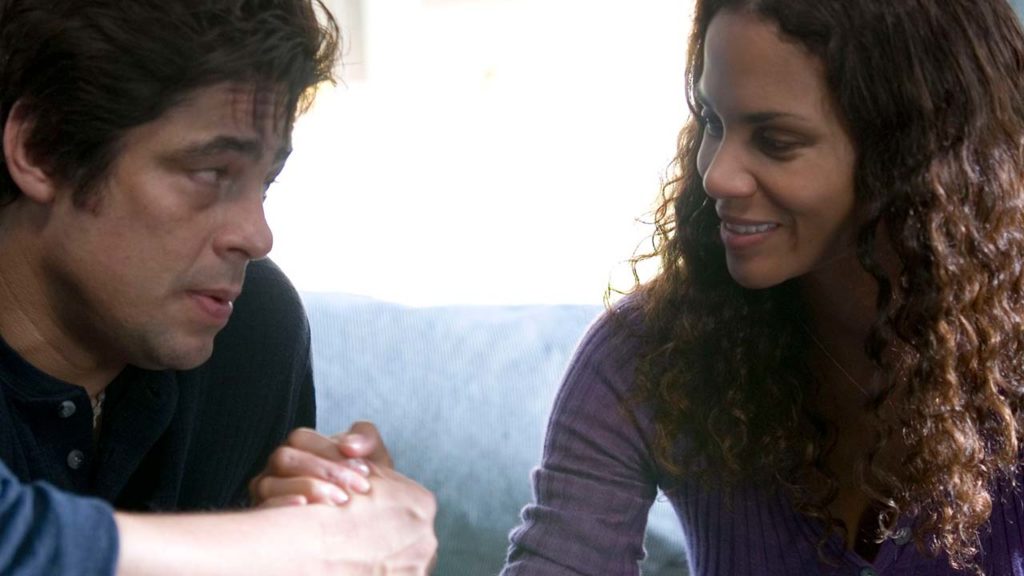
Susanne Bier’s Things We Lost in the Fire is a melodrama in the vein of Alejandro González Iñárritu’s 21 Grams in almost every way: the story of a nuclear family shattered by a random death, told as a nonlinear narrative, with conspicuously arty cinematography, and costarring Benicio Del Toro.
Even a single-sentence description of the basic plot conveys how overwrought things get: Audrey (Halle Berry) impulsively takes in her dead husband Brian’s (David Duchovny) heroin-addicted friend Jerry (Del Toro). Audrey’s motivations are semi-consciously selfish; she perhaps thinks that she can retain some connection with her dead husband by indefinitely extending his fruitless effort to help his childhood friend to kick his drug habit.
But unaware of the adage that one must beware what one asks for, she becomes resentful when her plan unexpectedly succeeds. Jerry does in fact begin to kick drugs, a neighbor takes an implausibly quick shine to him and offers him a job, he teaches one of her kids to swim (a task at which her husband had previously failed), and he responds to her flirtatious advances.
Inexplicably, the movie ends with the wrong Velvet Underground song; someone chose “Sweet Jane” over “Heroin.” Nor is there anything from the Low album of the same name. If the filmmakers thought these selections were too obvious, then how do you explain everything else in the movie?
This blogger is not ashamed to admit being in love with Shakespeare in Love, and not just for the generous displays of Gwyneth Paltrow’s lovely young bubbies.
Full of American actors affecting English accents with varying degrees of outrageousness, it only partly qualifies as Europudding, and is in fact more in the vein of “let’s put on a show!” theater farces like Noises Off and Waiting for Guffman. Director John Madden’s Shakespeare in Love succeeds beautifully, but the formula is not ironclad; Becoming Jane obviously attempted the same stunt by warping the biographical details of Jane Austin’s life onto her novels, but rather failed to capture her dry wit and particular brand of practical passion.
Oi, get yer bubbies out!
Co-screenwriter Tom Stoppard, already an expert at playing fast and loose with Shakespeare in his play Rosencrantz and Guildenstern Are Dead, lays more than a few easter eggs for English majors and other enthusiasts of Elizabethan drama. Bloody playwright John Webster cameos as a disturbed young lad. Many favorite Shakespeare cliches appear not just in the play-within-the-movie, but also in the body of the movie itself: ghosts, cross-cross-dressing, and a “bit with a dog.” But perhaps the movie’s biggest achievement is to humanize perhaps the most revered writer in the English language, and yet still illuminate the unmatched passion and achievement of his work. A Shakespeare beset with writer’s block struggles to find a hook for the unwritten Romeo and Ethel, the Pirate’s Daughter reminds us that he was probably no unearthly creature taking dictation from beyond, and that creating such art was, simply, hard work.
Judi Dench in full Queen Bitch mode
Shakespeare in Love thankfully doesn’t let historical accuracy get in the way of a good gag. Will makes weekly visits to an apothecary practicing psychotherapy a few hundred years early. The contemporary theater world is shown more than once as a precursor to today’s movie biz. In order to bankroll the production of a new play, financier/kneecapper Hugh Fennyman (Tom Wilkinson) suggests Globe Theater owner Philip Henslowe (Geoffrey Rush) pay actors with a portion of the profits, when of course there never are any. Brilliant! One wonders if Miramax honchos Harvey & Bob Weinstein perceived the irony.
But the movie is sometimes more accurate than one might think for something that is admittedly a slightly fluffy farce. For example, it is in fact plausible for Shakespeare to fear he may have been indirectly responsible for rival playwright Christopher Marlowe’s death. Marlowe died in 1593, which according to the all-knowing Wikipedia, was about the time Romeo and Juliet was written.
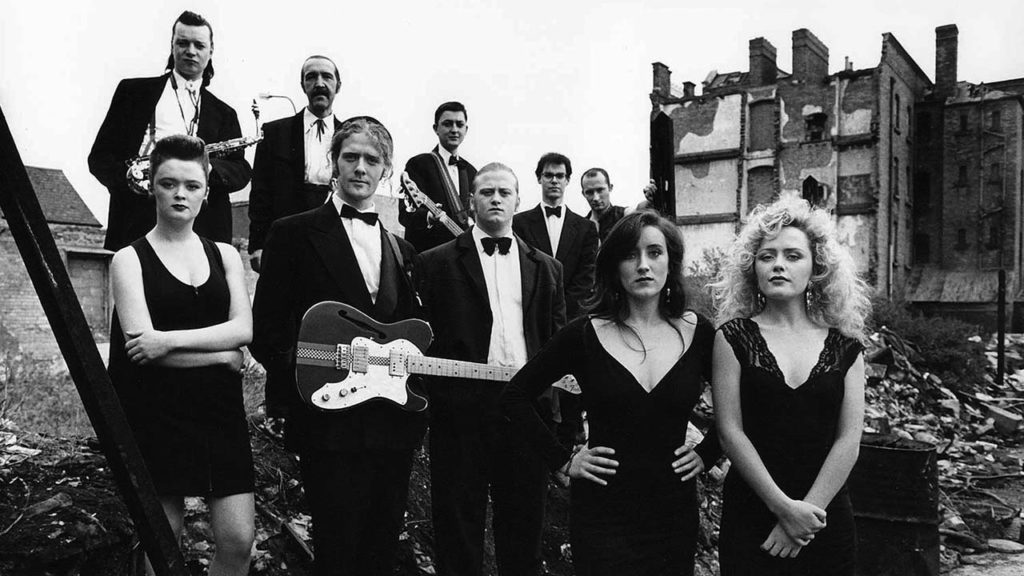
The Commitments remains a favorite, even some 17 years after first seeing it in the theater. I’ve owned the soundtrack since then, but for whatever reason, had not revisited one of my favorite films. But having recently seen and loved Once, costarring Commitments alum Glen Hansard, I was inspired to check it out one more time and see if I still loved it after all these years.
If The Commitments (the band) are the World’s Hardest Working Band, then The Commitments (the movie) may be the World’s Most Unashamedly Crowd-Pleasing Movie. There’s not a single scene that doesn’t charm, amuse, or get me rocking to the sweet sounds of soul music.
“Is this the band then? Betcha U2 are shittin’ themselves.”
Where are they now? Original members Dick Massey and Kenneth McCluskey still tour as The Commitments. Director Alan Parker (look for VHS copies of one his film Birdy in one scene) built on his success with musicals Fame, Pink Floyd’s The Wall, and The Commitments by directing the mammoth production Evita. Andrew Strong (Deco Cuffe), a wee 16 at the time, still has his golden voice and is now a solo artist. Maria Doyle Kennedy (Natalie) is now a star of the television series The Tudors. And Glen Hansard just won some kind of award or another…
Two bits of fun trivia gleaned from the IMDB entry: the actual kid from U2’s Boy and War album covers cameos in the film, and the script racks up a spectacular 145 F-bombs.
Had I seen The Assassination of Jesse James by the Coward Robert Ford earlier, I might have included it among my Most Disappointing Films of 2007. Certainly not because it’s “bad,” for could I make a better movie myself? Could I make a movie at all? And who appointed me a critic, anyway? But this blog is about my personal reactions to movies, so here goes.
Assassination was praised to the high heavens by publications including Sight & Sound, so I had expected it to be one of the year’s gems. And indeed, the acting is excellent and Roger Deakins’ cinematography is breathtaking. But I would describe the movie as “novelistic,” not necessarily a good thing with cinema, as opposed to, you know, novels.
Assassination no doubt inherited its notably slow pace (not in and of itself a problem for me) from its source material, the novel by Ron Hansen. I haven’t read it, but I suspect my own chief complaint likewise derives from the book: the omniscient narration. I’m not one that thinks voiceover narration is a screenwriter’s crutch to be avoided at all costs, but there are two extremes in which it can be misused: to redundantly explicate the action seen on screen or to impart information better shown that told. The Assassination of Jesse James does both.
Through amber fields of grain
I wish I had made a note of an example or two, but there are numerous instances of narration that could simply have been cut for not adding anything to what we’re watching onscreen at the moment. But on the opposite end of the spectrum, one of the most significant events of the story, Ford’s ultimate disillusionment with James and decision to betray him to the law, happens offscreen and is offhandedly recounted by the narrator. Ford approaching the authorities to become a criminal informant would have made for a dramatic scene.
Although the comparison is not quite fair, I am I huge fan of the HBO series Deadwood and couldn’t help but contrast the two in my head. Please set aside for a moment the only roughly related settings (Deadwood is set in 1870s South Dakota, and Assassination in 1882 Missouri) and bear with me for a moment.
The James Gang in happier days
Most obviously, actor Garret Dillahunt appears in both. Dillahunt may have been typecast as a 19th Century sort, but his characters could not be more different. The Francis Wolcott of Deadwood is an educated, urbane, and yet dangerously perverted proto Master of the Universe, a far cry from the suicidally ignorant Ed Miller in Assassination. But where the two diverge, and Deadwood certainly prevails, is the dialogue. David Milch’s scripting is the kind of astonishingly profane poetry that might result when characters with Victorian educations find themselves living in the ass-end of the world. I found myself spoiled by my memories of the prematurely-cancelled Deadwood, and wished Assassination had a little more of its poetry.
But enough griping – time for the praise! Roger Deakins‘ cinematography is delicious, full of warm oranges and deep unbroken fields of black. A notable visual effect used to open new chapters in the story is a narrow field of focus with a blurry halo, suggesting old daguerrotypes (similar to what I’ve seen recently in The Illusionist). Guest critic Snarkbait christened the effect “Ye Old Timey Filter No. 4,” but according to an interview with Deakins in American Cinematographer (no longer online: theasc.com/ac_magazine/October2007/QAWithDeakins/page1.html), the filter is his own invention and appropriately called the Deakinizer.
One of Roger Deakins’ many striking silhouette images throughout The Assassination of Jesse James by the Coward Robert Ford.
There is fine acting all around, and two fun cameos from James Carville and Nick Cave (who cowrote the film’s music). Casey Affleck rounds out an excellent year in his career after Gone Baby Gone with a great performance as Robert Ford, obviously not billed above Brad Pitt but arguably the main character. Sam Rockwell (as Charley Ford) is especially great near the end of the film, as his simple-minded character tragically breaks down. Pitt makes a charming and earthy, yet plainly sociopathic Jesse James. James’ curse is that he’s always the smartest man in the room, but one need only witness the particularly unhinged laugh Pitt gives him to see how lunatic and criminal the man actually is.
I lied, one more complaint: Mary-Louise Parker & Zooey Deschanel, both fine, name actors, appear in miniature roles with minimal dialogue. Perhaps their characters were similarly minor in the original novel, but they seem underserved in the film. Perhaps the female presence in the actual lives of these historical figures was not significant, but to return to Deadwood for a moment, Deadwood repeatedly proved it is not historical revisionism to include women in a modern-day portrait of a bygone era.
This blogger may have to burn his Rock Snob card, for I just watched and enjoyed the Blue Man Group concert film The Complex Rock Tour Live. I’d long assumed that the Blue Man Group’s seemingly permanent residency on Lafayette Street in downtown Manhattan was some kind of tourist trap like Mars 2112 or Jekyll and Hyde, but now I’m wishing I had looked closer.
For any others that may also have prematurely dismissed them, the Blue Man Group is equal parts performance art collective, percussion ensemble, and, well, blue. The Complex Rock Tour DVD captures the group live in 2002, with a show that is at once both an actual rock concert and an ironic commentary upon one.
I had to fight the suspicion throughout that a blue-clad trio of catburglars had slipped into my apartment and raided my cd collection. As I watched, I started to compile in my head a list of artists that must have been influences:
Emergency Broadcast Network. EBN was a trailblazing multimedia performance group that fused Marshall McLuhan-esque media theory with techno, all in the style of a television news broadcast from hell. Their caustic and aggressive social commentary is a far cry from The Blue Man Group’s squeaky clean naïveté, but it’s hard not to watch footage of their live performances without seeing an ancestor of the Complex Rock Tour‘s ironic infographics.
Laurie Anderson’s Home of the Brave concert film (1986). All the ingredients are here, albeit in artier form: film, performance art, mime, masks, dance, etc.
Peter Gabriel and Robert LePage’s Secret World Live and Growing Up Live tours were as much theater as rock concerts, utilizing simple yet hugely symbolic shapes and props: a tree, an egg, the moon, etc.
Talking Heads’ Stop Making Sense concert film (1983), for all the same reasons as Laurie Anderson and Peter Gabriel above.
King Crimson. Some of the Blue Man music bears more than a passing resemblance to the polyrhythmic tuned percussion King Crimson employed in the early 1980s with tracks like “Waiting Man” and “Neil and Jack and Me.” Not only that, one of the members of the Blue Man band can be spotted played the Chapman Stick, popularized by Tony Levin.
Rock Snobs might be surprised to hear traces of even more modern music in the Blue Man Group repertoire. I caught snippets of the instrumental so-called “post-rock” of UNKLE, Battles, and Explosions in the Sky.
And finally, the one influence the Blue Men actually namecheck with a (brief) cover version in their show is Devo, but I don’t own any of their music! Maybe I should take this as a recommendation.
As humorous and toe-tapping as The Complex Rock Show is, the Manhattan-based Blue Man Group end the proceedings with “Exhibit 13”, a haunting piece incorporating footage of actual World Trade Center debris that showered over Brooklyn only a few months prior. The piece is available online.