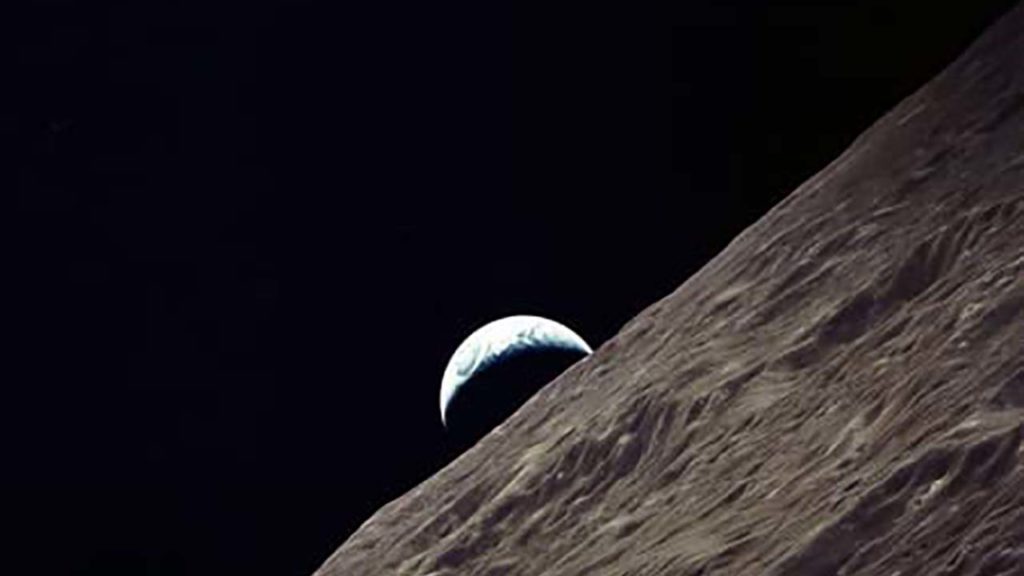
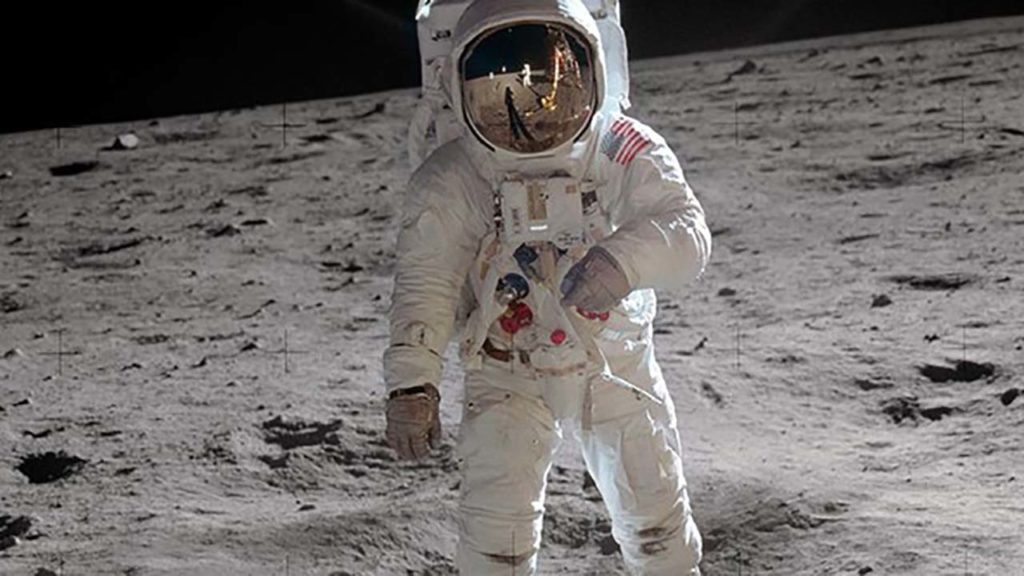
It was a weird experience to finally see the original film for the soundtrack to which I’ve listened to countless times. Brian Eno and Daniel Lanois’ Apollo: Atmospheres & Soundtracks is a gorgeous piece of work, and very much colored my expectations of what the film would be. Having long pictured a largely abstract compilation of otherworldly lunar footage, I was surprised to find For All Mankind a more straightforward documentary than what was already in my head. (Bits and pieces from the compilation album Music for Films III also appear.)
Unlike In the Shadow of the Moon, the 2007 feature documentary on the same subject, For All Mankind exclusively uses original footage taken during the Apollo Missions, much of it by the astronauts themselves. The absence of new narration or footage rightly places the emphasis solely on the achievements of the original participants. But a drawback is that the interviewees on the soundtrack are not identified (the Criterion DVD edition includes an option to display subtitles identifying the speakers).
I was completely ignorant that NASA first began spacewalks during the Apollo missions. I was under the impression they began during the later space shuttle missions. In retrospect, it makes perfect sense that NASA would test spacewalks in orbit over the Earth before attempting to step out of a capsule onto the moon, but: Wow!
The astronauts were very conscious of Stanley Kubrick’s 2001: A Space Odyssey. Each astronaut could bring one cassette tape to play on a portable deck, and one chose Strauss’ “Also Sprach Zarathustra”. Another describes seeing the moon surface up close as being like something from 2001.
Due to the film’s nature of being comprised of original footage, there’s perhaps too much of the astronauts goofing off in zero-G, and not enough of the spectacular lunar footage. But it goes to show that even the pilots selected for being the most sane and calm people in the word still turn to excited kids when playing in outer space (with the rare exception to prove the rule).
There’s a huge interest in Japanese manga and anime in the US, but it’s rare for an anime feature film to get a theatrical release. From the name and poster alone (indeed, what caught my own interest), one might not even guess Paprika is foreign-language, let alone anime. Anime is a medium, not a genre, but it does have a certain popular perception in the US: either the apocalyptic sci-fi of Akira or the fairy tale fantasia of Spirited Away. And that’s not even taking into account the expectations of a generation of kids that grew up watching the dubbed Robotech and Star Blazers serials (which would be exemplified by… me).
The popular perception is not wrong; I’m not an anime expert, but Paprika has several of the superficial trappings: cybernetic technology (like Ghost in the Shell), a ghostlike female creature (like director Satoshi Kon’s earlier Millennium Actress), and an exponentially growing world-eating beast (like Akira and America’s own The Blob). But what sets Paprika apart is its psychedelic imagery, adult themes, and sheer weirdness.
Valley of the Dolls
Like Blade Runner, it’s equal parts detective story and science fiction, with a splash of horror. The mystery genre provides a structure for the nominal plot: Paprika is the dream alter ego of Dr. Atsuko Chiba, a dream researcher building a machine for use in psychoanalytic dream analysis. The device they’re building is called the “DC Mini”, a name which, every single time, made me think of DC Comics’ miniseries. Chiba’s Blade Runner-esque mission is to track down three missing DC Mini devices, and their co-creator.
I hate it when that happens
Paprika even shares a theme with Blade Runner: the moral repercussions of new technologies. If dreams are a kind of “place”, and can be a shared reality (like the world of The Dreaming in Neil Gamain’s Sandman comic book series), what is the difference between it and real life? The potential of one world bleeding into another is very literally dangerous. One of the film’s villains uses the dream reality to commit a very disturbing form of rape, and another goes so far as to label the technology a potential form of terrorism: “Implanting dreams into other people’s heads is terrorism.” This is not hyperbole in the film’s universe: the city is almost destroyed by dreams.
Two final little things:
What’s the deal with the name? Is it a translation issue, or something about Japanese culture (or cuisine) I’m not aware of? A metaphor of spices and recipes is used at one point, but it still seems oddly random.
A key character is movie-obsessed cop, an amateur filmmaker in his youth. His noirish dreams only further expand the Blade Runner parallels. Paprika explicitly equates movie watching with dreams and memory.
I very much loved writer/director Noah Baumbach‘s previous film The Squid and The Whale, blessed with an excellent script and superb performances all around (especially by the versatile Jeff Daniels – heartbreaking in Pleasantville, and capable of humanizing no less an icon than George Washington in The Crossing).
Margot at the Wedding features another dysfunctional family, but so spectacularly so that the characters didn’t seem recognizably human to me. I don’t think the problem is as simple as merely identifying with the particulars of their lives (abusive father, celebrity lifestyle, etc.), for I also had little in common with the family in The Squid and The Whale.
It’s like De Palma’s Sisters meets Allen’s Interiors
Margot (Nicole Kidman) brings her son to her family home for her sister’s Pauline (Jennifer Jason Leigh) wedding to layabout Malcolm (Jack Black). Pauline is the sole family member insecure Margot can physically face, which she can only manage through passive aggressive games asserting her superiority. We barely glimpse a third sister and their mother, from whom Margot literally flees. They feud with the strangely savage neighbors, providing yet another set of characters for Margot to look down upon.
Unlikely Jack Black Romantic Pairing (no. 845 in a series)
Margot’s favorite pastime is armchair psychoanalysis coupled with a kind of inverse hypochondria. Obsessed with detecting symptoms of mental illness in everyone around her (the irony being that she’s often correct), she fails to diagnose herself. She’s a fiction writer whose work bears more than a passing resemblance to her family’s history. Margot’s failure of imagination amounts to a kind of theft, and is a central theme of the movie. “How much of your work is autobiographical?” is no doubt a cutting question nearly every writer (including Noah Baumbach) hears at least once a day. Margot’s lover Dick (Ciarán Hinds) even uses it as a weapon to publicly attack her. It is cruel, but in her case, accurate.
The first thing to say about You Kill Me is to give props to Ben Kingsley, if for no other reason than my fear that he will break my kneecaps if I don’t. Even after his terrifying turn in Sexy Beast, it’s still a surprise to see how perfectly natural for him to inhabit a role like Frank, an almost superhumanly talented mob assassin. For a man of a certain age who once played Ghandi, he can certainly act up some serious physical menace. But You Kill Me gives him a chance to enrich this character type instead of merely repeat it. In Sexy Beast, he was funny because he was so very extremely menacing. Here, his character is menacing and funny.
You Kill Me is a bicoastal film, literally illustrating Frank’s different worlds by setting the action in two different cities. In Buffalo, You Kill Me shares with The Sopranos a look into the operations of modern-day gangsters. Their lives are somewhat less exciting than the fantasy lucrative lifestyle seen in The Godfather and Scarface, but still sharply divided by cultural heritage and identity. Frank may seem to be a pathetic figure, but when sober, he is the sole factor keeping his small-time Polish crime family in business.
Yeah, I find alcoholic assassins irresistible too
The problem is, he is sober less and less when the story opens, and his family must fix him in order to survive. So Frank is ordered from Buffalo to San Francisco to dry out, leaving behind his family (both by blood and criminal association) and yet quickly forging a new one: Dave (Bill Pullman), a shady real-estate dealer no better than a gangster himself; Tom (Luke Wilson), a gay fellow alcoholic; and implausible love interest Laurel (Téa Leoni, also an executive producer).
This man played Ghandi
The problem with Laurel is not only the creepy age differential (a long-standing Hollywood pox from which it seems even indies aren’t immune), but with her underdeveloped character. What little we learn of her history (a recently deceased, unloved stepfather) seems insufficient to explain what makes her so lonely and desperate that she would attach herself to possibly the most unstable and unreliable person in the world. What happened to her to make her so blasé and amoral that she clings so fervently to Frank and cross the country to risk her life for him?
I suppose 2 Days in Paris can be seen as both inspired by and a refutation of Before Sunrise and Before Sunset, the pair of films Julie Delpy made with director Richard Linklater and co-star Ethan Hawke. Although more realistic than most romantic comedy/dramas in terms of dialog and emotion, it would be fair to say those films buy into cliches of young love and romantic adventures in two renowned “cities of lovers” abroad, Vienna and Paris. Despite that, both are huge personal favorites of mine, and I strongly recommend watching them back to back, especially if you happen to be about the same age as the actors.
The tourists went that-a-way
As writer and director of 2 Days in Paris, Julie Delpy portrays a most unromantic view of Paris, as perhaps only a Frenchwoman could. With only a fleeting glimpse of the Eiffel Tower, we mostly spend time in its moldy bohemian apartments, eating its fast food, and as captive audiences to its sleazily racist cab drivers.
Not coincidentally, the film’s view of relationships is also bleak; Celine and Jesse (Hawke) experience intense passion and heartbreak over a total of 48 hours together (with a 10 year interruption) in Sunrise/Sunset, but Marion and Jack (Adam Goldberg) suffer the overfamiliarity and jealousy of a years-old relationship in 2 Days in Paris. Along with mere bickering, Marion and Jack fumble unsexily in bed, sneeze in each others faces, and accuse each other of infidelities.
Comment dit-on… action?
The couple’s disastrous two Parisian days build to a climactic argument that is unfortunately covered over in voiceover. It’s a lovely bit of writing, but it sums things up too well. It’s implied that the couple stays together, but perhaps in 10 years Delpy will make 2 Days in New York, and we can see how Marion and Jack have got on.
In the Shadow of the Moon may not be the most radical or revelatory documentary ever made, but if the point was to get out of the way of some true American badasses and let them tell their story, then it should be counted as a success.
The DVD edition is introduced by co-producer Ron Howard, whom, along with Tom Hanks, is an avowed space-nut and maker of the great Hollywood retelling of the Apollo 13 mission. He doesn’t address the big question: why a big theatrical documentary on NASA’s Apollo Program, now? Is it simply that the aforementioned true American badasses are frankly getting on a bit, and that this is one last chance for them to strut their Right Stuff?
I can see your house from here
The biggest clue is that the film takes pains to place the missions in a historical and political context of the Cold War, civil rights, the Viet Nam War, and the spate of assassinations the country suffered in the late sixties. When Kennedy called in 1961 for NASA to land a man on the moon within the decade, it was a truly audacious and inspiring moment. As astronaut Gene Cernan put it, “science fiction.” The almost incalculable amounts of money and impetuous were there, surviving even the assassination of the man that inspired the astonishing endeavor.
Time passes. Walls fall, the White House falls afoul of diminishing returns. Subtract the Cold War space race with the Soviet Union, and NASA reduces its ambition to decades of launching spy & corporate satellites and performing zero-g experiments in the Space Shuttle (although I must say detecting anti-matter sounds pretty cool), losing the Apollo 11 tapes, and apparently too busy with constant maintenance on the International Space Station to do anything else.
In 2004, Bush makes a fool out of himself by calling for NASA to land American boots on Mars by 2020. This time an entire nation rolls its eyes and knows it’s a flimsy, sparkly distraction from the many disasters of his term of office (and this, before Katrina). Maybe I’m stretching things to find a political critique in the timing of this film, but that’s my theory. It’s a kick in the pants – in a time of crew cuts, tail fins, and assassinations, the United States landed on the freaking moon nine freaking times.
I want my MTV
As a nobody web designer, I don’t mean to diminish the work of post-Apollo rocket scientists and brave astronauts; only that the momentum kick-started by Kennedy has sputtered out by almost any measure. After all, what has NASA done lately that one might call, bug-eyed, “science fiction”? I do love the Mars explorer robots Pathfinder, Spirit, and Opportunity, though! I love robots on Mars. Robots on Mars are neat-o, man. Hi, robots on Mars!
One gripe: In the Shadow of the Moon has a cheesy score, especially disappointing in light of Brian Eno & Daniel Lanois’ gorgeous music for For All Mankind, a documentary film of lunar footage from the Apollo missions.
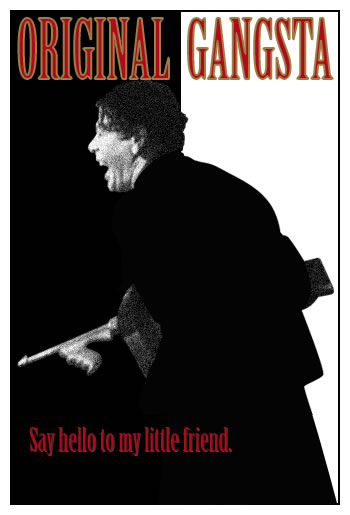
The shame of the nation.Say hello to my little friend.
The Onion AV Club’s How’d it get burned? 22 film remakes dramatically different from the originals piece points out that while Al Pacino’s Scarface has become a modern gangsta icon, nobody slaps the original Paul Muni incarnation from 1930 onto t-shirts, posters, and cheezy mirrors for sale by street vendors. A quick Googling confirmed that there are no 1930/1983 Scarface mashups to be found. So I set out to rectify that with some quickie Photoshop jobs.
It has crossed my mind that the reason no one seems to have posted this sort of thing on the intertubes yet is that it’s probably semi-illegal. If not against the movie studios owning the rights to the property, then at least to the estate of Paul Muni. But this is just for fun, and I’m not trying to sell t-shirts or anything.
UPDATE: I took another spin through Google after finishing the above post, and found a few examples of prior art:
“Keep it Gangsta T-Shirt” on Cafe Press: one of the only “gangsta” graphics I could find that used 1930s imagery. No longer available.
Good ol’ Bahstuhn Cahtholick Ben Affleck is an all grown-up, big-boy director now, and lookit, he made himself a pretty decent movie. That said, Gone Baby Gone is a big plate of grim, with side order of depressing.
Affleck makes excellent use of location footage and local color. And not surprising for a movie directed by an actor (recently, Julie Delpy’s 2 Days in Paris and George Clooney’s Good Night and Good Luck), Affleck privileges the characters and performances over the plot. We also see plenty of B-roll footage of the faces and voices of Bostoners on the streets, in the bars, and on local TV screens.
How many times I gotta tell you, bro? I pahked the cahr down on the yahds.
Gone Baby Gone is one of the first movies to poach some of the excellent acting talent premiered in HBO’s superb series The Wire. Doubtless by accident, Michael Kenneth Williams and Amy Ryan both play characters diametrically opposed to their TV counterparts; Williams is a sardonic po-lice resolved to the corruption around him (compare and contrast with The Wire‘s Omar, a parasite that feeds on the drug trade), and Ryan plays a coked-out winner of bad-mother-of-the-year, the exact opposite in every way (including accent) of her salt-of-the-earth B’more Port Authority po-lice on The Wire.
Pay no attention to my rug.
The few bad points to mention (other than the aforementioned pervasive grim tone), are Ed Harris’ inconsistent rug and a middle section papered over almost entirely by voiceover narration.
As I was compiling the best and worst movies I saw in 2007, I found I still had enough for a special category: movies that absolutely don’t deserve to be called bad, even when it’s just me here talking to myself on my stupid blog. But for one reason or another, here are the movies of 2007 from which I expected something a bit more:
28 WEEKS LATER A disappointingly conventional follow-up to the truly scary original.
AMERICAN GANGSTER I was hoping for a bit more from Ridley Scott and the two fine actors, perhaps another crime epic on the level of Heat. But American Gangster is essentially a biopic, a genre in which good narrative storytelling is often forsaken in favor of a string of illustrated events from history. Yes, it’s interesting that these people actually lived and (more or less) did these things, but a story this does not make.
BECOMING JANE I loved the recent film version of Pride & Prejudice, and Becoming Jane sure sounded like a good idea: play fast & loose with the real Jane Austen’s biography to create a frothy romance in her own style. But the end result fell oddly flat, with little of the real woman’s spark. The direction and performances were fine; I think the fault lay in the script.
CHARLIE WILSON’S WAR Probably the finest-pedigreed film of the year, with Mike Nichols directing, Aaron Sorkin writing, and Tom Hanks, Julia Roberts, and Philip Seymore Hoffman starring. So why doesn’t the movie take off?
I AM LEGEND The superb trailer all but had me waiting in line at the theater weeks before this movie came out. Perhaps unsurprisingly, it couldn’t live up to the promise; it’s full of preposterous implausibilities and plot holes (and that’s if you even accept the basic premise). The best zombie movie I’ve seen is still 28 Days Later.
KNOCKED UP I was a big lover of Judd Apatow’s The 40-Year-Old Virgin, but I don’t think Knocked Up quite measures up to its predecessor’s painful hilarity. Additionally, I could just barely swallow the premise that the two characters might hook up in an alcohol-fueled bonding moment, but not at all that they might stay together.
THE LIVES OF OTHERS A complex character study that would have made my personal-best list had it not undone itself in the end by hailing its complicated protagonist a “good man.”
A MIGHTY HEART Michael Winterbottom is one of my favorite filmmakers of all time, and this movie held tremendous promise for me as it was done in a similar faux-documentary style as Road to Guantanamo. But whereas I wanted to tell everyone I met that Road to Guantanamo is essential viewing for every citizen of the world, I just can’t say the same for A Mighty Heart.
STARDUST All apologies to Saint Neil Gaiman, for whom nearly all he touches turns to gold, but Stardust just didn’t do anything for me. Gaiman’s and Roget Avery’s script for Beowulf was brilliant, but this adaptation of his illustrated novel by another screenwriter had no pixie dust.
ZODIAC I know Zodiac has been praised to the high heavens, for both its special effects (didn’t notice that it even had special effects? Exactly!) and for its storytelling, but I just didn’t feel it.
Coming up next: the 11 Best Movies I’m Most Embarrassed I didn’t see in 2007!
Just like Elizabeth: The Golden Age and Before Sunset, it’s the sequel that no one asked for! After the warm fuzzies of yesterday’s list of the Best Movies I Saw in 2007, it’s time for a little meanspirited snark.
I might be committing professional suicide for publishing this list, for five out of nine of these movies may or may not have something in common (a something which could lead to the aforementioned professional suicide if revealed). So with a little judicious self-censorship, onward!
[Name of Latin Pop Star Biopic Withheld]
A new low in probably my most-hated film genre: the musical biopic. Once again, the life story of an important musician is told by filmmakers who obviously don’t care about the music and would much rather tell a story about drug addiction (and not only that, the same drug story every time: q.v. Bird, Ray, Walk the Line, etc.). Bladder-bustingly long, amateurishly over-edited, and the ostensible lead [name of hollow-cheeked latin pop star withheld] is shoved aside by [name of latina pop star famous for magnificent gluteus maximus withheld] as she tries to make it her story.
Fantastic Four: Rise of the Silver Surfer
Fantastic Four 2 somehow manages to be better than the original in many ways, and yet less funny (the original at least had humor on its side). Who cast Mr. Whitebread as Dr. Victor Von Doom, the Eastern European dictator of Latveria?
[Name of First-Installment-in-Projected-Fantasy-Franchise Withheld]
The fantasy genre leaves me cold, so it was a minor miracle that Peter Jackson, Fran Walsh, and Philippa Boyens made three Lord of the Rings movies that could turn genre grumps like me into fans of elves, dwarves, and wizards. [name of movie company withheld] tried to recapture the magic with [name of first-installment-in-projected-fantasy-franchise withheld], but forgot the magic. Humorless, self-serious, and wastefully expensive, [name of first-installment-in-projected-fantasy-franchise withheld] is full of awkward shifts in tone (for a more kid-friendly movie than Lord of the Rings, it turns shockingly violent at one point) and spurious plot twists (the most annoying instance being when the king of all [name of large white arctic mammal withheld] pledges his life to a [name of annoying little girl withheld] with no evidence that she’s anything special).
[Name of Woeful Time-Travelling Ecological Parable / Ostensible Children’s Film Withheld]
I pity the children for whom this will be one of their earliest moviegoing experiences. My generation had E.T. and Time Bandits. This one gets… lame Department of Homeland Security critiques and Intel-Inside bunnies? Oh, and let’s not forget the horrific song by [name of psychedelic rock dinosaur withheld]… could this be the man that cowrote [name of fifth best selling album of all time withheld]?
[Name of Numerology-Themed Thriller Withheld]
A premise that could have been fun if not treated with such grim self-seriousness. Wannabe thriller directors would do well to remember that even Se7en and Memento had a little wit. Memo to [name of rubber-faced & formerly overpaid actor withheld]: you proved you could branch out into dramatic roles that still played to your comedy skills in [name of underrated movie directed by Peter Weir withheld] and [name of masterpiece directed by Michel Gondry withheld]. How about some more of that, please?
Resident Evil: Extinction
Not much I can say about this one. It’s on this list because I saw it and it’s bad, but I didn’t really get worked up over its badness as much as these others. The setup is actually not that bad, at least until the zombies attack… and attack… and attack.
[Name of Mean-Spirited Action Flick Apparently Written by Committee Of 12-Year-Old-Boys Withheld]
Porn for NRA-joining latent psychos who applaud when movie heroes shoot people. What on earth were [name of actor that reportedly turned down [name of famous fictional British spy franchise withheld] withheld] and [name of rightly revered character actor withheld] thinking when they signed on for this? Hot Fuzz is everything that this piece of shit is not.
Spider-Man 3
It pains me to list this movie here more than any other. Spider-Man 2 was one of my favorite movies in recent years, and I frequently rant to friends about how it’s a paragon of what Hollywood ought to be doing: like Lord of the Rings, it’s a mass-market genre entertainment that thrills, entertains, and moves. So this mess of a sequel depressed me all out of proportion to its only mere badness.
Transformers
Funny enough, it’s a pretty entertaining movie until the eponymous robots show up and start speaking, and shortly thereafter, fighting. Then it somehow becomes punishingly stupid, and considerably less fun.