Category: Movies

Movie Reviews

  • Everything You Know is Wrong: U2: Zoo TV Live From Syndey

    Everything You Know is Wrong: U2: Zoo TV Live From Syndey

    If I could build a time machine to take me to see any band in history, it would be a trip to the early 90s to catch U2 at any point along their legendary Zoo TV tour.

    New to DVD, director David Mallet’s Zoo TV: Live From Sydney documents the lads’ performance in Sydney during the aptly named Zoomerang leg. Rewatching the event in the 21st century is interesting; on one hand, it’s almost shocking how far ahead of the curve U2 was in 1993, preaching a pretty weighty post-modern, ironic kill-your-television thesis in front of thousands of rock ‘n’ roll fans each night.

    But on the other hand, the fixation on cable and satellite TV now looks rather quaint. True cultural desensitization and alienation via media oversaturation came, in the end, from the internet. “Everything you know is wrong”, indeed.

    Zoo TV was less a rock concert than a carefully choreographed theatrical event. Bono donned multiple costumes and personas throughout each show: a drunken rock star clad in leather and fly shades, a paramilitary guerrilla in fatigues, a gold lamé cowboy hat-wearing megachurch televangelist blasting millions of U2 bucks into the audience, and finally emerging as MacPhisto, a kind of washed-up wasted devil tired of life, but still up for a good time.

    U2 Zoo TV Sydney
    I’d hate to see the band’s utility bill at the end of this tour…

    Regardless, what’s amazing is that despite all the high-mindedness and avant-garde video art contributed by Brian Eno and Emergency Broadcast Network, U2 still managed to put on a truly spectacular rock concert and get millions of people around the globe to come and love every second of it. And for me to buy the DVD.

  • Is George Miller’s Happy Feet about bootyshaking or overfishing?

    Is George Miller’s Happy Feet about bootyshaking or overfishing?

    Happy Feet is a tough one to try to reduce to a single stars-out-of-five rating. It possesses two extreme split personalities, its lack of integration calling into question its integrity. Was there a struggle behind the scenes between a studio wanting another cookie-cutter cartoon animal kid flick vs. a filmmaker envisioning something of substance?

    The first film totally embodies the worst cliches of the contemporary CGI animated film: dancing, singing animals talking the kind of stereotypical enthnic jive that would be condemned as racism in a live-action film. People laugh at Robin Williams’ “let me ‘splain something to joo” Mexican schtick in Happy Feet, but feel queasy about Ahmed Best’s gay rastafarian routine as Jar-Jar Binks in Star Wars Episode I. The cuteness of seeing anthropomorphized penguins shimmying to contemporary pop hits wears off fast, yet takes up at least half the film, sorely testing the patience of any adults forced to be in the audience (in my case, it was a free work junket).

    The second film is more in keeping with director George Miller’s track record with Babe: Pig in the City. A surprisingly dark and edgy film, the sequel to Babe was a stealth “real movie” that appealed to adults as much as kids, having more in common with City of Lost Children and Brazil than Charlotte’s Web. After seemingly endless, I say endless, musical routines, Happy Feet slowly begins to reveal its true nature as an ecological parable. Don’t get me wrong; I’m all for turning kids into ecowarriors, but many childrens’ films have managed to blend life lessons more fully into the narrative; Toy Story II is about engaging with life, love and friends now as opposed to worrying about the future or pining for the past; Iron Giant is about breaking the cycle of violence; Happy Feet is about… either bootyshaking or overfishing. I’m not sure, and neither is the film itself.

  • Too Much Reality: Michel Gondry’s The Science of Sleep

    Too Much Reality: Michel Gondry’s The Science of Sleep

    Michel Gondry is a treasure; endlessly inventive and thankfully prolific. His music videos (especially Björk’s “Bachelorette” and The White Stripes’ “Fell in Love With a Girl“) and films (Human Nature and Eternal Sunshine of the Spotless Mind) are all personal favorites, with “Bachelorette” and Eternal Sunshine especially moving me deeply.

    But I found myself a tiny bit unsatisfied with The Science of Sleep, despite its flood of original imagery and enthusiastic performances. For a movie that concerns the blending of fantasy with reality, I think the problem is that there’s too much reality. Stephane (Gael García Bernal) experiences a smooth continuum between his waking and dream life, which his mother explicitly acknowleges as an actual condition, in other words, a mental illness.

    In the cold light of his mother’s diagnosis and his often hurtful behavior towards his crush Stephanie (Charlotte Gainsbourg), Stephane is less of a charmingly eccentric dreamer, and rather a sad case that could probably not have a successful relationship without medication.

  • If all bad movies could be this bad: Ed Wood’s Plan 9 From Outer Space

    If all bad movies could be this bad: Ed Wood’s Plan 9 From Outer Space

    Rating: 0.5 out of 5.

    Glorious! A masterpiece! Three cheers for Edward D. Wood, Jr.: writer, director, editor, and genuine auteur! Don’t let the no-stars rating fool you; this was so much more fun than some of our other no-stars, recently including The Wind in the Willows.

    If only all bad movies were this bad. Seriously, it’s impossible to consciously make a cult film by expensively camping it up (as Tim Burton tried with Mars Attacks) or playing it straight (read Esquire nail exactly how Snakes on a Plane is misconceived). And I don’t mean to dump on Tim Burton; not coincidentally his eponymous Ed Wood is one of my all-time favorite movies, and I think one of Burton’s best. I do, however, mean to dump on Snakes on a Plane.

  • Terry Jones’ The Wind in the Willows (Mr. Toad’s Wild Ride)

    Terry Jones’ The Wind in the Willows (Mr. Toad’s Wild Ride)

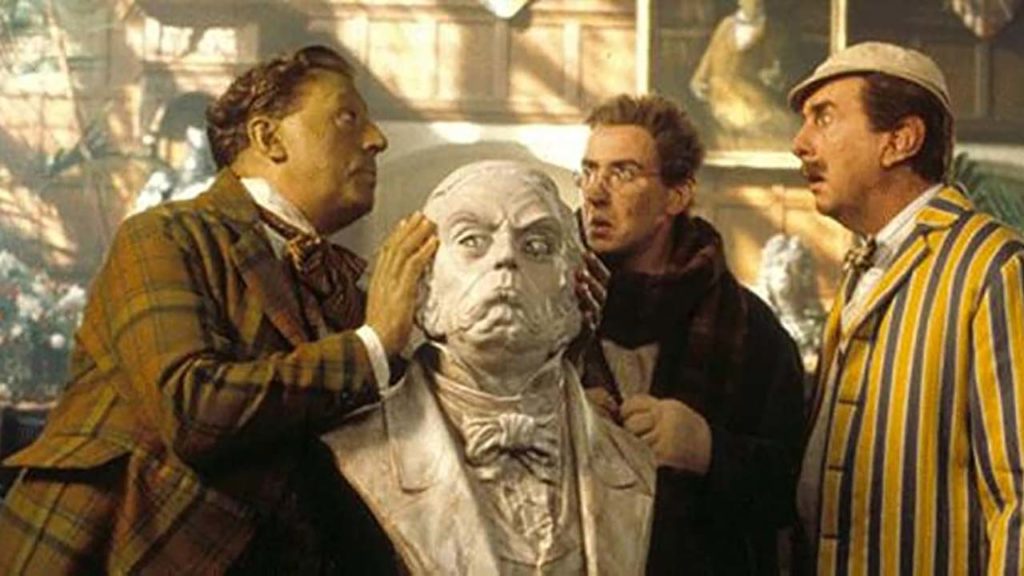
    What’s this? Mr. Toad’s Wild Ride? A film written and directed by Terry Jones? I didn’t know he made anything after Erik the Viking. Wait, and it stars Jones & Eric Idle? With cameos by John Cleese and Michael Palin? Why, it’s practically a Monty Python movie… the only two missing are Graham Chapman, because he’s dead, probably, and Terry Gilliam, because he’s… American, perhaps. How could I possibly never have heard about this movie?

    OK, let’s take a closer look at the DVD box. Released by Disney? Hm, that’s not necessarily a good sign. How about a quick web search. Wait, the original title was The Wind in the Willows? Why did Disney change it for home video? Did it not get a theatrical release? (A user comment on IMDB indicates Disney went straight to video with a different title)

    Terry Jones and Eric Idle in Mr. Toad's Wild Ride

    Now let’s start playing it. Jones was never the visual stylist in the Python films (that was left to the other Terry). Willows looks kind of expensive, yet kind of cheap at the same time. Where’s Steve Coogan? He got first billing, but I don’t see him anywhere. Hey, there’s Idle, with a silly rubber tail! Oh no, he’s not going to start singing a song, is he? Oh god, it’s a musical…

    Ninety minutes later, my brains are dribbling out of my nostrils. This has got to be one of the worst movies ever made. Coogan is practically unrecognizable (that’s him as The Mole). The great Stephen Fry shows up for a few blustery lines of dialogue but fails to elevate things. Jones looks ridiculous in green face paint and a fat suit (I hope) that I suppose is meant to read as “toad.” And sure enough, it was only a matter of time, he winds up in drag.

  • Michael Mann’s Miami Vice movie is stylish but slight

    Michael Mann’s Miami Vice movie is stylish but slight

    Miami Vice is decidedly slight on character and depth, which is not surprising considering the source material. It is quite so, however, considering writer/director Michael Mann’s track record once leaving the iconic 80s tv show behind.

    The deep characterization in all his crime dramas ranging from Thief through Collateral elevate them above the ultrastylized and hyperviolent genre films they would have been otherwise. Even the most minor characters in Heat have backstories and substance. Thief and Heat each revolve around a long coffeeshop conversation; how many genre films slow down long enough for the characters to talk to each other? And it also has to be said of Collateral that Mann somehow drew an actual performance out of the increasingly looney Tom Cruise, probably one of his last before he heads further down Michael Jackson lane to crazy town.

    But Miami Vice is disappointingly empty, despite an engagingly twisty-turny plot and typically brilliant editing and cinematography. But when there is no investment in the characters, who cares when they start shooting each other in the face?

  • Peter Cushing as Doctor Who in Daleks’ Invasion Earth: 2150 A.D.

    Peter Cushing as Doctor Who in Daleks’ Invasion Earth: 2150 A.D.

    Daleks’ Invasion Earth: 2150 A.D., the second Doctor Who feature film, follows Dr. Who & The Daleks by one short year, and clearly betrays where the public’s interest lay at the time by ditching any mention of Dr. Who in the title. The first film largely disregarded the TV show’s premise and continuity, and the sequel similarly plays fast and loose with its own predecessor. Dr. Who has yet another young female relative, a niece named Louise? Why does she call her uncle “Doctor”? Did Barbara elope with that twit Ian?

    Otherwise, the screenplay is loosely based on the original 1964 TV serial The Dalek Invasion of Earth, starring William Hartnell. It follows the original farily closely, especially in the early seqences showing a war-ravaged London and the iconic image (well, to Brits, anyway) of a Dalek rising out of the Thames (actually better realized in the original – here they cut away from a Dalek head poking out of the water and back to it fully emerged).

    It’s just barely slightly better in terms of action and spectacle (the Dalek flying saucer isn’t half-bad, considering), but nevertheless just as mind-numbingly stupid. Let’s start with the title. Why is it set in the future? Everyone’s dressed in 1960s clothing, with contemporary rifles and cars. If there’s nothing to be gained, it might as well be set in present day. Plus it would be that much more of an exciting thought for kids to to imagine an invasion might happen today rather than next century.

    Daleks' Invasion Earth: 2150 A.D.
    Curious that the Doctor and the Daleks both barely feature in the poster for their own movie

    Look out, Robo-men! Why did the Robo-men take off their helmets and suddenly become human again when the Doctor simply orders them to attack the Daleks? And why do they scream like little kids? Why do the Daleks have fire hydrant guns? Why do the Daleks only take male prisoners? What do they do with the women?

    Of course, there’s also the music. After another set of pointless psychedlic opening titles, a sequence depicting a bank robbery is set to… Beethoven? WTF? After that we get a generic lighthearted score, determinedly whimsical even when Dr. Who discovers a corpse. Incidentally, this Doctor is badass. Crossing the countryside on foot, a Robo-Man orders him to halt. The Doctor shoots him and turns right back to the map. “As I was saying…”

    And finally, why did the Daleks invade England? The “magnetic influence of the North and South Poles” is located under Watford, of course!

  • Pierce Brosnin lets it rip in Richard Shepard’s The Matador

    Pierce Brosnin lets it rip in Richard Shepard’s The Matador

    Full of suspenseful set-pieces involving assassination, The Matador is a genre film on the surface. It’s actually more of a character piece about one man about to pay the price for a lifetime of being a pathological loner (paradoxically, while indulging his lusts in every other way imaginable), and another grasping at his last chance to save both his professional and family lives.

    Pierce Brosnin lets it rip as Julian Noble, a sleezebag assassin with a Magnum P.I. mustache. Interestingly, he frequently boasts of his bisexuality, but we only see him having sex onscreen with women. The is-he-or-isn’t-he ambiguity actually comes into play regarding an imporant plot point resolved near the very end of the film. Even better, the plot informs character, which is something of a rarity.

    Hope Davis‘ character defies cliche by enjoying a genuinely sexual relationship with her husband, but is also more openly seduced (in a platonic manner) by the exotic allure of an assassin. Perhaps Julian has lost any James Bond-like sexual allure he may have had, but discovers he can make people like him by simply revealing what he does for a living.

    Disappointingly, the movie ends rather cheesily, with Julian finding some humanity deep inside his depravity.

  • Sometimes we are the camera in Michael Haneke’s Caché (Hidden)

    Sometimes we are the camera in Michael Haneke’s Caché (Hidden)

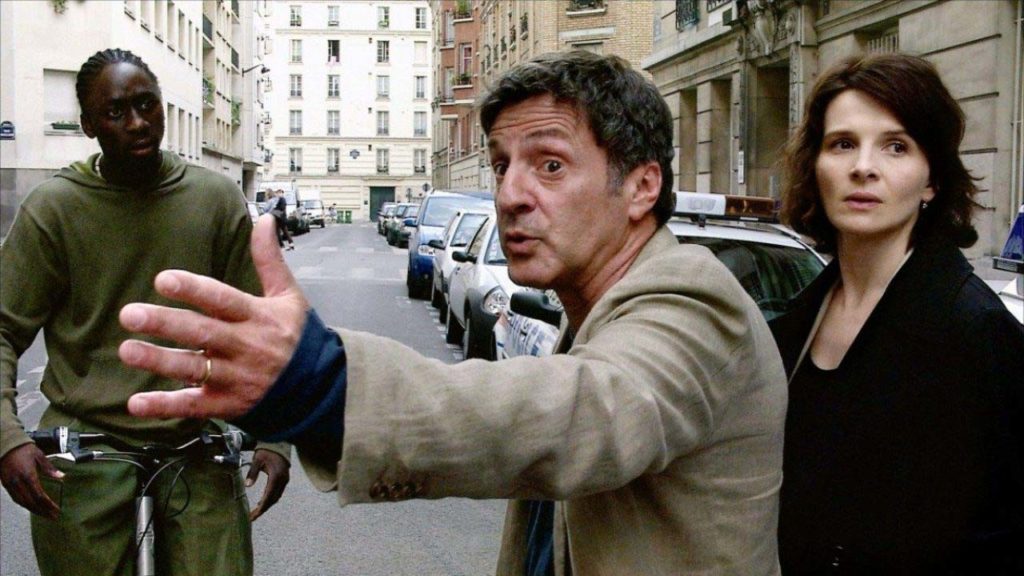
    An art-thriller directed by Michael Haneke, of whose previous films I’ve only seen Le Pianiste (The Piano Teacher). A major theme is that of video image-making (a main character is a television host) and surveilance. The interest in video images brings to mind the films of Atom Egoyan (Calendar, Felicia’s Journey), and perhaps even the search for meaning (that may or may not even be there) in photographs in Blow Up.

    The point of view of the “camera” is crucial; sometimes the image we’re watching is revealed as that of an actual video camera within the film. After we learn the first static shot is actually a film-within-the-film, we constantly suspect later static shots until the camera moves. Sometimes, we are the camera.

    Juliette Binoche in Caché

    A digression: if the academic term for a sound heard in the fictional context of the film (as opposed to, say, the score) is “diegetic” but how does one refer to a film or video image seen by characters within a film? Movies ranging from Citizen Kane (the newsreel sequence) to Starship Troopers (the fascistic TV commercials) feature moving images in the world of the film, so there must be an academic term.

    Caché famously features an enigmatic final shot, supposedly revealing a clue to a major unanswered plot point. So even though I knew to inspect it closely, and the mere location depicted obviously tells you what to look for, I still couldn’t spot it. Later, someone told me what to look for and I watched again. And sure enough, there is it, beautifully choreographed right there in plain sight. Hint: check out some action that moves from the top left of the screen down to the bottom left.

  • Peter Cushing brings Doctor Who to the big screen in Dr. Who & The Daleks

    Peter Cushing brings Doctor Who to the big screen in Dr. Who & The Daleks

    Dr. Who & The Daleks is the first of two feature films based on the classic BBC TV series Doctor Who. They are, as the fans say, “non-canonical,” and thank god for it. The TV series was a true all-ages affair; typically enjoyable for children, but with extra layers of subtext for grownups (or at least attractive ladies for the dads). But this movie is dumbed down to the point where it’s dull and condescending to even the youngest audience member.

    Screen legend Peter Cushing plays “Doctor Who” (in the movie, that’s apparently his actual name) as a silly old (human!) man, a harmless mad scientist. The other characters don’t fare well either. The original TV incarnations of Ian and Barbara were both intelligent and capable, employed in the noble profession of school teachers. This Ian is a total prat, serving mainly as comic relief, and Barbara is reduced to a screaming plot device.

    Dr. Who and the Daleks

    Other things grate to longtime fans (it’s “the TARDIS,” not just “TARDIS”!) and regular viewers alike (the music is wretched). Truth be told, cheesy effects and silly technobabble are actually great pleasures to be found in the original series, but the extra money spent on the movie must have gone to the wrong places (the sets and extra Dalek props, evidently). The advanced Dalek technology includes lava lamps (I’m not kidding). And make up your minds, Daleks, is it a neutron or neutronic bomb?

    And finally, if it’s pitched so low, what are the moral lessons it has to teach youngsters? Based on what The Doctor has to teach the naive glam-rock aliens threatened by the Daleks, don’t trust anyone who claims to want to help you. Instead, fight and kill them.