Category: Movies

Movie Reviews

  • Yo La Tengo perform live to Jean Painlevé’s Science is Fiction in Prospect Park, 2006

    Yo La Tengo perform live to Jean Painlevé’s Science is Fiction in Prospect Park, 2006

    Hoboken institution Yo La Tengo performs a live score to several of French filmmaker Jean Painlevé’s underwater documentaries. Interestingly, English subtitles indicate the films were apparently not silent in their original form, with narration and perhaps scores of their own. So not only is the audience’s experience of the films filtered through a spoken-French-to-written-English translation, but also by Yo La Tengo’s contemporary score.

    Most of the films concerned the mating rituals and birth cycles of sea creatures ranging from octopi to mollusks. A rare intrusion of a human hand is seen during the dissection of a pregnant male sea horse. Without seeing the films in their original form, it’s hard to judge if they were clinical or artful in tone. Only one film was clearly intended to be abstract: a series of images of vividly colored liquids crystalizing, evoking the “Beyond Infinity” sequence in 2001: A Space Odyssey. But Yo La Tengo’s musical interpretation transformed nearly every sequence into a dreamlike, non-literal cinematic experience.

    I’m curious… was the band influenced by the original soundtracks? To what degree was the performance planned and/or improvised?

  • Cleavon Little is the new sheriff in Mel Brooks’ Blazing Saddles

    Cleavon Little is the new sheriff in Mel Brooks’ Blazing Saddles

    On rewatch as an adult, Blazing Saddles didn’t quite live up to my childhood memories. For instance, I recall the infamous bean-induced fart sequnce being a veritable symphony of bad taste; alas, the real thing is just a minute or so long at most. But it turns wonderfully crazy near the end, finally becoming funny as the cast crashes postmodern-style into another movie set and an actor shouts “Piss on you, I’m working for Mel Brooks!”

    Gene Wilder proves his range by gives the polar opposite performance than in Young Frankenstein and The Producers. Stoned mellow, he graciously supports star Cleavon Little. Still, Wilder gets to wrap up the picture by kicking up his heels (still munching the popcorn from their movie date) and confessing his longing to ride off into the sunset with Sheriff Bart.

  • Johnny Depp delivers a truly strange performance in Pirates of the Caribbean: Dead Man’s Chest

    Johnny Depp delivers a truly strange performance in Pirates of the Caribbean: Dead Man’s Chest

    Pirates of the Caribbean: Dead Man’s Chest is a healthy dose of frivolous fun; I don’t care what the critics are saying. I could do without Orlando Bloom’s cardboard performance, or the minature controversy around Keira Knightly being airbrushed on the posters, but that’s not what the movie is about.

    As with the first installment, watch it for Johnny Depp’s fresh one-of-a-kind reinterpretation of the age-old Hollywood stock character, the pirate rogue. The first film had an extra layer of enjoyment as one could sense Depp must have been truly mystifying the Disney studio heads. By now surely they’re in on the joke and were more willing to let him rip, but it’s still a truly strange performance.

    That may sound like a positive review, but it still only gets three stars since it’s by no means a great movie and certainly won’t stand the test of time.

  • Drew Thomas’ 2006 documentary Coachella

    Drew Thomas’ 2006 documentary Coachella

    I don’t normally review music DVDs on this blog, but since Drew Thomas’ 2006 documentary Coachella received a theatrical release in Europe, I thought it deserved a mention. It’s a rare concert film that is as interested in the concertgoers and the character of the event itself as in simply capturing the performances.

    Favorite moments: Thom Yorke actually smiling before Radiohead rips into “Planet Telex”, the unexpected sight of a crowd grooving to Squarepusher’s difficult arrhythmic beats, The Flaming Lips‘ furry freakout, and The Polyphonic Spree joyously heralding the sun on, fittingly, Sunday morning. Scariest moments: Iggy Pop’s return of the living dead, and Fischerspooner dressing up in fright wigs and fishnet speedos.

  • Tommy Lee Jones’ almost unbearably gruesome The Three Burials of Melquiades Estrada

    Tommy Lee Jones’ almost unbearably gruesome The Three Burials of Melquiades Estrada

    Tommy Lee JonesThe Three Burials of Melquiades Estrada joins Jim Jarmusch‘s Dead Man as one of my few highly-rated westerns. Like Dead Man, its tone meanders from the darkly comic to the melodramatic, and is at times almost unwatchably gruesome. Which does nothing to explain why I liked it, I know.

    Special mention to Barry Pepper for taking what must be one of the most thankless roles in movie history: his character is a onanistic, racist brute; he is beaten, dragged by a horse, forced at gunpoint to disinter a corpse, bitten by a rattlesnake, and not the least of which, spends a good part of the movie with his pants down (come to think of it, so does Dwight Yoakam).

  • A god walks among us in Bryan Singer’s Superman Returns

    A god walks among us in Bryan Singer’s Superman Returns

    It’s probably my own fault for buying into the hype, but Superman Returns left me cold. There’s not a lot of drama implicit in the story of an omnipotent alien from another planet, and I just can’t buy the “god walks among us” metaphors.

    Spider-Man is a real, troubled human being burdened with great responsibility; Batman is a human being wracked with guilt and obsessed with revenge; Daredevil is a literally broken man overcompensating for far more than just his disability. With Superman, it’s just plain hard to relate to an alien, even if he suffers such petty human problems as unrequited love.

    An obvious point of conflict is conspicuously absent: instead of any jealousy or anger from Richard White (James “Cyclops” Marsden), he simply acquieses to his romantic rival. It’s more like Superman to be above & beyond mere mortal jealousy; what makes White so noble? Perhaps he’s intimidated by Superman’s sheer potency. Just as the character is defined by nepotism (he’s the Daily Planet’s editor-in-chief’s son), Marsden is Bryan Singer‘s X-Man star who was conspicuously erased very early in Brett Ratner’s X3. Hmm…

    Parker Posey in Superman Returns
    Unsurprisingly, Parker Posey is far and away the best thing in Superman Returns.

    Another disappointment: whereas Spider-Man 2 exuded a strong sense of New York, the Metropolis of Superman Returns is a blank, generic city without character. It’s a timeless locale – the present, yet nostalgic – where when a superhero returns from across the galaxy to save them, the citizens all run out and buy newspapers.

    As for the cast, Parker Posey wins for best screen presence. While Kevin Spacey gurns, hams, and scenery-chomps, she scores laughs with mere looks on her face. There was a lot of concern over the casting of a relatively inexperienced former soap star for the lead, but I thought Brandon Routh was just fine. Kate Bosworth (made up to look like Rachel McAdams), however, is was too young to be plausible as a star journalist with a five-year-old kid, and to be at all appealing to (yes I have to say it again) an omnipotent alien from another planet. Points detracted for dull, overhyped outtakes of Marlon Brando’s mumbled improv bullshit, and shafting screen legend Eva Marie Saint with about 5 minutes of screen time.

  • Shane Black’s Kiss Kiss Bang Bang

    Shane Black’s Kiss Kiss Bang Bang

    Even if the marketing hadn’t trumpeted the dramatic return of burnt-out Hollywood high-concept screenwriter Shane Black, it’d be painfully obvious Kiss Kiss Bang Bang is a movie crafted specifically for the audience he practically created with his Lethal Weapon quadrilogy.

    The all-over-the-place plot leaves a few threads dangling (What happened to the whole Michelle Monaghan femme fatale setup? Was it too obvious to be anything other than a red herring?), but that’s not really what matters; the movie is exactly what what Hollywood execs and critics alike mean when they use the belabored cliche “a ride that you either get on or you don’t.”

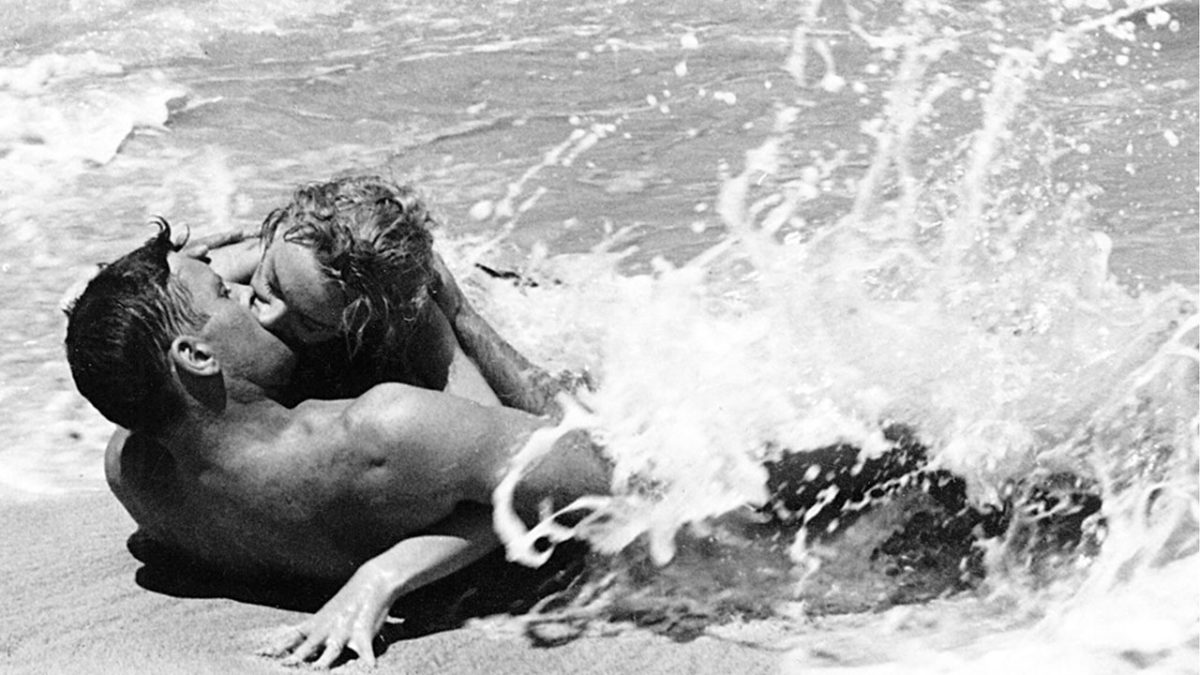
  • Burt Lancaster’s and Deborah Kerr’s beach clinch in From Here to Eternity

    Burt Lancaster’s and Deborah Kerr’s beach clinch in From Here to Eternity

    From Here to Eternity is famous for a lot of reasons: Burt Lancaster’s and Deborah Kerr’s hot clinch on the beach, the mere presence of Frank Sinatra, and, like a lot of canonical classics, its own fame.

    But, gradually, it dawns on you: what it’s really about is the utter inconsequence of our lives. Constantly overshadowing the many plot threads is the inevitable appearance of the Japanese overhead. And once they arrive, all the personal and professional troubles, the affairs and crimes, everything, becomes irrelevant.

  • Jean-Pierre Jeunet’s Le Fabuleux Destin d’Amélie Poulain

    Jean-Pierre Jeunet’s Le Fabuleux Destin d’Amélie Poulain

    One of my favorite films of all time. It’s just such a movie, you know? The same is true of virtually all of Jean-Pierre Jeunet’s films; I have such fond memories of seeing Delicatessen on a crappy 16mm print at college, City of Lost Children at the Cambridge Film Festival, and Amélie and A Very Long Engagement at the Paris Theater in New York City. We won’t mention Alien Resurrection, OK?

    Although a big hit in France, my understanding is that there was something of a backlash against it, due in part to its literally candy-colored portrayal of a storybook Montemartre far removed from reality. Also, a reviewer in Sight & Sound (a film journal whose opinion I nearly always respect, if not always agree with) utterly slammed the film, apparently personally offended by the sexual politics. But I find Amélie so delightful, inventive, and so full of feeling that I can confidently state anybody that hates this movie just hates movies, period.

  • Orson Welles’ F for Fake is part documentary, part essay, part practical joke

    Orson Welles’ F for Fake is part documentary, part essay, part practical joke

    F for Fake is Orson Welles’ last completed movie: part documentary, part essay, part practical joke. Welles portrays himself much as one might imagine him: a robust raconteur settled in for the long haul at a good restaurant, surrounded by educable pretty young things, eating and telling tall tales with great relish.