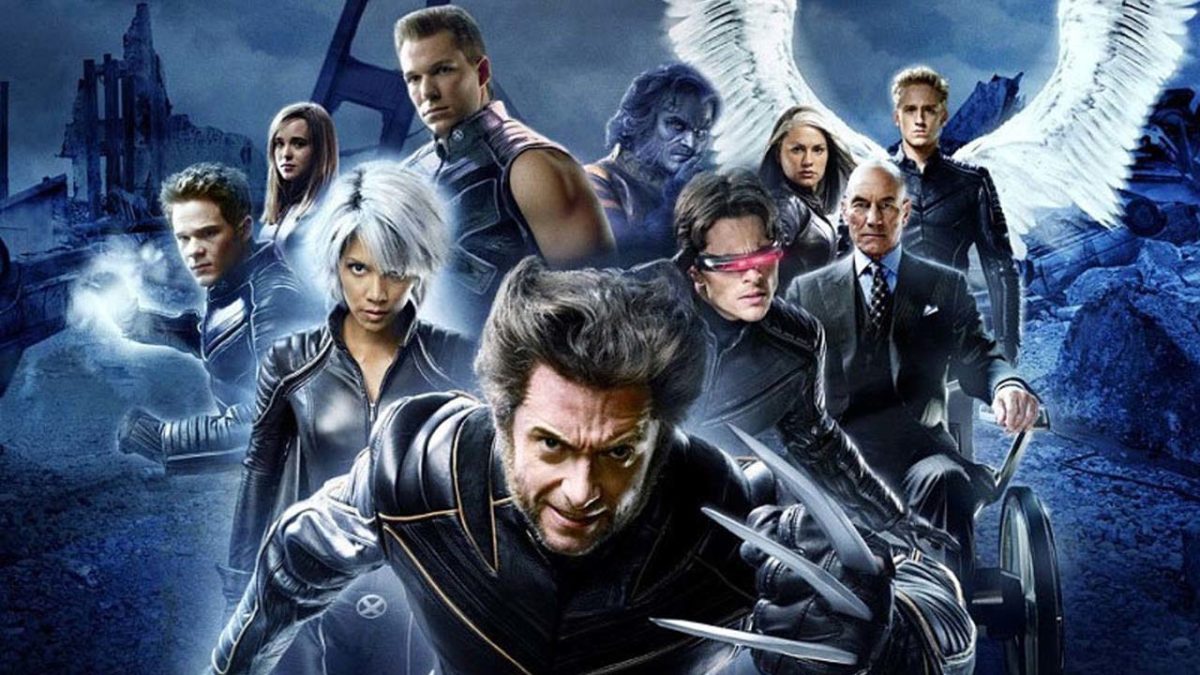
God help me, but I agree with Harry Knowles’ review. Sometimes you need a fanboy to point out what’s wrong with a movie crafted for fanboys. He picked up on the absurdly sensitive Wolverine, the important Phoenix backstory cursorily related in hammy exposition, and the sudden and arbitrary shifts from day to night. But the worst crime of all is that the movie is actually boring; a mere ninety minutes seemingly stretched to what felt like 2-plus hours.
Also bothering me: why on earth was X-Men III: The Last Stand such a massive hit? Not just the question of general quality, but also the fact that it’s set in a densely self-referential world comprehensible only to dorks that read the comics as kids (cough, cough), or at least to moviegoers who happen to remember the first two installments really well. Perhaps the answer is as simple as it being a holiday weekend with no real competition in theaters, but still, it must have been off-putting and mystifying to mere mortals.
It’s tempting to blame the whole mess on jobbing director Brett Ratner, but if Bryan Singer had still been involved, would the script have been any different?
A few disconnected thoughts on J.J. Abrams‘ Mission: Impossible III:
I rue the day Terminator 2 (aka “T2“) came out and was a big hit; now every pre-ordained blockbuster comes abbreviated: ID4, LXG, AVP, X2, X3, and now of course M:I:III.
Like most summer action blockbusters, M:I:III is at first enjoyably preposterous but quickly becomes exhausting. Although the plot is incredibly complex, it has no throughline to thread it all together; it’s a series of sequences.
M:I:III is capped off with a truly terrible song by Kanye West. Of course it’s hard to top the version by U2’s rhythm section, but the producers could have covered themselves by picking somebody with a little more edge.
Like Michael Jackson, it’s now almost impossible to watch Tom Cruise perform without his public persona coloring everything. On the other hand, he’s nothing if not intense, so perhaps that works in his favor here.
For all the negative buzz regarding V for Vendetta writer Alan Moore’s total disavowal of James McTeigue’s adaptation, I was surprised to find that the film kept far closer to the book than I expected. Closer, in fact, than the two other travesties of Moore’s comics, League of Extraordinary Gentlemen and From Hell. Perhaps not coincidentally, it’s better than both, if by itself still not very good.
It’s impossible for me to imagine how I would have reacted had I not read the book several times, but I suspect I would have had very mixed feelings either way. When it comes to movies based on comics, it’s the prerogative of every fan to obsess over “what they changed.” So let me point out a few changes I feel illustrate how the filmmakers either misunderstood or deliberately warped some key themes that make the book what it is.
“The only verdict is vengeance; a vendetta, held as a votive, not in vain, for the value and veracity of such shall one day vindicate the vigilant and the virtuous.”
First, the dystopian state of Great Britain as seen in the film is in a far less desperate state than in the book. The book opens with Evey at the absolute end of hope, her parents dead and herself alone, blacklisted and unable to survive. She makes a misguided and pathetic attempt to prostitute herself, runs afoul of the corrupt police, and is “saved” (in more ways than one) by V. Her susceptibility to V’s seduction is much more plausible if she herself is already a victim of the state. In the film, as played by Natalie Portman, she’s a rather happy person with a regular job, and her encounter with V is motivated by a redundant invented character called Deitrich. Every theme Deitrich represents is already covered by the character Valerie (which is, incidentally, lifted almost unaltered from the book).
But perhaps the biggest deviation is the very nature of the fascist state Great Britain has become. In the book, it’s something that just happens; a form of order that arises out of the chaos following a nuclear world war. In the film, the great societal disruption is a conspiracy machinated by a cabal of shadowy old white men, who then step in and profit from the reconstruction. Of course, the filmmakers are obviously reaching for an analogy to the Bush Administration, Carlyle Group, Halliburton, etc. While that may make the story of the film relevant to today, it obscures a more powerful point of the book: it’s far more scary when fascism arises out of the common consent of the people, as it did with Nazi Germany.
It’s taken me many years and many viewings to realize that the movie is actually very, very funny. Perhaps this shouldn’t be surprising for a movie that directly followed Dr. Strangelove, but the sombre serious air about the film disguised some of the comedy to my young mind watching the movie almost every year, running uncut on a local Philadelphia TV channel. Just a few of the many huge “jokes” packed into the film: the entire human condition condensed into chimp pantomime, fantastic visions of the future punctured by hilariously closed-minded humans more interested in sandwiches, and the most naked human emotions shown on screen coming from apes and computers as opposed to supposedly evolved humans.
2001 On the web: Kubrick 2001 presents an elaborate, though sometimes silly, animated explication. Then there’s The Underview, helpfully including the complete Zero Gravity Toilet instructions. [update: link no longer available]
I vaguely recall seeing Mask when I was a kid, but only recently learned A) it was directed by Peter Bogdanovich and B) there’s a well-regarded director’s cut available on DVD.
The film is very unconventional for the genre of disabled-person-beating-the-odds. Roy, doomed to die from Craniodiaphyseal dysplasia, loses his friend, his girl, and dies in his sleep never fulfilling his dream of traveling Europe. And yet, it is nevertheless moving and even uplifting. I think one reason is the sympathetic matter-of-fact presentation of a biker gang, a group often maligned or at least treated condescendingly by Hollywood.
Oops. I should have let The Dark Crystal live on in my childhood memories as a Good Movie. Seeing the brilliant Mirrormask reminded me how much this movie affected my childhood, but seeing it again as an adult I find it has not aged well. The special effects of course cannot rival contemporary digital epics, but I was surprised to find the storytelling stilted and overly dumbed-down. Recent kids’ movies are pitched at a more sophisticated level, not feeling the need to start with a lonnnnng opening expository narrative and pause every 15 minutes or so to do a plot recap.
Still, you have to admire Jim Henson’s sheer bloodymindedness at spending five years pulling off this difficult-to-make film. And it scores points for just being so weird.
And a quick word about the DVD: cheap menus and a horrendous print. What’s up with that?
I think, but I’m not sure, this is supposed to be a comedy. Honestly, The Ice Harvest is one of the worst movies I’ve seen in a long time. It apparently aspires to be a comedy of villainies along the lines of Bad Santa, extending even into the casting of Billy Bob Thornton, but it decidedly lacks the x-factor that can twist violence & mean-spiritedness into satire.
No matter how much I hated it, it nevertheless narrowly misses a one-star rating, which is reserved for true crimes against humanity, like Polar Express.
Pride & Prejudice: The timeless love story between Miss Elizabeth Bewitching-yet-Blind Bennet and Mr. Darcy, Earl of Wetblanket-Upon-Broadchestshire. In the most romantic way possible, they truly deserve each other.
A wicked contemporary satire, and a distant cousin to Lord of War, if a little less urgent. The level of public anxiety over Big Tobacco isn’t terribly high at the moment, but the larger theme of corporate and governmental spin is a timely one.
Also like Lord of War, it kicks off with insane energy: one of the best opening title sequences I’ve ever seen, followed by flurry of pop-up infographics, freeze-frames, and ironic subtitles. Too bad that after the first half hour or so, it settles down into fairly straightforward family melodrama.
As Bubble‘s loos into the lives of factory workers in an economically depressed town turns into a noir (as Steven Soderbergh himself notes on the commentary track), I caught a whiff of class anthropology. That said, I understand Soderbergh’s point that critics’ charges of exploitation are condescending; the non-actors are intelligent human beings who wholly knew what they were getting into.
With this project, Soderbergh is tackling several unknowns at once: high-definition video, the feasibility of simultaneous release, and the storytelling device of drawing on the real-life experiences of non-actors. How does one tell if an experiment is a success when there are so many variables?