Category: Movies

Movie Reviews

  • Motherless Brooklyn is a civics lesson wrapped in an actorly exercise

    Motherless Brooklyn is a civics lesson wrapped in an actorly exercise

    I understand the generally negative reception that Edward Norton’s Motherless Brooklyn encountered, but I didn’t dislike it for two very mundane reasons:

    1. I happened to watch it in the middle of binging HBO’s Perry Mason miniseries (with which it coincidentally happens to have a great deal in common), and frankly, Motherless Brooklyn comes out on top. Perry Mason‘s unrelenting dour tone and gruesome violence could have used a dose of Motherless Brooklyn‘s lightness and humor.

    2. I recognized at least one location as being just a few blocks from my apartment. Funny how a few simple props like a vintage phone booth and some old newspapers can zap a Brooklyn street decades into the past.

    But yes, Motherless Brooklyn is not great in and of itself. Ed Norton’s performance is little more than an actorly exercise, and it’s bewildering how many other characters his character Lionel meets are so patient and understanding of his tics. Alec Baldwin’s growly performance is more The Simpsons‘ Mr. Burns than Glengarry Glen Ross. And for a movie about racist civic policies, it’s awkward for it to feature Michael K. Williams as the apparently unnamed “Trumpet Man”, a character dangerously close to magical black person cliche.

  • Toys shoot to kill in G.I. Joe: Retaliation

    Toys shoot to kill in G.I. Joe: Retaliation

    Jon M. Chu’s 2013 toy-based sequel G.I. Joe: Retaliation is inappropriately cruel for a movie based on children’s toys/cartoons/comics, in which nobody ever really got hurt. The gun fetishism is unsurprising, but it is surprising that its heroes and villains both shoot to kill. There’s a spectacular amount of onscreen death: first half the cast, then an entire city.

    It’s also a mess structurally — particularly all the ninja business, which seems crudely spliced in from a different movie. But it does have its pleasures:

    • The pure action poetry of the mountainside monastery fight sequence.
    • Jonathan Pryce clearly enjoying himself. You know he positively leapt at the chance to play an evil master of disguise impersonating the US President. But today, the assumed reverence for the Commander in Chief now seems like it’s from another century.
    • Lee Byung-hun’s torso. My goodness.
    • Campy Cobra Commander strutting in slow motion never stops being funny.
    • A handful of actually amusing one-liners, so props to whomever punched up the script — wish you could have fixed more.
  • The Hunt is weak tea, at a time that calls for strong coffee

    The Hunt is weak tea, at a time that calls for strong coffee

    I watched Craig Zobel’s The Hunt mostly out of curiosity, to see what the red hats were so worked up about. Turns out it is not what today’s generation of American fascists assumed, but neither is it otherwise. There is potential for satire somewhere in the premise, but it’s too confused and unfocused to be anything other than just more both-sides-ism. Besides, Kevin Smith already covered similar territory in 2011 with Red State.

    The Hunt‘s gentle caricature of Trumpism is weak tea, at a time that calls for strong coffee. The movie seems more interested in taking shots against political correctness — a pitifully tired target in 2020. Does anyone find it funny anymore that it’s polite to try to refer to people as they identify, and not how someone else identifies them? This is especially infuriating when Trumpism is currently leading to police rioting in the streets, government inaction while a pandemic is killing thousands, a resurgence of overt racism, and eager submission to authoritarianism. But no, let’s make jokes about how libtards listen to NPR, har har.

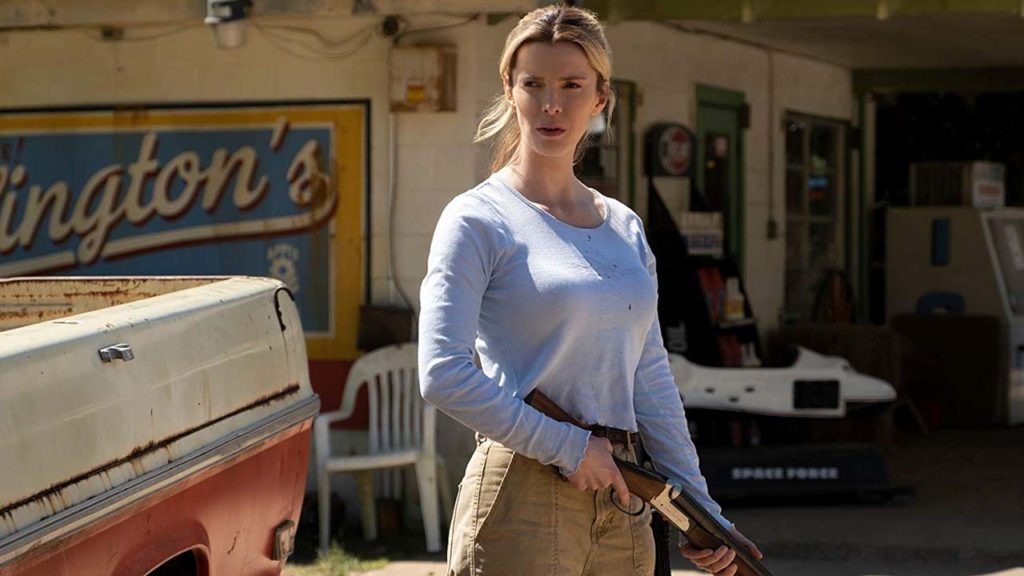
    Betty Gilpin in The Hunt
    Betty Gilpin in The Hunt, with nary an NPR tote in sight.

    The Hunt seems to equate liberalism with wealth, which looks just plain retrograde at a time when Americans are marching in the streets for equality and to please not to be murdered by Officer Friendly. If I were to stretch and strain to give this movie more credit that it deserves, perhaps the point is to frame America’s current divisions as primarily class driven, with ideology as performative cloaking. But I doubt it’s being that clever.

    Also, I must say the shared DNA with Donnie Darko was unexpected, and Hillary Swank and Betty Gilpin are superstars that deserve better showcases than this.

  • Interstellar is a yet another time twisty Nolan scenario

    Interstellar is a yet another time twisty Nolan scenario

    The torturously complex premise of Christopher Nolan’s Interstellar requires a constant stream of exposition throughout, something I don’t recall being a problem in the director’s other time twisty scenarios like The Prestige and Inception. It’s also less emotionally urgent than either, perhaps indicating that the high-concept structure overwhelmed everything else.

    If Coop (Matthew McConaughey) — and by proxy, the audience — needs to have everything constantly explained to him (before, during, and after anything happens), maybe he’s not the right person for the job. I know, I know, he’s the pilot, and realistically each member of such a crew would have their area of expertise. But perhaps the protagonist of the film, and the one that is most lauded by humanity at the end, should have been either Murph (Jessica Chastain) or Amelia (Anne Hathaway).

    And I think maybe we were supposed to feel sentimental affection for the robots? I couldn’t even tell you how many there were.

  • What are men, compared to rocks and mountains: Pride & Prejudice

    What are men, compared to rocks and mountains: Pride & Prejudice

    Who doesn’t have great affection for the beloved 1995 BBC adaptation of Pride and Prejudice? But: I daresay Joe Wright’s 2005 feature film adaptation (the one with the ampersand) is my P&P. It may be less faithful to the text, but that’s fine; it’s its own thing. It’s delicious and I adore it.

    I think of it as the precision-tooled sportscar version of Jane Austen’s novel; it may lose a lot of nuance, but it is a marvel of adaptation, It perhaps only suffers from omitting too much of the Wickham material, and softening Mr. Bennett’s culpability in the family’s dire situation.

    Pride & Prejudice

    The cast was selected with laser-guided missile accuracy, and the necessarily highly condensed screenplay makes some welcome adjustments:

    • Mrs. Bennett (Brenda Blethyn) is less broad, and less oblivious to Mr. Bennett’s (Donald Sutherland) teasing, which is tweaked to be more loving than cruel.
    • Lady Catherine (Judi Dench) is less of a cartoon villain, and is instead truly imposing and powerful. She may be wrong, but you can understand where she’s coming from.
    • Lydia (Jena Malone) is more naive than an out-of-control wild child.
    • And one other adjustment that I quite like: this Caroline Bingley (Kelly Reilly) has a begrudging respect for Lizzie (Keira Knightley), recognizing her wit and formidability, as opposed to her all-encompassing contempt in the 1995 version.

    Rewatching the 1995 and 2005 adaptations in quick succession, an important (and in retrospect, obvious) point struck me for the first time, despite having also read the novel some years ago. Charles and Caroline Bingsley inherited their fortune from their late father, a tradesman. In other words, they are nouveau riche, not landed gentry like the Darcys and the Bennets. That they look down on tradesman like Lizzie’s uncle Mr. Gardiner, a lawyer, is nakedly hypocritical. Jane Austin bringing the socioeconomic critique!

    For those interested in further exploring Austen’s extensive Hollywood career, please consult her official Letterboxd page.

    (We watched this on old-fashioned DVD, and it was a very stressful experience: the previews were non-anamorphic, but thankfully the feature was anamorphic. My heart!)

  • Elisabeth Moss has a villain problem in The Invisible Man

    Elisabeth Moss has a villain problem in The Invisible Man

    For a movie named after the antagonist, Leigh Whannell’s The Invisible Man has a villain problem.

    At one point, Cecelia (Elisabeth Moss) asks an interesting question: her husband is famous and wealthy, and can have anyone — so why her? In one question, she essentially admits her longstanding insecurity at having a handsome rich man choose her for marriage, and also gets at the more pressing anxiety: why continue to fixate on her after the end of everything? Why go to such extreme lengths to torture and entrap her? Why not just let her go?

    The movie’s answer seems to simply be: because he’s crazy. He’s not exactly like the Joker in The Dark Knight, who wants to watch the world burn just for the sake of it, but more like the loony villain in Skyfall whose absurdly complex revenge scheme isn’t because he’s diabolically clever but because he’s just plain nuts.

    Here’s a free thesis idea for film theory students: compare/contrast movies about men who may or may not be going insane (Shutter Island, Shock Corridor, Jacob’s Ladder), vs. those about women (Repulsion, Unsane, Horse Girl).

    Forget about the advanced optics in the invisibility suit – the real money must be in that amazing floorboard-creaking-prevention tech, right?

  • Brad Pitt works out his daddy issues in space, in Ad Astra

    Brad Pitt works out his daddy issues in space, in Ad Astra

    Maybe this isn’t fair, but I couldn’t help but associate Ad Astra with Joker. If Joker is a shallow remix of Taxi Driver and King of Comedy, Ad Astra is a bland smoothie of Solaris and Apocalypse Now, with a cavalcade of stars you may remember from Space Cowboys and Armageddon. I half expected Harrison Ford to appear, standing in a corner, creepily ordering Brad Pitt to “terminate, with extreme prejudice” — so it’s more Apocalypse Now than 2001: A Space Odyssey, which at least had the decency to have jokes.

    Brad Pitt and Liv Tyler in Ad Astra
    Brad Pitt has a few issues to work out before he can open his heart to Liv Tyler.

    But really, Ad Astra is merely the story of an emotionally repressed mope (Brad Pitt), working through his daddy issues by haphazardly murdering a bunch of people just like his dad (Tommy Lee Jones) did — as if they were mere bureaucratic red tape stopping the only person in the universe that can save the universe from saving the universe — and then, having saved the universe, finally becoming ready to open his heart to Liv Tyler. Anybody out there have any empathy for someone who can’t open their heart to Liv Tyler? Pure fiction!

    And as for its pseudo-sciencey verisimilitude, somewhere, Kim Stanley Robinson is banging his head against his writing desk.

  • Terminator: Dark Fate is a trashcan of exposition

    Terminator: Dark Fate is a trashcan of exposition

    Criticizing the plots of popcorn action blockbusters is usually a fool’s errand. Nobody cares if Hobbs & Shaw makes any sense, but surely it’s fair game in the Terminator franchise, where untangling pseudo-scientific time travel logic is 99% of the fun.

    So the biggest disappointment of Dark Fate (other than its singularly unmemorable title, and the cruel execution of a digital Edward Furlong avatar) is that it offhandedly tosses its biggest question marks into a trashcan of exposition. I’m glad this movie revolves around three women, and relegates Arnold Schwarzenegger to a supporting role, but it seems to me that if your story involves a robot assassin that reprograms itself for good, after a lifetime of guilt and regret, that deserves more than a few perfunctory lines of exposition.

    While we’re on the topic of telling-not-showing: Dark Fate introduces a new, rather creepy idea to the clichéd evil A.I. subgenre. Rather than a diabolical Matrix-style plan to subjugate humanity, the A.I. in Dark Fate simply turns off the world’s power and then sits patiently on its circuitry butt for a few decades while most of humanity kills itself off. Again, like Schwarzenegger’s Cyberdyne T-800 developing a conscience offscreen, this is far more interesting than any of the car chases or plane crashes.

  • Jim Jarmusch’s The Dead Don’t Die is an unaffectionate homage

    Jim Jarmusch’s The Dead Don’t Die is an unaffectionate homage

    I guess it shouldn’t be surprising that Jim Jarmusch would make a zombie movie, since he’s already cycled through idiosyncratic interpretations of westerns (Dead Man), vampires (Only Lovers Left Alive), samurai (Ghost Dog), and thrillers (The Limits of Control). But unlike these, The Dead Don’t Die reads as an unaffectionate (or to coin a word, disaffectionate) homage to its genre.

    Directly quoting Night of the Living Dead and Return of the Living Dead, The Dead Don’t Die initially seems to be taking a nostalgic poke at contemporary interpretations of the genre: be they the frenetic 28 Days Later rabid variety, or the mopey end-times soap opera of The Walking Dead. But Jarmusch takes the inherent nihilism of the zombie horror subgenre to its logical end: there is no “post-” after the apocalypse, and zombie movies are dumb and you’re dumb for watching them.

    Iggy Pop in The Dead Don't Die
    Iggy Pop as Coffee Zombie, with whom I think many of us can relate.

    The cast is notably diverse in race, age, and gender (at times looking like the most Jarmusch that ever Jarmusched, with just enough room for delights like Iggy Pop as Coffee Zombie, Carol Kane as Chardonnay Zombie, and Tom Waits as Hermit Bob). But while The Walking Dead has vague themes of the apocalypse being the great socioeconomic leveler, here it’s part of a cynical joke. It’s hard not to interpret the casting of Tilda Swinton as a scotswoman in samurai kitsch as an allusion to her role in the Disney/Marvel appropriation of an asian comic book character in Doctor Strange.

    Fittingly, her subplot builds to a glancing swipe at sci-fi/superhero blockbusters, with the iconic Star Wars Star Destroyer reduced to a tchotchke keychain wielded by its star Adam Driver, and then inflated back up into a dinner-plate flying saucer straight out of Plan 9 From Outer Space. Zombies and spaceships are taken seriously by millions as part of a modern mythos, but from the condescending perspective of Swinton’s woman-who-fell-to-earth, it’s all naught but “a wonderful fiction”.

  • 1917 is not the first single-take movie, but it’s one of the best

    1917 is not the first single-take movie, but it’s one of the best

    Every review or casual comment about 1917, from pan to praise, will all begin with the same undeniable fact: it’s an astounding technical achievement. While far from the first apparent single-take feature-length film, it’s certainly one of the most seamless.

    Better, the feat is partially insulated from charges of gimmickry in that the structure derives directly from the urgency of the plot. There’s an essay waiting to be written about how both Sam Mendes and Christopher Nolan approached the venerable war film genre in the 21st Century: by experimenting with structure and time.

    Claire Duburcq in 1917

    A couple things took me out of the experience:

    1. The very intrusive score. Often so overbearing that I suspected the filmmakers doubted the power of their imagery. One particular example being Schofield’s (George MacKay) mad run across the battlefield being accompanied by a pounding rock score, when surely the shells, screaming, and guns would have been more effective.
    2. Sentimental war movie cliches, most notably coming across a pretty young woman in the middle of a battlefield.
    3. Casting movie stars as the various superiors the soldiers encounter throughout the film has some deleterious effects: it’s distracting when the two leads are relative unknowns, it calls attention to an episodic structure, and it relies too much on melodramatic camera reveals (holding the lens on Mark Strong’s boot for so long seemed a bit rich).
    4. An unimaginative, unevocative title. These are not perfect analogies, but imagine if Platoon had been titled 1967, or if M*A*S*H had been 1951.