I remember liking Grant Gee’s Radiohead documentary Meeting People is Easy when I first saw it in the late nineties, but now it just looks like a simplistic feature-length exposé of how music journos are twits that ruin everything.
I was rather astonished to find Isle of Dogs defeat my expectations and become one of my least favorite Wes Andersons, if not the least.
Anderson is one of my absolute favorite filmmakers (I know, I know, join the club), but like a lot of my faves, I have significant reservations. It’s no great insight to point out that all of his films are male-centric, all with male protagonists, all with predominantly male casts, and all featuring at best one primary female supporting character.
He’s hardly unique in this respect, so it’s unfair to single him out when there are far more egregious examples (like, for example, almost every director ever). But it feels especially overt in the context of a fantasy fable, where anything goes. Why on earth did this have to be such a Snausage fest?
With a little effort, I count maybe five speaking female characters from memory. Of those, two are — sorry for this, but quite literally — bitches bred to be pretty or bear litters. Interpreter Nelson may share narration duties, but she merely translates the words of other male characters. Yoko-ono is practically mute. That leaves Tracy — about whom I barely know where to begin. At a time when pop culture is calling for greater representation of asian characters in film, the best I can say about her is thank goodness she wasn’t a Japanese character voiced by post-Ghost in the Shell Scarlett Johansson.
Sorry to go on and on about the lack of female representation in an animated dog movie, but I just cannot overlook here what I could previously accept as a given with Anderson. It was worth it for his singular visual style and quirks, and he would occasional feature complex female characters like Margot, Suzy, and Miss Cross amidst all the boys. In Rushmore, Miss Cross is the love object of a precocious but immature boy emulating his notions of adulthood, and his inappropriate crush is part of the point. She is thankfully written and acted as far more than a token, but there’s no equivalently interesting female character in Isle of Dogs, and what’s the excuse? Why does the little pilot have to be boy? Why does the entire pack of dogs have to be male? It’s just so frustrating.
I’m also deducting points for another of my common movie complaints: when one of the most visually-oriented mediums that humanity has ever created — animation — is misapplied to primarily verbal works. The worst example of this in my mind is Richard Linklater’s Waking Life, throughout most of which I could not fathom why the painstaking process of animation was applied to stationary talking heads. Although the animation craft on display in Isle of Dogs is often extraordinarily wonderful, the screenplay is so verbose and overwritten that it often must halt to allow for a few pages of dialogue. Stop motion becomes stopped motion.
In Delbert Mann and Paddy Chayefsky’s Marty (1955), Ernest Borgnine plays a basically decent man, trapped in a kind of stasis by social forces that are only more amplified today: misogyny, distrust of the educated, racism, and classism. Even the changing economic landscape looms over him, as corporate consolidation threatens his dream to own a small business.
One or two more generations, and it’s easy to imagine Marty’s family chanting “lock her up” at a MAGA rally, and his friends as incels trolling women on the internet. His family exemplifies a moment of social transformation between extended families living together and a trend towards isolation and nuclear families. His mother and aunt spent a lifetime working until they couldn’t work any more. In their old age, they are left with nowhere to live and nothing to do. His cousin is transitioning towards the American Dream of a house and child, but the accompanying burdens and anxieties outweigh any happiness.
In the language of today, we would say that Marty needs to ditch his toxic friends.
Outside the family tumult, his circle of friends is adrift in an increasingly isolated social world of movies, bars, and dance clubs — all in the pursuit of women that they seem to desire and loathe in equal measure.
I cannot tell you how utterly relieved I was when Marty made that last-minute phone call. I think I would have been devastated if he hadn’t.
I’m kicking myself for wasting a rare Sunday movie theater outing on stunt choreographer-turned director Chad Stahelski’s John Wick: Chapter 2. I can’t deny the high craft and artistry that puts it near the top of its genre, but I’m just too sick and tired of gun culture as escapist entertainment.
Give me a kung fu movie any day, where the fighting is beautiful and balletic. I just can’t turn off my brain and enjoy brutal MMA and/or firearm combat, where the aim is to maim or murder. Granted, maybe my mood was negatively influenced by the psychopaths in the theater that applauded every time somebody our hero Johnny W. put a bullet through a brain or stabbed some guy in the groin.
OK, fine, I have to admit that Keanu Reeves does execute one incredible gun-related trick that impressed even this pacifist: he one-handedly flips his hand around the back of a pistol, opens & closes the chamber, and flips his hand back to the grip. That was awesome.
Searching for other positive comments to make: Ian McShane is, as usual, delicious. He’s in Shakespeare while everyone else is just in some dumb movie. I also always like Common (see also Hell on Wheels and Selma), and the reunion of Keanu and with his Matrix costar Laurence Fishburne is entertainingly hammy.
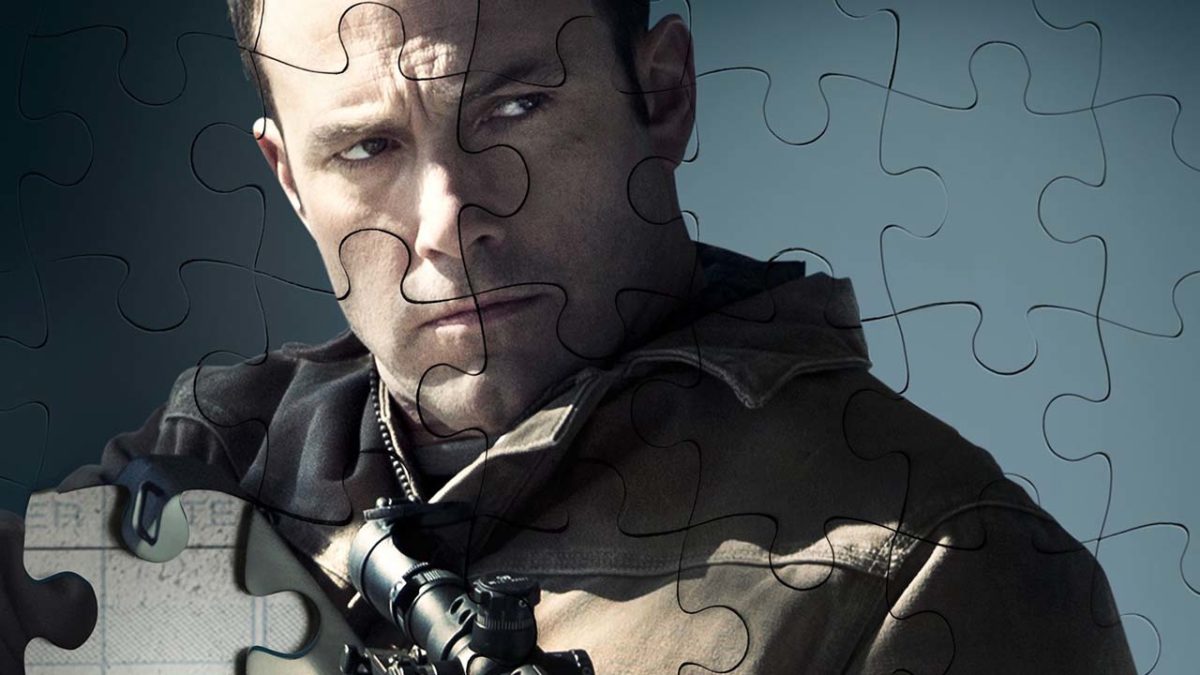
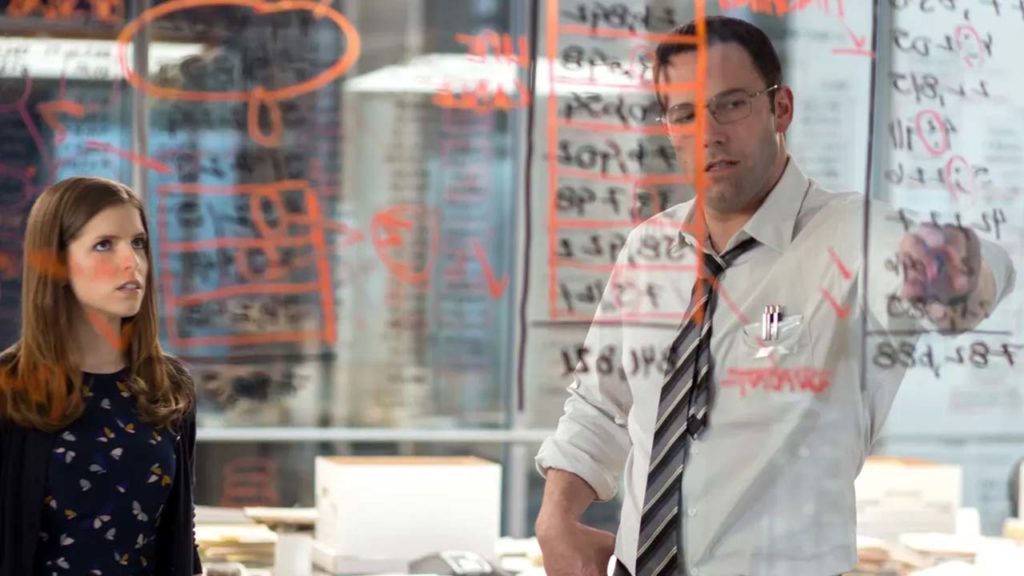
You can imagine the elevator pitch: “A Brilliant Mind meets Death Wish! Ben Affleck! Anna Kendrick!”
Director Gavin O’Connor’s The Accountant flirts with righteous anger at big business financial corruption, but wimps out by ultimately fingering a single venal individual with a hired army of faceless mercenaries. There’s nothing engaging about a plot that can be resolved by the hero shooting a few people in the head.
Only a fool would go to a violent action flick and complain about its violent action, but I’m a fool, so here you go: I found The Accountant’s gunplay and brutality a little hard to take. The protagonist has high-functioning autism, with its corresponding problems with empathy and emotional intelligence. But his capability to cooly execute without remorse seems to me to be more in the realm of psychopathy. Even the brainwashed supersoldier Jason Bourne was tortured with remorse, making him more of a tragic figure than a gunslinging Dirty Harry.
A Brilliant Mind meets Death Wish.
It does have an enjoyably twisty plot, but cheats by untangling much of its complex backstory in a lengthy expositional infodump near the end (thankfully ameliorated by the ever-capable J.K. Simmons’ delivery). The suspense of waiting for certain character backstories to be revealed is entertaining, but the particular mystery the movie saves for its climactic reveal is also its most obvious.
Anna Kendrick can’t help but be charming and likable, but she’s given almost zero characterization here. I wish more had been made of a young, idealistic professional who naively blows the whistle on a poisonously dangerous corruption. But she’s is pretty much a blank love interest with an incongruously swank, well-appointed loft apartment. And she throws herself at Ben Affleck a little quickly (but I’ll chalk that up to PTSD and Ben’s pretty chin dimple).
All of that said, there’s a lot to commend The Accountant. It’s an original story, not a sequel, adaptation, or remake. And while I’m uncomfortable with its equation of autism with psychopathy, the movie mostly avoids either romanticizing or exploiting the disability.
Nancy Meyer’s 2015 trifle The Intern is a little outside the usual scope of this blog, but it sparked a couple thoughts I needed to get out:
What a waste of a decent premise: a retiree reenters a transformed workforce, while the young founder of a startup grapples with success. But so little is at stake for either.
Ben (Robert De Niro) enjoys a comfortable retirement, with a nice home, stable finances, and good health. While he’s a widower, he hardly seems overtaken with grief or loneliness. His urge to reenter the workforce stems from a vague, half-felt malaise, not out of any financial or emotional urgency. He’s… fine.
Just because she’s a boss doesn’t mean she can’t be quirky and adorkable.
Jules’ (Anne Hathaway) primary dilemma is whether she should maintain her company’s status quo (which has been functioning… fine) or bring on a more experienced CEO as her business grows (which would also be… fine). She’s also… fine.
The overall feel of this movie is like taking a warm milk bath, where every character was fine, is fine, and will be fine.
But for all its gentle geniality, The Intern does briefly dally with melodrama, as Jules’ frustrated stay-at-home husband smooches another woman. Here, old-school Ben takes a more feminist stance than she. For once, she does not take his seasoned advice, and opts to avoid confrontation with her husband. Similarly, she decides to do nothing with her company. So… everything’s fine.
If you dig the deeply cynical TV series Black Mirror, you’ll love this documentary profile of businessman/artiste/madman Josh Harris. Love, hate, or pity him, Harris is undoubtedly a fascinating individual who succumbed to information-age and surveillance state delusion back during a time when we still used terms like “cyber-surfing the information superhighway” to describe the arriving networked world. Ondi Timoner’s documentary We Live in Public argues the point that however mad and irresponsible Harris may have been, he was definitely a visionary who saw what was coming over the horizon.
Of particular interest to me was the story of his venture Pseudo, where I worked for a few months in 1999-2000. This was after Harris left the company and launched his underground hotel project, so the doc necessarily omits this interesting phase in the company’s history. Going by this film alone, you’d get the impression Pseudo continued operating as a non-stop orgy right up to the end. But in actual fact, it did receive a large investment, followed by a major effort to mainstream itself as a serious company. When Pseudo finally burned through this cash infusion and went out of business, it was considerably a more sober and normalized operation than the wild bacchanalia it may have been in its early period.
As a footnote, I found it amusing that a documentary about the destructive effects of technology on society and the individual psyche would ship on a DVD encoded with a form of DRM (Pixeltools) that prevented it from playing on my totally run-of-the-mill DVD player.
A dystopia ruled by three corporate fiefdoms: petrochemicals, munitions, and Aqua-Cola. A diseased and starving population terrorized by a religious army motivated by martyrdom. A decadent ruling class reliant upon the subjugation of women. Environmental collapse. Car culture run amok.
It must be escapist summer blockbuster season!
In case I sound too snarky, let me be clear: I checked my pacifism at the door and loved every second of George Miller’s Mad Max: Fury Road. More visionary lunatic filmmakers should get multimillion dollar budgets.
I was going to add it should have been called Furiosa, but I see that’s the title of the forthcoming sequel. Fitting, because Charlize Theron owned a film in which the Tom Hardy’s title character played second fiddle to a largely female cast.
Cormac McCarthy and Ridley Scott were bound to be an odd couple in any case. All the richly composed and poetic dialogue in the world doesn’t disguise the fact The Counselor is basically a grimy, scuzzy, sleazy, feel-bad potboiler.
There is an element of pulp to several of McCarthy’s novels, but here it’s brought to the forefront. As highly regarded as he is as a literary novelist, his subject matter is still mostly comprised of cowboys, bandits, whores, thieves, madmen, and murderers.
This is Ridley Scott in full erotic thriller mode (see Black Rain and Someone to Watch Over Me). He has somewhat tamped down the extremely grainy stylization he used to employ (especially in Gladiator and Black Hawk Down), opting instead for a sun-blazed Miami Vice-like palette. Perhaps McCarthy should pitch his next screenplay to Michael Mann?
Most impressive is the huge all-star cast. Even the smallest roles are populated by familiar faces (watch for Rosie Perez, Dean Norris, and John Leguizamo). I have never been one of those people who dislike Cameron Diaz (her most famous detractor being perhaps Sophia Coppola who lampooned her in Lost in Translation), but here she is perhaps the weakest link.
When even the humblest movies are planned to allow for multiple sequels if at all financially feasible, the Riddick trilogy (and counting?) must be one of the most haphazard of movie franchises.
I doubt many would have expected any kind of sequel at all to 2000’s Pitch Black, and yet The Chronicles of Riddick appeared four years later to reinvent its surviving character as the hero of a grand sword & sandal epic in outer space. It’s not unlike the later John Carter of Mars, but less wasteful in terms of money spent, and with 100% more hovering Judi Dench.
Even more improbable still, with David Twohy’s Riddick, Vin Diesel is now officially the headliner of a trilogy. Having achieved the holy number of installments, now three movies can be packaged together in budget multi-dvd box sets in time for Black Friday shopping. Or should that be that Pitch Black Friday? Oh, please yourself.
Riddick has more in common with Pitch Black than Chronicles, but one thing they all share is surprisingly good art direction and set design. Chronicles, especially, went far above and beyond the call of duty. I’d argue that it draws more from Dune‘s visual imagination than the typically plundered art direction of Alien or Star Wars. Even Riddick has more believable alien landscapes than the volcano top conclusion to After Earth, which looked like it had been shot on the tiniest soundstage M. Night Shyamalan could book.
Katie Sackoff and Dave Bautista in Riddick
Riddick‘s plot is admirably simple (man trapped alone on a hostile planet, struggles to simply survive, then gain a foothold to escape), and the first 30 minutes or so are crackerjack. But then additional characters show up and so there has to be… shudder… dialog.
Sadly, everything falls apart at this point — and I mean everything, from the visuals to the script. What started out as an intriguing shipwreck story turned into something conventional and cheap. The bulk of what follows is set inside a single room, and not in a good way (like a good submarine movie, for instance), but in a bad way (like, they ran out of money and ideas).
Riddick is also unfortunately sexist. Battlestar Galactica fan favorite Katee Sackoff gets the coveted only-girl-in-the-movie role, and she dutifully works what her momma gave her. She’s sadly stuck with a retrograde character who exists mostly to concede to Riddick’s brutish flirtations. It’s unclear if her character is actually gay or simply allows her male colleagues to assume she is, but either way, it’s stomach turning when she acquiesces to Riddick’s crude propositions. Her utility exhausted, she simply vanishes from the film.