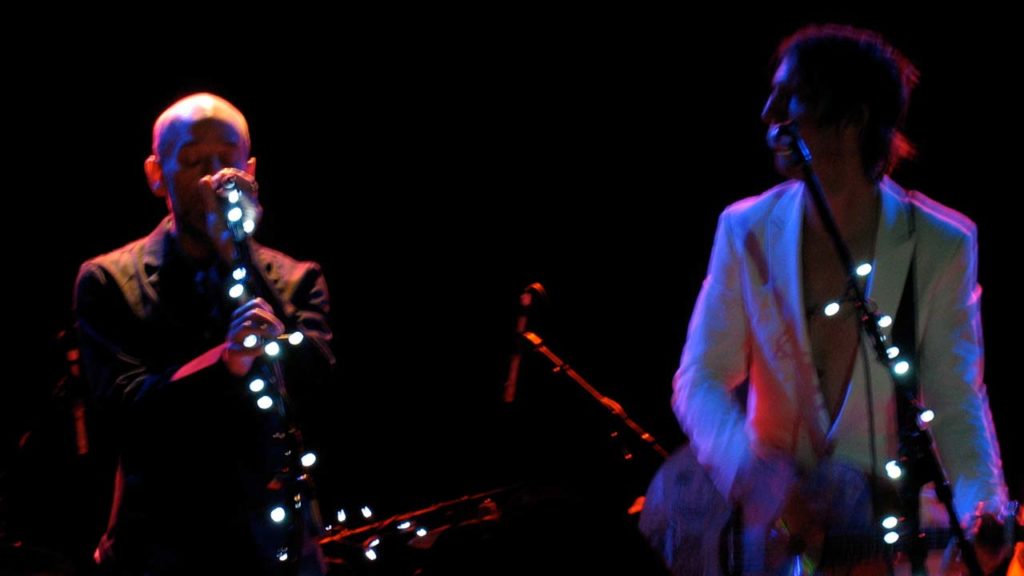
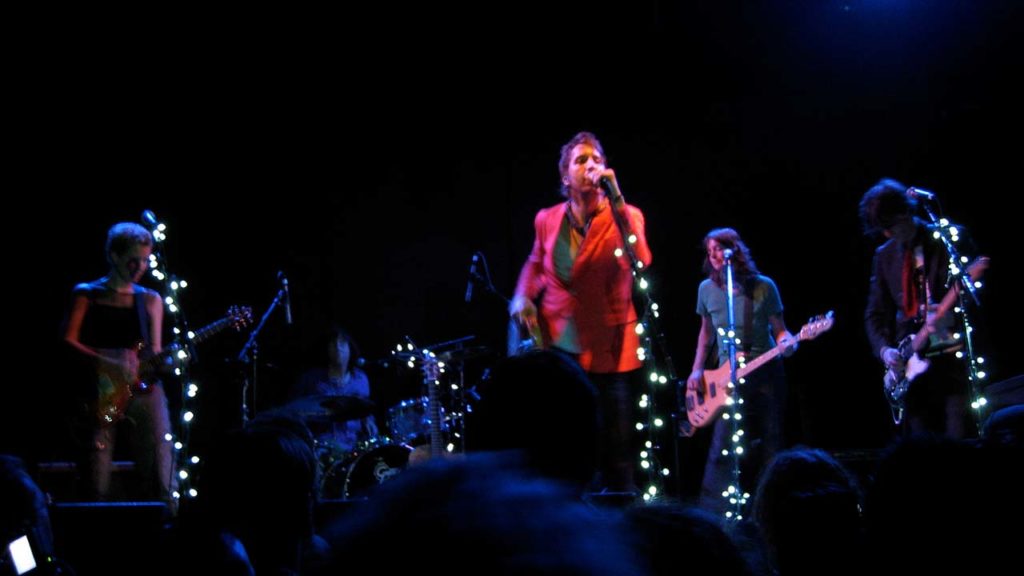
Glen Hansard (of The Frames and The Commitments) and Markéta Irglová recorded an album together called The Swell Season, and now tour under the name. They fell in love while filming the excellent Once, and are now a couple.
Interestingly, they got their Oscar-winning song “Falling Slowly” out of the way right away, perhaps to avoid having the audience call it out as a request over and over throughout the evening. Personally, I felt Hansard goofed off a bit too much, even during serious songs like a new one I believe was called “Broke Down.”
It may seem overkill for the so-called slowcore band Low to be the subject of another documentary feature film only a mere four years after Low in Europe, but it must be because they’re just so interesting. Filmmaker David Kleijwegt’s You May Need a Murderer could just as well be titled Low in America, as he speaks with founding members Alan Sparhawk and Mimi Parker at home in Duluth, Minnesota, and on tour across America in support of the Drums & Guns album. The key characteristics of that record are what most inform the film: Sparhawk’s mood post-nervous breakdown, and Low’s most overtly expressed social and political commentary yet. Low had also just adopted a new bass player, Matt Livingston, after Zak Sally’s long tenure, but he does not participate (he’s only barely glimpsed, even in live onstage footage).
You May Need a Murderer is a much more satisfying film overall than Low in Europe. Whether by their own desire to open up or by Kleijwegt’s persuasive interview skills, Sparhawk and Parker are notably more candid and direct, especially on the topic of their faith. Which is exactly what one would single out as the most interesting thing about Low: Sparhawk and Parker are a married Mormon couple that that tithe a tenth of all their income to the church. I suppose Low might belong in that rare category of bands whose music is often characterized by religious beliefs, like the often overtly Christian U2, but would never be filed under “Inspirational” in record stores. Unlike U2’s joyous hymns and optimistic calls to activism, Low’s inspirations are considerably more dark and apocalyptic.
When Low gets political they do so with a vengeance. Sparhawk is in despair over America’s economy and politics, and has long believed that the world may reach a crisis point in his lifetime (he stops short of predicting it will actually “end”). Sparhawk’s genuine beliefs gives him the real authority to criticize George W. Bush’s claim to faith. The title song “You May Need a Murderer” is sung from the point of view of one who goes before his god and asks to be used as a warrior. It becomes clear that the speaker is in effect staring into a mirror, bringing his own baggage to an imaginary conversation, and justifying his own dark impulses. Sparhawk is, needless to say, talking about self-proclaimed men of faith like Bush and Tony Blair. The song is utterly terrifying, and raises the hairs on the back of my neck every time. It may be the ultimate statement on the topic, and does not compare favorably to the similarly-themed song by Bright Eyes, “When the President Talks to God.”
The most surprising personal topic to come up is Sparhawk’s apparent nervous breakdown in 2005. We see Sparhawk appearing very anxious backstage before a show, but otherwise functional. But he describes himself as having been “clinically delusional” at the point of his breakdown, and while having nominally recovered, he also cops to being a drug addict. To him, the biggest conflict these two aspects of his life have is with his religion.
This blogger has been a big fan of the bespectacled, water-obsessed Laura Veirs ever since first discovering her infectious song “Galaxies” on the late & lamented MP3 blog Salon Audiofile in 2005. Why it was not a huge hit, featured in iPod and car commercials, or soundtracking the denouements of The O.C. or Gray’s Anatomy, I’ll never understand. Still, she’s evidently doing well for herself, for I’ve now seen her live three times in New York City, and each time she’s graduated to a larger venue.
This is the first time I’ve seen her perform solo, without her band The Saltbreakers (whom she lovingly refers to as The Bearded Men). Like seemingly every other singer/songwriter these days, she employs live looping technology (pioneered by Joseph Arthur and popularized by K.T. Tunstall) to become a one-woman band, accompanying herself with looped beats and bass lines all generated on a single acoustic guitar. The mood was great and she was well-received, and she later ranked New York City as the best audience of the tour on her MySpace blog.
I own (or once owned) a whopping 26% of these overrated (so they say) canonical classics! Hey, Chalkhills, what did I ever do to you? I love XTC (Apple Venus and Wasp Star being two of my all-time favorite albums, hands-down), so my tastes can’t be all bad, can they? But having read your list, I find that for every one of your selections that brings steam out of my ears, there’s another with which I have to begrudgingly agree.
So here’s my annotated list, including, for fun, the format in which I purchased each offending title and whether or not I eventually discarded it:
2. U2 – The Joshua Tree 20th Anniversary Edition boxed set U2’s true masterpiece Achtung Baby was yet to come, but the complex depth of that record wouldn’t have been possible without the unironic earnestness of The Joshua Tree. And yes, maybe I’m a snob (not to mention old) for upgrading to the remastered anniversary edition, but just the other day I listened to the revived recording of “Mothers of the Disappeared” with my jaw literally hanging open and the proverbial chills running up and down my spine.
3. Nirvana – Nevermind cassette (discarded) It was a gift, I swear. While I intellectually understand what the mass-market breakthrough of Nirvana did for music (basically, sparking a fresh explosion of so-called “alternative” music comparable to punk’s effect on a stagnant world of disco and stadium rock in the early 1970s), I always preferred the rock ‘n’ roll songcraft of Pearl Jam to the loud ‘n’ sloppy depression of Nirvana.
5. The Beatles – Let It Be cd, The “Naked” version Any antipathy towards the Beatles seems a bit strange coming from an XTC fansite — surely Andy Partridge and Colin Moulding are acolytes. Do I still have to discard Let It Be if I own the McCartney-approved “Naked” edition, as opposed to the original with Wall-of-Schmaltz orchestral overdubs by Phil Spector? Let it Be is not my favorite Beatles long-player (that would definitely be The White Album), and obviously one the lads tossed off at the tail end of their (actually quite brief) association. But how is that any different, really, from their early quickie LPs recorded in mere hours with the aid of amphetamines?
7. The Police – Synchronicity cassette (discarded) I agree with Chalkhills’ assessment that Synchronicity is a surprisingly dark album for a mainstream platinum hit, but I believe that’s exactly what makes it special. What other band, at the peak of their commercial success, released such a paranoid, neurotic album? OK, maybe Radiohead’s Kid A.
8. Lou Reed – Transformer vinyl Agreed. “Walk on the Wild Side” and “Satellite of Love” are both masterpieces, but I couldn’t name a single other song from the album. Am I redeemed by owning the vinyl edition? It must be said that it earns extra Cool Points for being produced by David Bowie, but the back cover photograph of Lou with the boner in his tight jeans is just plain gross.
9. Miles Davis – Bitches Brew Complete Bitches Brew Sessions boxed set Yes, I am that poseur that owns the Complete Sessions boxed set. I have to very, very strongly object to Chalkhills’ dismissal here (and I do I detect a strong anti-jazz bias?). Miles changed music forever when he plugged in to rock, fusion, and funk. Trying to pretend Bitches Brew never happened is as fruitless as still complaining about Bob Dylan going rock (or country, or Christian, etc…) or The Sex Pistols giving the world the finger. The difference is that it still sounds fresh and new.
12. Led Zeppelin – Physical Graffiti vinyl I love me some Zeppelin, but I have to agree that Physical Graffiti isn’t a keeper. It is, however, better than its follow-up Presence (but that’s not saying much).
19. Beck – Midnite Vultures cd (sold) Agreed. I listened to it once, and then sold it as quickly as I could. Blech!
21. Derek and the Dominoes – Layla and Other Assorted Love Songs cd (sold) I could not agree more: two brilliant songs in “Layla” and “Little Wing,” padded out with a forgettable batch of filler. Legend has it the substance-abusing Clapton literally does not recall recording the album.
22. The Who – Tommy vinyl (triple gatefold with lyric booklet) I don’t disagree that Tommy is loaded down with a lot of silliness and filler, but hey, it’s a rock opera, and the first one at that. What do you expect?
26. U2 – Zooropa cd I firmly, absolutely disagree. Zooropa may be a product of its time (the cut ‘n’ paste postmodern media overloaded 1990s), but it includes some of U2’s all-time best songs, including the title track and Stay (Faraway So Close). The multilayered production by Flood and Brian Eno may make the songs “sound weird,” but it also rewards a lifetime of repeat listens.
32. The Flaming Lips – The Soft Bulletin cd I regrettably agree. Give me Yoshimi Battles the Pink Robots any day, but I just can’t get into this one.
34. Dave Brubeck – Time Out cd Blaspheme! Blaspheme! Again with the jazz hate! I was not aware anybody disliked this album. What’s wrong with you? If you had included Miles Davis’ Kind of Blue on your list, I think I would have had an aneurism.
39. Wilco – Being There cd (sold) Like the rest of the world, I loved Yankee Hotel Foxtrot, so I sought out some older Wilco albums. And I suspect like most of those people, I got rid of them.
42. The Police – Zenyatta Mondatta cd Disagree! Zenyatta Mondatta is my favorite Police album. Granted, “De Doo Doo Doo, De Da Da Da” is the epitome of pop silliness (except for maybe “Louie Louie” and R.E.M.’s “Stand”), but the rest of the album is full of classic reggae-inflected new wave pop.
44. Jane’s Addiction – Nothing’s Shocking cd As Perry Farrell himself once sang, “Stop!” Jane’s Addiction’s debut studio album Nothing’s Shocking is a fantastic batch of songs. Perry Farrell’s wild persona and Dave Navarro’s famously louche lifestyle got all the press, but my god, haven’t you listened to the rhythm section? Jane’s Addiction proved that prog could live without shame in a new world after Led Zeppelin, and they got even better in their next album Ritual De Lo Habitual (before self-destructing, alas).
50. Cocteau Twins – Heaven or Las Vegas cd I don’t have a really strong opinion about it, but I enjoy listening to it from time to time. I didn’t even know it was especially popular. Sorry, jeez.
51. Radiohead – I Might be Wrong cd It’s a fair statement that most live albums begin life as contractual obligations. But what actually does bother me more about I Might Be Wrong is that it’s basically an EP sold at LP prices. That said, the performances are strong, and prove that the weird, arty music on Kid A and Amnesiac can and really do come to life on stage.
54. Tori Amos – Under the Pink cd (sold) I loved Tori’s official solo debut Little Earthquakes, but I suspect my sensitive teenager self may have been crushing on the cute & quirky redhead at the piano.
55. Arrested Development – 3 Years, 5 Months, & 2 Days In The Life Of… cd (sold) “…non-threatening rap-lite for sensitive white liberals who want to “keep it real” and experience hip-hop safely.” Zing! Busted.
64. Pink Floyd – The Dark Side of the Moon 30th Anniversary SACD Again, blaspheme! Yes, enough copies of Dark Side of the Moon exist on this planet to form their own continent, but don’t you think there is a reason for that? Mere momentum alone can’t be enough to explain its appeal. If you want to single out one Pink Floyd album for being overrated and overpurchased, please allow me to direct you to The Wall, which unlike most other Floyd albums, appeals to sullen immature teenagers but does not grow in sophistication as they do.
65. Sarah McLachlan – Fumbling Towards Ecstasy, Surfacing cds (still on my shelf but I really ought to sell them) Ouch! You got me here. I once liked both of these, but quickly fell out of love with them. I maintain there are some decent songs underneath the slick adult contemporary overproduction.
69. U2 – War vinyl U2 charts no less than three times on this haters list, rivaling the Beatles and the entire genre of jazz for raising Chalkhills’ bile. I suggest revisiting “Sunday Bloody Sunday” and tell me if the drums don’t make the hair on the back of your neck stand up.
80. R.E.M. – Out of Time cd OK, maybe it’s not their best, and it is especially disappointing for having come right after the legendary, essential album Green. But “Shiny Happy People” is maybe the best 3/4-time pop song ever, and the whole second half is superb.
83. Grateful Dead – any album Reckoning (lp) & Infrared Roses (cd) Yep, I picked up a secondhand vinyl copy of Reckoning for pennies and it’s pretty loose and rambling, even for the Dead. But I do dig the crazy electronic jams on Infrared Roses, man.
90. Sting – Ten Summoner’s Tales cd (sold) I’ll cop to liking “Fields of Gold” back in the day. Oh god, did I just admit that out loud on the internet?
There, done. Finally, I just want to say that yes, I do have a sense of humor and I get the point of Chalkhill’s rant. Responding to their List of Hate was just an excuse for me to scribble out a few words about some of the dustiest old artifacts from my music collection. Thanks!
I came late to appreciating Low, but they have since become one of my favorite bands. I was vaguely aware that trainspotting music critics had christened a genre to categorize bands like Low: slowcore, the distinguishing characteristics of which being playing very quietly and slowly. An overgeneralization, it turns out, but it never hurts to be famous for something unique. “Venus,” a free promotional MP3 from their expansive compilation box set A Lifetime of Temporary Relief given away on Amazon.com, lived in rotation on my iPod for some time, and finally convinced me to buy the 2005 album The Great Destroyer. I first saw them live in Brooklyn’s McCarren Park Pool in 2006, supporting Iron & Wine (whom I like well enough, but if you ask me it should have been the other way around). Even in direct sunlight, their music is beautiful and engrossingly enigmatic.
Director Sebastian Schrade’s documentary Low in Europe was filmed on their 2002-2003 tour of Europe, before they wrote and recorded my two favorite albums of theirs: The Great Destroyer and Drums and Guns. It’s part concert film and part documentary, but not enough of each. There are no complete musical performances included, and although the principals are all intelligent and interesting, the fact is the interviews are sometimes a little less than gripping.
The band first expresses their ambivalence about operating within the commercial music industry. They address their reputation for slow tempos and low volume with good humor; in their early days, they played really slow, in the fuck-you avant-garde spirit but not the loud ‘n’ sloppy letter of punk, to antagonize and challenge the audience. Their contrary nature extends to their personal lives: principal members Alan Sparhawk and Mimi Parker, practicing Mormons and a longtime married couple, tour with their children and view it as a simplified and focused way of life. This came as something of a surprise to me, who feels perhaps he had a heretofore undiscovered prejudice that Mormons couldn’t be rock stars.
The heavily-documented Low can be further investigated on the three documentary shorts included with the A Lifetime of Temporary Relief boxed set, and on the forthcoming You May Need a Murderer, a new doc coming out June 3.
The Musical Box is a Canadian group that stages elaborate recreations of entire concerts given by the English progressive rock band Genesis in the early 1970s. They perform closely-observed note-for-note cover versions of the original songs, in the original set list order, with full recreations of the set design, props, costumes, vintage instruments, and even the mannerisms of the original Genesis. So while it is technically true that they are essentially a cover band, how many of those tour the world several times over and land gigs at significant venues like The Highline Ballroom? It speaks to both the integrity of the original Genesis music and to The Musical Box’s own skills that they are not a mere tribute band gigging through bars and frat houses.
At the Highline Ballroom, The Musical Box performed Genesis’ famed “Black Show,” originally in support of the 1973 album Selling England By the Pound, and widely bootlegged as the “Rainbow Show”. Genesis’ typical “White Show” was more elaborately staged, but due to venue requirements and the troubles of shipping their gear internationally, they would sometimes play the stripped-down Black Show, so known for its low stage lighting and simple black backdrop. The Musical Box’s performance had amazing sound fidelity, and was one of the best-sounding live concerts I’ve ever heard. No doubt the actual Genesis (many of whom have seen The Musical Box live and have even sat in with them on occasion) wish they had such modern audio technology at their disposal in the early 1970s.
The members of The Musical Box are as much actors as they are crack musicians. Fittingly, Peter Gabriel himself was mostly acting onstage; the famously shy young man masked his discomfort with an outlandish stage persona full of costumes, masks, and mime. Denis Gagné is older than the stringbean-thin Gabriel at the time, but does an extraordinary job of capturing his vocals and stage presence, right down to the hilariously filthy stories Gabriel would tell between songs to entertain the audience as the rest of the band retuned their instruments.
The only performer not in ’70s bell-bottom costume was Gregg Bendian as “Phil Collins.” He was, however, paradoxically one of the most authentic performers, recreating Collins’ unmistakably muscular and enthusiastic drumming. After becoming famous as a television actor and cheesy pop superstar in the ’80s, and Disney balladeer in the ’90s, it’s easy to forget that Collins is first and foremost one of rock’s best drummers.
The rest of Genesis was very serious and reserved, and relied on Gabriel to engage the audience as they played. François Gagnon enlivens the bearded, serious Steve Hackett’s guitar embellishments (not one of Genesis’ core songwriters, Hackett was however a brilliant guitarist and one of the inventors of the two-handed tapping technique). Sébastien Lamothe straps on a genuine double-necked Rickenbocker to play Mike Rutherford, with the dedication to verisimilitude to grow a full beard and flowing locks. David Myers plays Tony Banks, the stoic and unsmiling anchor on stage right, but sadly relies on modern synthesizers (nothing compares to the raw sound of an actual Mellotron).
And finally, a cheap shot: the audience was far from the usual sort seen at New York City venues. A noticeably older set, with a very strong dork flavor (with shirts tucked in over pot bellies), but there was a surprising number of women (not traditionally an audience for progressive rock).
A few notes on the songs:
Cinema Show – it’s difficult to fully appreciate the very long (approx. 5 minutes!) instrumental power trio sequence featuring Collins, Banks, Rutherford until you witness it live. Wow! Genesis was a lot “heavier” than I ever realized from simply listening to the albums.
Firth of Fifth – Hackett’s hair-raising melody line must be one of the best guitar moments in rock, ever, and no doubt Lamothe relishes playing it live.
The Musical Box – the coda sequence (during which Gabriel famously wore a grotesque “old man” mask) drove the crowd bananas. Clearly the band is aware of the song’s power, for they took their name from it.
The Battle of Epping Forest is the rare classic Genesis song that I haven’t already memorized over the years. Gabriel affected lots of character voices in the original, and thus this is perhaps the one point when Gagné’s impersonation fails him.
Supper’s Ready – had The Musical Box not already provided a premature climax to the show, the closing “Apocalypse” sequence to Supper’s Ready would have been it.
The Knife (encore) – why aren’t Genesis credited more often for recording one of the earliest hard rock songs? The Knife is so dark, loud, and aggressive, it could possibly even be called metal.
This blogger may have to burn his Rock Snob card, for I just watched and enjoyed the Blue Man Group concert film The Complex Rock Tour Live. I’d long assumed that the Blue Man Group’s seemingly permanent residency on Lafayette Street in downtown Manhattan was some kind of tourist trap like Mars 2112 or Jekyll and Hyde, but now I’m wishing I had looked closer.
For any others that may also have prematurely dismissed them, the Blue Man Group is equal parts performance art collective, percussion ensemble, and, well, blue. The Complex Rock Tour DVD captures the group live in 2002, with a show that is at once both an actual rock concert and an ironic commentary upon one.
I had to fight the suspicion throughout that a blue-clad trio of catburglars had slipped into my apartment and raided my cd collection. As I watched, I started to compile in my head a list of artists that must have been influences:
Emergency Broadcast Network. EBN was a trailblazing multimedia performance group that fused Marshall McLuhan-esque media theory with techno, all in the style of a television news broadcast from hell. Their caustic and aggressive social commentary is a far cry from The Blue Man Group’s squeaky clean naïveté, but it’s hard not to watch footage of their live performances without seeing an ancestor of the Complex Rock Tour‘s ironic infographics.
Laurie Anderson’s Home of the Brave concert film (1986). All the ingredients are here, albeit in artier form: film, performance art, mime, masks, dance, etc.
Peter Gabriel and Robert LePage’s Secret World Live and Growing Up Live tours were as much theater as rock concerts, utilizing simple yet hugely symbolic shapes and props: a tree, an egg, the moon, etc.
Talking Heads’ Stop Making Sense concert film (1983), for all the same reasons as Laurie Anderson and Peter Gabriel above.
King Crimson. Some of the Blue Man music bears more than a passing resemblance to the polyrhythmic tuned percussion King Crimson employed in the early 1980s with tracks like “Waiting Man” and “Neil and Jack and Me.” Not only that, one of the members of the Blue Man band can be spotted played the Chapman Stick, popularized by Tony Levin.
Rock Snobs might be surprised to hear traces of even more modern music in the Blue Man Group repertoire. I caught snippets of the instrumental so-called “post-rock” of UNKLE, Battles, and Explosions in the Sky.
And finally, the one influence the Blue Men actually namecheck with a (brief) cover version in their show is Devo, but I don’t own any of their music! Maybe I should take this as a recommendation.
As humorous and toe-tapping as The Complex Rock Show is, the Manhattan-based Blue Man Group end the proceedings with “Exhibit 13”, a haunting piece incorporating footage of actual World Trade Center debris that showered over Brooklyn only a few months prior. The piece is available online.
U23D is actually a fairly traditional concert movie, a mostly straight-up filmed record of a representative show of a single tour. U2 had already produced one theatrical feature film about themselves (1988’s Rattle and Hum), and released numerous productions on video and DVD before and since. So what could have been just another video of the world’s most overexposed band needed to differentiate itself somehow. Turns out the latest 3D technology filling a 40-foot screen consuming your peripheral vision is more than enough to justify its existence.
3D has come a long way from what I remember as a kid, watching Creature of the Black Lagoon on TV with red-and-blue cardboard glasses. At first, the degree of depth is disorienting and headache-inducing, but before too long the brain and eyes adjust. Your perspective is not that of the audience but as if you were standing right on stage with the lads. Sometimes I felt as if I should have been holding a tambourine!
In a state called vertigo
The old songs I’ve memorized from thousands of plays on LP, tape, CD and now iPod are still great. The martial drumbeat to “Sunday Bloody Sunday” still sends chills down my spine, and I have to admit I even choked up a little during “Pride (In the Name of Love).” I was disappointed by the relative lack of songs from the band’s 90s “postmodern irony” trilogy Achtung Baby / Zooropa / Pop, but Zoo TV Live in Sydney is a good document of that era. I now have a new appreciation for “Love and Peace or Else,” a new song from How to Dismantle an Atomic Bomb that hadn’t quite made an impression on me yet.
One blind Bono sez: Coexist or else
I’m a longtime fan that has never seen U2 live. There was a frustration at every opportunity; if they weren’t sold out, I was too broke, sans car, or all of the above. So U23D made a kind of stopgap pilgrimage for me. U2 must be one of the only rock bands to ever preserve the original personnel for so long; here’s hoping they stick together long enough for another tour so I can see them for real.
If I could build a time machine to take me to see any band in history, it would be a trip to the early 90s to catch U2 at any point along their legendary Zoo TV tour.
New to DVD, director David Mallet’s Zoo TV: Live From Sydney documents the lads’ performance in Sydney during the aptly named Zoomerang leg. Rewatching the event in the 21st century is interesting; on one hand, it’s almost shocking how far ahead of the curve U2 was in 1993, preaching a pretty weighty post-modern, ironic kill-your-television thesis in front of thousands of rock ‘n’ roll fans each night.
But on the other hand, the fixation on cable and satellite TV now looks rather quaint. True cultural desensitization and alienation via media oversaturation came, in the end, from the internet. “Everything you know is wrong”, indeed.
Zoo TV was less a rock concert than a carefully choreographed theatrical event. Bono donned multiple costumes and personas throughout each show: a drunken rock star clad in leather and fly shades, a paramilitary guerrilla in fatigues, a gold lamé cowboy hat-wearing megachurch televangelist blasting millions of U2 bucks into the audience, and finally emerging as MacPhisto, a kind of washed-up wasted devil tired of life, but still up for a good time.
I’d hate to see the band’s utility bill at the end of this tour…
Regardless, what’s amazing is that despite all the high-mindedness and avant-garde video art contributed by Brian Eno and Emergency Broadcast Network, U2 still managed to put on a truly spectacular rock concert and get millions of people around the globe to come and love every second of it. And for me to buy the DVD.
I hope to post my reactions soon, but the five stars above should give a hint as to my general feelings.
In the meantime, here’s some coverage of the show on the web: The Tripwire’s review features excellent photographs by Erin Chandler. Billboard also reviews the show and posts a video of Joseph’s duet with Michael Stipe on “In the Sun.”