Category: TV

Television reviews

  • Before the Fall: The Caprica SyFy Series Premiere

    Before the Fall: The Caprica SyFy Series Premiere

    The recently concluded television series Battlestar Galactica (2003-2009) was critically acclaimed and much beloved by a relatively small group of fans and critics that appreciated the brainy show’s bleak, pessimistic view of humanity. It will certainly live forever as a classic achievement in television, but the common consensus is that it failed to reach the wide audience it could have.

    Executive Producer Ron Moore told Variety “‘We had viewers say that if they were able to trick their wives or girlfriends into watching Galactica, they loved it. But with the name Battlestar Galactica screaming science fiction,’ he adds, ‘there was just such a high hurdle to get female viewers to even try it.’” So comes Caprica, a prequel ostensibly engineered from the beginning for greater appeal.

    In an original move, its unrated (read: blood ‘n’ boobs) movie-length pilot episode premiered day-and-date on DVD and digital download in May 1999, nearly a year before the series proper. It preserves some of the signature vernacular of its parent series, including technobabble like “Cylon” (a marketing term short for, we finally learn, Cybernetic Lifeform Node), the trip-on-the-tongue “gods damn it,” the infamous euphemism “frak,” and even epithets like “dirt eater.”

    The character of Bill Adama (Edward James Olmos in Battlestar Galactica) appears as a young boy, and one supposes we might later even see some of the “final five” Cylons from the original series (Michael Hogan, Kate Vernon, Michael Trucco, Rekha Sharma, and Aaron Douglas), who ought to have been running around in some form at this point in BSG chronology. Some of the same core themes are still present, particularly religious intolerance and families coping with catastrophic disaster. Even the special effects are up to par with Galactica‘s groundbreaking spaceship battles, although applied to spectacularly convincing digital cityscapes.

    Caprica
    Caprica, like Battlestar Galactica, holds that there are no Surgeon General warnings in space

    But there are significantly worrisome signs that indicate a fatal miscalculation on The SyFy Channel’s part (worse than their astonishingly stupid rechristening from “Sci-Fi”): Caprica hinges on two men and three annoying teens, relegating its only two adult female characters to the sidelines. It may very well be the case that many women were discouraged from giving Battlestar Galactica a chance, but it’s also true that the show featured a bevy of significant, complex women: self-destructive firebrand Starbuck (Katee Sackhoff), president of all humanity Laura Roslin (Mary McDonnell), Dick Cheney-esque war criminal Captain Cain (Michelle Forbes), and conflicted Cylons Three (Lucy Lawless), Six (Tricia Helfer), and Eight (Grace Park). So far, at least, Caprica includes only two lead female roles, neither of whom figures strongly in the pilot episode: Amanda Graystone (Paula Malcomson, from Deadwood) and Sister Clarice Willow (Polly Walker, from Rome).

    But maybe this gender inequality makes a kind of sense. The real core dynamic between the two male leads makes for classic storytelling. Industrialist Daniel Graystone (Eric Stoltz) invented a virtual reality playground called the Holoband, and has since turned to developing weaponized robotics. Joseph Adama (Esai Morales) is a crooked lawyer tied to an offworld organized crime syndicate that put him through law school, and further control him with threats.

    A terrorist bombing claims their daughters (and Adama’s wife), and the two men later bond over mutual grief, coffee, and cigarettes (like Battlestar Galactica, doctors and nutritionists many thousands of years in our past haven’t yet warned people about the dangers of caffeine and nicotine). The two men may be of different planets, races, and religions, but become bound by complicity in an act of industrial espionage that leads to a murder of an elected official (cast and costumed in thick glasses to resemble Dr. Tyrell (Joe Turkel) from Blade Runner).

    If one of the two had been female, the viewer might naturally expect a romantic subplot. Caprica‘s creators may have avoided this kind of distraction, but the downside is that the primary narrative conflict is between two men, and the only two adult female characters are solely defined by their relationships with the men and/or kids in their lives. Daniel and Amanda’s daughter Zoe (Alessandra Toressani) is killed in a terrorist attack, but we never see the icy Amanda mourn as we do Daniel. Her character is simply Daniel’s wife, nothing more. Sister Willow, at least, is revealed by the end to be more than she seems. Here’s hoping we see Amanda and Sister Willow significantly expanded in future episodes.

    Another thing Battlestar Galactica got right was to sidestep altogether the trap of annoying child characters. It was an adult show, for intelligent adults. Caprica obviously also didn’t learn from a lesson from Jericho (2006-2008), a generally smart show whose weakest characters were a pair of whiney teens that were thankfully written out. Out of Caprica‘s trio of kids, two die but unfortunately come back to a kind of immortality (if you only counted one, check out the deleted scenes available on the DVD edition).

    Caprica
    Wait, there was a woman in Caprica? Let’s hope poor Paula Malcomson actually gets some scenes in the full series.

    The first 10 minutes pack in a massive download of important information, especially tricky for any viewers not already versed in the fictional Galactica universe. Certain key points are reiterated once things slow down later, but a new viewer tuning in cold might get the sense they were supposed to be versed in all this stuff already, instead of just getting teased with a barrage of info to be unpacked later. When a title card reads “58 years before The Fall,” Galactica fans will catch the reference to the sneak attack by the Cylons that nearly eradicates their human creators, the inciting incident that motivated the entire story arc of the parent series.

    We then cut directly to the decadent V Club, implying this civilization’s late-Rome-like decadence to be one of the direct causes of the coming Fall. A fully immersive virtual reality simulation not unlike The Matrix, the V Club is full of teens dancing to dated techno, ogling hot lesbians, making simulated human sacrifice, and squaring off in a fight club knockoff. Its banality betrays a failure of imagination not just on the part of Caprica‘s teens, but also on the filmmakers. A rebellious generation co-opts a virtual world in which they can do absolutely anything they want, and all they can come up with is a single nightclub that only spins techno from Earth’s 1990s? No gay boys want to make out in public too? Nobody wants to fly? Nobody wants to enhance their virtual appearance, say, to make themselves younger, more beautiful, covered in fur or made of diamond?

    The titular city Caprica is the capital of twelve planets colonized by humanity. We only caught glimpses of its future before it is decimated in the first episode of Battlestar Galactica, so there is plenty of unexplored territory for a new prequel series to fill in. Its fashions resemble 1950s America, perhaps meant to capitalize on the popularity of the series Mad Men. We’re supposed to agree that this is a corrupt, decadent society on the cusp of collapse. But how, exactly? They’re playing god(s) by delving into dangerous technological areas like robotic weapons and artificial intelligence, or at least a means of recording a human individual’s consciousness into a computer. They’ve designed virtual reality systems capable of simulating any desire.

    The society is racist to the core; Taurans (from the sister planet Taurus) are called “dirt eaters” and associated with organized crime (although to be fair, the latter actually is true – they seem modeled on the immigrant Sicilian mafia of 1920s America). Like Michael Corleone in the Godfather trilogy, Joseph is ostensibly an upstanding citizen forced to compromise with his heritage. Unable to completely extricate himself from the mob, he tries to Capricanize everything else is his life: changing his surname to Adams and raising his son as a Caprican, all to the consternation of his mother.

    Caprica Alessandra Torresani
    Zoe, genius hacker, goes clubbing in The Matrix.

    This society’s most truly dangerous trait appears to be its ingrained religious intolerance. The population is almost uniformly polytheistic, and intolerant of the minority monotheists. Underground militants have formed the Soldiers of the One, a cult that believes in a combination of monotheism and anti-science. Their secret representative Sister Willow recruits teen students from her exclusive private school. Zealous Ben (Avan Jogia), in turn, drafts Zoe and her friend Magda, and later stages the suicide bombing that claims the Graystone and Adama families. Ben was presumably being manipulated by Sister Willow (Polly Walker), who also had designs on Zoe’s brilliant computer skills that didn’t necessarily hinge on her remaining alive.

    The biggest addition to the Battlestar Galactica mythos is a deeper look into artificial intelligence. Like the Terminator franchise, I appreciate Caprica‘s emphasis that developing artificial intelligence is a separate pursuit than building robots. Too many science fiction stories seem to equate the two, including Battlestar Galactica itself in its controversial final episode (for the record, I loved its audacity). The Day the Earth Stood Still and Forbidden Planet‘s humanoid robots have minds of its own, but what about being robots makes them so, as opposed to immobile computers? Blade Runner‘s replicants and A.I.’s boy robots look human first, and it is never asked what exactly makes them sentient beings (unless the question is how we anthropomorphize things that outwardly seem human).

    Artificial intelligence is almost always automatically evil in movies such as Terminator and 2001: A Space Odyssey. It is rarely inherently innocent, as in A.I.: Artificial Intelligence. Caprica features two disturbing scenes of a human consciousness waking up trapped in a crude robot body. That’s called over-egging your pudding. Also creepy: the advances made by Zoe lead directly to Daniel’s clumsy warrior robots becoming the effective killing machines christened Cylons.

    Speaking of, how could a luminary in the cybernetics business not realize his own daughter was a genius-level hacker? Apparently working on her own, Zoe comes up with a means of preserving the 100 terabytes of human data stored in the human brain, and complement it with 300 MB of digital detritus that person has left behind on Caprica’s equivalents of Google and Facebook: medical records, playlists, email, searches, social networking, etc. Her breakthrough allows Graystone to resurrect Adama’s late daughter as well (although we don’t see how he obtained her 100 terabytes of brain matter). The resultant duplicate quickly goes insane, so Zoe is somehow special, the only digital human mind that doesn’t go mad.

    Some awfully big events are revealed in the DVD edition’s deleted scenes: Adama learns early on that Zoe was involved in the bombing, adding an extra dimension to his interactions with her father. Also, boy bomber Ben’s mind was also successfully uploaded into the V Club by Sister Willow, suggesting that Zoe might not be so unique after all, and that her scientific breakthroughs may have been in part developed by the Soldiers of the One. Both of these strike me as great layers of complexity that would have only added to the story.

  • Semper Gumby: HBO’s Generation Kill

    Semper Gumby: HBO’s Generation Kill

    The HBO miniseries Generation Kill comes from David Simon and Ed Burns, the masterminds behind the superlative series The Wire. Simon himself is a former journalist, the state of the industry thereof being a primary preoccupation of the fifth season of the The Wire. So it makes sense that he would be drawn to a war story seen through the eyes of a fellow writer.

    Generation Kill is based on the nonfiction book by Evan Wright, a Rolling Stone reporter embedded in the US Marine Corps 1st Reconnaissance Battalion, the first boots on the ground during the 2003 invasion of Iraq. Actor Lee Tergesen plays Wright as a wide-eyed innocent among perverse killers, delightedly scribbling the marines’ colorful boastings in his notebook, when not dodging sniper fire. The most quotable is the manic driver Corporal Josh Ray Person, well-cast as James Ransone, basically reprising his character Ziggy Sobotka from The Wire season two.

    The marines’ lingo flashes back to pop culture circa 2003, which already seems so very far away. A rumor spreads that J-Lo is dead, reminding us of the brief period when Jennifer Lopez was the most famous woman on the planet. Everyone’s a “dog” or “bra” (not as in the undergarment but as in “bro”). In between harrowing battles (which the warriors long for but hate when they arrive), much of their experience is comprised of long stretches of boredom. They supply their own soundtrack, recollecting what lyrics they can and recreating every part of a song a cappella with great enthusiasm.

    Generation Kill
    Cpl. Josh Ray Person: “When my band opened up for Limp Bizkit in Kansas City, we fucking sucked. But then again, so did they. The only difference is that they became famous and I became a marine.”

    After exhausting the conversational value of their bowel movements and each other’s alleged sexual orientations, there’s nothing but time to talk about the origins and motivations of the war. One popular theory is that it is a nothing but another race war. As one soldier puts it, it’s “White man’s destiny to rule the world” and “White man won’t be denied.” Or is it to clear the ground for more Starbucks franchises? Or maybe it’s a war over the scarcest resource of all: virgins.

    Marines are trained to depersonalize and vilify the enemy, all with the aim of being effective killers. So they are essentially ill-equipped for a 21st century war in which they are expected to request permission before engaging any target, and for situations in which they must deal diplomatically with the civilian population — some of which may be threats in disguise, but most often are just people who either need their help or would rather they just leave. When the marines do wish to offer compassion, they are thwarted by their command or by cold hard reality — oftentimes there’s nothing they can do.

    They’re also fatally underequipped in a literal sense: they’re issued less body armor than Wright was able to purchase on eBay, they have state-of-the-art nightvision goggles but no batteries, and as if they didn’t stand out enough, they’re clad in the wrong camouflage style. They subsist on only one M.R.E. (Meal, Ready to Eat) each day, supplemented with copious caffeine pills, Skittles, Hustler, and Skoal. But as one marine quips, “Semper Gumby – always flexible.” As characterized here, these Marines never miss an opportunity to bitch, but pride themselves on being able to “make do.”

    Generation Kill
    Lt. Col. Stephen ‘Godfather’ Ferrando: “What’s foremost in Godfather’s mind? We’re still very much in the game, gentlemen.”

    Aside from the frustratingly elusive Iraqi army or suicide bombers, there are few antagonists marines hate more than Reservists, the Army, and their own incompetent command. But they gradually learn that their superiors are often far wiser than they realized. Lieutenant Colonel Stephen “Godfather” Ferrando (Chance Kelly) (so nicknamed because of a hoarse voice derived from lung cancer) nearly causes a mutiny by refusing to aid a fatally injured Iraqi boy. In a rare deference from a man that has no need to explain himself to his subordinates, he explains in detail why he made his decision: it was literally impossible to save the boy.

    Later, he reveals to the reporter that he is always fully conscious of ineffective commanders like the grossly incompetent Captain Dave McGraw (Eric Nenninger), known to his detractors as “Captain America.” Godfather can’t always act on every single infraction, lest policing his people become his entire role in the military machine. Even the reprehensible Sergeant Major John Sixta (Neal Jones) turns out to be more canny than anyone suspected; he knows his job is to make himself into a cartoon villain against which the men can direct their frustrations. His role is part of the time-tested marine tradition: a morale-building figure. And for audiences of this series, a bit of comic relief (“That helmet is the proppity of the Yoo-Ess-of-Ay!”).

    I found the series to be disappointingly fractured, no rival at all to Simon and Burns’ masterpiece The Wire. Only the sublime final scene rises to the vaulted heights The Wire regularly reached. One marine had spent weeks shooting and editing a home movie of the invasion. When the company finally reaches Baghdad, they find they literally cannot watch the completed movie. Each walks away, in silence, one by one. In the tradition of The Wire, this closing montage is set to a perfectly chosen piece of music (Johnny Cash’s apocalyptic “When the Man Comes Around”) and sends shivers down the spine.

  • Cool Britannia: David Yates’ BBC Miniseries State of Play

    Cool Britannia: David Yates’ BBC Miniseries State of Play

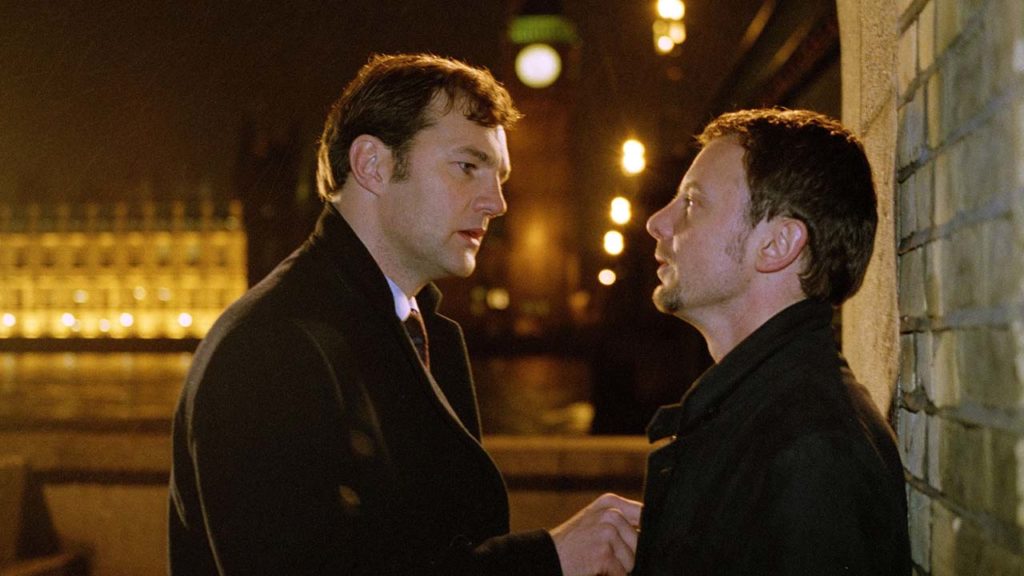
    The 2003 BBC miniseries State of Play is nothing less than six straight hours of intelligent drama, liberally spiced with suspense, action, and tasty plot twists. The entire epic tale is delivered by a veritable plethora of British Isles telly & film who’s who: writer Paul Abbot, director David Yates, and actors David Morrissey, John Simm, Kelly Macdonald, Polly Walker, Bill Nighy, and James McAvoy. Abbot is apparently a superstar television writer in the UK, and Yates directed the last two Harry Potter films (as well as reuniting Nighy and Macdonald in 2005 for The Girl in the Cafe).

    State of Play is an especially good tonic after happening to recently watch the dour The International, which falls more or less into the same genre category. The key differential is a heathy dash of comic relief that never crosses over into farce, mostly supplied by the sublimely quirky Bill Nighy. But more importantly, the intricate tale of high-level political conspiracy feels pertinent.

    Bill Nighy, John Simm, Kelly Macdonald in State of Play
    The Herald newsroom follows the money in State of Play

    The International, although based on an actual banking scandal (a topic that could not be more timely), sabotaged its plausibility by limiting the protagonists to two lone wolfs that take on a crooked multinational financial conglomerate on their lonesome. Here, numerous fleshed-out cops and reporters alternately clash and collaborate as they chase down a gargantuan story.

    State of Play is both a classic newspaper story (like All the President’s Men) and a police procedural (like The French Connection). It’s worth noting that each of these genres are about the piecing together of stories, and the suspense comes from the audience follows along with them as the discover the pieces of the narrative. Granted, the luxurious six-hour running time was a luxury The International could not enjoy.

    David Morrissey & John Simm in State of Play
    The Next Doctor faces off against The Master for the first time

    The details of the plot were undoubtedly timely in 2003 and continue to be now, proven by its American feature film remake in 2009. After suffering through 8 years of a Bush/Cheney administration, Americans can intimately relate to oil companies meddling in governmental operations. Although State of Play is fictional, the affair between a Member of Parliament and a staff member that winds up dead inescapably calls to mind US Representative Gary Condit’s affair intern Chandra Levy, found murdered in 2001. A subplot involving an MP’s compromised expense account now looks even more timely than Abbot could have predicted in 2003, considering the atrocious widespread abuse that currently threatens to remove Gordon Brown and possibly even the Labour Party from power.

    Apart from the sometimes overenthusiastic editing (making the series sometimes feel a bit like the satire Hot Fuzz), the only misstep is Nicholas Hooper’s percussive, bombastic score, including an incongruous didgeridoo-infused theme suddenly introduced in part six. But one of the series’ greatest pleasures is to hear Kelly Macdonald (a crush ever since her unforgettable performance as the ultimate naughty schoolgirl in Trainspotting) pronounce “murder” with all the wonderful extra diphthongs her Scottish accent provides.


    Must read: BBC’s State of Play Left Me in a State of Awe on Pop Culture Nerd

  • The plural of chad is chad in HBO’s Recount

    The plural of chad is chad in HBO’s Recount

    The 2008 HBO television movie Recount dramatizes the traumatic few weeks at the close of the 2000 Presidential election. That hectic time brings back three distinct feelings for this blogger: bewilderment at the founding fathers’ purpose for the Electoral College (as everyone no doubt remembers, it was never in doubt that Al Gore won the popular vote), nausea at the Supreme Court and Bush Campaign’s abrupt circumvention of our democracy, and finally, the sudden omnipresence of this blogger’s first name: chad (defined as “a piece of waste material created by punching cards or tape”). I’ve heard all the jokes, but Recount was able to teach me one new factoid: the “plural of chad is chad.”

    Although a thriller involving presidential politics, its tone is nothing like that of All the President’s Men; not least, everything takes place in sunlight and no one smokes. Director Jay Roach (yes, of the Austin Powers movies) carries things along at a breakneck pace. This is how it probably felt to those on the inside of the Florida hurricane (involving even a little boy from Cuba you might recall was named Elian Gonzales). But for a viewer, it feels like a 2-hour barrage of facts, figures, and dramatic recreations of key events. Perhaps unavoidably, much of the story is told through reams of history and exposition placed into the characters’ mouths.

    Laura Dern in Recount
    Laura Dern as Katherine Harris during her 15 minutes of fame

    Like Oliver Stone’s W., this dramatization of real events provides ample opportunity for famous actors to exercise their skills as impersonators. Most notably, Laura Dern embodies Florida Secretary of State Katherine Harris in all her tacky glory. Harris is unflatteringly depicted as caught in over her head by circumstances. She is vain about her appearance, yet blind to how she is perceived. Baker orders the Republican lobbyist Mac Stipanovich (Bruce McGill) to attach himself to her, to circumvent laws that prohibit the administration from interfering in Florida state matters. It’s an easy task; using flattery, he implies Harris is in control while he’s actually feeding her directives directly from the Bush campaign.

    The early part of the film concerns the fundamental difference of approach between Warren (“Chris”) Christopher (John Hurt) and James Baker (Tom Wilkinson) – both actors affecting convincing American accents. Christopher is a gentleman of the old school, obedient to propriety. Baker, on the other hand, is a ruthless shark willing to play dirty. Christopher is forced to leave the effort due to family matters, and the weight of responsibility falls upon protagonist Ron Klain (Kevin Spacey), General Counsel for the Gore Campaign.

    If true, here’s something I didn’t know: one of the final nails in the coffin of the recount came from no less than Joe Lieberman. In the version of events presented by the film, Lieberman directly interfered in the matter of questionable absentee ballots filed by military service members. The Gore campaign argued that according to the Bush team’s own standards, any improperly submitted ballots shouldn’t be valid. Lieberman initially agreed with the tactic, then wimped out on national television and spoke out against his own campaign, making it seem as if his own people were the ones stooping to underhanded tactics to win.

    Kevin Spacey and Denis Leary in Recount
    Kevin Spacey and Denis Leary as Ron Klain and Michael Whouley

    As a staunch Democrat still simmering over what happened eight years ago, Recount reads to me as very pro-Gore. But I’m curious as to what Bush supporters think of the film. Does it look fair to them? I suppose they might look at Bush Campaign National Counsel Ben Ginsberg (Bob Balaban) and Baker and see two men doing everything they can to support the candidate they believe legally won the election. But when Ginsberg is quoted sneering at Democrats being willing to cheat and steal elections, I wanted to find the real man and spit on his shoe.

    Watching this film brings back all my disgust at the real villain, of course, The Supreme Court. The movie illustrates the heartbreaking catch-22: The Supreme Court paused the recount, causing most Florida counties to miss the deadline, and then saying the recount could not continue because the deadline had passed. And then to rub it in, The Court stated that this particular ruling applied to the current situation only, and could not be applied to any future scenario.

    As Gore Campaign strategist Michael Whouley (Denis Leary) points out for the audience, this is something The Court had never done before in history. I recall from the time that one theory was that the Court perhaps fancied were saving the nation from a brutal blow to its foundations, in the same way that Ford did by pardoning Nixon in 1974. Regardless, the whole situation still smells eight years later.

    The great tragedy is that the more the Gore campaign dug into the system, the more dirt they found. For instance, they uncover irrefutable evidence that thousands of legitimate African American voters were disenfranchised in Florida, but were powerless to do anything about it except weakly hope that it wouldn’t happen again next time. Now, in 2008, when racism matters more than ever, let’s certainly hope it doesn’t.

  • Paul Giamatti and Laura Linney are the second first couple in Tom Hooper’s John Adams

    Paul Giamatti and Laura Linney are the second first couple in Tom Hooper’s John Adams

    This blog celebrates Independence Day 2008 in a New York City Starbucks, tapping out a review of the HBO miniseries John Adams. Believe it or not, the timing is accidental, but July 4th has proven to be an auspicious date in American History. On-and-off-again friends and foes Thomas Jefferson and John Adams both died on the same date, exactly 50 years after the ratification of what they called The Declaration of Independency. The tale sounds too good to be true, and yet it is.

    HBO is back on its game at last, after a period of apparent dormancy following the natural conclusion of flagship original programs Sex and the City and The Sopranos, the premature cancellations of Deadwood and Rome, and the criminal abbreviation of the final season of The Best Television Show Ever Made (sometimes referred to as The Wire). Finely pedigreed, this lavish, over seven-hour miniseries by history buff Tom Hanks’ production company Playtone is based on the biography by David McCullough. However, it fails to reach the epic profundity of The Wire and Deadwood, which in the opinion of this blogger, possibly have more to say about the true nature of the America we have actually inherited from Adams and his contemporaries.

    Paul Giamatti and Laura Linney in John Adams
    America’s second first couple

    This blogger does not consider himself a patriot in the flag-waving sense of the word, and is not especially moved by stories of early American history. However, the dramatization of these legendary events and the characterization of dusty old American heroes were intriguing enough to make me consider picking up a copy of McCullough’s tome. The adult life of John Adams encompassed such elementary school social studies touchstones as the Revolutionary War, the Declaration of Independence, and the Constitution. In short, Adams was not only present during many of the key points in early American history, but a crucial participant. Nevertheless, history has chosen other heroes. As Adams was a statesman and not a military man, and indeed spent most of the Revolutionary War on a frustrating mission abroad in Europe, we don’t see reenactments of such key events as the Boston Tea Party, which one might have expected of a lavish big-budget HBO production. It makes sense, but there is unintentional comedy when a character remarks “Boy, how ’bout that Boston Tea Party last night, huh?” (OK, I admit I’m paraphrasing, but the effect is the same.)

    After the Revolutionary War (waged in part by “godless Hessian mercenaries,” including one of my ancestors, Johannes Schwalm), Adams returned to the States United only to be turned right back around for his appointment to the impossible, thankless job of ambassador to former mortal enemy Great Britain. There’s a brilliantly tense scene in which Adams meets the slightly odd but clearly seething King George III for the first time. When Adams finally came home for good, he suffered persistent criticism at having been safe and coddled in Europe throughout the turmoil at home (it also seems his weight was a favorite talking point of the newspapers). But the miniseries makes clear that the biggest sacrifice made for his duty was the effects of his absence on his family. He loses a son to alcoholism and a son-in-law to naive investments, but on the other hand, his son John Quincy Adams succeeded him as the sixth president.

    Paul Giamatti and David Morse in John Adams
    If I had a dollar for every time…

    As the second president of the States United, Adams and his veep Jefferson both had the same aims: avoid war between France and England at all costs. Adams was stuck in the peculiarly ironic position of having a truce with Britain and antipathy with France, the exact opposite of the nation’s situation during the Revolutionary War. His administration grappled for the first time with many issues that still resonate today, including the concepts of freedom of speech, a deliberate national deficit (as espoused by Alexander Hamilton), and so-called “enemy combatants” (which were, at the time, specifically understood to be French refugees suspected of remaining loyal to an enemy monarchy). Adams reluctantly supported the Alien and Sedition Acts, not because he believed in them (he didn’t) but that he nobly felt it was his duty to stand behind the wishes of the people’s representatives in Congress. During his administration, he and Abigail moved into the partially completed White House, which is shown to have been built by slaves. This blogger should perhaps not have been surprised by this revelation, and yet he was.

    The cast is a veritable showcase for “Hey It’s That Guy”s, providing substantial roles for a parade of familiar character actors — not least headliner Paul Giamatti. In many ways, Thomas Jefferson (Stephen Dillane) is the most interesting, and surprising characterization. As portrayed here, he was a mon who kept his own council and was somewhat shy, far from the loquacious and commanding personalities of many of his contemporaries. Adams, however, correctly perceived the quiet man’s powerful opinions about independence, and drafted him to write the Declaration of Independence.

    Jefferson could also be proud, and his effrontery is priceless as Benjamin Franklin (Tom Wilkinson) quickly produces a red pen to make amendments. Franklin was one of a kind, and indisputably brilliant, but a massive egotist and hedonist. He was technically correct about how to effectively operate as ambassador to France, but it didn’t stop him from selfishly enjoying his job. He gamely played the role of “rustic” in coonskin cap, took mistresses (although Wikipedia does point out he was a widower at the time), lived a life of leisure, and knew when not to discuss politics (which was: most of the time). Originally a friend and ally to Adams, Franklin became an antagonist in France, and Adams appears never to have forgiven him.

    Paul Giamatti and Tom Wilkinson in John Adams
    America’s First Rascal shows John around his crib

    George Washington (David Morse) is portrayed as gruff and humbly diplomatic, but also quite intelligent and perceptive, not to mention physically imposing. He was such a popular hero after the Revolution that his inauguration was a forgone conclusion, but it was later alleged John Adams would have actually won the electoral college vote without a conspiracy to anoint Washington as America’s first hero.

    John’s cousin Samuel Adams (Danny Huston) figures significantly in the Early Continental Congress, and now we can finally see what Sam did to deserve having such a beverage named after him (I kid; actually he really was a brewer on top of all his other achievements).

    One interesting figure this blogger had never heard of was John Dickinson (Zelijko Ivanek). As the representative from Pennsylvania, Dickinson argued passionately against splitting from Britain, and correctly foresaw the Civil War as an inevitable result.

    And finally, there’s a plum role for Laura Linney as Abigail Adams, about as strong a woman as she could have been at the time. At one point, we see her scrubbing the floor with no motion to help from her husband. But clearly it was not just lip service when John Adams late in life claims Abigail was his most trusted advisor.

    Sarah Polley in John Adams
    I apologize for failing to mention Sarah Polley in this article

    In a great scene near the end, an aged Adams dresses down John Trumbull, the painter of “The Declaration of Independence” (now residing in the Capitol building – which was, incidentally, also built by slaves), for historical inaccuracies. Ironically, the scene is an invention, according to Wikipedia, but it seems to have been consistent with Adams’ beliefs and preoccupations. In his retirement, he was concerned that the story of the American Revolution and his own reputation would (or even could) be reported accurately.

    He predicted a romanticized version in which future Americans would believe “Franklin smote the earth with his electrical rod and out came Washington and Jefferson.” It seems he may have been correct; Franklin and Jefferson are heroes to this day, while he remains relatively obscure. It is true that there isn’t much scandal or legend about his character and personality for schoolchildren to latch on to. Jefferson had Monticello and his inventions, and Franklin had his aphorisms and inventions of his own. One other reason Adams is not exactly a popular hero is that he first made himself known for defending English soldiers accused of perpetuating an unprovoked massacre. The defense attorney was never a much-loved profession, but set an early precedent for lawyers becoming presidents.

    Finally, two smaller observations: The miniseries was partially filmed in Colonial Williamsburg, but many other locations were realized with superlative special effects. Beyond the obvious recreations of old Boston and Philadelphia, the DVD bonus features reveal that certain shots I never questioned, such as Adams ascending the staircase to a impressive European mansion, were in fact partly copmputer-generated. Also of interest is the gruesome contemporary medicine: exsanguination, inoculation, and mastectomy, all without anesthesia.

  • It’s the end of the world in Michael Crichton’s The Andromeda Strain

    It’s the end of the world in Michael Crichton’s The Andromeda Strain

    Michael Crichton’s novel The Andromeda Strain was first adapted into a feature film in 1971, and now into a television miniseries from executive producers Tony and Ridley Scott. This 2008 incarnation is part feel-bad thriller, part wish fulfillment. As we thrill to the speculative illustration of how civilization might suddenly come to an end, we also can only hope the government does in fact have an elaborate and high-tech procedure in place for identifying and containing new contagious disease outbreaks.

    The original book is only nominally about a supervirus, evidently of extraterrestrial origin, that threatens the human race. It is actually more about how intelligent, well-meaning people can make subtle errors of judgement that may cascade into catastrophe. Chrichton would also employ Chaos Theory as a key theme in his Jurassic Park novels.

    The Andromeda Strain
    Good times, good times

    But the miniseries complicates this interesting theme with added government venality (a basically honorable president is undercut by a corrupt chief of staff), the media (a drug addicted reporter breaks the cover-up), and the environment (strip mining of the ocean floor leads to the crisis). To give but one example of the diminishing returns: in the book, a simple unnoticed glitch in a supposedly perfect computer system causes a dangerous communication blackout at the worst possible time. It’s both more plausible and more suspenseful than the miniseries version of events, in which General Mancheck (Andre Braugher) deliberately creates the blackout, to everyone’s mild and temporary frustration.

    The book is not without its flaws, particularly an undramatic ending in which the continuously adapting virus eventually mutates into harmlessness. But the miniseries disappoints by giving the virus a definitive origin, indicating it is expressly targeted towards humans, and showing its definitive defeat.

    The Andromeda Strain
    The Andromeda Strain cast checks in for the long haul

    Miscellaneous other thoughts:

    • Mikael Salomon’s direction is very boring and staid, except for a wildly over-the-top decontamination procedure that is filmed in a stylized, almost erotic fashion.
    • The miniseries is probably one of the talkiest sci-fi movies and/or TV shows I’ve ever seen. The bulk of the action is set in a single interior location, and nearly every scene comprises heated conversations in laboratories or over teleconferences.
    • The miniseries is laden with even more pseudoscientific bullshit than Crichton’s original novel: wormhole-enabled time travel and nanotech buckyballs from the future are the order of the day. The whole thing ends in the kind of temporal paradox that would drive an episode of Doctor Who or Star Trek.
    • The miniseries updates the book’s euphemism of “unmarried man” into “don’t ask don’t tell” territory, for a subplot involving Major Keane (Rick Schroder).
    • Spot the homage to Hitchcock’s The Birds!
    • Why does the underground facility begin to disintegrate during the run-up to setting off an atom bomb? Wouldn’t there just be a countdown and then an explosion?
    • This blogger, a longtime fan of the TV show Lost, is happy to see Daniel Dae Kim in a starring role.
    • Benjamin Bratt is really terrible, giving the proverbial phone-it-in performance. He delivers every line with the same intonation, whether it’s saying goodbye to his family for possibly the last time or announcing humanity’s first discovery of an alien life form.
  • Kelly Macdonald and Bill Nighy bond over extreme poverty in The Girl in the Café

    Kelly Macdonald and Bill Nighy bond over extreme poverty in The Girl in the Café

    Richard Curtis and David Yates’ The Girl in the Café, a BBC movie aired in the US on HBO, was incredibly cute, and my heartstrings were indeed pulled, but I couldn’t shake the sense the love story was mere dressing for the real purpose of the film: explicating the issue of extreme poverty to help warm the public up for Live 8. Of course, I feel heartless for criticizing this aspect of it.

    Plus, the age difference between Bill Nighy and Kelly Macdonald was so vast that — forget about their characters’ conflict over whether to battle or defer to stubborn politicians — it’s an issue unto itself. But if possible to overlook that, it’s a perfectly charming and lovely movie.

    Reykjavik should hereby pass an ordinance decreeing its name shall heretoforth be spoken only in Macdonald’s Scottish accent.

  • My Eyes Bleed

    My Eyes Bleed

    After an entire summer of no TV at all (Netflix, like Ben & Jerry’s, doesn’t count), I watched three hours in a row tonight and my eyes are still uncrossing. Everybody knows the old saw about television being the opiate of the masses (opium must flourish in vast wastelands). But when exactly did TV’s drug metaphor of choice change to crack?

    Lost

    Gone are the days of The A-Team, where one could switch on any random episode and know immediately what’s going on. Lost, like kissing-cousin action/dramas Alias and 24, depends at least as much on plot continuity as character development. Not coincidentally, these are the only three shows I watch.

    I’m passing on 24 this year, because no matter how exciting the plotting, the politics became too unpalatable for me. The overarching theme of the entire last season boils down to the following: torture is a great tool for fighting terrorism. OK… I might listen to such an argument… if our inept intelligence community ever manages to catch a terrorist BEFORE striking! Please, give me a break. And making fun of Amnesty International was just wrong. Can you tell I’m angry?.

    I’ve yet to decide if I’m going to commit to another whole year of Alias. No matter how sexy Lena Olin is, the show has lost its fun plot-driven nature and converted into a more typical wing-it-week-by-week format. So that leaves Lost, the only one of the three about which I’ve actually been impatient all summer.

    Like any good drug, with everything Lost gives, it only demands more. The addictive nature of the show is to eke out information in tiny little dimebags… I mean, pieces. So I’ve waited all summer for the answer to countless questions, at least one of which was “answered” tonight. I put that in scare quotes because all it did was metastasize the number of questions to absurd proportions. But disappointingly, I found it a bit of a cheat to discover the contents of the hatch to be a new character introduced just 5 minutes before. Where’s the suspense in that? Imagine if it had been Jack’s father or fiance instead. Wouldn’t you just have jumped out of your chair? OK, maybe just junkies like me.

    To add a little spice to the evening, the local ABC news affiliate broke in repeatedly to keep us informed on a Jet Blue plane making an emergency landing with its landing gear twisted sideways. Would they have been so morbidly enthusiastic about the story if Lost wasn’t about the survivors of a plane crash? And just to top all the breathless action off, we’re treated to a Jet Blue commercial! Oops… awkward! (Aside: my friend Dave helpfully suggested they should simply land sideways. Thanks Dave!)

    Invasion

    Uh… so? In short, this one did nothing for me. I guess they figured keeping “of the Body Snatchers” in the title added up to too many syllables.