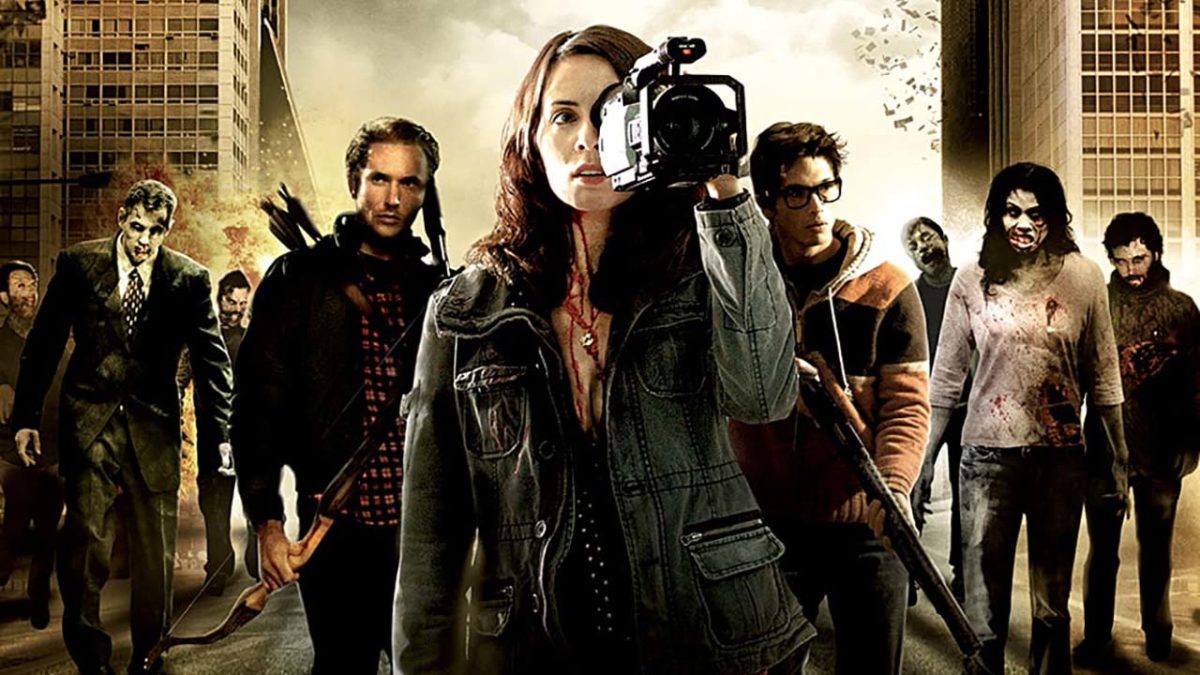
Quarantine, remade by director John Erick Dowdle (co-written with brother Drew) from the Spanish movie REC (2007), follows in the now-firmly established horror fauxmentary tradition. Previous entries Blair Witch Project, Diary of the Dead, and Cloverfield are all ostensibly comprised of found footage recovered from cameras found at the scenes of horrific disasters. Quarantine‘s only wrinkle is that, unlike its predecessors, this pretense is not explained as such on screen. Quarantine‘s conceit is that we’re watching raw footage, edited in-camera, abandoned by the late characters themselves. There are no implied, unseen survivors that picked up the pieces.
Cloverfield never provided a convincing psychological motivation to explain why its cinematographer would keep his camcorder running throughout his desperate flight from toxic alien creatures swarming across Manhattan. A much more intelligent examination of an obsession to capture everything on video came from the less expected source of none other than the zombie godfather himself, George A. Romero. His underrated Diary of the Dead features a group of young film students with pretensions to becoming great documentarian filmmakers, and what better subject to document than their own first-hand experiences during a zombie outbreak? Although Cloverfield had significantly greater budgetary resources at its disposal to create eerily realistic images of Manhattan crumbling beneath the feet of a Godzilla-like monster, Quarantine follows in the more modest footsteps of Diary of the Dead in striving for greater psychological realism.
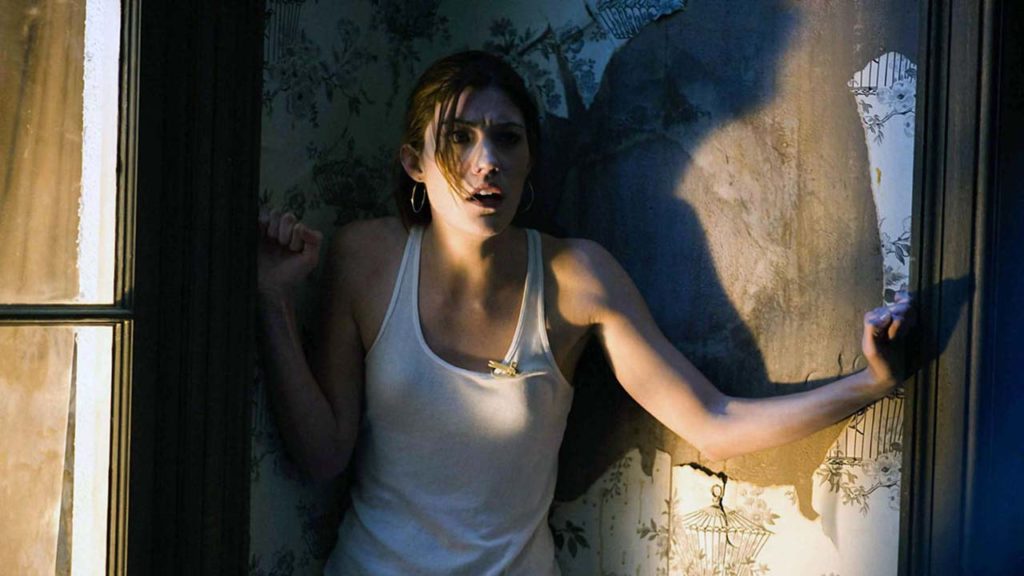
In story terms, the justifications for Quarantine‘s characters to keep filming continually evolve as their circumstances worsen. Like Romero’s Dawn of the Dead, Quarantine features members of the press as main characters. The first full 12 minutes are devoted to reporter Angela Vidal (Jennifer Carpenter) and cameraman Scott Percival (Steve Harris) shooting a television news segment on a local fire department. By the time an emergency finally arrives and the duo hitches a ride along to the scene, we’ve become fully endeared to the bubbly, spunky reporter and the charmingly filthy firefighters. As the routine investigation turns into a confrontation with a feral-seeming elderly woman, Angela senses the opportunity to score some sensational footage. It’s clear she fancies herself a more serious reporter.
In true horror movie fashion, Angela (Jennifer Carpenter) sheds layers of clothing throughout her ordeal
Later, as the elderly woman is revealed to be patient zero for a new highly contagious disease, the Los Angeles Center for Communicable Disease quickly quarantines the building, cutting off all their communications and falsely reporting to the public that it has been evacuated. The trapped tenants are a random assortment of Los Angelans: an opera tutor and his hot young live-in protege, a veterinarian, a cleaning woman, a mom and her baby (whom we meet again near the end of the film, in horrifying transformed fashion), toy dogs, an immigrant couple, and… what’s missing? That’s right! If this is L.A., where are all the unemployed actors?
Building manager Yuri (Rade Serbedzija) keeps conveniently remembering exits (including a back door and a basement entry to a sewer), but all are blocked. By this point, Angela has morphed into a righteous crusader wanting more footage as proof of the city’s outrage against justice and human rights. But when the virus spreads to most of the people trapped in the building, the power goes off, and panic truly sets in, Angela’s motivations switch to pure survival. The camera now only proves useful as a source of light, and anything captured on video happens by chance as they frantically navigate through the corridors. Then, in true horror movie fashion, things get even worse. In a scene rivaling the nail-biting basement sequence in Silence of the Lambs, Angela and Scott find themselves barricaded in a pitch-black attic with their camera’s lamp broken. The remainder of the movie is seen through the greenish haze of their night-vision filter.
While Quarantine may seem to tip its hat to horror tradition as protagonist Angela sheds layers of clothing over the course of her ordeal, the movie is actually quite subversive in showing her lose her spirit. Atypically for a horror movie protagonist, she is no plucky survivor that defeats the menace. She pretty much just breaks down.
ground floor, coming up
Quarantine may be yet another in a long line of zombie flicks, but I would argue its true genre identity is as an urban nightmare. Cloverfield relived 9/11 in the form of another Godzilla and its highly toxic babies, and Guillermo Del Toro’s Mimic envisioned swarms of giant cockroaches breeding in abandoned subway stations. Quarantine touches on another deep anxiety of urban dwellers: a viral contagion born of city filth. The entire outbreak plays out in the confines of an aging tenement building (with what seems to be a clothing sweatshop hidden in the back), a place many city slickers might recognize as home.
What made Quarantine the most frightening for me in particular was not the gore or the booga-booga scare factor, but rather the disturbing plausibility of its fictional disease. In reality, all we hear about are the dangers of diseases like HIV jumping from bushmeat to humans, and the avian or swine flu incubating in impoverished nations where people live in close quarters with animals. What about those of us living in developed, supposedly civilized cites, full of dogs, roaches, rats, and yes, a certain number of crazy nutjobs?
A hyper-evolved form of the rabies virus is the most plausible pseudo-scientific explanation I’ve yet heard for zombies, especially compared to the vaguely described Venusian radiation in Romero’s Night of the Living Dead. Like the “superflu” in Stephen King’s The Stand and the distilled “rage” virus in Danny Boyle’s 28 Days Later, this strain of rabies was genetically engineered by a lone terrorist holed up in the attic of the tenement. An ominous clue is dropped halfway through the film about an unaccounted-for tenant living in the attic. When we finally meet him, he appears to have been infected for quite some time. Blind and emaciated, he scrambles around in the total darkness of his former home and laboratory (scattered with disgusting medical photos and newspaper clippings about Doomsday Cults).
The creepy figure is played by the unusually tall and slender Doug Jones, most recently seen as the Silver Surfer in Fantastic Four and Abe Sapien in Hellboy. I worked on the official website for Guillermo Del Toro’s marvelous Pan’s Labyrinth, for which Jones was interviewed about his experiences playing The Faun and The Pale Man; for someone that so typically plays monsters, he’s a super-nice, funny, and charming dude. I skimmed through the bonus features on the Quarantine DVD, and it’s a crying shame that he apparently wasn’t interviewed.
In place of a musical score, Quarantine features a complex sound design built around an eerily creaking, groaning old building. It also forgoes other standard movie pleasures, being a gruesome, depressing, and punishing experience. In that respect, it’s similar to how the nauseatingly (literally) bleak Blindness. In contrast, the sublime Children of Men is the rare movie nightmare set at the brink of the end of humanity that nevertheless carries a spark of uplift and hope.
Bill Maher, standup comedian and star of Cannibal Women in the Avocado Jungle of Death, remade himself into a satirical political pundit on the cable TV shows Politically Incorrect and Real Time. He most famously spoke truth to power when he defied the conventional wisdom after 9/11 and correctly stated that one thing the perpetrators were not were cowards. Not surprisingly, he was swiftly fired by Comedy Central. Had he stopped there, his arguable legacy would have been to blaze the trail for the likes of Jon Stewart and Stephen Colbert to crossover from the gutter of comedy to mainstream political punditry. Maher’s peer Al Franken went even further, from heckler to actual politician.
But Maher was not content to stop there. His latest incarnation is, for better or worse, the popular face of a growing movement against organized religion. Unlike the rational scientist Richard Dawkins (mostly rational, that is; his recent statements against children’s fantasy literature like Harry Potter reveal him to be at best a killjoy and at worst a censor) and the even more strident Christopher Hitchens, Maher uses comedy and outright mockery to advance the cause of atheism in the sometimes disturbingly theocratic American society. Are we sure Maher and his movie Religulous are really what atheists need to combat the encroachment of church upon state? As Michael Moore is to liberals, so too may Maher be to atheists everywhere: maybe not the best spokesperson.
Religulous teams Maher with director Larry Charles, also responsible for the high-concept low art Borat: Cultural Learnings of America for Make Benefit Glorious Nation of Kazakhstan (2006) and Brüno (2009). While Borat and Brüno fall on the fauxmentary end of the continuum, Religulous skirts with being an actual documentary but stops short of pretensions to impartiality.
Maher and Charles talk their way into enemy territory like the Holy Land Experience theme park in Orlando, the Creation Museum in Kentucky (a temple to the denial of basic science that would be hilarious were it not such an astounding celebration of willful ignorance), and the Truckers’ Chapel in Raleigh. Maher and Charles may have used subterfuge to gain access, but the finished film is open about their deception. The filmmakers openly brag over such stunts by proudly including footage of the Holy Land Experience’s publicist freaking out at the presence of a bunch of godless liberals armed with a camera. All of this attitude is actually not necessary; the film is at its best when Maher allows his interviewees to simply talk their way into deep graves (which most of these intolerant ignoramuses do with great gusto).
And on the third day, Jesus went to Orlando
My biggest issue with the movie is its use of satirical editorial juxtaposition that on at least one occasion is outright racist. I agree it’s fun to snicker at clips of cheesy old biblical movies, easy to mock the nauseatingly confused “former homosexual” Pastor John Wescott of Exchange Ministries with snippets of gay porn, and chuckle at the bald scam being run by José Luis de Jesús, a pastor from Puerto Rico claiming to be the direct descendent of Jesus Christ. But Maher refers to African American preacher Pastor Jeremiah Cummings’ gold jewelry as “bling” and intercuts footage of a comically stereotypical pimp. Wescott is obviously in deep denial, and Cummings and Miranda are despicable con artists out for nothing but their own profit, but such cheapshots are uncalled for.
In the midst of all this fervent madness, it’s somewhat surprising that the Catholic Church and even the Vatican itself come across as the most enlightened. Maher is kicked out of the Vatican proper, but meets with the supremely sane and rational Father George Coyne, head of the Vatican observatory. Coyne is one man of the cloth, at least, that does not deny science or celebrate ignorance. Maher also strikes interview gold with the hilariously outspoken former Vatican scholar Father Reginald Foster.
The plot thickens! Maher does not actually self-identify as an atheist. As he told The Onion’s A.V. Club:
I’m not an atheist. There’s a really big difference between an atheist and someone who just doesn’t believe in religion. Religion to me is a bureaucracy between man and God that I don’t need. But I’m not an atheist, no. I believe there’s some force. If you want to call it God… I don’t believe God is a single parent who writes books.
Bill Maher, to The A.V. Club
Whether Maher positions himself as an atheist or merely a crusader against oppressive organized religion, he takes a kind of gleeful pride in it. Smug atheists can be just as insufferable as holier-than-thou theists. Even before becoming a self-appointed voice against religion, Maher had become somewhat infamous for louche behavior (dating and sometimes marrying strippers, frequenting the Playboy Mansion, etc.). His outspoken opinions and tabloid-ready behavior probably don’t help theists take him seriously.
I imagine most fundamentalists picture atheists as being a lot like Maher: proud, condescending, and avoiding the responsibility that comes with religious-derived morals (in other words, not having the threat of eternal damnation in hell to motivate one to not sin). What I think believers need to understand is many people arrive at atheism only after protracted periods of difficult soul searching, and aren’t necessarily smug about it.
Religulous may be preaching to the converted, but it can’t ever hurt to keep the pressure on those that would oppress and exploit others by claiming to have the ear of God.
The Flaming Lips are an odd band to have achieved mainstream success. After years of noncommercial psychedelic art-rock experimentation like the four-disc Zaireeka (1997), they broke through to mass appeal with The Soft Bulletin (1999) and Yoshimi Battles the Pink Robots (2002). The latter features the finest existential love song to ever become the official rock song of Oklahoma:
Do you realize that everyone you know someday will die And instead of saying all of your goodbyes, let them know You realize that life goes fast It’s hard to make the good things last You realize the sun doesn’t go down It’s just an illusion caused by the world spinning round
“Do You Realize??”, The Flaming Lips
The Lips also have more ambition than most of their contemporaries when it comes to the audiovisual aspects of a rock group’s responsibilities. They were inspired by how some of their forebears did more than contract third parties to film them live in concert or to direct hagiographic documentaries. The Beatles (A Hard Day’s Night, Help!, Yellow Submarine), The Who (Tommy, Quadrophenia), and Pink Floyd (The Wall) all made feature films that deserve to be considered among their canonical audio-only discography. As Lips frontman Wayne Coyne told Pitchfork:
we’d always talked about how the Flaming Lips should have a movie, like the Ramones have a movie, or the Beatles. Not in a pretentious way, just like, “Yeah! We should have a movie!” We thought, “Well, why not? We’ll just sort of make one and see what happens.”
Wayne Coyne
They began talking up Christmas on Mars years ago, and the longer the delay, the greater the legend. It was rumored to be either an expensive folly on the scale of Axl Rose’s album Chinese Democracy (in production for 14 years for a budget of $13 million) or an elaborate meta joke. But in fact, the Lips did in all seriousness work on the project off and on for about seven years. They produced the whole thing in their stomping grounds of Oklahoma City, mostly around Coyne’s own home. For better or for worse, it’s entirely their vision, written and co-directed by Coyne, with Bradley Beesley (who directed several of the band’s music videos) and George Salisbury.
The Alien Super-Being gets great reception
Surely Coyne & co. must have been familiar with the infamous b-movie Santa Claus Conquers the Martians (1964). The spectacularly awful movie was hilariously massacred on both Mystery Science Theater 3000 in 1991 and by Cinematic Titanic in 2008. Like this ignoble predecessor, Christmas on Mars is saddled with long sequences of bad dialogue delivered poorly by amateur actors. Even cameos by the Lips’ pals Fred Armisen and Adam Goldberg are really awkward.
Partly inspired by the psychedelia of Stanley Kubrick’s 2001: A Space Odyssey, Christmas on Mars actually owes more to the blue-collar atmosphere of Ridley Scott’s Alien. The humans characters are ordinary people in an extraordinary locale, struggling to survive. One year prior, humanity has established a dilapidated space station on Mars. Worse, the crew members are slowly going mad and suffering hallucinations. As they conclude, man is not meant to live in space. The sole purpose of the colony, other than constantly repairing its decaying infrastructure, seems to be to support a test-tube baby due on midnight, Christmas Eve. The only woman on the station lives in a bubble, feeding the baby through a tube grafted into her belly.
Major Syrtis (Lips member Steven Drozd) has taken it upon himself to organize a Christmas Pageant to raise morale. He is in fact partially responsible for their current predicament, as he apparently sacrificed storage space to cart some Christmas accoutrements to Mars, a decision that has near-fatal consequences for the colony. The colony’s only source for happiness is very nearly ruined when his chosen Santa commits suicide.
The Lips discretely invite you to enhance your viewing experience in whatever manner you choose
The Alien Super-Being (Coyne) lands nearby in a spherical spacecraft, which conveniently shrinks to a size suitable to be swallowed until he needs it again. Even though Coyne wrote the script, and is quite a talker if the DVD’s bonus interviews are to be judged, the role he assigned himself has no dialogue. He fills Santa’s shoes and repairs both Syrtis’s busted snow machine and the colony itself. He saves Christmas and allows the baby to be born.
Far more interesting are the beautiful optical special effects (at least, I assume they’re optical – if they actually are digital, they’re uncommonly beautiful). Some of the abstract psychedelia was so freaky I feared it might burn out my aging television. Most curious is the strange preoccupation with vaginal imagery. The Alien Super-Being passes in and out of his spaceship through a vaginal portal. Syrtis hallucinates a visiting spaceman with a pulsating genitalia for a face, and later dreams of an entire marching band with similar orifices in place of faces (say that ten times quickly).
A pre-movie sequence advises viewers to have sex, smoke pot, or just do whatever they like while watching the movie. This boring blogger dared to disobey these instructions and simply watched it alone at home, stone cold sober. Not to put too fine a point on it, I suspect Christmas on Mars is one of those things best experienced in an altered state.
Strictly speaking, Baz Luhrmann has made only one musical, the guilty pleasure Moulin Rouge (2001). But, last seen directing Puccini’s opera La bohème on Broadway, he can’t seem to resist the genre. Strictly Ballroom (1992), Romeo + Juliet (1996), and now Australia all incorporate key elements of the musical: exaggerated emoting, spectacle, and especially, songs. Australia directly quotes whole numbers from The Wizard of Oz, but is actually better described not as Luhrmann’s Oz but as his Gone With the Wind. Which is to say, it’s an overlong costume drama faintly condescending towards its non-white characters and preoccupied with the epic spectacle of cities burning during wartime.
Australia‘s biggest flaw is structural, being essentially two discrete movies featuring the same characters. Imagine a double feature of a movie and its sequel, smashed together into one. The first half concerns the Australian market for cattle needed to support the Allies’ war effort. Englishwoman Lady Ashley (Nicole Kidman – a native Aussie who even here has to affect an accent) owns a small ranch in the outback, and believes her absent husband is cheating on her. She travels down under to sell the land in order to pay down debt, but also to rid her husband of what she imagines to be his adulterous refuge. There, she learns he has been murdered by the monopolizing “King” Carney’s (Bryan Brown) henchman Neil Fletcher (David Wenham, Faramir in Lord of the Rings).
Blast it! This war is a spot of bother.
She meets the hunky Drover (Hugh Jackman), a man whose name is his job, whose job is his name, and the sort of fictional Australian that actually says “Crikey” (q.v. Crocodile Dundee). Audience members interested in the beefcake factor will be delighted to see Jackman has built up his body to a size even bigger than for the Canadian mutant superhero Wolverine in three (soon to be four) X-Men films (although the neck-to-head ratio threatens to tip over into freakish territory). Lady Ashley also befriends the film’s narrator, the young “half-caste” boy Nullah (Brandon Walters). Nullah spent most of the movie thoroughly annoying the hell out of me as he shouts out the name “Drover! Yay Drover! Drover, Drover, Drover, yay!” over and over and over again. Ugh.
Nullah’s grandfather, a mystical Aboriginal known as King George (David Gulpilil), has been framed for Lord Ashley’s murder. He watches over Nullah from afar, and encourages him to become a storyteller. The fact that we are being told this story by a little boy to some degree explains and excuses the cast’s hammy mugging and how, on the whole, everyone seems to take death pretty well. After losing Lady Ashley’s husband and Nullah’s mother, our gang of heroes is only really upset by the death of Kipling Flynn (Jack Thompson), an alcoholic collaborating with Carney. They are moved perhaps because he is given a chance to redeem himself right in front of them (as opposed to, say, an innocent person dying offscreen).
Crikey! Get along, little wallabies!
Lady Ashely finds she can make more money by tending the ranch and selling its cattle. Not to mention to effect a trifold moral victory: avenging her husband’s murder, beating the local monopoly, and righting a whole host of injustices made against the little boy. Nullah’s white father sexually exploited and murdered his mother, and if that weren’t trouble enough, the state wishes to abduct her and “breed the black out of her.” Such was official Australian policy until the 1970s; for a much better film along these themes see Phillip Noyce’s hugely affecting Rabbit Proof Fence (2002).
All this fuss and to-do is largely resolved and winds down about 1 hour and forty minutes in, the length of a typical movie. But Australia is no typical movie, and has about another hour and half to go. The happy surrogate family living together on the ranch must work itself all the way back up into an all-new conflict: the return of the villainous Fletcher for his revenge. The turmoil of World War II is reduced to an arbitrary inconvenience to the characters as they fight to restore their new makeshift family.
The movie is full of not-always-convincing computer-generated spectacle like cattle stampedes and Japanese kamikaze attacks. But one fleeting little shot caught my eye and reminded me why I like Luhrmann so much. Watch for a brief moment as a velvet curtain drops, and Luhrmann invisibly cuts to the reverse angle. Classy and cool.
Director Julian Jarrold’s lavish period piece Brideshead Revisited trots the globe like a genteel James Bond adventure, visiting London, Venice, and Morocco, but especially the opulent Castle Howard. From the perspective of an ignoramus that hasn’t read Evelyn Waugh’s 1945 novel, this compressed version of what I imagine to be a grander prose narrative doesn’t much fit the traditional structure of a feature-length movie. For instance, a major character disappears halfway through, and the internal contradiction of another’s stunted emotional life versus his grasping desires is not a very cinematic subject.
The voraciously ambitious Charles Ryder (Matthew Goode) is the only child of a bitter, sarcastic, widowed father. He leaves his emotionally stifling home behind to study history at Oxford. His true aspirations are to be a painter, even though the chilly atheist does not seem to posses the rich emotional life of an artist. His middle-class London fashions divide him from his new upper-class peers, but from his first arrival on campus, he feels immediately drawn to the “sodomites.” As we learn more about Charles, we see that he does not so much share their sexuality as he is fascinated by their outwardly dramatic, emotionally honest natures, and considerable wealth – none of which he posesses. Curiously, Goode’s most recent screen appearance is as the similarly emotionless and sexually ambiguous Ozymandias in Watchmen.
“My loves, my hates, down even to my deepest desires; I can no longer say whether these emotions are my own, or stolen from those others we desperately wish to be”
One among Charles’ new friends is equally hungry to attach himself to him in return. The alcoholic, infantile Sebastian (Ben Whishaw) has more love for his teddy bear and housekeeper than for his extremely Roman Catholic mother Lady Marchmain (Emma Thompson, whose role is not much more than a cameo, despite being featured front and center in the poster). Charles is awestruck by the wealth and opulence of Sebastian’s vast family estate Brideshead. As they pass through the chapel, the staunchly atheist Charles mimics his host and genuflects. Sebastian upbraids him, for not only is he from another social class altogether, worse, he is not Catholic. Charles first exposes the essential nature of his character when he replies that he was “just trying to fit in.”
But just as Charles’ cold home was defined by an unloving patriarch, Brideshead is blanketed by Lady Marchmain’s oppressive miasma of Catholic guilt. Lord Marchmain (Michael Gambon) escaped by decamping to Venice, where Catholics are a bit more liberal: they live their lives as they wish, and simply confess their sins away when necessary. At first, it seems only Lord Marchmain’s mistress Cara (Greta Scacchi) understands the situation: this homosexual dalliance is just a phase for Charles, but Sebastian is truly in love with him.
We later learn that Lady Marchmain, whom one might assume would be blinkered by her pious faith, is fully aware of her son’s pain. She also gives an even more astute analysis of what drives Charles to attach himself to the family: “You’re so desperate to be liked, Charles.”
“Drinking is not a hobby, Sebastian.”
Charles is able to psychoanalyze himself in the end: “did I want too much?” All his actions are driven by desire: for the affections of the Oxford gay clique, to reside in Brideshead, to marry Sebastian’s sister Julia (Hayley Atwell), and to be praised by high society as a painter. But Charles is icily detached, with a notable lack of emotion and empathy. He calmly divorces his wife offscreen, in order to marry Julia and become lord of Brideshead.
But as her family gives the sacrament of last rites to Lord Marchmain against his wishes, she perceives a miracle as he relents and reaccepts his faith in his final moments. Her own faith is rekindled and she rejects Charles. In the end, his actions have marked the final generation of the family, and that the desirous manse will be left to no one.
Director Fernando Meirelles has examined desperate pressure cookers (City of God) and institutional corruption (The Constant Gardener) before. Blindness proves perfect to meld both themes, with a science fiction twist imagining the downfall of civilization itself.
Blindness is part of a special subset of the horror/sci-fi/disaster genre: the dystopian end-of-civilization nightmare. Whereas the typical entry works by introducing a disrupting element into the status quo (typically a monster), a few instead subtract one fundamental fact of life that we take for granted. The basic recipe is simple: flip one switch, and watch civilization fall in short order. In Children of Men, humanity becomes infertile. In The Happening, the biosphere starts pumping out poison. In the comic book series Y: The Last Man, all males on the planet suddenly die off. In innumerable zombie flicks death is no longer absolute. It may not be a coincidence that at least two members of the Blindness cast already have relevant experience on their resumes: Julianne Moore in Children of Men and Alice Braga in I Am Legend.
“The only thing more terrifying than blindness is being the only one who can see.”
All of these stories bleed over into the genre realms of science fiction and horror. Blindness, however, is based on the magical realist (if it’s accurate for me to call it that) novel by Jose Saramago. The novel is set in a generic city, featuring unnamed characters (the movie, filmed in Sao Paulo, Brazil, effectively preserves both conceits – I didn’t notice until the credits rolled that the characters did not have names). Without getting bogged down in pseudo-scientific details, Zaramago posits a highly contagious “White Blindness” that rapidly sweeps the globe, affecting everyone but one random woman. The movie’s explanation is a far more literal highly communicable disease, diagnosed for the audience by the unnamed opthamologist “Doctor” (Mark Ruffalo). By sheer coincidence, The Doctor’s Wife (Moore) appears to be immune.
The obvious challenge for the filmmakers is how to render a prose story about blindness into the most visual storytelling medium of all. Cinematographer César Charlone (who also shot City of God and The Constant Gardener) meets the challenge by creating stunning visuals which paradoxically obscure. The picture frequently flares into a burned-out whiteness, often a relief from the ugly filth in which the characters find themselves living as the safety net of society collapses.
The story brutally details a basically pessimistic view of human nature. Right from the start, humanity’s inherent greed and avarice make a catastrophic situation worse. The very first victim of the disease is immediately exploited by a car thief (ironic, as automobiles are shortly to become the most futile of valuables to steal). As the blindness disease spreads, the authorities (represented by The Minister of Health, in what amounts to a cameo by Sandra Oh) attempt to contain the infected in isolation wards, a weak euphemism for concentration camps. As The Man With the Black Eye Patch (Danny Glover) states in a nicely written but implausibly eloquent monologue, “the disease was immune to bureaucracy.”
“I know that part inside you with no name, and that’s who we are, right?”
The infected are made up of characters from many cultural and economic backgrounds, much like Alejandro González Iñárritu’s Babel (2006). Left alone to self-organize, two opposing societies coalesce around two very different natural leaders. The Doctor and his Wife create a fragile but functioning democracy, but the King of Ward Three (Gael Garcia Bernal) forges a depraved Sodom built on exploiting their few resources for short-term base pleasures. Inevitably, the two fledgling states go to war, as much out of ideology as for want of resources.
As the ward denizens’ circumstances get worse and worse, the movie itself becomes a punishing experience to watch (an imitative fallacy). In terms of depictions of violence, it is no less explicit than, say, Children of Men, but wholly lacks that superior film’s dark wit and essential thread of hope. Whereas Children of Men had no real villain (Luke, Chiwetel Ejiofor, was actually more of a Che Guevarra-type revolutionary), there is little or no subtlety of character in Blindness‘ wholly evil bad guys. Would the central allegory be more interesting to ponder if the villains were not so unambiguously monstrous? Even I Am Legend dropped hints that its vampire/zombie-like monsters possessed crude intelligence, a will to live, and empathy for their own kind.
The fragile community in the wards disintegrates into a hell of gang rape and open war. Then, amazingly, it gets worse. But as the walls of the prison burn, the prisoners discover the doors have actually been left open. If anything, the world outside has become worse off than the pressure cooker in which they were imprisoned. After a harrowing trip through the devastated city, they experience one fleeting moment of joy as they bathe in the rain. Afterwards, they set up an eden in the Doctor and his Wife’s former home, like a less-satiric version of the fortified suburban shopping mall in George A. Romero’s Dawn of the Dead. The Doctor’s Wife’s newly extended family embraces her as their “leader with vision.”
I was right to worry. Zack Snyder’s Watchmen movie is indeed a sexed-up and dumbed-down shadow of the richly multi-layered graphic novel by Alan Moore and Dave Gibbons.
I’ve already unleashed my pent-up anxieties about the then-forthcoming movie in 10 Reasons the Watchmen Movie Will Suck). Now that the notably long-gestating and troubled production is finally out in the wild, I’m puzzled why so many comics fans utterly adore it (q.v. Wil Weaton and AintItCoolNews), while mainstream film critics are competing to deliver the most vicious teardown (q.v. The New Yorker and The Hollywood Reporter). The exception to the rule is the always-unpredictable (bless him) Roger Ebert, who gave the “powerful experience” four out of four stars.
As a lifelong comics fan, I ought to naturally fall into the first camp, but I cannot relate to geeks like Kevin Smith, for whom, after spending decades anxiously pining to see Watchmen playacted on the big screen, found the result “fucking astounding” and “joygasmic.” Endlessly fascinated by the original, I personally never even wanted a Watchmen movie in the first place. But as a lover of both comics and movies, I felt obligated to suffer through it.
My aforementioned rant also repeated the old saw that Watchmen is the Citizen Kane of comics, and attempting to adapt it into another medium is folly. What is important about the example of Citizen Kane in particular isn’t so much its characters or incident, but rather how the story is told. As Welles did to movies in 1941, Moore did to comics in 1986: stretching, bending, or breaking every so-called rule of comics, and revolutionizing how the medium could be used to tell stories. Like Welles, Moore didn’t invent the many storytelling devices he used: including scrambled chronology (flashbacks nestled within flashbacks – not just as a storytelling device but a key insight into how one character perceives reality), mixing of media (prose pieces expand the story), and stories-within-stories (the embedded Tales of the Black Freighter comic book that foreshadows a cataclysmic ending). Watchmen is in essence a book, not a movie.
Nite Owl might have some trouble doing up the snaps on his super suit
Robert Rodriguez and Frank Miller’s Sin City inaugurated the recent trend of treating comic books not just as raw story material but as actual storyboards. But whereas Snyder had room to expand the story of Frank Miller’s relatively short graphic novel 300 into his previous film, Watchmen is a massive beast of a book that only realistically had to be brutally cut and/or significantly altered to squeeze into a roughly two-hour motion picture narrative. Maybe, just maybe, that’s exactly what Snyder should have done: radically reinvent the story to fit another medium. Instead, he created a slavishly accurate translation that comics fanboys like Wheaton, Smith, and Ain’t It Cool News apparently thought they somehow deserved.
In the end, Snyder and screenwriters David Hayter and Alex Tse did make numerous cuts, many out of simple necessity. Some of them hurt (especially the murder of Hollis Mason, essential to the story). Whereas I suggest above that the movie fails to reinvent the book as a film, Snyder’s mostly faithful adaptation does in fact make many significant alterations, but they are arguably the wrong ones. My three primary objections are the out-of-character violence, the flawed characterization of key character Adrian Veidt, and the altered ending.
I. Here’s What’s Wrong With: The Violence
First let me pre-empt the immediate objections: I am not a prude that decries any portrayal of violence in fiction (be it movies, video games, whatever). I have never subscribed to the reductive theory that censoring movies is the way to reduce real-world ills; if an individual is so damaged as to be inspired to violence by a movie (or even to take up smoking), there’s something more wrong with that individual than can be repaired by censoring movies for everyone else. So I don’t object to Watchmen‘s notably extreme violence and gore per se, but rather to its injudicious use by all its characters, regardless of whether it is motivated by their individual natures.
All of the so-called superheroes in the Watchmen movie are shown to be brutal killers. It does makes sense in the cases of Ozymandias (a megalomaniac who rationalizes killing in the theory that it will save others), Dr. Manhattan (an unemotional non-human that finds nothing extraordinary in life), The Comedian (a misanthropic, nihilistic mercenary), and, most especially, Rorschach.
One of the most difficult-to-watch sequences of the entire film is a flashback relating Rorschach’s (Jackie Earle Haley) origin story. His voiceover narration states that, early in his career as a costumed vigilante, he was originally “too soft on crime,” meaning to him, that he used to let criminals live. He goes on to recall the specific case in which he cracked. He tracks down the hideout of a creep that has kidnapped and killed a little girl, and fed her to his dogs. This case is beyond the pale for a street-level vigilante more accustomed to busting up organized crime and purse snatchers. Rorschach sees no point in apprehending him on the police’s behalf, and summarily executes him in a rage. This sequence is unbelievably violent, but it speaks volumes about Rorschach, why he is the way he is, and what differentiates him from his peers, the vigilante fraternity.
I’m hard pressed to decide which Silk Spectre costume is more impractical
But all this is undercut when we also see Nite Owl (Patrick Wilson) and Silk Spectre (Malin Akerman) execute an entire gang of would-be muggers. Muggers, not demonic child molesters! What’s their excuse for splintering bones and severing spines? At what point in their careers did they adjust their moral compasses and decide it’s justified for them to kill? To murder is totally out of character for both of them, and undercuts the entire point of the Rorschach sequence. Their actions make them no different than Rorschach. If the point is that they think they are different than Rorschach but are not, the movie doesn’t seem to be aware of this contradiction. Silk Spectre’s fighting style, incidentally, seems inspired by Madonna’s “Vogue” dance and maximized to strike sexy poses (not that I’m complaining).
The movie also alters the already-horrific rape scene in the book in two very strange ways: it makes it considerably more violent, but also explicitly clear that the actual act of rape was interrupted before… there is no word for the crime… completion, I’ll say. In later scenes, it is explicitly spelled out that Sally (Carla Gugino) and The Comedian (Jeffrey Dean Morgan) have consensual sex some years later, conceiving Laurie (who assumes his mother’s mantle of Silk Spectre). My interpretation of the rape scene as it appears in the book has always been that Laurie was conceived during the rape, and that there is no evidence in the text that Sally and The Comedian had any kind of relationship afterwards.
In both the book and the movie, the aged Sally cries and kisses a picture of the original hero group The Minutemen, which included a young Comedian. The scene is ambiguous in the book; I always assumed that Sally’s feelings were very complex – certainly not that she forgave or loved her rapist, but more that she was sad and nostalgic for a world long-lost. Laurie’s biological father (for better or for worse) and most of the population of New York were all murdered. Her happiness and glory days are long gone. Wouldn’t you cry too? But in the movie, it’s made utterly clear that she consensually slept with The Comedian some time after his attempted rape. If we are expected to believe that a fictional woman could do that, the movie ought to spend some time examining her psychology and motivations, which it does not.
The Minutemen
In fact, this scene was so squeamish that the crowd in the theater became unruly (an opening-night screening on Manhattan’s Upper West Side), and at least one person (a man, as it happens), got up and walked out, loudly complaining all the way. I also note without judgement that a few other people also walked out during the absurdly long sex scene between Nite Owl and Silk Spectre. Personally, the most offensive aspect of that scene for me was its ironic soundtrack of Leonard Cohen’s lovely “Hallelujah”.
II. Here’s What’s Wrong With: Adrian Veidt
To pull off a workable movie version of Watchmen, I would argue that the one character it would be most important to get right is Adrian Veidt. Strangely for such a visual director as Snyder, Veidt’s origin story is told not as a flashback (as with all other characters) but as a dull lecture given to a bunch of industrialists. He takes pleasure in explaining that he has patterned his hero persona after no less grandiose historical models than Alexander the Great and Pharaoh Ramesses II, also known as Ozymandias. Everyone should have known that this one would be nothing but trouble. A statue in Veidt’s arctic hideaway (his version of Superman’s Fortress of Solitude) is inscribed with the Percy Bysshe Shelley verse:
My name is Ozymandias, king of kings: Look on my works, ye Mighty, and despair.
Percy Bysshe Shelley
One of the key details that makes the superhero characters in the book so interesting is that only one of them is actually “super.” Dr. Manhattan (Billy Crudup) is a nonhuman being that exists on a quantum level of reality, but every other “hero” character is mortal. Exemplary and/or damaged in certain ways, but all human. We know from the book that Veidt has honed his body to near-perfect physical fitness, but the movie clearly shows him to possess superhuman strength and speed. It’s a pity to make Veidt more than human, because, like all of history’s greatest heroes and villains, he is just a man.
Ozymandias speaks the only instance of the word “Watchmen” in the book.
Most curiously of all, the movie implies Veidt is gay. If you think my gaydar is on the fritz, bear with me here for a moment. First, we see a brief flashback of Veidt hanging out in front of the legendary Manhattan nightclub Studio 54 with gay and/or androgynous pop icons The Village People, David Bowie, and Mick Jagger. Additionally, actor Matthew Goode made the bizarre choice to give his character a speech defect, perhaps meant to be the sort of lisp that codes movie characters as “gay.” It’s so dominant that some lines of dialogue were actually difficult to understand. Goode seems to speak clearly in Match Point and Brideshead Revisited (in the sexually ambiguous role of Charles Ryder), so we can rule out it being natural for him. The original graphic novel does not make any suggestions as to Veidt’s sexuality at all, which makes a kind of sense, as he is a megalomaniac that probably doesn’t want or need anybody, of any gender.
III. Here’s What’s Wrong With: The New Ending
Veidt’s final solution to save the world is utterly insane, but one aspect in particular is brilliantly manipulative. He distracts his former comrades from his machinations with a conspiracy theory perfectly tailored to their own little psychodrama: an invented serial killer targeting former superheroes. While the world slides towards armageddon, they are preoccupied running around the globe fretting about a “mask killer.”
Meanwhile, Veidt plots to save the world from immanent nuclear war, a threat the other heroes are aware of but never consider to be something they can affect. In the graphic novel, he fabricates a nonexistent extraterrestrial threat, and stages a massive alien attack on Manhattan that kills thousands (millions?). Humanity is effectively united in a new but fragile world order, looking outward for foes, rather than at each other.
Veidt’s plot in the movie is significantly different, framing Dr. Manhattan for the destruction of New York. Both endings imagine a kind of 9/11 in 1985, but the movie version is more self-contained and less absurd, perhaps meant to be easier for audiences to digest. The comic version is admittedly utterly batshit insane, which is part of the point: the faux attack is so shockingly unprecedented that it shocks the entire world into submission. It also underscores Veidt’s true diabolical evil genius: he’s the only one of his kind that sees outside of the superhero psychodrama, and he knows that to truly unite the world behind a fiction, it has to be something new, not something humanity has already rejected: the superhero.
Also, as contributing blogger Snarkbait notes, why would the Soviets necessarily react peaceably to the threat of Dr. Manhattan? He was already a threat to them for decades, but had long since stopped becoming a deterrent (as the story begins, they were encroaching on Afghanistan anyway). It shouldn’t have surprised any citizens of this fictional world that Dr. Manhattan might blow something up. But it would shock the entire world if a gigantic alien squid were to decimate a city.
New York suffers again: the movie shows only the attack, while the book shows only the aftermath
Another issue entirely is the pathetic cop-out of depicting only the decimated buildings of Manhattan, and not the accompanying piles of bodies (something the book does not shy away from). Co-screenwriter David Hayter chalks it up to a fact of the movie being a big-budget product of a major studio:
The ending of the book shows just piles of corpses, bloody corpses in the middle of Times Square, people hanging out of windows just slaughtered on a massive scale. To do that in a comic book, and release it in 1985, is different from doing it real life, in a movie, and seeing all of these people brutally massacred in the middle of Times Square post 2001. That’s a legitimate concern, and one that I shared.
If you’re doing the movie for $40 million, fine – bloody bodies everywhere. And that’s fine, and it’s a niche film, and only the hardcore fans would go see it. But if you’re doing it on this big of a scale, I just don’t think that’s… I understood their [Warner Bros.’] reticence to putting those images on screen.
David Hayter
IV. Here’s What’s Right With Watchmen
Quite a rant this is turning into. Who needs this much negativity in their lives (and blogs)? The movie was not a crime against humanity, and certainly could have been a lot worse. As io9.com reports, for all its flaws, Snyder’s flawed alterations look like genius compared to the rude bastardization the studio Warner Bros. wanted: to set it in the present day, cut all flashbacks, cut the sequences on Mars, cut Rorschach’s psychoanalysis, and worst of all, end with the villain Veidt dying, apparently based on the conventional wisdom that audiences are conditioned to expect villains to die.
The movie kept one of my favorite little character moments of the book: when the old crimefighting duo of Nite Owl and Rorschach are reunited, Nite Owl finally snaps and tells him people only put up with him because he’s a lunatic and they’re afraid of him. Rorschach shows a final glimmer of the last bit of humanity left in him, and puts out his hand: “you’re a good friend, Dan.” But he doesn’t let go. Rorschach has long since lost his ability to interact normally.
Nite Owl and Rorschach get the old band back together
Watchmen is, remarkably, a period piece. Snyder keeps the original setting of the book in the 1980s, complete with nostalgic easter eggs: including a vintage Apple Macintosh desktop, Pat Buchanan, Annie Leibovitz, John McLaughlin (of The McLaughlin Group, not the jazz fusion guitarist), Andy Warhol, Henry Kissinger, Ted Koppel, Lee Iacocca, Truman Capote (seen in Warhol’s Factory), Fidel Castro, Mick Jagger, and David Bowie. But one background detail in the book (a repeatedly reelected Nixon) is expanded to an absurd degree.
Jackie Earle Haley was extraordinary, far and away the best asset of the movie. More than any other cast member, Haley seemed to really understand the complex character. Rorschach is undoubtedly an unhinged, right-wing, sexually stunted nutjob, but in a strange kind of way, he becomes the moral center of the very liberal graphic novel. The same utterly uncompromising nature of his character that causes him to appoint himself an executioner of criminals also makes him unable to live with the grand lie that Veidt architects. For all his sins, Rorschach is right about one thing: the world deserves the truth. Haley’s final scene was perfectly performed, and the one moment in the entire movie imbued with real emotion.
Some of the best bits of Watchmen commentary, clips, humor, and esoterica that bubbled up on teh interwebs during the buildup to this geek apocalypse:
Todd Klein’s Watching Watchmen, the best-written review of the film I’ve yet read. Klein is the comics letterer extraordinaire, and friend to both Moore and Gibbons.
Reading the Watchmen: 10+ Entrance Points Into the Esteemed Graphic Novel (no longer online: comicsreporter.com/index.php/reading_the_watchmen_various_entrance_points_into_the_esteemed_graphic_nove) by Tom Spurgeon. A sober look at the phenomenon from the point of view of one who’s fallen in and out and in love with the book, and has no interest in the movie. Via The Comics Journal.
Levitz on Watchmen, in which DC Comics CEO Paul Levitz reveals the heartening statistic that DC hurriedly ran hundreds of thousands of additional copies of the book to meet demand. (also via The Comics Journal)
5 Reasons a Watchmen Movie was Unnecessary (no longer online: blog.spout.com/2009/03/05/5-reasons-a-watchmen-movie-was-unnecessary) by Christopher Campbell. Prejudges the movie “redundant, rehashed, irrelevant, ridiculous and inescapably disappointing superhero cinema.” I’m jealous they received more comments than my own 10 Reasons the Watchmen Movie Will Suck, despite having precisely twice the number of bullet points!
This is Not a Watchmen Review by Sean Axmaker, asking not only why the world needs a Watchmen movie, but why it would need another Watchmen review. Guilty.
Why Alan Moore Hates Comic Book Movies by San Shurst. Total Film’s brief exclusive interview with Moore in which he pithily nails the problem with movies: “everybody who is ultimately in control of the film industry is an accountant.” On Watchmen’s 100 million dollar budget: “Do we need any more shitty films in this world? We have quite enough already. Whereas the 100 million dollars could sort out the civil unrest in Haiti. And the books are always superior, anyway.
Will You Watch the Watchmen? by Jason A. Tselentis. A consideration of the then-forthcoming movie from the point of view of a designer. I posted what I thought was a decent comment but was rejected. Ouch!
This is not an opinion you’re likely to find anywhere else on the internet, but we are prepared to argue that Diary of the Dead is one of the best of the entire George A. Romero zombie cycle. It sports the best special effects, is the least repetitive or trigger-happy, and is a welcome return to the focused social satire of the first (Night) and second (Dawn) installments.
Curiously, Diary of the Dead is the first to break the continuity of Romero’s ongoing story of society in zombie meltdown. The first four films follow a rough chronology: Night of the Living Dead depicts the initial wave as seen by a small group caught in a country farmhouse. Dawn of the Dead takes place a few weeks later, showing the breakdown of cities (and even the media). Day of the Dead featured an isolated group surviving in isolation as the world was long since overrun by the undead. Land of the Dead shows the ultimate gated community fall to an evolved zombie horde. But Diary of the Dead is a return to the early days of the outbreak, a more fertile ground for storytelling: you never get tired of human characters witnessing such horrors for the first time.
Saving the human race, one nonfiction documentary short subject at a time
The rules are still the same: simply, the dead don’t stay dead. The zombie epidemic is not due to a plague or virus, which was the potent contribution of Danny Boyle’s 28 Days Later to the zombie genre. Arguably, Romero’s concept is more bleak. A virus might be mitigated or even cured, but if anybody, anybody at all, that dies will revive as a unintelligent carnivorous monster that feels no pain and never tires, it cannot be stopped. If humanity is to somehow regroup and survive, it will forever have to burn or decapitate anyone that ever dies.
Diary of the Dead opens on a group of University of Pittsburgh film students making a tongue-in-cheeck mummy movie in the woods of Pennsylvania, under the guidance of alcoholic Professor Maxwell (Scott Wentworth). Many of these kids are privileged, but judging from the events of Romero’s other films, we know that the luxuries of the rich are of little worth against the living dead. But none of these movie aficionados have ever seen any of Romero’s films, otherwise they’d be more prepared.
One of them, Eliot (Joe Dinicol), wears Coke-bottle glasses in an apparent homage to Romero’s famous spectacles. Budding director Jason Creed (Joshua Close) looks down his nose on the commercial horror genre, and has the not-so-secret ambition to become a documentary filmmaker. But Jason gets his chance to do both, as he documents their their flight from a real-life plague of zombies. Jason’s footage, later completed by girlfriend Debra (Michelle Morgan) comprises a film within a film: “The Death of Death.”
Romero’s scathing indictment of our broken health care system, or just some more zombie gore?
In a world in which nearly everyone carries a cellphone camera around in their pocket, “shoot me” can have a different meaning than you usually hear in zombie movies. With a batch of young filmmakers documenting a real-life tale of horror using new portable video technology, Diary of the Dead superficially resembles Cloverfield. One of Cloverfield‘s most telling moments showed a group of New Yorkers instinctively reacting to the horrible sight of a chunk of the Statue of Liberty hurtling into the middle of a street by whipping out their cell phone cameras and taking pictures to transmit to their friends.
But Diary of the Dead‘s true inspiration is actually a bit older; it rips off the basic plot of The Blair Witch Project, in which a batch of student filmmakers set off to shoot a horror film in the woods and accidentally stumble onto the real thing. Cloverfield became increasingly implausible as the fleeing teenagers cling to their cameras throughout their travails. In contrast, Diary of the Dead surprisingly sports more believable psychology than Cloverfield, constantly questioning its characters’ compulsion to document everything. Indeed, it’s one of the biggest themes of the movie.
Diary‘s mix of themes also includes the return of the media as a prominent presence for the first time since Night and Dawn. In what I felt was one the film’s only dramatic missteps, the characters first learn of the zombie breakout via radio (really? radio? in an age of instant text messaging?), and are convinced of the incredible news reports a little too quickly. But perhaps their immediate acceptance of what the voices of authority tell them is one of Romero’s points.
Two characters in Dawn of the Dead were media professionals, working in broadcast news. But in this case, something only possible in the 21st century internet age, the Diary of the Dead kids are able to become part of the medium itself. Jason starts out as a frustrated documentarian making a silly commercial mummy film, but given the chance he chooses to document. As citizen journalists, they edit their footage on laptops and post to YouTube and MySpace. They also download other clips from around the world, providing the film with what are basically a series of short vignettes. They watch as a U.S. SWAT team cleans out zombies from an apartment complex, and as counterparts on the other side of the globe document an overrun Japan. One of the spookiest clips is a brief shot from the point of view of a truck driving under a bridge from which someone has hung themselves. After the truck cab jostles the corpse, it starts to move.
Three radio monologues were voiced by horror genre luminaries Guillermo Del Toro (whose ghost story Devil’s Backbone shares some elements of the zombie genre), Simon Pegg (who paid homage to the genre as comedy with Shawn of the Dead), and Stephen King (brilliant as a heartland evangelical preacher: “Get down on your &$#@ing knees!”). There’s also a funny bit featuring a badass Amish guy, who’s deaf but handy with a scythe and dynamite.
The ending to this very short movie (a little over 90 minutes) is a bit abrupt. But given that it is narrated by Debra, it is possible she has survived beyond what we’ve seen, long enough to release “The Death of Death” in some form, perhaps after humans have reclaimed the planet. One might imagine Diary‘s premise would lend itself to a lower budget than the grandiose Land of the Dead, which starred actual stars like Dennis Hopper and John Leguizombie — sorry — John Leguizamo. But Diary sports a bigger cast, more locations, and even more accomplished CG, so it can hardly have been cheaper to make.
You’ve been reading an entry in the our George A. Romero Zombie Cycle Film Festival. Join us in revisiting all five canonical episodes in the original epic zombie saga:
Zombie godfather George A. Romero waited more than a decade to create Dawn of the Dead, the first sequel in his zombie cycle that would eventually number five (soon to be six) installments. Night of the Living Dead was marketed under the tagline “They won’t stay dead,” which beautifully told audiences all they needed to know. Still, the marketing teams behind Dawn of the Dead were able to find room for improvement and crafted the even more memorable “When there’s no room in hell, the dead will walk the earth.” Gone is the classic oxymoron “Living Dead.” Now and for the rest of Romero’s zombie movies, the foes are known simply as “The Dead.”
Dawn of the Dead doesn’t feature any characters from the original film (unsurprising, as none of them made it through alive), but there’s no reason why it can’t be seen as taking place about three weeks after the onset of the same plague witnessed by an isolated bunch of people in the Pennsylvania countryside in the original film. This time around, we open in Center City Philadelphia, as a different batch of survivors nobly keep a television station operational as society slowly collapses about them. Conditions eventually break down in the studio as well, and two of them selfishly escape to seek safe ground via helicopter. As they lift off, note the best image of all Romero’s zombie films: in the background, lights eerily switch off floor-by-floor in a skyscraper. In a rare case of artful restraint on Romero’s part, his camera lingers on the scene just long enough for it to register.
Bringing new meaning to the phrase “shop ’till you drop”
The team of survivors includes two contrasting pairs. Pilot Steve (David Emge) is the weak link in the group, while station manager Gaylen (Francine Parker) is the heart and brains. Two very different SWAT commandos throw their lot in with these civilians: the diminutive but athletic and enthusiastic Roger (Scott H. Reiniger), and the tall, quiet, and serious Peter (Ken Foree). But together, the two soldiers are more than the sum of their parts and manifest leadership qualities. Echoing the social subtext of the original film, race becomes irrelevant (Peter is black and Roger is white) and the two become fast friends.
Gaylen, Steve, and Peter in their consumerist paradise
The four set down upon the roof of a suburban shopping mall, a relatively new American invention in 1979. They purge it of lingering zombies and turn it into what is equal parts fortress and paradise. It is here where one realizes that Dawn of the Dead is probably the most openly satirical of all Romero’s zombie movies. It’s impossible to miss the critique of our materialist consumer society, as these survivors gleefully take whatever they want off the racks, for free. Even the stoic commandos are thrilled by the opportunity to go on an unlimited shopping spree. They live off fine wine and canned caviar as the barbarians are literally at the gate. You know it’s the end of the world when shopping mall muzak is the soundtrack for our heroes’ systematic mass zombie slaughter and corpse collection. Infamous Italian horror director Dario Argento composed the soundtrack as well as served as script consultant.
Roger is not a morning person, it seems
Unfortunately, Dawn of the Dead fizzles with a weak ending, especially compared to the pitiless conclusion of Night of the Living Dead. Internal strife and the zombie hordes assembling outside are not their only problems. A ragtag caravan of roadwarrior survivors arrive and disrupt the stalemate. But the central consumerist satire still resonates enough for the movie to have been effectively remade in 2004 by director Zack Snyder, without Romero’s involvement.
You’ve been reading an entry in our George A. Romero Zombie Cycle Film Festival. Join us in revisiting all five canonical episodes in the original epic zombie saga:
I haven’t had the pleasure of seeing what is now recognized as the first zombie movie ever made: White Zombie (1932), starring none other than Bela Lugosi. But arguably, George A. Romero’s Night of the Living Dead (1968) is the actual zombie urtext. It preceded the first of its four official sequels by almost a decade, but laid down the definitive template for the great flood of derivatives, remakes, homages, and ripoffs to come. Night of the Living Dead is in the public domain, and can be legally downloaded for free from Archive.org.
One may wonder about the mental health of such obsessive zombie fans, but now that this blog is hosting a Romero Zombie Cycle film Festival, I must now count myself among them. Also, the word “zombie” is just kind of fun to say. Zombie, zombie, zombie. Perhaps sensing the recent spike in the zombie zeitgeist, Romero himself has picked up the pace of his zombie cycle, adding fresh new entries in 2005 and 2007, with yet another planned for the near future.
What exactly is the appeal? The basic zombie conceit is uncomplicated. Indeed, the Night of the Living Dead marketing tagline “They won’t stay dead!” pretty much says it all. Simply, any and all dead people (no matter what the manner of their expiration) will inevitably come back to life as unthinking, unfeeling, carnivorous monsters. There’s something pure to Romero’s original concept, without the complexities added by later zombie stories. Horror and science fiction blog io9 posits that war and social upheaval correlate with spikes in zombie movie production. Danny Boyle’s 28 Days Later (2002), forever retooled the zombie concept for a world obsessed with contagious diseases (SARS, AIDS), and the essentially animalistic badness of human nature (torture, terrorism). Boyle’s zombies don’t want to eat; they are just plain mad.
“They won’t stay dead!”
Romero’s zombies have some rudimentary intelligence and are able to open doors, employ simple tools like bludgeons, and are afraid of fire. But they have no remnants of their former memories or personalities, and exist only to sup upon the living. Common to nearly every zombie tale is that an epidemic effects a breakdown of societal order, be it on a micro (such as the classic horror movie scenario of a few survivors locked in a farmhouse in Night of the Living Dead) or macro scale (witness the total collapse of civilization in Brooks’ novel World War Z). There’s a basic pessimism inherent in the genre; everything we regard as human is fragile. Faced with zombie hordes, the living turn on each other, cut and run, or totally shut down.
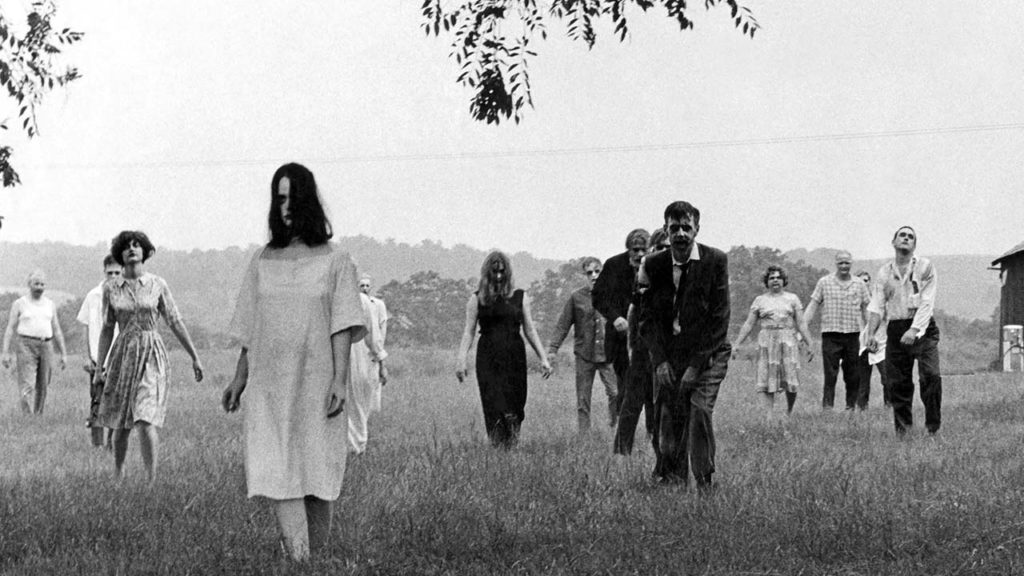
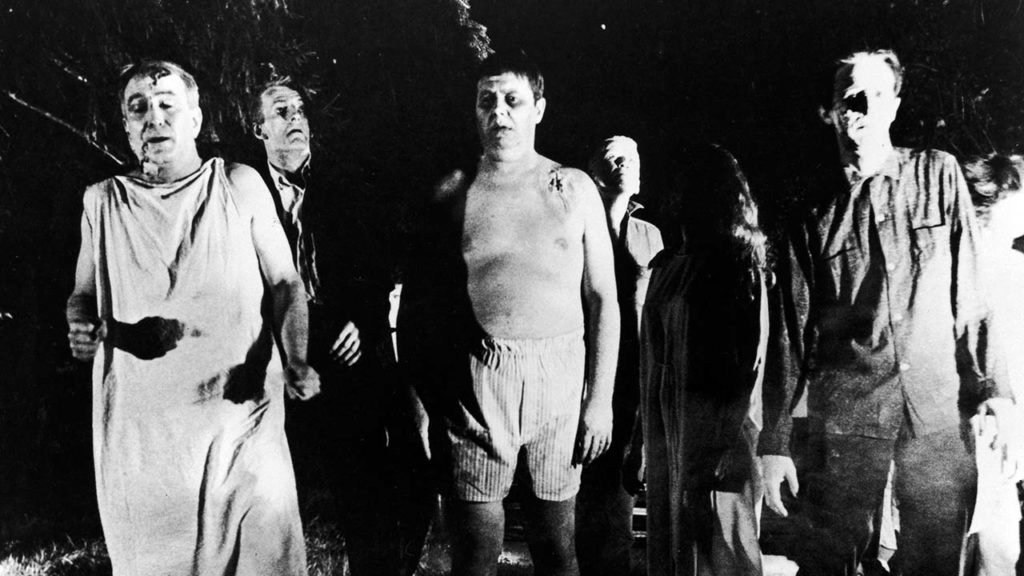
Romero & John A. Russo’s Night of the Living Dead screenplay includes some pseudo-scientific technobabble concerning a returning space probe contaminated with radiation from Venus, but for all intents and purposes the origin of the phenomenon is irrelevant to the story. Later zombie films would introduce the concept of a blood-transmitted virus, but it is irrelevant here whether or not any victim is contaminated by a germs or extraterrestrial radiation. Merely dying is all it takes to become a monster. In a way, Romero’s original conception of the zombie, absent of any plague metaphor, is the bleakest of all variants. Human society will be forever changed in a world in which even those that die naturally will have to be decapitated before they revive as beastly ghouls.
Ben (Duane Jones) greets the undead hordes
Like all of Romero’s zombie flicks, Night of the Living Dead is set in the Pittsburgh, PA area (except Day of the Dead, which is the odd one out for many reasons to be discussed in the forthcoming review). The opening sequence is set in graveyard littered with American flags, perhaps meant as a silent allusion to the vast numbers of fresh corpses being sent back from the Vietnam War. A random assortment of survivors barricade themselves in a farmhouse. Romero tells Parallax-view.org that the cast and crew actually lived in that farmhouse while filming: “We had no bread. We were literally sleeping out of that farmhouse, chopping ice out of the tank behind the toilet bowl in order to wash our faces, and we were taking baths out in the creek.”
In the best horror movie tradition, we have a cross-section of society with representatives of every gender, age, class, and race: a traumatized woman, a young couple, a classic nuclear family, and a lone black man. For all intents and purposes, their various social standings are erased as they all must unite to defend themselves against a common foe. Ben (Duane Jones) proves himself the most intelligent, sane, and capable of the bunch. But the humans can barely agree on anything, and expend most of their energy on infighting. One suspects that they wouldn’t be able to get along even without the zombie hordes assembling outside.
Night of the Living Dead is notorious for remaining unrated by the MPAA, proudly showcasing a considerable amount of gore (and even a little nude zombie derriere) unprecedented in 1968. But I think it’s fair to say that the true reason the movie is remembered as more than a cheapie horror flick is its African American protagonist. Of superior intelligence and maturity than everyone else, he alone (spoiler alert!) survives while the rest of the gang self-destructs.
But unbeknownst to him, authorities have mobilized to sweep the countryside in order to execute any and all shambling zombies. It’s impossible to ignore this group’s resemblance to a lynch mob of the white male establishment, bearing scythes and hunting rifles. Given this scenario, one might predict the powerful, racially charged ending. In an interesting stylistic choice, the final sequence is told as a photomontage, a series of still images showing us the tragic aftermath of what happens when the supposedly civilized “living” are given free reign to indulge in their bloodlust.
You’ve been reading an entry in our George A. Romero Zombie Cycle Film Festival. Join us in revisiting all five canonical episodes in the original epic zombie saga: