Category: 2 Stars

Pretty Bad, Really

  • Thinning the Herd: M. Night Shyamalan’s The Happening

    Thinning the Herd: M. Night Shyamalan’s The Happening

    The Happening is the latest in a long line of light entertainments that depict attacks of one sort (terrorist) or another (alien) upon New York City.

    A mysterious mass hysteria strikes the idyllic Bethesda Terrace (a place I walk through several times a week) in Manhattan’s Central Park, and quickly fans out to the entire city. What is later referred to as “the event” or “the happening” (the latter a term originally popularized by hippies, I believe) appears to be some kind of airborne toxin that causes every human being within range to calmly and passively commit suicide.

    Speaking as a New Yorker that lived through 9/11, this opening sequence pushes fewer emotional buttons than, say Cloverfield, which was explicitly analogous to post-9/11 New York as Godzilla was to post-Hiroshima and Nagasaki Japan. But it’s impossible to not be shaken by the charged image of office workers willingly jumping to their deaths from skyscrapers.

    Having ticked the disaster movie genre box of “wholesale massacre in Manhattan,” writer/director/producer M. Night Shyamalan abandons New York for the remainder of the movie and transfers the action to his old stomping grounds of Philadelphia, PA. High school teachers Eliot (“Marky” Mark Wahlberg) and Julian (John Leguizamo) catch wind (so to speak) of the event, and presciently make plans to take the next Amtrak train out of 30th Street Station with their families. Eliot is experiencing some friction in his marriage with Alma (Zooey Deschanel), and warns Julian that she may be acting “weird.” It’s up to the viewer to decide if he’s talking about the character Alma or the actress Zooey, whose eyes and face were truly made for the movies but whose eccentric line readings are indeed “weird.”
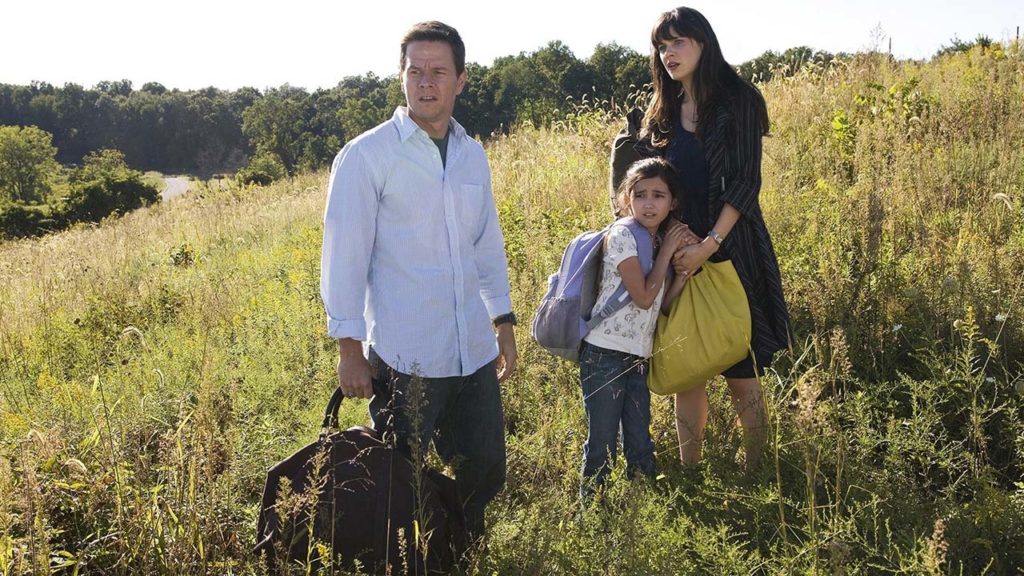
    Mark Wahlberg and Zooey Deschanel in The Happening
    Mark Wahlberg and Zooey Dschanel go antiquing in beautiful downtown Filbert, PA

    The train halts on the way from Philly to Harrisburg, stranding the occupants in the middle of nowhere — which is to say, the real-life small town Filbert, PA. Science teacher Eliot berates himself “be scientific, douchebag!” and uses logic to deduce the facts from the bits of evidence he’s picked up along the way: his hunch is that they are not experiencing a terrorist chemical attack, but rather that the earth’s biosphere is releasing a fatal toxin targeted to areas heavily populated by humans. They set off on foot in small groups into the kind of beautiful rolling fields where Shyamalan set his earlier parable The Village.

    They come across a for-sale “Model Home”, a giant McMansion full of artificial goodies. The perfect dream home is actually in no way a refuge: there is no food or shelter, and it only serves as a lure to other groups less enlightened than they; the mere arrival of even one more fellow traveller could boost the local population to a point where the plants may attack.

    Here the film’s first hint of humor appears: Eliot notices a giant indoor plant eerily looming in a corner. He attempts to negotiate with it for the future of humanity, until he realizes that it too is plastic. The artificial model home is a blunt metaphor for humanity’s disposable consumerism and impact upon the environment.

    The Happening
    Manhattan is destroyed for the 4,937th time by Hollywood

    At this point, The Happening becomes a different movie, a better one, receiving a much-needed injection of Shyamalan’s characteristic wit and masterful use of horror and suspense tropes: creepy shadows half glimpsed through window slats, batty old lady (Betty Buckley) with creepy dolls in her bed, etc. But overall it’s uncharacteristically clumsy. His best films (for my money: The Sixth Sense, Unbreakable, and Signs) are plotted so tight you couldn’t remove a single frame without harming them.

    It’s unfortunately overwritten with pages and pages of poor dialogue, including this unintentional howler featured in the trailer: note Marky Mark’s impeccable grammar upon being told his Amtrak train has lost contact: “With whom?” Julian also states with odd formality that his wife is travelling separately to “the town of Princeton.” To be charitable, perhaps Shyamalan figured high school teachers might habitually speak clearly with correct grammar.
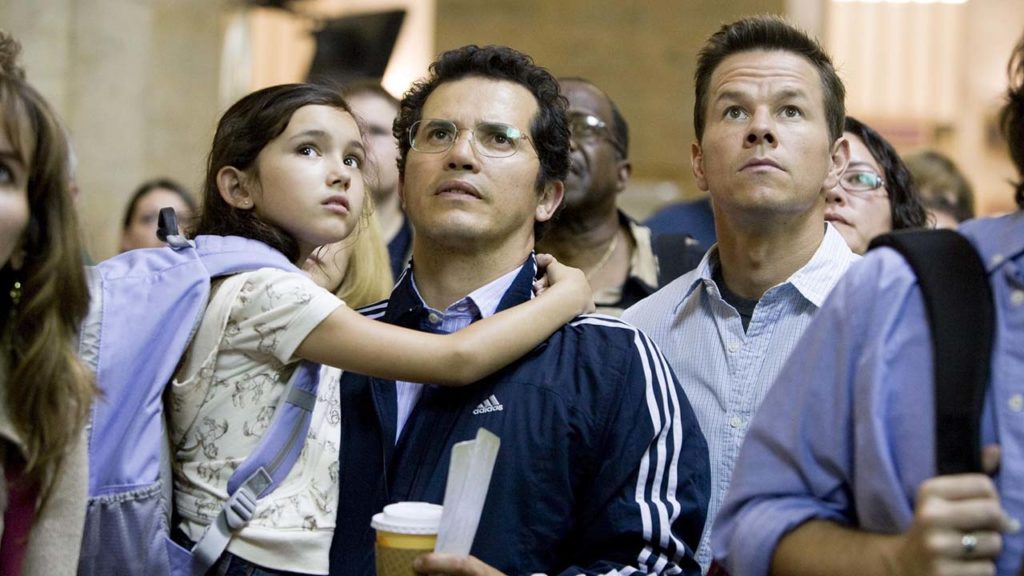
    John Leguizamo and Mark Wahlberg in The Happening
    Do we have time for a cheesesteak and some Auntie Anne’s before our train to nowhere?

    There’s too strong a reliance on fake television news broadcasts to convey exposition (a device only resorted to once or twice in Signs), even concluding the film with a talking head scientist explaining the takeaway message for the slower members of the audience: “we’re threatening the planet.” Watch The Sixth Sense and Unbreakable again and see how much Shyamalan at his best is able to communicate without dialogue. How much would Unbreakable have sucked if Bruce Willis’ character had openly mused about how he was turning into Superman?

    Significantly for a director known for working in the horror & suspense genres (fantasy, too, if you count the execrable misstep The Lady in the Water), The Happening is Shyamalan’s first R-rated movie. As if to live up to its horror film billing, the narrative frequently pauses for conspicuously gory set-pieces: a woman stabs herself with a knitting needle, a man sets a lawn mower to run over himself, etc.

    These brief episodes of gore contrast with what must have been the major challenge for his story: to visualize something inherently invisible: a wind-born toxin. Shyamalan signals an oncoming attack with gusts of wind. Which is, of course, preposterous because plants don’t cause wind. The characters outrunning wind is about as preposterous as the advancing killer frost in Roland Emmerich’s environmental disaster movie The Day After Tomorrow.
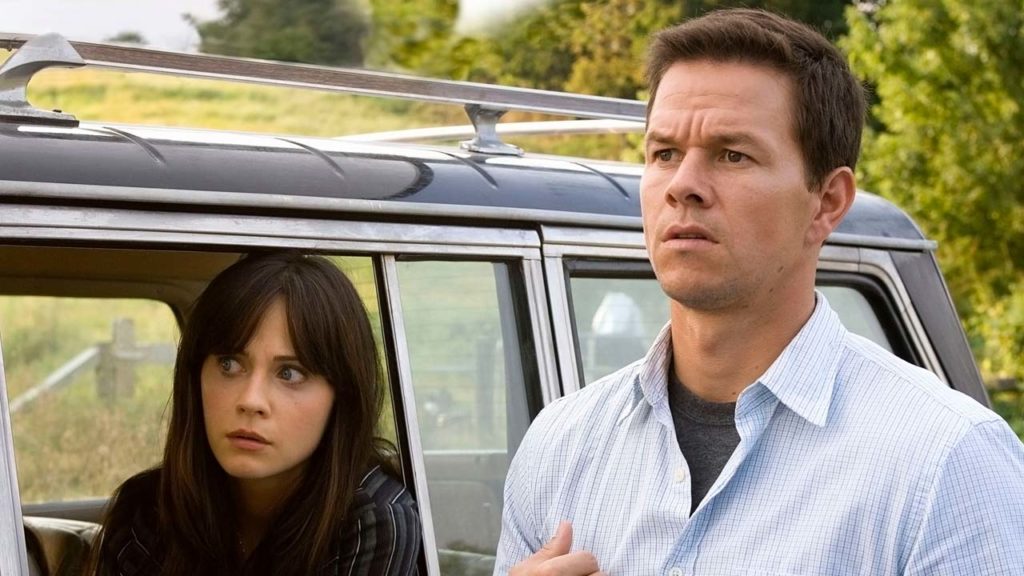
    Zooey Deschanel and Marky Mark Wahlberg in The Happening
    Zooey Deschanel and Marky Mark Wahlberg peek around the corner for the next plot twist

    The film’s environmental issues first appear with a faint flavor of creationism in an early scene set in Eliot’s classroom. He believes there are aspects of nature we may never truly understand, although science may slap an explanation on them in retrospect. But “just a theory” is the language of anti-intellectual creationists who wish to discount evolution. In the hindu worldview, does an act of nature equal an act of god? Is the earth being malicious, defensive, or both? The planet may not be acting with conscious intelligence, but rather as a mere reaction to stimuli; a kind of thinning of the herds.

    As was the case with the 2003 blackout in the northeastern U.S., Shyamalan was correct in observing that everyone’s first thought in any post-9/11 calamity would be that it’s a terrorist attack. But it’s pretty much established very early that the culprits are the plants. This pretty much drains the suspense out of the picture, and I actually wished for one of Shyamalan’s patented twist endings. It does seem hugely wimpy compared the ruthless and unsparing The Mist. If Shyamalan had had the guts to go for a bleak ending like writer/director Frank Darabont’s Stephen King adaptation, The Happening might have been better received and perhaps remembered as one of his best.

  • There’s Something in the Mist: Frank Darabont’s The Mist

    There’s Something in the Mist: Frank Darabont’s The Mist

    Has writer/director Frank Darabont been weighed down by the heavy legacy of his first feature film? The Shawshank Redemption remains one of the most popular movies ever made, if not quite (yet?) accepted into the canon. The Mist, after The Green Mile, is Darabont’s third Stephen King adaptation, so far only having made only one feature not derived from a King work. After two prison yarns (one set very much in the real world, the other with a dash of the supernatural), Darabont now turns to one of King’s more characteristically gruesome horror tales.

    King writes at great length about classic horror movies in his nonfiction book Danse Macabre, and The Mist squarely fits into one kind of classic b-movie structure. We open in a seemingly bucolic lakeside town with simmering tensions between local residents and wealthier weekenders summering in lovely lakeside homes. A mysterious, mostly unseen, and definitely hostile alien force traps a random assortment of local personalities in a supermarket.

    The horror works best before we actually see any evidence of the supernatural; for example, a character bolts into the store, full of nervous but not yet terrified citizens, crying the simultaneously eerie and hilarious line “There’s something in the mist!” For home viewers, a big reveal was spoiled right in the DVD menus: one of the adversaries is a very biblical swarm of giant beastly locusts.

    The Mist
    They’re heeeeeeere…

    Like virtually every zombie movie ever made, a cross-section of society is trapped in a confined location, under siege by unstoppable forces. The microcosm includes representatives of all the usual suspects, including a top New York City lawyer (because we all know NYC sharks are more venal than the regular kind) Brent Norton (Andre Braugher), a couple of good ol’ boys, the town cutie pie, a few handsome young lads from the nearby military base, and the resident looney fundamentalist Mrs. Carmody (Marcia Gay Harden).

    The Mist is not above another classic horror movie cliche: the virginal good girl kisses a boy and immediately dies horribly in the very next scene. The heroes that arise are, of course, unlikely: a grocery bagger (an interesting character with a lot left up to us to fill in: he’s not a young man, and he’s got brains and skills, so how did he end up in such a dead-end job?) and a relatively wealthy artist David (an outsider to the town, viewed as elitist).

    The Mist
    Cthulhu… gesundheit!

    We first see “our hero” (more on that later) David (Thomas Jane) in the very first shot. He’s an illustrator of movie posters: I spotted three shout-outs to genre movies both actual and potential: Guillermo Del Toro’s Pan’s Labyrinth, John Carpenter’s remake of The Thing, and Stephen King’s own Dark Tower. He’s a macho, badass painter, using the back of his own hand as a palette, and bitching about studios cobbling together cheap posters in Photoshop.

    Speaking of craven movie studios, sometimes studios whitewash action and horror movies to cater to more lucrative PG-13 audiences (like Blade III: Trinity, extraordinarily lame & tame compared to Guillermo Del Toro’s outrageously gory Blade II – vampire autopsy, anyone?). The Mist is one of the few R-rated horror movies I’ve seen that might have been better with less gore and profanity. Most especially the profanity – I’m certainly guilty of salty language in my own vocabulary, but the overall F-bomb count in The Mist is so absurdly high that it becomes eye-rolling; as if the filmmakers were deliberately striving for a record.

    Thomas Jane in The Mist
    Play misty for me?

    Overall, I’d have to say I really did not care for the movie, finding it overwritten. At numerous points, characters explicate the plot, elapsed time, and character arcs – to paraphrase an example: “It’s only been two days, and Mrs. Carmody has already turned everybody against us… in only two days!” It’s also too reliant on CG gore for a story than depends on the horror of the unseen (also where M. Night Shyamalan’s otherwise great Signs falls down). But the best bits of the movie are squeezed between the CG set pieces, and the entire affair is redeemed by an utterly astonishing ending.

    Although I normally don’t concern myself with spoilers on this blog, it would be cruel of me to reveal the ending here. Suffice to say, it’s impossible to imagine how a script this bleak was financed and distributed (by Dimension Films). I also wish I had seen the movie in theaters so I could see firsthand how an average audience would react to such an ending. The big downer at the end of Cloverfield did not go over well with audiences, to say the least, and The Mist makes that one look positively wimpy.

    Like Signs and Stephen Spielberg’s War of the Worlds, The Mist depicts a massive alien invasion from the perspective of regular folk, as opposed to the global view taken by movies such as The Day The Earth Stood Still and Independence Day. But The Mist has a truer ending than any of these examples. The core theme is of the roles people assume under extreme duress. Their illusions about themselves are amplified and they believe their own myth. Just as the fundamentalist Mrs. Carmody compensates for a lifetime of exile from healthy human interaction by elevating herself into a demagogue (I’m reminded of the characterization of the young Adolf Hitler in the movie Max, as he first finds the mass adulation he desires as he rallies a crowd into a racist frenzy), David falls all too well into the role of hero. He never complains when people turn to him for strength and leadership.

    The so-called “hicks” that fight him in the beginning of the film were right; he does think he’s smarter than everybody else. In movies, he’s exactly the kind of guy other characters automatically defer to in dire situations: So-and-so’s dying of third degree burns? Tell David! What do we do next? Ask David!

    The utter demolition of the stock hero character type is so surprisingly strong that it’s practically subversive. I had thought postmodern genre films had petered out after their late-90s golden age of Scream, Starship Troopers, and Wild Things. But The Mist is a new entry in the postmodern genre cycle, in the sense that it comments critically upon the horror movie genre, and yet still actually is a horror movie. The Mist may be a monster movie, but it’s not about a Thing, an Alien, or a Creature from a black lagoon; it reveals the standard hero character to be a kind of monster himself.

  • John Sturges honors Kurosawa honoring Ford in The Magnificent Seven

    John Sturges honors Kurosawa honoring Ford in The Magnificent Seven

    John Sturges’ The Magnificent Seven is Hollywood’s answer to Akira Kurosawa’s hugely popular Seven Samurai. It suffers in comparison, especially if, like this blogger, one watches them in quick succession. The remake is quaint, chaste, and dated in ways the fairly frank original isn’t. To put it another way, Seven Samurai is a period piece of its 16th Century setting, while The Magnificent Seven is a period piece of its 1960 production.

    A remake was inevitable considering the dizzying circle of influence. Kurosawa was a fan of the Hollywood western and especially of director John Ford, all of which directly informed Seven Samurai. Hollywood’s transposition of the story to the American West for The Magnificent Seven was fairly straightforward. Its great success led to three motion picture sequels, a television series, and is reportedly set to be remade again in 2009.

    The original eponymous seven samurai were actually ronin, masterless mercenaries akin to the Western outlaw: morally ambivalent drifters, killers with a personal code of honor. The Western genre is usually about outlaws, for the simple reason that they’re more dramatically interesting than regular plain folk. In both versions of 3:10 to Yuma (1957 and 2007), for example, the villain Ben Wade (Glen Ford and Russell Crowe) is a far more appealing and seductive character than the good guy Dan Evans (Can Heflin and Christian Bale).

    The Magnificent Seven
    The meeting of the Badass Society is adjourned

    An exception to the rule is the classic High Noon, in which Gary Cooper plays an honest lawman who prevails under extreme duress. The biggest clue the magnificent seven are not classic good guys: Yul Brynner appropriately sports his trademark black hat. Upping the badass quotient and testosterone levels are no less than Steve McQueen (here getting to drive a real mustang on screen), Charles Bronson, and the very lanky James Coburn.

    The basic scenario is similar: seven American gunslingers accept a pittance in order to defend a Mexican village besieged by bandits. But the many alterations beyond this all reflect some very “Hollywood” thinking. In the original, it is enough for the samurai that there be an injustice they are capable of addressing. But in a Hollywood film, there must be individual motivations, which interestingly have the side effect of rendering some characters less heroic. Harry Luck (Brad Dexter) is convinced Chris (Brynner) has an ulterior motive, such as pilfering a non-existent gold mine. The dandy bounty hunter Lee (Robert Vaughn) is also along for selfish reasons; he’s on the lam for an unspecified transgression, and needs to disappear for a while.

    The original Seven Samurai is actually technically comprised of only five actual samurai plus two pretenders. Kikuchiyo (Toshiro Mifune) is a peasant posing as a samurai, and Katsushiro (Isao Kimura) is an earnestly romantic young boy seeking samurai training and adventure. Perhaps to economize the story, The Magnificent Seven combines these two characters into one: Chico (Horst Buchholz), a former farmer that worships the outlaws and attaches himself to them in order to become one.

    Steve McQueen and Yul Brynner in The Magnificent Seven
    Go ahead and make our day

    So that leaves Chris, Bernardo (Bronson), and Vin (McQueen). In this remake’s best sleight-of-hand, we’re in the dark as to their motivations until near the very end. None of them are young men, and what drives them turns out to be the fantasy of settling down into an agricultural lifestyle. The gruff Bernardo befriends a batch of scrappy kids, becoming a kind of protective older brother if not a father figure. Chris and Vin seal their friendship with the mutual confession that they both hanker for a simpler life (a sort of admission very difficult for two very macho men).

    But many poor changes outweigh these aforementioned interesting ones. Being a product of Hollywood, it’s actually less violent, profane, and sexy than the original Japanese film. The Mexican villagers are wise and saintly, compared to the more realistically flawed farmers in Seven Samurai. The threat of sexual violence is whitewashed away; the bandits are not interested in the Mexican women. We see too much of the villains, and the chief bandit Calvera (Eli Wallach) is practically a featured character.

    James Coburn in The Magnificent Seven

    But just as I was beginning to dismiss the remake as inferior to the original in every way, and of historical interest only, the movie darkens and becomes interesting again. The Mexican villagers, like their ancient Japanese counterparts, do reveal a dark side after all. Despite their initial success in beating back the bandits with the outlaws’ help, they have a crisis of faith and betray the outlaws in order to return to the comfort zone of their parasitic relationship with the bandits.

    In the old west, an outlaw may very well find a home in a frontier town where no one knows his past deeds (a core theme of the HBO series Deadwood and the situation in which Clint Eastwood’s The Unforgiven opens). But in ancient feudal Japan’s caste system, a ronin could never take a step down and live among farmers. This also proves to be the case in The Magnificent Seven: Chris and Vin mosey on out of town and Chico stays behind, rejecting his pretensions to being a rebel outlaw, and reverting to his destined life as a farmer.

  • But seriously, why so serious? Batman goes anime in Gotham Knight

    But seriously, why so serious? Batman goes anime in Gotham Knight

    Batman: Gotham Knight is a direct-to-DVD production from Warner Premiere, intended as a back-door prequel to the feature film The Dark Knight. Warner Bros. has tried this tactic before, and will again. 2003’s The Animatrix was a planned interlude in Matrix franchise, enjoying extensive involvement from creators The Wachowskis.

    Coming soon is a motion-graphics animated version of Alan Moore and Dave Gibbons’ graphic novel Watchmen, preceding the forthcoming live action feature film adaptation (no doubt Moore, who has long since divorced himself from his past work for Warner Bros.’ DC Comics, has a few choice words for this development).

    Batman Gotham Knight
    Do you think that maybe we’ve all forgotten that Batman a childrens’ comic book about a millionaire who dresses up like a bat to catch bank robbers?

    The Animatrix and Gotham Knight are portmanteau films, the products of multiple writers and animation teams. But the latter is only tangentially related to its sister live-action film, The Dark Knight. A pair of detectives figure as characters in both, and the gang war that percolates in the background of The Dark Knight is the driving incident behind many of the Gotham Knight tales. But the short films (mostly in an anime style) vary wildly in quality and comprehensibility:

    • “Have I Got a Story For You” (Shoujirou Nishimi) – A pack of skate rats tell tall tales of the Batman, until the real deal shows up. One of the best of the lot, with a unique hand-drawn animation style, mixed with a little CG.
    • “Crossfire” (Futoshi Higashide) – Two detectives are literally caught in the crossfire of a gang war. Suffers from particularly awful dialogue.
    • “Field Test” (Hiroshi Morioka) – Batman receives a new toy from Lucius Fox that works a little too well.
    • “In Darkness Dwells” (Yasuhiro Aoki) – Guest-starring two veterans of Batman’s rogues’ gallery: Killer Croc and Scarecrow. Some of the best animation, but the story is incomprehensible.
    • “Working Through Pain” (Toshiyuki Kubooka) – Batman, shot in the gut, struggles alone just to get home. He has hallucinatory flashbacks to his spiritual training in the art of overcoming physical pain. He recalls how his teachers rejected him for his impure motivations (to enable his revenge plan, not to attain higher spirituality). This, one of the best stories, leads directly into…
    • “Deadshot” (Jong-Sik Nam) – …one of the worst. A master assassin (a blatant rip-off of the character Bullseye from Marvel Comics’ Daredevil) targets Lieutenant Gordon. A really lame conclusion to the collection.
  • You won’t like Edward Norton when he’s angry in The Incredible Hulk

    You won’t like Edward Norton when he’s angry in The Incredible Hulk

    The Incredible Hulk is Hollywood’s latest incidence of what has become known as a “reboot.” The term came out of the comic book world, with further derivations in computer terminology. When a franchise begins to show its age with stalled creative energy and declining sales, its owners may opt to check it into surgery to be refreshed with a new cast, creative team, and updated plot particulars.

    Warner Bros. and DC Comics kick-started their valuable but stagnant Batman and Superman feature film properties, making them relevant to 21st century audiences, and now it’s Marvel Comics’ turn. Emboldened by recent successes with Spider-Man and The Fantastic Four (and conveniently ignoring the failures Daredevil and Elektra), Marvel has obtained funding to independently produce its own films with greater creative control and, presumably, a larger chunk of the financial return. The massive success of 2008’s Iron Man seemed to prove their instincts correct.

    Remarkably, The Incredible Hulk comes only five years after Ang Lee and James Schamus’ Hulk, itself a reboot of the comic book, cartoon, and television series. Even before Marvel announced it was to start over from scratch, the original Hulk film had already been seen as a critical and commercial failure, even though the reviews were not actually terrible (54 on MetaCritic and 61 on Rotten Tomatoes, both about the same as what The Incredible Hulk scored) and it earned $245 million worldwide.

    Edward Norton in The Incredible Hulk
    NORTON SMASH!!!

    I fully realize this is the minority opinion, but the Lee/Schamus version is a far, far better film, not only in comparison with its successor but also on its own terms. To paraphrase a review I recall reading at the time, “only the director of Eat Drink Man Woman and Sense & Sensibility would look at the Hulk comics and see ‘sprawling family melodrama.’” Lee and Schamus saw the core story as more than a simple Strange Case of Dr. Jeckyll & Mr. Hyde retread, and instead chose to tell a deeper tale of fathers and sons. The Hulk himself was created using motion-capture technology using Ang Lee’s own body language, and realized on screen as a giant green petulant baby (which is both absurdly funny and oddly moving, like the original King Kong). I still maintain it is one of the most brilliantly edited films I’ve ever seen, the closest in flow and visual style to a comic book a film has ever come. It’s also just really fucking weird, in a good way.

    Liv Tyler in The Incredible Hulk
    Liv Tyler, in the thankless role of superhero love interest

    With Marvel in total charge of its own intellectual property at last, The Incredible Hulk had low artistic ambitions and was unsurprisingly crafted with comic book geeks in mind. In harsh contrast with arthouse mainstays Lee and Schamus, it was directed by action film specialist Louis Leterrier (of Transporter 2 and Danny the Dog) and written by Zak Penn, who has apparently cornered the market on super-hero scripts (including X-Men 2 & 3, Elektra, and the upcoming Avengers and Captain America). The backwards-facing film gives the fanboys a nod with admittedly fun cameos from Lou Ferrigno (who also voiced The Hulk’s few lines, and who also seems not to have aged one bit) and original Hulk co-creator (with Jack Kirby) Stan Lee. But the CGI is surprisingly unconvincing for a film that should have been state-of-the-art; the Hulk looks like he’s made of string cheese and quivering gelatin.

    The Incredible Hulk
    It’s showtime at The Apollo

    Truth be told, I was actually rather enjoying the film, until one niggling fault grew to an unignorable degree that ruined the entire experience for me. Key character Emil Blonsky (Tim Roth) remains tragically underdeveloped. Any screenwriting student (hell, any film fan) should know the storytelling mantra “show don’t tell,” and yet Blonsky’s motivations are only hinted at in one or two lines of dialogue: he’s a career soldier grumpy about turning forty. Blonsky eventually evolves into the Hulk’s nemesis The Abomination, a hideous beast that lives to destroy. As the two creatures smash Harlem to bits in the final reel, there was no sense that the Abomination was once a man. What drove him to this? Interestingly, Roth plays a not entirely dissimilar character in Francis Ford Coppola’s Youth Without Youth: a man who uses up his youth in pursuit of an unattainable goal. In each case, the opportunity for a second chance is a mixed blessing.

    Rumor has it an alternate, significantly longer cut of the film will eventually be released on DVD, preserving more of Edward Norton’s reported script doctoring, so this blogger hopes he will be able to revise his opinion at a later date.


    Must read: Peter Bradshaw’s review of The Incredible Hulk as told to him by… The Hulk (spotted on Kottke.org)

  • It’s the end of the world in Michael Crichton’s The Andromeda Strain

    It’s the end of the world in Michael Crichton’s The Andromeda Strain

    Michael Crichton’s novel The Andromeda Strain was first adapted into a feature film in 1971, and now into a television miniseries from executive producers Tony and Ridley Scott. This 2008 incarnation is part feel-bad thriller, part wish fulfillment. As we thrill to the speculative illustration of how civilization might suddenly come to an end, we also can only hope the government does in fact have an elaborate and high-tech procedure in place for identifying and containing new contagious disease outbreaks.

    The original book is only nominally about a supervirus, evidently of extraterrestrial origin, that threatens the human race. It is actually more about how intelligent, well-meaning people can make subtle errors of judgement that may cascade into catastrophe. Chrichton would also employ Chaos Theory as a key theme in his Jurassic Park novels.

    The Andromeda Strain
    Good times, good times

    But the miniseries complicates this interesting theme with added government venality (a basically honorable president is undercut by a corrupt chief of staff), the media (a drug addicted reporter breaks the cover-up), and the environment (strip mining of the ocean floor leads to the crisis). To give but one example of the diminishing returns: in the book, a simple unnoticed glitch in a supposedly perfect computer system causes a dangerous communication blackout at the worst possible time. It’s both more plausible and more suspenseful than the miniseries version of events, in which General Mancheck (Andre Braugher) deliberately creates the blackout, to everyone’s mild and temporary frustration.

    The book is not without its flaws, particularly an undramatic ending in which the continuously adapting virus eventually mutates into harmlessness. But the miniseries disappoints by giving the virus a definitive origin, indicating it is expressly targeted towards humans, and showing its definitive defeat.

    The Andromeda Strain
    The Andromeda Strain cast checks in for the long haul

    Miscellaneous other thoughts:

    • Mikael Salomon’s direction is very boring and staid, except for a wildly over-the-top decontamination procedure that is filmed in a stylized, almost erotic fashion.
    • The miniseries is probably one of the talkiest sci-fi movies and/or TV shows I’ve ever seen. The bulk of the action is set in a single interior location, and nearly every scene comprises heated conversations in laboratories or over teleconferences.
    • The miniseries is laden with even more pseudoscientific bullshit than Crichton’s original novel: wormhole-enabled time travel and nanotech buckyballs from the future are the order of the day. The whole thing ends in the kind of temporal paradox that would drive an episode of Doctor Who or Star Trek.
    • The miniseries updates the book’s euphemism of “unmarried man” into “don’t ask don’t tell” territory, for a subplot involving Major Keane (Rick Schroder).
    • Spot the homage to Hitchcock’s The Birds!
    • Why does the underground facility begin to disintegrate during the run-up to setting off an atom bomb? Wouldn’t there just be a countdown and then an explosion?
    • This blogger, a longtime fan of the TV show Lost, is happy to see Daniel Dae Kim in a starring role.
    • Benjamin Bratt is really terrible, giving the proverbial phone-it-in performance. He delivers every line with the same intonation, whether it’s saying goodbye to his family for possibly the last time or announcing humanity’s first discovery of an alien life form.
  • Indiana Jones seeks fortune and glory in The Temple of Doom

    Indiana Jones seeks fortune and glory in The Temple of Doom

    In order to catch up on the overwhelming backlog of movies I intend to cover here on this blog, I’m going to keep it brief with a few disconnected thoughts:

    An opening caption places the action in “1935.” Raiders of the Lost Ark was set in 1936, so, The Temple of Doom is actually a prequel! Interesting, but why? Everything is basically the same, except for the absence of Marion (Karen Allen). Had that caption not been there, Indy would have seemed to have unceremoniously dumped her, offscreen.

    On the topic of “Indy Girls,” how could Steven Spielberg and George Lucas trade in the spunky, resourceful, independent, strong Marion for the helpless screaming ignorant bimbo Willie (Kate Capshaw)? It’s a crying shame only partially excused by Marion’s belated return in the fourth installment, Indiana Jones and the Kingdom of the Crystal Skull.

    Harrison Ford in Indiana Jones and the Temple of Doom
    Harrison Ford’s “Oh $#!&” face is unparalleled

    In the DVD bonus features, Spielberg and Lucas both desperately defend Temple of Doom‘s “dark” tone, comparing it to Star Wars: The Empire Strikes Back. This is puzzling, as to my eyes, The Temple of Doom is notably more jokey and cartoony than Raiders of the Lost Ark. Worse, it is casually sexist and racist, and not to mention, quite unkind to the cuisine of India.

    The globe-trotting begins in Shanghai, with an old-school Hollywood musical number. Jonathan Ke Quan (Short Round) is actually Vietnamese, and clearly a good sport.

    The Temple of Doom has the least compelling MacGuffin of all the Indiana Jones films. While the others concerned the Ark of the Covenant, the Holy freakin’ Grail, and UFO artifacts, this time Indy must recover and return a stolen relic to a starving Indian village. He only learns of the injustice in the first place by accident.

    Ke Huy Quan and Kate Capshaw in Indiana Jones and the Temple of Doom
    The Temple of Doom is widely criticized as sexist and racist, but can we talk about its retrograde attitude towards global cuisine?

    It must be said that this is the only film in the series that has Indy grapple with the moral grey areas of his profession. Not exactly a stand-up model archeologist, he explicitly vocalizes his motivations for the first time: “fortune and glory.” So this time around, his relic-hunting is in the service of justice and not his own personal gain.

    Hey, it’s that guy! Can you spot the Dan Akroyd cameo?

    Indy and pals stumble upon a sacrificial pagan ceremony dead for only 100 years? That’s not very exciting. If you’re making up a fake religion, why not make it a thousand or more?

    One of many tragic flaws that cripple this film is the obvious tinkering with the formula, made in the mistaken belief there would be more for the kids to identify with. Yes, I’m talking about all the annoying children running about the place: obviously Short Round (Ke Huy Quan), but also the horde of child slaves toiling in a mine (a straight lift from Pinocchio). Memo to Spielberg and Lucas: kids had no trouble flocking to Raiders of the Lost Ark, so you don’t need to give them an on-screen cypher.

  • Who do you think you are, Mr. Big? Sex and the City: The Movie

    Who do you think you are, Mr. Big? Sex and the City: The Movie

    Yep, I saw it. I work for the movie company that produced it, so I got to go for free. The standard line with Michael Patrick King’s now decade-old Sex and the City franchise is that it has always appealed mostly to gay men and the women that love them. Even though this blogger more or less a whitebread straight dude (while I like naked lady bottoms and affirm Sean Connery is the best James Bond, automobiles and professional sports don’t move me), I don’t mean that as a disclaimer. While I’d never seen more than portions of the original television show, and I’d not voluntarily pay see the movie in the theater or rent the DVD, I’m not ashamed to say I’ve seen it.

    Sex and the City
    After shopping, let’s go shopping

    I had recently seen an advance screening of a yet-to-be released film (that will have to remain nameless here) that had more than a little in common with the plot and characters of Sex and the City. Let me just say that in comparison, Sex and the City is a masterpiece, and at least, watchable by straight men. The male characters in the film are endowed with more characterization and complexity than I would have expected. When Mr. Big (Chris Noth) does something “bad,” it’s because he’s confused and conflicted, not because he’s a douchebag (which is the explanation of any and all bad behavior by male characters in the aforementioned movie-that-cannot-be-named-for-professional-reasons).

    Sex and the City
    Hey there, Mr. Big Stuff

    To get into the nitty gritty of the plot, there was one aspect that I just couldn’t wrap my head around: Miranda (Cynthia Nixon) makes an understandably bitter comment about marriage in general to Mr. Big that becomes one of many influences upon his spontaneous decision to leave Carrie (Sarah Jessica Parker) at the altar. Miranda neglects to tell Carrie about her comment, and the event and its cover-up is weighted by the film as A) the worst thing one friend can do to another and B) the single reason why Mr. Big stood Carrie up.

    When Miranda eventually comes clean, Carrie reacts as if she sees Mr. Big and his actions in a wholly new light, and the reconciliation begins. I just don’t get it; it seems to me, based on the fictional characters’ actions and motivations in the world of the film, that Miranda’s minor indiscretion is exactly that, and the true problem is in fact Mr. Big’s ambivalence about Carrie’s desire for a disgustingly overblown princess wedding. But I suppose the answer to my confusion may simply be that I don’t get it because I’m a dude.

    And finally, a Public Service Announcement for any other bloggers searching the interwebs for movie stills with which to illustrate their reviews of Sex and the City: depending on your inclinations, exercise caution when Googling “Mr. Big.”

  • Jake Kasdan spoofs the musical biopic in Walk Hard: The Dewey Cox Story

    Jake Kasdan spoofs the musical biopic in Walk Hard: The Dewey Cox Story

    This blogger finds most so-called biopics wanting. The two- to three-hour feature film format is more akin to an essay or short story than a book, and as such is ill-equipped to sum up the entire life of a human being in more than a string of highlights. Yet studios and filmmakers keep churning out parades of Classics Illustrated-like films that seem to exist mostly to mint Oscars and Golden Globes based on actors’ abilities to imitate historical figures. The best of them ought more deservedly to be recognized for their abilities to create new characters from whole cloth.

    But I reserve a special degree of hate for musical biopics; I’m looking at you, Bird, Ray, Walk the Line, La Vie en Rose, and El Cantante! They all seem to be forged from the same template: troubled genius beset by addiction, and the woman that loves him anyway. Comfortingly, the existence of Walk Hard: The Dewey Cox Story proves I’m not alone in bemoaning this most pathetic genre. Walk Hard touches on each cliche in turn: physical infirmity (Cox is tragically “nose blind”), drugs, disapproving parent, dead sibling, etc.

    John C. Reilly in Walk Hard The Dewey Cox Story
    pssst… your bouffant is cramping my style

    At its best, director and co-writer (with Judd Apatow) Jake Kasdan’s Walk Hard is a history of popular music and narcotics from the 1950s on. The chameleonic Cox evolves with the times, beginning as a diamond-in-the-rough Ray Charles type, breaking through like a young Johnny Cash, becoming a pop superstar Elvis Presley, passing through a Bob Dylan folkie stage, and ending up as a Brian Wilson, an obsessive pop genius unable to complete his unachievable masterpiece (like Wilson’s own notorious Smile). The best running gag in the movie involves Cox’s succession of drug addictions (pot, cocaine, heroin, pills, and, well, everything…), which no doubt gave the MPAA a heart attack.

    Lest I sound like I’m praising the film for being clever, here’s the bad news. The self-proclaimed “The Unbearably Long, Self-Indulgent Director’s Cut” DVD edition repeats the same jokes over and over. Its idea of hilarity is to repeat the name “Cox” as much as possible, which should give some hint as to the overall level of sophistication. Each character explicitly verbalizes and explicates the genre cliches and their own character types: the unsupportive starter wife, the doomed sibling, the venal music studio boss, and the disapproving father (whose refrain “The wrong kid died!” follows Cox through his life as both curse and motivation).

    Historical celebrity cameos are repeatedly signposted with their full names, lest anyone in the audience not catch on that the batch of four candy-colored lads from Liverpool noodling on sitars in an Indian ashram are, in fact, The Beatles. It is great fun, however, to see Jack Black, Jason Schwartzman, Paul Rudd, and Jack White do their best Paul McCartney, Ringo Starr, John Lennon, and Elvis Presley, respectively.

    John C. Reilly in Walk Hard The Dewey Cox Story
    The 70s were a decade of taste and restraint

    One little quibble: as the characters age, the makeup jobs are actually too good, far better than, say the outrageously silly age makeup for Jennifer Connelly and Russell Crowe in A Beautiful Mind. This unfortunately ruins the genuinely funny gag that John C. Reilly plays Cox as a teenager with no attempt to hide his age. Why not carry it through to the end, with Reilly looking exactly the same when Cox is supposed to be 70?

    Does anybody remember when Reilly was a serious actor? I’m happy for him that he’s no doubt building a significant nest egg off his recent string of lowbrow comedies (Talladega Nights, Step Brothers, etc.), but I hope we will see more of the fine actor of Sydney (aka Hard Eight), Boogie Nights, and The Hours.

  • Charlton Heston is the alpha and The Omega Man

    Charlton Heston is the alpha and The Omega Man

    Now that’s a good intro: Robert Neville (Charlton Heston) cruises through an empty city with the top down. It’s eerie, but he seems happy, grooving to jazz from his onboard 8-track cassette deck. But suddenly! Screech! Ka-pow! He brakes, produces a machine gun and fires at a fleeting humanoid silhouette. A striking montage follows of a desolated, deserted city.

    Heston was once known as a liberal, and here his character entertains an interracial romance (with afro-licious Rosalind Cash) no more common in movies now than it was in 1971. Unfortunately, it’s now impossible to take Heston seriously, thanks to Phil Hartman’s classic mockery on Saturday Night Live and to Heston’s own Alzheimer’s-fueled descent into right-wing senility.

    Interestingly, Heston’s oeuvre is dominated by dystopian sci-fi: Planet of the Apes, The Omega Man, and Soylent Green form a trilogy of apocalyptic despair. Remakes of Apes (by Tim Burton) and Omega (Wil Smith’s I Am Legend) made him nearly obsolete even before he died. Can a new Soylent Green (which is, incidentally, much better than its reputation suggests) be far behind?

    Charlton Heston in The Omega Man
    Shopping at the end of the world, like the zombies in Dawn of the Dead

    Compared to the bestial vampires that populate I Am Legend, the creatures in The Omega Man are an intelligent, religious cult. They don’t attack Neville with technology (like, say, shoot him) simply because they choose not to.

    As for entertainment in a time before VHS, the last man alive on earth is stuck with whatever happened to be in the theaters at the time; he screens the concert film Woodstock over and over. As for The Omega Man‘s own music, the orchestral jazz pop score is not just outdated, but bizarrely inappropriate.

    The crucifixion pose at the end is a bit much. I didn’t expect much subtlety, but that’s laying it on a bit thick.