Anyone who’s ever had the misfortune of a conversation about movies with this blogger is no doubt aware that I like musicals about as much as I like biopics. That is to say, not at all.
I do, however, love Tim Burton, and count Ed Wood among my personal favorite films. So if he could make a biopic I can love, I didn’t think it unrealistic to hope that he might melt my cranky moviewatcher’s heart with a musical. But it’s been a long time since Burton has directed a personal project, instead working on existing franchises and remakes like Planet of the Apes and Charlie and the Chocolate Factory. He did add a healthy dose of the trademark Burton flavor to each, not to mention key members of his troupe (Helena Bonham Carter in Apes and Johnny Depp in Charlie), but fans like myself are still waiting for the next burst of pure Burton madness in the spirit of Edward Scissorhands.
Oi t’ink he’s up to summat
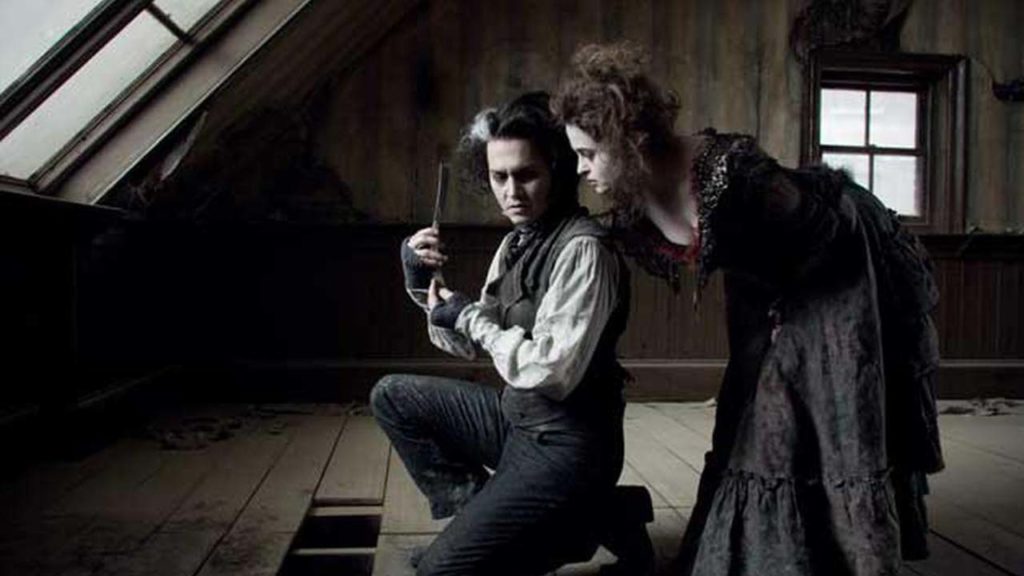
The Sweeny Todd tale originated in a prose serial form in 1846, and after several permutations, eventually became a stage musical by Stephen Sondheim in 1979. Burton’s 2007 film adaptation doesn’t quite manage to break free of its stagebound, er, staging. Despite the opportunity a film has to expand a play’s world, the action is limited to just a few locations. The rich art direction doesn’t defeat the impression that the whole thing was shot on a small soundstage. Speaking of art direction, Burton’s vision of late 19th century London is very colorful, provided that that color is blue. That said, it isn’t long before a few generous gallons of red are splashed about the place.
And now, the chewing of scenery, for your delight & edification
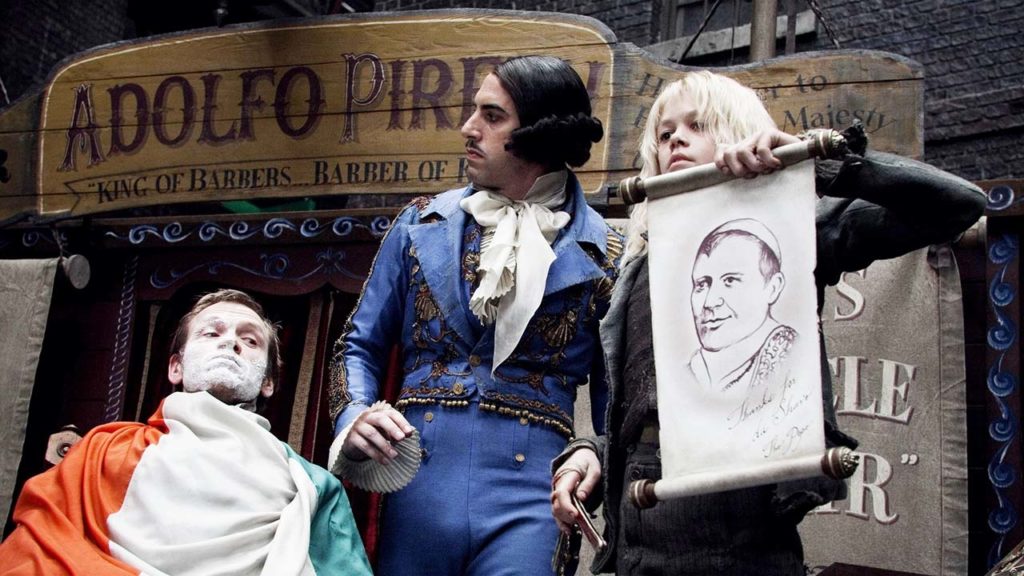
Timothy Spall, once of Mike Leigh’s British kitchen sink dramas, continues to indulge in the new scenery-chewing persona he developed as Peter Pettigrew in the Harry Potter films. Helena Bonham Carter looks like she just stepped out of The Nightmare Before Christmas, and Sascha Baron Cohen sports no less than two outrageous accents.
Sweeney Todd: The Demon Barber of Fleet Street has joined Waitress in the most unlikely mini genre of 2007: movies about pie shops. But while Waitress was a largely cutesy concoction, Sweeney Todd adds to the recipe a preoccupation with vengeful cannibalism a la The Cook The Thief His Wife & Her Lover.
And finally, a technical note: the DVD edition suffers from an unusually uneven audio mix. The music is far, far louder than dialogue sequences, so be prepared to drive your remote control volume switch throughout.
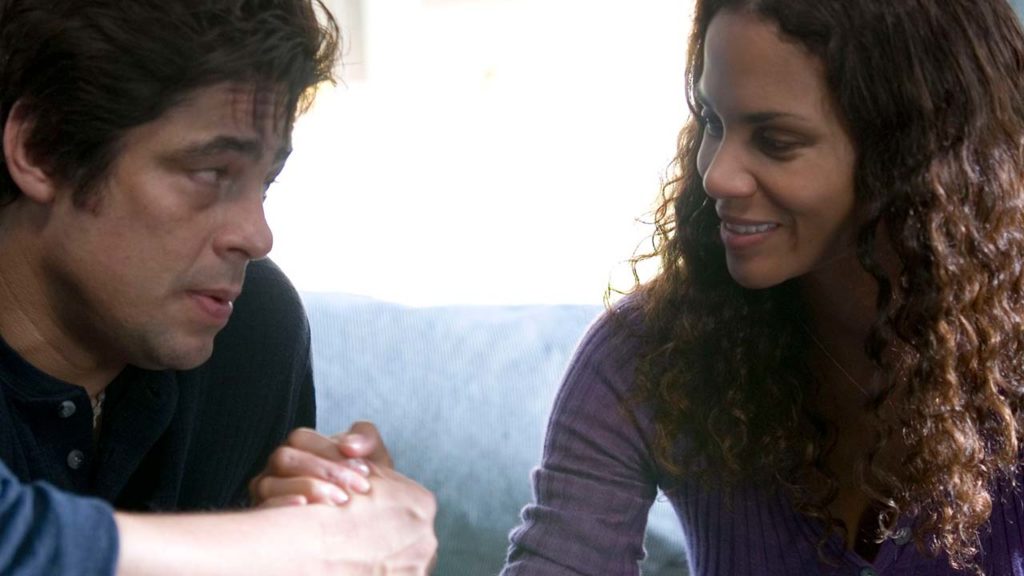
Susanne Bier’s Things We Lost in the Fire is a melodrama in the vein of Alejandro González Iñárritu’s 21 Grams in almost every way: the story of a nuclear family shattered by a random death, told as a nonlinear narrative, with conspicuously arty cinematography, and costarring Benicio Del Toro.
Even a single-sentence description of the basic plot conveys how overwrought things get: Audrey (Halle Berry) impulsively takes in her dead husband Brian’s (David Duchovny) heroin-addicted friend Jerry (Del Toro). Audrey’s motivations are semi-consciously selfish; she perhaps thinks that she can retain some connection with her dead husband by indefinitely extending his fruitless effort to help his childhood friend to kick his drug habit.
But unaware of the adage that one must beware what one asks for, she becomes resentful when her plan unexpectedly succeeds. Jerry does in fact begin to kick drugs, a neighbor takes an implausibly quick shine to him and offers him a job, he teaches one of her kids to swim (a task at which her husband had previously failed), and he responds to her flirtatious advances.
Inexplicably, the movie ends with the wrong Velvet Underground song; someone chose “Sweet Jane” over “Heroin.” Nor is there anything from the Low album of the same name. If the filmmakers thought these selections were too obvious, then how do you explain everything else in the movie?
The Netflix queue is, by its nature, the opposite of the instant gratification of a rental store. You add movies you think you might want to see some day, then sit back and wait for them to arrive in an order decided by computer, according to factors and algorithms outside of your control. Enough time had passed since I added Year of the Dog that I could no longer recall why. Possibly I read a good review somewhere, or maybe I was curious about the sudden reappearance of Molly Shannon (part of “my” Saturday Night Live of the mid-90s — am I right that people feel the most affection for the SNL cast of their college years?). But I feel baited and switched; this is not a drama or romantic comedy but rather a movie with an agenda.
Writer/director Mike White’s Year of the Dog is a feature-length dramatization of Janeane Garofalo’s gag “You can love your pets, but you can’t love your pets.” Not unlike Lily in Eagle Vs. Shark, Peggy (Shannon) is a gentle sweetheart, but alienated and lonely. Her relationship with brother Pier (Thomas McCarthy from The Wire Season 5) and sister-in-law Bret (Laura Dern) is distant at best, and her closest friends are oblivious workmates.
This commute’s a bitch
When she loses the unconditional love of her dog Pencil, she becomes hungry for, as she puts it, a single word to define her. On a date with Al (John C. Reilly), Peggy demonstrates a dislike of hunting, the seed from which her new fervor for an animal activist lifestyle grows. Her one word, she decides, is to be “vegan.”
Her new life teases her at first with the possibility of love with Newt (Peter Sarsgaard), but he is too much like her, or what she might become: unable to love humans nearly as much as animals. From here, the tone shifts to the disturbing, as Peggy causes her life to fall apart. Her clumsy activism costs her her job and family, and she soon descends to theft and attempted murder.
You can love your pets, but you can’t LOVE your pets
And yet, the movie appears to present her ultimate state as a happy ending of sorts. She chooses to be friendless and unloved, but has found meaning and purpose. The most important part of the movie is missing: what happens between Peggy hitting rock bottom (where she becomes unable to function in society) and her total ascendance as a self-assured being? I don’t buy the sudden switcheroo that it’s all OK because she has discovered herself.
Would real-life animal activists find Peggy and Newt amusingly exaggerated versions of themselves, or insulting stereotypes? Even as I am the owner of two rescued casts, it strikes me that choosing the love of animals over that of people is a kind of mental illness that begs for correction, not celebration.
I’ve been a Kenneth Branagh fan ever since seeing the joyous trifle Much Ado About Nothing on a date with my first girlfriend in high school. Probably to my date’s dismay, it was also the moment I fell passionately in love with Emma Thompson. Later, I enjoyed his down and dirty Henry V, the Hitchcockian noir Dead Again, the over-the-top-and-beyond bombast of Mary Shelley’s Frankenstein, and even met another future date at Hamlet. But As You Like It is decidedly lacking in Branagh’s proven flair for translating theatre to the medium of cinema. In the US at least, it was originally intended for theatrical release through Picturehouse, but went straight to HBO.
Having never read the play nor seen it performed, I’ll cop to having done a little cramming on Wikipedia, the 21st Century answer to Cliff’s Notes. Branagh has relocated the action from a French duchy to an enclave of expatriate Europeans in 19th century Japan, but to what advantage? There is little sense of a European community abroad in an alien land; in fact very few Asian actors appear at all, even in the background. A silently-staged ninja attack is a promising opening, but ultimately disappointing to arthouse audiences with highbrow wire-fu expectations raised after Ang Lee’s Crouching Tiger, Hidden Dragon.
Rosalind & Celia’s pretty frocks
Obviously a low-budget film, As You Like It suffers in ways that similarly-priced movies made virtue. Stanley Tucci’s The Impostors, for example, made the cheap sets part of the fun, and beat Branagh by a few years to the device of an epilogue featuring an ensemble cast breaking the fourth wall by literally walking off-set and behind the camera.
Other miscellaneous disappointments:
There’s an over-reliance on long, clumsy steadycam takes, especially one fumbled shot in which Kevin Kline’s face is obscured throughout most of his delivery of the play’s most famous monologue: “All the world’s a stage…”
With a private English garden standing in for the forests of Japan, the overcast weather mutes the color palette. The most vibrant colors are the occasional blossoming tree and the pretty frocks worn by Rosalind (Bryce Dallas Howard) and Celia (Romola Garai).
Brian Blessed (a regular in Branagh’s company) doesn’t do nearly enough of his trademark shouting. Perhaps he was afraid to rupture the delicate Howard’s eardrums.
The omnipresent score is really, really bad.
And finally, As You Like It sports what must be the cheapest fake lion in cinema history; it was probably possible to stage something more convincing on the stage in Shakespeare’s day.
I get that Cloverfield is meant to be a modern day analogue of Godzilla. I get that postwar Japanese moviegoers witnessed an enraged giant lizard borne of nuclear technology stomp Tokyo flat in an unstoppable pique, and I get that Godzilla became a classic for that very reason. I get that we Westerners were long due to be attacked on film by own very own allegorical creature as pop therapy for our terrorism anxieties.
Perhaps we need that movie some time. But significantly more advanced than Godzilla in terms of visual style and special effects, I don’t think Cloverfield is that movie.
As a longtime fan of J.J. Abrams from Alias and Lost, and made a helpless sucker by the film’s clever marketing, I very much wanted to love Cloverfield. However, I found it extremely difficult to watch and to like, for two basic reasons both related to my being a New Yorker for a decade & change: I. unlikeable and unrealistic characters, and II. what can only be described as 9/11-ploitation.
I. The Characters
We know the backgrounds of only two characters, Rob and Beth. Rob has recently been promoted to Vice President of an unspecified type of company at an improbably young age, and is about to leave for a long business trip to Japan. In my understanding of lifestyles of the rich & beautiful in New York City, such young execs were more commonly found in the dot-com 90s economy, but even now still exist in scrappy new media companies like CollegeHumor.com. But let’s assume Rob helped invent the next Facebook and move on.
Yowza howza! Yes, it’s true, all New Yorkers go to parties like this all the time.
We don’t know what Beth, his one true love, does for a living, if anything. She lives with her family high up in the northern tower of the Time Warner Center (more on that later). Her stunning looks and wardrobe might peg her as model, but she appears to be a socialite born of privilege. But far from the slow trainwrecks that are Paris and Nicky, Beth appears to be a sweet, sober girl. In fact, she leaves a party not unconscious in the back of a limo, but out of propriety, to go home to bed, alone.
Us regular joes are supposed to identify with and care about these people? For all its faults, Steven Spielberg’s War of the Worlds (another monster-attack film touching uncomfortably upon domestic disaster in a post 9/11 world) featured an everyman type character in auto repairman Tom Cruise. To be fair, Godzilla was full of white-coated scientists and teeth-gritted soldier-types, so the genre doesn’t exactly call for comparatively boring lower wage-earners that don’t live in luxury condos and party in downtown lofts.
II. 9/11-sploitation
Godzilla was utterly frank in linking the monster with the horrors of the nuclear age. So if the Cloverfield beast is a personification of terrorism, how does the metaphor fit? Did US military adventurism in Afghanistan and Iraq unearth the monster? Is the beast a heretofore undiscovered subterranean oil-feeder, angered by our draining the earth’s supply of fossil fuel?
Without a clear metaphor, Cloverfield just seems to enjoy alluding to the superficial events and imagery of 9/11 without any depth: skyscrapers “pancaking” themselves flat, streets filling with clouds of debris, ash-coated survivors struck numb. I’m not against popular fiction using metaphor to touch upon raw nerves that maybe need to be tweaked now and then… but is Cloverfield it?
Don’t worry, New Yorkers, it’s only a movie.
One of the film’s key set pieces is set atop the twin towers of the Time Warner Center. The allusion is clear, but it’s a stretch factually. Are there residential apartments in the TW Center? As both a New Yorker and Time Warner employee, this is news to me. I should also add that the geography of Manhattan as seen in the film is just this side of realistic. In a space of about 6 hours, it’s plausible the characters could make it from lower Manhattan to the roof of the Time Warner Center at the southern foot of Central Park (assuming, that is, that their young thighs are capable of the trek).
Invasion of the Bodysnatchers is one example of a sci-fi thriller that has worked well enough to illuminate concerns of the times to warrant multiple remakes. Just to name three: the original took on McCarthyism, the Abel Ferrara 90’s version looked at obedience and conformity in the military, and Robert Rodriguez’s The Faculty found the story useful as a satirical critique of high school peer pressure. But none of the various Bodysnatchers films presented us with recreations of cities pressed flat; were contemporary Japanese made sick by the sight of their horrors anthropomorphized in a giant lizard? Seeing my home city’s skyline smoking and collapsing was not something I would call cathartic.
I saw the film early evening on opening day, with an audience full of kids just out of school. The movie went over like a lead balloon; the conclusion was loudly heckled and booed. I suspect the kids mostly objected to the unconventional structure and ending. Which is, for what it’s worth, what I found best about the film: it provides a very movingly unexpected happy ending.
To the editors of Time Magazine that picked District B13 as one of the 10 best films of the year [update: link no longer online], I can only ask, dude, Que la baise vous pensaient-elles? Yes, granted, it touches on some extremely sensitive and timely issues in a racially and culturally divided Paris, but those moments are bolted-on and heavy-handed, serving as mere filler between admittedly awesome parkour sequences. I had more fun at The Transporter.
Happy Feet is a tough one to try to reduce to a single stars-out-of-five rating. It possesses two extreme split personalities, its lack of integration calling into question its integrity. Was there a struggle behind the scenes between a studio wanting another cookie-cutter cartoon animal kid flick vs. a filmmaker envisioning something of substance?
The first film totally embodies the worst cliches of the contemporary CGI animated film: dancing, singing animals talking the kind of stereotypical enthnic jive that would be condemned as racism in a live-action film. People laugh at Robin Williams’ “let me ‘splain something to joo” Mexican schtick in Happy Feet, but feel queasy about Ahmed Best’s gay rastafarian routine as Jar-Jar Binks in Star Wars Episode I. The cuteness of seeing anthropomorphized penguins shimmying to contemporary pop hits wears off fast, yet takes up at least half the film, sorely testing the patience of any adults forced to be in the audience (in my case, it was a free work junket).
The second film is more in keeping with director George Miller’s track record with Babe: Pig in the City. A surprisingly dark and edgy film, the sequel to Babe was a stealth “real movie” that appealed to adults as much as kids, having more in common with City of Lost Children and Brazil than Charlotte’s Web. After seemingly endless, I say endless, musical routines, Happy Feet slowly begins to reveal its true nature as an ecological parable. Don’t get me wrong; I’m all for turning kids into ecowarriors, but many childrens’ films have managed to blend life lessons more fully into the narrative; Toy Story II is about engaging with life, love and friends now as opposed to worrying about the future or pining for the past; Iron Giant is about breaking the cycle of violence; Happy Feet is about… either bootyshaking or overfishing. I’m not sure, and neither is the film itself.
Miami Vice is decidedly slight on character and depth, which is not surprising considering the source material. It is quite so, however, considering writer/director Michael Mann’s track record once leaving the iconic 80s tv show behind.
The deep characterization in all his crime dramas ranging from Thief through Collateral elevate them above the ultrastylized and hyperviolent genre films they would have been otherwise. Even the most minor characters in Heat have backstories and substance. Thief and Heat each revolve around a long coffeeshop conversation; how many genre films slow down long enough for the characters to talk to each other? And it also has to be said of Collateral that Mann somehow drew an actual performance out of the increasingly looney Tom Cruise, probably one of his last before he heads further down Michael Jackson lane to crazy town.
But Miami Vice is disappointingly empty, despite an engagingly twisty-turny plot and typically brilliant editing and cinematography. But when there is no investment in the characters, who cares when they start shooting each other in the face?
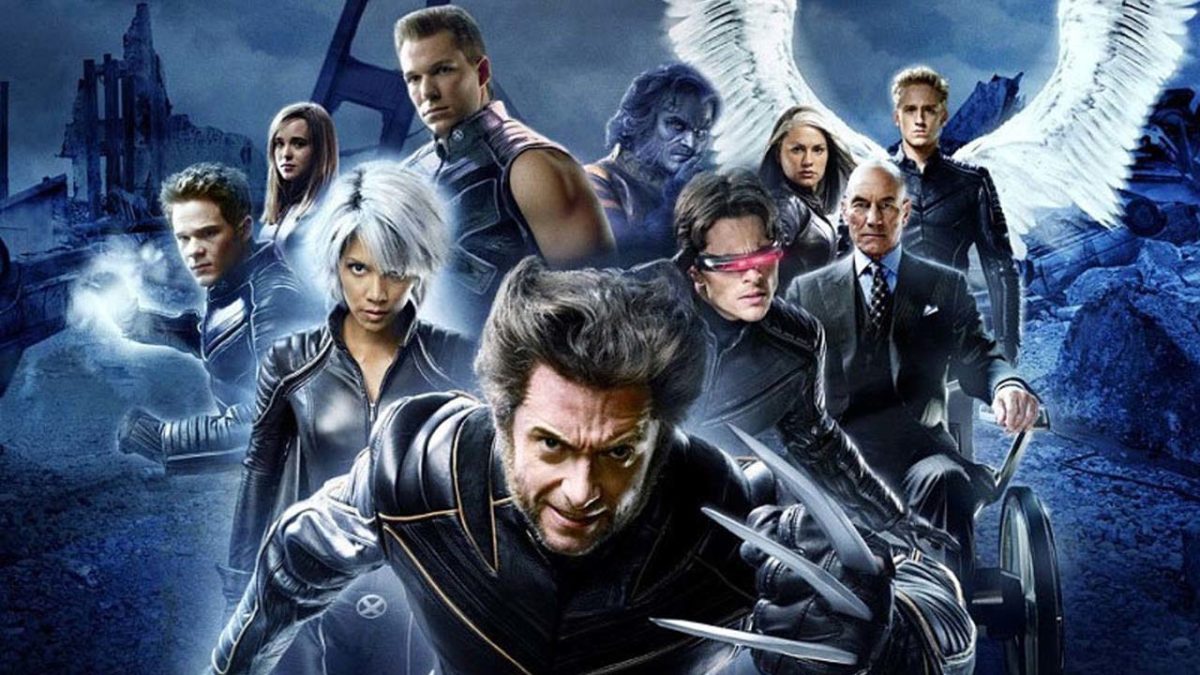
God help me, but I agree with Harry Knowles’ review. Sometimes you need a fanboy to point out what’s wrong with a movie crafted for fanboys. He picked up on the absurdly sensitive Wolverine, the important Phoenix backstory cursorily related in hammy exposition, and the sudden and arbitrary shifts from day to night. But the worst crime of all is that the movie is actually boring; a mere ninety minutes seemingly stretched to what felt like 2-plus hours.
Also bothering me: why on earth was X-Men III: The Last Stand such a massive hit? Not just the question of general quality, but also the fact that it’s set in a densely self-referential world comprehensible only to dorks that read the comics as kids (cough, cough), or at least to moviegoers who happen to remember the first two installments really well. Perhaps the answer is as simple as it being a holiday weekend with no real competition in theaters, but still, it must have been off-putting and mystifying to mere mortals.
It’s tempting to blame the whole mess on jobbing director Brett Ratner, but if Bryan Singer had still been involved, would the script have been any different?
Oops. I should have let The Dark Crystal live on in my childhood memories as a Good Movie. Seeing the brilliant Mirrormask reminded me how much this movie affected my childhood, but seeing it again as an adult I find it has not aged well. The special effects of course cannot rival contemporary digital epics, but I was surprised to find the storytelling stilted and overly dumbed-down. Recent kids’ movies are pitched at a more sophisticated level, not feeling the need to start with a lonnnnng opening expository narrative and pause every 15 minutes or so to do a plot recap.
Still, you have to admire Jim Henson’s sheer bloodymindedness at spending five years pulling off this difficult-to-make film. And it scores points for just being so weird.
And a quick word about the DVD: cheap menus and a horrendous print. What’s up with that?