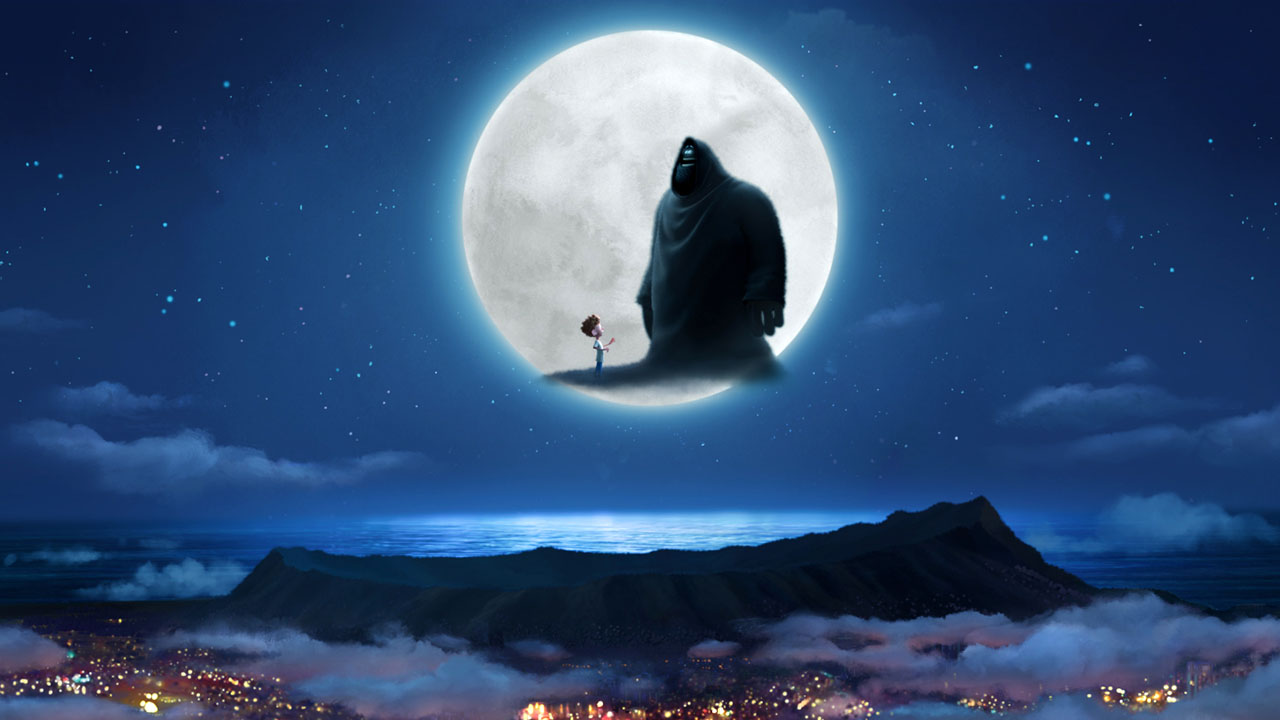
A better title might be “Orion is Afraid”, or maybe “Charlie is Afraid”.
What odd timing, for Orion and the Dark to come out so close to the similarly-themed-if-pitched-at-a-very-different-audience Beau is Afraid. Were Charlie Kaufman and Ari Aster comparing notes, over a few cups of coffee?
Other than its general theme of anxiety, the unusual structure is the most obvious evidence of the author’s usually idiosyncratic touch. There’s about 15 minutes of table-setting, 17 minutes to reveal the framing device, and an 1 hour and 20 minutes until we zoom all the way out to the outer framing device.
It is otherwise very conventional and generic. I’m disappointed that I am forced to repeat my complaint about almost every single English-language animated feature: Orion and the Dark is just as hyper-verbal and overwritten as any mainstream animated feature, constantly spewing with torrents of ceaseless dialogue. The dominance of text over imagery is holding the entire animation medium back.
But I did like its pretty funny (and timeless) joke about non-apologies.
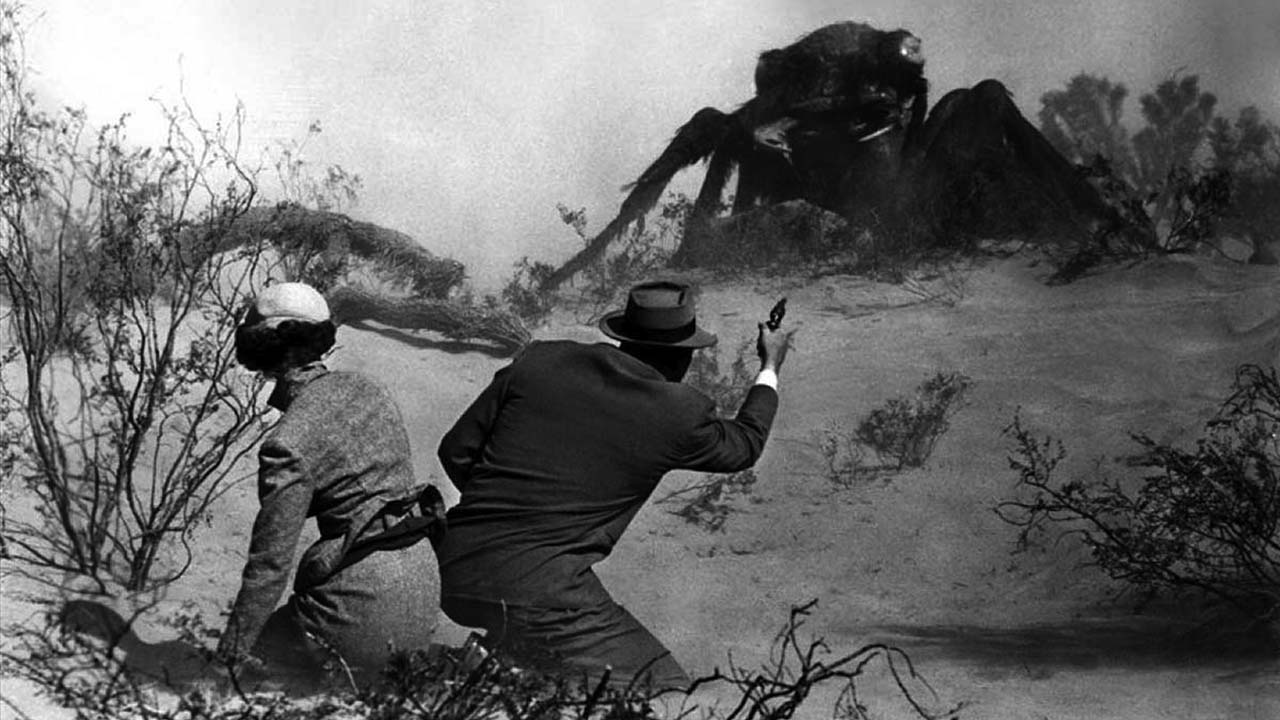
Gordon Douglas’ Them! (1954) is far more polished, slick, and straight-faced than its b-movie premise (and exclamation point!) would suggest.
The subplot involving a traumatized orphan is genuinely distressing to watch, James Whitmore gives a rather modern haunted performance, and some of the effects are surprisingly gruesome. From a giant monster crushing a human torso in its mandibles, to our heroes tiptoeing through a gooey clutch of insect eggs, you can draw a straight line to Dan O’Bannon, Ridley Scott, and H.R. Giger’s ideas for Alien.
I have faint memories of watching an edited-for-TV version as a child, so this rewatch was suffused with a little extra eeriness, as I occasionally recognized a scene or image. For some reason, the repeated references to “unexplained sugar theft” echoed in my memory, and I still can’t tell if it was intentional comedy. To modern audiences, the aggressive banter between Pam (Joan Weldon) and Graham (James Arness) is simultaneously toxic and hilarious.
It’s also interesting to note the very-1950s preoccupation on authority figures maintaining secrecy and public order. Were this to be made today, the cast of characters would be a ragtag band of misfit teenagers and/or science nerds, and the government/police/military would be absent or ineffective. There would probably also be a pair of single parents and/or divorcées in the mix.
What is left for any new war film to say today, after landmarks like these:
The Deer Hunter and Platoon scratched open American society’s unhealed scabs over a pointless, unwinnable (indeed, lost) war.
Dark comedies like M*A*S*H, Catch-22, and Blackadder Goes Forth ruthlessly mocked clueless generals, while still being compassionate towards those that sacrificed themselves.
Saving Private Ryan permanently disrupted the war film formula, utilizing new storytelling techniques and filmmaking technology in service of empathy, viscerally placing the audience in the meat grinder that so many of the Greatest Generation were marched into.
More recently, 1917 and Dunkirk both employed formal experimentalism to tell war stories on an individual and geopolitical scale, simultaneously.
I know there are many other key highlights in the genre (I didn’t even mention one of my personal favorites, Paths of Glory), but you get the idea: the best war movies have opened eyes and shifted public opinion.
Edward Berger’s 2022 adaptation of All Quiet on the Western Front seems rather quaint in comparison, perhaps negatively affected by being seen mostly on small screens, via Netflix. It’s comprised of a series of vignettes that bluntly illustrate the obvious truths that every sensible person with a conscience already knows: what we think of as “war” is mechanized, industrialized slaughter on an obscenely huge scale, with soldiers as game tokens pushed around a map by armchair generals far behind the front line. As Stanley Kubrick’s 2001: A Space Odyssey famously satirized, despite thousands of years of civilization, war is a ritualized version of clans of cavemen having it out with clubs and rocks, for temporary control of a fetid pond, at least until the next famine, drought, or wildfire.
But then again, recent history has seen corrupt warmongers like George W. Bush and Vladimir Putin stage costly invasions for power and profit. So maybe every new generation of moviegoers does occasionally need new war films to rub their faces in the ugliness and brutality of war. But is All Quiet on the Western Front going to pierce the propaganda bubble in, say, Russia? And even if it did, would it change any minds that haven’t already been made up?
There are many downright strange aspects to the one-and-only Popeye movie, and you may be forgiven for thinking the strangest of all is that it was directed by Robert Altman, or perhaps that there has been no subsequent attempt at a reboot.
But to me, the biggest mystery is how this could possibly be one of Robin Williams‘ most muted performances. In Altman fashion, the ostensible lead character is merely one part of a huge ensemble, as in Nashville or Gosford Park. I would not have expected Ray Walston or Shelley Duvall to overpower Williams under any circumstances, especially in a kids’ movie. Speaking of the latter, Duvall absolutely nails the part of Olive Oyl, and is the best thing here.
Popeye has an easy-going, laid-back slacker vibe, even during the slapstick action sequences. Fittingly for the famously mumbling, inarticulate sailor man, the story is largely visual, and non-reliant on dialog. You could turn down the volume and have essentially the same experience. Indeed, Popeye would probably make great viewing for toddlers (or adult stoners) that vibe on The Teletubbies, or whatever today’s equivalent is. Compare and contrast with the heavily scripted, highly verbal kids’ movies from the Pixar and Dreamworks assembly lines.
I wonder if Warren Beatty studied Altman’s Popeye, in preparation for his own idiosyncratic comic strip adaptation, Dick Tracy. And the giant, sprawling set (not to mention the presence of Williams) also brings to mind Steven Spielberg’sHook.
Based on the book of the same name by Lizzy Goodman, Will Lovelace and Dylan Southern’s documentary Meet Me in the Bathroom surveys the early-oughts music scene in New York City, particularly The Moldy Peaches, The Strokes, Interpol, Yeah Yeah Yeahs, LCD Soundsystem, and TV on the Radio. For the health and hygiene of all involved, I hope the titular bathroom was not the one in the Mercury Lounge.
I don’t know if you knew this, but people tend to have strong opinions about music, and it’s difficult to find two people that share the same set. A quick skim through the Letterboxd reviews displays a wide array of stances, ranging from (paraphrasing) “it was all noisy garbage until James Murphy tried ecstasy” to “Julian Casablancas is a delicate snowflake that must be protected at all costs”. But to be fair, there is common ground: most seem to acknowledge that gentrification sucks, 9/11 was traumatic, and Ryan Adams and Courtney Love were not good influences, to say the least.
The Strokes tear it up
Despite living in NYC at the time, being about the right age, and a big live music fan, I’m not a devotee of any of these bands in particular. There is one I actively dislike, one that I’ve never heard of, one that I’ve seen live, and the rest I enjoy to different degrees. OK, I’ll name names: The Strokes always sounded to me like a bunch of annoying drunks just thrashing around, The Rapture somehow never crossed my radar, and I’ve seen TV on the Radio (albeit after they made it big).
There’s an astonishing amount of footage available, considering it all dates from a point in time right before everybody started carrying cameras around in their pockets. But it’s a pity the new voiceover interviews are awkwardly delivered in the present tense, redundantly narrating exactly what you’re seeing, just like a reality TV show. There were numerous fascinating individuals and stories in this milieu, and it should have all added up to more than a feature-length episode of Behind the Music.
The dapper gents of Interpol
In retrospect, the ’90s were a golden age for female-led bands (see Garbage, Curve, Belly, The Breeders, and countless more), but in the early 2000s, it seems that Kimya Dawson of The Moldy Peaches and Karen O of the Yeah Yeah Yeahs stood nearly alone. The latter speaks very movingly about the sexism she encountered, primarily from the music press. Her exuberant stage persona sadly descended into a form of self-flagellation, a hole she had to dig herself out of.
Karen O is not the only fragile soul depicted as driven to express herself in public despite deep insecurity, shyness, and various economic and political headwinds. Coming across as the most well-adjusted are TV on the Radio and the very dapper Interpol. The only figures that seemed to roll with the punches and just have fun are Adam Green and Kimya Dawson of The Moldy Peaches. Certainly, none of them responded well to being asked idiotic, insulting questions by VJs, over and over and over; one exchange that stood out to me was Casablancas bemoaning his belated realization that the music biz is… a biz.
The Yeah Yeah Yeahs
As naive as he sounds now, it is true that nascent file sharing tools stalled these bands’ momentum (sales of a critical Interpol album were killed by it leaking online far ahead of release, and DJs like Murphy saw the value of their meticulously curated LP collections suddenly evaporate as any kid with a laptop and modem could cue anything up on demand), gentrification pushed everyone out of Williamsburg and Dumbo, and of course 9/11 changed everything.
As a New Yorker since 1996, the inclusion of explicit 9/11 footage struck me as tasteless, something that even Michael Moore had the decency to exclude from Fahrenheit 9/11. But upon reflection, I think it might be useful to occasionally illustrate what it was like to live through it, for those elsewhere who may admonish New Yorkers to “never forget” but don’t truly understand what they think we don’t remember. Particularly memorable is footage of members of The Strokes picking through the detritus-strewn streets, before it occurred to anyone that the ash was carcinogens and incinerated bodies.
The doomed All the Pretty Horses should have, by all rights, been a golden ticket for all involved. Let’s run through its pedigree and prestige factors:
based on an acclaimed novel with popular name recognition
directed by an indie darling
screenplay by a proven specialist in adapting novels to film
starring beautiful young up-and-comers
score by a notable musician/producer
distributed by a household-name movie company known for boffo box office and landing major awards
Instead, a heavily compromised version underperformed and was widely panned, demoralizing director Billy Bob Thornton, alienating musician Daniel Lanois, and generally disappointing everyone. Thornton’s presence in the tabloids at the time may have contributed to audiences not taking him seriously. But the key to understanding what what went wrong is, unsurprisingly, Miramax and — trigger warning! — Harvey Weinstein. Yuck.
Peter Biskind’s book Down and Dirty Pictures is an essential history of the indie boomlet within the 1990s movie industry. Particular attention is paid to the illustrative saga of Miramax, for whom Thornton had made a tremendous splash as writer, director, and star of Sling Blade in 1996. Studio cofounder Harvey Weinstein was riding high at the time for his marketing acumen, but was simultaneously loathed for interfering in the artistic process — to the point where he was known within the industry as “Harvey Scissorhands”.
Matt Damon and Henry Thomas wonder what went wrong.
Biskind relates how Weinstein forced Thornton to excise more than an hour from his initial 3-4 hour assembly cut, partly out of understandable practicality (a shorter running time would allow theaters to run more screenings per day) but also petty retaliation for Thornton’s refusal years before to similarly abbreviate Sling Blade. Thornton has since asserted that the assembly cut was just that, and distinct from his intended 2 hour and 42 minute cut. However unjust the butchery may have been, it’s hard to imagine how Thorton thought he could possibly get a nearly three-hour-long film into theaters without having a contractual right to final cut, even under a hypothetical producer less ruthless than Weinstein.
After Orson Welles met similar obstacles during the making of The Magnificent Ambersons, he struggled for the rest of his life to continue making movies his way. Biskind heartbreakingly describes Thornton as beaten down and defeated, to the point where he suffered health issues. In the coming years, Weinstein’s far worse abuses of power would become more widely known. In light of how he abused and exploited women, the stifling of a few movies may seem rather unimportant. But it is a pity that this particular one is so compromised.
Penélope Cruz has more chemistry with this hat than she does with Matt Damon in All the Pretty Horses. Seriously though, she looks fantastic in this hat.
It’s difficult to judge how I might have experienced the film if I had not known ahead of time that it was so heavily edited, but it does feel off somehow. It has notably uneven pacing; weirdly accelerating through some plot developments with choppy montages, especially in the opening sequence when Cole (Matt Damon) is forced to leave his family ranch, but slows down to a pensive crawl for others. The romance between Cole and Alejandra (Penélope Cruz) feels inert, and the looming threat from her powerful, overprotective father (Rubén Blades) never materializes. It’s hard to guess whether the full film fleshed any of this out.
Miramax was not averse to letting finished films sit on the shelf if deemed not of box office or award value — or, perversely, if insurance incentivized them to strategically not release them. Miramax also doesn’t have much of a history of releasing special editions for the home entertainment market, even for their biggest pictures. So for a movie that was not a success in its ostensibly more commercial Scissorhands incarnation, it’s interesting to note that Miramax did entertain the release of the director’s cut of All the Pretty Horses on DVD, but Thornton and Lanois refused.
From the movie’s brief foray into a ruthlessly bleak world more characteristic of Cormac McCarthy’s oeuvre.
Weinstein had disliked Lanois’ unconventional guitar-based score, despite his fame and proven success with Sling Blade, and commissioned an entirely new, more conventional one from Marty Stuart. Lanois now proudly refuses to license his original score in any form, and Thornton will not release his director’s cut without it. Thornton and Lanois are still close friends, as evidenced by his appearance in the documentary Here Is What Is, so it’s safe to say the conflict is not between them. Hopefully now that Weinstein split from Miramax in 2005, the company folded in 2010, and Weinstein is finally incarcerated, cooler heads might allow the proper release of the definitive film and score.
Another ray of hope is that Cormac McCarthy has since become an even bigger literary superstar — having been selected for Oprah’s Book Club and enjoyed successful film adaptations of his novels No Country for Old Men and The Road — and perhaps his hard-earned Hollywood clout might help a definitive version of All the Pretty Horses see the light of day. The counterargument is that his collaboration with Ridley Scott, The Counselor, was itself a bizarre fiasco.
All the Pretty Horses is probably one of McCarthy’s most palatable works, which I don’t intend as a backhanded compliment; it is more accessible in comparison to his more characteristic poetically bleak tone. Its back half (the protagonist’s imprisonment and an extended chase sequence) is closer in spirit and tone to the likes of Blood Meridian, but its core elements of friendship and romance provide some relief from the brutality of his resolutely cruel literary universe. As the first volume in a loose trilogy called The Border Trilogy, Thornton’s film could very well have kicked off a motion picture franchise. Revisiting or continuing this saga is unlikely to say the least, but it would be welcome.
Director Michael Haneke has made Funny Games twice, a decade apart. They are essentially the same movie: nearly shot-for-shot, with the same title, similar music and location, and at least one of the actors physically resembling one of the original cast.
The few adjustments include the spoken language, updated telephone technology, and added Americanisms. So this is not a case of a filmmaker completing a rough draft (as Michael Mann’s L.A. Takedown was to Heat), or reimagining a film (as Alfred Hitchcock did with The Man Who Knew Too Much). So why recreate an earlier work in a fashion that hews so closely to the original?
The marketing images created for the 1997 and 2007 versions both utilize the stylistic fetishization of violence in popular entertainment.
Haneke has frankly stated that both Funny Games are his commentary upon violence in cinema, particularly American. His particular depiction of violence here is deliberately senseless, cruel, and unmotivated. The cyclical nature of the attacks is reflected in the very existence of the two films themselves. The remake is a sequel, or the sequel is a remake, just like the unimaginative popular entertainments that Haneke is satirizing.
Perhaps the 2007 version, featuring internationally bankable stars Naomi Watts (also a producer), Tim Roth, and Michael Pitt, allowed him to more directly confront English-speaking audiences with his cynical thesis. As if prophetic, the American home-invasion themed The Strangers would be a box office success the very next year.
Funny Games introduces us to a happily carefree family, immediately signaled as affluent and cultured. They own a vacation home, boat, and listen to classical music. Even their neighbors have refined taste; they are heard enjoying the downtown New York avant-garde musician John Zorn. The family is not unlikeable, but Haneke’s depiction of their easy privilege seems designed to invite either envy or eat-the-rich distaste.
Class envy is certainly implied when they are shortly terrorized by home intruders: unsurprisingly a pair of young white men. Their choice of golf whites and equipment is no accident; perhaps only fencing accoutrement would have been more apt. Had either Funny Games been made a mere few years later, critics would be analyzing these characters in the distressing language of today — disaffected male incel rage — and compared their appearance to the preppy white supremacists that rallied in Charlottesville, VA in 2017 with the fascistic Donald Trump’s open approval.
The obscurely-motivated home intruders from the 1997 (left) and 2007 (right) versions of the film.
Haneke, already known for employing the mechanics of cinema to indict or confront the audience in Caché (Hidden), does so here as well, albeit significantly less subtly. One character breaks the fourth wall five times:
He winks at the camera during a childish yet sadistic hot/cold game.
He bets the family they will be dead in 12 hours, then turns to the camera and asks how the audience would bet, and whose side it’s on.
As the husband pleads for it to be over, he whines “But we’re not up to feature film length yet” and says the audience wants a “real ending”.
He literally rewinds the film to alter events to a manner more satisfying to him.
In the very last shot, he gazes directly at the camera again.
All suggesting one possible theory for his motive: his performative concern that audiences are suitably entertained and get their money’s worth — traditionally the role of the filmmaking, distribution, and marketing teams. Indeed, he seems at times to be directing and editing the action.
Even the marketing for each movie seems designed to comment upon the visual fetishization of violence in popular entertainment. The original poster depicts a child in bonds, and the latter a beautiful woman in distress, with her anguish and tears presented in a fetchingly artistic manner.
The intruders behave dispassionately and ritualistically, and when they are through with this family, they immediately move on to another. We never learn for sure what motivates them, if anything, so we are left to wonder about the film itself, and our culpability for paying to watch it — and other violent delights that the entertainment industry offers.
With a release history more tangled than a TNG time travel plot, Star Trek: The Motion Picture is now finally available in its most complete form yet: a 2022 4K remaster of the 2001 Director’s Edition of the 1979 film. Got that?
Engadget has the full details, but in short, don’t call it a “restoration”. The original elements have been fully rescanned and regraded, with effects recreated, all suitable for contemporary screens. Thankfully for the Trek completist, the basic edit has not changed — so there is no “new” canonical material to trigger a warp core meltdown as Memory Alpha is updated. After more than 40 years, the movie finally no longer has a “yeah, but…” asterisk attached to it.
The cast of Star Trek: The Motion Picture model their jumpsuits and miniskirts.
But I still just can’t get behind it. While it has many of the typical Trek trappings (cosmic alien first contacts, tension between workplace hierarchies and personal relationships, and an overemphasis on Spock — more on that later), it lacks the core spirit of Star Trek, which for my latinum, is gee-whiz model UN nerds in space.
It was also always fatally out of step with the times. It borrowed all the wrong things from prior landmarks like 2001: A Space Odyssey (the ponderous psychedelia, conflict with artificial intelligence, the too-tight jumpsuits and too-short skirts), but not the Flash Gordon adventurism that Lucas and Spielberg would employ to define action and sci-fi in the coming decade.
Spock’s voyage beyond the infinite.
Back to Spock: The character is the most overused aspect of Trek, appearing in the original series, the animated series, The Next Generation, Discovery, Strange New Worlds, and almost every movie (including the J.J. Abrams reboots). It’s not fair of me to complain about Spock oversaturation when talking about the very first movie, long before the character was run into the ground. But even so, it all just feels so tedious and simplistic. I understand the character appeals to people on the autism spectrum, but doesn’t the concept of a neurotypical person consciously electing to suppress emotion, out of a cultural/religious impulse, undercut the life experiences of those born that way, without that choice?
The character of Spock may be a challenging exercise for any actor, but on the evidence here, I’m not sure that Leonard Nimoy did much more than simply gaze at everything and everyone impassively. And he’s not the only one who seems emotionless: Ilia (Persis Khambatta) is already an alien ice queen when we meet her, so it isn’t much of a transformation when she is reborn as a walking Siri/Alexa device. And Decker (Stephen Collins) never seems too perturbed when the woman he loves is abducted and assimilated.
Drinking game: down a Romulan ale every time someone says “Spock!” or “orifice”.
As Solo and Rogue One were to Star Wars, The Many Saints of Newark is to The Sopranos: mere fanfic dressed up as a prequel. We did not need to learn how Uncle Junior hurt his back.
Unpopular pop culture opinion: The Sopranos is overrated. Yes, it opened the floodgates for what came to be called “prestige TV”, but so much of what followed is better. Tony Soprano may be the archetypal male sociopath character that rationalizes his behavior to himself and to his TV audience, but I would argue that Walter White, Al Swearengen, Jimmy McNulty, and Don Draper are all more complex and interesting figures.
It’s a more common problem for a movie to fail from not having enough substance, but if anything, Alan Taylor’s The Many Saints of Newark has too much material for a two-hour movie. It’s been so long since I’ve seen The Sopranos that it took me ages to untangle the complex family tree in my head. I couldn’t remember which characters we were expected to remember from the series, and which were new.
Some intriguing coloration is given to Tony’s mother, one of the series’ biggest unalloyed villains (not to mention the most Freudian), but she is barely a footnote in this overstuffed mess. I can’t help but think it would have been a better movie if it had focused on her, and perhaps also Janice and Carmela, both of whom merely cameo.
Everyone remembers Andrew Davis’ The Fugitive for Harrison Ford and Tommy Lee Jones’ chemistry (despite rarely sharing the screen) and its iconic action pieces (especially the train and dam sequences). But all of this must hang upon a plot framework, and the lopsided movie’s momentum dissipates as it gets bogged down in the details. The first half is so singularly focused on thrills, that it fails to set up the unexciting pharmaceutical company corruption details introduced too late in the game. For a movie like this, the conspiracy should be as interesting as the action.
It’s also hard to overlook the fact that the Marshal’s (Jones) most defining character trait, that the audience is clearly expected to admire, is that he proudly does not bargain or negotiate. Faced with a hostage situation involving a person of color, his solution is to summarily execute. I suppose this is to raise the stakes for the titular fugitive — you’ll be shot dead before you’re arrested — but even to early ’90s audiences, it’s impossible to imagine a U.S. Marshal treating an affluent white felon the same way as a poor black felon. Seems awkward now that this role earned Jones an Academy Award and a sequel.