“Please let me know if there’s another way we can screw up tonight.”
Not only is Nicholas Meyer’s The Undiscovered Country my personal favorite Star Trek movie, I may go far as to argue that it is the best. It truly ticks every box of what makes Star Trek Star Trek, and comes the closest to getting everything just right.
Watching it back-to-back with its immediate predecessor is especially informative. Director William Shatner’s The Final Frontier is not quite the unmitigated fiasco its reputation would have it, but it has many flaws, the most tragic being its deep lack of dignity. There was no escaping the increasing ages of its beloved cast, but it’s just plain preposterous to open with Kirk free-climbing a mountainside, and then end with him embarrassingly huffing and puffing up a tiny hill. And poor Uhura is treated even worse, in what must be one of the most sexist scenes in Trek’s entire history.
Classic Star Trek was in the process of being eclipsed by the Next Generation TV series, midway through its 1987-1994 run at the time, just hitting its stride in quality and popularity. It would have been heartbreaking for the low point of The Final Frontier to have been the last adventure for the classic Enterprise crew. Things could have gone so wrong. Thankfully, The Undiscovered Country reclaims everything that The Final Frontier squandered, and allows the full original cast to go out on a high note.
Cold war brinksmanship in outer space.
Far from ignoring the cast’s age, The Undiscovered Country instead embraces it. Our former space cowboy heroes have all aged into diplomatic and strategic roles in Starfleet, and their frontier mindsets chafe at the transition. We’re no longer asked to believe William Shatner is possessed of ageless physical prowess. Kirk wins a fight largely through a lucky sucker punch, and when he’s smooched by the much younger Iman, the moment is immediately undercut… twice.
The stakes are high enough to be serious, but not so low that the movie resembles a feature-length television episode, the excuse often made by fandom to apologize for the too-frequent mediocrity of the feature films. The previously thinly-drawn foes the Klingons are here reimagined as canny equals, on the opposing side of an interstellar cold war. Christopher Plummer is superb as a canny political operator — today, we would recognize his paper-thin charm and propensity for brazen assassinations as very Putin-like. The metaphor for US/Russian relations may be unsubtle but it packs a punch, particularly as Kirk struggles to overcome a lifetime of prejudice.
Meyer & Denny Martin Flinn’s screenplay is a thing of beauty, with an airtight plot, crackling dialog, and just the right balance of humor and gravitas; it’s somehow the funniest and the most serious Trek movie. The at-the-time cutting edge CGI special effects are used efficiently and for story purposes instead of mere flash and sizzle (globules of alien blood floating in zero-gravity not only looks neat, but is a significant plot detail). The entire cast is on point, and everyone gets a moment to shine.
As if to make up for The Final Frontier, Nichelle Nichols has several standout scenes (including my favorite among many classic Trek facepalms):
The Undiscovered Country begs the question: why can’t Star Trek always be this good?
The buzz is true; the under-the-radar cult gem Miracle Mile is surprisingly great. Harry (Anthony Edwards) and Julie’s (Mare Winningham) hellacious night on Los Angeles’ titular Miracle Mile suggests Before Sunrise crossed with Children of Men crossed with After Hours, but without the reprieve of a hopeful ending. Unless you consider life on a geologic scale, in which everything we are becomes oil and diamonds.
Director Steve de Jarnatt’s Miracle Mile is simultaneously an emotionally affecting love story and a gripping thriller, but its most extraordinary achievement is its patience to allow grand events to slowly unfold, from the personal (boy accidentally sleeps through date with girl) to the cataclysmic (the literal end of the world).
The frenzied breakdown of society over little more than a rumor seems inevitable when everyone has spent a lifetime under the chronic anxiety of nuclear meltdown and/or war — all the while externally carrying on with everyday small business: playing trombone in the park, catcalling in diners, stealing stereos, cheating on diets, and flirting in museums. The best anyone can hope for is to have someone to embrace at the end.
John Landis’ Trading Places is remarkably unafraid to take a cold hard look at racism, privilege, and inequality. It still retains the power to incite gasps and raise eyebrows, decades after release.
With two major caveats, Trading Places is one of my personal favorite comedies.
Caveat one: for a movie with guts enough to deal so directly with such heated issues, it is oblivious to its own sexism. The only real female character is a sorely underwritten hooker-with-a-heart-of-gold stereotype (poor Jamie Lee Curtis).
Caveat two: Dan Aykroyd’s blackface bit is excruciatingly cringeworthy, and nearly upends the film’s entire context of interrogating racism. For shame, everyone involved.
With these reservations out of the way: wow! Trading Places is as scathingly relevant now as in 1983. Rapacious investor siblings Randolph and Mortimer Duke (Ralph Bellamy and Don Ameche) disagree over whether their elevated social status is due to nature or nurture. They stage a Mark Twain-esque scenario, pitting their Prince (golden boy Aykroyd) against a Pauper (small-time con artist Eddie Murphy). Needless to say, their little social experiment is just as rooted in race as it is in class. The Duke’ sole concession to equality is that they view both pawns with contempt.
The Duke brothers represent the worst of American capitalism: the breed of parasitic short-term opportunists leeching off the economy that Tom Wolfe would satirize as self-proclaimed “masters of the universe” in his decade-defining novel The Bonfire of the Vanities. Terrifyingly, Landis could count on contemporary audiences automatically intuiting them as villains, but the same isn’t true today. In 2016 and 2018, enough Americans voted for a new batch of overtly racist predatory capitalists to grant them the power of the White House and Senate.
Trading Places is indebted to the films of Preston Sturges, but it also brings to mind Billy Wilder’s Some Like It Hot. It has its own problematic aspects that haven’t aged well (such as dim-witted female characters with the sole aim of finding wealthy husbands), but is surprisingly progressive with its ambivalent attitudes on gender and sexuality.
More obviously, Trading Places shares with Some Like it Hot a propensity to break the fourth wall. Eddie Murphy’s classic spit-take to the “bacon, lettuce, and tomato sandwich” line is, for my money, one of the funniest moments in movie history:
One of the greatest living Americans. If anyone deserves to be lionized in a feature-length hagiography, it’s The Notorious Ruth Bader Ginsberg.
In these dark times, it’s heartening to see this unapologetic celebration of one woman’s lifelong championship of American values like fairness, justice, and equality. Glimpses of her personal life prove she also lived by these values, especially in how she plowed a pioneering course through formerly male-only spaces like Harvard law school, and how she and husband Marty modeled a successful marriage of equals.
But an obvious but unspoken dark subcurrent runs through Betsy West and Julie Cohen’s documentary: Ginsberg is not getting any younger, and it’s unbearably terrifying to contemplate American life without her. She was instrumental in many of the anti-discrimination rulings that protect Americans today, against the powerful so-called “conservative” forces that expressly believe that Americans are not equal, that women should be paid less than men and excluded from male spaces, and that non-white people should not vote. The film makes the point that she was not long ago considered a moderate, but the rise of far-right forces have recast her relatively straightforward moderation as leftism.
After West and Cohen’s film rests its case, the dissenting opinion is delivered by Professor Helen Alvaré of the Scalia Law School. Try not to puke as you sit through the staggering hypocrisy of someone associated with one of the most notorious right-wing ideologues in recent American history, voice the surface-level, rational-sounding criticism that a Supreme Court Justice should not voice personal political opinions.
In ordinary times, with ordinary politicians, I might agree that justices ought to tread lightly in the public forum. But these are not ordinary times, and Trump is not an ordinary politician. Alvaré’s argument boils down to: liberals should not enjoy the same freedom of speech as the rich and powerful. Today, with predatory nationalists and criminals sullying the White House and dominating Congress, I counterargue: anyone who does not have open antipathy for the Trump Administration is either ignorant or somehow profiting.
In a national climate that elevates uninformed opinion over knowledge and expertise, we need this celebration of raw, burning intelligence. The serious, reserved Ginsberg is now endearingly pleased to find herself a pop-culture icon and inspiration to young people, but especially to young women. More like her, please.
In Delbert Mann and Paddy Chayefsky’s Marty (1955), Ernest Borgnine plays a basically decent man, trapped in a kind of stasis by social forces that are only more amplified today: misogyny, distrust of the educated, racism, and classism. Even the changing economic landscape looms over him, as corporate consolidation threatens his dream to own a small business.
One or two more generations, and it’s easy to imagine Marty’s family chanting “lock her up” at a MAGA rally, and his friends as incels trolling women on the internet. His family exemplifies a moment of social transformation between extended families living together and a trend towards isolation and nuclear families. His mother and aunt spent a lifetime working until they couldn’t work any more. In their old age, they are left with nowhere to live and nothing to do. His cousin is transitioning towards the American Dream of a house and child, but the accompanying burdens and anxieties outweigh any happiness.
In the language of today, we would say that Marty needs to ditch his toxic friends.
Outside the family tumult, his circle of friends is adrift in an increasingly isolated social world of movies, bars, and dance clubs — all in the pursuit of women that they seem to desire and loathe in equal measure.
I cannot tell you how utterly relieved I was when Marty made that last-minute phone call. I think I would have been devastated if he hadn’t.
Doug Liman’s Fair Game is an important movie. The legacy of the Bush Administration’s war on terror comprises many grand injustices: civilian casualties, torture, increased resentment worldwide, eroded civil liberties, et al. In other words, lots of raw material for screenplays.
Most treatments of the war on terror in movies so far have been fictional explorations of its cost upon American soldiers and their families (including The Messenger and In the Valley of Elah). Fair Game belongs to a different genre: the dramatization of actual figures in the midst of specific events. Fair Game is structured as a more conventional biopic than more rigorous recreations like The Road to Guantanamo, United 93, and Zero Dark Thirty.
Fair Game dramatizes the public scapegoating of CIA officer Valerie Plame and former Ambassador to Africa Joe Wilson simply because their jobs tasked them with giving answers to difficult questions, questions that they didn’t realize had already been given scripted answers by the Bush Administration. Plame and Wilson’s intelligence conflicted with the preconceived fictional narrative that Iraq was pursing a nuclear weapons program. Plame and Wilson were both firmly ensconced within the system, and chewed up by it when they tried to resist their exploitation.
Naomi Watts as Valerie Plame in Fair Game
One possible flaw with Fair Game is that it strives to position Plame and Wilson as the protagonists of a traditional two-hour biopic narrative. They are burdened with traditional character motivations, such as to clear their names, save their marriage, and expose villainy. The facts of history don’t really make for a conventionally satisfying climax to a thriller plot. When Dick Cheney’s Chief of Staff Scooter Libby was convicted for perjury and obstruction of justice, it was through no direct action of the fictionalized Plame and Wilson.
Fair Game rightly highlights Plame and Wilson’s heroism in exposing the administration’s lies, but the demands of a conventional biopic to present its protagonists as having vindicated themselves doesn’t really fit in this particular case.
Conventional wisdom will tell you there is only one good Matrix movie, and it’s called The Matrix. Conventional wisdom is wrong.
The Wachowski‘s The Matrix Reloaded does everything movie lovers claim they want from sequels, and complain that Hollywood so rarely gives them: it expands the cast of characters while still taking care to enrich the returning players, it delves deeper into the themes of the first film while widening the scope to include even more, it explores the fictional universe in ways that illuminate the character’s motivations, it ups the ante on cutting-edge special effects, and expertly raises the stakes for a grand climax in a promised subsequent film.
Stop! It’s bullet time.
The Matrix Reloaded is smarter, has more exceptional action set pieces, and employs a more consistent sense of morality than the original The Matrix. It always bothered me that Neo (Keanu Reeves) and Trinity (Carrie-Anne Moss) casually sacrifice innocent humans by the dozens in the first film. I am sure it was a deliberate creative choice that in Reloaded, the heroes battle only virtual “programs”.
So why the popular opinion that both Matrix sequels suck? Here’s my theory: the concluding film in the trilogy (The Matrix Revolutions) fails to live up to everything set up by Reloaded. The mediocre third film makes all three look bad in retrospect. With time, I maintain people will look back and reappraise the entire trilogy and recognize The Matrix Reloaded as the best of the three.
A true gem. I think Peter Weir’s The Truman Show is part of informal trilogy (with The Eternal Sunshine of the Spotless Mind and Man On the Moon) in which Jim Carrey found a way to channel his manic energy and rubber-face-pulling into dramatic roles, in films that were not only populist, but also critically acclaimed.
That said, there are a few scenes in which it’s clear Weir wasn’t able to rein in Carrey’s more outré compulsions. Many interesting supporting characters (Noah Emmerich as Truman’s lifelong ersatz pal, who nevertheless seems to have some genuine affection for him, and Laura Linney as a decidedly more professional actor just doing a job) simply disappear from the film. It may not be perfect, but it builds to a very moving emotional wallop at the end.
Books are books, and movies are movies. I usually don’t want or expect any adaptation to copy its source — in fact, it’s usually in everyone’s best interests for a derivative work to strive to be its own thing, and not… well, derivative. But Tom Tykwer and the Wachowskis‘ Cloud Atlas turned out to be an astonishingly faithful adaptation of David Mitchell’s novel. For a book so sprawling and commonly assumed unadaptable, I fully expected more characters and incident to have been necessarily jettisoned. But almost everything is there, with most of the screenwriters’ additions coming in the form of structural, as opposed to material, changes.
Being so faithful to this particular book comes with a potential downside. One of the greatest pleasures to be had in the novel is its wide range of genres and tones. Sequences include a pulpy 70s thriller, a light-hearted old folks farce, a sci-fi dystopia, and a postapocalyptic wasteland. Each is familiar to a degree, but only insofar as Mitchell employs known genre tropes to his own ends. Each is written in a different voice, ranging from archaic historical vernacular to imaginary fractured and devolved languages of the far future.
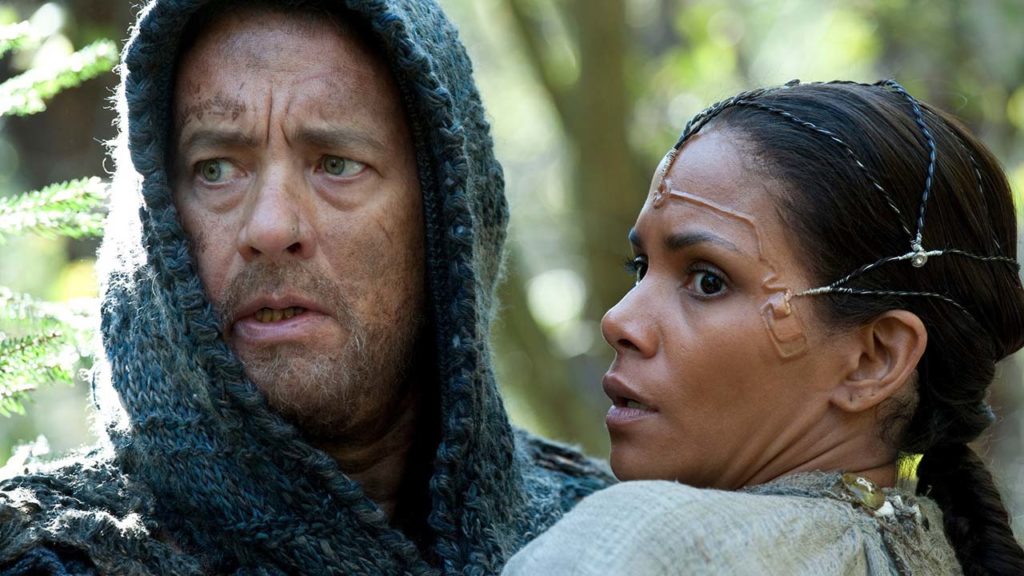
Tom Hanks and Halle Berry in Cloud Atlas.
These devices may work better on the page than on the screen, for a reader is able to savor the lushly stylized language of each period. But subtract the novel’s devices of epistolary exchanges, internal monologues, fireside storytelling, and formal interviews, you’re only left with dialogue and visual depictions of action. What’s illustrated on screen comes across as a gumbo of The China Syndrome, The Matrix, The Road, and Best Exotic Marigold Hotel. For instance, when David Mitchell took on the tone of a conspiracy thriller, I found it impressive. But when it’s realized on screen, it feels like a Friedkin or Frankenheimer knockoff with extra corny dialog.
“Times are you say a person’s beliefs ain’t true, they think you’re saying’ their lives ain’t true and their truth ain’t true.”
Zachry (Tom Hanks) on the metaphysical conundrum
The aforementioned faithfulness extends to plot, tone, character, theme, incident… indeed almost everything except structure. The elegantly spiraling structure of David Mitchell’s novel is one of its most justly celebrated features, and it could have theoretically been adopted to cinema. Instead, the film scrambles the various story lines into one long montage that comes at you in a nearly three-hour-long avalanche. The obvious benefit is the highlighting of how recurring themes are interlinked and interwoven, how patterns of behavior repeat throughout history, and for the more metaphysically inclined, how souls are reincarnated, and how good and bad deeds echo forwards and backwards through time.
James Darcy and Ben Whishaw in Cloud Atlas.
The three directors told the A.V. Club that they all worked simultaneously in close collaboration, but were required to be credited for specific sequences. For better or for worse, it seems pretty clear to me that the action sequences set in futuristic Korea have the Wachowski brand all over them. In this dystopia, corporations have replaced both government and religion, not that dissimilar to the world of the Wachowski-produced V for Vendetta). While intense and lengthy, these glorified chase sequences are not as extreme as their eyeball-spraining 2008 film Speed Racer. But Tykwer is a highly kinetic and visually oriented director as well, as he proved right away with Run Lola Run, so maybe I’m off base here.
“My life amounts to no more than one drop in a limitless ocean. Yet what is any ocean, but a multitude of drops?”
Adam (Jim Sturgess), Cloud Atlas
One of the primary selling points of the movie is its stunt casting of a relatively small troupe of actors into a multitude of roles. The sad truth is that some of the makeup effects for actors playing across gender or race boundaries just don’t work. Hugo Weaving suffers in particular, with no amount of latex able to disguise his permanent menace and leer (how much do you want to bet he’s a sweet family man in real life?). But there are a few triumphs. For instance, I didn’t recognize Hugh Grant in at least two of his roles. Tom Hanks runs up and down the hamminess scale in his various characters here, but I thought he was genuinely excellent in the role of Zachry, a humble but atypically thoughtful goat herder whose deepest religious beliefs are challenged.
Bae Doona in Cloud Atlas.
Like many, I fell in love with the beautifully written, structured, and ingenious novel. But most interestingly of all, it’s the first thing I can remember reading in a long time that had anything approaching a message, or, for lack of a better term, a “moral of the story”. In short, resisting oppression of all sorts is always worth it, even if one person can’t fix the world. Mitchell shows us a world seemingly inevitably doomed to drastic decline via slavery, global warming, societal collapse, usury, and world war, but its heroes nevertheless act against political, corporate, or religious oppression. Many (but not all) of them suffer for it, but their acts resonate in ways both large and small.
“Wars do not combust without warning.”
Cloud Atlas
It is in this context that I must pinpoint one serious crime the movie commits against the book. I noticed only one significant deviation from the novel that, for me, almost negates everything I found most powerful in the book. I don’t object that something was added (in fact, I usually argue that most adaptations of books need to be more liberal in their interpretations), but rather that what was added betrayed a desire for sentiment — in essence, a happy ending. Anyone that has experienced the novel and the film will know exactly what I’m talking about. The movie ends on a positive note for humanity at its chronologically latest point, while the book ends with a moving internal monologue set near the beginning, as a character decides to dedicate his life to the abolitionist movement.
Despite serious reservations like this, I was totally swept up in the movie and have to rate it highly overall. As a movie, it’s a towering, almost unbelievable achievement. It was essentially an independent production, with a large portion of the financing coming directly from the filmmakers themselves. Cloud Atlas was not made as a corporate exercise; it exists because three filmmakers felt they had to do it. The message of resisting oppression of all sorts, including corporate, must not have been a good selling point when it came time for them to shop their movie around to potential distributors, giant corporations all. So go see Cloud Atlas, if for no reason other than its verve and audacity.
Genre fiction has long resided on the less reputable side of the divide between escapism and literature. But as The Atlantic notes, cult writers like Neil Gaiman are increasingly crossing over into the mainstream while established novelists like Michael Chabon are exploring sci-fi/horror/fantasy territory blazed by the likes of Margaret Atwood.
Few have blurred these barriers as well as Cormac McCarthy, a writer with firm bona fides in the literary world whose devastating 2006 novel The Road incorporated elements of speculative fiction. It became a crossover hit and landed a spot in the world’s biggest book club: The Oprah Winfrey Show. Its vision of a burned world populated by dehumanized scavengers is sometimes even described as a zombie story, sparking an argument over whether or not it qualifies as horror or science fiction. My own two-fold answer: yes, of course, to both. But the question is also irrelevant. Speculative futures and fanciful technologies are not the true subjects of science fiction, but rather means to an end: illuminating the world of here and now.
The Road was in theaters roughly contemporaneously with its dimwitted cousin Terminator Salvation, the fourth entry in an escapist action franchise detailing a formulaic battle for the fate of humanity. But The Road was set at a time long after such heroic struggles were lost, if they were even attempted. The world itself is terrifyingly realized onscreen, using actual desolate locations: particularly an eerily abandoned stretch of turnpike in Pittsburgh, and the still largely lifeless blast zone around Mount St. Helens in Washington. The only technical problem I noticed was the somewhat distracting tooth continuity throughout. Decay: now you see it, now you don’t.
“If I were God, I would have made the world just so and no different.”
I re-read the novel a few days before first seeing the film, which turned out to be a mistake. The book remained the emotional, visceral experience it was on my first read, but its freshness in my mind kept me somewhat detached throughout the movie. I could not help but dispassionately analyze the particulars of the adaptation. I’m among those who loved the book, but didn’t necessarily desire the movie to be faithful.
The mechanics of how it could be done fascinated me. How do you adapt a book that lives and dies on the Steinbeckian terse, harsh, understated poetry of its language? Joe Penhall’s screenplay is remarkably faithful in terms of plot and sequence of events, and the few changes are effective. In particular, a neat narrative trick near the end seamlessly combines three separate incidents into a single sequence: The Boy falls ill, The Man loots an abandoned boat, and they are robbed.
It’s hard to imagine a better director for The Road than John Hillcoat, whose previous film The Proposition, from a screenplay by Nick Cave, could have been the movie that McCarthy never made himself. But The Road as a film somehow fails to recreate the emotionally devastating effect of its source material. Another candidate for director might have been Alfonso Cuaron, who managed to transform P.D. James’ novel Children of Men into a gut-wrenching vision of a near-future society disintegrating before our eyes.
McCarthy had presented Hillcoat with a significant challenge; the novel is a long denouement to a story we didn’t see. Perhaps the strongest argument against genre fans claiming The Road as their own is that most zombie stories concern the fall of civilization. The Road is set long after this cataclysm, where everything has been taken away, even the very names of the people and places that remain. All that remains is the drudgery of mere survival.
“If there is a God up there, he would have turned his back on us by now. And whoever made humanity will find no humanity here.”
That said, McCarthy does glancingly allude to a cataclysmic event (possibly a natural disaster) followed by human violence on a massive scale, waged by tribes described as Bloodcults. There are many aspects of the back story that Hillcoat and Penhall opt to clarify (particularly the Man and Boy’s family life), but the massive wars that swept the world in the preceding years is not one of them. This largely unspoken past in crucial to the book, as the reader contemplates how the Man, the Boy, and everyone they encountered somehow lived through it all, be it through fighting, hiding, or collaborating. The Man’s strategy for survival is to lay low and instill in his son the need to preserve a metaphorical “light” of basic humanity. We see numerous alternative strategies that also worked, but which result in the destruction of the soul. One such walking dead man we meet is Old Man (Robert Duvall), who apparently collaborated with the Bloodcults until the toxic landscape claimed his health.
Some of McCarthy’s poetically spare language is preserved in the limited voiceover narration delivered by the Man (Viggo Mortensen). But some evidence exists onscreen that the filmmakers feared the audience might not be able to put two and two together. While being scarcely mentioned by name in the book, “cannibalism” is one of the first words spoken in the film. It presents this savagery as the specific omnipresent threat that forces the Man and Boy to remain totally alone and self-reliant. Another clue the movie is more obsessed with cannibalism than the book: in the closing credits, a character is chillingly named only as “well-fed woman”. That’s certainly more humor than can be found in the text.
“I told the boy when you dream about bad things happening, it means you’re still fighting and you’re still alive. It’s when you start to dream about good things that you should start to worry.”
Another key element I missed from the book is the realization that the Boy has literally never seen another child, ever, which goes a long way towards explaining his careless reaction to glimpsing another boy. Long accustomed to hiding from all contact, he explodes with the dangerous need to connect. Although The Boy has evidently known little else, he seems to have the inborn need to cling to signs of life. The boy also marvels at a glimpse of a beetle whose metallic-like wings refract the grayish light and provide one of the film’s only flashes of color.
The ending of the novel is something that can only work in prose. A simple change in verb tense hints at a possible future, a radical change in thinking for characters previously forced to organize their lives around immediate survival. Beyond an overarching quest to reach the ocean, they indulged in little talk of the future, or of any kind of continuance at all. Life on the literal and metaphorical road is a sick combination of drudgery and terror. Every event in their lives is sudden, unexpected, and never likely to recur in quite the same way. The final words in the novel are perhaps the first thing the boy hears that hints of a comforting routine he might expect in his future. Translated to film, Hillcoat and screenwriter Joe Penhall do perhaps the only thing they could do: plug a bunch of words into a character’s mouth that was silent in the book.
“My heart was ripped out of me the night he was born.”
The casting is pretty much perfect, particularly Kodi Smit-McPhee, who so resembles Charlize Theron that it’s eerie. Even the supporting cast is superlative, including Robert Duvall, Guy Pearce, Michael K. Williams, Molly Parker, and Garret Dillahunt. The latter is an interesting, versatile actor, having previously played an upper-crust psychopath in Deadwood, a criminal idiot in The Assassination of Jesse James by the Coward Robert Ford, a murderous cyborg in Terminator: The Sarah Connor Chronicles, and here a vile cannibal.