Category: 4 Stars

Good Stuff

  • Solitary Confinement: Moon

    Solitary Confinement: Moon

    Moon is a rare science fiction thriller that doesn’t derive its tension solely from the spectacle of spaceships, robots, or offworld locale. Rather, it’s a psychodrama about paranoia, in the Philip K. Dick tradition of Blade Runner, Minority Report, and A Scanner Darkly (not to mention the countless movies Dick indirectly inspired, such as Dark City, 12 Monkeys, and The Matrix). Moon’s futuristic trappings hide several onion layers of deeper themes: bioethics, torture, labor exploitation, and questioning the nature of the self and one’s perception of reality.

    Director Duncan Jones (aka Zowie Bowie, son of David Bowie), shot Moon on an extraordinarily economical budget of $5 million, achieved largely by restricting production to soundstages and substituting practical miniatures for costly CGI. A beneficial side-effect is a pleasing tactility lacking in most contemporary sci-fi films, where entire characters and environments are now routinely virtual. As a beat-up rover slowly trundles across the uneven lunar surface, kicking up dust, bumping and rattling all the way, it feels real because it is.

    Duncan Jones' Moon
    Our circuit’s dead, there’s something wrong

    As his character’s name Sam Bell implies, Jones conceived the role with Sam Rockwell in mind. Rockwell was great in Confessions of a Dangerous Mind and Matchstick Men, and is great here. He must hold the screen virtually alone for most of the film, and Jones was right to hype him for an Academy Award nomination.

    Sam is a blue-collar miner and the sole occupant of a partially automated base dedicated to strip-mining the dark side of the moon for a compound needed back on earth for clean power. It may sound like technobabble but in fact the science is sound: Helium-3 is a real element believed to be plentiful on the moon and theoretically may someday provide a sustainable source of energy. But in the true sci-fi dystopian tradition, Sam’s employer Lunar Industries turns out to be as insidious as the Weylan-Utani corporation that exploits the Nostromo mining platform crew in Ridley Scott’s Alien.

    Lunar Industries boasts of profitably saving the Earth’s environment by providing clean power on the cheap, made possible by engaging in practices that are arguably immoral but commonly accepted. The exploitation of cloned life is a direct parallel to today’s outsourcing of labor to developing countries with more lax human rights. If one wonders how a future society might be so inured to cloning that they would condone Sam’s servitude, media broadcasts overheard at the end of the film spill the beans: no, they don’t.

    That is, if we’re optimistic and assume what he hear is real – it’s possible they’re the fantasy of a dying man imagining his moral victory. But perhaps it’s like how many in the western world live now; we enjoy affordable consumer electronics and clothing manufactured by workers that literally live inside their factories, and don’t ask why our purchases don’t cost more. Jones told Suicide Girls [update: link no longer available] that Moon is the first part in a projected trilogy, so perhaps we will see prequels or sequels that flesh out a world where human cloning is a fact of life.

    Sam’s madness and physical deterioration is partially explained within the science fiction context as a result of the inherent instability of cloned life. Apparently, like early experiments with animals like Dolly the sheep in 1996, clones are more prone to disease, organ failure, and premature death. Dolly survived about half the normal lifespan for a sheep. Like the “replicants” in Blade Runner, these clones come with built-in expiration dates. But then, don’t we all? While Blade Runner‘s Dekker comes to terms with his true nature through escape, Sam instead chooses to confront.

    Sam Rockwell in Duncan Jones' Moon
    I am obligated to make a lame “Sam I Am” joke somewhere in this review, so here it is.

    Discovering he is merely a commercial product with inbuilt obsolescence is just one of Sam’s problems. His quarters and workspace look like they might have once been as clean and white as 2001: A Space Odyssey‘s Discovery One vessel, or at least the inside of an Apple Store, but have long since become stained and soiled with the filth and grit of the many Sams that came before him. Also like the Discovery One astronauts, Sam periodically receives prerecorded video messages beamed from earth. These asynchronous conversations are not unlike email, and a poor substitute for real human interaction.

    You don’t have to look far for a metaphor: the common practice of solitary confinement is increasingly recognized as a form of torture. The harrowing New Yorker article “Hellhole” by Atul Gawande recounts how a psychologically stable person can go mad in a matter of weeks or even days without human contact. We first meet Sam three years into his tour of duty.

    Sam’s interactions with the base’s computer GERTY (voiced by Kevin Spacey) are likewise reduced to the rudiments of online communication; its “face” is comprised of happy/sad/neutral emoticons. GERTY is a rarity in science fiction: a compassionate example of artificial intelligence. Countless movies (including 2001: A Space Odyssey, The Matrix, Wargames, The Terminator, I Robot, et al.) have trained us to expect artificial intelligences to be inherently evil or, at least, dangerously unstable. But GERTY is more like David (Haley Joel Osment) in A.I.: Artificial Intelligence, Robby the Robot in Forbidden Planet, or Wall-E: an artificial creation that rigidly follows its programming, but whose parameters allow it to exhibit genuine compassion and caring for its charge.

    Kevin Spacey in Duncan Jones' Moon
    GERTY ROTFLMAO

    I loved the movie overall, but was disappointed by the lack of ambiguity in its storytelling. The trailer reveals more than I would have liked to know if I had watched the movie cold, and the movie itself reveals its secrets very early by quickly dropping the word “clone.” Would it have been more interesting had there been hints of a possibility that Sam might be delusional, hallucinating a clone, and was in fact alone the whole time? Maybe I’ve been conditioned by too many Twilight Zone episodes, Fight Club, and M. Night Shyamalan movies, but I anticipated a twist ending that never came.

    I’ve touched on several of Moon‘s more obvious inspirations, but I’m also reminded of Steven Soderbergh’s Solaris remake, in which a clone-like creature murders his original. Cloning is just beginning to enter the zeitgeist, having recently figured into the braindead actioner The Island but also the more contemplative Never Let Me Go, based on the highly regarded novel by Kazuo Ishiguro. Clones may very well prove to be the next zombies or vampires.

  • Christopher Nolan’s Fugue State: Inception

    Christopher Nolan’s Fugue State: Inception

    In his 1999 essay Celluloid Vs. Digital, Roger Ebert cites studies equating the experience of watching a movie to entering a fugue state: “film creates reverie, video creates hypnosis.” In other words, experiencing a film in the traditional manner, projected at 24 frames per second in a darkened theater, affects the brain in a way akin to dreaming. Inception is far from the first movie set in dreams, but it may be alone in attempting to encode the experience into the architecture of a film itself. Whether you compare it to onion skins or a puzzlebox, the form follows the content.

    The bar has been set very low by the likes of Avatar, but Inception is finally proof that movies with budgets in the hundreds of millions need not be moronic and disposable. Yes, Inception is a sci-fi action movie full of well-tailored outlaws, guns, fight sequences, and exploding mountain fortresses, but it’s also an intelligent, complex experience for adults. If it took a weak remake and two movies about a vigilante in a rubber bat costume for Nolan to get here, then so be it.

    Joseph Gordon-Levitt in Inception
    “It’s not, strictly speaking, legal.”

    Inception is the natural progression from Following, Memento, and The Prestige, Christopher Nolan’s quartet of wholly original visions. Insomnia, a safe remake of the far more incendiary Norwegian original, now seems like a detour, a paying of dues to enter the mainstream. His pair of Batman franchise entries injected a modicum of psychological realism into the pulp source material, but the grimly ponderous weight of it all was perhaps more than it could bear. For my money, nobody other than Tim Burton has managed to find the right mixture of camp and solemnity that makes up Batman.

    While Inception may have some surface resemblance to numerous heist, caper, long con, action, and science fiction films, it is nevertheless a very welcome New Thing. Its deepest thematic links are probably to cerebral sci-fi meditations Solaris and Until the End of the World. The nightmare planet in Andrei Tarkovsky’s Solaris haunted visitors with imperfect reincarnations of their most emotionally significant others. When a grieving astronaut is reunited with his ersatz wife, long dead of suicide, is it a blessing or a curse?

    Leonardo DiCaprio and Elliot Page in Inception
    “A single idea from the human mind can build cities. An idea can transform the world and rewrite all the rules.”

    Wim Wenders’ Until the End of the World posits a future in which dream-reading technology would be enormously addictive, psychologically damaging, and permanently alter society. If a technology is ever invented for a group of people to not only enter an individual’s dreams but also to construct the dreamworld itself, how plausible it is that society would not be radically transformed? In Inception, Dom Cobb (Leonardo DiCaprio) is a master at corporate espionage. His expertise is with a process normally utilized for the “extraction” of trade secrets, but inverted to inception: to implant an idea, a task which proves to hold massive significance to Cobb. Like a drug, we’re told, these machines gradually seep away users’ ability to dream on his or her own. We glimpse a sort of opium den in which burned-out dream junkies go to re-experience the normality of not only dreaming, but more importantly, waking up from dreams. Wenders’ The End of Violence would similarly look at another dystopian future in which global surveillance is taken to its logical extreme.

    Inception‘s action sequences beg comparison to everything from James Bond, Jason Bourne, and Mission: Impossible. Its creative fight sequences, taking place in virtual arenas in which the laws of time and gravity are fluid, recall The Matrix. But the true narrative and structural template is much more along the lines of long-con tale much loved by David Mamet (particularly Homicide and Redbelt) and heist films Rififi, Thief, and Heat, in which a crack team of criminal experts work with a psychologically damaged leader on a high-stakes One Last Job.

    The bloodless massacre of hordes of armed thugs seems designed to resemble video games. The obliquely portrayed violence is partly explained by a PG-13 rating that hypocritically permits dozens of onscreen shootings, but disallows blood, and thus any sense of the repercussions and ramifications of violence. But in the world of the film, the thugs are explained to be manifestations of the subconscious. A slight-of-hand morality magic trick that makes it OK for our heroes to mow them down with machine guns and grenades (again, this flashes back to The Matrix, in which the good guys rationalize away their mass killing of virtual avatars).

    Marion Cotillard in Inception
    “You mustn’t be afraid to dream a little bigger, darling.”

    Inception had already developed a reputation as a mind-bender even before release, but I found it to be surprisingly straightforward if you pay a little bit of attention. If you choose to take the film at face value, pretty much everything you need to know is spelled out for you, often in frankly literal exposition (usually in exchanges with Page’s inquisitive character). The key ambiguity is a simple but profound question raised in its final moments. Interpreted one way, the film neatly wraps itself up in an airtight box (which is extraordinary in and of itself, when most big-budget movies often fail to make logical sense). Interpreted another way, it calls into question everything you’ve seen.

    This moment hinges on Cobb’s totem, a personal item that each dream-traveller must rely upon to detect whether or not they are awake. Both Cobb and Arthur (Joseph Gordon-Levitt) warn Ariadne (Page) to never allow anyone else to touch hers. But Cobb also freely admits that his totem first belonged to his wife Mol (Marion Cotillard). Complicating matters, unless I missed something, we never see her with it outside of the dream world. The top had symbolic meaning to Mol, for she locked it up in a metaphorical safe in her dreams. Cobb then uses it to plant the notion in her head that the dream world is not real, in order to encourage her to break her addiction and wake up with him. If the top was real, would she not be able to test herself with it when she woke up?

    One further clue that suggests much of what we saw may be Cobb’s dream: if he and Mol lived the equivalent of 50 years in Limbo, several levels deep into their subconscious, why do they seem to only wake up through one level of dreaming? Is Cobb still trapped a few levels down?

    Elliot Page in Inception
    “Dreams feel real while we’re in them. It’s only when we wake up that we realize something was actually strange.”

    And one wonders about the implausible dream technology itself. It’s offhandedly said to have been developed by the military for training purposes, but very little time is spent on the mechanics of the technology. Some sort of IV is involved in the process of linking people together, but how exactly does an Architect create and realize the world? We see Ariadne fiddle with papier-mache models, and verbally describe the world to the participants, but we’re also told that the architect need not necessarily enter the dream personally, so it’s not her mental map that makes things possible. If the agents are able to conjure things on the fly (Eames produces a grenade launcher out of thin air, and Ariadne folds a city in half), why do they not take more advantage of their effectively unlimited abilities during the heist? Cobb makes a big deal out of a prospective architect being able to devise labyrinths, something like a video game level designer. But Ariadne’s work is literally short-circuited and we never see a dramatic payoff to the theme of mazes.

    Ray Bradbury once said that he was not concerned with the mechanics of interstellar travel; if a story he wished to tell required a rocket ship to ferry characters to another world, that was good enough for him. So is it pedestrian of me to wonder about these practicalities, or do these questions actually matter a great deal? Is the lack of specificity about how this miraculous technology actually works a clue? I believe it is linked to the troubling ambiguity of Cobb’s desire to “go home.” Does he simply want to clear his name so he can re-enter his home country, or does he want to plunge deeper into his fantasy? Is he actually guilty of a crime like Roman Polanski, or merely obsessed with indirect culpability like Kelvin in Solaris or Teddy in Shutter Island? Either way, he may have the opportunity to construct a false reality in which he can absolve himself.

    I believe Inception is one for the ages, and not just because it has been endorsed by Al Gore. Like 2001: A Space Odyssey and Blade Runner, it’s the rare science fiction film likely to remain well-regarded for years.

    Random Observations:

    • How many heist movies have you seen in which the master thief attempts the mythical One Last Job before retiring?
    • Despite Leonardo DiCaprio sporting Nolan’s own haircut, Inception might suffer in comparison to his somewhat similar character in his most recent film, Shutter Island. Two thrillers in a row about a man wracked with guilt over his dead spouse.
    • Wikipedia puts the budget at $160 million, plus a $100 million publicity campaign. As usual, these numbers make my head spin. But at least this time the result is a strong movie.
    • Like Paul Thomas Anderson, Nolan has developed his own personal actors’ troupe. Inception features return appearances by Michael Caine, Ken Watanabe, Cillian Murphy.
  • Design is how it works: Gary Hustwit’s Objectified

    Design is how it works: Gary Hustwit’s Objectified

    Objectified finds its thesis in a quotation from one of history’s prime industrialists, Henry Ford: “Every object, whether intentional or not, speaks to whoever put it there.” In other words, everything we select, purchase, and interact with, was first designed and manufactured by a skilled artisan. That person’s job is to obsess about you, your body, needs and habits, and how their product might become a part of your life.

    Director Gary Hustwit’s previous documentary feature Helvetica was a celebration of typographers and graphic designers, and inspired laypeople to recognize the long history and great labor that went into the typefaces they use every day on their computer screens. Similarly, Objectified profiles the often unknown industrial designers behind the stuff we buy.

    Jonathan Ives in Objectified
    Jonathan Ives’ inner sanctum. After conducting this interview, Apple had the filmmakers shot.

    Apple’s resident guru Jonathan Ive is perhaps the most famous design auteur featured. Ive is probably the second most famous person at Apple, justly acclaimed for his singular design aesthetic that first caught the public imagination with the bondi blue iMac and then the stark, white, deceptively “simple” iPod. Ive’s boss Steve Jobs famously said that design is “not just what it looks like and feels like. Design is how it works,” a principle born out in Ive’s work. Knowing inside and out the particulars of different materials and manufacturing is just part of designing a product’s externals. Ive brandishes precision-tooled parts from a disassembled MacBook Pro to illustrate that Apple spends an enormous amount of time and resources not just designing their products, but also the custom machines and processes necessary to mass produce them.

    Naoto Fukasawa in Objectified
    Naoto Fukasawa rethinks the CD player.

    Objectified spends some considerable time on the topic of sustainability, a responsibility that regrettably only recently entered the industrial designer’s job description. Valerie Casey of IDEO relates the incredible anecdote of the difficult process of developing a new toothbrush. When the product is finally ready and in stores, she embarks on a much-needed vacation to Fiji. If you didn’t already guess where this story was going, she finds a discarded IDEO toothbrush washed up on a beach halfway around the world. In less than a week, her product had become pollution.

    Objectified necessarily makes a brief detour into interaction design (this brief digression would be worthy of a film unto itself, but in the meantime, the curious can refer to Steven Johnson‘s 1997 book Interface Culture: How New Technology Transforms the Way We Create and Communicate). When we interact with most analog products, their form follows their function. As a thought experiment, would an alien from outer space (or a Tarzan raised in the wild) be able to infer an object’s function simply by looking at it? That is likely the case with a spoon or chair, but not so much with an iPhone.

    For many products of the digital age, the outward form factor gives no clues as to the function. Thus, interaction design was born with the Xerox PARC graphical user interface. Many of our daily tasks are now abstracted onto a two-dimensional screen. The Apple iPhone and iPad have popularized the touchscreen, which likely signals the beginning of another sea change when peripherals like keyboards and mice will be revealed to have been a temporary evolutionary bump, now marked for extinction.

    Objectified
    Awww yeah, designers know what time it is.

    The last images we see are of the devices used to make the movie itself: a computer, hard drive, and camera. Tellingly, the Objectified Blu-ray edition has no menu structure at all. You put it in, it plays, and the supplementary features follow immediately after the closing credits. It’s a completely guided, linear experience that speaks to the film’s elevation of the creator over the consumer.

  • What Did I Ever Do to You? David Mamet’s Homicide

    What Did I Ever Do to You? David Mamet’s Homicide

    Detective Bobby Gold (Joe Mantegna) comes to see himself as torn between two discrete worlds in David Mamet‘s Homicide (1991). Only when maneuvered into a position in which he must choose, the duality unravels and he finds he is no one special and belongs nowhere in particular.

    Gold’s partner Sullivan (William H. Macy) has an unreserved man-crush on him, taking every opportunity to publicly butter him up and extol the therapeutic pleasures of police work. He reminds their peers that his revered partner is “Bobby The Orator,” so-called for his skill at negotiation. Indeed the moniker is deserving, for he is called on to calm a rabid dog with mere words, and later sweet-talk a ferociously stubborn mother into betraying her son.

    But Gold is certainly no action hero, confirmed in a early scene as he is beaten up and disarmed by an overweight civilian, in the sanctuary of the police station. By the end of the film, he has lost his sidearm a second time and is quickly physically bested again by Randolph (Ving Rhames). Is it too much of a stretch to link his failure to control his weapon with impotence and castration? He certainly feels perpetually aggrieved. At each unfair turn in these very unfair events, he repeats his refrain: “What did I ever do to you?”

    William H. Macy and Joe Mantegna in Homicide
    “You got some heavy troubles on your mind? Huh, babe? We’ll work it out. We’ll play some cops and robbers. We’ll bust this big criminal. We’ll swagger around.”

    Bobby accidentally comes across a seemingly mundane murder while chasing down the sexier Randolph case (the kind of unambiguous, action-packed police work, with measurable results, that grants Gold and Sullivan existential satisfaction). Elderly Jewish woman Mrs. Klein has been found murdered in her inner-city candy shop. Everything points to a simple robbery, “everything” being, of course, the supposition that poor neighborhood African Americans have robbed a rare white business.

    Klein’s son, not quite grieving but resigned to a lifetime of persecution, sighs “It never ends.” When Bobby asks “What never ends?”, granddaughter (Rebecca Pigeon) coldly clarifies for him: “On the jews.” Already the murder escalates from a robbery to a hate crime, and this is a strong whiff of catnip for a man who also believes himself to be perpetually put-upon and aggrieved. As the Klein family correctly infers, Bobby is a Jew. But he wears a 5-point star as a cop. His sublimated Jewish pride only comes out in defense against the occasional professional flare-up in which he is called an ethnic slur.

    Fittingly for a detective celebrated for a mastery of words, pursuing the Klein murder case is more an act of literary scholarship than one of police procedure. Gold’s investigation brings him to a Jewish research library where he senses deeper mysteries encoded in his ancestral Yiddish. His single best clue is the tantalizing derivation of the nonsense-seeming word “Grofatz.” All of this leads him into a confrontation with a decades-old group of Zionist warriors (who may be or may not be the Mossad, although the name is not mentioned in the film) who awaken him to his vengeful Jewish identity. Hungry for the rush of positive action that his cop side is currently denying him, he elbows his way into their ranks and becomes addicted to violent action.

    Rebecca Pigeon in Homicide
    “Hey, you’re better than an aquarium, you know that? There’s something happening with you every minute.”

    But Homicide is a policier on the surface only. Like most of Mamet’s plays and screenplays, the plot is structured around a deep, complex confidence game. House of Games, The Spanish Prisoner, Glengarry Glen Ross, Spartan, and Redbelt all feature a long con of one form or another at their cores. A sucker is a sucker because of the truism that if one looks hard enough for something, one will find it. Most of Gold’s apparent clues and leads evaporate into meaningless happenstance. What is at stake is not what he thinks, and he finds himself used and abandoned.

    Special mention goes to fine cinematography by the great Roger Deakins. The decaying Baltimore provides for two spectacular chase scenes, one along the rooftops and another below the asphalt. Each coils into a labyrinth, spiraling down and in, deeper and deeper, until Bobby encounters physically powerless but immovable minotaur-like figures the disarmed man must battle with his words alone.


    Must read: Homicide: What Are You, Then? by Stuart Klawans

  • The Time Has Come to Act: Stanley Tucci’s The Impostors

    The Time Has Come to Act: Stanley Tucci’s The Impostors

    I’m not blind to its shortcomings, but The Impostors is one of my most favorite movie comfort foods. That I find it so funny and purely enjoyable is really saying something, considering its milieu is the joblessness, desperation, and looming international conflict of The Great Depression.

    The pitch: a loving homage to old-school Hollywood screwball comedies, with an all-star cast of 90s New York City indie personalities. It has the feel of a filmed stage play (like Peter Bogdanovich’s Noises Off) crossed with the loosey-goosey, making-it-up-as-they-go-along feel of a Marks Brothers or Laurel & Hardy romp. The stagey production values become a virtue as the same few sets are redressed over and over to amusing effect. Finally, the entire soundstage-bound facade is unveiled during a celebratory dance number that breaks the fourth wall. The Impostors is a refreshingly affectionate pastiche, and not satiric or ironic in the least.

    Stanley Tucci and Oliver Platt in The Impostors
    “To life… and its many deaths.”

    The freewheeling farce is above all a love letter to the craft of acting. Arthur (Stanley Tucci) and Maurice (Oliver Platt) are two perpetually out-of-work actors so enamored of their chosen profession that they will not consider pursuing any other line of work even when faced with starvation. Their daily routine consists of staging acting exercises for themselves in public, duping passersby into serving as their participatory audience, like a prototype for the modern-day pranksters Improv Everywhere.

    An escalating series of misadventures finally delivers them into a scenario in which their acting skills for once become useful: the opportunity to portray fabulously rich cruise ship passengers, to save the day, and of course to die magnificently heartbreaking deaths while doing so. What Arthur and Maurice yearn for, even more than to eat, is the opportunity to die in front of an audience. Not for nothing is their toast “To life… and its many deaths.”

    It’s worth noting that most of the legitimate passengers are anything but; most have either lost fortunes during the Depression, are conspiring to steal new ones, or plot to wreak terrorist havoc in the name of fascism. Almost everyone’s an impostor.

    Lily Taylor and Campbell Scott in The Impostors
    “The danger of the chase has made you perspire. It has made me also… moist.”

    Tucci’s paean to acting attracted an ensemble cast to die for, including a dream team of 1990s indie superstars including Lily Taylor, Steve Buscemi, Hope Davis, Isabella Rossellini, Tony Shalhoub, Alison Janney, Alfred Molina, Richard Jenkins, and Campbell Scott (who shamelessly steals and runs away with the movie with a sublimely odd character that answers the unasked question: what if Marvin the Martian were a lovestruck Nazi?). And there’s still room in the souffle for wildcards like a pre-Lost Michael Emmerson, Scottish comedian Billy Connolly, and a cameo by a manic Woody Allen in a superfluous skit that could easily have been cut.

    The Impostors apparently landed with a bit of a thud after the critical and commercial success of Tucci and Scott’s justly acclaimed Big Night (which I also love, not least for containing cinema’s all-time greatest omelette-making scene).

  • Nothing to Say and No Way to Say It: Revolutionary Road

    Nothing to Say and No Way to Say It: Revolutionary Road

    The first few minutes of Sam Mendes’ Revolutionary Road feature one of the boldest jump cuts this side of 2001: A Space Odyssey. Frank (Leonardo DiCaprio) and April (Kate Winslet) meet cute out of a crowd of Beatnik hipsters at a loft party. Like any flirting young couple, how each chooses to introduce themself comprises a promise as to whom each will become should they grow up together. The glamorous April simply says she is studying to be an actress, as if that is all Frank needs to know. He in turn cracks wise about toiling in nothing jobs holding him back from vaguely-defined great aspirations.

    After this very brief scene, Mendes jump cuts to several years later to find Frank and April married in suburbia with two kids. An older Frank privately cringes during April’s weak debut in a community theater production. It turns out she’s not a great actress after all, but cursed to be just smart and sensitive enough to know it. Her sense of definitive failure and his frustration at her frustration combusts into a blistering roadside argument on par with any of the cataclysmic rows between Elizabeth Taylor and Richard Burton in Who’s Afraid of Virginia Woolf?.

    Leonardo DiCaprio and Kate Winslet in Revolutionary Road
    “You were just some boy who made me laugh at a party once, and now I loathe the sight of you.”

    Frank and April’s all-consuming pride escapes as barely-veiled condescension toward their peers in the office and on their suburban street. They both share mutually incompatible senses of superiority, feeling destined for something great without knowing what, or having any obvious natural talent to nurture. It provides no satisfaction when Frank does eventually manifest an aptitude in marketing, something they both view as disappointing and beneath them. Who or what propped them up with this sense of superiority?

    Are we to read their hubris as a critique of the Greatest Generation (Frank is a World War II veteran, an experience he romanticizes even while acknowledging his sheer terror at the time)? This generational theory would be supported by how the older Givings family views them – but more on the Givings later. Or were Frank and April’s egos boosted by overpraising parents? We hear much of Frank’s late father, who toiled in obscurity for years at the same firm where Frank now finds himself trapped, but any other relatives are wholly absent from their lives. Perhaps if Frank and April had been born a few generations later, they would be the sort of overconfident personalities drawn to compete on reality TV shows.

    Kate Winslet in Revolutionary Road
    “No one forgets the truth, Frank, they just get better at lying”

    After April gives up on her dream of acting after her disastrous debut, she latches onto a fantasy of moving to Paris and supporting Frank so he may find his. But Frank is even less evolved than she; he never specifies what he imagines himself becoming. Writer? Politician? Artist? He has nothing to say, and no way to say it.

    Their Gallic escape plan is not fully thought through, and Frank never really commits anyway. He’s clever enough to excel amongst the duller coworkers with whom he shares daily steak and martini lunches. He becomes further ensnared by success in the business world, as measured by income, the sexual availability of naive office girls, and a step above his father on the ego-stroking ladder of promotion.

    One flaw of the film is dialogue that sometimes strays from naturalism into the novelistic. Even in the midst of the fiercest of arguments, April is still poised enough to deliver zingers like “No one forgets the truth, Frank, they just get better at lying” and “You’re just some boy who made me laugh at a party once, and now I loathe the sight of you.”

    Michael Shannon in Revolutionary Road
    “Hopeless emptiness. Now you’ve said it. Plenty of people are onto the emptiness, but it takes real guts to see the hopelessness.”

    I promised to return to the Givings family, whom I believe are the key to understanding the film. Helen Givings (Kathy Bates) gently teaches April how to be a good housewife, offering passive aggressive critiques of such fripperies as lawn maintenance. But she slowly reveals a longing admiration for the Wheelers as an ideal American nuclear family: a nice, good-looking, successful, model young couple in love. The relatively coarse neighbors the Campbells also idealize the Wheelers.

    Helen hopes that some of their pixie dust might rub off on her troubled son John (Michael Shannon), a mathematician and intellectual brought low by mental illness and electroshock therapy (whether it is the disease or the cure that ails him most is a question that bleakly amuses him). John proves to have the coldest, clearest, starkest view of reality, and cuts right through all the subterfuge and doublespeak with which these American nuclear families delude themselves. Everything he says is correct, but tragically, Frank and April interpret the bitterly damaged man as a kindred spirit and not as what he is: a holy fool (in the sense of idiot savant) that damningly illustrates their faults.

    Kathy Bates in Revolutionary Road
    Helen admires the Wheelers’ splendid picture window looking out on Revolutionary Road

    In some ways, the final scene is the most devastating, and it doesn’t even feature the Wheelers at all. The Givings chat at home alone, long after the Wheelers revealed themselves to be fatally fractious and tortured. We witness Helen rewrite history, belittling the Wheelers in terms of their ability to maintain the value of their home (read: their family). As she’s busy erasing her emotional stake in the Wheelers, her husband Howard (Richard Easton) turns off his hearing aid to literally drown her out. He gazes at her emptily, dispassionately, dead inside. We might imagine their marriage survived the kind of emotional flashpoint that destroyed the Wheelers, but trapped them in a cold, loveless life together.

  • Cool Britannia: David Yates’ BBC Miniseries State of Play

    Cool Britannia: David Yates’ BBC Miniseries State of Play

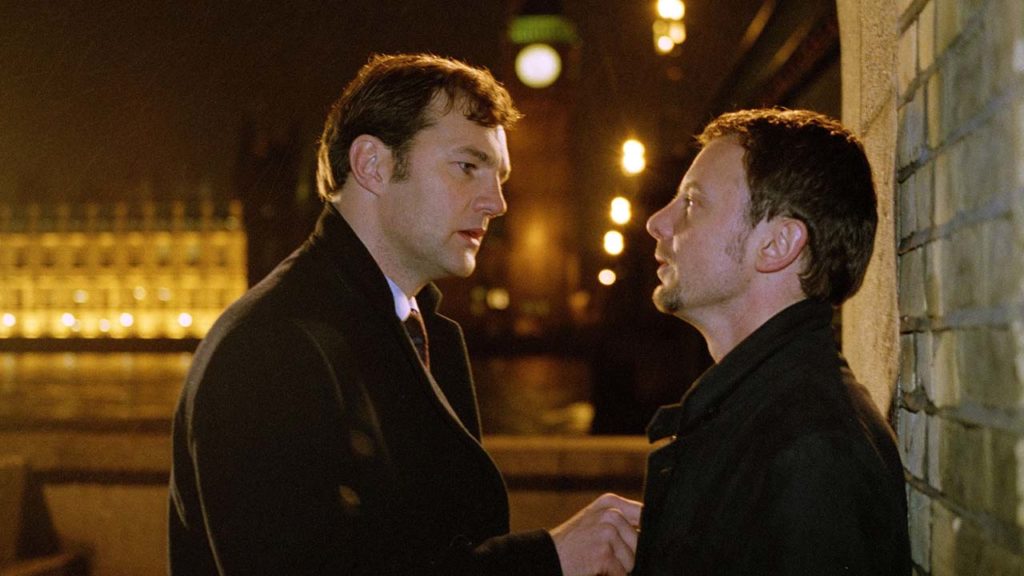
    The 2003 BBC miniseries State of Play is nothing less than six straight hours of intelligent drama, liberally spiced with suspense, action, and tasty plot twists. The entire epic tale is delivered by a veritable plethora of British Isles telly & film who’s who: writer Paul Abbot, director David Yates, and actors David Morrissey, John Simm, Kelly Macdonald, Polly Walker, Bill Nighy, and James McAvoy. Abbot is apparently a superstar television writer in the UK, and Yates directed the last two Harry Potter films (as well as reuniting Nighy and Macdonald in 2005 for The Girl in the Cafe).

    State of Play is an especially good tonic after happening to recently watch the dour The International, which falls more or less into the same genre category. The key differential is a heathy dash of comic relief that never crosses over into farce, mostly supplied by the sublimely quirky Bill Nighy. But more importantly, the intricate tale of high-level political conspiracy feels pertinent.

    Bill Nighy, John Simm, Kelly Macdonald in State of Play
    The Herald newsroom follows the money in State of Play

    The International, although based on an actual banking scandal (a topic that could not be more timely), sabotaged its plausibility by limiting the protagonists to two lone wolfs that take on a crooked multinational financial conglomerate on their lonesome. Here, numerous fleshed-out cops and reporters alternately clash and collaborate as they chase down a gargantuan story.

    State of Play is both a classic newspaper story (like All the President’s Men) and a police procedural (like The French Connection). It’s worth noting that each of these genres are about the piecing together of stories, and the suspense comes from the audience follows along with them as the discover the pieces of the narrative. Granted, the luxurious six-hour running time was a luxury The International could not enjoy.

    David Morrissey & John Simm in State of Play
    The Next Doctor faces off against The Master for the first time

    The details of the plot were undoubtedly timely in 2003 and continue to be now, proven by its American feature film remake in 2009. After suffering through 8 years of a Bush/Cheney administration, Americans can intimately relate to oil companies meddling in governmental operations. Although State of Play is fictional, the affair between a Member of Parliament and a staff member that winds up dead inescapably calls to mind US Representative Gary Condit’s affair intern Chandra Levy, found murdered in 2001. A subplot involving an MP’s compromised expense account now looks even more timely than Abbot could have predicted in 2003, considering the atrocious widespread abuse that currently threatens to remove Gordon Brown and possibly even the Labour Party from power.

    Apart from the sometimes overenthusiastic editing (making the series sometimes feel a bit like the satire Hot Fuzz), the only misstep is Nicholas Hooper’s percussive, bombastic score, including an incongruous didgeridoo-infused theme suddenly introduced in part six. But one of the series’ greatest pleasures is to hear Kelly Macdonald (a crush ever since her unforgettable performance as the ultimate naughty schoolgirl in Trainspotting) pronounce “murder” with all the wonderful extra diphthongs her Scottish accent provides.


    Must read: BBC’s State of Play Left Me in a State of Awe on Pop Culture Nerd

  • California Guitar Trio & Tony Levin’s Stick Men, live at the B.B. King Blues Club, New York, June 22, 2009

    California Guitar Trio & Tony Levin’s Stick Men, live at the B.B. King Blues Club, New York, June 22, 2009

    The California Guitar Trio may not actually be from California (they actually hail from Belgium, Japan, and the US), but there are indeed three of them and they each play a guitar. In a way, that tells you everything and nothing you need to know.

    As designated spokesman Paul Richards explained during their June 22nd show at The B.B. King Blues Club in New York City’s Times Square, they met as students in one of Robert Fripp’s early Guitar Craft courses. The promising pupils became members of the touring outfits The League of Crafty Guitarists and The Robert Fripp String Quintet, and formed the CGT to present their original repertoire interspersed with well-chosen progressive rock and classical covers.

    As a King Crimson fan, I’ve wound up seeing them live no less than three times. The 1992 R.F.S.Q. show in Philadelphia still stands in my mind as one of the best concerts I’ve attended, and I recall their opening sets for King Crimson in 1995 (also in Philly) and The Trey Gunn Band in New York in 1997 going over great with audiences (during most concerts I’ve been to, audiences can’t be pried away from the bar during the opening act). Richards also told the crowd they had been recording and touring the world for 18 years, long since deserving to cease being described as former students of Fripp. (but a little namedropping never hurts!)

    The California Guitar Trio
    The California Guitar Trio

    Monday night’s concert was also an unmissable chance to see Tony Levin‘s Stick Men, a new band formed with fellow stick player Michael Bernier and drummer Pat Mastelotto. The droll, genial Levin is one of the world’s greatest bassists, a fan-favorite — as proven by the inevitable moment at every Peter Gabriel show where the crowd goes wild as he is introduced — and not to mention one of the world’s longest-running bloggers.

    Mastelotto is a powerhouse, a true drum demon obviously enjoying himself enormously on his array of acoustic drums plus various electronics a drum geek would have to identify (comments below, please). He shattered a stick at one point (startling Bernier as a bit of shrapnel flew in his direction), but deftly swapped the casualty for a new one.

    I’m not familiar with Bernier’s music, but as if his talents weren’t obvious on Monday night, Levin gave him props as a player who influenced his own technique (meaning a lot coming from the legend that helped pioneer the Chapman Stick instrument in the first place). Also, Bernier’s got a little bit of a Hugh Grant thing going on.

    The California Guitar Trio
    California Guitar Trio & Tyler Trotter perform Tubular Bells

    Generally speaking, the Trio gave a mellow, contemplative show, while the Stick Men came out blasting with some very dense, funky, mostly instrumental prog rock. They were really, really loud – very glad I brought my earplugs – and even chased a few people out of the venue. I’m shamefully behind on my CGT and Levin album-buying, so I wasn’t familiar with much of the later repertoire of either trio. I only own the first three CGT albums (including what I think is a rare copy of an eponymous cd I purchased at the R.F.S.Q. show, that isn’t even listed on their official site). Copies of their latest are on order from Amazon as I write, but I picked up a pristine-sounding live recording available for sale right after the show.

    Here’s the set list according to Hideyo Moriya’s Roadcam [update: URL no longer available], along with some of my subjective comments:

    1. Punta Patri
    2. Unmei – Beethoven’s 5th Symphony rearranged by Moriya in a 1960s surf guitar style that totally, unexpectedly works.
    3. Cathedral Peak
    4. Tubular Bells / And I Know / Walk Don’t Run – A condensed version of the album-length progressive rock epic by Mike Oldfield (perhaps more famously known as the theme music from The Exorcist). Their sound engineer Tyler Trotter joined the band on melodium.
    5. Portland Rain
    6. Andromeda
    7. TX
    8. Moonlight Sonata – Richards briefly described Fripp’s Guitar Craft lesson of “circulation” as a key technique that has stuck with them. Here they’ve distributed the notes among three guitars, passing single notes from one to another. I’m not an expert, but when it comes to classical music, Bach in particular seems well-suited for the guitar.
    9. Echoes – Longtime Pink Floyd fans (myself included, I must admit) recognized it from the first note, but when the major melody appeared, the audience went nuts, even more so than when some King Crimson covers appeared later in the evening! The CGT version includes a gorgeous ambient interlude, stretching the bounds of what an acoustic guitar can do when connected to all sorts of electronic devices.
    10. Eve – Levin joined them for this ballad, sounding a bit like his own “Waters of Eden”
    11. Melrose Avenue – A great, terse rocker. With Levin & Mastelotto.
    12. Blockhead – With all three Stick Men. One of my favorite CGT tunes, but they omitted any kind of solo (Fripp himself plays a stunner on the R.F.S.Q. album The Bridge Between). Amazingly, they started circulating power chords.

    The Stick Men stayed on stage for the next set, which included the following (and a lot more):

    • Sasquatch
    • Red – The classic King Crimson barnstormer, which Levin modestly identified as “we didn’t write that one.”
    • Indiscipline – Sung by Bernier.
    • Soup (or Superconductor?)
    • Encore: Larks Tongues in Aspic Part II – An effortless-seeming version with the CGT. King Crimson fans will know what I’m talking about when I say here’s another possible interpretation of the “Double Trio” concept.

    Levin congratulated an audience member in the first row for consuming a slice of cheesecake during one of the rockier numbers. He also described their recent, greatly meandering European tour, which sounded very exciting to someone with a normal day job. No doubt a professional musician will quickly counter that that much traveling and border-crossing is grueling. But if there’s time for even a few days off along the way, it sounds to me like a great way to see the world. Or maybe I’m wrong and touring is just hell.

    Tony Levin's Stick Men
    Tony Levin’s Stick Men

    Thanks for reading, and I invite anyone to please comment below. And finally, if anyone cares enough to have read this far, one last thing: fellow New Yorkers might know what I’m talking about when I say that some days New York is more New Yorky than usual. Monday was one of those days, and the nutters were out in force. On my way to the venue, I was blessed (or cursed, maybe, I’m not sure) by a green-clad street preacher wielding a cross made of twisted wire. Minutes later, the guy sitting next to me in Starbucks got an earful from a totally different preacher. And then, in B.B. King’s, one audience member in the back near me was obviously stoned; not on something relatively harmless that merely makes you stupid, but rather on the sort of thing that makes you manic and insane (cocaine? speed?). He couldn’t stop loudly babbling for the entire concert, and was almost literally bouncing off the walls. I kept hoping the management would toss him out, but no luck.

  • Kristin Scott Thomas is unshowy but brilliant in Philippe Claudel’s I’ve Loved You So Long

    Kristin Scott Thomas is unshowy but brilliant in Philippe Claudel’s I’ve Loved You So Long

    Writer / director Philippe Claudel’s I’ve Loved You So Long is a textbook exercise in the dramatic withholding of narrative information. Juliette (Kristin Scott Thomas) is released from prison after serving 15 years for an unspecified crime, and is unwillingly housed with her sister Léa (Elsa Zylberstein). Léa is initially her only ally, and her husband Luc (Serge Hazanavicius) is distrustful for what turns out to be very good reason.

    Léa and Luc have adopted two children (a big clue to the central mystery of the movie), including their precocious older daughter P’tit Lys (Lise Ségur, a rare movie tyke that is actually endearing). As part of her probation, Juliette is required to sign in weekly with a lonely cop (Frédéric Pierrot) with even more psychological issues than she. The slow drip of information ramps up the drama, but we’re told just enough to see that the movie is actually about Juliette’s gradual, sometimes painful reentry into life, not her mysterious crime.

    Elsa Zylberstein and Kristen Scott Thomas in I've Loved You So Long
    Elsa Zylberstein and Kristen Scott Thomas in I’ve Loved You So Long

    Thomas’s unshowy performance is acting of the highest degree. The British actress already proved her fluency in French in Tell No One, although a line of dialogue here explains away her accent. She doesn’t distract by inviting the audience to be constantly impressed at how talented she is.

    But that said, there were a few moments where I marveled at the complex emotions she conveyed. Two scenes in particular stand out: Juliette almost physically recoils when introduced to Léa’s colleague Michel (Laurent Grévill) and when reunited with her estranged mother. Also watch for the almost indescribably complex expression that plays across her face when she meets a sleazy bloke in a pub shortly after her release.

    Elsa Zylberstein and Kristen Scott Thomas in I've Loved You So Long
    Elsa Zylberstein and Kristen Scott Thomas in I’ve Loved You So Long

    Only two factors kept me from considering the movie more highly. There’s a seemingly extraneous and unresolved subplot about Léa ignoring a student who appears to have a crush on her, and claims he’s a subject of prejudice. Was the point merely that Léa is an attractive, sympathetic person? Secondly, the movie arguably descends into talky melodrama at the very end; without revealing too much, we learn the truth about what motivated Juliette’s crime, and why she stubbornly kept her silence for so long.

  • The Decemberists Live at Radio City Music Hall, June 10, 2009

    The Decemberists Live at Radio City Music Hall, June 10, 2009

    Robyn Hitchcock & The Venus 3 (including Peter Buck of R.E.M. and Bill Rieflin of Ministry, R.E.M., and The Humans) opened with an enjoyable 30-minute set. I was unfamiliar with Hitchcock, but by total coincidence had just days before seen his appearance in Jonathan Demme’s Rachel Getting Married. His quirky non sequiturs between songs (“I had a root canal this morning, which is why I’m wearing a hat” – which he wasn’t) contrasted with his focused, tight songs. The Decemberists’ Colin Meloy briefly joined in on tambourine and backing vocals.

    I’m a latecomer to The Decemberists, only catching on with their third album The Crane Wife (2006), which features a guest appearance by Laura Veirs, one of my favorite singer/songwriters, on the wonderful track “Yankee Bayonet.” My interest was further piqued by a review (that I now can’t track down) that compared them to early Genesis, of which I am also a longtime fan. It’s a bold comparison, for few would classify The Decemberists’ music as progressive rock. But it is fitting insofar as their compositions are often epic narratives, encompassing styles ranging from pastoral folk to hard rock, all performed with high musicianship that eschews flashy individual soloing. Further bolstering their prog rock cred, the first half of The Decemberists’ set was the entirety of their 2009 concept album, The Hazards of Love.

    Robyn Hitchcock and The Venus 3 live at Radio City Music Hall
    Colin Meloy joins Robyn Hitchcock & The Venus 3 as they warm up the crowd

    In retrospect, a concept album was inevitable for a such a band that had already shown a penchant for lengthy story-based songs like “The Mariner’s Revenge Song” (on Picaresque, 2005) and “The Crane Wife Parts 1-3.” Compared to Genesis’ grand but slightly inconsistent epics “Supper’s Ready” and The Lamb Lies Down on Broadway, The Hazards of Love is actually one of the most cohesive concept albums I’ve heard. It rivals The Who’s Quadrophenia for clarity of vision and cohesiveness of its recurring musical themes.

    An instrumental organ intro (sorry to keep bringing them up, but possibly an idea borrowed from Genesis’ “Watcher of the Skies”) launches the epic fairy tale. The role of a girl that falls in love with a forest creature is sung on record and live by the airy, sweet voice of Lavender Diamond’s Becky Stark. Shara Worden, a multi-instrumentalist powerhouse, blowed everybody’s hair back as the evil forest queen.

    Although a few tracks can stand on their own (especially “The Rake’s Song”), the entire suite deserves to be heard in one piece. It was a very bold move to release a 58-minute song suite at a time when the long-player album is dying, and music is consumed track-by-track and randomly shuffled by iPod algorithms. Personally, I had found the album a little slow to absorb, but now that I’ve witnessed the whole thing live… wow. It’s brilliant, and made to be experienced live, in one piece.

    The Decemberists live at Radio City Music Hall
    Becky Stark & Shara Worden join The Decemberists to cover Heart’s “Crazy On You”

    The second set mostly featured songs I didn’t know, so it’s time for me to visit Amazon MP3 to buy up their back catalogue. Peter Buck came back out to join them for a cover of “Begin the Begin” from my favorite R.E.M. album Lifes Rich Pageant (I was unable to shake Michael Stipe’s hook “The insurgency began and you missed it” from my head the entire walk home from the show). Stark and Worden rejoined the band for a full-blooded cover of all things, Heart’s “Crazy On You.” Their rendition was totally faithful, and yet somehow managed to sound both like a Decemberist original as well as something Fleetwood Mac might have done. They ended on a high note for me, with one of my personal favorite Decemberist songs, “Sons & Daughters.”