Named after the ancient Persian city, Marjane Satrapi’s graphic novel Persepolis is a memoir of her life in Europe and Iran after the Iranian revolution. This animated feature joins the growing ranks of comic book adaptations that prove that comics are not only about superheroes that dress up in animal-themed costumes to battle crime. Hopefully it, along with other good comics-to-film triumphs Ghost World and A History of Violence, will broaden moviegoers’ awareness of the many alternative genres already explored in comics.
The spirit of punk invades Iran
In a rare privilege perhaps only ever shared by Frank Miller in making Sin City with Robert Rodriguez, Satrapi served as co-director and writer of the film (with Vincent Paronnaud). She sings music to my ears in the DVD bonus features; to paraphrase, she states that it is a fool’s errand to make a literal, strict adaptation of any graphic novel to film. As comics writer Alan Moore once brilliantly and succinctly put it, comics are wholly unlike movies because, simply, “movies move.”
The recent trend in Hollywood is to perform fan service (as it’s known) and make the most literally faithful adaptations possible. Sin City, 300, and the upcoming Watchmen all procede from the flawed presumption that the source materials’ fanbase (the nerdy, genre-convention-attending strawmen in studios’ equations that they expect to be buying the tickets and DVDs) want nothing less than perfect transitions from page to screen. But such a thing is never possible, let alone desirable.
Politically conscious at a young age
That said, Persepolis the film does share the strikingly stark look of Satrapi’s characteristic pen and ink illustrations. A mostly black & white animated French memoir about a young Iranian woman could never be mistaken for blockbuster material, but it is funny, illuminating, and moving.
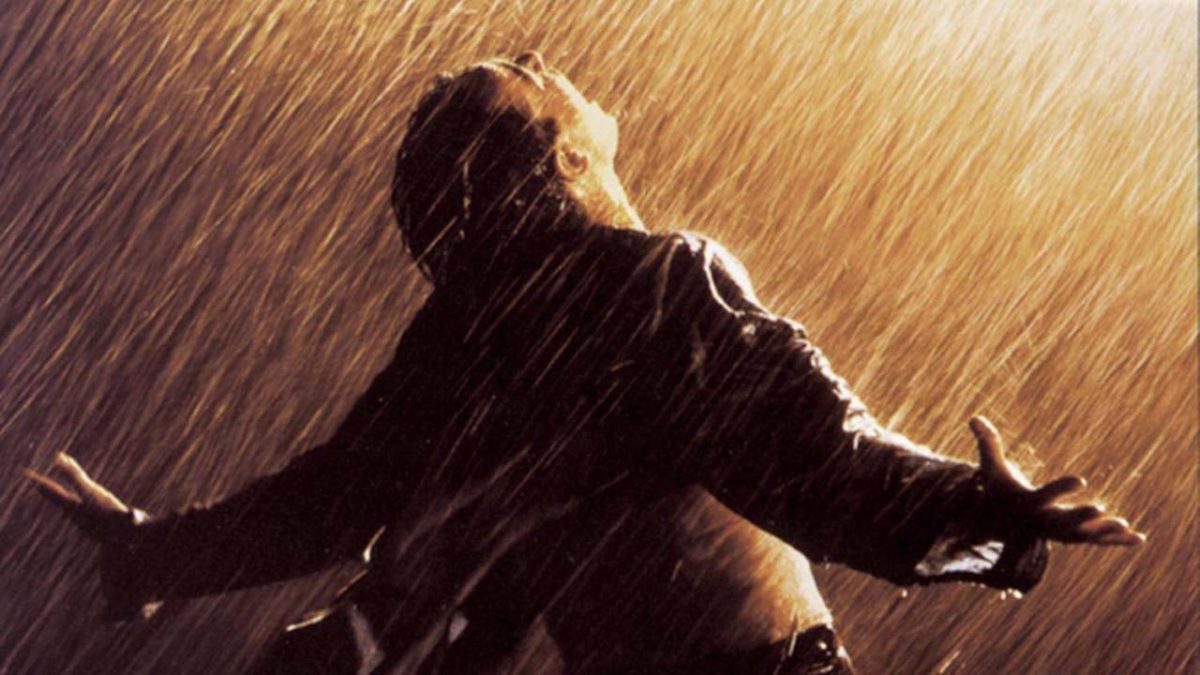
It’s hard to believe now, but The Shawshank Redemption was a relative flop at the box office, and overlooked in all seven of its Academy Award nominations (losing the 1994 Best Picture to Forrest Gump). But true to its own themes, it found redemption late in life, on television and home video. It regularly tops the running popularity poll in IMDB.com, but has the reputation for never being taken very seriously by critics.
That said, director Frank Darabont pierces the legend that the film was poorly reviewed, in a Charlie Rose Show interview included among the DVD bonus features. The four or five most widely read papers in the country did pan the film (Roger Ebert of the Chicago Sun-Times being a notable exception), but nationwide, the contemporary reviews were highly positive.
Shawshank: The Redeeming Feature, a British television documentary also included on the DVD, posits the theory that any critical disdain is attributable to its conclusive happy ending. The original novella and Darabont’s screenplay adaptation both end on an ambiguous note of hope, but the studio Castle Rock specifically requested a concrete happy ending. Darabont still seems to have mixed feelings about the inserted coda, but there’s no doubt it delivers massive satisfaction and uplift.
“I know what you think it means, sonny”
Despite the movie’s wild popularity, it doesn’t widely known that it is an adaption of the Stephen King novella Rita Hayworth and Shawshank Redemption (a clunky title without even a “The” to aid in its scansion). It’s an atypical work that deals not at all with the supernatural, but King’s highly characteristic voice does show through in the sharp plotting, monstrous villains, and hilariously colorful dialogue. Seriously, did anyone at any time or in any social milieu ever actually call anyone “fuckstick?” Like many of King’s filthy turns of phrase, if they didn’t, they should have.
Of note, Rita Hayworth and Shawshank Redemption was originally published with three other novellas in a single volume, Different Seasons. Two more became successful films: Apt Pupil (by director Bryan Singer) and The Body (as Stand By Me, by Barry Levinson).
“Get busy living, or get busy dying”
The Shawshank Redemption has its share of warm fuzzies, but repeatedly counterpunches with frank representations of the injustice of prison life, including rape, brutality, and exploitation. One glaring area in which it appears to wimp out, however, is its failure to acknowledge race. Racial tensions must have been at least as much of a problem in 1930s-50s prisons as they are now, if not more so.
The original character in the novella was a white Irish American, and Darabont reveals in the DVD bonus features that Morgan Freeman was an unconventional addition to the cast, an obviously correct decision they couldn’t pass up. Perhaps injecting racial themes into the script at that point would have been one theme too many for an already overstuffed movie, but they do percolate in the background. Red, for example, reflexively calls even the most marginal authority figure “sir.” Not only does Freeman carry a wholly natural gravitas (I recall a review of March of the Penguins that described him as “America’s favorite narrator”) but Red & Andy’s friendship is made that much more profound for the effective irrelevance of their races.
While most Hollywood movies are structured around adversarial relationships between male antagonists, The Shawshank Redemption is a rare tale of deep, sincere male friendship. It could very well be the greatest man-love story ever told, able to bring a lump to the throat of even the most macho of viewers.
Andrew Stanton’s Finding Nemo immediately preceded Pixar’s slightly more sophisticated collaborations with director Brad Bird, The Incredibles and Ratatouille. But despite being one of Pixar’s more overtly kid-oriented films, Andrew Stanton’s Finding Nemo is rife with anxiety and death. In the tradition of its spiritual ancestor Bambi, which also famously features a mother’s arbitrary murder in its opening moments, Finding Nemo is childlike without being childish.
If I was stranded in a dentist’s office aquarium, and I could take only one of Stanton’s Pixar movies with me, I’m afraid I wouldn’t select Finding Nemo. I found his follow-up WALL-E to be a more sophisticated film that relies less on dialog and celebrity personae.
For better or for worse, Glengarry Glen Ross is very pointedly set in a world of men. I believe only one woman so much as appears onscreen, in the background of one single scene. It’s no accident, oversight, or deliberate act of Hollywood misogyny to banish women from this 24-hour slice of the lives of five bottom-rung salesmen.
Glengarry Glen Ross is full of grand, showboating performances from a dream cast of male master actors Al Pacino, Jack Lemmon, Alec Baldwin, Alan Arkin, Ed Harris, Kevin Spacey, and Jonathan Pryce. Baldwin very nearly steals the entire movie with a hilariously aggressive motivational monologue: “What’s my name? ‘Fuck you,’ that’s my name.”
It’s all the more extraordinary that Pryce, sometimes guilty of outrageously affected accents and scenery-consumption himself, masterfully underplays his part as a shy, passive man who can barely speak, let alone assert himself against predator Ricky Roma (Pacino).
All together now: “What’s my name? …”
The screenplay by David Mamet, expanded from his own stage play, set a high standard for gloriously poetic profanity not to be surpassed until David Milch’s series Deadwood. Famous for his naturalistic dialog (every “um,” “uh,” and stutter is right there on the page; there is no improvisation), Mamet is also a meticulous craftsman of mystery and suspense.
But there is one plot detail that trips me up on each viewing: the morning after the sales office is robbed, Shelley Levene (Lemmon) brags about having pulled off an impressive sale of eight units of sketchy property. Roma’s ears prick up at his mention of the signing having been just that morning, obviously sensing something fishy about Levene’s claim. But the time of closure is not inconsistent with Levene’s story, nor is there any reason to suspect that Levene, whatever else he may be guilty of, falsified this particular sale in any way. Roma may simply be surprised that the lately taciturn and ineffectual salesman Levene could not have pulled off such a feat at such an unlikely time unless his spirits were buoyed somehow. Still, Roma demonstrates perhaps the film’s only act of kindness by being the only one to give the old master one last chance to swap victorious war stories.
Over the course of its truly epic length of 177 minutes, Lindsay Anderson‘s O Lucky Man! (1973) picks up the continuing saga of Mick Travis (Malcolm McDowell) from If…. While If…. used a British public school as a metaphorical microcosm with which to satirize British class culture, O Lucky Man! widens its lens to take in all of England for its bleak portrait of capitalism triumphant.
Travis appears to have matured out of his schoolboy fantasy of perpetrating a school massacre and has since joined the corporate world. Because of McDowell’s inherently impish persona, one might not expect his character here to be sincere, but Travis is now ruthless and genuinely willing to endure anything to climb the ladder of profit and social advancement. Early on, he is urged by a senior colleague to “try not to die like a dog,” but it’s a warning he is never equipped to quite comprehend.
“When do we live?”
His journey is so long and involved that it would hardly count as a spoiler to recount it here: Travis is promoted from the lowest rung on the corporate ladder all the way up to a high-level mission, yet he has been set up to fail. As he is ordered around the English countryside by his officebound superiors, he becomes lost on the way to Scotland, is arrested and tortured by the army, survives a military strike by an unseen enemy, stumbles into an idyll, is nursed back to health (er, literally), donates his body to medical research, falls in with Alan Price‘s touring band (including groupie Patricia (Helen Mirren), talks his way into the employ of the most venal businessman in England after his previous assistant’s timely suicide (a prime example of Travis’ alleged “luck”), becomes party to illegal chemical weapons sales in a corporate-funded civil war in a third-world nation, takes the fall for his boss, is imprisoned to five years of hard labor, is evidently reformed, tries and fails to talk a poor woman out of suicide with a hilarious litany of trite platitudes, is robbed and becomes homeless, tries to proselytize like Jesus and is, finally and fittingly, stoned by his peers. But in the the end, he is discovered as a future movie star.
So long and thanks for the milk
An early form of David Sherwin’s script was written by McDowell himself, based on his own experiences as a coffee salesman. I think it’s fair to presume that the beginning and ending are drawn directly from McDowell’s life story. At opposite ends of the film, the fortunate Travis is chosen from the masses for higher callings. The young man at the beginning is all too eager to commence his journey, but the beaten-down and disillusioned man at the end is no longer able to take any pleasure out of his unlucky luck.
Terry Gilliam’s mad, brilliant yarn The Adventures of Baron Munchausen is a strongly anti-war fable to which every kid (and adult!) ought to be exposed.
Like the best of its kind (including Ratatouille and Gilliam’s own Time Bandits), The Adventures of Baron Munchausen works on multiple levels and is accessible to all ages. It is, however, a Gilliam film, as as such possessed of a certain degree of darkness and naughtiness. But depictions of tobacco, decapitation, and brief nudity (of the young Uma Thurman variety… thank you, Terry!) were evidently A-OK for kiddies in its era, and merited a mere PG rating. Special mention must also be paid to the spirited performance by a very young, adorable (but in a non-cloying way) Sarah Polley.
What must be the most ironic caption in cinema history, “The Late 18th Century: The Age of Reason,” is followed immediately by harrowing imagery of warfare that wouldn’t be out of place in Kubrick’s Paths of Glory. Further driving the point home for the slower members of the audience, a trip to Hades finds Vulcan (Oliver Reed) forging ICBMs out of hellfire.
In a theme straight out of Noam Chomsky, the military industrial complex (personified by Jonathan Pryce’s hilariously accented bureaucrat) imprisons the people within the walls of their own city with a sham state of perpetual war. In the end, the Baron (John Neville) defeats these villains not with more violence, but by inspiring the people to throw open their doors and thus their minds.
Must read: The Adventures of Baron Munchausenfun facts from Dreams, the Terry Gilliam Fanzine.
With the delightful WALL-E, Pixar continues its as-yet unbroken winning streak of instant-classic films for all ages. While my personal favorites are Brad Bird’s darker and more psychologically complex The Incredibles and Ratatouille, Andrew Stanton’s WALL-E is easily also one that will resonate decades hence with children of all ages (as the saying goes).
Other animation studios continue to produce disposable pastiches such as Shrek and Ice Age, laden with pop cultural references that will not age well and eventually be forgotten. While eye-popping now, perhaps some day Pixar’s animation will appear less than state-of-the art, and I do fear that one day Pixar may miscalculate and produce a critical and commercial failure. If they ever do, it will be because they lost their emphasis on storytelling craft and sense for timeless relevance.
WALL-E trips the light fantastic.
WALL-E looks backwards in cinema history for inspiration to envision its grim distant future. WALL-E’s daily travails on an ecologically collapsed Earth resemble the desolate wastelands seen in such joyless apocalyptic downers as The Terminator and The Matrix. WALL-E is the lone survivor of his kind, dispassionately salvaging spare parts from his dead comrades. All this is potentially very scary stuff for kids, but the little guy has become charmingly eccentric over the course of his several-hundred year long mission, and his positive, can-do energy provides an amusing counterpoint to the dead world about him. Still, the themes of loneliness and environmental crisis are there for adults to plainly see and even the youngest viewers to pick up on.
Long before WALL-E, the camp sci-fi classic Logan’s Run supposed a future devolved humanity, reduced to a self-sustaining infantile state. Humanity imprisoned itself for the sake of survival, but the rational was long since forgotten and the closed system no longer unnecessary. It takes the rebellion of one free spirit to wake up the whole of society to the reality outside the walls of their enclosed womb (or tomb).
WALL-E befriends the DustBuster3000
WALL-E draws its ecological metaphors and even the visual design of WALL-E himself from the classic hippie science-fiction film Silent Running. The last remnants of an overpopulated Earth’s biosphere are preserved in orbiting greenhouses, until venal corporations decide they are no longer necessary and are to be demolished. But one driven botanist and his team of cute gardening droids conspire to preserve a garden of eden forever, adrift in space, but a great cost: their rebellion is a bloody, murderous one.
The last major cinematic touchstone for WALL-E is, of course, 2001: A Space Odyssey. The visual design of the Buy ‘n’ Large ark carrying the remnants of humanity is all about the clean, white lines of Kubrick’s space station, and none of the filthy grunge that has dominated science fiction ever since Ridley Scott’s Nostromo in Alien (but Sigourney Weaver does provide the voice of the ship’s computer, perhaps finally finding vengeance against Alien‘s evil computer M.O.T.H.E.R.).
WALL-E‘s chief villain is the droid AUTO, with the single, sinisterly unblinking red eye of HAL 9000. Both are artificial intelligences that stunt the evolutionary advancing of the human race in a twisted literal reading of their programming to protect it. Deleterious overprotection is also a theme in Andrew Stanton’s Finding Nemo; the Marlon learns that his prohibitive coddling of his son prevents him from blossoming.
Pistol-packin’ Princess Leia-bot comin’ through!
But more than anything, WALL-E is a love story. If you think about it too much, you realize WALL-E is several hundred years old, and is thus rocking the cradle when he falls for the later model droid EVE. A pistol-packin’, short-tempered spitfire in the fine tradition of Princess Leia, EVE is so far advanced that she’s practically a different species of robot. Still, when WALL-E upends an entire society in stasis, he also awakens EVE to the joys of life.
Pixar has long had business ties to Apple, but this is the first film of theirs to make overt in-jokes. WALL-E has somehow rigged a vintage VHS cassette of Hello, Dolly! to play on nearly-as-vintage iPod. Apple’s resident industrial design genius Jonathan Ive reportedly consulted on the design of EVE. WALL-E’s startup sound is the classic Macintosh boot-up fanfare. The “evil” robot AUTO speaks with the voice of MacInTalk, the text-to-speech technology invented by Apple in the early 90s. Any one of these gags would have been cute, but taken as a whole, one suspects the Berlin wall between companies is breaking down, resulting in crass product placement.
If…. is the first in director Lindsay Anderson’s trilogy of films featuring Malcolm McDowell as the Mick Travis, whose misadventures continue in O Lucky Man! and Britannia Hospital. Everything I read about the trilogy repeats the same word to descibe Travis: “everyman.” On the evidence, I take this instance particular of “everyman” to mean Travis is a blank slate, a shapeless person pushed and molded by the forces of society about him.
If…. begins with the epigram “Wisdom is the principal thing; therefore get wisdom; and with all thy getting, get understanding” from The Book of Proverbs, but an even better statement of the film’s themes is spoken my Travis himself: “When do we live? That’s what I want to know.”
“When do we live? That’s what I want to know.”
The initially realistic portrayal of life at a British public school, filmed at Cheltenham College but referred to simply as “College”, includes frank depictions of the corporal punishment and homosexuality (mostly repressed, save for in one case, genuine young love). The pupils’ lives are so regimented and ordered that even virtuous activities such as studying are forbidden if not conducted at the proper time and place. Most of the rampant cruelty and capriciousness comes from Whips (the senior class, with privileges) and is sanctioned, or rather, willfully ignored by the aloof adult faculty. It becomes clear the school is satirical microcosm of the British class society: a self-perpetuating system in which the young underclassmen “Scum” eventually grow into the roles of the oppressors.
I think I’ll call you Mini-Malcolm
Much of the students’ time is preoccupied with paramilitary war games couched in religion. As the school chaplain admonishes them, “Jesus is your commanding officer.” The sermon also instructs that desertion is the worst wartime crime, and as all Christians are born with original sin, all are likewise deserters. During one war game, Travis and friends deliberately shoot live rounds at their own comrades. Curiously, the headmaster mildly scolds them as if they had committed an infraction as naughty as nipping at the communal wine. But the first irrefutable instance of the film’s turn towards surreality is when the headmaster produces a faculty member from within a cupboard drawer for whom Travis to apologize.
From this point on, it is clear at least some of Travis’ experiences are fantasy. And what do teenage boys fantasize about but hooking up with hot girls and violently lashing out at enemies? He beds a beautiful waitress (Christine Noonan) in a violently animalistic coupling, who might very well be another figment of his imagination. Together they uncover a cache of weapons and pickled medical anomalies in the school basement (his subconscious?), including a grotesque human fetus. Travis’ anarchic adolescent fantasies climax with a massive school shooting during a nauseatingly patriotic festival honoring The Crusades. Unlike the considerably more tragic school shootings typical to films made in an era of actual teen massacres like Columbine (in films as diverse as Elephant, Empire Falls, and The Basketball Diaries), Travis’ war is a comically carnivalesque affair and the consequences fall offscreen.
Mmmf mmmmf mmff mmmmfff….
Miscellany:
The otherwise spiffy Criterion Collection DVD edition appears to be a censored cut, not the X-rated full version originally screened in some parts of the world.
The assistant director was Steven Frears, who went on to direct Dangerous Liaisons, High Fidelity, and The Queen. In the Criterion DVD bonus features, Frears states that If…. was filmed at the same time as the Paris Riots in 1968, lending powerful immediacy to the theme of violent student rebellion.
The film alternates between black & white and color film stock. There are conflicting explanations according to Wikipedia, but the primary motivations seemed to have been that of budget and time (black & white film taking less time to light for). Anderson, however, liked the “texture” and continued to use the device. It was apparently not intended to delineate reality vs. fantasy.
Mick repeatedly plays the music “Sanctus” from Missa Luba, an African-tinged version of the Latin Mass. Difficult for modern ears to believe, but it was a hit single at the time. (also from Wikipedia)
Full of interesting tidbits, Wikipedia also cites a visual allusion to Alfred Hitchcock’s The Lodger in McDowell’s first appearance, showcasing his instantly recognizable eyes.
Writer and director Cristian Mungiu’s 4 luni, 3 s?pt?mâni ?i 2 zile (4 Months, 3 Weeks and 2 Days) is an unsensational drama on a very sensational topic. Like Cristi Puiu’s The Death of Mr. Lazarescu, it is shot in Dogme style with a handheld camera, long takes, and no score. Both films remorselessly lead the viewer through journeys likely undertaken by many throughout human history, of which most of the rest would rather look away from.
Although it seems ridiculous to talk about such a serious film in terms of “spoilers”, I do wish to caution any readers who have not yet seen the film to stop here.
In 1987 Romania, students Otilia (Anamaria Marinca) and Gabita (Laura Vasiliu) pool their money and make elaborate plans for an unspecified illicit event. What exactly the two young women seek is withheld for some time, building considerable suspense. No matter one’s political or religious beliefs, it is a simple fact that any society in which abortion is illegal produces a corresponding black market in dangerous back-alley procedures. 4 Months is not a passionate argument for or against the legality of abortion, but rather an unadorned illustration of two women’s experiences obtaining one.
4 Months begs comparison with another naturalistic film on a similar theme: Mike Leigh’s Vera Drake. It would be reductive to say 4 Months is a “better” film, but in comparison, it does make Vera Drake seem like a conventional courtroom drama with overly emotive acting.
Michel Gondry’s Be Kind Rewind is a more mainstream effort than the personal and heartfelt The Science of Sleep, but still imbued with his signature handmade style and many of his particular (some might say peculiar) obsessions.
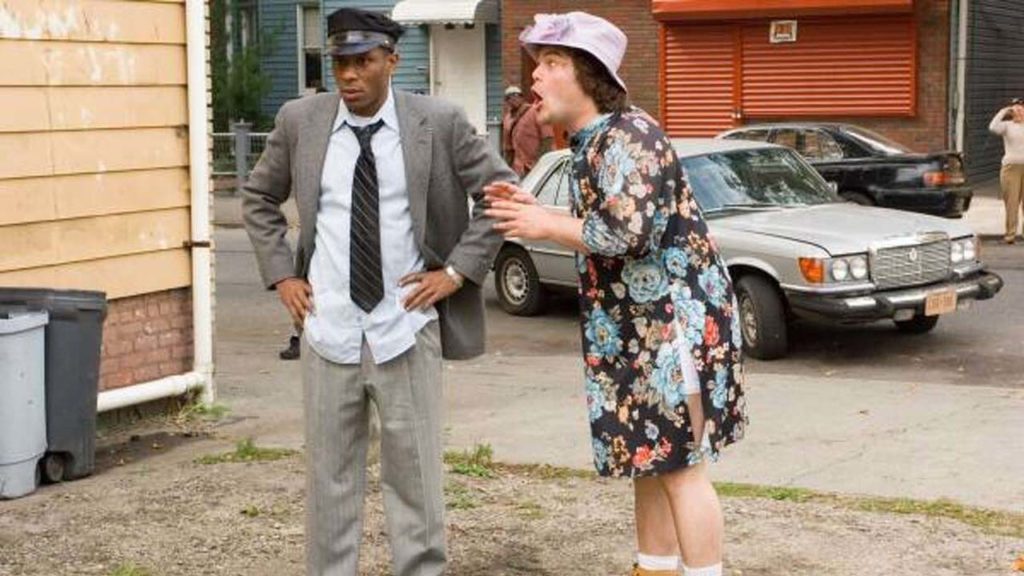
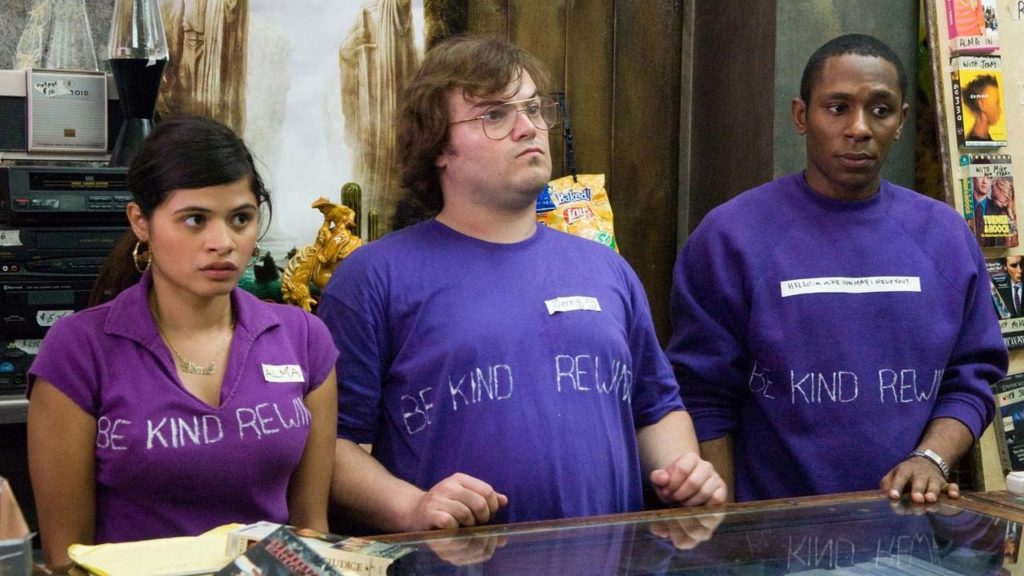
The premise is brilliant in its simplicity: a pair of misfit doofuses accidentally erase every tape in their retro video rental store, and decide to remake an eclectic selection of them from scratch. The considerable humor comes not just in how Mike (Mos Def) and Jerry (Jack Black) recreate shots, costumes, casting, and special effects, but also in how they must reconstruct entire plots and scenes from memory alone. If you had to condense a movie you hadn’t seen since childhood (say, for example, Ghostbusters) down to 20 minutes, equipped only with a camcorder and a budget of approximately $0, how would you do it? Jerry randomly coins the word “sweded” to describe their work, a puzzling term that isn’t even a pun, but spontaneous absurdity is a virtue in Gondry’s world.
Mos Def has mos def had enough of Jack Black.
Desperation inspires them to find a means of artistic expression, something many people spend lifetimes daydreaming about but never seize for themselves. Much as how Tim Burton characterized Ed Wood in his eponymous biopic, Mike and Jerry have true amateurs’ supreme confidence in their total filmmaking abilities. Their own ingenuity and the power of moviemaking inspires them with the realization that they can do anything and the trust that people will like what they do. Also like Wood, each obstacle they encounter merely increases their creativity.
“I am Robocop. Anything you say can and will be held against you in a court of Robocop.”
Even before the inciting incident of mass erasure, Jerry was already something of an outsider artist. He operated an auto shop with very creative notions of “repairing” cars into souped-up rocket-powered BatMobiles. His character is initially very unlikable, and evidently something of a misogynist. We see him taunt and nearly physically threaten a woman in the video store. Later, he reveals a longing for cutie Alma (Melonie Diaz) working in the local laundry, but when moviemaking provides him with the opportunity to interact with her, he treats her as would a little boy with a “No Girls Allowed” treehouse. But that’s not to imply there’s something cute about his attitude towards women; there appears to be a barely suppressed contempt and threat of violence.
An obvious paradox is that Be Kind Rewind is a film from a major motion picture studio that celebrates the indie spirit (not to mention fair use of copyrighted materials) and vilifies the venal movie biz executives that inevitably materialize with cease-and-decist orders. Speaking of venal movie execs, the movie’s home at New Line Cinema no doubt introduced several hardly canonical films like the New Line property Rush Hour 2 into Gondry’s script. The overabundance of New Line posters and VHS tapes in the set design bric-a-brac is something of a joke. While it’s funny that a run-down video store might still have ratty old Blast From the Past posters hanging around, would a competing mainstream neon-lit DVD store (Blockbuster in all but name) really shill for the long-forgotten Woo?
How long until they get around to remaking Gummo and American Psycho?
Be Kind Rewind is at its most brilliant when recreating classic (and some not-so-classic) moments from cinema history, so much so that everything else in the film feels like a distraction from the true delights. But the powerfully moving climax is the premiere screening of Mike and Jerry’s masterpiece, made in collaboration with their entire community. Their maturity as auteurs is marked by their first truly original work; their film within a film is a fictionalized musical biopic of Fats Waller. If only all actual musical biopics could be so wonderful!
Full disclosure: I first saw an advance screening of Be Kind Rewind on February 22, but as I was then employed by the movie company distributing the film, I decided not to post my thoughts. Regardless, I had nothing to do with making or marketing the film, and any opinions expressed above are mine alone.