In this blog’s opinion, Ang Lee’s Sense and Sensibility is the best-of-breed within Jane Austen film adaptations. Please note, however, there are two very good reasons to discredit my opinion on this subject:
I. Despite my English major, I am ashamed to admit I have read only one Jane Austen novel: Emma. Yeah, I know, I’ve got to get working on that.
II.Sense and Sensibility features two of this blog’s all-time favorite movie crushes: Emma Thompson and Kate Winslet. Any film featuring just one of these English roses automatically earns extra credit. Any film featuring Emma and Kate, together, equals porn (especially if they hop into bed together, as they do here… granted, as sisters keeping their toes warm, but still!). Any film featuring Emma and Kate, plus a screenplay by Emma, equals bliss.
“Always resignation and acceptance. Always prudence and honor and duty. Elinor, where is your heart?”
A few extra notes:
Guest commentator (and first-class Austen aficionado) Snarkbait has coined the best phrase for this genre: “Regency Era froth”.
Actor Greg Wise (John Willoughby) later became Mr. Emma Thompson, after Kenneth Branaugh foolishly let her get away.
Hugh Grant’s trademark stammer, persistent interest in the carpet, and out-of-control hair are still charming even in 18th Century surroundings. But it is difficult to stifle a snicker when the devilish Grant, as Edward Ferrars, expresses an interest in joining the Church.
I wish I had Alan Rickman’s (Col. Brandon) vocal cords.
Hey, look! It’s Tom Wilkinson in a cameo as the soon-to-be-late Mr. Dashwood! This blog thinks Wilkinson is one of the finest and most versatile actors working today.
Required viewing: Emma Thompson’s 1996 Best Adapted Screenplay Oscar acceptance speech (not on YouTube as of this writing, but here is the text).
In the Valley of Elah is a dark story about the psychological damage of war, certainly not a recipe for an entertaining night at the movies. This blogger will cop to finding it difficult to work up the enthusiasm to sit down for a movie on such a troubling topic, fearing the resultant depression (despite my love and respect for cinema as an art form, and staunch sympathy for the anti-war movement, sometimes a person just needs a little light entertainment). But writer/director Paul Haggis structured the plot as a murder mystery, with a few pinches of wry humor, to craft an excellent film that is not punishingly sad.
Hank Deerfield (Tommy Lee Jones) is a pious, patriotic, and disciplined man. But he is also emotionally detached; he dispassionately investigates the mysterious death of his own son. Drawing upon his skills as both a former army soldier and police sergeant, he outwits both the army’s own investigators and the resident local police smartypants Det. Emily Sanders (Charlize Theron). Impressively for an old coot, he is even able to locate a back-alley cell phone phreaker, in an unfamiliar town, using only a diner’s phone book. But the seemingly cold man does reveal his pain and weakness before the end, and even a buried unsavory side involving racism.
(Don’t Go Back To Sgt.) Rockville
The title derives from the Biblical parable of David and Goliath, a macho mano-a-manu beatdown that occurred during the battle of the Israelites vs. the Palestinians. Aside from the obvious parallels to the locale and participants of the ancient and never-ending Middle East conflicts, the tale is also a metaphor for how Deerfield views manhood and how he raised his son: to stand tall against any odds. But as Deerfield learns unpleasant truths about his son (drugs, torture, prostitutes) and his country (unjustified war, institutional corruption), he must, late in life, come to reevaluate his most core beliefs. So what makes this clearly liberal anti-war film special is its respect for exactly the type of person it might indict: the god-fearing patriot.
Whitman’s Sampler, my favorite!
Finally, I’d like to highlight one excellent scene (in every way: writing, acting, and directing): as Deerfield phones his wife Joan (Susan Sarandon) to tell her their son is dead, the scene begins in the middle, and in the end the camera pulls back to show Joan has torn apart the room. A lesser film would have shown the whole thing, for the sake of melodrama.
Like many young men cursed with a privileged life of education and time to think for themselves, Chris McCandless (Emile Hirsch) wanted only a vaguely defined “truth” and to not have to rely on anyone. Synthesizing his reading of Henry Thoreau and Jack London, he imagined for himself a life of self-sufficiency in the wilderness. So McCandless dropped out of society in the summer of 1990, leaving behind all connections whatsoever, including his legal name and identity. Despite his absolutely clean break, he never seemed to view this transformation as permanent; he mentions more than once that he may write a book when he “comes back.”
Interestingly for a young man, he also seems to make a point of avoiding even temporary female companionship. He rejects the friendship of Jan (Katherine Keener), and abandons his younger sister Carine (Jena Malone), the person with whom he apparently had the closest bond. Carine narrates the film, with total sympathy for his beliefs and actions. But even she points out that he acted with “characteristic immoderation.”
The rough guide to self-actualization
McCandless died alone in August 1992. He remains a controversial figure (should his asceticism be admired, or was he a fool?), and his solitary death the subject of an intriguing mystery (was he really trapped with food poisoning, or did he allow himself to die slowly as a form of passive suicide?). This film interpretation of his story does make it clear that he was a privileged kid who hadn’t truly suffered. While drinking with new buddy Wayne (Vince Vaughn), he lets slip his adolescent belief that one of the worst forms of tyranny in the world is “parents.” As we see, his parents (Marcia Gay Harden and William Hurt) are all too human and not half as monstrous as he imagines. So perhaps his adventure was more than an idealistic reaction to mere money, society, and materialism. He was also running away from the “free” things that living in society affords, what everyone craves in life: family, friends, and lovers.
Hence the title
A note on the music: just as McCandless looks backwards for literary inspiration, he also has antiquated taste in music for a kid living in the early 90s. His new name for himself, “Supertramp” puns on the classic rock band and his new lifestyle. He christens his new and final home, an abandoned bus, after The Who’s “Magic Bus.” For the music of the film itself, director Sean Penn drew upon two musicians that made names for themselves in the early 90s: Pearl Jam’s Eddie Vedder (who contributed songs to Dead Man Walking), and guitarist/composer Michael Brook. Vedder’s songs for the film were released as an album, but Brook’s excellent score is also available digitally.
Into the Wild is yet another in a long series of films I’ve seen recently that are based on books I haven’t read (The Kite Runner, No Country for Old Men, The Namesake, The Assassination of Jesse James, etc.). But even so, I believe I can detect a few remnants of the film’s prose origins as John Krakauer’s book:
the film is broken into chapters with onscreen titles
voiceover narration
the visual device of superimposed text from McCandless’ own journals provides a second voice
episodic feel – but that’s justified by the events/phases of his journey – he keeps making clean breaks every time he comes close to settling in somewhere
This blogger is not ashamed to admit being in love with Shakespeare in Love, and not just for the generous displays of Gwyneth Paltrow’s lovely young bubbies.
Full of American actors affecting English accents with varying degrees of outrageousness, it only partly qualifies as Europudding, and is in fact more in the vein of “let’s put on a show!” theater farces like Noises Off and Waiting for Guffman. Director John Madden’s Shakespeare in Love succeeds beautifully, but the formula is not ironclad; Becoming Jane obviously attempted the same stunt by warping the biographical details of Jane Austin’s life onto her novels, but rather failed to capture her dry wit and particular brand of practical passion.
Oi, get yer bubbies out!
Co-screenwriter Tom Stoppard, already an expert at playing fast and loose with Shakespeare in his play Rosencrantz and Guildenstern Are Dead, lays more than a few easter eggs for English majors and other enthusiasts of Elizabethan drama. Bloody playwright John Webster cameos as a disturbed young lad. Many favorite Shakespeare cliches appear not just in the play-within-the-movie, but also in the body of the movie itself: ghosts, cross-cross-dressing, and a “bit with a dog.” But perhaps the movie’s biggest achievement is to humanize perhaps the most revered writer in the English language, and yet still illuminate the unmatched passion and achievement of his work. A Shakespeare beset with writer’s block struggles to find a hook for the unwritten Romeo and Ethel, the Pirate’s Daughter reminds us that he was probably no unearthly creature taking dictation from beyond, and that creating such art was, simply, hard work.
Judi Dench in full Queen Bitch mode
Shakespeare in Love thankfully doesn’t let historical accuracy get in the way of a good gag. Will makes weekly visits to an apothecary practicing psychotherapy a few hundred years early. The contemporary theater world is shown more than once as a precursor to today’s movie biz. In order to bankroll the production of a new play, financier/kneecapper Hugh Fennyman (Tom Wilkinson) suggests Globe Theater owner Philip Henslowe (Geoffrey Rush) pay actors with a portion of the profits, when of course there never are any. Brilliant! One wonders if Miramax honchos Harvey & Bob Weinstein perceived the irony.
But the movie is sometimes more accurate than one might think for something that is admittedly a slightly fluffy farce. For example, it is in fact plausible for Shakespeare to fear he may have been indirectly responsible for rival playwright Christopher Marlowe’s death. Marlowe died in 1593, which according to the all-knowing Wikipedia, was about the time Romeo and Juliet was written.
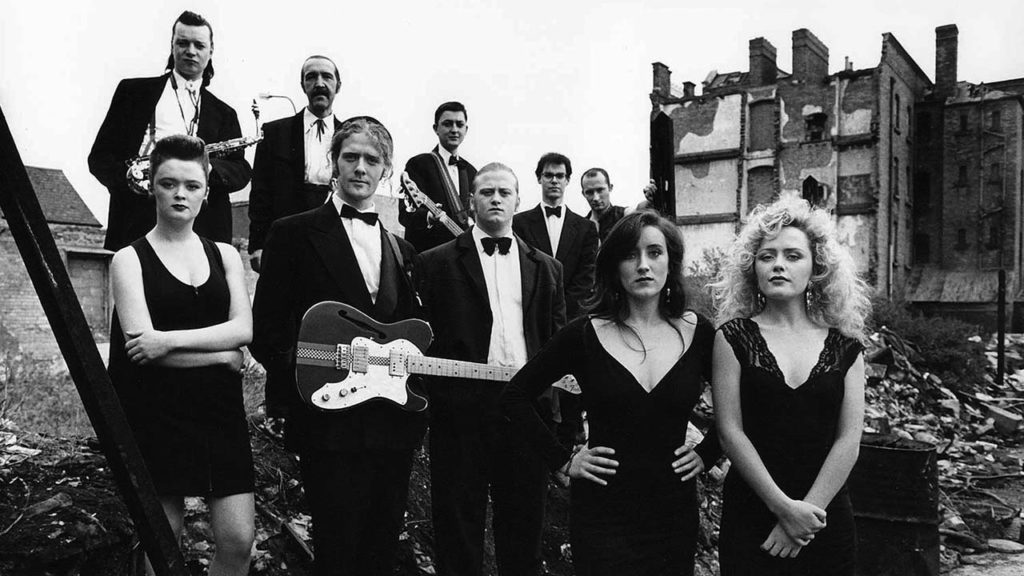
The Commitments remains a favorite, even some 17 years after first seeing it in the theater. I’ve owned the soundtrack since then, but for whatever reason, had not revisited one of my favorite films. But having recently seen and loved Once, costarring Commitments alum Glen Hansard, I was inspired to check it out one more time and see if I still loved it after all these years.
If The Commitments (the band) are the World’s Hardest Working Band, then The Commitments (the movie) may be the World’s Most Unashamedly Crowd-Pleasing Movie. There’s not a single scene that doesn’t charm, amuse, or get me rocking to the sweet sounds of soul music.
“Is this the band then? Betcha U2 are shittin’ themselves.”
Where are they now? Original members Dick Massey and Kenneth McCluskey still tour as The Commitments. Director Alan Parker (look for VHS copies of one his film Birdy in one scene) built on his success with musicals Fame, Pink Floyd’s The Wall, and The Commitments by directing the mammoth production Evita. Andrew Strong (Deco Cuffe), a wee 16 at the time, still has his golden voice and is now a solo artist. Maria Doyle Kennedy (Natalie) is now a star of the television series The Tudors. And Glen Hansard just won some kind of award or another…
Two bits of fun trivia gleaned from the IMDB entry: the actual kid from U2’s Boy and War album covers cameos in the film, and the script racks up a spectacular 145 F-bombs.
Michael Clayton is a that rare thing: an intelligent, fictional thriller for grownups. Like any self-respecting Thriller for Grownups, it’s relentlessly grim in tone, the chronology is fractured, and a high level of detail demands your attention. It doesn’t approach impenetrability like Syriana, but it unfortunately doesn’t engage the brain as much as a good puzzler could. Everything is spelled out for the viewer in the end, except for a few niggling logistical questions. (Such as, why would two expert assassins opt for something so messily conspicuous as a car bomb?)
Michael Clayton has all the whiff of being based on a true story, but is in fact a wholly original work from writer/director Tony Gilroy – his first film as director after a successful run of screenplays including the Jason Bourne trilogy. George Clooney carries the film with the complex, compromised title character, and Oscar winner Tilda Swinton sweats convincingly as a dying-inside corporate executioner. But in my mind the real star is Tom Wilkinson.
Now this is a musical (of sorts) I can get behind. The unnamed “Guy” (Glen Hansard, already a rock star in The Frames and a movie star from The Commitments) is a street busker, playing popular songs for pennies during the day, and saving his own passionate compositions for the empty streets at night. “Girl” (Markéta Irglová) is an immigrant from the Czech Republic, looking at an unhappy future as a single mother, in servile jobs, with no outlet for her own musical talent. Each has become stuck, but their meeting jostles each other into motion.
What a fucking great movie. That’s it; that’s my entire review. See it, and get the soundtrack.
So far, it seems this movie blog is definitive proof of the truism that criticism is cheaper than praise; it’s easier to pick apart what’s wrong with a bad or mediocre movie than it is to praise what’s good. So sitting down to write something about a really great film like Away From Her, I find myself at a loss for what to say.
Already a seasoned actor at 29, Sarah Polley proves herself a mature and sensitive writer/director on her very first outing. Although concerned with Alzheimer’s, Away From Her is thankfully not a movie “about” a disease. I felt the biopic Iris, although finely acted by no less than Kate Winslet, Judi Dench, and Jim Broadbent, fell into the trap of educating the audience about a disease more than looking at the experiences of the real-life figures whose lives were surely defined by more than Iris Murdoch’s disease.
Julie Christie and Gordon Pinsent in Away From Her.
Fiona (Julie Christie) and long-time husband Grant (Gordon Pinsent) are already aware of her relatively early-onset Alzheimer’s as the movie begins, but react to its sudden progression with different degrees of preparedness. Worse, as her short term memory leaves her, memories of old traumas resurface just as it is time for her to enter an assisted living community, making an impossible situation no easier for either of them. The next time Grant sees her, she appears to have forgotten him altogether… or has she? The possibility that Grant may be reading his fears into Fiona’s behavior and lapses is one of the most powerful questions of the film.
Sarah Polley, writer/director of Away From Her.
Polley reportedly talked Julie Christie out of semi-retirement, and she deserves an Oscar for her Canadian accent alone. Christie’s long resume and Oscar nomination put her in the entertainment media’s spotlight this winter, but Gordon Pinsent is excellent as Grant, arguably the lead role. Away From Her may be a powerfully sad movie, but not one that anyone should be afraid of being bummed out by.
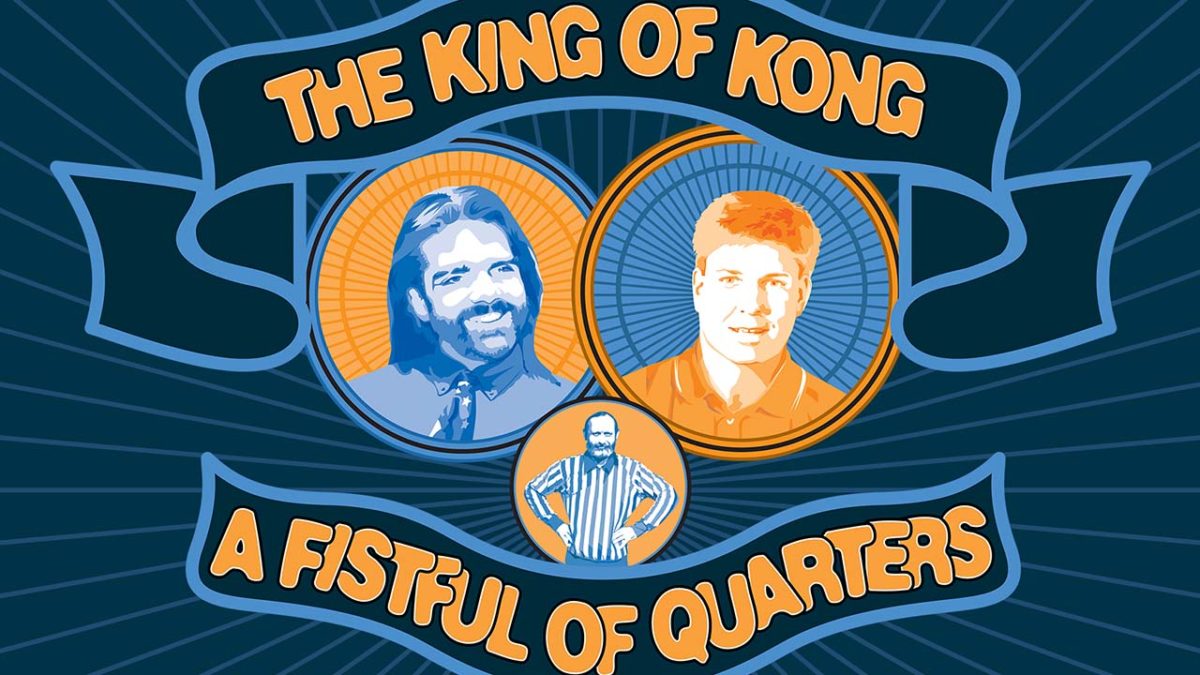
First, full disclosure: I work for the movie company that distributed The King of Kong: A Fistful of Quarters. My miniscule role in marketing the film was limited to designing the official movie website, and I am under no obligation or prohibition to write this review (which happens to be positive, anyway). Any opinions expressed here are mine alone. I mostly avoid writing about movies released by my employer. I’m making a rare exception in this case because The King of Kong has been out of theaters for some time, and my personal opinion on this blog is certainly not going to have any impact on its revenue. Having just seen it again, I have a few thoughts I would like to record here.
I would hate to be an English teacher, at any level, for one reason: the countless “it’s a metaphor for life” papers I would have to grade. Probably one of the biggest cliches of kids’ essays is to pull out that refrain, e.g. “the light at the end of the dock in The Great Gatsby in a metaphor for life.” After grading a few dozen of those I just might want to start throwing things and switch to another career, like, say for example, web design.
Billy Mitchell with the ladies of Namco
That said, I’m about to commit that very grievous essay sin: if anything is a metaphor for life, it’s Donkey Kong. Let’s look at the evidence:
Donkey Kong is an intensely difficult game.
The game’s god/creator, Shigeru Miyamoto, did not supply it with a predefined ending.
The number of levels is undeclared at the outset.
Anyone with a quarter can play.
Most players die very quickly.
A very select few thrive and have their names entered into history.
How you play, not just how long you live, determines your score. In other words, you can reach the exact same point in the same level as somebody else but have a higher score.
Even the best of the best players cannot “win” the game; everyone will eventually drop dead without warning and through no gameplay fault of their own. This point has become known as the game’s “kill screen.”
That list of bullet points just about covers it; Donkey Kong is so clearly a metaphor for the human experience that the film thankfully doesn’t even bother to explicitly state its themes. Kids, let that be a lesson for all your future school essays.
The King of Kong (2007) Documentary
Directed by Seth Gordon
Shown: Steve Wiebe
The King of Kong is a very rousing film that works best to an audience; if possible, watch it with friends. From what I can gather, viewers respond to two basic things: the frankly weird subculture of professional video gaming, and the more universal story of the underdog vs. an entrenched power network. A suspicion is gaining traction that the story is too perfect, the hero Steve Wieve too all-american, and the villain Billy Mitchell too evil. The movie’s official message board (no longer online) features heated discussions including actual figures featured in the film, and documentarian Jason Scott has gone so far as to publish a passionate teardown of filmmakers’ ethics.
Personally, I wish the film had been more clear on a few points:
As you can read on the above links, Billy Mitchell’s well-timed taped submission may have seemed fishy but turned out to be genuine.
Most viewers (including myself) all ask the same question: how long does it take to play one of these “perfect” games? The movie finally discloses the answer incidentally near the end, as if the filmmakers weren’t deliberately withholding the information, but rather didn’t realize it was something viewers needed to know.
All in all, the subculture featured in the film is a truly unique bunch of people, and a great find by the filmmakers. Some of them may deserve a little mockery, but my favorite moment in the film goes to a Robert Mruczek, who describes how professional sports records are broken once in a lifetime, but he sees gaming records broken every day. And how exciting is that?
Chasing Amy is far and away Kevin Smith’s best film, and not coincidentally his most heartfelt. It’s not nothing to tell a universal guy’s story while still featuring significant and sympathetic female characters.
Yes, Chasing Amy is spectacularly profane and the characters are prone to giving extended on-the-nose speeches perfectly explicating their inner motivations, but the central theme is worthy and true: love can be a mixture of elevating another to a height to which you can’t measure up, while paradoxically needing to have them do the same to you. More literally, Holden (Ben Affleck) feels both fascinated and threatened by what he perceives as Alyssa’s (Joey Lauren Adams) more adventurous and worldly sexuality, but also needs to believe that he has power over her and has somehow tamed her.
Not one to pass up an opportunity to cite Jaws
Out of Smith’s oeuvre, the closest to Chasing Amy is Jersey Girl. But his personal meditations on fatherhood required more of his trademark raunch to offset the treacle than the PG-13 allowed. It did, however, feature the single cruelest joke I’ve ever heard: Andrew Lloyd Webber is “the second-worst thing that’s ever happened to New York City.” Zing! Nobody, not even Lloyd Webber, deserves that.
A far better writer than I has already been here and done that: please refer to Matthew Dessem’s review on The Criterion Contraption. I disagree with his obvious dislike of the film, but every point he makes against it is fair.