Category: 4 Stars

Good Stuff

  • Ben Affleck’s pervasively grim Gone Baby Gone

    Ben Affleck’s pervasively grim Gone Baby Gone

    Good ol’ Bahstuhn Cahtholick Ben Affleck is an all grown-up, big-boy director now, and lookit, he made himself a pretty decent movie. That said, Gone Baby Gone is a big plate of grim, with side order of depressing.

    Affleck makes excellent use of location footage and local color. And not surprising for a movie directed by an actor (recently, Julie Delpy’s 2 Days in Paris and George Clooney’s Good Night and Good Luck), Affleck privileges the characters and performances over the plot. We also see plenty of B-roll footage of the faces and voices of Bostoners on the streets, in the bars, and on local TV screens.

    Ben Affleck directs Gone Baby Gone
    How many times I gotta tell you, bro? I pahked the cahr down on the yahds.

    Gone Baby Gone is one of the first movies to poach some of the excellent acting talent premiered in HBO’s superb series The Wire. Doubtless by accident, Michael Kenneth Williams and Amy Ryan both play characters diametrically opposed to their TV counterparts; Williams is a sardonic po-lice resolved to the corruption around him (compare and contrast with The Wire‘s Omar, a parasite that feeds on the drug trade), and Ryan plays a coked-out winner of bad-mother-of-the-year, the exact opposite in every way (including accent) of her salt-of-the-earth B’more Port Authority po-lice on The Wire.

    Ed Harris and Amy Ryan in Gone Baby Gone
    Pay no attention to my rug.

    The few bad points to mention (other than the aforementioned pervasive grim tone), are Ed Harris’ inconsistent rug and a middle section papered over almost entirely by voiceover narration.

  • U2 in a state called vertigo: U23D

    U2 in a state called vertigo: U23D

    U23D is actually a fairly traditional concert movie, a mostly straight-up filmed record of a representative show of a single tour. U2 had already produced one theatrical feature film about themselves (1988’s Rattle and Hum), and released numerous productions on video and DVD before and since. So what could have been just another video of the world’s most overexposed band needed to differentiate itself somehow. Turns out the latest 3D technology filling a 40-foot screen consuming your peripheral vision is more than enough to justify its existence.

    3D has come a long way from what I remember as a kid, watching Creature of the Black Lagoon on TV with red-and-blue cardboard glasses. At first, the degree of depth is disorienting and headache-inducing, but before too long the brain and eyes adjust. Your perspective is not that of the audience but as if you were standing right on stage with the lads. Sometimes I felt as if I should have been holding a tambourine!

    U23D
    In a state called vertigo

    The old songs I’ve memorized from thousands of plays on LP, tape, CD and now iPod are still great. The martial drumbeat to “Sunday Bloody Sunday” still sends chills down my spine, and I have to admit I even choked up a little during “Pride (In the Name of Love).” I was disappointed by the relative lack of songs from the band’s 90s “postmodern irony” trilogy Achtung Baby / Zooropa / Pop, but Zoo TV Live in Sydney is a good document of that era. I now have a new appreciation for “Love and Peace or Else,” a new song from How to Dismantle an Atomic Bomb that hadn’t quite made an impression on me yet.

    U23D
    One blind Bono sez: Coexist or else

    I’m a longtime fan that has never seen U2 live. There was a frustration at every opportunity; if they weren’t sold out, I was too broke, sans car, or all of the above. So U23D made a kind of stopgap pilgrimage for me. U2 must be one of the only rock bands to ever preserve the original personnel for so long; here’s hoping they stick together long enough for another tour so I can see them for real.

  • The Iron Giant

    The Iron Giant

    The Iron Giant is a sorely underrated animated film, remarkable on so many fronts, not the least for being a rarity (among the company of The Incredibles — not coincidentally also directed by Brad Bird) as a story truly for the ages and for “all ages.” Also one of the few movies capable of choking up such a hardened emotional rock as myself.

  • Bong Joon-ho’s Salinui Chueok (Memories of Murder)

    Bong Joon-ho’s Salinui Chueok (Memories of Murder)

    A police procedural based on a true serial killer case, a rare phenomenon for South Korea in the 1980s. Grizzled detectives chasing down a serial killer is well-trod territory in film, but director Bong Joon-ho approaches it with a genre-defying sense of humor. Also surprisingly effective is its pleasantly lackadaisical pacing that truly takes its time to fully investigate character and incident.

  • Everything You Know is Wrong: U2: Zoo TV Live From Syndey

    Everything You Know is Wrong: U2: Zoo TV Live From Syndey

    If I could build a time machine to take me to see any band in history, it would be a trip to the early 90s to catch U2 at any point along their legendary Zoo TV tour.

    New to DVD, director David Mallet’s Zoo TV: Live From Sydney documents the lads’ performance in Sydney during the aptly named Zoomerang leg. Rewatching the event in the 21st century is interesting; on one hand, it’s almost shocking how far ahead of the curve U2 was in 1993, preaching a pretty weighty post-modern, ironic kill-your-television thesis in front of thousands of rock ‘n’ roll fans each night.

    But on the other hand, the fixation on cable and satellite TV now looks rather quaint. True cultural desensitization and alienation via media oversaturation came, in the end, from the internet. “Everything you know is wrong”, indeed.

    Zoo TV was less a rock concert than a carefully choreographed theatrical event. Bono donned multiple costumes and personas throughout each show: a drunken rock star clad in leather and fly shades, a paramilitary guerrilla in fatigues, a gold lamé cowboy hat-wearing megachurch televangelist blasting millions of U2 bucks into the audience, and finally emerging as MacPhisto, a kind of washed-up wasted devil tired of life, but still up for a good time.

    U2 Zoo TV Sydney
    I’d hate to see the band’s utility bill at the end of this tour…

    Regardless, what’s amazing is that despite all the high-mindedness and avant-garde video art contributed by Brian Eno and Emergency Broadcast Network, U2 still managed to put on a truly spectacular rock concert and get millions of people around the globe to come and love every second of it. And for me to buy the DVD.

  • Too Much Reality: Michel Gondry’s The Science of Sleep

    Too Much Reality: Michel Gondry’s The Science of Sleep

    Michel Gondry is a treasure; endlessly inventive and thankfully prolific. His music videos (especially Björk’s “Bachelorette” and The White Stripes’ “Fell in Love With a Girl“) and films (Human Nature and Eternal Sunshine of the Spotless Mind) are all personal favorites, with “Bachelorette” and Eternal Sunshine especially moving me deeply.

    But I found myself a tiny bit unsatisfied with The Science of Sleep, despite its flood of original imagery and enthusiastic performances. For a movie that concerns the blending of fantasy with reality, I think the problem is that there’s too much reality. Stephane (Gael García Bernal) experiences a smooth continuum between his waking and dream life, which his mother explicitly acknowleges as an actual condition, in other words, a mental illness.

    In the cold light of his mother’s diagnosis and his often hurtful behavior towards his crush Stephanie (Charlotte Gainsbourg), Stephane is less of a charmingly eccentric dreamer, and rather a sad case that could probably not have a successful relationship without medication.

  • Sometimes we are the camera in Michael Haneke’s Caché (Hidden)

    Sometimes we are the camera in Michael Haneke’s Caché (Hidden)

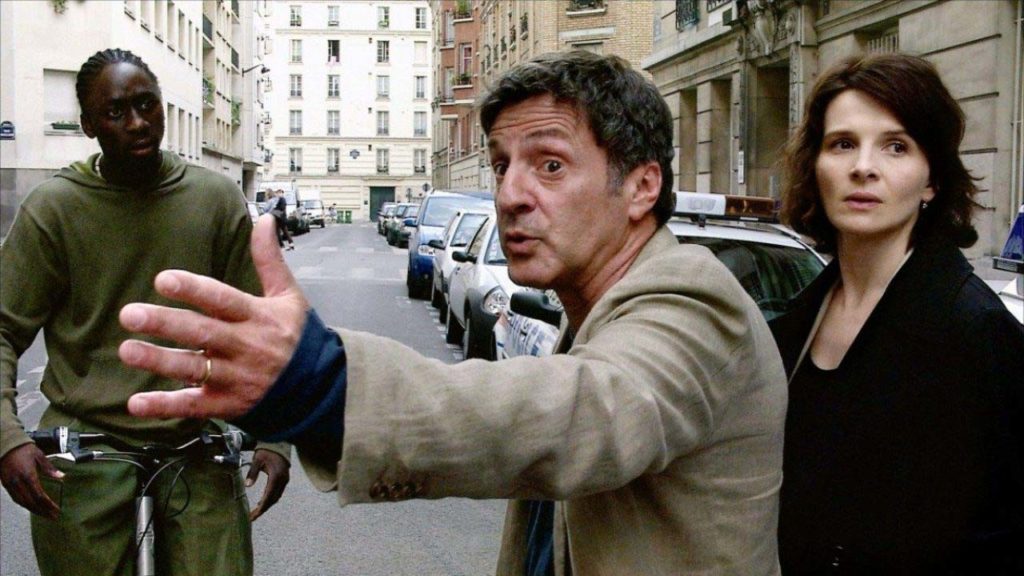
    An art-thriller directed by Michael Haneke, of whose previous films I’ve only seen Le Pianiste (The Piano Teacher). A major theme is that of video image-making (a main character is a television host) and surveilance. The interest in video images brings to mind the films of Atom Egoyan (Calendar, Felicia’s Journey), and perhaps even the search for meaning (that may or may not even be there) in photographs in Blow Up.

    The point of view of the “camera” is crucial; sometimes the image we’re watching is revealed as that of an actual video camera within the film. After we learn the first static shot is actually a film-within-the-film, we constantly suspect later static shots until the camera moves. Sometimes, we are the camera.

    Juliette Binoche in Caché

    A digression: if the academic term for a sound heard in the fictional context of the film (as opposed to, say, the score) is “diegetic” but how does one refer to a film or video image seen by characters within a film? Movies ranging from Citizen Kane (the newsreel sequence) to Starship Troopers (the fascistic TV commercials) feature moving images in the world of the film, so there must be an academic term.

    Caché famously features an enigmatic final shot, supposedly revealing a clue to a major unanswered plot point. So even though I knew to inspect it closely, and the mere location depicted obviously tells you what to look for, I still couldn’t spot it. Later, someone told me what to look for and I watched again. And sure enough, there is it, beautifully choreographed right there in plain sight. Hint: check out some action that moves from the top left of the screen down to the bottom left.

  • Yo La Tengo perform live to Jean Painlevé’s Science is Fiction in Prospect Park, 2006

    Yo La Tengo perform live to Jean Painlevé’s Science is Fiction in Prospect Park, 2006

    Hoboken institution Yo La Tengo performs a live score to several of French filmmaker Jean Painlevé’s underwater documentaries. Interestingly, English subtitles indicate the films were apparently not silent in their original form, with narration and perhaps scores of their own. So not only is the audience’s experience of the films filtered through a spoken-French-to-written-English translation, but also by Yo La Tengo’s contemporary score.

    Most of the films concerned the mating rituals and birth cycles of sea creatures ranging from octopi to mollusks. A rare intrusion of a human hand is seen during the dissection of a pregnant male sea horse. Without seeing the films in their original form, it’s hard to judge if they were clinical or artful in tone. Only one film was clearly intended to be abstract: a series of images of vividly colored liquids crystalizing, evoking the “Beyond Infinity” sequence in 2001: A Space Odyssey. But Yo La Tengo’s musical interpretation transformed nearly every sequence into a dreamlike, non-literal cinematic experience.

    I’m curious… was the band influenced by the original soundtracks? To what degree was the performance planned and/or improvised?

  • Tommy Lee Jones’ almost unbearably gruesome The Three Burials of Melquiades Estrada

    Tommy Lee Jones’ almost unbearably gruesome The Three Burials of Melquiades Estrada

    Tommy Lee JonesThe Three Burials of Melquiades Estrada joins Jim Jarmusch‘s Dead Man as one of my few highly-rated westerns. Like Dead Man, its tone meanders from the darkly comic to the melodramatic, and is at times almost unwatchably gruesome. Which does nothing to explain why I liked it, I know.

    Special mention to Barry Pepper for taking what must be one of the most thankless roles in movie history: his character is a onanistic, racist brute; he is beaten, dragged by a horse, forced at gunpoint to disinter a corpse, bitten by a rattlesnake, and not the least of which, spends a good part of the movie with his pants down (come to think of it, so does Dwight Yoakam).

  • Burt Lancaster’s and Deborah Kerr’s beach clinch in From Here to Eternity

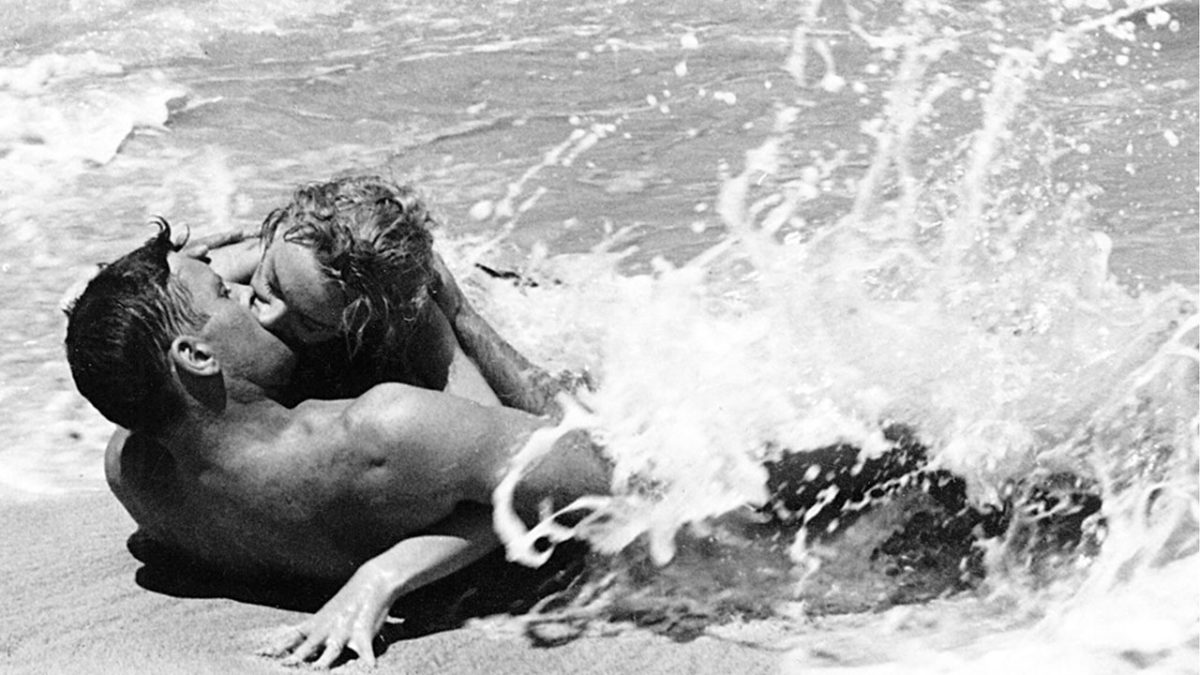
    Burt Lancaster’s and Deborah Kerr’s beach clinch in From Here to Eternity

    From Here to Eternity is famous for a lot of reasons: Burt Lancaster’s and Deborah Kerr’s hot clinch on the beach, the mere presence of Frank Sinatra, and, like a lot of canonical classics, its own fame.

    But, gradually, it dawns on you: what it’s really about is the utter inconsequence of our lives. Constantly overshadowing the many plot threads is the inevitable appearance of the Japanese overhead. And once they arrive, all the personal and professional troubles, the affairs and crimes, everything, becomes irrelevant.