Judging from the sprawl, spectacle, and general excess of Babylon, I can only assume that the success of Whiplash and La La Land earned director Damien Chazelle a blank check. More the pity that he spent it on this navel-gazing love letter to Hollywood, from Hollywood, as if anybody needed another one of those. Babylon is not very loving, as love letters go.
When you can see through the effluvia (human and animal) splattered across the screen, its thesis is punishingly obvious: Hollywood is a grotesque meat grinder that consumes and discards beautiful young people, while preserving them forever in celluloid amber. It’s a dream factory, vomiting and excreting fantasies that are ersatz, ephemeral, and as worthless as prop money that washes away in the rain. Yes, and? Tell us something we don’t know.
Extra credit to Chazelle for properly citing his sources in a pre-end-credits bibliographical appendix, even if it is in the form of a typical film geek’s YouTube supercut. Hey, maybe you’ve seen 2001: A Space Odyssey? It’s pretty great, you should check it out!
After suffering through these three hours of torture, the Paramount+ algorithm recommended Wolf of Wall Street, which is (chef’s kiss) A+ if-you-liked-this-cocaine-movie-you-may-also-like-this-other-cocaine-movie pattern matching.
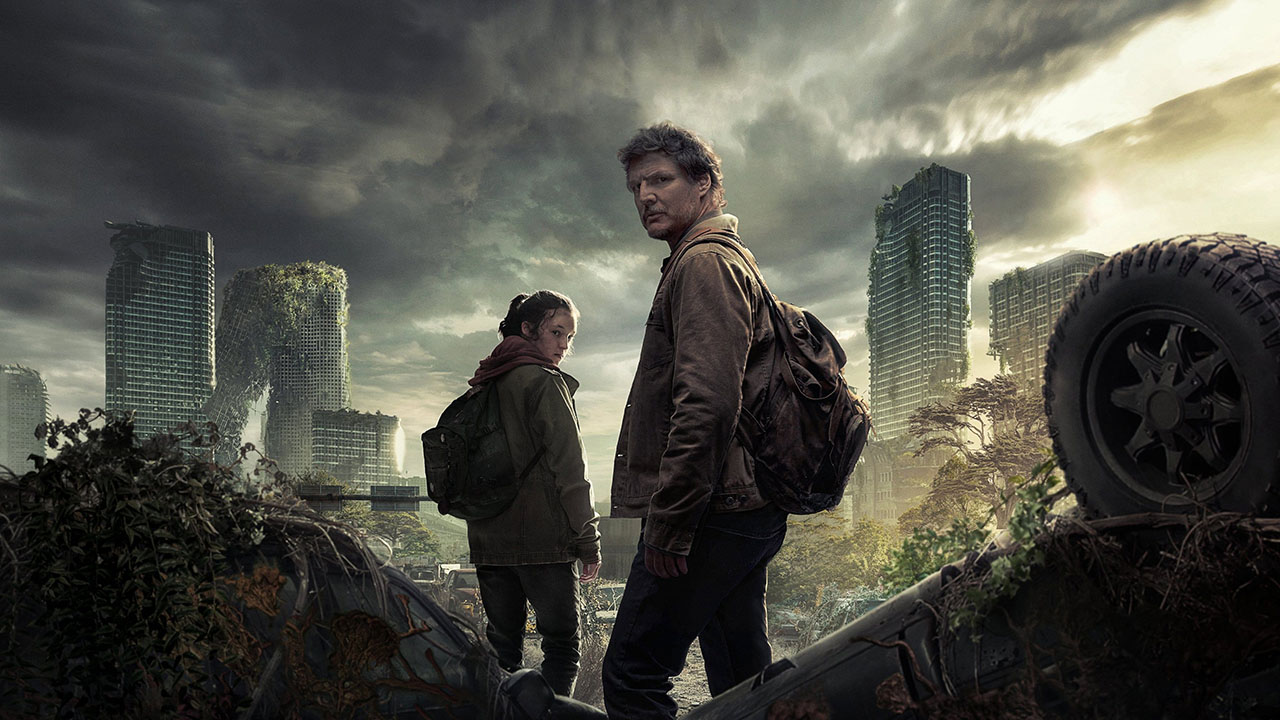
This blog has long enjoyed horror trash, including the zombie subgenre. Aside from one early standout episode (more on this later), The Last of Us was nothing we haven’t seen before; just another zombie show.
It ultimately amounted to little more than an episodic road trip through a post-apocalyptic wasteland, fighting off the monster and/or bandit of the week. It was fancy Walking Dead, for snobs who would never be caught (un)dead watching the long-running AMC horror-tinged soap opera — but with a luxe budget, overqualified guest stars (typically booked for one episode max), and an air of pretentious nihilism in place of camp melodrama.
The Last of Us was not even the best post-apocalyptic show on HBO, with that distinction clearly belonging to Station Eleven — and if you broaden your definition a little, Watchmen and The Leftovers. It’s not even a standout in the realm of prestige TV anti-heroes, especially considering how HBO itself pioneered the art with Tony Soprano, Omar, and Al Swearengen.
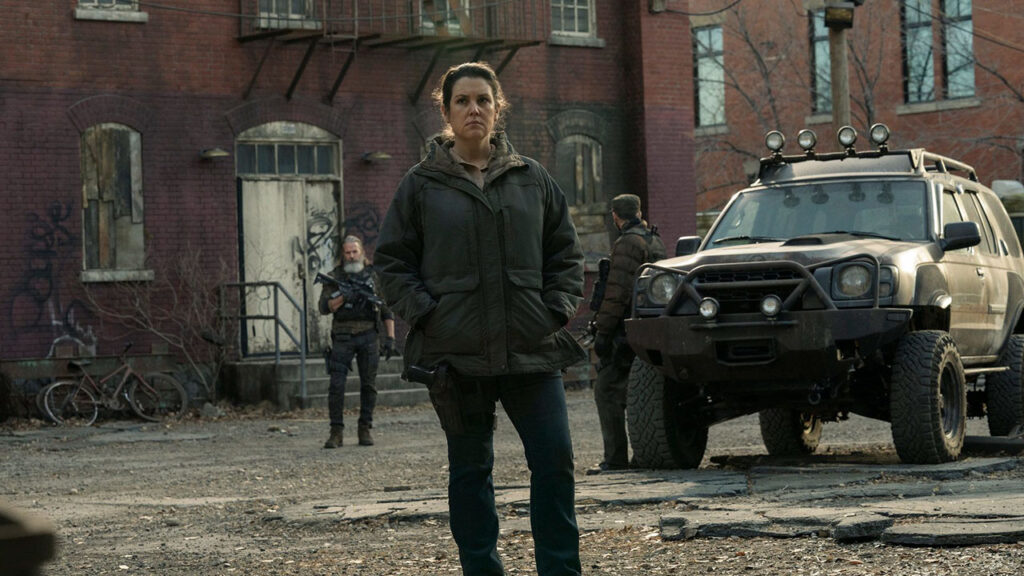
By the “standout episode” above, I am referring to “Long, Long Time”, starring Murray Bartlett and Nick Offerman as two men finding love and companionship after the end of the world. Criminally, a guest star of similar clout, Melanie Lynskey, was not afforded the same attentions. She played a thinly-drawn despot, who might have made a passable temporary antagonist on The Walking Dead. Worse, her character’s death was played for comedy, or as a kind of just-desserts moral justice, which is just insulting to the audience’s intelligence.
Melanie Lynskey as the disposable despot of the week, in The Last of Us
The Last of Us might be notable if it was comprised of more self-contained short stories like “Long, Long Time”, with room for real character studies. But across a scant nine episodes, the plots are boringly repetitive: each ad hoc society our heroes encounter always turns out to be a malevolent dictatorship, and the featured guest star always dies at the end. With only one real banger of an episode, The Last of Us is like an album with one hit single, and the other tracks are all skips.
And finally, spare me the pedantic debates over whether or not the fungi creatures in The Last of Us qualify as zombies. This is a distinction without a difference, and a zombie by any other name is a zombie. This line of overly-literal thinking would also disqualify 28 Days Later and The Crazies from the canon, which is just silly. Call it Night of the Living Mushrooms if it makes you feel better.
What is left for any new war film to say today, after landmarks like these:
The Deer Hunter and Platoon scratched open American society’s unhealed scabs over a pointless, unwinnable (indeed, lost) war.
Dark comedies like M*A*S*H, Catch-22, and Blackadder Goes Forth ruthlessly mocked clueless generals, while still being compassionate towards those that sacrificed themselves.
Saving Private Ryan permanently disrupted the war film formula, utilizing new storytelling techniques and filmmaking technology in service of empathy, viscerally placing the audience in the meat grinder that so many of the Greatest Generation were marched into.
More recently, 1917 and Dunkirk both employed formal experimentalism to tell war stories on an individual and geopolitical scale, simultaneously.
I know there are many other key highlights in the genre (I didn’t even mention one of my personal favorites, Paths of Glory), but you get the idea: the best war movies have opened eyes and shifted public opinion.
Edward Berger’s 2022 adaptation of All Quiet on the Western Front seems rather quaint in comparison, perhaps negatively affected by being seen mostly on small screens, via Netflix. It’s comprised of a series of vignettes that bluntly illustrate the obvious truths that every sensible person with a conscience already knows: what we think of as “war” is mechanized, industrialized slaughter on an obscenely huge scale, with soldiers as game tokens pushed around a map by armchair generals far behind the front line. As Stanley Kubrick’s 2001: A Space Odyssey famously satirized, despite thousands of years of civilization, war is a ritualized version of clans of cavemen having it out with clubs and rocks, for temporary control of a fetid pond, at least until the next famine, drought, or wildfire.
But then again, recent history has seen corrupt warmongers like George W. Bush and Vladimir Putin stage costly invasions for power and profit. So maybe every new generation of moviegoers does occasionally need new war films to rub their faces in the ugliness and brutality of war. But is All Quiet on the Western Front going to pierce the propaganda bubble in, say, Russia? And even if it did, would it change any minds that haven’t already been made up?
There are many downright strange aspects to the one-and-only Popeye movie, and you may be forgiven for thinking the strangest of all is that it was directed by Robert Altman, or perhaps that there has been no subsequent attempt at a reboot.
But to me, the biggest mystery is how this could possibly be one of Robin Williams‘ most muted performances. In Altman fashion, the ostensible lead character is merely one part of a huge ensemble, as in Nashville or Gosford Park. I would not have expected Ray Walston or Shelley Duvall to overpower Williams under any circumstances, especially in a kids’ movie. Speaking of the latter, Duvall absolutely nails the part of Olive Oyl, and is the best thing here.
Popeye has an easy-going, laid-back slacker vibe, even during the slapstick action sequences. Fittingly for the famously mumbling, inarticulate sailor man, the story is largely visual, and non-reliant on dialog. You could turn down the volume and have essentially the same experience. Indeed, Popeye would probably make great viewing for toddlers (or adult stoners) that vibe on The Teletubbies, or whatever today’s equivalent is. Compare and contrast with the heavily scripted, highly verbal kids’ movies from the Pixar and Dreamworks assembly lines.
I wonder if Warren Beatty studied Altman’s Popeye, in preparation for his own idiosyncratic comic strip adaptation, Dick Tracy. And the giant, sprawling set (not to mention the presence of Williams) also brings to mind Steven Spielberg’sHook.
It would have been more fun to watch this hot mess earlier, during the miniature cultural moment that briefly dominated social media discourse. It seems that the juicy, gossipy disasters must have occurred mostly behind the camera, for the actual film itself isn’t a total fiasco. I’ve unfortunately seen the not-dissimilar Serenity (2019), and I’m here to tell you that Don’t Worry Darling is a five-star, 100% fresh tomato, two-thumbs-way-up masterpiece in comparison.
For audiences conditioned by Black Mirror, the only real suspense is waiting to see if the inevitable twist will be more Westworld– or Matrix-flavored. In other words: is our hero Flo trapped in a Stepford robot body or an Oculus Rift prison?
But take a step back and consider the core premise: does anybody think that if toxic incel/misogynist/extremely-online/gamergate types were to have the opportunity to construct a virtual fantasy world, that it would amount to mere Leave it to Beaver cosplay? (but TBH, featuring a Dita Von Teese NPC is understandable; I’m only human)
In its final moments, Olivia Wilde’s film does make a fitful attempt at adding complexity: we learn at least one woman has consciously elected to live in this man’s world. It’s too much, too late, and yet not enough.
Based on the book of the same name by Lizzy Goodman, Will Lovelace and Dylan Southern’s documentary Meet Me in the Bathroom surveys the early-oughts music scene in New York City, particularly The Moldy Peaches, The Strokes, Interpol, Yeah Yeah Yeahs, LCD Soundsystem, and TV on the Radio. For the health and hygiene of all involved, I hope the titular bathroom was not the one in the Mercury Lounge.
I don’t know if you knew this, but people tend to have strong opinions about music, and it’s difficult to find two people that share the same set. A quick skim through the Letterboxd reviews displays a wide array of stances, ranging from (paraphrasing) “it was all noisy garbage until James Murphy tried ecstasy” to “Julian Casablancas is a delicate snowflake that must be protected at all costs”. But to be fair, there is common ground: most seem to acknowledge that gentrification sucks, 9/11 was traumatic, and Ryan Adams and Courtney Love were not good influences, to say the least.
The Strokes tear it up
Despite living in NYC at the time, being about the right age, and a big live music fan, I’m not a devotee of any of these bands in particular. There is one I actively dislike, one that I’ve never heard of, one that I’ve seen live, and the rest I enjoy to different degrees. OK, I’ll name names: The Strokes always sounded to me like a bunch of annoying drunks just thrashing around, The Rapture somehow never crossed my radar, and I’ve seen TV on the Radio (albeit after they made it big).
There’s an astonishing amount of footage available, considering it all dates from a point in time right before everybody started carrying cameras around in their pockets. But it’s a pity the new voiceover interviews are awkwardly delivered in the present tense, redundantly narrating exactly what you’re seeing, just like a reality TV show. There were numerous fascinating individuals and stories in this milieu, and it should have all added up to more than a feature-length episode of Behind the Music.
The dapper gents of Interpol
In retrospect, the ’90s were a golden age for female-led bands (see Garbage, Curve, Belly, The Breeders, and countless more), but in the early 2000s, it seems that Kimya Dawson of The Moldy Peaches and Karen O of the Yeah Yeah Yeahs stood nearly alone. The latter speaks very movingly about the sexism she encountered, primarily from the music press. Her exuberant stage persona sadly descended into a form of self-flagellation, a hole she had to dig herself out of.
Karen O is not the only fragile soul depicted as driven to express herself in public despite deep insecurity, shyness, and various economic and political headwinds. Coming across as the most well-adjusted are TV on the Radio and the very dapper Interpol. The only figures that seemed to roll with the punches and just have fun are Adam Green and Kimya Dawson of The Moldy Peaches. Certainly, none of them responded well to being asked idiotic, insulting questions by VJs, over and over and over; one exchange that stood out to me was Casablancas bemoaning his belated realization that the music biz is… a biz.
The Yeah Yeah Yeahs
As naive as he sounds now, it is true that nascent file sharing tools stalled these bands’ momentum (sales of a critical Interpol album were killed by it leaking online far ahead of release, and DJs like Murphy saw the value of their meticulously curated LP collections suddenly evaporate as any kid with a laptop and modem could cue anything up on demand), gentrification pushed everyone out of Williamsburg and Dumbo, and of course 9/11 changed everything.
As a New Yorker since 1996, the inclusion of explicit 9/11 footage struck me as tasteless, something that even Michael Moore had the decency to exclude from Fahrenheit 9/11. But upon reflection, I think it might be useful to occasionally illustrate what it was like to live through it, for those elsewhere who may admonish New Yorkers to “never forget” but don’t truly understand what they think we don’t remember. Particularly memorable is footage of members of The Strokes picking through the detritus-strewn streets, before it occurred to anyone that the ash was carcinogens and incinerated bodies.
Jaume Collet-Serra’s Black Adam is an appalling fiasco, easily one of the worst, most ill-conceived movies of 2022. Like the lightning bolt that adorns the titular character’s unitard, it points straight down — down to the bottom of the year’s most painful time-wasters, among bad company like Fantastic Beasts: The Secrets of Dumbledore and Uncharted.
If the notoriously shelved Batgirl movie was worse than this, it must have been a truly historic boondoggle. I don’t think it takes too much imagination to suspect that Batgirl was merely mediocre, but Black Adam was too expensive — and too beholden to its star The Rock — to let lie. If Black Adam was deemed suitable for release, any garbage is worthy of a tile on the HBO Max app.
There can’t be many comic book villains that are genuine household names, familiar outside of fandom circles. Maybe Lex Luthor and perhaps Dr. Doom, the latter by sight if not by name? I myself have read a lot of comics, but had never heard of Black Adam. So, consulting Wikipedia for help in understanding this nonsense, I was surprised to learn it’s a supporting character from the 1940s Captain Marvel comics (a property now known as Shazam, thanks to obvious legal snafus), and only intermittently employed since. The film opens with seven full minutes of narration to explain this tediously backstory, which is somehow simultaneously complex and childishly simplistic. Seven minutes! I counted!
The choice to create an entire mass-market movie around a deep-cut comic book character doesn’t strike me as good business sense. It barely alludes to the ostensibly related Shazam movie, and relegates more familiar superfriends like Dr. Fate (Pierce Brosnan) and Hawkman (Aldis Hodge) to supporting roles. Utterly mystifying.
Marvel has had this formula figured out for years: first, gain a foothold with well-known goodies like Spider-Man, before giving starring roles to baddies like Venom. They also typically remember to make their movies at least a little fun, and encourage their stars to flex their movie-star charisma. The Rock was reportedly keen on playing this character, but you’d never know it from his dour, bored performance.
The doomed All the Pretty Horses should have, by all rights, been a golden ticket for all involved. Let’s run through its pedigree and prestige factors:
based on an acclaimed novel with popular name recognition
directed by an indie darling
screenplay by a proven specialist in adapting novels to film
starring beautiful young up-and-comers
score by a notable musician/producer
distributed by a household-name movie company known for boffo box office and landing major awards
Instead, a heavily compromised version underperformed and was widely panned, demoralizing director Billy Bob Thornton, alienating musician Daniel Lanois, and generally disappointing everyone. Thornton’s presence in the tabloids at the time may have contributed to audiences not taking him seriously. But the key to understanding what what went wrong is, unsurprisingly, Miramax and — trigger warning! — Harvey Weinstein. Yuck.
Peter Biskind’s book Down and Dirty Pictures is an essential history of the indie boomlet within the 1990s movie industry. Particular attention is paid to the illustrative saga of Miramax, for whom Thornton had made a tremendous splash as writer, director, and star of Sling Blade in 1996. Studio cofounder Harvey Weinstein was riding high at the time for his marketing acumen, but was simultaneously loathed for interfering in the artistic process — to the point where he was known within the industry as “Harvey Scissorhands”.
Matt Damon and Henry Thomas wonder what went wrong.
Biskind relates how Weinstein forced Thornton to excise more than an hour from his initial 3-4 hour assembly cut, partly out of understandable practicality (a shorter running time would allow theaters to run more screenings per day) but also petty retaliation for Thornton’s refusal years before to similarly abbreviate Sling Blade. Thornton has since asserted that the assembly cut was just that, and distinct from his intended 2 hour and 42 minute cut. However unjust the butchery may have been, it’s hard to imagine how Thorton thought he could possibly get a nearly three-hour-long film into theaters without having a contractual right to final cut, even under a hypothetical producer less ruthless than Weinstein.
After Orson Welles met similar obstacles during the making of The Magnificent Ambersons, he struggled for the rest of his life to continue making movies his way. Biskind heartbreakingly describes Thornton as beaten down and defeated, to the point where he suffered health issues. In the coming years, Weinstein’s far worse abuses of power would become more widely known. In light of how he abused and exploited women, the stifling of a few movies may seem rather unimportant. But it is a pity that this particular one is so compromised.
Penélope Cruz has more chemistry with this hat than she does with Matt Damon in All the Pretty Horses. Seriously though, she looks fantastic in this hat.
It’s difficult to judge how I might have experienced the film if I had not known ahead of time that it was so heavily edited, but it does feel off somehow. It has notably uneven pacing; weirdly accelerating through some plot developments with choppy montages, especially in the opening sequence when Cole (Matt Damon) is forced to leave his family ranch, but slows down to a pensive crawl for others. The romance between Cole and Alejandra (Penélope Cruz) feels inert, and the looming threat from her powerful, overprotective father (Rubén Blades) never materializes. It’s hard to guess whether the full film fleshed any of this out.
Miramax was not averse to letting finished films sit on the shelf if deemed not of box office or award value — or, perversely, if insurance incentivized them to strategically not release them. Miramax also doesn’t have much of a history of releasing special editions for the home entertainment market, even for their biggest pictures. So for a movie that was not a success in its ostensibly more commercial Scissorhands incarnation, it’s interesting to note that Miramax did entertain the release of the director’s cut of All the Pretty Horses on DVD, but Thornton and Lanois refused.
From the movie’s brief foray into a ruthlessly bleak world more characteristic of Cormac McCarthy’s oeuvre.
Weinstein had disliked Lanois’ unconventional guitar-based score, despite his fame and proven success with Sling Blade, and commissioned an entirely new, more conventional one from Marty Stuart. Lanois now proudly refuses to license his original score in any form, and Thornton will not release his director’s cut without it. Thornton and Lanois are still close friends, as evidenced by his appearance in the documentary Here Is What Is, so it’s safe to say the conflict is not between them. Hopefully now that Weinstein split from Miramax in 2005, the company folded in 2010, and Weinstein is finally incarcerated, cooler heads might allow the proper release of the definitive film and score.
Another ray of hope is that Cormac McCarthy has since become an even bigger literary superstar — having been selected for Oprah’s Book Club and enjoyed successful film adaptations of his novels No Country for Old Men and The Road — and perhaps his hard-earned Hollywood clout might help a definitive version of All the Pretty Horses see the light of day. The counterargument is that his collaboration with Ridley Scott, The Counselor, was itself a bizarre fiasco.
All the Pretty Horses is probably one of McCarthy’s most palatable works, which I don’t intend as a backhanded compliment; it is more accessible in comparison to his more characteristic poetically bleak tone. Its back half (the protagonist’s imprisonment and an extended chase sequence) is closer in spirit and tone to the likes of Blood Meridian, but its core elements of friendship and romance provide some relief from the brutality of his resolutely cruel literary universe. As the first volume in a loose trilogy called The Border Trilogy, Thornton’s film could very well have kicked off a motion picture franchise. Revisiting or continuing this saga is unlikely to say the least, but it would be welcome.
What is left to be said about one of the most talked-about movies ever made? But rewatching Alfred Hitchcock‘s Psycho again for the first time in years, with a live audience at Rooftop Reds at Brooklyn Navy Yards, upended a few of my old opinions.
Reams have been written about its still-unusual structure, which violates every tenet of screenwriting — and considering the early exit of its top-billed actor, even the Hollywood star system itself. My memory was that the movie came to a crashing halt after Marion (Janet Leigh) met her fate, and never recovered its early dread, suspense, and wit — almost to the point of becoming a different movie. But on this rewatch, I was surprised to find that it flowed more soothly that I recalled.
Note the mirrors and reflections in Psycho.
It’s much funnier than I remembered, rife with intentional dark comedy, not “oh how quaint in retrospect” tittering. Some of the scenes that once felt out-of-place to me, such as when Sam (John Gavin) and Lila (Vera Miles) voice their dark suspicions to the comically folksy Sheriff Chambers and his wife, now play as willful satire. The Chambers’ inability to perceive the perversion and rot in their own community, in the form of harmless quiet boy Norman (Anthony Perkins), is an unfortunately timeless social issue.
The early office scenes hold up well, considering six decades of increasing cultural awareness of sexual harassment in the workplace. It’s very clear why Marion would be tempted to drop everything and flee: her subservient position to gross men, coupled with her hopeless financial insecurity.
Her lover Sam, a divorcée bunking in the back room of a hardware store, is suffering through a similar economic situation. But not subject to such harassment and humiliation, he never fully wraps his head around the extreme lengths that Marion took to escape. The very square Sam stands out as a 1950s-style relic that doesn’t belong in a dark thriller from 1960. But I’ve come to realize that that’s exactly the point: Sam is a basic normcore man’s man, which is intensely threatening to a resentful, twisted incel like Norman.
Still more mirrors and reflections.
Psycho is a clear ancestor to David Lynch‘s preoccupations in Blue Velvet and Twin Peaks. Lynch and Hitchcock both repeatedly examined the violent and sexual obsessions barely repressed below the surface of polite society. But the problem with Hitchcock is, as soon as he could depict more violence and sex on screen, he did, and all the artful subtext of masterworks like Vertigo (1958) turned into the overt nastiness of Frenzy (1972).
But Psycho (1960) sits at an interesting pivot point between his two extremes; racier than you may remember (with a few firsts or near-firsts, like depicting a secret tryst in a seedy hotel room, its star in a brassiere on the poster, and even an open toilet seat onscreen), but still using cinematic artifice in place of explicitness (the infamous shower scene technically features less nudity than you’d see during a shampoo commercial today, but still feels shocking, due to the effective montage and scoring).
The Ice Storm takes place at the precise moment when the burned-out remnants of the ’60s sexual revolution belatedly limped into the disaffected ’70s suburbia. The centerpiece of the film is a supposedly liberating “key party” that proves otherwise, thanks to long-simmering resentments and inhibitions. Two generations of two families clash during a single disastrous night, beset by heavily portentous bad weather and bad ideas.
Director Ang Lee and screenwriter James Schamus adapt Rick Moody’s novel, in what was either a nightmare or dream come true for art directors and costume designers. The very specific milieu of New Canaan, Connecticut in 1973 is rendered in oranges and browns, with the cast clad in plaids and shaggy hair, and the sets dressed with period flotsam like waterbeds and styrofoam packing peanuts.
Indeed, its overpowering upper-middle-class ’70s tackiness was the primary talking point at the time, and I recall titters from the audience when I first saw it in the theater. The fashions may be unflattering for most of the cast, but it must be noted that Sigourney Weaver looks stunning regardless.
A key party may have seemed like an exciting idea in the abstract.
In the 2008 Criterion Collection edition, production designer Mark Friedberg describes recreating his childhood playroom, designed by his architect father. He also incorporated his grandmother’s paintings and his father’s furniture. Realizing the titular ice storm took a couple strategies, depending on the surface, including hair gel, cast resin, and biodegradable goop.
The striking visuals are made even more convincing by the crinkling, crackling sound design. Also of note is the minimalist score by Michael Danna, featuring a Native American flute. The end credits feature another creature of the 1970s: David Bowie’s melancholic re-recorded version of “I Can’t Read.”
The film and novel both cite the Marvel Comics series Fantastic Four, which features a uniquely dysfunctional family unit. The conceit is effective, if a little obvious. Lee and Schamus would later more directly explore this territory in the under-appreciated Hulk (2003). I am also reminded of Todd Field’s Little Children (2006), which also posits that the behavior of adults and their children is not all that different — albeit in a bone-dry satirical tone that makes it a hard movie to like.
“Sometimes the shepherd needs the comfort of the sheep”
The casting for The Ice Storm is excellent all around, particularly for the young actors, who all went places. Tobey Maguire and Elijah Wood would each go on to headline major franchises. The former plays a complex character, perhaps the only one who comes through the evening with his innocence intact. Yes, he had dark designs that wreak havoc, but he pulls back from causing real harm. Christina Ricci is especially perfect here; she appears worldly and cynical beyond her age, and yet simultaneously so young and vulnerable.
Of the four deleted scenes included in the Criterion Collection edition, two foreshadow the fateful key party. With these scenes cut, the party is less signposted as a significant event, and its true nature as a pivotal moment comes more of a surprise:
Ben (Kevin Kline) at the office, concerned with stagflation. Schamus cut the scene because it was “too funny” – this despite the fact they were under the impression the movie as a whole was going to be funnier than it turned out: uncomfortable and squirmy.
Elena (Joan Allen) and the reverend at a diner, before the party. Timely gas crisis lines are visible out the window.
Ben & Elena in bed, mentioning the party again.
Paul (Maguire) calls Wendy (Ricci) with a “moral dilemma.” He hasn’t been privy to what she’s been up to in his absence, so he doesn’t know she’s probably the wrong person to come to with these kinds of problems.
On the same disc, Rick Moody describes seeing an adaptation of his work as someone else’s interpretation of your dream. Like a translation of a poem into another language, it is patently impossible, and says more about the translator than the original poet.