Writer and director Cristian Mungiu’s 4 luni, 3 s?pt?mâni ?i 2 zile (4 Months, 3 Weeks and 2 Days) is an unsensational drama on a very sensational topic. Like Cristi Puiu’s The Death of Mr. Lazarescu, it is shot in Dogme style with a handheld camera, long takes, and no score. Both films remorselessly lead the viewer through journeys likely undertaken by many throughout human history, of which most of the rest would rather look away from.
Although it seems ridiculous to talk about such a serious film in terms of “spoilers”, I do wish to caution any readers who have not yet seen the film to stop here.
In 1987 Romania, students Otilia (Anamaria Marinca) and Gabita (Laura Vasiliu) pool their money and make elaborate plans for an unspecified illicit event. What exactly the two young women seek is withheld for some time, building considerable suspense. No matter one’s political or religious beliefs, it is a simple fact that any society in which abortion is illegal produces a corresponding black market in dangerous back-alley procedures. 4 Months is not a passionate argument for or against the legality of abortion, but rather an unadorned illustration of two women’s experiences obtaining one.
4 Months begs comparison with another naturalistic film on a similar theme: Mike Leigh’s Vera Drake. It would be reductive to say 4 Months is a “better” film, but in comparison, it does make Vera Drake seem like a conventional courtroom drama with overly emotive acting.
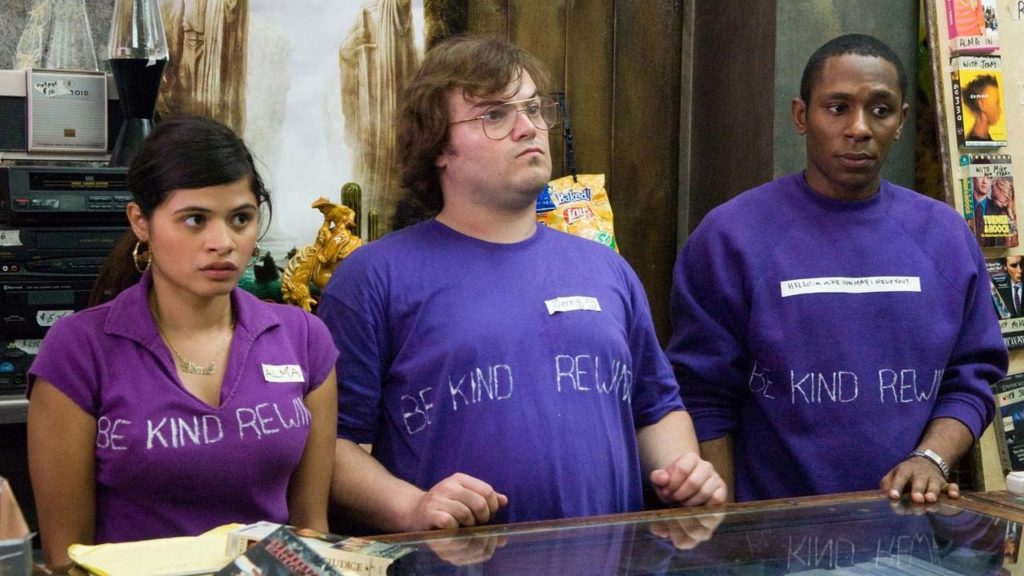
Michel Gondry’s Be Kind Rewind is a more mainstream effort than the personal and heartfelt The Science of Sleep, but still imbued with his signature handmade style and many of his particular (some might say peculiar) obsessions.
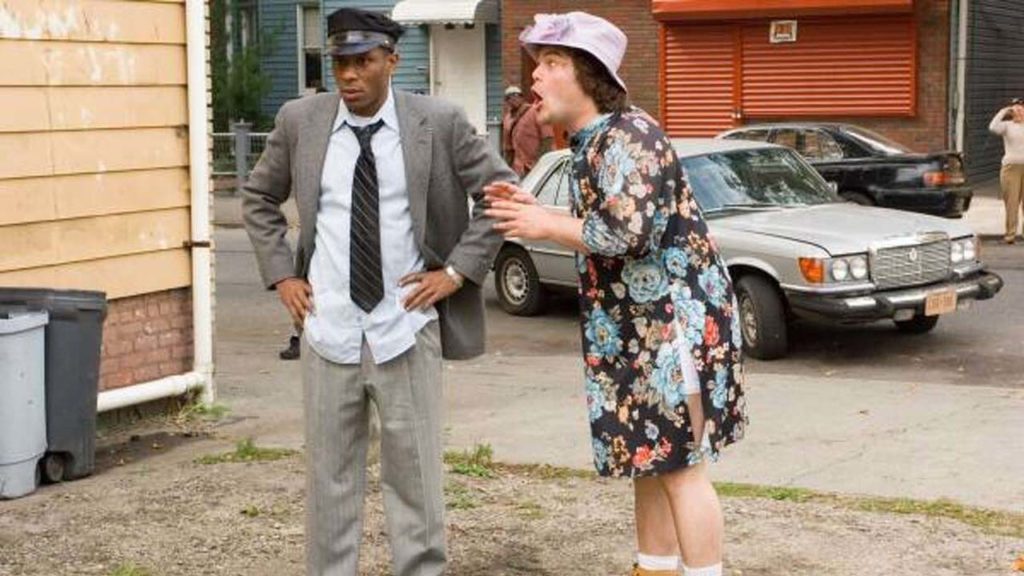
The premise is brilliant in its simplicity: a pair of misfit doofuses accidentally erase every tape in their retro video rental store, and decide to remake an eclectic selection of them from scratch. The considerable humor comes not just in how Mike (Mos Def) and Jerry (Jack Black) recreate shots, costumes, casting, and special effects, but also in how they must reconstruct entire plots and scenes from memory alone. If you had to condense a movie you hadn’t seen since childhood (say, for example, Ghostbusters) down to 20 minutes, equipped only with a camcorder and a budget of approximately $0, how would you do it? Jerry randomly coins the word “sweded” to describe their work, a puzzling term that isn’t even a pun, but spontaneous absurdity is a virtue in Gondry’s world.
Mos Def has mos def had enough of Jack Black.
Desperation inspires them to find a means of artistic expression, something many people spend lifetimes daydreaming about but never seize for themselves. Much as how Tim Burton characterized Ed Wood in his eponymous biopic, Mike and Jerry have true amateurs’ supreme confidence in their total filmmaking abilities. Their own ingenuity and the power of moviemaking inspires them with the realization that they can do anything and the trust that people will like what they do. Also like Wood, each obstacle they encounter merely increases their creativity.
“I am Robocop. Anything you say can and will be held against you in a court of Robocop.”
Even before the inciting incident of mass erasure, Jerry was already something of an outsider artist. He operated an auto shop with very creative notions of “repairing” cars into souped-up rocket-powered BatMobiles. His character is initially very unlikable, and evidently something of a misogynist. We see him taunt and nearly physically threaten a woman in the video store. Later, he reveals a longing for cutie Alma (Melonie Diaz) working in the local laundry, but when moviemaking provides him with the opportunity to interact with her, he treats her as would a little boy with a “No Girls Allowed” treehouse. But that’s not to imply there’s something cute about his attitude towards women; there appears to be a barely suppressed contempt and threat of violence.
An obvious paradox is that Be Kind Rewind is a film from a major motion picture studio that celebrates the indie spirit (not to mention fair use of copyrighted materials) and vilifies the venal movie biz executives that inevitably materialize with cease-and-decist orders. Speaking of venal movie execs, the movie’s home at New Line Cinema no doubt introduced several hardly canonical films like the New Line property Rush Hour 2 into Gondry’s script. The overabundance of New Line posters and VHS tapes in the set design bric-a-brac is something of a joke. While it’s funny that a run-down video store might still have ratty old Blast From the Past posters hanging around, would a competing mainstream neon-lit DVD store (Blockbuster in all but name) really shill for the long-forgotten Woo?
How long until they get around to remaking Gummo and American Psycho?
Be Kind Rewind is at its most brilliant when recreating classic (and some not-so-classic) moments from cinema history, so much so that everything else in the film feels like a distraction from the true delights. But the powerfully moving climax is the premiere screening of Mike and Jerry’s masterpiece, made in collaboration with their entire community. Their maturity as auteurs is marked by their first truly original work; their film within a film is a fictionalized musical biopic of Fats Waller. If only all actual musical biopics could be so wonderful!
Full disclosure: I first saw an advance screening of Be Kind Rewind on February 22, but as I was then employed by the movie company distributing the film, I decided not to post my thoughts. Regardless, I had nothing to do with making or marketing the film, and any opinions expressed above are mine alone.
Bringing new meaning to the phrase “get a real job,” I now learn that my last full-time gig was for a “fake company.” Years after the fact of its demise, Pseudo.com founder Josh Harris has pronounced to Boing Boing that Pseudo Programs Inc. was in fact a massive performance art piece, aided and abetted by the since discredited New York Times journalist Jayson Blair.
What is Harris up to? Is he, as my former colleague Jacki Schechner puts it, “Batsh*t Crazy”? [update: link no longer online] Has he been retroactively inspired by the literal definition of the word with which he chose to christen his venture, and now remembers things the way he wants to? To give him the benefit of the doubt, this pronouncement itself may be the performance piece. Or, he may indeed just be batshit crazy.
Regardless, wow! All of this comes as some surprise to me, as I drew a regular paycheck at the time. I was there, so I can attest that Pseudo was “real” insofar that it had actual employees, sitting behind desks, computers, cameras, and studio mixing consoles. We reported every day for real work, for pay, with benefits. We produced countless hours of audio, video, and animated programming for exclusive broadcast over the internet, years before technology and bandwidth made such things commonplace and trivial. If I was a small pawn in someone’s conceptual art piece, well, it’s still a bullet point on my resume, man. But it may explain why I’m having trouble locating most of my past colleagues on LinkedIn.
Some of the comments on the Boing Boing piece are more amusing and insightful than anything I could attempt here, but I thought it might do the public record some good for a former employee to contribute a few thoughts and memories about the tiny corner of Pseudo I was briefly involved with.
I joined the company in November 1999, right at the precarious peak of the infamous dot com bubble. Countless startups were all trying to figure out how to make money on the internet (wake me when somebody figures that one out). Pseudo was one of the first and most notorious, with a rough-and-tumble reputation of hard partying and drugs. Worse than all that (at least in the eyes of Wall Street) was how it excelled at its true forte: burning money in spectacular fashion (and speed). Media executive David Bohrman had been recently brought on as CEO in an effort to steer the chaotic company into profitability. To illustrate how much old-world thinking was driving Pseudo at the time, Pseudo’s disparate programs were fractured and reorganized into “channels,” an amusingly quaint metaphor ill-suited for the internet.
The Q.B. Club logo. I don’t know who designed it, but that’s the font Triplex, and it’s got a whole lotta Illustrator action goin’ on
One of these new ventures was the Politics Channel, still remembered now for its groundbreaking online coverage of the 2000 Democratic National Convention. But I was to be part of another channel no one, not even Wikipedia, now remembers: The Quarterback Club Channel. The Quarterback Club was a collaborative venture by several NFL players (including Warren Moon, Kordell Stewart, and Boomer Esiason) to consolidate their various moneymaking and charity ventures. Yes, that’s correct. This I, who couldn’t possibly care less about professional sports, and in fact often disdains them, took a job working for football celebrities. To my family at the time, I was working for the NFL, but to me, I was right where I wanted to be. To a former film student also interested in web design, making short animated films for the internet looked like the perfect job.
It was easy to get hired with the dot com bubble was at its apogee. As is my policy, I was utterly frank in my interview. I had used the then-new and trendy web animation tool Flash for a few projects by then, but was hardly an expert. What they had in mind for me was to execute Flash animated cartoons, then a radically new thing, from the writing, directing, and art by Kevin Ross (with whom I still have beers). Here’s a rough transcript of my interview:
MY FUTURE BOSS: “Do you know Flash?”
ME: “Well, yes…”
MY FUTURE BOSS: “You’re hired!”
That was easy! But the humiliations started early. One of my first tasks was to tote Warren Moon’s briefcase around after him on a visit to the Pseudo offices. Although I had never heard of him, but I was informed he was far too famous to carry his own shit. I have clear memories of it being made of orange basketball rubber, which makes no sense but that’s what I recall.
The Q.B. Club, Politics, and Comedy teams were housed catty-corner to the main Psuedo building, on the north side of Houston & Broadway. If Pseudo’s legendary partying was still going on under the reign of new grownup-in-charge David Bohrman, we saw none of it over at our depressing digs. The confusion over the two locations was always a problem. Once, Boomer Esiason mistakenly showed up at our place, and was clearly unimpressed as we tried to give him directions to find the main office (I didn’t know who he was, but my having met him really impressed my sports-fan cousin). There was everything to be read into our placement; the Pseudo veterans hated how Bohrman was mainstreaming the company.
Despite its justified reputation for profligate spending, Pseudo could be petty, cheap, and wracked by turf wars. Our NoHo Pseudo annex was viewed as intruding on the old skool’s SoHo territory, and they let it be known by delaying our computer and software orders for weeks. We were effectively crippled, but Kevin Ross and I produced the first and part of the second episodes of Q.B. Toons on my own personal PowerBook G3 (it could handle the animation, but didn’t really have the processor oomph for the multi-layered audio tracks we needed). The situation was so dire, and we were so obviously unwanted, that I know many of us considered quitting (not a single one of the Q.B. Club team ever did, choosing instead to ride out the weird situation). Speaking for myself, I was convinced Pseudo was the wave of the future, and the best possible place for a former film student to be.
Many of the “new-skool” employees came with little understanding of the medium in which they were to work: the internet. But to be fair, at the time, who did? Our boss was a former Navy Seal, and some of the rest came from television and video production. Time and time again we came up against a frustrating inability to write and communicate clearly. Kevin and I coined the phrase “purple puppy” to describe the kinds of random requests we would receive, as in, “Can you put in a purple puppy?” I still amuse myself with the in-joke to this day.
Kordell Stewart was not amused by “Activator Man”
All told, I was there for a little more than half a year. The rest of Pseudo had some success promoting the film American Psycho and selling the SpaceWatch Channel to Space.com for a chunk of change. Meanwhile, we only able to produce four episodes of Q.B. Toons. The first was little but a crappy teaser, featuring a holiday greetings from Warren Moon (what Scrooge would not be moved by that?). The second episode told the full, fleshed-out tale of li’l Moon in his first-ever game. The third starred Bernie Kosar and was a disaster, in my opinion, taking ages to produce and looking the worst. But our fourth, and what turned out to be our last, is our masterpiece. Reportedly our supervisors, and Kordell Stewart himself, were not amused and it remained unaired. We were inspired by the cut-out animations of the Monty Python genius Terry Gilliam, but the visual allusions were lost on everybody.
Klik-a-Kandidate: Bush wallows in his daddy’s riches, and Gore rides the information superhighway
We labored under an air of impending doom throughout, and the only ray of light was the daily visit by an enterprising young woman that sold homemade sandwiches door-to-door. I still have copies of some of the internal emails that circulated after each new article predicted Pseudo’s demise. So with the writing on the wall, we tried to diversify with two new projects for the Politics Channel: Klik-a-Kandidate and Campaign Dope. We were finally put out of our misery during the first round of layoffs in June 2000. The day began with an almost comical omen: as we were all called to assemble in the main Pseudo offices, I scraped my arm against the rusty grille of an old truck while crossing the street. There was not a single Band-Aid to be found in all of Pseudo, so I clutched a paper towel to the stubbornly bleeding wound for the rest of the day.
About half of the Quarterback Club staff was called into a brief meeting with Bohrman (like being picked, or as in this case not, for a dodgeball team). Our burden relieved, we dragged our pink-slipped asses back to our offices to hurriedly copy our SWF files onto Zip disks (remember those?) in time to grab a few pints at the local pub (which I recall being a really good, authentic Irish pub, actually… I wonder if it’s still there?). I spent the rest of the night in the emergency room for a tetanus shot. The next day I got a call from ABCNews.com, but I declined to comment, thinking I might hurt my chances at finding a new job (but I was working again within days). A second round of layoffs only a few months later put the rest of the company to its definitive end. The domain Pseudo.com appears to live on as a some kind of patchwork of affiliate music links.
Even if it took some wild pronouncements by Josh Harris for it to happen, it’s nice to see Pseudo back in the news. It was a great talking point for me in job interviews right after it imploded, but these days it’s hard to find someone who’s even heard of it. I now work for Warner Bros., and I certainly hope that the original Warners (Harry, Albert, Sam, and Jack) don’t someday rise from the grave and say “Psyche! Just kidding!”
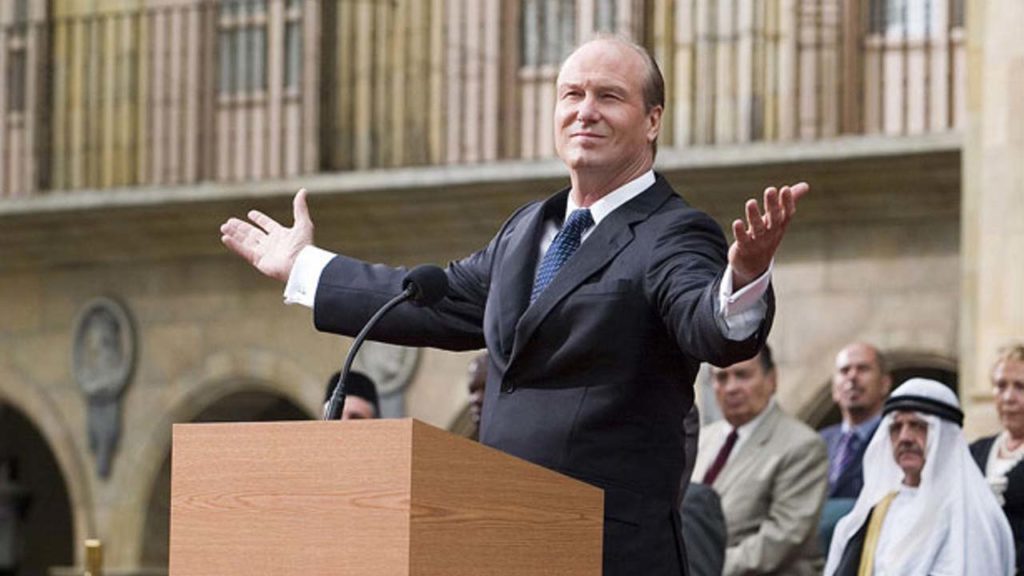
Vantage Point is an awesome technical achievement, and I don’t mean that to damn it with faint praise. Director Pete Travis and writer Barry Levy demonstrate excellent plotting, spatial sense, editing, logistics, and continuity. As a thriller it moves forward relentlessly, and feels comprehensible, self-contained, and very satisfying.
It is structured around a single gimmick, but it’s a good one. As one of the cinematic children of Rashomon (including The Usual Suspects and Courage Under Fire), it retells the same event from multiple points of view.
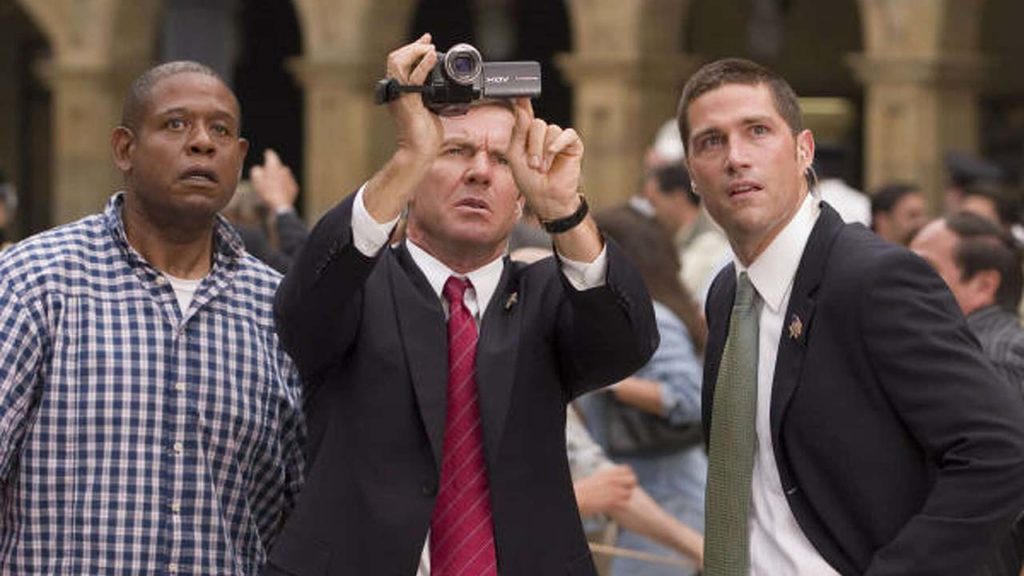
An assassination attempt on the US president in Spain is foiled by veteran Secret Service agent Thomas Barnes (Dennis Quaid) and civilian Howard Lewis (Forest Whitaker). The advantage of this structure is to withhold information and create suspense. The first time we spot Lewis, from the hyper-cautious Barnes’ perspective, he seems to be acting fishily. But when we soon see the events from his point of view, we learn he’s an innocent.
But the structure works the other way; almost a full hour passes until we see fellow Secret Service agent Taylor’s (Matthew Fox) side of the story, and the simple fact of his prolonged absence causes the audience to suspect him. At about the one-hour mark, the rigid, neat structure breaks down and we begin to see slivers of each character’s experiences mixed together, as they all draw to a single time and place for the climax.
A turkey in every pot and a thriller in every multiplex
But the crucial falling-down point of the movie is the trumped-up assassination plot itself, which is seemingly crafted for maximum storytelling drama and not real-world terrorist efficacy. Would an actual successful assassination be so hi-tech and complex? This plot relies on lots of wireless technology, split-second timing, blackmail (coercing someone to perform key tasks better done by someone the plotters could count on) and at least two inside men (one of whom must have spent almost a lifetime preparing).
This is how terrorism works only in the movies. Real-life assassins tend to be lone gunmen who manage to slip through security with their sheer unpredictability, and terrorist attacks like Oklahoma City and 9/11 didn’t depend on technology more complex than fertilizer and box cutters. While we’re on the subject, what are these particular assassins’ motivations, exactly? It becomes clear they don’t wish to kill the president but to capture him. Whatever they hope to accomplish, they seem quite pleased with themselves.
OK, everybody skootch in a little… say cheese!
All of these questions are negated in the end by a news broadcast that claims that a lone assassin has been shot and killed. This conclusion plays to the public’s lust for conspiracy theories than continues to plague 9/11 and the JFK assassination.
Extra observations:
One of the biggest plot twists is spoiled in the trailer.
Barnes is a cliche we’ve seen before, played by Clint Eastwood in In the Line of Fire.
There’s an oddly tiny role for Sigourney Weaver as television news director Rex Brooks. Was there more intended for her character? Perhaps she took the role for an opportunity to spend a few days in Spain.
Hey, it’s Hollywood’s go-to middle eastern guy, Said Taghmaoui (from The Kite Runner and Three Kings). He does turn out to be a villain, but so do two white dudes, so the movie totally isn’t racist.
This blog celebrates Independence Day 2008 in a New York City Starbucks, tapping out a review of the HBO miniseries John Adams. Believe it or not, the timing is accidental, but July 4th has proven to be an auspicious date in American History. On-and-off-again friends and foes Thomas Jefferson and John Adams both died on the same date, exactly 50 years after the ratification of what they called The Declaration of Independency. The tale sounds too good to be true, and yet it is.
HBO is back on its game at last, after a period of apparent dormancy following the natural conclusion of flagship original programs Sex and the City and The Sopranos, the premature cancellations of Deadwood and Rome, and the criminal abbreviation of the final season of The Best Television Show Ever Made (sometimes referred to as The Wire). Finely pedigreed, this lavish, over seven-hour miniseries by history buff Tom Hanks’ production company Playtone is based on the biography by David McCullough. However, it fails to reach the epic profundity of The Wire and Deadwood, which in the opinion of this blogger, possibly have more to say about the true nature of the America we have actually inherited from Adams and his contemporaries.
America’s second first couple
This blogger does not consider himself a patriot in the flag-waving sense of the word, and is not especially moved by stories of early American history. However, the dramatization of these legendary events and the characterization of dusty old American heroes were intriguing enough to make me consider picking up a copy of McCullough’s tome. The adult life of John Adams encompassed such elementary school social studies touchstones as the Revolutionary War, the Declaration of Independence, and the Constitution. In short, Adams was not only present during many of the key points in early American history, but a crucial participant. Nevertheless, history has chosen other heroes. As Adams was a statesman and not a military man, and indeed spent most of the Revolutionary War on a frustrating mission abroad in Europe, we don’t see reenactments of such key events as the Boston Tea Party, which one might have expected of a lavish big-budget HBO production. It makes sense, but there is unintentional comedy when a character remarks “Boy, how ’bout that Boston Tea Party last night, huh?” (OK, I admit I’m paraphrasing, but the effect is the same.)
After the Revolutionary War (waged in part by “godless Hessian mercenaries,” including one of my ancestors, Johannes Schwalm), Adams returned to the States United only to be turned right back around for his appointment to the impossible, thankless job of ambassador to former mortal enemy Great Britain. There’s a brilliantly tense scene in which Adams meets the slightly odd but clearly seething King George III for the first time. When Adams finally came home for good, he suffered persistent criticism at having been safe and coddled in Europe throughout the turmoil at home (it also seems his weight was a favorite talking point of the newspapers). But the miniseries makes clear that the biggest sacrifice made for his duty was the effects of his absence on his family. He loses a son to alcoholism and a son-in-law to naive investments, but on the other hand, his son John Quincy Adams succeeded him as the sixth president.
If I had a dollar for every time…
As the second president of the States United, Adams and his veep Jefferson both had the same aims: avoid war between France and England at all costs. Adams was stuck in the peculiarly ironic position of having a truce with Britain and antipathy with France, the exact opposite of the nation’s situation during the Revolutionary War. His administration grappled for the first time with many issues that still resonate today, including the concepts of freedom of speech, a deliberate national deficit (as espoused by Alexander Hamilton), and so-called “enemy combatants” (which were, at the time, specifically understood to be French refugees suspected of remaining loyal to an enemy monarchy). Adams reluctantly supported the Alien and Sedition Acts, not because he believed in them (he didn’t) but that he nobly felt it was his duty to stand behind the wishes of the people’s representatives in Congress. During his administration, he and Abigail moved into the partially completed White House, which is shown to have been built by slaves. This blogger should perhaps not have been surprised by this revelation, and yet he was.
The cast is a veritable showcase for “Hey It’s That Guy”s, providing substantial roles for a parade of familiar character actors — not least headliner Paul Giamatti. In many ways, Thomas Jefferson (Stephen Dillane) is the most interesting, and surprising characterization. As portrayed here, he was a mon who kept his own council and was somewhat shy, far from the loquacious and commanding personalities of many of his contemporaries. Adams, however, correctly perceived the quiet man’s powerful opinions about independence, and drafted him to write the Declaration of Independence.
Jefferson could also be proud, and his effrontery is priceless as Benjamin Franklin (Tom Wilkinson) quickly produces a red pen to make amendments. Franklin was one of a kind, and indisputably brilliant, but a massive egotist and hedonist. He was technically correct about how to effectively operate as ambassador to France, but it didn’t stop him from selfishly enjoying his job. He gamely played the role of “rustic” in coonskin cap, took mistresses (although Wikipedia does point out he was a widower at the time), lived a life of leisure, and knew when not to discuss politics (which was: most of the time). Originally a friend and ally to Adams, Franklin became an antagonist in France, and Adams appears never to have forgiven him.
America’s First Rascal shows John around his crib
George Washington (David Morse) is portrayed as gruff and humbly diplomatic, but also quite intelligent and perceptive, not to mention physically imposing. He was such a popular hero after the Revolution that his inauguration was a forgone conclusion, but it was later alleged John Adams would have actually won the electoral college vote without a conspiracy to anoint Washington as America’s first hero.
John’s cousin Samuel Adams (Danny Huston) figures significantly in the Early Continental Congress, and now we can finally see what Sam did to deserve having such a beverage named after him (I kid; actually he really was a brewer on top of all his other achievements).
One interesting figure this blogger had never heard of was John Dickinson (Zelijko Ivanek). As the representative from Pennsylvania, Dickinson argued passionately against splitting from Britain, and correctly foresaw the Civil War as an inevitable result.
And finally, there’s a plum role for Laura Linney as Abigail Adams, about as strong a woman as she could have been at the time. At one point, we see her scrubbing the floor with no motion to help from her husband. But clearly it was not just lip service when John Adams late in life claims Abigail was his most trusted advisor.
I apologize for failing to mention Sarah Polley in this article
In a great scene near the end, an aged Adams dresses down John Trumbull, the painter of “The Declaration of Independence” (now residing in the Capitol building – which was, incidentally, also built by slaves), for historical inaccuracies. Ironically, the scene is an invention, according to Wikipedia, but it seems to have been consistent with Adams’ beliefs and preoccupations. In his retirement, he was concerned that the story of the American Revolution and his own reputation would (or even could) be reported accurately.
He predicted a romanticized version in which future Americans would believe “Franklin smote the earth with his electrical rod and out came Washington and Jefferson.” It seems he may have been correct; Franklin and Jefferson are heroes to this day, while he remains relatively obscure. It is true that there isn’t much scandal or legend about his character and personality for schoolchildren to latch on to. Jefferson had Monticello and his inventions, and Franklin had his aphorisms and inventions of his own. One other reason Adams is not exactly a popular hero is that he first made himself known for defending English soldiers accused of perpetuating an unprovoked massacre. The defense attorney was never a much-loved profession, but set an early precedent for lawyers becoming presidents.
Finally, two smaller observations: The miniseries was partially filmed in Colonial Williamsburg, but many other locations were realized with superlative special effects. Beyond the obvious recreations of old Boston and Philadelphia, the DVD bonus features reveal that certain shots I never questioned, such as Adams ascending the staircase to a impressive European mansion, were in fact partly copmputer-generated. Also of interest is the gruesome contemporary medicine: exsanguination, inoculation, and mastectomy, all without anesthesia.
It may seem overkill for the so-called slowcore band Low to be the subject of another documentary feature film only a mere four years after Low in Europe, but it must be because they’re just so interesting. Filmmaker David Kleijwegt’s You May Need a Murderer could just as well be titled Low in America, as he speaks with founding members Alan Sparhawk and Mimi Parker at home in Duluth, Minnesota, and on tour across America in support of the Drums & Guns album. The key characteristics of that record are what most inform the film: Sparhawk’s mood post-nervous breakdown, and Low’s most overtly expressed social and political commentary yet. Low had also just adopted a new bass player, Matt Livingston, after Zak Sally’s long tenure, but he does not participate (he’s only barely glimpsed, even in live onstage footage).
You May Need a Murderer is a much more satisfying film overall than Low in Europe. Whether by their own desire to open up or by Kleijwegt’s persuasive interview skills, Sparhawk and Parker are notably more candid and direct, especially on the topic of their faith. Which is exactly what one would single out as the most interesting thing about Low: Sparhawk and Parker are a married Mormon couple that that tithe a tenth of all their income to the church. I suppose Low might belong in that rare category of bands whose music is often characterized by religious beliefs, like the often overtly Christian U2, but would never be filed under “Inspirational” in record stores. Unlike U2’s joyous hymns and optimistic calls to activism, Low’s inspirations are considerably more dark and apocalyptic.
When Low gets political they do so with a vengeance. Sparhawk is in despair over America’s economy and politics, and has long believed that the world may reach a crisis point in his lifetime (he stops short of predicting it will actually “end”). Sparhawk’s genuine beliefs gives him the real authority to criticize George W. Bush’s claim to faith. The title song “You May Need a Murderer” is sung from the point of view of one who goes before his god and asks to be used as a warrior. It becomes clear that the speaker is in effect staring into a mirror, bringing his own baggage to an imaginary conversation, and justifying his own dark impulses. Sparhawk is, needless to say, talking about self-proclaimed men of faith like Bush and Tony Blair. The song is utterly terrifying, and raises the hairs on the back of my neck every time. It may be the ultimate statement on the topic, and does not compare favorably to the similarly-themed song by Bright Eyes, “When the President Talks to God.”
The most surprising personal topic to come up is Sparhawk’s apparent nervous breakdown in 2005. We see Sparhawk appearing very anxious backstage before a show, but otherwise functional. But he describes himself as having been “clinically delusional” at the point of his breakdown, and while having nominally recovered, he also cops to being a drug addict. To him, the biggest conflict these two aspects of his life have is with his religion.
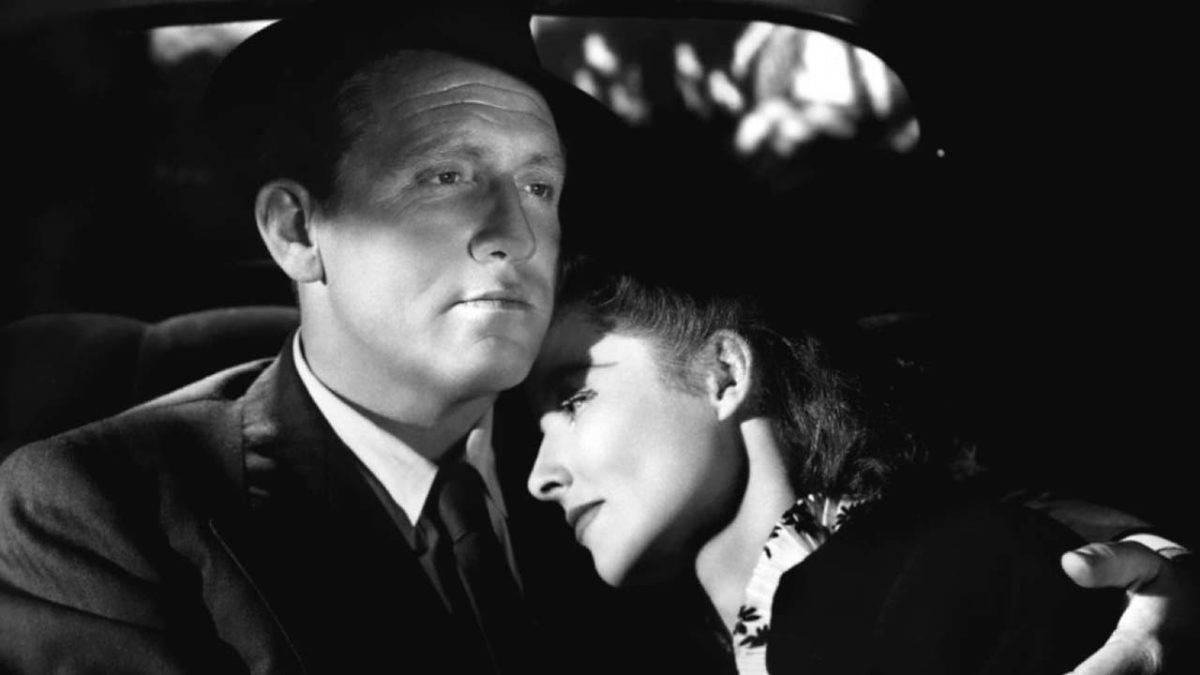
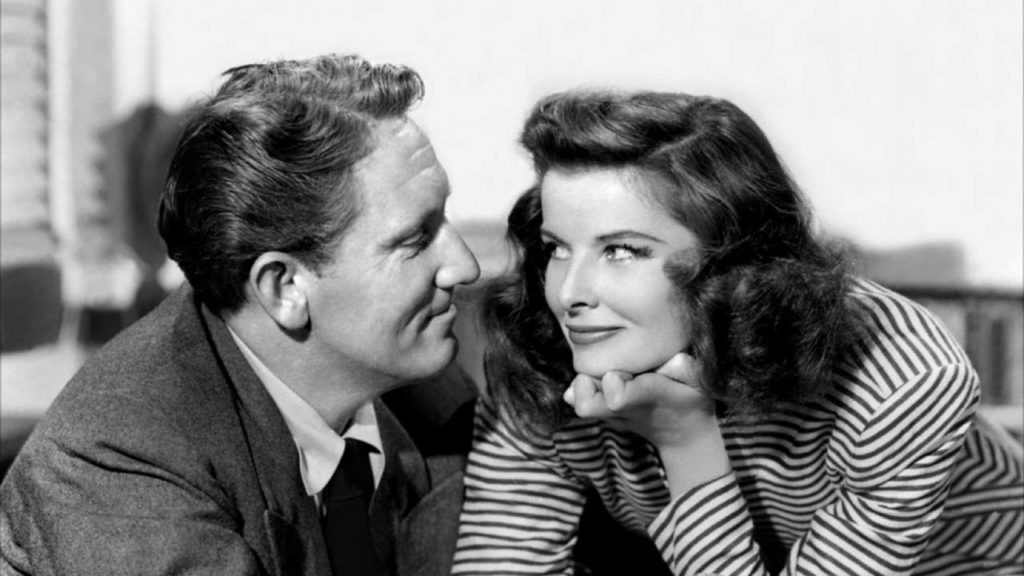
George Stevens’ Woman of the Year is one of the most famous Spencer Tracy and Katherine Hepburn double-acts, but there’s no question who was the real star.
Discounting a brief glimpse of her character’s newspaper byline, there is much talk of star reporter Tess Harding (Hepburn) before her delayed reveal. In a scene that would make Laura Mulvey’s head spin, the first time we finally spy Hepburn, the camera travels up her leg as she adjusts her stocking in her editor’s office. Was she flirting with her editor? Is any practical explanation necessary to justify a 1940s starlet showing a little leg? It’s hard to imagine Hepburn as a sexpot. He intellect and sass are undoubtedly sexy, but not in a way I would imagine would appeal to a 1942 everyman. Her face and figure are made up entirely out of angles, drawn by protractor and calculated by slide rule.
“No one will ever believe we were married sober.”
Even decades later, the rumor persists that one of or both Tracy & Hepburn were gay, and their marriage served as each other’s beards. I don’t bring this up to perpetuate the gossip, but rather to segue into the primary theme of Woman of the Year: a battle of the sexes, or at least, their perceived gender roles. In the tradition of Hollywood’s best bedroom farces, two opposites attract into a marriage, and it’s not long before the barbs are flying — some of which really sting.
Sam Craig (Tracy) is a true man’s man, who covers sports for the paper and hangs out in the pub. But the question of the movie is, how much of a woman is Tess? She is witty, urbane, educated, and globetrotting. But she is deserving of blame for impulsively adopting a war orphan without being conscious of the responsibilities. But the movie seems to equate this serious fault with her inability to make pancakes. And I don’t think it’s merely a fact of the 1942 gender politics or this blogger’s modern sensibilities, for the end of the film is genuinely confusing, sending mixed signals about what exactly Sam wants of Tess: does he really want her to relinquish her independence and be his breakfast chef, and does she really want to acquiesce?
Janus Films and the Criterion Collection have released two classic short films for children from French filmmaker Albert Lamorisse: White Mane (1952), and The Red Balloon (1956). Each is mostly silent, with only the odd line or two of dialogue. In essence, both are extended chase sequences that deserve to be taught in film school.
I vaguely recall seeing The Red Balloon in elementary school, as an ancient film print running through our rattling projector. As the little boy Pascal (Pascal Lamorisse) makes his way to school through a depressingly grey Paris, he frees a stray balloon (the reddest red you’ll ever see on film) tangled on a lamppost. The balloon becomes his faithful and playful pet, but causes him nothing but grief. He is kicked off the bus, made late for school, gets in trouble with maman, and provokes a gang of ruffians in short pants. Still, throughout, the boy remains the faithful defender of his adopted friend, and is ultimately rewarded after suffering tragedy.
Le ballon rouge (The Red Balloon)
White Mane is the story of a proud, wild horse sought after by cruel ranchers. Only Folco (Alain Emery), a poor young fisherman, treats the horse with the due respect in order to be able to approach and eventually ride him. The two become equals, as opposed to master and pet. Shockingly, their tale ends in an apparent suicide, as Folco and the horse both chose the freedom of death over living under oppression (poverty for Folco, captivity for the horse).
Le cheval sauvage (White Mane)
Together, the two films present the following morals: adults are cruel and unfair, intent on stamping out pleasure and freedom, and animals and inanimate objects make better friends than humans. Both feature heartbreaking tragedies that would almost certainly never figure into contemporary children’s films.
The Incredible Hulk is Hollywood’s latest incidence of what has become known as a “reboot.” The term came out of the comic book world, with further derivations in computer terminology. When a franchise begins to show its age with stalled creative energy and declining sales, its owners may opt to check it into surgery to be refreshed with a new cast, creative team, and updated plot particulars.
Warner Bros. and DC Comics kick-started their valuable but stagnant Batman and Superman feature film properties, making them relevant to 21st century audiences, and now it’s Marvel Comics’ turn. Emboldened by recent successes with Spider-Man and The Fantastic Four (and conveniently ignoring the failures Daredevil and Elektra), Marvel has obtained funding to independently produce its own films with greater creative control and, presumably, a larger chunk of the financial return. The massive success of 2008’s Iron Man seemed to prove their instincts correct.
Remarkably, The Incredible Hulk comes only five years after Ang Lee and James Schamus’ Hulk, itself a reboot of the comic book, cartoon, and television series. Even before Marvel announced it was to start over from scratch, the original Hulk film had already been seen as a critical and commercial failure, even though the reviews were not actually terrible (54 on MetaCritic and 61 on Rotten Tomatoes, both about the same as what The Incredible Hulk scored) and it earned $245 million worldwide.
NORTON SMASH!!!
I fully realize this is the minority opinion, but the Lee/Schamus version is a far, far better film, not only in comparison with its successor but also on its own terms. To paraphrase a review I recall reading at the time, “only the director of Eat Drink Man Woman and Sense & Sensibility would look at the Hulk comics and see ‘sprawling family melodrama.’” Lee and Schamus saw the core story as more than a simple Strange Case of Dr. Jeckyll & Mr. Hyde retread, and instead chose to tell a deeper tale of fathers and sons. The Hulk himself was created using motion-capture technology using Ang Lee’s own body language, and realized on screen as a giant green petulant baby (which is both absurdly funny and oddly moving, like the original King Kong). I still maintain it is one of the most brilliantly edited films I’ve ever seen, the closest in flow and visual style to a comic book a film has ever come. It’s also just really fucking weird, in a good way.
Liv Tyler, in the thankless role of superhero love interest
With Marvel in total charge of its own intellectual property at last, The Incredible Hulk had low artistic ambitions and was unsurprisingly crafted with comic book geeks in mind. In harsh contrast with arthouse mainstays Lee and Schamus, it was directed by action film specialist Louis Leterrier (of Transporter 2 and Danny the Dog) and written by Zak Penn, who has apparently cornered the market on super-hero scripts (including X-Men 2 & 3, Elektra, and the upcoming Avengers and Captain America). The backwards-facing film gives the fanboys a nod with admittedly fun cameos from Lou Ferrigno (who also voiced The Hulk’s few lines, and who also seems not to have aged one bit) and original Hulk co-creator (with Jack Kirby) Stan Lee. But the CGI is surprisingly unconvincing for a film that should have been state-of-the-art; the Hulk looks like he’s made of string cheese and quivering gelatin.
It’s showtime at The Apollo
Truth be told, I was actually rather enjoying the film, until one niggling fault grew to an unignorable degree that ruined the entire experience for me. Key character Emil Blonsky (Tim Roth) remains tragically underdeveloped. Any screenwriting student (hell, any film fan) should know the storytelling mantra “show don’t tell,” and yet Blonsky’s motivations are only hinted at in one or two lines of dialogue: he’s a career soldier grumpy about turning forty. Blonsky eventually evolves into the Hulk’s nemesis The Abomination, a hideous beast that lives to destroy. As the two creatures smash Harlem to bits in the final reel, there was no sense that the Abomination was once a man. What drove him to this? Interestingly, Roth plays a not entirely dissimilar character in Francis Ford Coppola’s Youth Without Youth: a man who uses up his youth in pursuit of an unattainable goal. In each case, the opportunity for a second chance is a mixed blessing.
Rumor has it an alternate, significantly longer cut of the film will eventually be released on DVD, preserving more of Edward Norton’s reported script doctoring, so this blogger hopes he will be able to revise his opinion at a later date.
Michael Crichton’s novel The Andromeda Strain was first adapted into a feature film in 1971, and now into a television miniseries from executive producers Tony and Ridley Scott. This 2008 incarnation is part feel-bad thriller, part wish fulfillment. As we thrill to the speculative illustration of how civilization might suddenly come to an end, we also can only hope the government does in fact have an elaborate and high-tech procedure in place for identifying and containing new contagious disease outbreaks.
The original book is only nominally about a supervirus, evidently of extraterrestrial origin, that threatens the human race. It is actually more about how intelligent, well-meaning people can make subtle errors of judgement that may cascade into catastrophe. Chrichton would also employ Chaos Theory as a key theme in his Jurassic Park novels.
Good times, good times
But the miniseries complicates this interesting theme with added government venality (a basically honorable president is undercut by a corrupt chief of staff), the media (a drug addicted reporter breaks the cover-up), and the environment (strip mining of the ocean floor leads to the crisis). To give but one example of the diminishing returns: in the book, a simple unnoticed glitch in a supposedly perfect computer system causes a dangerous communication blackout at the worst possible time. It’s both more plausible and more suspenseful than the miniseries version of events, in which General Mancheck (Andre Braugher) deliberately creates the blackout, to everyone’s mild and temporary frustration.
The book is not without its flaws, particularly an undramatic ending in which the continuously adapting virus eventually mutates into harmlessness. But the miniseries disappoints by giving the virus a definitive origin, indicating it is expressly targeted towards humans, and showing its definitive defeat.
The Andromeda Strain cast checks in for the long haul
Miscellaneous other thoughts:
Mikael Salomon’s direction is very boring and staid, except for a wildly over-the-top decontamination procedure that is filmed in a stylized, almost erotic fashion.
The miniseries is probably one of the talkiest sci-fi movies and/or TV shows I’ve ever seen. The bulk of the action is set in a single interior location, and nearly every scene comprises heated conversations in laboratories or over teleconferences.
The miniseries is laden with even more pseudoscientific bullshit than Crichton’s original novel: wormhole-enabled time travel and nanotech buckyballs from the future are the order of the day. The whole thing ends in the kind of temporal paradox that would drive an episode of Doctor Who or Star Trek.
The miniseries updates the book’s euphemism of “unmarried man” into “don’t ask don’t tell” territory, for a subplot involving Major Keane (Rick Schroder).
Spot the homage to Hitchcock’s The Birds!
Why does the underground facility begin to disintegrate during the run-up to setting off an atom bomb? Wouldn’t there just be a countdown and then an explosion?
This blogger, a longtime fan of the TV show Lost, is happy to see Daniel Dae Kim in a starring role.
Benjamin Bratt is really terrible, giving the proverbial phone-it-in performance. He delivers every line with the same intonation, whether it’s saying goodbye to his family for possibly the last time or announcing humanity’s first discovery of an alien life form.