Lars and the Real Girl is warm, funny, and moving, but felt a little “screenplay” to me. Aside from the indie film cliche of The Small Town (which affords an isolated community of eccentrics and an economically small cast), it seems to be a precisely workshopped exploration of a simple compelling premise: a man falls in love with a sex doll. And yes, these particular models are, uh… real… and to Lars, even better than the real thing.
However, the fine script and performances really do sell the unlikely conceit. Ryan Gosling makes a potentially unappealing character very sympathetic, and indie queen Patricia Clarkson is so sublimely calm (watch her respond to each outrageous development in Lars’ life with a blink and a pause) that I suspect she would make a great shrink in real life.
If I were in a screenwriting class workshopping this script, I think perhaps I might point out one missing aspect: we see the town pull together to support Lars, but would they do so for just any citizen? I’m not sure there’s a sense of why they’re especially protective of Lars in particular.
As a true comedy auteur, Tina Fey’s acting has always come in tandem with her own writing. This double act has progressed from improv comedy at The Second City, to head writer for Saturday Night Live, to supporting player in the feature film Mean Girls, (for which she wrote the screenplay), and finally to executive producer and star of her own sitcom 30 Rock.
Baby Mama, written and directed by Michael McCullers, marks Fey’s first star turn in a project which she did not originate or write. Still, it certainly feels a lot like a Tiny Fey joint. Judging by the general tone and the chaotic improv of Fey’s partner-in-crime Amy Poehler, I suspect the two enhanced the production with a fair amount of script-doctoring.
Indeed, Fey’s character fits firmly in the public persona of Endearingly Neurotic Thirtysomething Single Girl established on SNL’s Weekend Update, as Ms. Norbury in Mean Girls, and as Liz Lemon in 30 Rock. The Tina Fey Notlash notwithstanding, she is evidently more grounded in real life, and married with a child. Meanwhile, the fictionalized “Tina Fey” is the idol of every girl with glasses and crush of every boy with… uh, glasses.
Fey must have an impressive rolodex, for like her flagship TV show 30 Rock, nearly every little role is Baby Mama is filled by a familiar face. When not being amused by alumni from The Daily Show and SNL, we’re treated to Steve Martin as a wild and crazy organic food magnate and Sigourney Weaver as an initially creepy but ultimately sympathetic fertility doctor. But personally, I wouldn’t dare make fun of Sigourney Weaver’s age, lest she come after me with a flamethrower or a space forklift.
Ridley Scott’s original Alien is one of the most effective and influential horror films ever made, and a personal favorite of mine, with no apologies. Its art direction and visual aesthetic were so far ahead of their time that pretty much only the hairstyles have dated, but the real keys to its longevity are its brains and depth of substance. No doubt there have since been dozens of dissertations on its gender themes and often overtly sexualized imagery designed by biomechanical artist H.R. Giger. Once you realize the portal to the crashed spacecraft is a giant vagina and the xenomorph’s head is an erect penis, you will never be able to un-see it.
But Alien‘s most unfortunate legacy is that it has forever melded the science fiction and horror genres in moviegoers’ expectations. Aside from the odd exceptions to the rule ranging from the parable-for-all-ages E.T. to the gut-wrenching social critique Children of Men, we now can’t have a horror film without a rubbery alien or a sci-fi film without eviscerations and gore.
Worst of all, the Alien franchise has been cursed with diminishing returns. Probably but not necessarily by design, James Cameron’s vapid sequel Aliens completely drained the core themes and subtexts from the original in favor of the mere spectacle of spaceships and bullets. Subsequent sequels achieved the rare feats of being by far the worst films of two extraordinarily talented directors: David Fincher’s compromised Alien3 (the only installment with the traditional numeral in the title) and Jean-Pierre Jeunet’s bizarre-but-not-in-a-good-way Alien: Resurrection.
Part of the problem is that there can be only a limited set of variations on the core premise. The original Alien found the right recipe on the first try: lone but nearly invincible creature vs. unarmed bunch of humans in claustrophobic environment = teh awesome. Most sequels multiplied the number of aliens only to find that their collective dramatic impact was lessened when all it took was a futuristic Colonial Space Marine’s rifle to dispatch one.
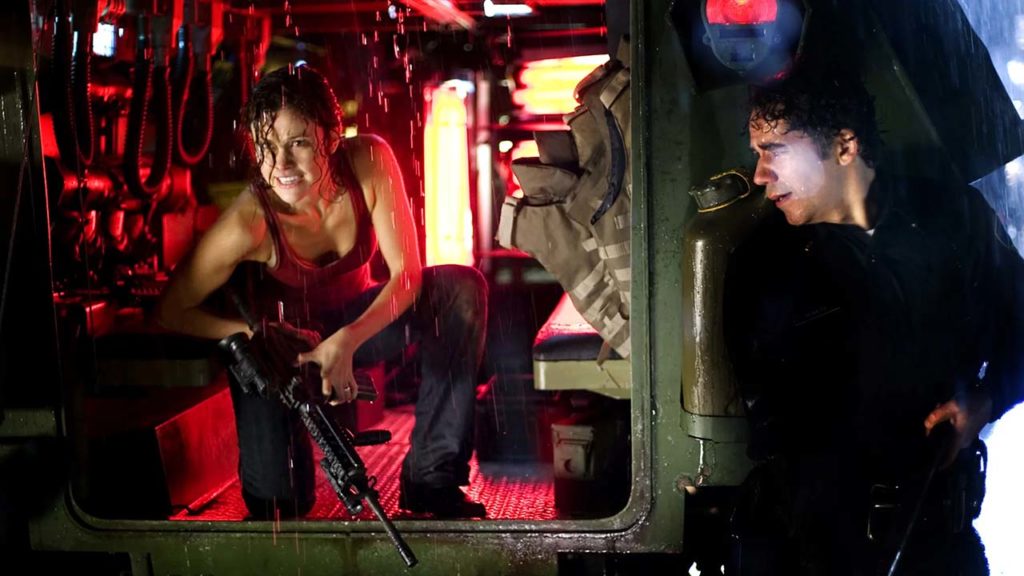
(l to r) The PredAlien and a Predator face off in Aliens vs Predator- Requiem.
Meanwhile, the less ambitious Predator franchise managed to only rack up a meager two installments. Perhaps their lesser appeal is attributable to what the Alien films got right; the “aliens” are not intelligent members of a society like the Predators, whose entire culture is based upon the concept of ritualistic hunting. Aliens are instinctual beasts that live to eat and (especially) to breed, so savage and animalistic that their species doesn’t even have a name.
The two spent properties found a new life together in the unholy crossover marriage Alien vs. Predator that began as comics and video games. Inevitably, they found their way back to cinemas as Hollywood attempted to reboot the cash flow with the first film in 2004. But this “new” series has already run out of variations on the core premise in only its second installment.
You wouldn’t know it, but there are some human characters in this film.
Believe it or not, AVP:R is the first Alien film set not only in the present day, but also actually on Earth. This time around we have a single Predator vs multiple aliens, with a variety of helpless human bystanders caught in the crossfire. Basically, the Predators screw up and accidentally seed Earth with a batch of aliens they had intended to breed as hunting stock. A lone Predator, perhaps fancying himself a sort of space age Mr. Fixit, attempts to whitewash his colleagues’ mess. He’s no sympathetic hero, however, for he doesn’t hesitate to take the pelt of a human as a trophy when the opportunity arises.
To go back to the aforementioned variety of helpless human bystanders: any decent screenwriter or producer (or, hell, anyone who’s seen a couple of movies) should have realized that there are three problems with this scenario: “variety,” “helpless,” and “bystanders.” The huge cast of human characters all remain underdeveloped. The lamest thread involves a bunch of so-called teenagers, obviously written by a screenwriter that was never actually a teenager. The only recognizable face (to this blogger, at least) is Reiko Aylesworth from 24, miscast as an Army soldier on leave. Her only purposes in the story seem to be to instruct the audience that guns work better if you shout while shooting, and to have someone on hand who might plausibly know how to fly a helicopter.
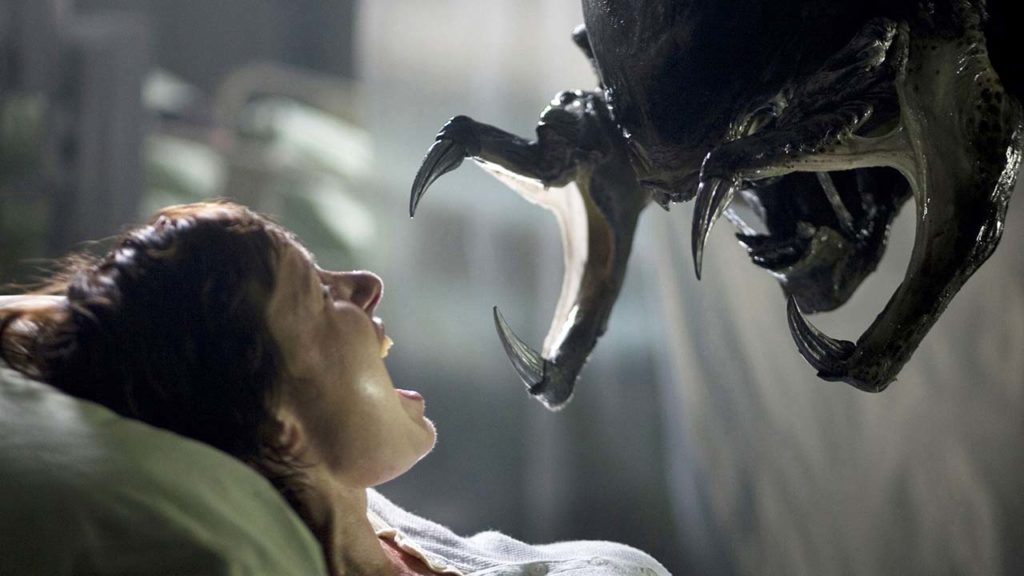
Mandible with care
AVP:R is so divorced from the six prior Alien films that there are only two tenuous continuity threads to link them. A Mrs. Yutani appears, presumably of the Weyland-Yutani corporation that, in the future, will operate under the secret agenda of locating more aliens as it strip mines the galaxy for fossil fuels. But perhaps the one true link to the original Alien film from 1979 is a sequence involving a chick stripping down to her skivvies. In the original, the truly badass Ripley (Sigourney Weaver) deservedly kicks back her heels and gets ready for a suspended-animation nap in her undies, but here all we get is a bland “hottie” stripping for her unlikely dweeb crush (an incidence of nerd wish-fulfillment that speaks volumes as to the maturity and life experiences of the filmmakers).
What should have been another major screenwriting red flag is the hugely unsatisfying ending. When the Predator, the closest thing the film has to a hero or protagonist, finally closes in on his prey, they go at it looking for all the world like two pro wrestlers in rubber suits. And then immediately… they’re both obliterated by a nuke. A small handful of the humans are only barely proactive and manage to survive untraumatized despite having watched all their families and loved ones killed.
So why do I keep punishing myself by watching each Alien sequel? I don’t ever again expect something as multilayered as the original, but I do keep thinking that these kinds of movies are supposed to be at best entertaining and at worst a little fun, and yet they always turn out torturously awful. AVP:R‘s best quality is its brisk 86 minute running time, even in its unrated extended DVD cut.
In this blog’s opinion, Ang Lee’s Sense and Sensibility is the best-of-breed within Jane Austen film adaptations. Please note, however, there are two very good reasons to discredit my opinion on this subject:
I. Despite my English major, I am ashamed to admit I have read only one Jane Austen novel: Emma. Yeah, I know, I’ve got to get working on that.
II.Sense and Sensibility features two of this blog’s all-time favorite movie crushes: Emma Thompson and Kate Winslet. Any film featuring just one of these English roses automatically earns extra credit. Any film featuring Emma and Kate, together, equals porn (especially if they hop into bed together, as they do here… granted, as sisters keeping their toes warm, but still!). Any film featuring Emma and Kate, plus a screenplay by Emma, equals bliss.
“Always resignation and acceptance. Always prudence and honor and duty. Elinor, where is your heart?”
A few extra notes:
Guest commentator (and first-class Austen aficionado) Snarkbait has coined the best phrase for this genre: “Regency Era froth”.
Actor Greg Wise (John Willoughby) later became Mr. Emma Thompson, after Kenneth Branaugh foolishly let her get away.
Hugh Grant’s trademark stammer, persistent interest in the carpet, and out-of-control hair are still charming even in 18th Century surroundings. But it is difficult to stifle a snicker when the devilish Grant, as Edward Ferrars, expresses an interest in joining the Church.
I wish I had Alan Rickman’s (Col. Brandon) vocal cords.
Hey, look! It’s Tom Wilkinson in a cameo as the soon-to-be-late Mr. Dashwood! This blog thinks Wilkinson is one of the finest and most versatile actors working today.
Required viewing: Emma Thompson’s 1996 Best Adapted Screenplay Oscar acceptance speech (not on YouTube as of this writing, but here is the text).
In the Valley of Elah is a dark story about the psychological damage of war, certainly not a recipe for an entertaining night at the movies. This blogger will cop to finding it difficult to work up the enthusiasm to sit down for a movie on such a troubling topic, fearing the resultant depression (despite my love and respect for cinema as an art form, and staunch sympathy for the anti-war movement, sometimes a person just needs a little light entertainment). But writer/director Paul Haggis structured the plot as a murder mystery, with a few pinches of wry humor, to craft an excellent film that is not punishingly sad.
Hank Deerfield (Tommy Lee Jones) is a pious, patriotic, and disciplined man. But he is also emotionally detached; he dispassionately investigates the mysterious death of his own son. Drawing upon his skills as both a former army soldier and police sergeant, he outwits both the army’s own investigators and the resident local police smartypants Det. Emily Sanders (Charlize Theron). Impressively for an old coot, he is even able to locate a back-alley cell phone phreaker, in an unfamiliar town, using only a diner’s phone book. But the seemingly cold man does reveal his pain and weakness before the end, and even a buried unsavory side involving racism.
(Don’t Go Back To Sgt.) Rockville
The title derives from the Biblical parable of David and Goliath, a macho mano-a-manu beatdown that occurred during the battle of the Israelites vs. the Palestinians. Aside from the obvious parallels to the locale and participants of the ancient and never-ending Middle East conflicts, the tale is also a metaphor for how Deerfield views manhood and how he raised his son: to stand tall against any odds. But as Deerfield learns unpleasant truths about his son (drugs, torture, prostitutes) and his country (unjustified war, institutional corruption), he must, late in life, come to reevaluate his most core beliefs. So what makes this clearly liberal anti-war film special is its respect for exactly the type of person it might indict: the god-fearing patriot.
Whitman’s Sampler, my favorite!
Finally, I’d like to highlight one excellent scene (in every way: writing, acting, and directing): as Deerfield phones his wife Joan (Susan Sarandon) to tell her their son is dead, the scene begins in the middle, and in the end the camera pulls back to show Joan has torn apart the room. A lesser film would have shown the whole thing, for the sake of melodrama.
Like many young men cursed with a privileged life of education and time to think for themselves, Chris McCandless (Emile Hirsch) wanted only a vaguely defined “truth” and to not have to rely on anyone. Synthesizing his reading of Henry Thoreau and Jack London, he imagined for himself a life of self-sufficiency in the wilderness. So McCandless dropped out of society in the summer of 1990, leaving behind all connections whatsoever, including his legal name and identity. Despite his absolutely clean break, he never seemed to view this transformation as permanent; he mentions more than once that he may write a book when he “comes back.”
Interestingly for a young man, he also seems to make a point of avoiding even temporary female companionship. He rejects the friendship of Jan (Katherine Keener), and abandons his younger sister Carine (Jena Malone), the person with whom he apparently had the closest bond. Carine narrates the film, with total sympathy for his beliefs and actions. But even she points out that he acted with “characteristic immoderation.”
The rough guide to self-actualization
McCandless died alone in August 1992. He remains a controversial figure (should his asceticism be admired, or was he a fool?), and his solitary death the subject of an intriguing mystery (was he really trapped with food poisoning, or did he allow himself to die slowly as a form of passive suicide?). This film interpretation of his story does make it clear that he was a privileged kid who hadn’t truly suffered. While drinking with new buddy Wayne (Vince Vaughn), he lets slip his adolescent belief that one of the worst forms of tyranny in the world is “parents.” As we see, his parents (Marcia Gay Harden and William Hurt) are all too human and not half as monstrous as he imagines. So perhaps his adventure was more than an idealistic reaction to mere money, society, and materialism. He was also running away from the “free” things that living in society affords, what everyone craves in life: family, friends, and lovers.
Hence the title
A note on the music: just as McCandless looks backwards for literary inspiration, he also has antiquated taste in music for a kid living in the early 90s. His new name for himself, “Supertramp” puns on the classic rock band and his new lifestyle. He christens his new and final home, an abandoned bus, after The Who’s “Magic Bus.” For the music of the film itself, director Sean Penn drew upon two musicians that made names for themselves in the early 90s: Pearl Jam’s Eddie Vedder (who contributed songs to Dead Man Walking), and guitarist/composer Michael Brook. Vedder’s songs for the film were released as an album, but Brook’s excellent score is also available digitally.
Into the Wild is yet another in a long series of films I’ve seen recently that are based on books I haven’t read (The Kite Runner, No Country for Old Men, The Namesake, The Assassination of Jesse James, etc.). But even so, I believe I can detect a few remnants of the film’s prose origins as John Krakauer’s book:
the film is broken into chapters with onscreen titles
voiceover narration
the visual device of superimposed text from McCandless’ own journals provides a second voice
episodic feel – but that’s justified by the events/phases of his journey – he keeps making clean breaks every time he comes close to settling in somewhere
Anyone who’s ever had the misfortune of a conversation about movies with this blogger is no doubt aware that I like musicals about as much as I like biopics. That is to say, not at all.
I do, however, love Tim Burton, and count Ed Wood among my personal favorite films. So if he could make a biopic I can love, I didn’t think it unrealistic to hope that he might melt my cranky moviewatcher’s heart with a musical. But it’s been a long time since Burton has directed a personal project, instead working on existing franchises and remakes like Planet of the Apes and Charlie and the Chocolate Factory. He did add a healthy dose of the trademark Burton flavor to each, not to mention key members of his troupe (Helena Bonham Carter in Apes and Johnny Depp in Charlie), but fans like myself are still waiting for the next burst of pure Burton madness in the spirit of Edward Scissorhands.
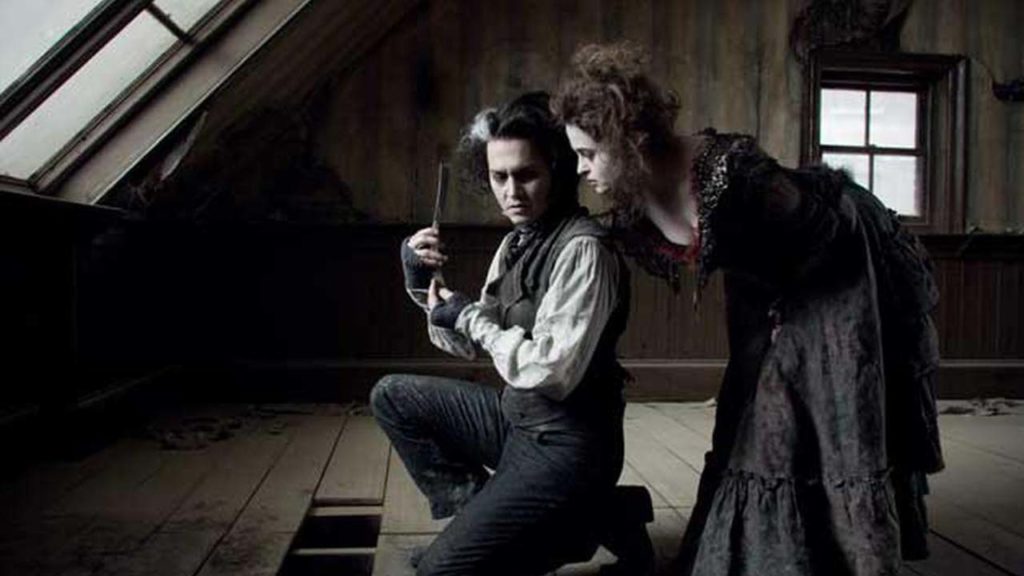
Oi t’ink he’s up to summat
The Sweeny Todd tale originated in a prose serial form in 1846, and after several permutations, eventually became a stage musical by Stephen Sondheim in 1979. Burton’s 2007 film adaptation doesn’t quite manage to break free of its stagebound, er, staging. Despite the opportunity a film has to expand a play’s world, the action is limited to just a few locations. The rich art direction doesn’t defeat the impression that the whole thing was shot on a small soundstage. Speaking of art direction, Burton’s vision of late 19th century London is very colorful, provided that that color is blue. That said, it isn’t long before a few generous gallons of red are splashed about the place.
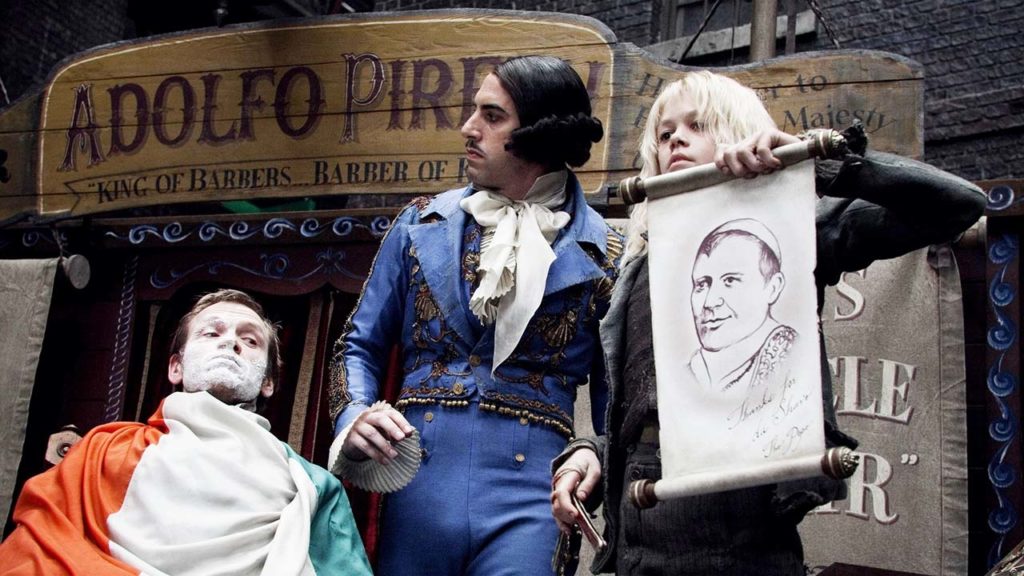
And now, the chewing of scenery, for your delight & edification
Timothy Spall, once of Mike Leigh’s British kitchen sink dramas, continues to indulge in the new scenery-chewing persona he developed as Peter Pettigrew in the Harry Potter films. Helena Bonham Carter looks like she just stepped out of The Nightmare Before Christmas, and Sascha Baron Cohen sports no less than two outrageous accents.
Sweeney Todd: The Demon Barber of Fleet Street has joined Waitress in the most unlikely mini genre of 2007: movies about pie shops. But while Waitress was a largely cutesy concoction, Sweeney Todd adds to the recipe a preoccupation with vengeful cannibalism a la The Cook The Thief His Wife & Her Lover.
And finally, a technical note: the DVD edition suffers from an unusually uneven audio mix. The music is far, far louder than dialogue sequences, so be prepared to drive your remote control volume switch throughout.
As a public service, this blog would like to issue a warning to anyone that under the impression that Se, jie (Lust, Caution) is an NC-17 erotic thriller. Judging from the marketing campaign alone, one might understandably imagine that the latest film from the director of Sense & Sensibility and Eat Drink Man Woman would be a sexy drama suitable for viewing with a significant other, but be warned that most of it is quite far from titillating. In fact, the first of three sex scenes can only be classified as a rape (albeit one complicated by the characters’ complex relationship).
Se, jie is set in 1942 Japanese-occupied Shanghai, with flashbacks to the few years preceding. A naive but sincerely dedicated bunch of Chinese student activists form a terrorist cell, with the aim to assassinate collaborator Mr. Yee (Tony Leung). Theater student Wong Chia Chi (Wei Tang) discovers she is a natural actress and gifted improviser, which unfortunately also makes her a superbly qualified as a undercover spy.
To fully inhabit her cover story as a married woman, she must first lose her virginity. This happens almost simultaneously with her cell losing their metaphorical virginity as they messily execute their first righteous assassination. As Paul Newman discovers in Alfred Hitchcock’s Torn Curtain, murder is hard work, and takes time.
Se, jie was released in the same year as Paul Verhoeven’s Black Book and concerns many of the same themes: wartime occupation, violent resistance, and the use of sex as undercover ingratiation. But while Verhoeven couldn’t resist front-loading his film with plenty of cheesecake, Ang Lee and James Schamus take the high road and don’t pretend that the morally empty Mr. Yee isn’t violently twisted, and that Wong Chia Chi doesn’t absolutely suffer for her cause.
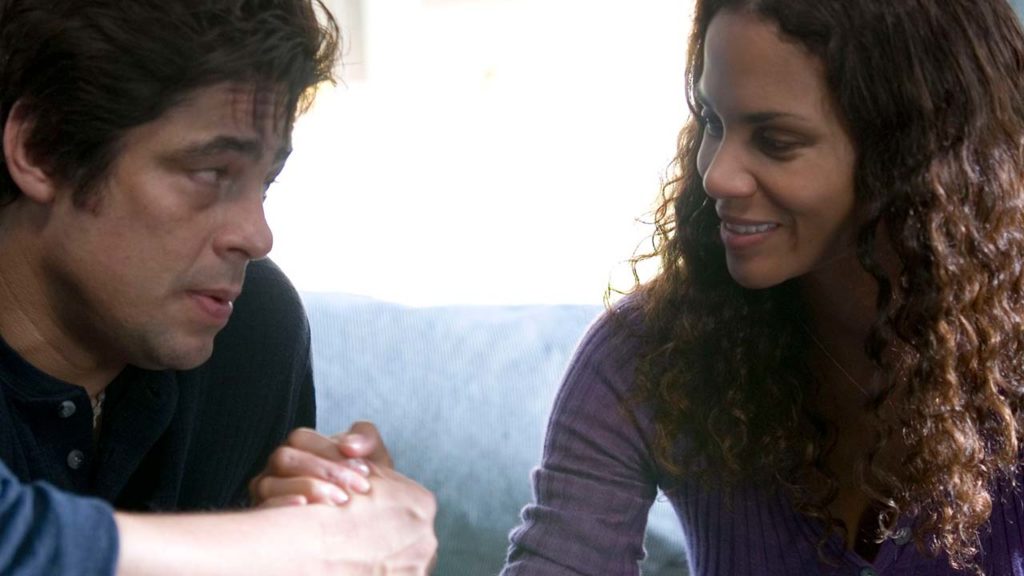
Susanne Bier’s Things We Lost in the Fire is a melodrama in the vein of Alejandro González Iñárritu’s 21 Grams in almost every way: the story of a nuclear family shattered by a random death, told as a nonlinear narrative, with conspicuously arty cinematography, and costarring Benicio Del Toro.
Even a single-sentence description of the basic plot conveys how overwrought things get: Audrey (Halle Berry) impulsively takes in her dead husband Brian’s (David Duchovny) heroin-addicted friend Jerry (Del Toro). Audrey’s motivations are semi-consciously selfish; she perhaps thinks that she can retain some connection with her dead husband by indefinitely extending his fruitless effort to help his childhood friend to kick his drug habit.
But unaware of the adage that one must beware what one asks for, she becomes resentful when her plan unexpectedly succeeds. Jerry does in fact begin to kick drugs, a neighbor takes an implausibly quick shine to him and offers him a job, he teaches one of her kids to swim (a task at which her husband had previously failed), and he responds to her flirtatious advances.
Inexplicably, the movie ends with the wrong Velvet Underground song; someone chose “Sweet Jane” over “Heroin.” Nor is there anything from the Low album of the same name. If the filmmakers thought these selections were too obvious, then how do you explain everything else in the movie?
This blogger is not ashamed to admit being in love with Shakespeare in Love, and not just for the generous displays of Gwyneth Paltrow’s lovely young bubbies.
Full of American actors affecting English accents with varying degrees of outrageousness, it only partly qualifies as Europudding, and is in fact more in the vein of “let’s put on a show!” theater farces like Noises Off and Waiting for Guffman. Director John Madden’s Shakespeare in Love succeeds beautifully, but the formula is not ironclad; Becoming Jane obviously attempted the same stunt by warping the biographical details of Jane Austin’s life onto her novels, but rather failed to capture her dry wit and particular brand of practical passion.
Oi, get yer bubbies out!
Co-screenwriter Tom Stoppard, already an expert at playing fast and loose with Shakespeare in his play Rosencrantz and Guildenstern Are Dead, lays more than a few easter eggs for English majors and other enthusiasts of Elizabethan drama. Bloody playwright John Webster cameos as a disturbed young lad. Many favorite Shakespeare cliches appear not just in the play-within-the-movie, but also in the body of the movie itself: ghosts, cross-cross-dressing, and a “bit with a dog.” But perhaps the movie’s biggest achievement is to humanize perhaps the most revered writer in the English language, and yet still illuminate the unmatched passion and achievement of his work. A Shakespeare beset with writer’s block struggles to find a hook for the unwritten Romeo and Ethel, the Pirate’s Daughter reminds us that he was probably no unearthly creature taking dictation from beyond, and that creating such art was, simply, hard work.
Judi Dench in full Queen Bitch mode
Shakespeare in Love thankfully doesn’t let historical accuracy get in the way of a good gag. Will makes weekly visits to an apothecary practicing psychotherapy a few hundred years early. The contemporary theater world is shown more than once as a precursor to today’s movie biz. In order to bankroll the production of a new play, financier/kneecapper Hugh Fennyman (Tom Wilkinson) suggests Globe Theater owner Philip Henslowe (Geoffrey Rush) pay actors with a portion of the profits, when of course there never are any. Brilliant! One wonders if Miramax honchos Harvey & Bob Weinstein perceived the irony.
But the movie is sometimes more accurate than one might think for something that is admittedly a slightly fluffy farce. For example, it is in fact plausible for Shakespeare to fear he may have been indirectly responsible for rival playwright Christopher Marlowe’s death. Marlowe died in 1593, which according to the all-knowing Wikipedia, was about the time Romeo and Juliet was written.