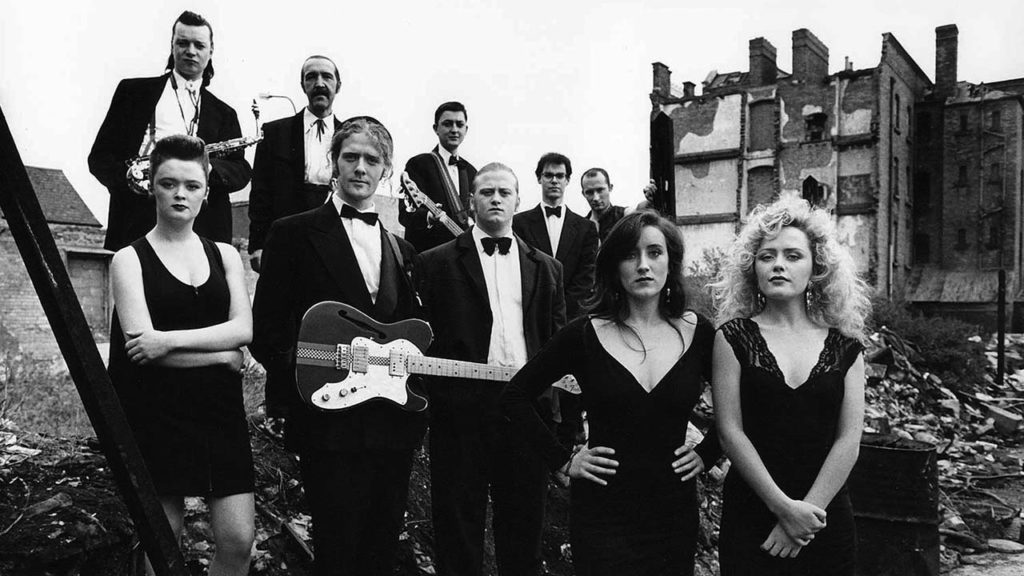
The Commitments remains a favorite, even some 17 years after first seeing it in the theater. I’ve owned the soundtrack since then, but for whatever reason, had not revisited one of my favorite films. But having recently seen and loved Once, costarring Commitments alum Glen Hansard, I was inspired to check it out one more time and see if I still loved it after all these years.
If The Commitments (the band) are the World’s Hardest Working Band, then The Commitments (the movie) may be the World’s Most Unashamedly Crowd-Pleasing Movie. There’s not a single scene that doesn’t charm, amuse, or get me rocking to the sweet sounds of soul music.
“Is this the band then? Betcha U2 are shittin’ themselves.”
Where are they now? Original members Dick Massey and Kenneth McCluskey still tour as The Commitments. Director Alan Parker (look for VHS copies of one his film Birdy in one scene) built on his success with musicals Fame, Pink Floyd’s The Wall, and The Commitments by directing the mammoth production Evita. Andrew Strong (Deco Cuffe), a wee 16 at the time, still has his golden voice and is now a solo artist. Maria Doyle Kennedy (Natalie) is now a star of the television series The Tudors. And Glen Hansard just won some kind of award or another…
Two bits of fun trivia gleaned from the IMDB entry: the actual kid from U2’s Boy and War album covers cameos in the film, and the script racks up a spectacular 145 F-bombs.
Had I seen The Assassination of Jesse James by the Coward Robert Ford earlier, I might have included it among my Most Disappointing Films of 2007. Certainly not because it’s “bad,” for could I make a better movie myself? Could I make a movie at all? And who appointed me a critic, anyway? But this blog is about my personal reactions to movies, so here goes.
Assassination was praised to the high heavens by publications including Sight & Sound, so I had expected it to be one of the year’s gems. And indeed, the acting is excellent and Roger Deakins’ cinematography is breathtaking. But I would describe the movie as “novelistic,” not necessarily a good thing with cinema, as opposed to, you know, novels.
Assassination no doubt inherited its notably slow pace (not in and of itself a problem for me) from its source material, the novel by Ron Hansen. I haven’t read it, but I suspect my own chief complaint likewise derives from the book: the omniscient narration. I’m not one that thinks voiceover narration is a screenwriter’s crutch to be avoided at all costs, but there are two extremes in which it can be misused: to redundantly explicate the action seen on screen or to impart information better shown that told. The Assassination of Jesse James does both.
Through amber fields of grain
I wish I had made a note of an example or two, but there are numerous instances of narration that could simply have been cut for not adding anything to what we’re watching onscreen at the moment. But on the opposite end of the spectrum, one of the most significant events of the story, Ford’s ultimate disillusionment with James and decision to betray him to the law, happens offscreen and is offhandedly recounted by the narrator. Ford approaching the authorities to become a criminal informant would have made for a dramatic scene.
Although the comparison is not quite fair, I am I huge fan of the HBO series Deadwood and couldn’t help but contrast the two in my head. Please set aside for a moment the only roughly related settings (Deadwood is set in 1870s South Dakota, and Assassination in 1882 Missouri) and bear with me for a moment.
The James Gang in happier days
Most obviously, actor Garret Dillahunt appears in both. Dillahunt may have been typecast as a 19th Century sort, but his characters could not be more different. The Francis Wolcott of Deadwood is an educated, urbane, and yet dangerously perverted proto Master of the Universe, a far cry from the suicidally ignorant Ed Miller in Assassination. But where the two diverge, and Deadwood certainly prevails, is the dialogue. David Milch’s scripting is the kind of astonishingly profane poetry that might result when characters with Victorian educations find themselves living in the ass-end of the world. I found myself spoiled by my memories of the prematurely-cancelled Deadwood, and wished Assassination had a little more of its poetry.
But enough griping – time for the praise! Roger Deakins‘ cinematography is delicious, full of warm oranges and deep unbroken fields of black. A notable visual effect used to open new chapters in the story is a narrow field of focus with a blurry halo, suggesting old daguerrotypes (similar to what I’ve seen recently in The Illusionist). Guest critic Snarkbait christened the effect “Ye Old Timey Filter No. 4,” but according to an interview with Deakins in American Cinematographer (no longer online: theasc.com/ac_magazine/October2007/QAWithDeakins/page1.html), the filter is his own invention and appropriately called the Deakinizer.
One of Roger Deakins’ many striking silhouette images throughout The Assassination of Jesse James by the Coward Robert Ford.
There is fine acting all around, and two fun cameos from James Carville and Nick Cave (who cowrote the film’s music). Casey Affleck rounds out an excellent year in his career after Gone Baby Gone with a great performance as Robert Ford, obviously not billed above Brad Pitt but arguably the main character. Sam Rockwell (as Charley Ford) is especially great near the end of the film, as his simple-minded character tragically breaks down. Pitt makes a charming and earthy, yet plainly sociopathic Jesse James. James’ curse is that he’s always the smartest man in the room, but one need only witness the particularly unhinged laugh Pitt gives him to see how lunatic and criminal the man actually is.
I lied, one more complaint: Mary-Louise Parker & Zooey Deschanel, both fine, name actors, appear in miniature roles with minimal dialogue. Perhaps their characters were similarly minor in the original novel, but they seem underserved in the film. Perhaps the female presence in the actual lives of these historical figures was not significant, but to return to Deadwood for a moment, Deadwood repeatedly proved it is not historical revisionism to include women in a modern-day portrait of a bygone era.
This blogger may have to burn his Rock Snob card, for I just watched and enjoyed the Blue Man Group concert film The Complex Rock Tour Live. I’d long assumed that the Blue Man Group’s seemingly permanent residency on Lafayette Street in downtown Manhattan was some kind of tourist trap like Mars 2112 or Jekyll and Hyde, but now I’m wishing I had looked closer.
For any others that may also have prematurely dismissed them, the Blue Man Group is equal parts performance art collective, percussion ensemble, and, well, blue. The Complex Rock Tour DVD captures the group live in 2002, with a show that is at once both an actual rock concert and an ironic commentary upon one.
I had to fight the suspicion throughout that a blue-clad trio of catburglars had slipped into my apartment and raided my cd collection. As I watched, I started to compile in my head a list of artists that must have been influences:
Emergency Broadcast Network. EBN was a trailblazing multimedia performance group that fused Marshall McLuhan-esque media theory with techno, all in the style of a television news broadcast from hell. Their caustic and aggressive social commentary is a far cry from The Blue Man Group’s squeaky clean naïveté, but it’s hard not to watch footage of their live performances without seeing an ancestor of the Complex Rock Tour‘s ironic infographics.
Laurie Anderson’s Home of the Brave concert film (1986). All the ingredients are here, albeit in artier form: film, performance art, mime, masks, dance, etc.
Peter Gabriel and Robert LePage’s Secret World Live and Growing Up Live tours were as much theater as rock concerts, utilizing simple yet hugely symbolic shapes and props: a tree, an egg, the moon, etc.
Talking Heads’ Stop Making Sense concert film (1983), for all the same reasons as Laurie Anderson and Peter Gabriel above.
King Crimson. Some of the Blue Man music bears more than a passing resemblance to the polyrhythmic tuned percussion King Crimson employed in the early 1980s with tracks like “Waiting Man” and “Neil and Jack and Me.” Not only that, one of the members of the Blue Man band can be spotted played the Chapman Stick, popularized by Tony Levin.
Rock Snobs might be surprised to hear traces of even more modern music in the Blue Man Group repertoire. I caught snippets of the instrumental so-called “post-rock” of UNKLE, Battles, and Explosions in the Sky.
And finally, the one influence the Blue Men actually namecheck with a (brief) cover version in their show is Devo, but I don’t own any of their music! Maybe I should take this as a recommendation.
As humorous and toe-tapping as The Complex Rock Show is, the Manhattan-based Blue Man Group end the proceedings with “Exhibit 13”, a haunting piece incorporating footage of actual World Trade Center debris that showered over Brooklyn only a few months prior. The piece is available online.
Michael Clayton is a that rare thing: an intelligent, fictional thriller for grownups. Like any self-respecting Thriller for Grownups, it’s relentlessly grim in tone, the chronology is fractured, and a high level of detail demands your attention. It doesn’t approach impenetrability like Syriana, but it unfortunately doesn’t engage the brain as much as a good puzzler could. Everything is spelled out for the viewer in the end, except for a few niggling logistical questions. (Such as, why would two expert assassins opt for something so messily conspicuous as a car bomb?)
Michael Clayton has all the whiff of being based on a true story, but is in fact a wholly original work from writer/director Tony Gilroy – his first film as director after a successful run of screenplays including the Jason Bourne trilogy. George Clooney carries the film with the complex, compromised title character, and Oscar winner Tilda Swinton sweats convincingly as a dying-inside corporate executioner. But in my mind the real star is Tom Wilkinson.
Now this is a musical (of sorts) I can get behind. The unnamed “Guy” (Glen Hansard, already a rock star in The Frames and a movie star from The Commitments) is a street busker, playing popular songs for pennies during the day, and saving his own passionate compositions for the empty streets at night. “Girl” (Markéta Irglová) is an immigrant from the Czech Republic, looking at an unhappy future as a single mother, in servile jobs, with no outlet for her own musical talent. Each has become stuck, but their meeting jostles each other into motion.
What a fucking great movie. That’s it; that’s my entire review. See it, and get the soundtrack.
I don’t know if the roughly 140 minute version of Southland Tales that made it to DVD is a butchered or merely abbreviated version of a masterpiece, but what I just saw is an unholy mess. I’m one of director Richard Kelly’s apologists for his divisive film Donnie Darko, which I found strangely affecting. Like Southland Tales, it was heavily edited down before release, and the abbreviated theatrical version doesn’t even make logical sense. Its emotional appeal is hard to pin down, and yet I found it hugely involving and moving. I was rooting for Kelly on his big follow-up, and even though it made the best-of-the-year lists of both The New York Times and The Village Voice, I guess I’m on the losing team now.
The opening moments recall Cloverfield and the TV series Jericho with ersatz home video footage of a nuclear attack on Texas. A long barrage of infographics, television fragments, and narration follows, outlining a tremendously involved backstory. Kelly has obviously created a huge fictional universe, the bulk of which proves superfluous to the comparatively simple story that concerns the bulk of the film that follows. Perhaps Southland Tales is the first entry in this Kellyverse, and indeed, it is comprised of four chapters (starting, no doubt modeled after Star Wars, with “Chapter 4”). But after this failure it’s hard to imagine Kelly securing the funding to complete additional chapters (at least as films; television or comics seem both more appropriate and more frugal).
Be thankful I couldn’t find a still of them making out
The ensemble cast is extraordinarily weird, featuring The Rock, Sarah Michelle Gellar, Seann William Scott, plus a complement of little people. No less than five past and present Saturday Night Live cast members also appear: Cheri Oteri, Amy Poehler, John Lovitz, Nora Dunn, and Janeane Garofalo (credited but I think I only spotted her in one shot near the end). Rounding it out are Miranda Richardson, John Laroquette, Wood Harris (Avon Barksdale in The Wire), and Kelly-booster Kevin Smith. And is that the weird little French woman from The City of Lost Children? You haven’t seen a movie until you’ve seen one with Wallace Shawn and Bai Ling making out. But in a way I suppose that makes sense; they are both aliens from another planet. Different planets, maybe, but still.
Justin Timberlake shills for Budweiser (not shown)
The music is likewise eccentric: Jane’s Addiction’s punk/prog masterpiece “Three Days” figures in the dialogue as an enigmatic prophesy and as the introduction to the official movie website, and Moby does his best Vangelis impression for his original score. Justin Timberlake (filmed in separation to most of the action) serves as narrator but also stars in a bizarre musical interlude and/or Budweiser commercial and/or Iraq war commentary: “I got sold out but I’m not a soldier.” And, why not toss in pop star Mandy Moore?
The Netflix queue is, by its nature, the opposite of the instant gratification of a rental store. You add movies you think you might want to see some day, then sit back and wait for them to arrive in an order decided by computer, according to factors and algorithms outside of your control. Enough time had passed since I added Year of the Dog that I could no longer recall why. Possibly I read a good review somewhere, or maybe I was curious about the sudden reappearance of Molly Shannon (part of “my” Saturday Night Live of the mid-90s — am I right that people feel the most affection for the SNL cast of their college years?). But I feel baited and switched; this is not a drama or romantic comedy but rather a movie with an agenda.
Writer/director Mike White’s Year of the Dog is a feature-length dramatization of Janeane Garofalo’s gag “You can love your pets, but you can’t love your pets.” Not unlike Lily in Eagle Vs. Shark, Peggy (Shannon) is a gentle sweetheart, but alienated and lonely. Her relationship with brother Pier (Thomas McCarthy from The Wire Season 5) and sister-in-law Bret (Laura Dern) is distant at best, and her closest friends are oblivious workmates.
This commute’s a bitch
When she loses the unconditional love of her dog Pencil, she becomes hungry for, as she puts it, a single word to define her. On a date with Al (John C. Reilly), Peggy demonstrates a dislike of hunting, the seed from which her new fervor for an animal activist lifestyle grows. Her one word, she decides, is to be “vegan.”
Her new life teases her at first with the possibility of love with Newt (Peter Sarsgaard), but he is too much like her, or what she might become: unable to love humans nearly as much as animals. From here, the tone shifts to the disturbing, as Peggy causes her life to fall apart. Her clumsy activism costs her her job and family, and she soon descends to theft and attempted murder.
You can love your pets, but you can’t LOVE your pets
And yet, the movie appears to present her ultimate state as a happy ending of sorts. She chooses to be friendless and unloved, but has found meaning and purpose. The most important part of the movie is missing: what happens between Peggy hitting rock bottom (where she becomes unable to function in society) and her total ascendance as a self-assured being? I don’t buy the sudden switcheroo that it’s all OK because she has discovered herself.
Would real-life animal activists find Peggy and Newt amusingly exaggerated versions of themselves, or insulting stereotypes? Even as I am the owner of two rescued casts, it strikes me that choosing the love of animals over that of people is a kind of mental illness that begs for correction, not celebration.
So far, it seems this movie blog is definitive proof of the truism that criticism is cheaper than praise; it’s easier to pick apart what’s wrong with a bad or mediocre movie than it is to praise what’s good. So sitting down to write something about a really great film like Away From Her, I find myself at a loss for what to say.
Already a seasoned actor at 29, Sarah Polley proves herself a mature and sensitive writer/director on her very first outing. Although concerned with Alzheimer’s, Away From Her is thankfully not a movie “about” a disease. I felt the biopic Iris, although finely acted by no less than Kate Winslet, Judi Dench, and Jim Broadbent, fell into the trap of educating the audience about a disease more than looking at the experiences of the real-life figures whose lives were surely defined by more than Iris Murdoch’s disease.
Julie Christie and Gordon Pinsent in Away From Her.
Fiona (Julie Christie) and long-time husband Grant (Gordon Pinsent) are already aware of her relatively early-onset Alzheimer’s as the movie begins, but react to its sudden progression with different degrees of preparedness. Worse, as her short term memory leaves her, memories of old traumas resurface just as it is time for her to enter an assisted living community, making an impossible situation no easier for either of them. The next time Grant sees her, she appears to have forgotten him altogether… or has she? The possibility that Grant may be reading his fears into Fiona’s behavior and lapses is one of the most powerful questions of the film.
Sarah Polley, writer/director of Away From Her.
Polley reportedly talked Julie Christie out of semi-retirement, and she deserves an Oscar for her Canadian accent alone. Christie’s long resume and Oscar nomination put her in the entertainment media’s spotlight this winter, but Gordon Pinsent is excellent as Grant, arguably the lead role. Away From Her may be a powerfully sad movie, but not one that anyone should be afraid of being bummed out by.
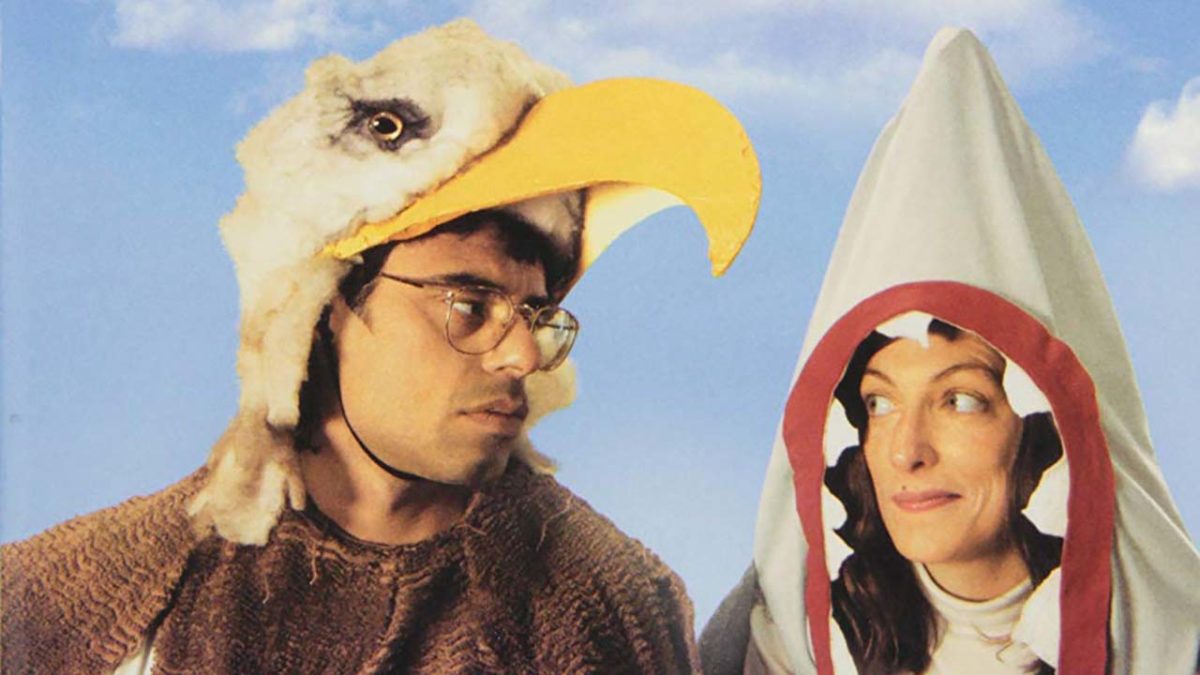
I’m not sure I took Taika Waititi’s Eagle vs. Shark as it may have been intended. A sort of New Zealand answer to Napoleon Dynamite, Eagle vs. Shark is the story of two misfit losers finding each other when no one else will have them. But I found one character as sympathetic as the other deplorable, while I suspect writer/director Waititi intended them to be seen as a good match, and deserving of a happy ending together.
Lily (pretty actress Loren Horsley, dressed down in frumpy clothes) may not be looking forward to any New Zealand beauty pageants, but she’s not un-cute. But being possibly the sweetest and nicest girl on the planet does not work to her advantage; awkward and over-earnest, she’s unable to say no to anybody, even when getting fired or dumped. Her only friend is her sweetheart brother, a cartoonist and world’s worst impressionist. Her favorite answer to each of life’s many disappointments is “it doesn’t matter.”
Fish or fowl?
We first meet Lily at her dead-end mall job at Meaty Bun, the sort of joint where layoffs are managed by literally pulling names from a hat (and even that is rigged). She has fallen in love with Jarrod (Jemaine Clement), a douchebag with a mullet who works at the nearby video game store. Jarrod is a true nerd: creepy and violently deranged. We learn later he is motivated by the impossible ideal of his over-achieving martyred brother (although there are family secrets to be uncovered there), and possesses an illegitimate daughter.
Jarrod and Lily have matching moles (not to be confused with the progressive rock band of the same name), and Lily is able to impress him with her natural talent at a gruesome video game. But beyond that, there is little connection beyond their shared isolation.
Pitching a tent
So I found myself rooting for something at odds with what the film presents as a happy ending: for Lily to break free of the poisonous dick Jarrod. Lily does manage at one point to say no to someone for the first time; she turns down a date with an even bigger loser than Jarrod. But despite this small sign of personal growth, her unrequited love for him is so absolute that even after he tries and fails to beat up a paraplegic, she goes on a suicide watch to protect him from his brother’s fate.
To be more positive, and to explain my three-star rating despite all the negativity above: I found Lily and her brother very endearing and the film often extremely funny. Awesome stop motion animation sequences throughout illustrate the love story through two anthropomorphized damaged apples.
The Bank Job is notable for being an at least partly “true” expose into the spectacular (and successful) robbery of Lloyds Bank in London in 1971. For whatever reason, an anonymous participant of the investigation chose to cooperate in the making of this fictionalized film rather than a book or magazine article. If even partly true, this expose would have held more weight as, say, a Vanity Fair article than a fictionalized theatrical film.
The far-reaching conspiracy story fingers the royal family, parliament, MI-5 & 6, the police, and even contemporary black power figure Michael X in a massive cover-up successfully withheld from the public for over 35 years. After being portrayed less than flatteringly in the 2006 film The Queen, the royal family is now surely even less amused with The Bank Job‘s allegations against Princess Margaret.
With its clever nonlinear structure, gruff alpha-male anti-hero (Jason Statham), and untrustworthy femme fatale (Saffron Burrows), The Bank Job seems at first a solid entry into the heist genre in the tradition of Rififi, Thief, and The Italian Job. But the tone shifts as the stakes rise, to a more serious and violent don’t-trust-anyone thriller a la the Bourne trilogy.