• Kill Screen: Seth Gordon’s The King of Kong: A Fistful of Quarters

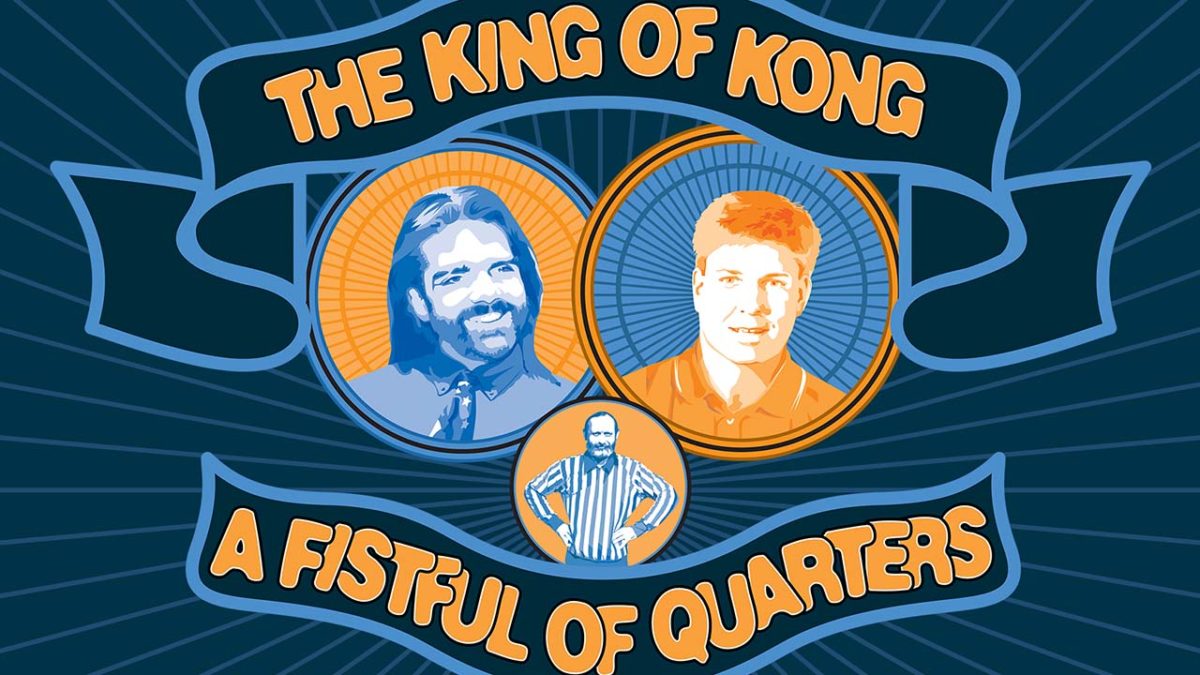
    Kill Screen: Seth Gordon’s The King of Kong: A Fistful of Quarters

    First, full disclosure: I work for the movie company that distributed The King of Kong: A Fistful of Quarters. My miniscule role in marketing the film was limited to designing the official movie website, and I am under no obligation or prohibition to write this review (which happens to be positive, anyway). Any opinions expressed here are mine alone. I mostly avoid writing about movies released by my employer. I’m making a rare exception in this case because The King of Kong has been out of theaters for some time, and my personal opinion on this blog is certainly not going to have any impact on its revenue. Having just seen it again, I have a few thoughts I would like to record here.

    I would hate to be an English teacher, at any level, for one reason: the countless “it’s a metaphor for life” papers I would have to grade. Probably one of the biggest cliches of kids’ essays is to pull out that refrain, e.g. “the light at the end of the dock in The Great Gatsby in a metaphor for life.” After grading a few dozen of those I just might want to start throwing things and switch to another career, like, say for example, web design.

    Billy Mitchell in The King of Kong
    Billy Mitchell with the ladies of Namco

    That said, I’m about to commit that very grievous essay sin: if anything is a metaphor for life, it’s Donkey Kong. Let’s look at the evidence:

    • Donkey Kong is an intensely difficult game.
    • The game’s god/creator, Shigeru Miyamoto, did not supply it with a predefined ending.
    • The number of levels is undeclared at the outset.
    • Anyone with a quarter can play.
    • Most players die very quickly.
    • A very select few thrive and have their names entered into history.
    • How you play, not just how long you live, determines your score. In other words, you can reach the exact same point in the same level as somebody else but have a higher score.
    • Even the best of the best players cannot “win” the game; everyone will eventually drop dead without warning and through no gameplay fault of their own. This point has become known as the game’s “kill screen.”

    That list of bullet points just about covers it; Donkey Kong is so clearly a metaphor for the human experience that the film thankfully doesn’t even bother to explicitly state its themes. Kids, let that be a lesson for all your future school essays.

    Steve Wiebe in The King of Kong
    The King of Kong (2007) Documentary Directed by Seth Gordon Shown: Steve Wiebe

    The King of Kong is a very rousing film that works best to an audience; if possible, watch it with friends. From what I can gather, viewers respond to two basic things: the frankly weird subculture of professional video gaming, and the more universal story of the underdog vs. an entrenched power network. A suspicion is gaining traction that the story is too perfect, the hero Steve Wieve too all-american, and the villain Billy Mitchell too evil. The movie’s official message board (no longer online) features heated discussions including actual figures featured in the film, and documentarian Jason Scott has gone so far as to publish a passionate teardown of filmmakers’ ethics.

    Personally, I wish the film had been more clear on a few points:

    • As you can read on the above links, Billy Mitchell’s well-timed taped submission may have seemed fishy but turned out to be genuine.
    • Most viewers (including myself) all ask the same question: how long does it take to play one of these “perfect” games? The movie finally discloses the answer incidentally near the end, as if the filmmakers weren’t deliberately withholding the information, but rather didn’t realize it was something viewers needed to know.

    All in all, the subculture featured in the film is a truly unique bunch of people, and a great find by the filmmakers. Some of them may deserve a little mockery, but my favorite moment in the film goes to a Robert Mruczek, who describes how professional sports records are broken once in a lifetime, but he sees gaming records broken every day. And how exciting is that?

  • Kevin Smith’s Chasing Amy is his best film

    Kevin Smith’s Chasing Amy is his best film

    Chasing Amy is far and away Kevin Smith’s best film, and not coincidentally his most heartfelt. It’s not nothing to tell a universal guy’s story while still featuring significant and sympathetic female characters.

    Yes, Chasing Amy is spectacularly profane and the characters are prone to giving extended on-the-nose speeches perfectly explicating their inner motivations, but the central theme is worthy and true: love can be a mixture of elevating another to a height to which you can’t measure up, while paradoxically needing to have them do the same to you. More literally, Holden (Ben Affleck) feels both fascinated and threatened by what he perceives as Alyssa’s (Joey Lauren Adams) more adventurous and worldly sexuality, but also needs to believe that he has power over her and has somehow tamed her.

    Chasing Amy
    Not one to pass up an opportunity to cite Jaws

    Out of Smith’s oeuvre, the closest to Chasing Amy is Jersey Girl. But his personal meditations on fatherhood required more of his trademark raunch to offset the treacle than the PG-13 allowed. It did, however, feature the single cruelest joke I’ve ever heard: Andrew Lloyd Webber is “the second-worst thing that’s ever happened to New York City.” Zing! Nobody, not even Lloyd Webber, deserves that.

    A far better writer than I has already been here and done that: please refer to Matthew Dessem’s review on The Criterion Contraption. I disagree with his obvious dislike of the film, but every point he makes against it is fair.

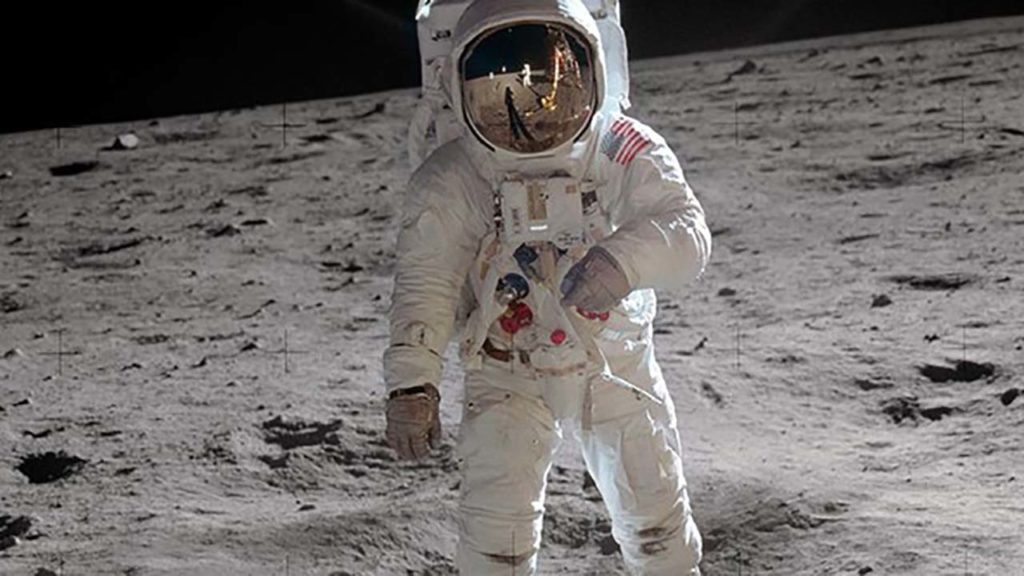
  • The atmospheres and soundtracks of Al Reiner’s Apollo Missions documentary For All Mankind

    The atmospheres and soundtracks of Al Reiner’s Apollo Missions documentary For All Mankind

    It was a weird experience to finally see the original film for the soundtrack to which I’ve listened to countless times. Brian Eno and Daniel Lanois’ Apollo: Atmospheres & Soundtracks is a gorgeous piece of work, and very much colored my expectations of what the film would be. Having long pictured a largely abstract compilation of otherworldly lunar footage, I was surprised to find For All Mankind a more straightforward documentary than what was already in my head. (Bits and pieces from the compilation album Music for Films III also appear.)

    Unlike In the Shadow of the Moon, the 2007 feature documentary on the same subject, For All Mankind exclusively uses original footage taken during the Apollo Missions, much of it by the astronauts themselves. The absence of new narration or footage rightly places the emphasis solely on the achievements of the original participants. But a drawback is that the interviewees on the soundtrack are not identified (the Criterion DVD edition includes an option to display subtitles identifying the speakers).

    I have little to add to Matthew Dessem’s excellent review on The Criterion Contraption, or to my own thoughts on In the Shadow of the Moon. Three small observations:

    • I was completely ignorant that NASA first began spacewalks during the Apollo missions. I was under the impression they began during the later space shuttle missions. In retrospect, it makes perfect sense that NASA would test spacewalks in orbit over the Earth before attempting to step out of a capsule onto the moon, but: Wow!
    • The astronauts were very conscious of Stanley Kubrick’s 2001: A Space Odyssey. Each astronaut could bring one cassette tape to play on a portable deck, and one chose Strauss’ “Also Sprach Zarathustra”. Another describes seeing the moon surface up close as being like something from 2001.
    • Due to the film’s nature of being comprised of original footage, there’s perhaps too much of the astronauts goofing off in zero-G, and not enough of the spectacular lunar footage. But it goes to show that even the pilots selected for being the most sane and calm people in the word still turn to excited kids when playing in outer space (with the rare exception to prove the rule).
  • Dreams and memory in Satoshi Kon’s Paprika

    Dreams and memory in Satoshi Kon’s Paprika

    There’s a huge interest in Japanese manga and anime in the US, but it’s rare for an anime feature film to get a theatrical release. From the name and poster alone (indeed, what caught my own interest), one might not even guess Paprika is foreign-language, let alone anime. Anime is a medium, not a genre, but it does have a certain popular perception in the US: either the apocalyptic sci-fi of Akira or the fairy tale fantasia of Spirited Away. And that’s not even taking into account the expectations of a generation of kids that grew up watching the dubbed Robotech and Star Blazers serials (which would be exemplified by… me).

    The popular perception is not wrong; I’m not an anime expert, but Paprika has several of the superficial trappings: cybernetic technology (like Ghost in the Shell), a ghostlike female creature (like director Satoshi Kon’s earlier Millennium Actress), and an exponentially growing world-eating beast (like Akira and America’s own The Blob). But what sets Paprika apart is its psychedelic imagery, adult themes, and sheer weirdness.

    Parika
    Valley of the Dolls

    Like Blade Runner, it’s equal parts detective story and science fiction, with a splash of horror. The mystery genre provides a structure for the nominal plot: Paprika is the dream alter ego of Dr. Atsuko Chiba, a dream researcher building a machine for use in psychoanalytic dream analysis. The device they’re building is called the “DC Mini”, a name which, every single time, made me think of DC Comics’ miniseries. Chiba’s Blade Runner-esque mission is to track down three missing DC Mini devices, and their co-creator.

    Paprika
    I hate it when that happens

    Paprika even shares a theme with Blade Runner: the moral repercussions of new technologies. If dreams are a kind of “place”, and can be a shared reality (like the world of The Dreaming in Neil Gamain’s Sandman comic book series), what is the difference between it and real life? The potential of one world bleeding into another is very literally dangerous. One of the film’s villains uses the dream reality to commit a very disturbing form of rape, and another goes so far as to label the technology a potential form of terrorism: “Implanting dreams into other people’s heads is terrorism.” This is not hyperbole in the film’s universe: the city is almost destroyed by dreams.

    Two final little things:

    • What’s the deal with the name? Is it a translation issue, or something about Japanese culture (or cuisine) I’m not aware of? A metaphor of spices and recipes is used at one point, but it still seems oddly random.
    • A key character is movie-obsessed cop, an amateur filmmaker in his youth. His noirish dreams only further expand the Blade Runner parallels. Paprika explicitly equates movie watching with dreams and memory.
  • Noah Baumbach’s Margot at the Wedding

    Noah Baumbach’s Margot at the Wedding

    I very much loved writer/director Noah Baumbach‘s previous film The Squid and The Whale, blessed with an excellent script and superb performances all around (especially by the versatile Jeff Daniels – heartbreaking in Pleasantville, and capable of humanizing no less an icon than George Washington in The Crossing).

    Margot at the Wedding features another dysfunctional family, but so spectacularly so that the characters didn’t seem recognizably human to me. I don’t think the problem is as simple as merely identifying with the particulars of their lives (abusive father, celebrity lifestyle, etc.), for I also had little in common with the family in The Squid and The Whale.

    It’s like De Palma’s Sisters meets Allen’s Interiors

    Margot (Nicole Kidman) brings her son to her family home for her sister’s Pauline (Jennifer Jason Leigh) wedding to layabout Malcolm (Jack Black). Pauline is the sole family member insecure Margot can physically face, which she can only manage through passive aggressive games asserting her superiority. We barely glimpse a third sister and their mother, from whom Margot literally flees. They feud with the strangely savage neighbors, providing yet another set of characters for Margot to look down upon.

    Jennifer Jason Leigh and Jack Black in Margot at the Wedding
    Unlikely Jack Black Romantic Pairing (no. 845 in a series)

    Margot’s favorite pastime is armchair psychoanalysis coupled with a kind of inverse hypochondria. Obsessed with detecting symptoms of mental illness in everyone around her (the irony being that she’s often correct), she fails to diagnose herself. She’s a fiction writer whose work bears more than a passing resemblance to her family’s history. Margot’s failure of imagination amounts to a kind of theft, and is a central theme of the movie. “How much of your work is autobiographical?” is no doubt a cutting question nearly every writer (including Noah Baumbach) hears at least once a day. Margot’s lover Dick (Ciarán Hinds) even uses it as a weapon to publicly attack her. It is cruel, but in her case, accurate.

  • Téa Leoni clings to the menacing Ben Kingsley in You Kill Me

    Téa Leoni clings to the menacing Ben Kingsley in You Kill Me

    The first thing to say about You Kill Me is to give props to Ben Kingsley, if for no other reason than my fear that he will break my kneecaps if I don’t. Even after his terrifying turn in Sexy Beast, it’s still a surprise to see how perfectly natural for him to inhabit a role like Frank, an almost superhumanly talented mob assassin. For a man of a certain age who once played Ghandi, he can certainly act up some serious physical menace. But You Kill Me gives him a chance to enrich this character type instead of merely repeat it. In Sexy Beast, he was funny because he was so very extremely menacing. Here, his character is menacing and funny.

    You Kill Me is a bicoastal film, literally illustrating Frank’s different worlds by setting the action in two different cities. In Buffalo, You Kill Me shares with The Sopranos a look into the operations of modern-day gangsters. Their lives are somewhat less exciting than the fantasy lucrative lifestyle seen in The Godfather and Scarface, but still sharply divided by cultural heritage and identity. Frank may seem to be a pathetic figure, but when sober, he is the sole factor keeping his small-time Polish crime family in business.

    Yeah, I find alcoholic assassins irresistible too

    The problem is, he is sober less and less when the story opens, and his family must fix him in order to survive. So Frank is ordered from Buffalo to San Francisco to dry out, leaving behind his family (both by blood and criminal association) and yet quickly forging a new one: Dave (Bill Pullman), a shady real-estate dealer no better than a gangster himself; Tom (Luke Wilson), a gay fellow alcoholic; and implausible love interest Laurel (Téa Leoni, also an executive producer).

    Ben Kingsley in You Kill Me
    This man played Ghandi

    The problem with Laurel is not only the creepy age differential (a long-standing Hollywood pox from which it seems even indies aren’t immune), but with her underdeveloped character. What little we learn of her history (a recently deceased, unloved stepfather) seems insufficient to explain what makes her so lonely and desperate that she would attach herself to possibly the most unstable and unreliable person in the world. What happened to her to make her so blasé and amoral that she clings so fervently to Frank and cross the country to risk her life for him?

  • Julie Delpy gives an unromantic tour of her city in 2 Days in Paris

    Julie Delpy gives an unromantic tour of her city in 2 Days in Paris

    I suppose 2 Days in Paris can be seen as both inspired by and a refutation of Before Sunrise and Before Sunset, the pair of films Julie Delpy made with director Richard Linklater and co-star Ethan Hawke. Although more realistic than most romantic comedy/dramas in terms of dialog and emotion, it would be fair to say those films buy into cliches of young love and romantic adventures in two renowned “cities of lovers” abroad, Vienna and Paris. Despite that, both are huge personal favorites of mine, and I strongly recommend watching them back to back, especially if you happen to be about the same age as the actors.

    Julie Delpy and Adam Goldberg in 2 Days in Paris
    The tourists went that-a-way

    As writer and director of 2 Days in Paris, Julie Delpy portrays a most unromantic view of Paris, as perhaps only a Frenchwoman could. With only a fleeting glimpse of the Eiffel Tower, we mostly spend time in its moldy bohemian apartments, eating its fast food, and as captive audiences to its sleazily racist cab drivers.

    Not coincidentally, the film’s view of relationships is also bleak; Celine and Jesse (Hawke) experience intense passion and heartbreak over a total of 48 hours together (with a 10 year interruption) in Sunrise/Sunset, but Marion and Jack (Adam Goldberg) suffer the overfamiliarity and jealousy of a years-old relationship in 2 Days in Paris. Along with mere bickering, Marion and Jack fumble unsexily in bed, sneeze in each others faces, and accuse each other of infidelities.

    Julie Delpy in 2 Days in Paris
    Comment dit-on… action?

    The couple’s disastrous two Parisian days build to a climactic argument that is unfortunately covered over in voiceover. It’s a lovely bit of writing, but it sums things up too well. It’s implied that the couple stays together, but perhaps in 10 years Delpy will make 2 Days in New York, and we can see how Marion and Jack have got on.

  • The Apollo astronauts strut the right stuff in Ron Howard’s In the Shadow of the Moon

    The Apollo astronauts strut the right stuff in Ron Howard’s In the Shadow of the Moon

    In the Shadow of the Moon may not be the most radical or revelatory documentary ever made, but if the point was to get out of the way of some true American badasses and let them tell their story, then it should be counted as a success.

    The DVD edition is introduced by co-producer Ron Howard, whom, along with Tom Hanks, is an avowed space-nut and maker of the great Hollywood retelling of the Apollo 13 mission. He doesn’t address the big question: why a big theatrical documentary on NASA’s Apollo Program, now? Is it simply that the aforementioned true American badasses are frankly getting on a bit, and that this is one last chance for them to strut their Right Stuff?

    In the Shadow of the Moon
    I can see your house from here

    The biggest clue is that the film takes pains to place the missions in a historical and political context of the Cold War, civil rights, the Viet Nam War, and the spate of assassinations the country suffered in the late sixties. When Kennedy called in 1961 for NASA to land a man on the moon within the decade, it was a truly audacious and inspiring moment. As astronaut Gene Cernan put it, “science fiction.” The almost incalculable amounts of money and impetuous were there, surviving even the assassination of the man that inspired the astonishing endeavor.

    Time passes. Walls fall, the White House falls afoul of diminishing returns. Subtract the Cold War space race with the Soviet Union, and NASA reduces its ambition to decades of launching spy & corporate satellites and performing zero-g experiments in the Space Shuttle (although I must say detecting anti-matter sounds pretty cool), losing the Apollo 11 tapes, and apparently too busy with constant maintenance on the International Space Station to do anything else.

    In 2004, Bush makes a fool out of himself by calling for NASA to land American boots on Mars by 2020. This time an entire nation rolls its eyes and knows it’s a flimsy, sparkly distraction from the many disasters of his term of office (and this, before Katrina). Maybe I’m stretching things to find a political critique in the timing of this film, but that’s my theory. It’s a kick in the pants – in a time of crew cuts, tail fins, and assassinations, the United States landed on the freaking moon nine freaking times.

    In the Shadow of the Moon
    I want my MTV

    As a nobody web designer, I don’t mean to diminish the work of post-Apollo rocket scientists and brave astronauts; only that the momentum kick-started by Kennedy has sputtered out by almost any measure. After all, what has NASA done lately that one might call, bug-eyed, “science fiction”? I do love the Mars explorer robots Pathfinder, Spirit, and Opportunity, though! I love robots on Mars. Robots on Mars are neat-o, man. Hi, robots on Mars!

    One gripe: In the Shadow of the Moon has a cheesy score, especially disappointing in light of Brian Eno & Daniel Lanois’ gorgeous music for For All Mankind, a documentary film of lunar footage from the Apollo missions.

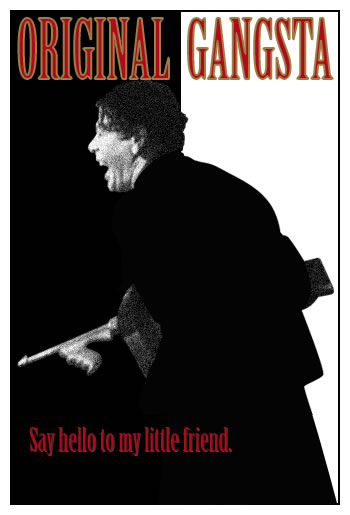
  • Paul Muni: Original Gangsta

    Paul Muni: Original Gangsta

    Paul Muni Scarface The Shame of the Nation
    The shame of the nation.
    Paul Muni Scarface Original Gangsta Say Hello to my little friend
    Say hello to my little friend.

    The Onion AV Club’s How’d it get burned? 22 film remakes dramatically different from the originals piece points out that while Al Pacino’s Scarface has become a modern gangsta icon, nobody slaps the original Paul Muni incarnation from 1930 onto t-shirts, posters, and cheezy mirrors for sale by street vendors. A quick Googling confirmed that there are no 1930/1983 Scarface mashups to be found. So I set out to rectify that with some quickie Photoshop jobs.

    It has crossed my mind that the reason no one seems to have posted this sort of thing on the intertubes yet is that it’s probably semi-illegal. If not against the movie studios owning the rights to the property, then at least to the estate of Paul Muni. But this is just for fun, and I’m not trying to sell t-shirts or anything.


    UPDATE: I took another spin through Google after finishing the above post, and found a few examples of prior art:

    “Keep it Gangsta T-Shirt” on Cafe Press: one of the only “gangsta” graphics I could find that used 1930s imagery. No longer available.

    GangsterGigars.com: exactly what it sounds like.

  • Dork Report for February 20, 2008 (Special Mutant Freak Edition)

    Dork Report for February 20, 2008 (Special Mutant Freak Edition)

    Whut- duh- huh? Wow!

    The Daily Telegraph: World’s Only Blue-Eyed Koala

    blue-eyed koala
    Gadzooks! A mutant koala kutie-pie

    Flickr: Pizzler’s Albino Moose photos

    albino moose
    How not to be seen

    Today’s Dork Report featured guest reporting by Dave.