Tag: 2008

  • A Clash of Faiths: Ridley Scott’s Body of Lies

    A Clash of Faiths: Ridley Scott’s Body of Lies

    Ridley Scott’s follow up to the gentle comedy of A Good Year and the crime drama American Gangster (partly modeled, I think, on Michael Mann’s epic Heat), returns to the politically-themed yet still action-oriented territory he first visited in Black Hawk Down. The key difference here is that, like Peter Weir’s The Kingdom and Pete Travis’ Vantage Point, Body of Lies is set in a fantasyland safely divorced from the very, very real events that inspired Black Hawk Down. All of these films have the air of gritty realism, but still indulge in the wish fulfillment of a very cinematic war on terror.

    Body of Lies can be seen as completing a kind of Middle East trilogy for Scott, after the aforementioned Black Hawk Down plus the Crusades epic Kingdom of Heaven. Screenwriter William Monahan wrote both Kingdom of Heaven and Body of Lies (adapted from the novel by David Ignatius). But of the three, the latter is clearly the least serious.

    Russell Crowe and Leonardo DiCaprio in Body of Lies
    Mesopotamia, and step on it!

    No doubt movie studio executives have calculated down to the last cent that world audiences are still too sensitive to actual terrorist attacks like London and Madrid in order to buy tickets for dramatic recreations on the big screen. Instead, most mainstream terrorism-themed movies are basically entertainments that only have the feel of serious import, and none of the substance. Body of Lies invents analogous terrorist attacks such as a sleeper cell blowing up their own London flat, and later, the bombing of a U.S. marine base in Turkey (I hope O’Neal – Demi Moore – from Scott’s G.I. Jane wasn’t stationed there). Vantage Point is a little more creative in imagining a worst-case-scenario of a presidential assassination, but has no interest in the repercussions beyond a Rashomon-like recounting of the immediate aftermath.

    So audiences get films like this, where shadowy CIA operatives sneak around Iraq and Jordan, saving the world from Islamic fundamentalism. They have seemingly limitless resources but no government oversight, and anything is possible with a little computer hacking. Meanwhile, more serious and realistic movies are ignored, like In the Valley of Elah and the truly excellent but emotionally devastating United 93. In comparison, Scott’s Black Hawk Down was unafraid to recreate actual events still raw in the American public’s memory: the catastrophic marine incursion into Somalia in 1993. And even to limit the scope to Scott’s own oeuvre, Kingdom of Heaven is a much smarter consideration of the clash of faiths in the Middle East.

    Leonardo DiCaprio and Golshifteh Farahani in Body of Lies
    Leo meets cute with an Iranian nurse (Golshifteh Farahani)

    Body of Lies is Russell Crowe’s fourth film with Scott, following Gladiator, A Good Year, and American Gangster. Here, he packs on some serious poundage to enter the same schlubby mode he debuted in Michael Mann’s The Insider, seasoned with a little of the crass bastard he played in A Good Year. Leonardo DiCaprio, on temporary loan from Martin Scorsese, sports a scrappy beard but still looks like a teenager. The pretty boy is constantly getting beaten up, cut, bruised, and losing fingers. But he meets cute with pretty Iranian nurse Aisah (Golshifteh Farahani), so that’s alright, then.

  • Every Day is Exactly the Same for James McAvoy in Wanted

    Every Day is Exactly the Same for James McAvoy in Wanted

    The Nine Inch Nails song “Every Day is Exactly the Same” is so thematically perfect for the early part of Timur Bekmambetov’s Wanted, that it seems to have been composed especially.

    But Wanted is weighed down by an overly extensive backstory that goes back thousands of years, and an approach to violent spectacle that borders on the sadistic. It’s hard not to sense a trend, as I’ve had the same complaints about a couple other movies I happened to see recently: Hancock, Speed Racer, and Southland Tales.

    Angelina Jolie and James McAvoy play assassins with superhuman abilities, directly tied to the action choreography and special effects: the power to “throw” bullets and slow down their perception of time in order to move superhumanly fast. All of this is framed in close and medium shots, a bad choice for an action film that ought to display its stunts and derring-do in full. It’s more visually disorientating than even the hyperkinetic Speed Racer, but the slow-mo sequences paradoxically render the proceedings rather boring — even when something that ought to be impressive is happening, a bullet sliced in twain by sword.

    James McAvoy, Common, and Angelina Jolie in Wanted
    James McAvoy, Common, and Angelina Jolie at the country fair

    It’s difficult to feel sympathy for a protagonist who, when causing a literal train wreck, resumes his murderous mission instead of aiding the countless innocent bystanders he has turned into collateral damage. In the end, Wesley smugly asks, “What the fuck have you done lately?” So, becoming a superhuman assassin has granted Wesley self-actualization: he’s free of his botched relationship and dead-end job, he’s physically fit, and he shoots people in the head for a living.

    So, Wanted flirts with the nihilistic themes of David Fincher and Chuck Palahniuk’s Fight Club, but without the irony. What many surface-level admirers of Fight Club seem to forget is that while it initially seems to celebrate its unnamed protagonist’s decisive break from the supposedly stifling bounds of society, his self-help credo attracts the wrong kind of followers and spins out of control to its ultimate logical end: anarchy.

  • Hancock begs to be read as a metaphor, but for what?

    Hancock begs to be read as a metaphor, but for what?

    Peter Berg’s Hancock refreshingly begins in the middle, bypassing the superhero genre’s now-standard structure. But that leaves a great deal of mythology to relate later, especially for a story not based on an already well-known household name like Spider-Man or Batman. But like most superhero movies, it neatly lays groundwork for potential sequels and prequels.

    Will Smith and Charlize Theron play estranged exes, who also happen to be thousands-year-old creatures that are mortal when paired — which begs to be read as some kind of metaphor, but for what? Mary (Theron) is married to a mortal (Jason Bateman), but how does an unemployed P.R. guy afford a gigantic house in L.A.? How did he get his great reputation if he’s unemployed?

    Even when you learn Mary’s back story, her behavior doesn’t make sense. A gross, unfunny sex scene opens a pandora’s box of plot holes: how do they have sex with humans? Not to mention give birth? Is a half-mortal child also superhuman? How did Mary plan on explaining her agelessness to her husband and child? One of them was on the scene as recently as 80 years ago, so why have none of these creatures ever been heard from before, throughout history?

    Will Smith and Charlize Theron in Hancock
    If these two crazy kids can’t make it work, who can?

    Hancock is shot in a notably expressive handheld camera style, and features special effects by John Dykstra (of The Matrix and Speed Racer fame). The DVD bonus features reveal many effects and stunts were done practically. Co-producer Michael Mann has a cameo appearance, and was attached to direct as some point, and the idea of a Mann superhero flick is truly something to imagine.

    A few extra observations on the cast:

    • Casting a major movie star like Charlize Theron in what seems at first to be a small role is a kind of spoiler, but that spoiler is itself spoiled in a fleeting shot included in the trailer.
    • Jason Bateman’s characteristic dry, wry sense of humor is a big asset here, but he doesn’t seem to emote during scenes in which his character’s wife is dying.
    • Eddie Marsan can easily pivot from Mike Leigh’s Vera Drake, to Alejandro González Iñárritu’s 21 Grams, to Michael Mann’s Miami Vice, proving he must be one of the most versatile actors working.
  • Ghost Town is The Sixth Sense as a romantic comedy

    Ghost Town is The Sixth Sense as a romantic comedy

    David Koepp’s Ghost Town pulls at the heartstrings without being too nauseating. With a tagline that implies The Sixth Sense as a romantic comedy, its tone and subject matter are roughly comparable to As Good As It Gets: the thawing of a misanthrope with some good qualities. It mostly earns it, but the last 2-3 lines of dialog don’t feel natural — the sort of thing a screenwriter might jot down first, and then later write an entire screenplay around. It’s a real bittersweet irony for Bertram’s (Ricky Gervais) first real friend (Greg Kinnear) to literally disappear.

    Poor Téa Leoni is once again saddled with an age-inappropriate love interest, as she was with Ben Kingsley in You Kill Me. I can’t picture Gwen and Bertram as lovers, but I can see them as forging a real friendship, amidst their unique situation. Their characters are well-drawn enough that I can buy his ironic wit appealing to her while her supposedly perfect fiancé may be a good human being but is utterly humorless.

  • H&K drop LSD with NPH in Harold & Kumar Escape From Guantanamo Bay

    H&K drop LSD with NPH in Harold & Kumar Escape From Guantanamo Bay

    On the way to a hoped-for idyll in their spiritual home Amsterdam, our two beloved stoners Harold and Kumar take unintended detours through Cuba (as collateral damage in the War on Terror), Florida (where they drop trou’ for a “bottomless” party), Alabama (rudely interrupting a Klu Klux Klan klatsch), and Texas (whereupon they pass the Mary Jane with the worst George W. Bush impersonator ever).

    Kal Penn and John Cho in Harold and Kumar Escape From Guantanamo Bay
    Harold and Kumar are the best of buds. Get it? “Buds”? Oh, never mind…

    Harold (John Cho) and Kumar (Kal Penn) are the 21st Century’s answer to Cheech and Chong, and their first film was a rather enjoyable, freewheeling affair that reveled in its absurdist plot twists and even aided in making Neil Patrick Harris a star again, deservedly. But this sequel unfortunately wastes too much time pairing Harold and Kumar off with their difficult-to-distinguish brunette love interests. It’s as if, like Talladega Nights, it wants to toy with heterosexual “gay panic” humor, but chickens out; the implication is that Harold and Kumar are actually more in love with each other than anybody else, even weed.

  • Jack Black and Mos Def are misfit auteurs in Michel Gondry’s Be Kind Rewind

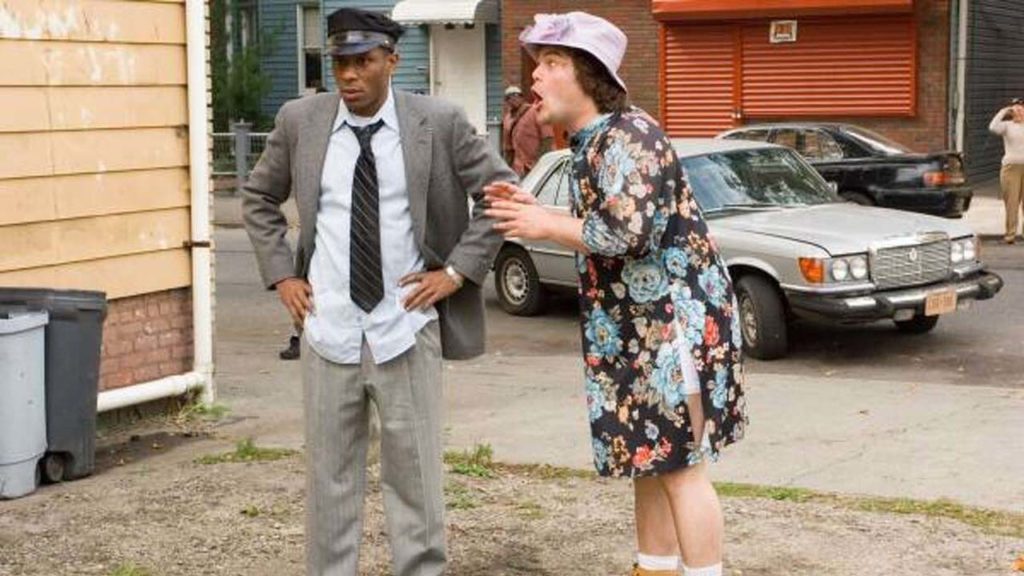
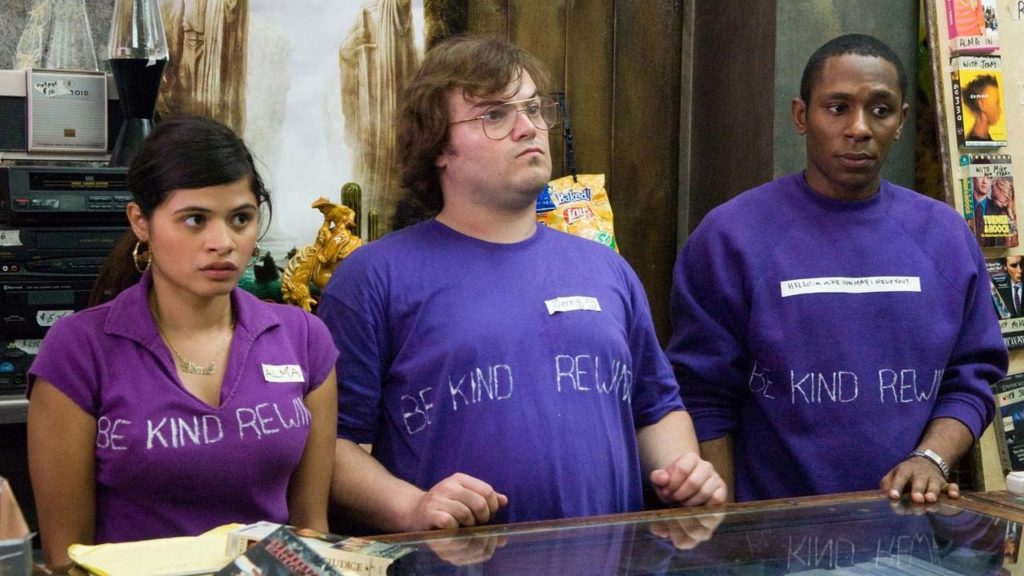
    Jack Black and Mos Def are misfit auteurs in Michel Gondry’s Be Kind Rewind

    Michel Gondry’s Be Kind Rewind is a more mainstream effort than the personal and heartfelt The Science of Sleep, but still imbued with his signature handmade style and many of his particular (some might say peculiar) obsessions.

    The premise is brilliant in its simplicity: a pair of misfit doofuses accidentally erase every tape in their retro video rental store, and decide to remake an eclectic selection of them from scratch. The considerable humor comes not just in how Mike (Mos Def) and Jerry (Jack Black) recreate shots, costumes, casting, and special effects, but also in how they must reconstruct entire plots and scenes from memory alone. If you had to condense a movie you hadn’t seen since childhood (say, for example, Ghostbusters) down to 20 minutes, equipped only with a camcorder and a budget of approximately $0, how would you do it? Jerry randomly coins the word “sweded” to describe their work, a puzzling term that isn’t even a pun, but spontaneous absurdity is a virtue in Gondry’s world.

    Mos Def and Jack Black in Be Kind Rewind
    Mos Def has mos def had enough of Jack Black.

    Desperation inspires them to find a means of artistic expression, something many people spend lifetimes daydreaming about but never seize for themselves. Much as how Tim Burton characterized Ed Wood in his eponymous biopic, Mike and Jerry have true amateurs’ supreme confidence in their total filmmaking abilities. Their own ingenuity and the power of moviemaking inspires them with the realization that they can do anything and the trust that people will like what they do. Also like Wood, each obstacle they encounter merely increases their creativity.

    Jack Black and Melonie Diaz in Be Kind Rewind
    “I am Robocop. Anything you say can and will be held against you in a court of Robocop.”

    Even before the inciting incident of mass erasure, Jerry was already something of an outsider artist. He operated an auto shop with very creative notions of “repairing” cars into souped-up rocket-powered BatMobiles. His character is initially very unlikable, and evidently something of a misogynist. We see him taunt and nearly physically threaten a woman in the video store. Later, he reveals a longing for cutie Alma (Melonie Diaz) working in the local laundry, but when moviemaking provides him with the opportunity to interact with her, he treats her as would a little boy with a “No Girls Allowed” treehouse. But that’s not to imply there’s something cute about his attitude towards women; there appears to be a barely suppressed contempt and threat of violence.

    An obvious paradox is that Be Kind Rewind is a film from a major motion picture studio that celebrates the indie spirit (not to mention fair use of copyrighted materials) and vilifies the venal movie biz executives that inevitably materialize with cease-and-decist orders. Speaking of venal movie execs, the movie’s home at New Line Cinema no doubt introduced several hardly canonical films like the New Line property Rush Hour 2 into Gondry’s script. The overabundance of New Line posters and VHS tapes in the set design bric-a-brac is something of a joke. While it’s funny that a run-down video store might still have ratty old Blast From the Past posters hanging around, would a competing mainstream neon-lit DVD store (Blockbuster in all but name) really shill for the long-forgotten Woo?

    Melonie Diaz, Jack Black, and Mos Def in Be Kind Rewind
    How long until they get around to remaking Gummo and American Psycho?

    Be Kind Rewind is at its most brilliant when recreating classic (and some not-so-classic) moments from cinema history, so much so that everything else in the film feels like a distraction from the true delights. But the powerfully moving climax is the premiere screening of Mike and Jerry’s masterpiece, made in collaboration with their entire community. Their maturity as auteurs is marked by their first truly original work; their film within a film is a fictionalized musical biopic of Fats Waller. If only all actual musical biopics could be so wonderful!

    Full disclosure: I first saw an advance screening of Be Kind Rewind on February 22, but as I was then employed by the movie company distributing the film, I decided not to post my thoughts. Regardless, I had nothing to do with making or marketing the film, and any opinions expressed above are mine alone.

  • Low get political in David Kleijwegt’s You May Need a Murderer

    Low get political in David Kleijwegt’s You May Need a Murderer

    It may seem overkill for the so-called slowcore band Low to be the subject of another documentary feature film only a mere four years after Low in Europe, but it must be because they’re just so interesting. Filmmaker David Kleijwegt’s You May Need a Murderer could just as well be titled Low in America, as he speaks with founding members Alan Sparhawk and Mimi Parker at home in Duluth, Minnesota, and on tour across America in support of the Drums & Guns album. The key characteristics of that record are what most inform the film: Sparhawk’s mood post-nervous breakdown, and Low’s most overtly expressed social and political commentary yet. Low had also just adopted a new bass player, Matt Livingston, after Zak Sally’s long tenure, but he does not participate (he’s only barely glimpsed, even in live onstage footage).

    You May Need a Murderer is a much more satisfying film overall than Low in Europe. Whether by their own desire to open up or by Kleijwegt’s persuasive interview skills, Sparhawk and Parker are notably more candid and direct, especially on the topic of their faith. Which is exactly what one would single out as the most interesting thing about Low: Sparhawk and Parker are a married Mormon couple that that tithe a tenth of all their income to the church. I suppose Low might belong in that rare category of bands whose music is often characterized by religious beliefs, like the often overtly Christian U2, but would never be filed under “Inspirational” in record stores. Unlike U2’s joyous hymns and optimistic calls to activism, Low’s inspirations are considerably more dark and apocalyptic.

    Low You May Need a Murderer

    When Low gets political they do so with a vengeance. Sparhawk is in despair over America’s economy and politics, and has long believed that the world may reach a crisis point in his lifetime (he stops short of predicting it will actually “end”). Sparhawk’s genuine beliefs gives him the real authority to criticize George W. Bush’s claim to faith. The title song “You May Need a Murderer” is sung from the point of view of one who goes before his god and asks to be used as a warrior. It becomes clear that the speaker is in effect staring into a mirror, bringing his own baggage to an imaginary conversation, and justifying his own dark impulses. Sparhawk is, needless to say, talking about self-proclaimed men of faith like Bush and Tony Blair. The song is utterly terrifying, and raises the hairs on the back of my neck every time. It may be the ultimate statement on the topic, and does not compare favorably to the similarly-themed song by Bright Eyes, “When the President Talks to God.”

    The most surprising personal topic to come up is Sparhawk’s apparent nervous breakdown in 2005. We see Sparhawk appearing very anxious backstage before a show, but otherwise functional. But he describes himself as having been “clinically delusional” at the point of his breakdown, and while having nominally recovered, he also cops to being a drug addict. To him, the biggest conflict these two aspects of his life have is with his religion.


    Must Read: PopMatters review

  • Robert Downey Jr.’s got a bum ticker in Jon Favreau’s Iron Man

    Robert Downey Jr.’s got a bum ticker in Jon Favreau’s Iron Man

    Jon Favreau’s Iron Man finds just the right tone for a superhero movie, pitched somewhere in the sweet spot between Spider-Man’s emotional melodrama and Batman’s grim vengeance. This blogger, a former lover of comic books (that stopped keeping up with them partly out of frugality, and partly lack of brain bandwidth), sees two high water marks in the recent surge of superhero-themed Hollywood feature films:

    Sam Raimi’s first two Spider-Man movies captured the key themes that made Spider-Man such a popular and lasting character in the first place (seriously, find me a kid in the English-speaking world who couldn’t tell you all about Peter Parker). The comic book on its simplest level was a parable of the sometimes unwelcome changes that come with adolescence. Also key to Peter Parker’s teen psyche was his constant negotiation between his own happiness and responsibilities towards friends, family, and society. Please, let’s not discuss the painfully awful Spider-Man 3; those bitter wounds of disappointment are still raw, oozing, and infected.

    Robert Downey Jr. in Iron Man
    Talk to the… nah, that’s too easy

    The other comic book superhero franchise to translate well to the screen in recent years is, of course, Batman. Helmed by such mature, serious artists as director Christopher Nolan and actor Christian Bale, Batman Begins perhaps could not help but to turn out as well as it did. The comic book character was originally conceived as a lone vigilante avenger in the 1930s, descended into camp self-parody in the 60s, then reverted back to grim form in the 70s. The character followed a parallel arc in his movie incarnations: Tim Burton’s Batman films are dark and weirdly wonderful, Joel Schumacher’s are tacky and cheesy, and now Christopher Nolan has restored the franchise back to its gothic roots. Note that Heath Ledger as the Joker in the upcoming sequel The Dark Knight doesn’t actually smile!

    Iron Man was heavily marketed as Robert Downey Jr.’s redemption after decades of louche behavior led to him becoming unhirable (or more accurately, uninsurable). Was Downey perfectly cast, or was the role tailored to suit him? If anything, from what little I know of the comics, the filmmakers may have actually toned Iron Man’s alter-ego Tony Stark down. Physical disability is a long-established theme in Marvel Comics’ stable of characters, take for example the blind Daredevil. Stark’s distinguishing characteristic was his bum ticker, but he was also famously an alcoholic prick. Do you think, perhaps, there’s a metaphor to be found in the character of a soulless munitions dealer who loses his literal heart but finds his conscience? Hmmm…

    Terrance Howard, Gwyneth Paltrow, Robert Downey Jr., and Jeff Bridges in Iron Man
    Djay da Pimp, Viola De Lesseps, Charlie Chaplin, and The Dude star in Iron Man

    Jeff Bridges totally rocks a bald pate, and blessedly underplays his role as chief baddie Obadiah Stane. He’s the mellow voice of reason, sounding for all the world like The Dude with an M.B.A. That is, until he raises his voice for the first time, and the good times are over, man. Unfortunately, Gwyneth Paltrow (as the alliterative Pepper Potts) and Terrence Howard (Jim Rhodes) don’t fare as well. Paltrow, with little experience in the sci-fi effects blockbuster genre, is hysterically unconvincing at running away from fireballs in high heels (you can imagine her pouting “But Harvey said I don’t have to run from fireballs!”). Howard is just plain boring, with little to say or do.

    Iron Man is quite enjoyable, provided you try to ignore the rather conservative gung-ho attitude toward the war on terror. It only disappoints at the very end, when it devolves into a CGI rock ’em sock ’em robot battle. It was inevitable according to the genre, and the natural trajectory of the plot, but still…