Tag: action

  • Sass and Kick Ass: James Bond: Casino Royale

    Sass and Kick Ass: James Bond: Casino Royale

    Paradoxically for one of the freshest James Bond films ever made, Martin Campbell’s Casino Royale (2006) is actually the third adaptation of the character’s debut in Ian Fleming’s 1953 novel. After a largely forgotten 1954 TV movie in which “Jimmy” Bond was awkwardly Americanized, the same premise was parodied in a 1967 farce bearing the same name, a expensive all-star disaster featuring good sports David Niven, Peter Sellers, Orson Welles, and Woody Allen. Meanwhile, the parallel and ongoing flood of proper Bond films abandoned the tainted Casino Royale, leaving it never satisfactorily presented on film. For most, Bond seemed born fully-formed as Sean Connery’s supremely suave secret agent in 1962’s Dr. No. But where did Her Majesty’s most ruthless servant come from?

    By 2006, the James Bond franchise had endured 20 movies and five lead actors (and that’s just counting the canonical installments), testament enough that it has been no stranger to innovation. The most recent overhaul was Goldeneye (1995), which introduced Pierce Brosnan alongside an incrementally more progressive attitude towards women. New-style “Bond Girls” like Michelle Yeoh were still dangerously sexy, but as adept with salty dialogue, grappling hooks, and AK-47s as the title character himself. Bond could no longer cheerfully ignore his stuffy bureaucratic boss M when played by the imperious Judy Dench, and Miss Moneypenny (Samantha Bond) was no longer a frump longing for Bond from afar, but rather a sassy foil rocking the sexy secretary look. Significantly, the one thing that didn’t change much at all was Bond himself. The many women in his life may have gained greater leeway to sass and kick ass, but he himself was still the same old sexist dinosaur. In retrospect, the Brosnan films now look like just more of the same.

    Daniel Craig in Casino Royale
    Say hello to my little friend

    Proper Bond films enjoyed many high points over the years, but the franchise was very nearly rendered obsolete by two very different spy trilogies: Austin Powers (whose satire was wholly redundant after the 1967 Casino Royale) and Jason Bourne. Starting in 2002, the latter did Bond one better, permanently supercharging the secret-agent genre with visceral urgency, persistent action, moderately realistic psychology, and most crucially, granting the main character a capacity for love. Bourne (Matt Damon) was a man of conscience, wracked by crippling self-doubt and guilt. He may have been capable of spectacular feats of killing, but resented the circumstances that forced him to use those skills in order to survive, or more importantly, to protect or avenge his loved ones. He didn’t manipulate women for intelligence and sexual gratification as Bond routinely would, but rather formed an emotional attachment with one in particular that would motivate his actions for an entire trilogy.

    Once the definition of high-gloss action thrillers, Bond was now on the defensive. The time was right in 2006 for its most radical reboot yet. The producers retired Brosnan (The Man With the Golden Parachute?) and underwent an extensive retooling of not just the series’ visual style but its core characters and mythos. But how much can you tweak Bond until he’s no longer the spy we love?

    The traditional pre-credit action sequence still exists, but Casino Royale discards candy-coated Technicolor for a grainy, stylized black-and-white noir style. Starting chronologically at the beginning, we see Bond execute his first two kills, fulfilling his final qualification for “double-oh” MI-6 status. Longtime Bond fans were also mollified by another grand tradition that immediate followed: a motion graphics title sequence featuring a bevy of semi-nude female silhouettes. This particular animation, with its stark red and black vector graphics, may have provided inspiration for the opening titles of the 2007 television series Mad Men. Unfortunately, Chris Cornell’s lame, tuneless song “You Know My Name” nearly ruins it.

    Eva Green in Casino Royale
    “You noticed…”

    Further comforting continuity with the previous installations comes via ridiculous amounts of high-end product placement (cars, watches, sunglasses, etc.) and a globe-trotting series of locations (Uganda, Madagascar, Bahamas, Miami, Montenegro, and Venice). Casino Royale also doesn’t fail to over-egg the pudding in terms of its villain. Le Chiffre (Mads Mikkelsen) is scarred and asthmatic, with chronically irritated tear ducts that seep blood. It was enough to signify evil in the old days that the baddie merely have metal teeth or a fluffy kitty cat.

    But that’s where the concessions to Bond tradition end. To discuss what’s new, let’s start with Bond himself. No matter how much testosterone fan-favorite Sean Connery exuded, he could still be slightly effete, fussing over vanities and creature comforts like a well-prepared martini. The Roger Moore era played up the tongue-in-cheek aspect of the series, but gorgeous women falling into bed with the frankly rather old, limp Moore was implausible at best. The suave Brosnan was born to play the classic version of Bond, but he wasn’t getting any younger as his films became as overblown and science-fictiony as the worst excesses of the Moore period. (I haven’t seen any of the Timothy Dalton or George Lazenby films, so I can’t comment on them.) Daniel Craig may not be the most macho Bond (Connery remains fandom’s favorite, for good reason), but he is clearly the most brutish and masculine. Younger, furious, and buff, he’s a giant slab of man. In a hilariously clever inversion of tradition, Bond now bares more flesh than any of his female companions, especially in an instantly iconic shot of him striding out of the ocean just barely wearing a scanty swimsuit. This Bond is almost absurdly physically fit, a parkour expert, and gets painfully bruised and scarred in fights. The days of Bond walking away from fisticuffs and fireballs with nary a hair or bowtie astray are over.

    Caterina Murino in Casino Royale
    Wait… there was another Bond Girl besides Eva Green?

    21st Century Bond Girls are smarter and more proactive than ever, but not at the expense of being drop-dead gorgeous and at least half the age of the current lead actor. In this blogger’s estimation, Eva Green as Vesper Lynd ought to go down in history as one of the greatest yet. She may not be as physically adept at action as Michelle Yeoh, but she is one of the most beautiful. Best of all, she’s enjoyably conceived by writers Neal Purvis, Robert Wade, and Paul Haggis as a true foil for the naughty double-entendres that still roll off this Bond’s tongue. She made such a strong impression on me, that when rewatching the film on DVD, I realized I had forgotten all about the other Bond Girl, Caterina Murino as Solange Dimitrios. Her character provides for a quick throwback to retro Bond; he flirts with her solely for information and then cruelly abandons her to certain death.

    The thrilling film downshifts for a long poker sequence, with no mercy shown for anyone who doesn’t understand the game (like, say, me). There does seem to have been a miscalibration however, during one scene where even I could sense Le Chiffre was double-bluffing an oblivious Bond.

    Dench is the only returning player from the Brosnan era, but her character is now part ruthless boss and part tough-love mother figure. The one convention of the classic, sillier Bond stories that I do miss is Q (Desmond Llewelyn) and his wonderful inventions. The highlight of every Connery, Moore, or Brosnan film for me was always the customary stroll through Q’s lab as his latest prototypes malfunction in amusingly lethal manners. I would cheerfully recite along with Q’s scolding catchphrase “Oh Bond, do pay attention.”

    Whenever I see any Bond film, I’m always surprised at how enthusiastically he lives up to his “license to kill” reputation. The body count is always high, but Casino Royale is even more violent than most. What differentiates it is the time spent dwelling on the aftermath, including Bond having to hide bodies instead of simply strolling away from the carnage without repercussions. There’s also a fleeting dash of crude morality rarely if ever seen in the series; Bond must awkwardly comfort Vesper, traumatized by her culpability in one of Bond’s kills. And whereas old-school Bond villains would merely threaten bodily harm with laser beams and tarantulas, Bond must now must face ugly, raw torture (which is A-OK with the hypocritical MPAA’s notion of PG-13 movies, apparently – but that’s a rant for another time).

  • Lean, Tailored, and Ferociously Fit: Jason Statham in Transporter 3

    Lean, Tailored, and Ferociously Fit: Jason Statham in Transporter 3

    Transporter 3, produced by Luc Besson and directed by Olivier Megaton, is an international product tailored for the American market. Despite its French locales, German cars, and adorably freckled Ukrainian hottie, the hero and villain are both quite American.

    The titular Transporter is Frank Martin (Jason Statham), a fighter and driver par excellence who earns a luxurious but lonely existence as an ask-no-questions courier. The events of his two previous misadventures have reformed his amoral ways and loner habits, as evidenced by his collaborative friendship with former nemesis Inspector Tarconi (François Berléand).

    So in order for there to even be a Transporter 3, its plot must corral this reformed man into a caper full of opportunities for carnage and lawbreaking. The villainous American Johnson (Robert Knepper) is conceived as Martin’s evil, less evolved twin: a mercenary like him, but unleavened by conscience. His ill-defined plan involves blackmailing Ukranian politician Leonid Vasilev (Jeroen Krabbe) into allowing a giant corporation to import a tanker full of barrels of toxic waste. At one point Martin is menaced by a truck full of the stuff on land, but the tanker hasn’t docked yet. Confusing.

    Natalya Rudakova in Transporter 3
    Natalya Rudakova in Transporter 3.

    Statham is this generation’s Jean-Claude Van Damme or Steven Segal. He’s already been typecast as the tough loner in a constant series of b-movies (some more B than others, but The Bank Job is a step up), but usually lightens things up with a hint of Jackie Chan-esque self-deprecation. He’s impeccably tailored, lean, and ferociously fit, looking and moving more like a gymnast than the previous generation of slow-moving bodybuilder action heroes. A good drinking game for any Statham film is to drink a shot every time his shirt comes off. You’re likely to get alcohol poisoning in this case.

    One of the reasons I enjoy producer Luc Besson’s Transporter franchise is that I dislike being expected to applaud the typical movie action hero that stands back and shoots bad guys from afar. This applies to pretty much any Stallone and Schwarzenegger film, but is also true of even James Bond (in which his fabled license to kill often translates into mowing down rooms full of extras with machine gun fire — or in the case of Moonraker, laser pistols) and Indiana Jones (audiences applaud him for shooting a scimitar-wielding baddie in Raiders of the Lost Ark, but really, is that fair?).

    In stark contrast, Martin almost never uses any weapon other than his own physicality. Most of the violence in the Transporter films is in the acrobatic, bloodless rock ’em sock ’em style of kung-fu flicks, liberally seasoned with impressive automobile carnage. The first few minutes of Transporter 3 feature a signature sequence in which Martin dispatches a room full of armed baddies using no tools save his own suit jacket. But I was startled to see Martin actually execute a few evildoers later in the film, something I don’t recall him doing in the previous two. It’s wholly out of character, and spoils the fun.

    Jason Statham in Transporter 3
    It’s never long until Jason Statham’s shirt comes off.

    What dooms Transporter 3 to be the worst of the franchise is that there are simply not enough action sequences, and what few there are are uninspired. I recall only two more notable action sequences: in one, Martin is tethered to his car by an explosive device (just roll with it), and must catch up to it on foot after it is stolen. Later, he launches it off a bridge onto the top of a speeding train, and then from there smashes it into the body of a detached passenger car. For a movie so concerned with car chases, it doesn’t help the audience when most of the vehicles are dictated by product placement to be the same brand (Audi) and color (black with tinted windows).

    The awkward, eyebrow-raising ending to Transporter 2 left it up in the air as to whether Martin is gay or just an extreme loner. Surprisingly, Transporter 3 actually revives that question and makes it its key subject. When Vasilev’s hot freckled daughter Valentina (Natalya Rudakova) comes on to him, Martin protests he’s “not in the mood” but certainly, absolutely, positively, no way no how, definitely not gay, how could you even ask, good grief. Well! I guess that settles that question, albeit in a rather disappointingly conventional manner.

    So the end of the film finds Martin not only reconfirmed as a good guy, but also in a steady heterosexual relationship. A key component of both the James Bond and Jason Bourne characters is that their greatest loves were murdered, so they choose to be emphatically alone. Where can Besson take Frank Martin in another sequel? Don’t expect Valentina to last long into Transporter 4.

  • Mutant Mayhem: Bryan Singer’s X-Men

    Mutant Mayhem: Bryan Singer’s X-Men

    Bryan Singer’s X-Men surprised me twice, first in a theater in 2000 and then again on a recent rewatch, by being better than it had any right to be.

    I used to be a comics fan, and read most of Chris Claremont and John Romita Jr.’s lengthy run on The Uncanny X-Men series in the mid-80s. Even though I had long since stopped reading comics regularly by the time the movie was announced in 2000, I recall being convinced there was no way a live-action X-Men movie could not be a ridiculous folly. I went to see it in 2000 partly out of morbid curiosity and partly out of a sense of duty as an ex-x-fan (see what I did there?).

    As it turned out, writer David Hayter and director Bryan Singer’s expert adaptation of the Marvel Comics source material was more fun, clever, and exciting than I had pessimistically assumed. Most welcome of all, it is frequently laugh-out-loud funny (in a good way), a key ingredient unfortunately lacking in its mostly humorless (but still pretty good) sequel X2: X-Men United (2003).

    X-Men
    It was easy to be pessimistic about an X-Men movie, but somehow this team pulled it off.

    Hayter and Singer managed to dig up every ounce of subtext baked into the X-Men mythos by original writer Stan Lee and artist Jack Kirby. At its heart, the comic book series was essentially a neverending sci-fi soap opera with a noble moral of progressive social awareness. The weirdo superheroes that make up The X-Men team are “mutants,” born of human parents but with superhuman powers typically manifesting during adolescence. Prior to Lee and Kirby’s innovation, comics’ superhero templates were either extraterrestrials like Superman or ordinary humans with artificially gained superpowers like Spider-Man (mere mortals Batman and Iron Man don’t count, no matter how inordinately driven to fight injustice). Unlike the physical ideal Superman, most of Lee and Kirby’s mutants did not view their powers as gifts, and some were outright monsters.

    The X-Men formula also incorporates deeper themes of racism, xenophobia, and even evolution. Indeed, the entire premise is built upon the theory of evolution: as multiple species of humans walked the earth simultaneously hundreds of thousands of years ago, so too do humans now find themselves sharing the earth with arguably the next branch of homo sapiens’ evolution: known in the comics as “homo superior.” Carried through to the next logical conclusion, this mutant minority is feared and demonized as freaks by the humans that vastly outnumber them.

    Patrick Stewart and Ian McKellen in X-Men
    The Royal Shakespeare Company mutants face off

    The X-Men’s sympathetic antagonist Erik Lehnsherr (Ian McKellen) is a survivor of a German concentration camp. The horrors he experienced at the hands of those that hated his ethnic group (but didn’t yet realize he was actually a different species) in 1944 Poland inform his actions as the supervillain Magneto. As he listens to contemporary American politicians argue over how to contain and suppress the increasing mutant population, he disgustedly states “I’ve heard these arguments before.” His former friend (and fellow mutant) Charles Xavier (Patrick Stewart) hopes to find a way to live in peace, and counters “That was a long time ago. Mankind has evolved since then.” But Magneto is unyielding. “Yes. Into us.”

    The crucial factor that had me simply assume the movie would be terrible was casting. It’s not hard to imagine a young actor able embody Spider-Man’s secret identity Peter Parker as a put-upon geek harboring tremendous reserves of guilt and righteousness. But how do you cast Wolverine, a diminutive, half-animal Canadian supersoldier with ridiculous hair? Easy! You hire the tall, absurdly handsome Australian studly song-and-dance man Hugh Jackman.

    Hugh Jackman in X-Men
    Talk to the claws

    Against all odds, Jackman totally nailed the fan-favorite character. The moment in the film when this former X-Men comics fan decided that Jackman succeeded is a sequence in which he steals an X-motorcycle and discovers a handy turboboost button. The entire audience at the New York Ziegfeld theater laughed heartily along with his undisguised glee at its total awesomeness. This doubter was completely sold.

    Another casting coup was the double-dose of Royal Shakespeare Company gravitas provided by McKellen and Stewart (both with extensive experience in fantasy and sci-fi genre material, as Gandalf in Lord of the Rings and Captain Picard in Star Trek: The Next Generation, respectively). Bruce Davison (as the xenophobic Senator Robert Kelly) also has a long history in science fiction, having starred in Willard and the influential classic The Lathe of Heaven.

    James Marsden later proved himself to be entertainingly charismatic in Enchanted, but here he’s a victim to the humorless character of Cyclops. As Wolverine correctly and succinctly psychoanalyzes him, he’s a dick. Similarly, Famke Janssen isn’t given a whole lot to work with as the no-fun-please Dr. Jean Grey (known in the comics as Marvel Girl, later to die and rise again as Phoenix in Brett Ratner’s crap sequel X-Men 3: The Last Stand). But together with Jackman, the trio brings alive the Wolverine/Cyclops/Phoenix love triangle drawn from the comics, helping to make the movie accessible.

    Famke Janssen in X-Men
    Just don’t call her Marvel Girl

    The one real weak spot in the cast is Halle Berry. Like Jennifer Lopez in Steven Soderbergh’s Out of Sight, she seems to have only one real acting performance under her belt (Monster’s Ball, of course). Here she turns in one of her most bland and toneless performances yet. For extra amusement, be sure to catch the deleted scenes on the DVD edition in which she can be heard affecting a weak pseudo-African accent. It’s a shame, because Storm was a very strong character in the comics around the time I read them. Writer Chris Claremont obviously had an affection for her, even promoting her to leader of the X-Men.

    Aside from casting, I imagine the second-biggest obstacle facing the filmmakers was how to introduce the complex X-Men universe to mainstream audiences while preserving its integrity to appease longtime fans. Hayter and Singer came up with the excellent solution of having us meet Professor X and his X-Men through the eyes of newbies Wolverine and Rogue (Anna “That’s my mother’s piano!” Paquin).

    Hugh Jackman and Anna Paquin in X-Men
    Ferocious mutant super-soldier Wolverine can really relate to Rogue’s teenage angst

    Both are very different characters that share key common experiences that allow them to bond in a big brother / little sister relationship: Wolverine is a loner amnesiac unaware there are others like him, and Rogue is a young runaway isolated by particularly extreme powers that prevent her from experiencing normal human interaction. Almost anyone can identify with the painful coming of age that comes with her exaggerated adolescence. A startling moment of pathos occurs between them when she sees him wield the fearsome metal claws sheathed in his forearms: “When they come out, does it hurt?” “Every time.”

    On an even more practical level, the filmmakers came up with an ingenious solution to the comics characters’ silly costumes by having the movie X-Men wear more photogenic uniforms. Cyclops’ joke about yellow and orange spandex is an easter egg for fans: Wolverine sports such an ensemble in the comics. Best of all, the requisite action set pieces are justified by the characters, not just the plot. For example, a big blow-out staged at a train station is the result of a heartbreaking misunderstanding that causes Rogue to flee the longed-for safe haven she had only just discovered.

    The franchise is now set to continue with a trilogy of prequels including this summer’s X-Men Origins: Wolverine, and rumored projects X-Men Origins: First Class and X-Men Origins: Magneto. But with the first of these wracking up some notably awful reviews, it’s clear the first in the series will still stand as the best for some time.

  • Competition is Weakening in David Mamet’s Redbelt

    Competition is Weakening in David Mamet’s Redbelt

    Redbelt is writer/director David Mamet‘s ode to jiu-jitsu, of which he himself is reportedly a purple belt. Mike Terry (Chiwetel Ejiofor) is a struggling black belt jiu-jitsu instructor, one of the few remaining practitioners of martial art in its authentic Japanese origins.

    The professional combat sport association MMA (Mixed Martial Arts) has tainted the martial art with commercialism and spectacle akin to professional wrestling. In contrast, Terry is a noble warrior with an absolute code of honor, like Robert Scott (Val Kilmer) in Mamet’s Spartan (2004). Terry is a former special forces soldier, with a past in one or both Gulf Wars he does not wish to discuss. One of his favorite aphorisms becomes something that he realizes he must live up to himself: “There is no situation from which you cannot escape.” He’s a fearsome fighter, able to win a bar fight without throwing a single punch. But another of his aphorisms, “competition is weakening,” reflects his choice to teach self-confidence and reliance, not aggressive combat.

    David Mamet directs Chiwetel Ejiofor in Redbelt
    “Competition is weakening”

    Like many of Mamet’s films, Redbelt features many of his regular stable of actors: Rebecca Pigeon (Mamet’s wife, who also performed the music), Ricky Jay, David Paymer, Joe Mantegna, and a cameo from Ed O’Neil. Anyone familiar with Mamet’s films would know to suspect a character played by any one of these actors is up to some mischief, especially if the latter two are seen to be in any kind of collusion. Significantly for a playwright/writer/director known for his characteristically dense dialog, the last long sequence is mostly wordless.

    Mamet states Redbelt is firmly in the fight film genre, singling out the two recent examples of Million Dollar Baby and Cinderella Man. Like the superb Spartan, it’s also something of a samurai movie. Just don’t call it a martial arts or action flick. It also includes healthy doses of two other Mamet obsessions: the long con and the corruption inherent in business. The most obvious advantage of the long con in storytelling terms is that it automatically provides a structure for a fiendishly complex plot, as it did for both House of Games (1987) and The Spanish Prisoner (1997).

    Emily Mortimer and Chiwetel Ejiofor in Redbelt
    “There is no situation from which you cannot escape”

    Mamet’s recurring theme of institutional corruption in the business world is probably best expressed in Glengarry Glen Ross. But in his book Bambi Vs. Godzilla (2007) and movie State & Main (2000), Mamet reveals the one particular business that fascinates him the most: Hollywood. As he states in the electronic press kit included in the Redbelt DVD, moviemaking is a business like any other, but the particulars of its moral bankruptcy fascinate him.

    This manifests in Redbelt as Terry is seduced by Hollywood as embodied by aging action star Chet Frank (Tim Allen). Frank first finds leverage in the fact that Terry is broke, but also recognizes that he is is secretly prideful, and seeks approval and recognition for the burden of honor he has been carrying for so long. These flaws make him manipulatable. Frank initially seems to provide the solutions to his problems, but turns out to be the precise inverse of his name: all empty promises, facades, scams, and pretense.

    The two corrupt worlds of Redbelt are both hungry for meat: professional sports need fighters to run through the grinder, and the movie business eats up ideas as raw material for its product. They find both in Mike, and neither wants to pay for what they try to take from him.

  • A Clash of Faiths: Ridley Scott’s Body of Lies

    A Clash of Faiths: Ridley Scott’s Body of Lies

    Ridley Scott’s follow up to the gentle comedy of A Good Year and the crime drama American Gangster (partly modeled, I think, on Michael Mann’s epic Heat), returns to the politically-themed yet still action-oriented territory he first visited in Black Hawk Down. The key difference here is that, like Peter Weir’s The Kingdom and Pete Travis’ Vantage Point, Body of Lies is set in a fantasyland safely divorced from the very, very real events that inspired Black Hawk Down. All of these films have the air of gritty realism, but still indulge in the wish fulfillment of a very cinematic war on terror.

    Body of Lies can be seen as completing a kind of Middle East trilogy for Scott, after the aforementioned Black Hawk Down plus the Crusades epic Kingdom of Heaven. Screenwriter William Monahan wrote both Kingdom of Heaven and Body of Lies (adapted from the novel by David Ignatius). But of the three, the latter is clearly the least serious.

    Russell Crowe and Leonardo DiCaprio in Body of Lies
    Mesopotamia, and step on it!

    No doubt movie studio executives have calculated down to the last cent that world audiences are still too sensitive to actual terrorist attacks like London and Madrid in order to buy tickets for dramatic recreations on the big screen. Instead, most mainstream terrorism-themed movies are basically entertainments that only have the feel of serious import, and none of the substance. Body of Lies invents analogous terrorist attacks such as a sleeper cell blowing up their own London flat, and later, the bombing of a U.S. marine base in Turkey (I hope O’Neal – Demi Moore – from Scott’s G.I. Jane wasn’t stationed there). Vantage Point is a little more creative in imagining a worst-case-scenario of a presidential assassination, but has no interest in the repercussions beyond a Rashomon-like recounting of the immediate aftermath.

    So audiences get films like this, where shadowy CIA operatives sneak around Iraq and Jordan, saving the world from Islamic fundamentalism. They have seemingly limitless resources but no government oversight, and anything is possible with a little computer hacking. Meanwhile, more serious and realistic movies are ignored, like In the Valley of Elah and the truly excellent but emotionally devastating United 93. In comparison, Scott’s Black Hawk Down was unafraid to recreate actual events still raw in the American public’s memory: the catastrophic marine incursion into Somalia in 1993. And even to limit the scope to Scott’s own oeuvre, Kingdom of Heaven is a much smarter consideration of the clash of faiths in the Middle East.

    Leonardo DiCaprio and Golshifteh Farahani in Body of Lies
    Leo meets cute with an Iranian nurse (Golshifteh Farahani)

    Body of Lies is Russell Crowe’s fourth film with Scott, following Gladiator, A Good Year, and American Gangster. Here, he packs on some serious poundage to enter the same schlubby mode he debuted in Michael Mann’s The Insider, seasoned with a little of the crass bastard he played in A Good Year. Leonardo DiCaprio, on temporary loan from Martin Scorsese, sports a scrappy beard but still looks like a teenager. The pretty boy is constantly getting beaten up, cut, bruised, and losing fingers. But he meets cute with pretty Iranian nurse Aisah (Golshifteh Farahani), so that’s alright, then.

  • Every Day is Exactly the Same for James McAvoy in Wanted

    Every Day is Exactly the Same for James McAvoy in Wanted

    The Nine Inch Nails song “Every Day is Exactly the Same” is so thematically perfect for the early part of Timur Bekmambetov’s Wanted, that it seems to have been composed especially.

    But Wanted is weighed down by an overly extensive backstory that goes back thousands of years, and an approach to violent spectacle that borders on the sadistic. It’s hard not to sense a trend, as I’ve had the same complaints about a couple other movies I happened to see recently: Hancock, Speed Racer, and Southland Tales.

    Angelina Jolie and James McAvoy play assassins with superhuman abilities, directly tied to the action choreography and special effects: the power to “throw” bullets and slow down their perception of time in order to move superhumanly fast. All of this is framed in close and medium shots, a bad choice for an action film that ought to display its stunts and derring-do in full. It’s more visually disorientating than even the hyperkinetic Speed Racer, but the slow-mo sequences paradoxically render the proceedings rather boring — even when something that ought to be impressive is happening, a bullet sliced in twain by sword.

    James McAvoy, Common, and Angelina Jolie in Wanted
    James McAvoy, Common, and Angelina Jolie at the country fair

    It’s difficult to feel sympathy for a protagonist who, when causing a literal train wreck, resumes his murderous mission instead of aiding the countless innocent bystanders he has turned into collateral damage. In the end, Wesley smugly asks, “What the fuck have you done lately?” So, becoming a superhuman assassin has granted Wesley self-actualization: he’s free of his botched relationship and dead-end job, he’s physically fit, and he shoots people in the head for a living.

    So, Wanted flirts with the nihilistic themes of David Fincher and Chuck Palahniuk’s Fight Club, but without the irony. What many surface-level admirers of Fight Club seem to forget is that while it initially seems to celebrate its unnamed protagonist’s decisive break from the supposedly stifling bounds of society, his self-help credo attracts the wrong kind of followers and spins out of control to its ultimate logical end: anarchy.

  • Michael Douglas vs. the yakuza in Ridley Scott’s Black Rain

    Michael Douglas vs. the yakuza in Ridley Scott’s Black Rain

    Ridley Scott’s police thriller Black Rain (1989) opens in New York City at a time when The Meatpacking District actually was a meatpacking district. Tough cop Nick (Michael Douglas) is a ridiculously aggressive, foul-mouthed tough guy who tools around the city astride his crotch rocket. The despised Internal Affairs department suspects him of being a bent copper (spoiler alert: rightly, it turns out!), and pressures him to name names. By sheer accident, he and rookie partner Charlie (Andy Garcia) witness a Yakuza assassination in a Meatpacking District bar. After a thrilling chase through some vintage Manhattan locations since replaced by nightclubs, luxury condos, and The Apple Store, they manage to apprehend the perpetrator. The Yakuza assassin Sato (Yasaku Matsuda), being Asian in a Hollywood movie, is of course a martial arts expert. Contrived plot machinations result in Nick and Charlie escorting Sato back to Japan, whereupon they immediately and embarrassingly lose him. By this point, the plot has been constructed in such a way as to raise Nick’s stakes to the highest level possible: the only two things that matter to him, his honor and job security, depend on one task: catching or killing the bad guy. If he returns to the States empty-handed, he’s almost certainly to be disgraced.

    Andy Garcia and Michael Douglas in Black Rain
    Andy Garcia refuses to pass the edamame

    In his Tokyo downtime, Nick entertains an unconsummated romance with gaijin Joyce (Kate Capshaw). The subplot is a boring distraction. Joyce is a mere love interest in the worst storytelling sense: her character is not integrated into the main thriller plot as is the female lead in Scott’s Someone to Watch Over Me. It strikes this blogger as something of a copout on the part of Scott and screenwriters Craig Bolotin and Warren Lewis that their protagonist Nick goes all the way to Japan but doesn’t do as the Japanese men do (which is to say, Japanese women).

    Nick and Charlie partner with upright Japanese cop Masahiro (Ken Takakura). Cultures clash, and the suave Charlie teaches the uptight Masahiro to party hearty, beating the Japanese at their own game (that being karaoke). When Nick’s moral ambiguity becomes known, the righteous Masahiro seems to convince Nick that theft of any sort is shameful. But in the end, it is Nick that teaches Masahiro that it’s OK to steal from criminals (in the moral universe of this film, at least). I’d never say that any work of fiction has an obligation to present morally-correct behavior (the kind of censorship that Hollywood theoretically left behind with the demise of the Production Code). But Black Rain seems to present Nick’s amoral behavior as The Right Thing, instead of the complicated actions of an interesting complex character.

    Michael Douglas in Black Rain
    A moodily backlit Michael Douglas contemplates a new hairdo

    Scott stages a huge shootout sequence at a refinery, seemingly chosen for maximum visual appeal (picture the clouds of steam, showers of sparks, bursts of flame, etc.). In a kind of self-referencial closed circuit, Scott’s aerial shots of Japan look just like Blade Runner‘s futuristic dystopian Los Angeles, which was itself inspired by Tokyo. Another direct lift from Blade Runner: Nick discovers sequins from Joyce’s dress at a crime scene, recalling the sequence in Blade Runner in which Deckard tracks down the origin of synthetic snake scales — belonging, of course, to one of cinema’s most famous femmes fatale.

    The opening credits state “In association with Michael Douglas.” Douglas is of course a successful producer (for instance, One Flew Over the Cuckoo Nest), but Black Rain has the feel of an ego trip. More trivia: the director of photography Jan de Bont was later to direct Speed.

    One final cheap shot before I go. I don’t know what has dated more: the cheesy music or Michael Douglas’ big hair.

  • Material Witness: Ridley Scott’s Someone to Watch Over Me

    Material Witness: Ridley Scott’s Someone to Watch Over Me

    Ridley Scott’s Someone to Watch Over Me (1987) is more of a drama than a police thriller, refreshingly focused on its characters over suspense and action alone. Mike Keegan (Tom Berenger) is a salt-of-the-earth Queens detective assigned to protect material witness Claire (Mimi Rogers) from assassination. Keegan is a modest family man, recently promoted to the second rung of the police hierarchy. It’s no glamorous job; he spends most of his working hours just sitting around not finishing crosswords. He’s utterly unlike the over-the-top testosterone-laden cop character played by Michael Douglas in Scott’s other police thriller, Black Rain.

    Tom Berenger in Someone to Watch Over Me

    Keegan is more-or-less happily married (to Lorraine Bracco as Ellie), but a man like him would never otherwise come into contact with a beautiful uptown girl like Claire. Cooped up in close proximity to each other every night, they inevitably lapse into an affair. Her effeminate but wealthy and powerful husband senses that Keegan is a romantic rival, but he is an effectively impotent character and frequently disappears from the film altogether. Also notable is song-and-dance man Jerry Orbach already typecast as a detective in a small role as Keegan’s tough Lieutenant.

    Mimi Rogers in Someone to Watch Over Me
    When Mimi Rogers heard Director Ridley Scott was big on visual spectacles, this isn’t what she had in mind

    One of the guaranteed pleasures of any Ridley Scott film is the visuals. Someone to Watch Over Me‘s opening credits feature the namesake song by George Gershwin sung by Sting over beautifully sleek aerial shots of New York City at night. The final shootout is perfectly staged in a claustrophobically enclosed space, with huge mirrors placed for maximum dramatic impact. The principals stalk each other in near silence, punctuated by the wide dynamics of sound design. Perhaps Scott was competing with that other upstart master of cinematic shootouts, Michael Mann (in particular, the similarly explosive conclusion to the contemporary thriller Manhunter).

  • John Sturges honors Kurosawa honoring Ford in The Magnificent Seven

    John Sturges honors Kurosawa honoring Ford in The Magnificent Seven

    John Sturges’ The Magnificent Seven is Hollywood’s answer to Akira Kurosawa’s hugely popular Seven Samurai. It suffers in comparison, especially if, like this blogger, one watches them in quick succession. The remake is quaint, chaste, and dated in ways the fairly frank original isn’t. To put it another way, Seven Samurai is a period piece of its 16th Century setting, while The Magnificent Seven is a period piece of its 1960 production.

    A remake was inevitable considering the dizzying circle of influence. Kurosawa was a fan of the Hollywood western and especially of director John Ford, all of which directly informed Seven Samurai. Hollywood’s transposition of the story to the American West for The Magnificent Seven was fairly straightforward. Its great success led to three motion picture sequels, a television series, and is reportedly set to be remade again in 2009.

    The original eponymous seven samurai were actually ronin, masterless mercenaries akin to the Western outlaw: morally ambivalent drifters, killers with a personal code of honor. The Western genre is usually about outlaws, for the simple reason that they’re more dramatically interesting than regular plain folk. In both versions of 3:10 to Yuma (1957 and 2007), for example, the villain Ben Wade (Glen Ford and Russell Crowe) is a far more appealing and seductive character than the good guy Dan Evans (Can Heflin and Christian Bale).

    The Magnificent Seven
    The meeting of the Badass Society is adjourned

    An exception to the rule is the classic High Noon, in which Gary Cooper plays an honest lawman who prevails under extreme duress. The biggest clue the magnificent seven are not classic good guys: Yul Brynner appropriately sports his trademark black hat. Upping the badass quotient and testosterone levels are no less than Steve McQueen (here getting to drive a real mustang on screen), Charles Bronson, and the very lanky James Coburn.

    The basic scenario is similar: seven American gunslingers accept a pittance in order to defend a Mexican village besieged by bandits. But the many alterations beyond this all reflect some very “Hollywood” thinking. In the original, it is enough for the samurai that there be an injustice they are capable of addressing. But in a Hollywood film, there must be individual motivations, which interestingly have the side effect of rendering some characters less heroic. Harry Luck (Brad Dexter) is convinced Chris (Brynner) has an ulterior motive, such as pilfering a non-existent gold mine. The dandy bounty hunter Lee (Robert Vaughn) is also along for selfish reasons; he’s on the lam for an unspecified transgression, and needs to disappear for a while.

    The original Seven Samurai is actually technically comprised of only five actual samurai plus two pretenders. Kikuchiyo (Toshiro Mifune) is a peasant posing as a samurai, and Katsushiro (Isao Kimura) is an earnestly romantic young boy seeking samurai training and adventure. Perhaps to economize the story, The Magnificent Seven combines these two characters into one: Chico (Horst Buchholz), a former farmer that worships the outlaws and attaches himself to them in order to become one.

    Steve McQueen and Yul Brynner in The Magnificent Seven
    Go ahead and make our day

    So that leaves Chris, Bernardo (Bronson), and Vin (McQueen). In this remake’s best sleight-of-hand, we’re in the dark as to their motivations until near the very end. None of them are young men, and what drives them turns out to be the fantasy of settling down into an agricultural lifestyle. The gruff Bernardo befriends a batch of scrappy kids, becoming a kind of protective older brother if not a father figure. Chris and Vin seal their friendship with the mutual confession that they both hanker for a simpler life (a sort of admission very difficult for two very macho men).

    But many poor changes outweigh these aforementioned interesting ones. Being a product of Hollywood, it’s actually less violent, profane, and sexy than the original Japanese film. The Mexican villagers are wise and saintly, compared to the more realistically flawed farmers in Seven Samurai. The threat of sexual violence is whitewashed away; the bandits are not interested in the Mexican women. We see too much of the villains, and the chief bandit Calvera (Eli Wallach) is practically a featured character.

    James Coburn in The Magnificent Seven

    But just as I was beginning to dismiss the remake as inferior to the original in every way, and of historical interest only, the movie darkens and becomes interesting again. The Mexican villagers, like their ancient Japanese counterparts, do reveal a dark side after all. Despite their initial success in beating back the bandits with the outlaws’ help, they have a crisis of faith and betray the outlaws in order to return to the comfort zone of their parasitic relationship with the bandits.

    In the old west, an outlaw may very well find a home in a frontier town where no one knows his past deeds (a core theme of the HBO series Deadwood and the situation in which Clint Eastwood’s The Unforgiven opens). But in ancient feudal Japan’s caste system, a ronin could never take a step down and live among farmers. This also proves to be the case in The Magnificent Seven: Chris and Vin mosey on out of town and Chico stays behind, rejecting his pretensions to being a rebel outlaw, and reverting to his destined life as a farmer.

  • They don’t make PG movies anymore like Steven Spielberg’s Raiders of the Lost Ark

    They don’t make PG movies anymore like Steven Spielberg’s Raiders of the Lost Ark

    In order to catch up on the overwhelming backlog of movies I intend to cover here on this blog, this blogger is forced to cover Raiders of the Lost Ark with only a few disconnected observations:

    The 2008 DVD reissues of the classic Indiana Jones trilogy have terribly designed menus; it looks like everything’s been overprocessed with Photoshop’s “Dust and Scratches” filter.

    The zippy, witty screenplay is by Laurence Kasdan, known to genre geeks as the beloved writer of the best Star Wars script, now and forever: The Empire Strikes Back.

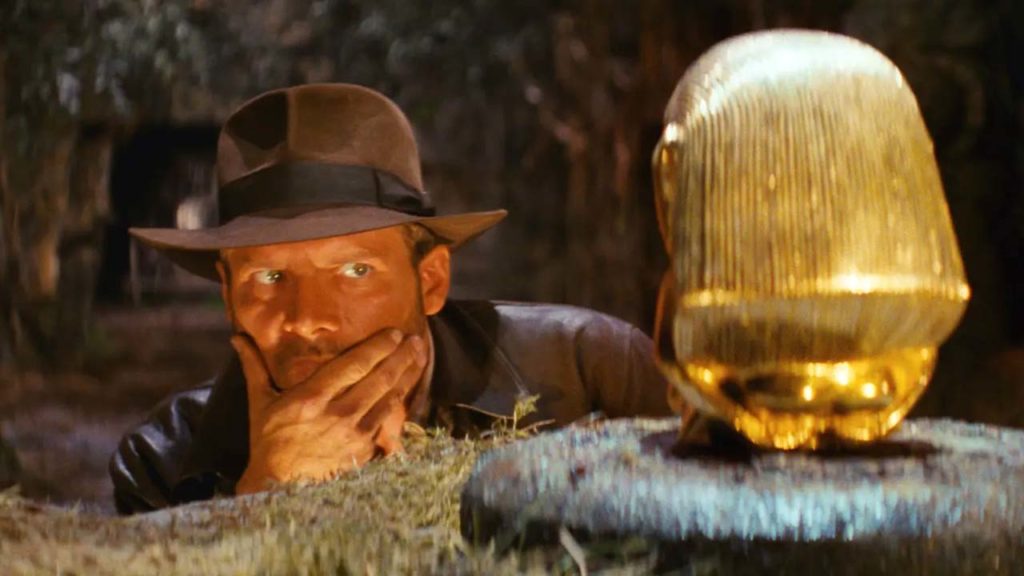
    Harrison Ford in Raiders of the Lost Ark
    Indy ponders the ethics of looting

    Hey, it’s that guy! A young Alfred Molina briefly appears in his first film role. In the DVD bonus features, he recounts an amusing tale involving his lack of difficulty in evoking fear in his performance as a batch of real tarantulas scrambled across his face.

    Does the Indiana Jones franchise really give the field of archaeology a good name? Indy is motivated by money; he loots relics without the permission of indigenous peoples, and sells them to a museum associated with the university where he teaches. It’s implied his job or tenure – and that of his boss Marcus – depend on it.

    Karen Allen is really winning as the hard-drinkin’ Marion, and it’s a pity she never became a bigger star, or at least appeared in the second and third installments. She was robbed!

    Karen Allen in Raiders of the Lost Ark
    Karen Allen, when she learned she wasn’t being called back for the sequels

    I think I had the official coloring book as a kid, and I recall being fascinated by the concept of lost cities buried under sand.

    For better or for worse, the practical details of the phantasmagoric climax are left unexplained: why is the Ark empty, why does it make bad guys’ heads explode and/or melt, why does it matter if your eyes are open or not, and how does Indy know all this information?

    There’s lotsa drinking, gunplay, gore, and German profanity – in other words, all the stuff kids love! They don’t make PG movies like this anymore.

    Kids, the moral of the story is: anyone with a non-American accent is not to be trusted.