Jaume Collet-Serra’s Black Adam is an appalling fiasco, easily one of the worst, most ill-conceived movies of 2022. Like the lightning bolt that adorns the titular character’s unitard, it points straight down — down to the bottom of the year’s most painful time-wasters, among bad company like Fantastic Beasts: The Secrets of Dumbledore and Uncharted.
If the notoriously shelved Batgirl movie was worse than this, it must have been a truly historic boondoggle. I don’t think it takes too much imagination to suspect that Batgirl was merely mediocre, but Black Adam was too expensive — and too beholden to its star The Rock — to let lie. If Black Adam was deemed suitable for release, any garbage is worthy of a tile on the HBO Max app.
There can’t be many comic book villains that are genuine household names, familiar outside of fandom circles. Maybe Lex Luthor and perhaps Dr. Doom, the latter by sight if not by name? I myself have read a lot of comics, but had never heard of Black Adam. So, consulting Wikipedia for help in understanding this nonsense, I was surprised to learn it’s a supporting character from the 1940s Captain Marvel comics (a property now known as Shazam, thanks to obvious legal snafus), and only intermittently employed since. The film opens with seven full minutes of narration to explain this tediously backstory, which is somehow simultaneously complex and childishly simplistic. Seven minutes! I counted!
The choice to create an entire mass-market movie around a deep-cut comic book character doesn’t strike me as good business sense. It barely alludes to the ostensibly related Shazam movie, and relegates more familiar superfriends like Dr. Fate (Pierce Brosnan) and Hawkman (Aldis Hodge) to supporting roles. Utterly mystifying.
Marvel has had this formula figured out for years: first, gain a foothold with well-known goodies like Spider-Man, before giving starring roles to baddies like Venom. They also typically remember to make their movies at least a little fun, and encourage their stars to flex their movie-star charisma. The Rock was reportedly keen on playing this character, but you’d never know it from his dour, bored performance.
There is no escape from the tyranny of continuity. Like daytime soaps, superhero comics exist in a quantum state of constant churn and perpetual stasis. Characters are introduced and die and un-die, relationships form and split and reform, villains are defeated and rally and are defeated again. Excelsior, and collect your pocket change to spend at the newsstand next month, true believer!
Avengers: Infinity War (2018) was the apotheosis of comics’ perpetually open-ended narrative, in movie form. It was a painful experience for any humanities student, or indeed anybody who loves novels and cinema. How quaint to expect a classical narrative, now that popular entertainment movies have become what Martin Scorsese has called a series of sequences. Avengers: Infinity War was 2+ hours of hors d’oeuvres before a long-promised fancy dinner. At about 18 movies into the Marvel Cinematic Universe series by that point, one began to wonder if we’d ever get to the main course, let alone dessert. It can’t be coincidental that the best episodes are the few that managed to wriggle free of the bonds of the larger umbrella story, particularly Black Panther, Ant-Man & The Wasp, and Thor: Ragnarok.
That Anthony & Joe Russo’s Endgame is so drastic an improvement over Infinity War that new corporate owners Disney must have issued a memo on Micky letterhead, reading “OK, good job, kids, but make sure the next one has a plot”. Its classical structure plot is so startlingly unfamiliar for anything with Captain America in it, that if anything, it’s almost too simple, like a video game. Our heroes discover they have to do five specific things to prepare for a confrontation; they do those five things; they have that confrontation; there’s a wound-licking denouement. Bingo: it’s a movie!
Like much of the movie, this is a striking image. Avengers: Endgame deserves credit for its relatively complex villain (relatively for the genre, I must stress). But I just can’t get over the expectation to take this stuff seriously.
I loved Marvel Comics as a kid, but was more of an X-Men, Fantastic Four, and Daredevil kind of guy. I always thought The Avengers were lame, and instinctually steered away from the likes of Captain America long before I ever learned the word jingoistic, from Iron Man before I learned the word asshole, and from Thor because — I mean, come on, seriously? So it’s been a struggle for adult-me to take the cinematic Avengers characters semi-seriously enough to enjoy in live-action form.
Of the six original movie Avengers, only one is female and all are white (well, one is often green, but you know what I mean). We can place the original whitebread Marvel Comics in the context of the 1960s, but what’s the movies’ excuse? Even years later, when the franchise has finally cultivated a deeper bench of female characters, it insultingly limits most of them to a single contrived hero shot.
The women of the Marvel Universe deserved more than a single hero shot, which plays as a contrived “insert girl power moment here” sticky note in the screenplay. Especially since one is the last surviving Valkyrie warrior (a god!) and another is the most powerful superhero, of any gender.
And to get specific with one head-scratcher I just can’t get over: when Brainy Hulk and Rocket Raccoon go on a special mission to Norway to re-recruit an incapacitated Thor, is it A) sexist, B) moronic or C) both that they ignore the last living Valkyrie warrior? She may have, you know, been useful. I mean, at least two of the official Avengers don’t even have superpowers (unless you count being really good at archery as super).
Speaking of, can we talk for a moment about how Hawkeye is totally let off the hook for going around the world summarily executing bad guys, without due process? Black Widow literally just stands there and watches him behead somebody. These are supposed to be heroes, with an aspirational moral element. That there wasn’t even a tossed-off line like “we don’t do that anymore” makes me suspect that a chunk of Hawkeye’s story was cut out of the final film, or that the filmmakers lost control over the many character arcs they had to juggle, or most worryingly, that they just thought it was super cool.
Griping aside, I have serious praise for Robert Downey Jr. for delivering some of the finest acting yet in any Marvel movie. His portrayal of a broken Tony Stark early in the film is almost uncomfortably real.
Like a teeter-tottering pile of mint-condition, unread, bagged & boarded collector’s edition comic books, the Marvel Cinematic Universe is quickly collapsing under the weight of its accumulating continuity.
Joe and Anthony Russo’s Avengers: Infinity War may be an edifying experience for the dedicated fan who’s seen all 19 or so preceding movies, and paid enough attention to the details to be able to follow what’s going on. But were it not for Tom Holland adding some levity as Spider-Man, and Josh Brolin as the relatively interesting villain Thanos (atypical for the superhero genre, to say the least), there isn’t much substance here beyond callbacks to previous installments and teasers for the next round of punch-punch boom-boom.
The Avengers: Infinity War is one part lunchbox, one part Wikipedia entry.
Picture the little kid coming to this for the first time. She is enamored by the idea of Spider-Man swinging through New York City, Captain America punching out baddies, and Iron Man fighting crime with his neato gadgetry. She has read and re-read her handful of comics, and is excited that her parents are taking her to the movie theater to see her heroes come to life on the big screen. Imagine how she feels when what she gets is more of a Wikipedia entry than a story.
It’s the same paradox that affects all indefinitely ongoing comics: the more pages that pile up, the more complex the continuity, the more impenetrable it comes, and before you know it the only people reading comics are grownups.
I was very pleasantly surprised by James Mangold’s The Wolverine. Everybody involved did the right thing by simply pretending that the appallingly awful X-Men Origins: Wolverine was never made.
Marvel Comics continues their (mostly) winning streak, showing everyone how superhero movies should be done. Hopefully soon we will be rid of grimly ultraviolet takes on children’s characters like Christopher Nolan’s Batman trilogy and Zack Snyder’s Watchmen and The Man of Steel. The Wolverine is just the right kind of “serious”, in the sense that it focuses on character and not on vengeful violence. I’m tired of gruesome sights like Superman summarily executing General Zod by snapping his neck.
The Wolverine should be commended for having four major female characters, when a typical superhero movie maxes out at one (such as Lois Lane in Man of Steel and Gwen Stacy in The Amazing Spider-Man). But The Wolverine squanders this achievement by casting women than look like supermodels, and a script that fails The Bechdel Test. All any of the women talk about are Logan and their daddy issues.
Mangold is a true chameleon, having tackled everything from indie drama (Heavy) to Oscar-bait biopic (Walk the Line). He’s handled action before (Knight and Day, 3:10 to Yuma), but here in his first real summer blockbuster popcorn movie, he exhibits a remarkable stylishness and even a little visual poetry. One scene stages a self-surgery straight out of a Cronenberg film. And when Wolverine races through the streets of a Japanese village to rescue his beloved imprisoned in a tower, swarms of ninjas shoot tethered arrows into his back, in an apparent homage to Akira Kurosawa’s Throne of Blood. The sight is startlingly moving, like something out of a violent fairy tale.
It also helps that until the climactic action sequence, not a single character parades around in a spandex costume. By the point that the villains Viper and Silver Samurai show up in full four-color splendor for a big comic book-esque fight sequence, I thought, what the hell, this movie has totally earned it.
The film buffs at Criterion Cast recently took a break from their usual discussion of the likes of Ozu, Godard, and Cox for in their year-end podcast review of the 2012 year in movies. Rather surprisingly to me, they talked up Batman: Year One and Dredd as two underrated 2012 releases. I had been happily ignoring both, but checked them out on Netflix and was soundly disappointed by both.
I used to be a big comics fan, but haven’t followed them in years. It seems both Marvel and DC Comics have since started animation factories cranking out adaptations of some of their more famous stories.
I’m sorry to say that Batman: Year One is inferior in every way to the original comics from the 1980s (which I believe I still have copies of somewhere). It takes a number of liberties from the source material, about which I’m ambivalent. Movies are movies, and comics are comics, and any adaptation from one to the other ought to make as many changes as the artists/writers/filmmakers/whatever wish. But a necessary question that immediately follows is: what was it about the source material that made it worthwhile in the first place, and how can it be preserved? Or at least translated or transformed to be equally exciting in another medium?
The Batman: Year One movie failed to capture much about the comics that has made them classics. At one point in the movie, a character tosses a photograph onto a table, rendered in David Mazzucchelli’s art style from the original comics. Intended as an homage, it merely emphasizes the unimaginative and bland animation style.
Without the timelessly stylized artwork, all you have left is Frank Miller’s hardboiled writing and plotting, which looks a little thin in the cold light of day.
Much of what’s wrong with X-Men Origins: Wolverine can be traced right back to its confused conception, indeed beginning with its clumsy title. The ungainly prefix is clumsily bolted on solely for it to alphabetize adjacent to the three previous X-Men films on Walmart shelves, iTunes, Pay-Per-View, and torrent trackers. The two halves split by a colon try to have it both ways: “X-Men Origins” brands it as part of a proposed series of prequels to the lucrative original trilogy (none else of which have yet to materialize, apparently discarded in favor of the complete reboot X-Men: First Class), while “Wolverine” promises a fresh new franchise in and of itself.
With the original trilogy still warm in its grave, barely a decade after it began, why rewind and start over again so soon? There’s no reason why a prequel featuring honest-to-goodness movie star Hugh Jackman as the fan-favorite icon couldn’t have stood on its own. One gets the feeling X-Men and X2: X-Men United were prematurely discarded. All of this is quite the pity, as director Bryan Singer’s interpretation was far superior than this and Brett Ratner’s weak X-Men 3: The Last Stand.
I can understand the desire to create a jumping-on point for new viewers, one that does not require a detailed memory of the events of the previous installments. But if what 20th Century Fox and Marvel Comics sought was a fresh start, this isn’t exactly it. The narrative contorts itself to slot into some of the established chronology, while simultaneously ignoring or contradicting many other significant elements of the canon.
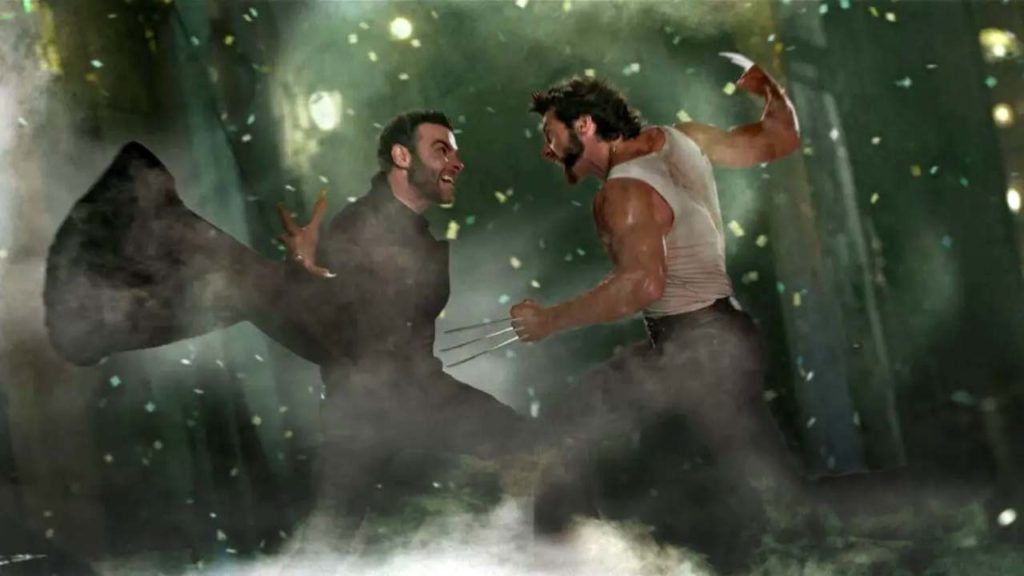
Sabretooth and Wolverine demonstrate the proper protocol in executing a man hug.
Danny Houston portrays a younger version of William Stryker, a role originated by Brian Cox in X2: X-Men United. We learn a little more of his villainous motivations and ties to Wolverine’s secret origin, none of which really surprise or illuminate. Fans might be pleased by superfluous cameos by a younger Cyclops (Tim Pocock) and Professor X (a digitally rejuvenated Patrick Stewart). Then there’s the matter of Sabretooth, whom we already met as Magneto’s henchman (Tyler Mane) in the original X-Men, but now entirely recast and reconceived as Logan’s brother Victor Creed (Liev Schreiber).
A prologue set in Canada’s Northwest Territories in the mid 1800s reveals Logan’s damaged psychology to be the product of fratricide. He and brother Victor were doted upon by a wealthy adoptive father, but their superstitious biological father wanted to kill them. The best sequence immediately follows: an impressive montage of the brothers fighting side-by-side through the Revolutionary War, Civil War, World Wars I and II, and Vietnam War. The wordless sequence succinctly illustrates the immortal warriors growing apart, as Victor becomes increasingly unstable while Logan slowly develops a moral code and distaste for killing.
A Wolverine film seemed like a promising idea when I first heard of it; it could have provided a neat way to shake off the detritus that had accumulated by the end of the original trilogy. Each subsequent installment added too many additional characters drawn from decades of Marvel Comics history, and quickly snowballed to the point where the ensemble cast became comically unwieldy (pun intended). So, the notion of a fresh story focused around just one character sounded like a wise choice.
But expecting a smart creative choice from 20th Century Fox was obviously too much, for the movie is overstuffed with a tremendous number of X-Men b-listers, including The Blob (Kevin Durand), Deadpool (Ryan Reynolds), Gambit (Taylor Kitsch), The White Queen (Tahyna Tozzi), and Bolt (Dominic Monaghan). The latter, incidentally, features in one of the best scenes in the film, in a low-key confrontation with Victor that approaches real drama.
The Amazing Adventures of the Uncanny C-List Characters, coming soon from Marvel Comics.
Worse than the proliferation of supporting characters is its menagerie of villains. Like Spider-Man 3, the film features a muddled array of enemies when just one well-developed villain would have suited the story better. At least three mortal nemeses align themselves against our hero here: Stryker, Sabretooth, and Weapon XI. The best, most iconic comic book villains are flamboyant characters intricately tied in with the origins of the hero: Batman vs. The Joker (Jack Nicholson, Heath Ledger), Spider-Man vs. The Green Goblin (Willem Dafoe), and Superman vs. Lex Luthor (Gene Hackman, Kevin Spacey). But Wolverine’s most serious foe here is the literally mute and expressionless Weapon XI, devoid of character or charisma. Worse, his moniker looks much better in print than spoken aloud; “Weapon Eleven” doesn’t quite roll off the tongue.
X-Men Origins: Wolverine is directed by Gavin Hood, of the critically respected film Tsotsi, making it unusually finely pedigreed for an escapist piece of entertainment based on kids’ comic books. Marvel Comics seems not to have learned its lesson from handing Hulk to Ang Lee and Thor to Kenneth Branagh. A good case study for Fox and Marvel would have been Warner Bros.’ disastrous Invasion, from Oliver Hirschbiegel, director of Downfall. Both Invasion and X-Men Origins: Wolverine are somehow fatally broken, to the point where they fail to make rudimentary sense (which ought to be a base requirement for popcorn special-effects-driven blockbusters). Is it too much to ask that films like this at least be internally logical?
Stryker’s scheme simply doesn’t add up. What exactly does he intend to do? Stryker is evidently dissatisfied with his creation Weapon X (who escaped and became Wolverine). After what he perceives as a failed beta test, Stryker moves on to Weapon XI, an ostensibly perfect soldier with superpowers extracted from other mutants. So why does he go to extreme lengths to keep Wolverine under observation by a fake girlfriend (Lynn Collins) for several years, when all he has to do is kill him and extract his powers with his super-syringe? Even more puzzling, if Stryker wants Logan dead, why does he trick him into signing up to become Weapon X? Stryker succeeds only in making an already near-indestructible man even more so.
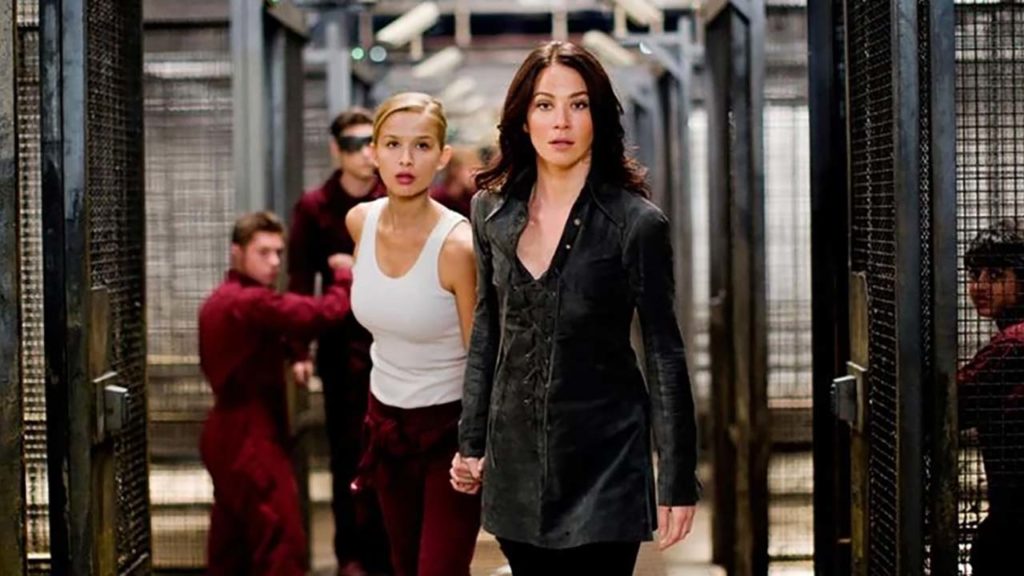
The White Queen and Silverfox look worried as they dash through some corridor or something, whatever, who am I kidding — Tahyna Tozzi and Lynn Collins are just in this movie to titillate the fanboys.
The problem with comic book superhero stories is that there’s a point at which your powerful protagonist becomes literally inhuman, and thus difficult to find sympathetic or relatable. The best example is Superman, literally an alien who can do almost anything. What kinds of problems would such a creature have, and how can any viewer relate to him? Here, Logan and his nemesis Victor are both effectively immortal, so there is little at stake in their conflict. The most interesting comic book superheroes must reconcile superhuman powers with their deep flaws and anxieties, like Spider-Man’s insecurities and Daredevil’s disability, or are normal human beings with extraordinary drive, like Batman and Iron Man.
A pirated version of X-Men Origins: Wolverine infamously leaked online before its official theatrical release. It was roundly panned, and Fox attempted damage control by claiming it was an unfinished workprint with placeholder CGI, sound effects, and titles. According to the Los Angeles Times, the version finally released in theaters was almost identical, an embarrassment to say the least.
The special effects are rather shoddy, especially compared to the state of the art as seen in its contemporaries Star Trek and Transformers 2: Revenge of the Fallen. Wolverine’s claws and Sabretooth’s bounding and pouncing suffer especially from unconvincing cheapness. The only two genuinely impressive exceptions were wasted, to showcase supporting character Cyclops’ laser eye-beams slicing large structures into geometric chunks.
Stray Observations:
Two easter egg codas follow the credits. One is totally unnecessary (Stryker’s fate is better left to the imagination), but the other is enjoyably campy, with a kind of sick humor that could have enlivened the rest of the film.
The DVD features an anti-smoking Public Service Announcement, no doubt penance for Logan’s signature cigar-chomping. But where are the warnings against drinking alcohol, riding motorcycles without helmets, killing people with blades, and performing unethical medical atrocities?
The script is a nonstop barrage of cliches: if I had subtracted one star for every time somebody utters “Let’s do this” or “Look what the cat dragged in,” my rating would be, well, a lot of negative stars.
It’s tempting to throw up one’s hands in despair that the well of source material for movies has dropped this precipitously low, to the level of plastic action figures. To be fair, trash (escapist or just plain trashy trash) has existed since the very first days of the medium. But cinema’s early conception as a theatrical presentation for a paid seated audience associated it with live theater, and many early narrative silent filmmakers looked to plays and literature for source material.
Over 100 years later, no amount of original material, adaptations of great works, or repeated remaking of other movies could be enough to feed the industry’s hunger for story. It took almost 80 years for Hollywood to draw upon comic books for anything beyond cheap serials, with mixed success. Richard Donner’s Superman (1978) reverberated for years, leading directly into other seriously budgeted prestige productions as Tim Burton’s Batman (1989) and Warren Beatty’s Dick Tracy (1990).
At the risk of sounding like a curmudgeon, something has changed. Drunk on the proceeds of a second wave of comics movies (particularly Bryan Singer’s X-Men and X2: X-Men United and Christopher Nolan’s Batman Begins and The Dark Knight), Hollywood burned hundreds of millions of dollars on failed projects based on comics properties that even many comics fans might not be terribly familiar with, including Tank Girl (1995), Elektra (2005), and Jonah Hex (2010). With the most well-known comic book properties exhausted for now, Hollywood is quickly turning to toys and even from board games (Peter Berg’s Battleship and Ridley Scott’s Monopoly are coming soon to a theater near you).
Ninjas: The reason 10-somethings played with G.I. Joes and also the reason 30-somethings went to see this movie
G.I. Joe: The Rise of Cobra is based on the eponymous line of plastic action figures and accessories marketed to boys in the early 1980s by toy company Hasbro. No doubt it was rushed into production after the massively lucrative success of Michael Bay’s two Transformers films, which were also based on a contemporaneous toy line. The critical reception to The Rise of Cobra was all but assured as soon as it was announced; it was of course widely and justly panned. But I happened to see it in quick succession with Transformers: Rise of the Fallen and X-Men Origins: Wolverine. In such company, it is a masterpiece, if for no other reason than its logic is internally consistent (if stupidly implausible).
Although possessed of a certain degree of deliberate camp not seen since Burton and Beatty’s comics-based films, the movie seems bizarrely unaware of spoofs that came before it. Echoing the Mystery Science Theater 3000 theme song, a title card announces the story is set in the “Not too distant future” — which, as any MST3K fan knows, promises cinematic crimes against humanity.
The futuristic settling weakly explains away the advanced weapons and transport technology readily available to G.I. Joe, an elite transnational military force with seemingly unlimited funding, and its nemesis Cobra, a terrorist organization enamored of teleconferencing. Traditional ballistics are deprecated in favor of cheesy laser blasters that provide for lots of death, all of it bloodless. To be fair, this is relatively more realistic than the comics and cartoons, where every shot simply missed and nobody was maimed, disfigured, or killed despite a constant state of war. The other major head-slapping moment of cultural deafness comes when a major action set piece is staged in Paris, as Cobra disintegrates the Eiffel Tower. Does no one involved remember Team America: World Police?
Body armor works better if molded with faux breasts and six-packs.
Its structure is a strange and confident gamble; rather than start the story in the middle, with its heroes and villains established and locked in perpetual battle as in the source material, we start before Cobra even rises. The movie makes plain its intentions to set up a franchise, not even giving birth to two of its most iconic characters until the final moments.
The entire movie is designed as one giant origin story hobbled with numerous flashbacks. First off, a prologue set in 1641 France features an ancestor to Scottish weapons dealer James McCullen (Christopher Eccleston), with little benefit beyond providing a framing device. Other flashbacks tell us more about the rivalry between dueling ninjas Snake Eyes (Ray Park) and Storm Shadow (Lee Byung-hun), and the relationship between Duke (Channing Tatum), The Baroness (Sienna Miller), and her brother The Doctor (Joseph Gordon-Levitt, hilariously full of himself in promotional interviews, citing the art of kabuki as his inspiration for acting much of the film behind a mask). The Baroness and The Doctor (not to be confused with Eccleston’s most famous role) are siblings, Duke dated The Baroness, and was once responsible for protecting the young Doctor. Got all that?
None of these tangled family ties figure into the original mythos established in the 1980s comic books and animated television series, which existed in service of promoting the toy line. The ancillary media provided characters and scenarios for play, all with the aim of inspiring kids to want to collect the whole set and stage epic battles in their parents’ basements. The stories provided by marketers arguably reduced the element of imagination in children’s play. But looked at another way, the entire G.I. Joe package could be seen as a large-scale multimedia act of world-building. Over time, the brand accumulated an epic story with a giant cast, and may have helped set the stage for later ambitious serialized popular fiction of the 21st century, like Lost.
Modelling the latest in terrorist fetishwear is Sienna Miller as The Baroness
The story ultimately centers around Duke and his pal Ripcord (Marlon Wayans), suggesting that the filmmakers failed to poll fans to find out what exactly it was they found appealing about G.I. Joe as kids. Ask anyone who actually read the comics, watched the cartoons, or played with the toys, and they will tell you Snake Eyes was always the coolest character. His unrequited love for the Joes’ sole female operative Scarlett and complex relationship with “brother” Storm Shadow provided most of the longest-running storylines.
Sommers’ movie minimizes the disfigured, mute ninja commando (despite the perfect casting of Park, from X-Men and Star Wars: The Phantom Menace), and inexplicably costumed with a mask incorporating a mouth. Scarlett’s affections are here transferred to Ripcord, and Storm Shadow is more overtly evil, whereas I recall his loyalties being more interestingly ambiguous, even in the simplistically kid-oriented comics. His apparent death is an obvious homage to The Phantom Menace, as is an underwater submarine battle lifted from any number of other George Lucas space battles. In the exact inverse to Storm Shadow, the purely villainous Baroness is here transformed into a fixer-upper.
Joseph Gordeon-Levitt and Christopher Eccelston as Gollum and Richard III, in G.I. Joe: The Rise of Cobra
One flaw the movie retained from the comics and cartoons: while each “Joe” has a distinct codename and personality, most of Cobra’s forces are nameless and faceless drones. Indeed, their stormtrooper brains have been surgically modified to turn them into obedient zombies. Some meager drama is derived from The Baroness’ potential rehabilitation, but her villainy is defused by making her another victim of mind control. Leaders Destro and Cobra Commander are classic examples of the grotesque figure in literature — like Gollum and Richard III — where physical deformity is an outward expression of evil.
Following the overt racial caricatures in Transformers: Rise of the Fallen, I feared the worst for Marlon Wayans as Ripcord. Indeed, the trailer made a point of highlighting his clowning around. But surprisingly, one of the few areas in which the film managed to outperform expectations was its treatment of its non-white characters. Wayans was given the opportunity to be often genuinely funny and not nearly as irritating as the trailer suggested. Ripcord gets real chances to prove himself, succeeds, and even gets the girl in the end. Further proving The Rise of Cobra‘s bona fides as a surprising source of affirmative action is Saïd Taghmaoui as the heroic Breaker, finally breaking out of his terminal stereotyping as a generic Middle Eastern terrorist / enemy combatant (q.v. Three Kings, Vantage Point, and Traitor). Now if we could just do something about Cobra being made up of evil Brits, Scots, Japanese, and Eastern Europeans.
In retrospect, the first X-Men movie did an incredible job of managing the introduction of a wide array of characters to mass audiences likely unfamiliar with the decades’ worth of continuity established in its comic book source material.
But the sequel X2: X-Men United crowds the stage with too many new faces in addition to the returning original cast, in addition to having a truly annoying complicated title. In short order, audiences not only have to recollect the original characters but also learn how Stryker (Brian Cox), Iceman (Shawn Ashmore), Pyro (Aaron Stanford), and Lady Deathstrike (Kelly Hu) fit in to the mutant menagerie. X2 also expands the ranks of the Blue Man Mutant Group, with Nightcrawler (Alan Cumming) joining Mystique (Rebecca Romijn-Stamos) in head-to-toe body paint, later to be accompanied by Beast (Kelsey Grammar) in Brett Ratner’s risible X-Men 3: The Last Stand.
Nightcrawler auditions for a spot in the Blue Men Mutant Group
Holocaust survivor Magneto (Ian McKellen) is still just as genocidal as his former Nazi oppressors, an irony he fails to perceive despite it being pointed out to him repeatedly. His aims and obsessions make for a very good villain, but also for a virtual repeat of the previous movie’s plot. In the original, Magneto built a device to forcibly mutate homo sapiens into homo superior, the arising species known as “mutants” to which both The X-Men and his Brotherhood of Evil Mutants belong. The weapon turned out to be faulty and instead simply killed every human within range. To a man like Magneto, said glitch was not a bug but a feature.
Nothing if not persistent, he employs basically the same scheme in X2. New baddie Stryker has reverse-engineered Professor X’s mutant-detection device Cerebro into a weapon capable of killing all mutants en masse. Magneto plots to repurpose it to kill all humans instead.
Kelly Hu as Lady Deathstrike, something of a deep cut from Marvel Comics lore.
Also recycled from the previous movie is the fact that Magneto is again not the movie’s true villain, despite long holding the rank of the X-Men’s official chief nemesis. The real antagonist last time around was intolerant politician Senator Robert Kelly (Bruce Davison). Now the foe is another powerless human, Colonel Stryker, a warmonger with a private army. Like Kelly, he’s a fervent speciesist, so enflamed with passionate hatred of mutants that he transforms his own mutant son Jason (Michael Reid McKay) into a component in his genocidal weapon.
One notable tweak to the original recipe is a heavier dose of violence and killing perpetrated by the fan-favorite Wolverine (Hugh Jackman). As a character, Wolverine is capable of both berserker rage and human empathy, but his movie incarnation seems to be able to turn it on and off at will. Coupled with a PG-13 rating dictating that his slaughter remain bloodless, this negates one of the tragic flaws of the character I recall from reading the comics as a kid.
Wolverine babysits The New Mutants
The Wolverine I remember constantly struggled to keep his animalistic side in check in order to live among his friends, lovers, and allies. The movie Wolverine is a little bit of a softy, actually, spending much of film babysitting mopey teen trio Iceman, Pyro, and Rogue, the latter still harboring an unrequited crush on a dude way too old, hairy, and Canadian for her.
X2‘s biggest problem is that it has no sense of humor, allowing the grimness of the scenario to drain most of the fun out of the experience. The original had only a single credited screenwriter, David Hayter, but the sequel teams him with Michael Dougherty and Dan Harris — hinting that the crowded stage of actors was paralleled by a few too many cooks in the kitchen backstage.
One good scene, at least, provides a reminder of what the first film got right: when the teen Iceman reveals his superpowers to his parents for the first time, his mother asks “Have you ever tried to… (awkward pause) not be a mutant?” It’s an excellent scene that uses humor to employ the sci-fi conceit of the mutant experience as a metaphor for a minority’s troubled coming of age.
Bryan Singer’s X-Men surprised me twice, first in a theater in 2000 and then again on a recent rewatch, by being better than it had any right to be.
I used to be a comics fan, and read most of Chris Claremont and John Romita Jr.’s lengthy run on The Uncanny X-Men series in the mid-80s. Even though I had long since stopped reading comics regularly by the time the movie was announced in 2000, I recall being convinced there was no way a live-action X-Men movie could not be a ridiculous folly. I went to see it in 2000 partly out of morbid curiosity and partly out of a sense of duty as an ex-x-fan (see what I did there?).
As it turned out, writer David Hayter and director Bryan Singer’s expert adaptation of the Marvel Comics source material was more fun, clever, and exciting than I had pessimistically assumed. Most welcome of all, it is frequently laugh-out-loud funny (in a good way), a key ingredient unfortunately lacking in its mostly humorless (but still pretty good) sequel X2: X-Men United (2003).
It was easy to be pessimistic about an X-Men movie, but somehow this team pulled it off.
Hayter and Singer managed to dig up every ounce of subtext baked into the X-Men mythos by original writer Stan Lee and artist Jack Kirby. At its heart, the comic book series was essentially a neverending sci-fi soap opera with a noble moral of progressive social awareness. The weirdo superheroes that make up The X-Men team are “mutants,” born of human parents but with superhuman powers typically manifesting during adolescence. Prior to Lee and Kirby’s innovation, comics’ superhero templates were either extraterrestrials like Superman or ordinary humans with artificially gained superpowers like Spider-Man (mere mortals Batman and Iron Man don’t count, no matter how inordinately driven to fight injustice). Unlike the physical ideal Superman, most of Lee and Kirby’s mutants did not view their powers as gifts, and some were outright monsters.
The X-Men formula also incorporates deeper themes of racism, xenophobia, and even evolution. Indeed, the entire premise is built upon the theory of evolution: as multiple species of humans walked the earth simultaneously hundreds of thousands of years ago, so too do humans now find themselves sharing the earth with arguably the next branch of homo sapiens’ evolution: known in the comics as “homo superior.” Carried through to the next logical conclusion, this mutant minority is feared and demonized as freaks by the humans that vastly outnumber them.
The Royal Shakespeare Company mutants face off
The X-Men’s sympathetic antagonist Erik Lehnsherr (Ian McKellen) is a survivor of a German concentration camp. The horrors he experienced at the hands of those that hated his ethnic group (but didn’t yet realize he was actually a different species) in 1944 Poland inform his actions as the supervillain Magneto. As he listens to contemporary American politicians argue over how to contain and suppress the increasing mutant population, he disgustedly states “I’ve heard these arguments before.” His former friend (and fellow mutant) Charles Xavier (Patrick Stewart) hopes to find a way to live in peace, and counters “That was a long time ago. Mankind has evolved since then.” But Magneto is unyielding. “Yes. Into us.”
The crucial factor that had me simply assume the movie would be terrible was casting. It’s not hard to imagine a young actor able embody Spider-Man’s secret identity Peter Parker as a put-upon geek harboring tremendous reserves of guilt and righteousness. But how do you cast Wolverine, a diminutive, half-animal Canadian supersoldier with ridiculous hair? Easy! You hire the tall, absurdly handsome Australian studly song-and-dance man Hugh Jackman.
Talk to the claws
Against all odds, Jackman totally nailed the fan-favorite character. The moment in the film when this former X-Men comics fan decided that Jackman succeeded is a sequence in which he steals an X-motorcycle and discovers a handy turboboost button. The entire audience at the New York Ziegfeld theater laughed heartily along with his undisguised glee at its total awesomeness. This doubter was completely sold.
Another casting coup was the double-dose of Royal Shakespeare Company gravitas provided by McKellen and Stewart (both with extensive experience in fantasy and sci-fi genre material, as Gandalf in Lord of the Rings and Captain Picard in Star Trek: The Next Generation, respectively). Bruce Davison (as the xenophobic Senator Robert Kelly) also has a long history in science fiction, having starred in Willard and the influential classic The Lathe of Heaven.
James Marsden later proved himself to be entertainingly charismatic in Enchanted, but here he’s a victim to the humorless character of Cyclops. As Wolverine correctly and succinctly psychoanalyzes him, he’s a dick. Similarly, Famke Janssen isn’t given a whole lot to work with as the no-fun-please Dr. Jean Grey (known in the comics as Marvel Girl, later to die and rise again as Phoenix in Brett Ratner’s crap sequel X-Men 3: The Last Stand). But together with Jackman, the trio brings alive the Wolverine/Cyclops/Phoenix love triangle drawn from the comics, helping to make the movie accessible.
Just don’t call her Marvel Girl
The one real weak spot in the cast is Halle Berry. Like Jennifer Lopez in Steven Soderbergh’s Out of Sight, she seems to have only one real acting performance under her belt (Monster’s Ball, of course). Here she turns in one of her most bland and toneless performances yet. For extra amusement, be sure to catch the deleted scenes on the DVD edition in which she can be heard affecting a weak pseudo-African accent. It’s a shame, because Storm was a very strong character in the comics around the time I read them. Writer Chris Claremont obviously had an affection for her, even promoting her to leader of the X-Men.
Aside from casting, I imagine the second-biggest obstacle facing the filmmakers was how to introduce the complex X-Men universe to mainstream audiences while preserving its integrity to appease longtime fans. Hayter and Singer came up with the excellent solution of having us meet Professor X and his X-Men through the eyes of newbies Wolverine and Rogue (Anna “That’s my mother’s piano!” Paquin).
Ferocious mutant super-soldier Wolverine can really relate to Rogue’s teenage angst
Both are very different characters that share key common experiences that allow them to bond in a big brother / little sister relationship: Wolverine is a loner amnesiac unaware there are others like him, and Rogue is a young runaway isolated by particularly extreme powers that prevent her from experiencing normal human interaction. Almost anyone can identify with the painful coming of age that comes with her exaggerated adolescence. A startling moment of pathos occurs between them when she sees him wield the fearsome metal claws sheathed in his forearms: “When they come out, does it hurt?” “Every time.”
On an even more practical level, the filmmakers came up with an ingenious solution to the comics characters’ silly costumes by having the movie X-Men wear more photogenic uniforms. Cyclops’ joke about yellow and orange spandex is an easter egg for fans: Wolverine sports such an ensemble in the comics. Best of all, the requisite action set pieces are justified by the characters, not just the plot. For example, a big blow-out staged at a train station is the result of a heartbreaking misunderstanding that causes Rogue to flee the longed-for safe haven she had only just discovered.
The franchise is now set to continue with a trilogy of prequels including this summer’s X-Men Origins: Wolverine, and rumored projects X-Men Origins: First Class and X-Men Origins: Magneto. But with the first of these wracking up some notably awful reviews, it’s clear the first in the series will still stand as the best for some time.
Batman: Gotham Knight is a direct-to-DVD production from Warner Premiere, intended as a back-door prequel to the feature film The Dark Knight. Warner Bros. has tried this tactic before, and will again. 2003’s The Animatrix was a planned interlude in Matrix franchise, enjoying extensive involvement from creators The Wachowskis.
Coming soon is a motion-graphics animated version of Alan Moore and Dave Gibbons’ graphic novel Watchmen, preceding the forthcoming live action feature film adaptation (no doubt Moore, who has long since divorced himself from his past work for Warner Bros.’ DC Comics, has a few choice words for this development).
Do you think that maybe we’ve all forgotten that Batman a childrens’ comic book about a millionaire who dresses up like a bat to catch bank robbers?
The Animatrix and Gotham Knight are portmanteau films, the products of multiple writers and animation teams. But the latter is only tangentially related to its sister live-action film, The Dark Knight. A pair of detectives figure as characters in both, and the gang war that percolates in the background of The Dark Knight is the driving incident behind many of the Gotham Knight tales. But the short films (mostly in an anime style) vary wildly in quality and comprehensibility:
“Have I Got a Story For You” (Shoujirou Nishimi) – A pack of skate rats tell tall tales of the Batman, until the real deal shows up. One of the best of the lot, with a unique hand-drawn animation style, mixed with a little CG.
“Crossfire” (Futoshi Higashide) – Two detectives are literally caught in the crossfire of a gang war. Suffers from particularly awful dialogue.
“Field Test” (Hiroshi Morioka) – Batman receives a new toy from Lucius Fox that works a little too well.
“In Darkness Dwells” (Yasuhiro Aoki) – Guest-starring two veterans of Batman’s rogues’ gallery: Killer Croc and Scarecrow. Some of the best animation, but the story is incomprehensible.
“Working Through Pain” (Toshiyuki Kubooka) – Batman, shot in the gut, struggles alone just to get home. He has hallucinatory flashbacks to his spiritual training in the art of overcoming physical pain. He recalls how his teachers rejected him for his impure motivations (to enable his revenge plan, not to attain higher spirituality). This, one of the best stories, leads directly into…
“Deadshot” (Jong-Sik Nam) – …one of the worst. A master assassin (a blatant rip-off of the character Bullseye from Marvel Comics’ Daredevil) targets Lieutenant Gordon. A really lame conclusion to the collection.