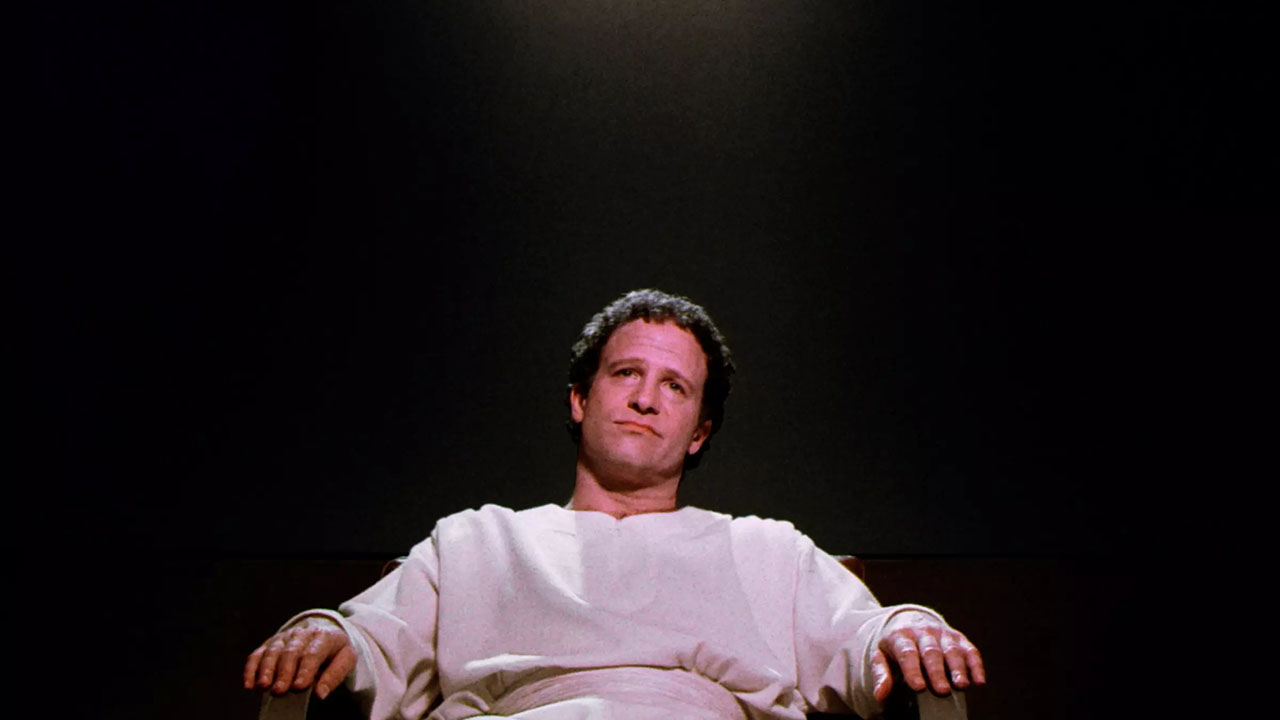
I sometimes find it perversely pleasing to hate a much-liked movie — one enshrined in The Criterion Collection, no less. Nice to know I am not yet a total victim of the monoculture!
I do respect one positive aspect of Albert Brooks’ Defending Your Life that many reviewers single out: it is indeed refreshing to see a secular afterlife onscreen. Brooks’ Daniel violently dies in the most 80s way possible, and finds himself in an afterlife not encumbered by ancient superstition, ignorance, guilt, or shame. But I found its conception frustratingly vague and inconsistent: his life is measured by a narcissistic focus on career achievement and inner fulfillment, but Meryl Streep’s Julia is judged for her sacrifice for others. Should one strive to be a compassionate and selfless person like Julia, or should we listen to more self-help podcasts and try to go viral on LinkedIn? If we are judged by how fully we achieve our own goals, and how good we feel about ourselves, then does that mean all the narcissists, megalomaniacs, and psychopaths automatically get into paradise?
I was also perpetually distracted by Daniel’s repeated assertion that he got hit by a bus, when by his own careless distraction, he in fact caused the accident. Perhaps, if anyone arrives at the pearly gates, having committed manslaughter while alphabetizing their CD longbox collection, then they should automatically get kicked back downstairs to the basement.
Defending Your Life is also inexcusably dated in ways other than compact discs. 1991 was not a hundred years ago. The AIDS joke is as appalling now as it was then, and there are multiple instances of casual racism, usually at the expense of asians.
And if Defending Your Life is to do double duty as a morality play and romantic comedy, there’s an utter void at its heart. I did not find Albert Brooks or Rip Torn amusing or charming in the least, and it’s left to Meryl Streep to strenuously overact in a failed attempt to conjure some romantic chemistry. Every time she doubles over in laughter at one of Daniel’s unfunny quips, I just hated the movie that much more.
When I was a dumb teenager that didn’t know anything about anything, or could tell The Factory from a factory, I first heard Lou Reed through his Transformer and New York albums — the former via the David Bowie connection, and the latter through one track’s inclusion on Rainbow Warriors, a Greenpeace benefit compilation popular at the time.
I would shortly discover that these two albums represented a more accessible side of Reed’s sometimes challenging or confrontational discography — for my next purchase was Songs for Drella. Good thing I didn’t pick up Reed’s notorious Metal Machine Music at that point, or I really would have stopped there. Luckily I think I heard Magic and Loss next, and was back on track.
Detail from the Songs for Drella album cover; which really ought to have clued me in that it was not going to be a rock ‘n’ roll album.
I didn’t know what to make about a drumless song cycle, co-credited with a name new to me at the time, John Cale, and all about an artist I was only vaguely aware of, Andy Warhol. You can excuse a rural kid at the beginning of the ’90s for knowing only one fact about Warhol: he was that one weird artist that screen-printed countless images of Marilyn Monroe and Campbell’s Soup cans.
I’ve come to appreciate the Songs for Drella album more over the years, coincident with learning more about Warhol and The Velvet Underground. Warhol had died only a few years earlier, and Reed & Cale’s songs feel very immediate and personal, and not at all hagiographic. They were in a unique position to have known Warhol better than many who might presume to have opinions about him or his work. They evidently retained complex feelings about him, for it’s right there in the title: “Drella” was a derogatory nickname (Dracula + Cinderella) that Warhol didn’t appreciate.
Detail from the original VHS/laserdisc cover. “I love images worth repeating and repeating and repeating”.
Many of the songs channel his voice in the first person, about the mundane (perceived slights at an MTV event), to the cataclysmic (his attempted assassination by Valerie Solanis — who herself would be the subject of a dramatic depiction in the film I Shot Andy Warhol a few years later). Lest this all sound too artsy fartsy, some of the tunes are real bangers, like the stomping “Work”.
A live performance in December 1989 at the Brooklyn Academy of Music was filmed by Ed Lachman, and a new 4K restoration is currently screening on The Criterion Channel. It was fortunately shot on film, not SD video, so it looks and sounds great. I listened to part of it through headphones, and the audio is notably clear and intimate. You can hear in the stereo mix when Reed or Cale even slightly turn their heads while singing.
“Work”, from Songs for Drella. The full film is available in much better quality on The Criterion Channel.
I strongly recommend the film for anyone with more than a passing interest in Cale, Reed, or Warhol, and who either doesn’t know the Songs for Drella album, or for whom it never clicked. Those with a mental image of Reed from his glam Rock ‘n’ Roll Animal period, or the cool tough guy downtown poet of the New York era, might be a little surprised to see him looking so studious here. The always-dapper Cale, with an excellent haircut, looks in his element. Watching a live performance of the whole song cycle straight through, with the two legendary musicians sitting opposite each other like a proper hoity-toity music recital, really suits the material.
The Night of the Hunter is a perennial source of fascination for cinéaste, both as a singular oddity in Hollywood history but also as a masterpiece in the truest sense: not only is it the best of what it is, it’s the only.
“Beware of false prophets, which come to you in sheep’s clothing but inwardly they are ravening wolves”
The Gospel of Matthew
It’s difficult to divorce any analysis of the film itself from its remarkable trajectory from rejection to acclaim. Watching it for the first time is one of those shocking, startling moviegoing experiences that makes one want more, more from whomever made this — by the way, who made this, again? And then when one finds out its director only made one film, this one –¦ impossible! How could this have come out of nowhere? How can there not be more? What could have possibly happened?
Noted actor and stage director Charles Laughton sadly did not live to see his only film as director receive its complete reappraisal and entry into the canon. Luckily for history, he saved his sketches, memos, and critically, hours of rushes. Nearly five decades later, film archivist Robert Gitt assembled these materials into the feature-length documentary Charles Laughton Directs The Night of the Hunter(available on the 2010 Criterion Collection edition). No mere making-of, compilation of deleted scenes, or blooper reel; but rather a fascinating dive into the process that led to a masterpiece.
Charles Laughton directs The Night of the Hunter
The two-and-a-half-hour treasure trove is perhaps a bit much for the casual fan to absorb, but it’s full of revelatory moments both extraordinary and mundane. In the latter category, it’s bemusing to watch Laughton struggle to coax a performance out of the very young Sally Jane Bruce, who was perhaps better suited to a Shirley Temple-like cutesy comedy. He seems to have also struggled to communicate with Shelly Winters (who, incidentally, between this and Lolita (1962), seems typecast as the doomed, sexually frustrated widow who makes poor choices when it comes to second husbands). Robert Mitchum delivered a remarkably un-vain performance, creating one of cinema’s most terrifying monsters in the sociopathic Reverend Powell. The documentary reveals that Mitchum essentially arrived with the character fully-formed, and Laughton didn’t have to give him much direction. But the film also pierces this bubble slightly: it’s disconcerting to see him josh around after missing a cue (“I would if I could remember my line”).
The Night of the Hunter is so gorgeously designed, lit, shot, and edited that it’s tempting to suspect that perhaps Laughton was great with actors but maybe less of a singular cinema auteur. History lionizes the fabled total control of the likes of Hitchcock and Welles, but Laughton’s single film tempts the suspicion that his collaborators were the true authors. It is true that novelist Davis Grubb provided concept art, but this documentary makes clear Laughton brought the full power of his theatrical staging talent to the Expressionist-inspired visual design of the film. But he did not merely draw upon the past, for his film is ahead of its time in its employ of bold jump cuts and striking aerial shots. He also modestly declined a deserved co-writer credit, and even acted offscreen throughout.
Like something out of David Lynch’s Twin Peaks, even The Night of the Hunter’s crime scenes are beautiful
This exhaustive examination can illuminate the remarkable making of a classic, but the finished film itself retains its aura as something special, mysteriously powerful, and certainly more than the sum of the ephemera that Laughton left behind. Like its unforgettable antagonist, The Night of the Hunter is dark, pitiless, and gruesome. The initial list of ingredients is very film noir, with shoot-first cops and desperate robbers, escaped convicts and gullible widows, and a classic macguffin in the form of literal buried treasure. But the bulk of the action quickly veers into territory uncommon for noir: a condemnation of insincere evangelical mania, and a surreal journey into hell by two homeless orphans pursued by a primal archetype, all while slowly starving to death.
The visual design of The Night of the Hunter drew from German Expressionism
In that respect The Night of the Hunter portends the similarly harrowing Grave of the Fireflies (1988). It does, however, pull back from the brink of pure nihilism with its concluding paean to the resilience of children to abide and endure, while allowing for a hint of lasting trauma in the famous line “It’s a hard world for little things”, and a heartbreakingly sincere exchange of gifts.
In our #metoo era, we are more conscious than ever of male abuse and gaslighting, including reexamining classic Hollywood film plots. The Night of the Hunter holds up well in our present, and it’s hugely empowering to see Lillian Gish as a formidable woman that isn’t fooled for one moment by the villain. She is the perfect archetypal mother figure, protector and nurturer of children, to counter and negate the masculine monster. She confronts him with the most emblematically male, violent, and dare I say phallic of movie props: a gun, but defeats him in the most emasculating way of all, by revealing him as pitiful.
Trainspotting is a lifelong personal favorite film. Essential.
FilmStruck subscribers should be sure to catch it one more time before before WarnerMedia and AT&T cruelly shut it down on November 29. FilmStruck is full of more invaluable treasures than anyone could watch in two weeks, but I must single out Trainspotting as a particular treat, as the commentary track, deleted scenes, and more from the 1996 Criterion Collection laserdisc are included.
One of many interesting details to be gleaned: Director Danny Boyle and producer Andrew Macdonald declined a higher budget in order to have the artistic freedom to depict the death of an infant. Yes, it is almost unbearable to watch, but it would have been a lesser movie without it.
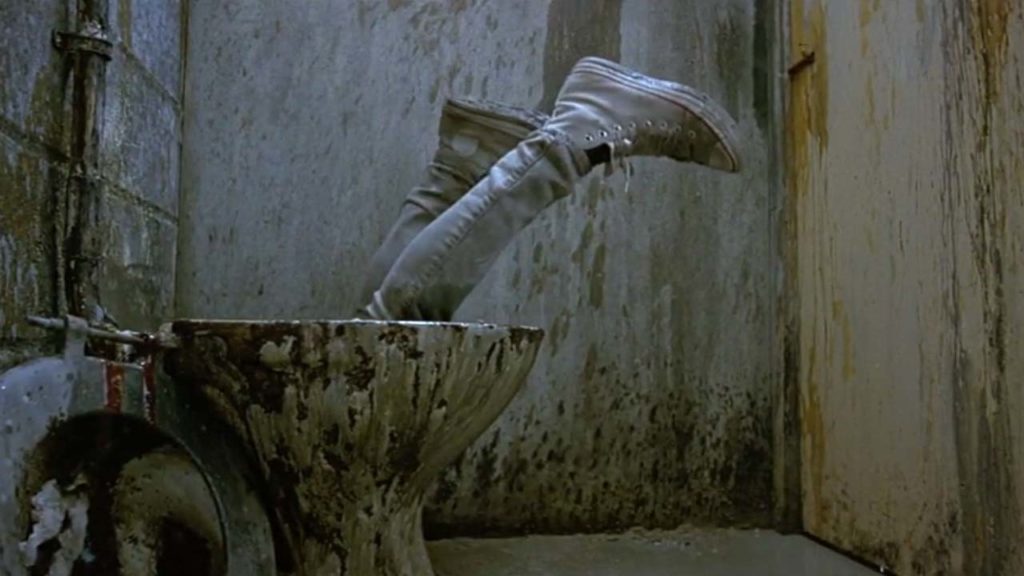
The worst toilet in Scotland.
Screenwriter John Hodge notes that novelist Irving Welsh regretted his dominant focus on the male characters, and made a point of highlighting female characters in subsequent novels. Great, but this only highlights the biggest shortcoming of its belated sequel T2 Trainspotting (2017), which made exactly the same mistake. It’s a cinematic crime to have Kelly Macdonald and Shirley Henderson in your movie but give them little to no material. Perhaps not on a par with WarnerMedia and AT&T’s philistine, craven axing of FilmStruck, but still pretty bad.
Further reading:
The spirit of FilmStruck will live on in The Criterion Collection’s own Criterion Channel streaming service, to launch in Spring 2019. According to the press release, some or all of its programming will also be available on a separate WarnerMedia streaming service, but as history has shown that such partnerships have not lasted, I will personally be subscribing directly from Criterion.
Detective Bobby Gold (Joe Mantegna) comes to see himself as torn between two discrete worlds in David Mamet‘s Homicide (1991). Only when maneuvered into a position in which he must choose, the duality unravels and he finds he is no one special and belongs nowhere in particular.
Gold’s partner Sullivan (William H. Macy) has an unreserved man-crush on him, taking every opportunity to publicly butter him up and extol the therapeutic pleasures of police work. He reminds their peers that his revered partner is “Bobby The Orator,” so-called for his skill at negotiation. Indeed the moniker is deserving, for he is called on to calm a rabid dog with mere words, and later sweet-talk a ferociously stubborn mother into betraying her son.
But Gold is certainly no action hero, confirmed in a early scene as he is beaten up and disarmed by an overweight civilian, in the sanctuary of the police station. By the end of the film, he has lost his sidearm a second time and is quickly physically bested again by Randolph (Ving Rhames). Is it too much of a stretch to link his failure to control his weapon with impotence and castration? He certainly feels perpetually aggrieved. At each unfair turn in these very unfair events, he repeats his refrain: “What did I ever do to you?”
“You got some heavy troubles on your mind? Huh, babe? We’ll work it out. We’ll play some cops and robbers. We’ll bust this big criminal. We’ll swagger around.”
Bobby accidentally comes across a seemingly mundane murder while chasing down the sexier Randolph case (the kind of unambiguous, action-packed police work, with measurable results, that grants Gold and Sullivan existential satisfaction). Elderly Jewish woman Mrs. Klein has been found murdered in her inner-city candy shop. Everything points to a simple robbery, “everything” being, of course, the supposition that poor neighborhood African Americans have robbed a rare white business.
Klein’s son, not quite grieving but resigned to a lifetime of persecution, sighs “It never ends.” When Bobby asks “What never ends?”, granddaughter (Rebecca Pigeon) coldly clarifies for him: “On the jews.” Already the murder escalates from a robbery to a hate crime, and this is a strong whiff of catnip for a man who also believes himself to be perpetually put-upon and aggrieved. As the Klein family correctly infers, Bobby is a Jew. But he wears a 5-point star as a cop. His sublimated Jewish pride only comes out in defense against the occasional professional flare-up in which he is called an ethnic slur.
Fittingly for a detective celebrated for a mastery of words, pursuing the Klein murder case is more an act of literary scholarship than one of police procedure. Gold’s investigation brings him to a Jewish research library where he senses deeper mysteries encoded in his ancestral Yiddish. His single best clue is the tantalizing derivation of the nonsense-seeming word “Grofatz.” All of this leads him into a confrontation with a decades-old group of Zionist warriors (who may be or may not be the Mossad, although the name is not mentioned in the film) who awaken him to his vengeful Jewish identity. Hungry for the rush of positive action that his cop side is currently denying him, he elbows his way into their ranks and becomes addicted to violent action.
“Hey, you’re better than an aquarium, you know that? There’s something happening with you every minute.”
But Homicide is a policier on the surface only. Like most of Mamet’s plays and screenplays, the plot is structured around a deep, complex confidence game. House of Games, The Spanish Prisoner, Glengarry Glen Ross, Spartan, and Redbelt all feature a long con of one form or another at their cores. A sucker is a sucker because of the truism that if one looks hard enough for something, one will find it. Most of Gold’s apparent clues and leads evaporate into meaningless happenstance. What is at stake is not what he thinks, and he finds himself used and abandoned.
Special mention goes to fine cinematography by the great Roger Deakins. The decaying Baltimore provides for two spectacular chase scenes, one along the rooftops and another below the asphalt. Each coils into a labyrinth, spiraling down and in, deeper and deeper, until Bobby encounters physically powerless but immovable minotaur-like figures the disarmed man must battle with his words alone.
Wes Anderson and co-writer Owen Wilson’s feature debut Bottle Rocket is based on their 1992 short film of the same name. Like Kevin Smith’s Clerks and Quentin Tarantino’s Reservoir Dogs, Bottle Rocket may not have turned the world upside down, but is now viewed as a key filmmaker’s ur text. His signature style is already fully present: meticulously constructed of primary colors, written in torrents of words, and shot perpendicularly against exacting mise-en-scène.
The Royal Tenebaums is the only of Anderson’s films to feature parents as featured characters throughout, but Rushmore, The Darjeeling Limited, and Bottle Rocket all concern misfit siblings with largely absent parents. Like the Tenenbaums and the Whitmans (of Darjeeling), the Adams brothers are privileged yet seem to possess nothing of their own.
James Caan and Owen Wilson in Bottle Rocket. “This seems like a nice soirée.”
Dignan (Owen Wilson) throws in his lot with local gangster Mr. Henry (James Caan), who proves to be both a bad boss and poor father figure. Dignan forms an amateur gang of sorts with brother Anthony (Luke Wilson) — an aimless young man suffering from self-diagnosed “exhaustion,” and their pushover friend Bob Mapplethorpe (Robert Musgrave) — of use mostly because he has access to a car. Every detail of Dignan’s grand scheme for his life is plotted out in the handwritten manifesto “75-Year Plan – Notes Re: Careers.” As he tells Anthony, “I think we both respond well to structure.”
Robert Musgrave, Owen Wilson, and Luke Wilson in Bottle Rocket. “On the run from Johnny Law… ain’t no trip to Cleveland.”
They feel the urge to steal (from a chain book store, hilariously, and even from their own parents’ home), not so much for money itself but to enable their fantasy of living independently on the road. Their dream is that being on the lam would provide the excitement they imagine their lives lack. But Dignan’s precise vision of the future is disrupted at every turn. The most cataclysmic event of all is when the romantic Anthony becomes smitten with motel maid Inez (Lumi Cavazos), and he gives up most of their illgotten spoils to help her. Dignan’s own future hasn’t factored in love; eventually he realizes he must set off on his own to find his destiny.
Lumi Cavazos in Bottle Rocket.
The 2007 Criterion Collection edition reprints a 1999 appreciation by producer James L. Brooks, in which he describes how the neophyte filmmakers had little notion of how movies are actually written and made, especially any aspect thereof involving creative compromise. Their first draft was reportedly so wordy that a simple table reading proved epic:
the longest entertainment known to man, beating Wagner’s Ring Cycle before we reached the halfway point of the reading. By the time we approached the last scene, all the water pitchers had been emptied, yet voices still rasped from overuse, and there were people in the room showing the physical signs of starvation.
James L. Brooks
The script was deemed unfilmable, beginning a long process of urging Anderson and Wilson to cut material they held dear, and they held everything dear. The movie still seemed doomed even after successfully shooting a workable script. When early cuts tested poorly before audiences, Brooks tried to console Anderson and Wilson by telling them that early feedback for E.T.: The Extra-Terrestrial was also poor, but it was saved by the music and a memorable logo. Indeed, Brooks credits the score by Mark Mothersbaugh of Devo for helping make the film work.
James Caan only worked on the film for three days, and still seems bemused by the whole thing. But the result has proven a cult classic, and launched the careers of not only Anderson but also the Wilson brothers. The Criterion Collection edition also includes Martin Scorcese’s 2000 appreciation from Esquire, in which he credits Anderson with a rare, true affection for his characters.
Dignan’s belief in his imperviousness is the flm’s “transcendent moment”: “they’ll never catch me, man, ’cause I’m fucking innocent.”
The opening credits of Andrei Tarkovsky’s 1972 film Solyaris state it is “based on the science fiction by Stanislaw Lem.” It’s perhaps telling that the term “science fiction” is used in place of simply “novel.” This faint hint of apology may hint at a lack of respect for the original Polish novel or the entire science fiction genre as serious literature. A similar ambivalence echoes decades later in the advertising campaign of director Steven Soderbergh’s2002 remake, emphasizing the romantic melodrama over the fantastic, futuristic setting.
Stanley Kubrick’s 2001: A Space Odyssey had arrived only a few years before Solaris, and was by a long shot the most serious stab at intellectual, literary science fiction cinema yet filmed. In his essay for the 2002 Criterion Collection DVD edition of Solaris, Phillip Lopate outlines three ways Tarkovky wished to distance his film from Kubrick’s. He found 2001: A Space Odyssey “cold and sterile,” and set out to infuse his own science fiction with “passionate human drama.” Unlike its predecessor’s gleaming high-technology, Tarkovsky built run-down and filthy sets for the space station, and found futuristic earthbound locations in the contemporary cars and architecture of Japan. Finally, Lopate points out that Solaris shares more themes with Alfred Hitchcock’s Vertigo than 2001, namely, “the inevitability of repeating past mistakes.”
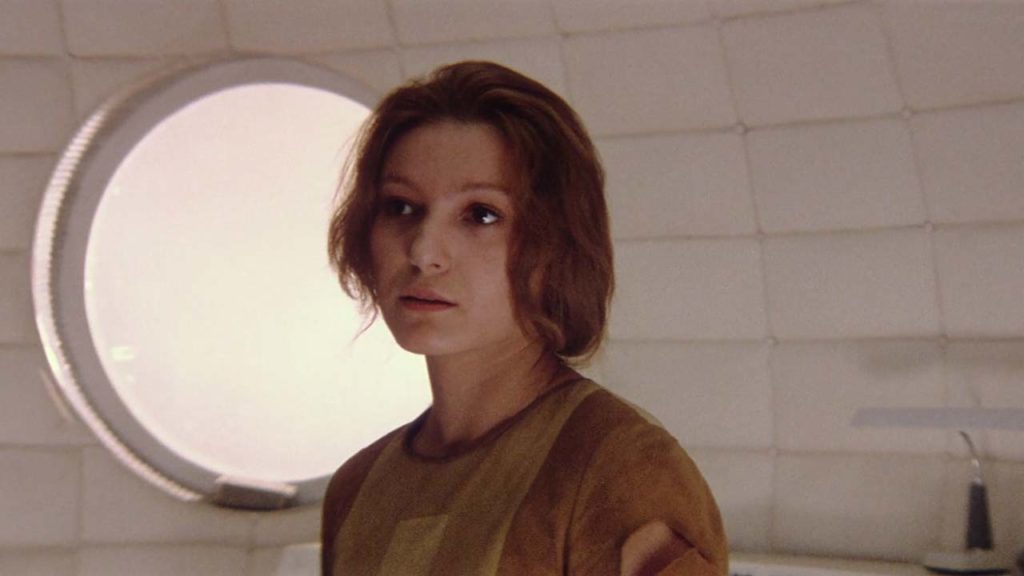
Kelvin sees dead people
The links between the two films go beyond the thematic into the political; Solaris is frequently cited as the Soviet Union’s answer to 2001: A Space Odyssey, so it ought to be viewed in the context of the Cold War. 2001: A Space Odyssey preceded actual manned moon landings, the US’ most definitive victory in the space race. Kubrick’s visuals were so effective that they spawned the still-simmering rumor that the moon landings were falsified using footage directed by Kubrick. But before all this, 2001: A Space Odyssey must have seemed like a threat or promise made to the USSR: saying, in effect, that the US is going to be first in space and the first to make first contact with alien intelligence.
So in this context, it’s hard not to interpret Solaris as at least partly a propaganda countershot. It too illustrates how the society of its makers and audience also have the brainpower and resources to extend their empire into space. But most unlike 2001: A Space Odyssey, Tarkovsky and co-writer Fridrikh Gorenshtein never allude to politics or even mention the names of other countries.
Kubrick’s film envisions no end to the Cold War, even at least thirty years into the future. Kubrick’s vision of the future is actually a wicked satire, showing how little he expects humanity to evolve despite significant technological advances. His future humans still engage in petty squabbles and apocalyptic brinksmanship in the face of a potentially paradigm-shifting revelation: the discovery of definitive evidence of alien intelligence in a manufactured monolith buried on Earth’s moon. The US scientists and government officials investigating the monolith seem unmoved by the powerful notion of alien contact, and instead hold boring boardroom meetings and pose for photographs.
In stark contrast, Tarkovsky’s Solaris has no sense of humor at all, about anything. Perhaps the most significant trait Solaris shares with Kubrick is a penchant for long takes. As Lopate also notes in his Criterion essay, atypically for a Russian filmmaker, Tarkovsky favored long takes over Eisensteinian montage.
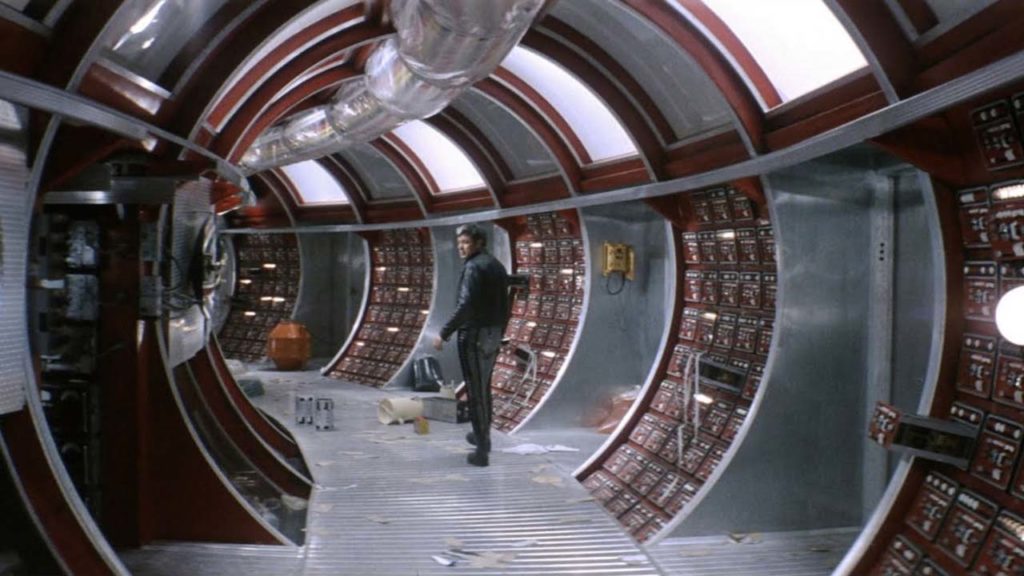
Kelvin inspects the ductwork
In this vision of the future, the Soviet Union operates a scientific research station in orbit over the ocean planet Solaris. An entire school of study called Solaristics has sprung up around the study of the ocean’s peculiar properties. Astronaut Berton (Vladislav Dvorzhetsky) returns to Earth with controversial claims that the Solaris ocean somehow creates physical manifestations of landscapes and monstrous creatures on the planet’s fluid surface. Dr. Gibarian (Sos Sargsyan), still stationed at Solaris, sends for his old friend, psychiatrist Chris Kelvin (Donatas Banionis). Berton, haunted and prematurely aged by his experiences, visits Kelvin at his father’s home in an attempt to warn him about what he is surely to experience, but Kelvin rudely dismisses him. We later learn the source of Kelvin’s misanthropy: his wife Hari (Natalya Bondarchuk) committed suicide after he left her some years before.
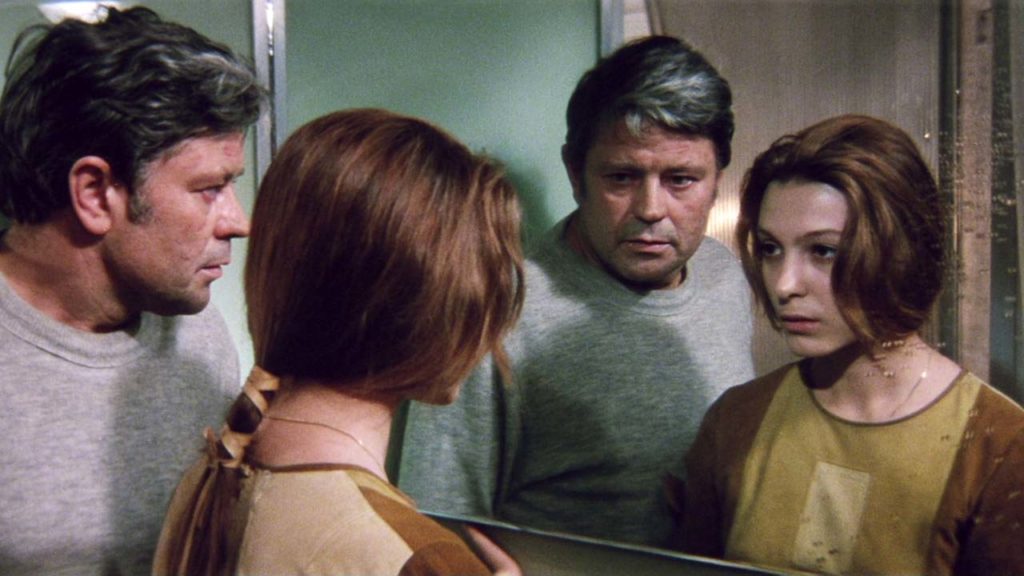
Kelvin arrives at Solaris to discover that Gibarian has already committed suicide. The strange manifestations Berton reported on the Solaris oceans are also occurring on board. Every surviving scientist still aboard the space station is haunted by “guests,” their euphemism for the apparitions that, as best they can determine, are somehow culled from their most emotionally intense memories. In due course, Kelvin’s dead wife reincarnates in a confused, partially-formed state. She is dazed and doesn’t quite understand who she is or why she is there, and doesn’t “remember” that she is dead. When she tries to undress, she discovers her dress is completely sewn shut; Kelvin’s imperfect memories of her apparently don’t include buttons ‘n’ zips. Kelvin also experiences feverish nightmares in which he confuses Hari with his long-dead mother.
The twice-doomed Hari (Natalya Bondarchuk)
In a kind of filmed suicide note, Gibarian tells Kelvin the manifestations have “something to do with conscience,” indicating that the common origin of every guest is that they are each the primary object of guilt in an individual’s mind. Gibarian asks Kelvin “did you see her yet?” suggesting that he sent for him because he correctly predicted Kelvin’s guest would be his dead wife Hari. The presence of Gibarian’s guest (a little girl) was evidently for him an intolerable curse, but perhaps he imagines it would be a gift for Kelvin to have Hari back. But the whole situation begs the question: if the authorities know about the manifestations, why would they agree to send such a psychologically damaged man as Kelvin?
When Kelvin attempts to leave Hari alone in his quarters, the not-quite-human creature manages to smash through the doorway in pursuit. She instinctively doesn’t want to be left alone, but can’t explain why. A suitable science fiction explanation might be that she somehow senses that she may literally dematerialize when Kelvin’s brain is not within proximity. Or her newly-formed mind may be suffering echoes of what the “real” Hari felt when she committed suicide after Kelvin left her. What if Kelvin becomes comfortable living with this reincarnation of Hari, and his guilt for the original woman’s death lessens… will her reincarnation then disappear?
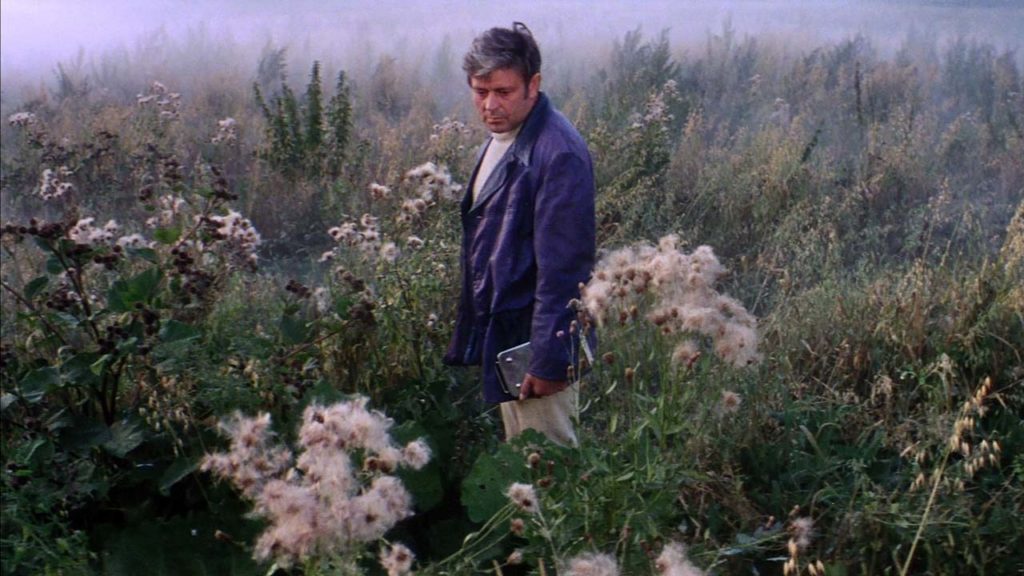
Kelvin at home in Mother Russia
An observation: like Lindsay Anderson’s If…, Solaris uses a mixture of black & white and color film. For most of the first hour, black & white footage initially signifies either film clips or teleconferencing (note that the film correctly predicts widescreen HDTV monitors and webconferencing in the future). But later sequences appear in black and white, without internal justification: first as Berton drives dejectedly back into the city (filmed in the city landscapes of Japan), and later as Kelvin locks himself in his cabin on Solaris. To confuse the matter still further, Kelvin brings a home movie with him from Earth, which is in color! I don’t have a theory to explain these logical discrepancies; I’m just pointing them out.
I’m surprised to find to find that I did not like the film as much as my first viewing almost a decade ago. Solaris is as talky and overwritten as its ostensible model 2001: A Space Odyssey is elegantly quiet. Totally self-serious and humorless, its three-hour running time is frankly a little trying on the patience. In his 1977 appreciation of the film reprinted in the Criterion edition booklet, Akira Kurosawa reports he was stunned by the expense when he visited the set, equivalent to 600,000,000 yen at the time.
But he defends the significant length of the early scenes set on Earth, which he interprets to be intended to instill nostalgia for Kelvin leaving nature behind forever. Indeed, the time spent on Earth in the early parts of the film does prefigure a significant homecoming at the end, when Kelvin seems to return to a dreamlike vision of his father’s house. The formerly lush and moving natural scenery landscape is now wasted and frostbit. It rains inside as well as out, suggesting a kind of baptism or rebirth in the waters of Solaris.
This blogger is slowly cooling on former favorite David Fincher. His underrated first feature Alien3 is highly compromised, but easily the next most thematically interesting entry in the Alien franchise (after, of course, Ridley Scott’s rich original). Se7en is one of the most gut-wrenchingly disturbing movies ever made, notable for having virtually no violence appear onscreen, despite its reputation. Fight Club is perhaps the movie of the nineties, an eccentric blast of countercultural fury.
But almost everything that followed seemed a disappointment. The Game was wildly implausible, without the pop and sizzle that carried the similarly over-the-top Fight Club. Panic Room was an empty exercise in style, seemingly conceived solely for Fincher to experiment with new digital techniques that would allow him to create impossibly continuous camera moves through the walls and floors of a city brownstone (and possibly also as another vehicle for star Jodie Foster’s persona as a single parent to be reckoned with). Zodiac was highly praised both as a tight procedural thriller and as a tour-de-force of still more bleeding-edge digital special effects (so good that most viewers wouldn’t suspect that many sequences were not traditionally shot in-camera), but it did absolutely nothing for me. I’m wondering if I missed some key aspect of it that would open it up to me – and that perhaps I should reappraise it now that a director’s cut is available on DVD.
You’re only as old as you feel
The advance marketing for The Curious Case of Benjamin Button excited me at first, but I was apprehensive when I learned the screenplay (loosely based on a 1921 short story by F. Scott Fitzgerald) was by Eric Roth, the writer of Forrest Gump. Indeed, it did turn out to be constructed in a similar vein and tone, even mimicking some of the corniest devices of Gump: the famous digital feather twirling in the wind has been replaced by an unlikely reappearing hummingbird; Forrest’s mother’s aphorism “life is like a box of chocolates; you never know what you’re going to get” has its analog in the less memorable “you never know what’s coming for you”; even Forrest Gump’s parade of cameos by famous or infamous Americans is here continued with an appearance by Teddy Roosevelt. Against my will, this cutesiness did succeed in drawing me in for most of its running time. I was engrossed for much of it, but its leisurely three-hour running time honestly strained my patience by about the two-hour mark.
Fincher and Roth relate the decades-long story via the framing device of Benjamin’s (Brad Pitt) one true love Daisy (Cate Blanchett) on her deathbed, introducing her adult daughter Caroline (Julia Ormond) to her biological father through a dramatic reading of his diary, with gaps filled in from her own memory. A soon-to-be infamous hurricane brews outside the Louisiana hospital room, shortly to erase much of Benjamin and Daisy’s milieu. The multiple layers of storytelling result is no less than three speaking voices to narrate the tale in voiceover. One framing device too far?
Cate Blanchett is a beautiful woman, and will be at any age, but it’s eerie to see her appear to be in her twenties.
The central conceit of the story is a fantastically unfortunate disease that afflicts one Benjamin Button. His body is born aged and decrepit, and ages backwards while his mind matures normally. As he aptly puts it when still a boy, he was “born old.” Taking this story as anything other than a parable or fairy tale would be to miss the point, but the photorealistic special effects place the movie firmly in believable reality. So this viewer’s mind (when not distracted by the high-tech visuals) pondered the logistics.
Some of the rules don’t seem to hold up: as a chronological adolescent, he manifests the typical sexual desires and self-centeredness. But his aged body strangely has the physical fitness and stamina/potency to act them out (we see him preening in front of a mirror, seemingly only aged from the neck up). Also, presumably, Benjamin can be assured to die when his body regresses to infancy. So, given his physical state at birth, is his death date pre-ordained? If he had been born with an infantilized body of a 20-year old, could he have been assured of only having two decades to live? Is he impervious to harm? There is onscreen evidence to support this theory: he somehow manages to survive being stepped on as a newborn, and later, is one of the few survivors of a German submarine attack on an outclassed tugboat during World War II.
Benjamin is adopted by Queenie (Taraji P. Henson), an unfortunately stereotypical African American character, and spends his youth and old age (and vice versa!) at the nursing home she manages. There, he meets his one true love Daisy, the niece of one of the tenants. Benjamin’s curious condition prevents him from having any kind of normal friendship or relationship with her, so he leaves home to find his way in the world.
He has his first serious relationship with Elizabeth Abbott (Tilda Swinton), an older woman who thinks she’s younger than him (later, we learn that meeting him helped her change her life). Eventually, Benjamin and Daisy do meet at roughly the same physical age and consummate their mutual love. When Daisy quite rightly asks Benjamin if he will still love her when she’s old and wrinkly, he jokingly turns it around and asks if she will still love him when he has acne.
But what first amuses eventually comes back around to become one of the most painfully emotional sequences in the whole movie: Benjamin does after all regress into senility (or perhaps even Alzheimer’s, before it was identified), trapped in the body of a pimply teenager. As always, the point is that the bell curve of a human life can be seen as a mirror image of itself: here, the impetuousness, aggression, and mood swings of senility are equated with the tumult of adolescence. Likewise, extreme youth and old age both are characterized as the ultimate states of dependence and vulnerability.
Tilda Swinton as Benjamin’s first lover, an older woman whom he allows to believe is younger
The special effects that allow an aged version of Pitt’s face to be superimposed over another, diminutive actor are light years in advance of the still-creepy digital rotoscoping animation style used in Robert Zemeckis’ The Polar Express and Beowulf (although the latter is an excellent film in spite of the ineffective effects). But no matter how eerily fluid and seamless the effects, I could not shake the feeling that I was watching something largely actualized by animators equipped with a giant computer server farm. These obviously cutting edge techniques are more comprehensible to me than whatever the makeup and/or CG wizards did to make 44-year-old Pitt and the 39-year-old Blanchett appear to be in their smooth-skinned and limber-limbed early 20s. Also, it must be said that an artificially aged Pitt in his hypothetical 50s and 60s is a dead ringer for Robert Redford.
There must be something in the bottled water filmmakers have been drinking recently, for I’ve noticed a decided trend towards movies about aging recently. Sarah Polley’s Away From Her and Tamara Jenkin’s The Savages both look at the senility that often comes at the end of life, and how it may affect the lives of those still living, for better or for worse. But another pair of movies dealt with mortality and the fear of unfinished business through the lens of fantasy: Francis Ford Coppola’s Youth Without Youth and Charlie Kaufman’s Synecdoche, New York. All of these movies tap into most people’s fear of aging: not only of losing physical health and thus independence, but also of the reliability of one’s own mind.
Akira Kurosawa’s Seven Samurai is awesome and perfect, and this most recent viewing has affirmed its place among my all-time favorites. It’s a big movie, by which I mean it makes the best use of its generous running time with just the right amount of everything: romance, comedy, drama, suspense, and action. Nearly half the film is taken up by a massive, expertly choreographed battle rivaling anything put to film by famous Western directors of violent spectacle like Michael Mann or Steven Spielberg. Long as it is, it’s about 15 minutes shorter than Gone With the Wind but twice as epic, twice as substantial, twice as… well, twice as good.
It is, in some ways, a simple tale broadly told. A rice farming village in 16th century Japan is under constant siege by a band of parasitic bandits that abduct its young women and regularly steal most of its annual yield. With no government or military to protect them, the villagers pool their meager resources to hire seven ronin (masterless samurai reduced to surviving hand-to-mouth as mercenaries) to fight on their behalf.
You messed with the wrong ronin
The archetypal characters seem simplistic on the surface: villains to boo and heroes to cheer. In case the viewer have any doubt as to who the bad guy is, the chief bandit wears a black eyepatch, for crying out loud! Kambei (Takashi Shimura), the supremely capable and wise leader of the samurai, essentially lays down a universal definition of “hero” with his recruitment call: “There’s a tough battle ahead, leading to neither money nor rank. Will you join us?”
And yet, many subtleties gradually unfold. Kikuchiyo (Toshiro Mifune) is one of the great pleasures of the movie, but also one of its greatest mysteries. He’s clownish and childishly impulsive, yet passionately moral. He’s a commoner masquerading as a samurai, his only certification being his ridiculously long sword (presumably the liberated former possession of a very tall samurai).
Kambei, whom in another life could have been a good shrink, correctly deduces Kikuchiyo’s motivations for having attached himself to the venture; he himself is a peasant farmer with pretensions to more. He directly identifies with the farmers’ plight, yet his deep-seated class insecurities fuel his a love-hate relationship with them. As an essay by Kenneth Turan in the Criterion Collection edition booklet points out, medieval Japan was a fiercely delineated caste society, and the fact that a former farmer might presume to call himself a samurai is a huge transgression. For a very different, more subdued dramatic performance by Mifune, see Kurosawa’s Stray Dog.
Toshiro Mifune is a wild and crazy samurai
As we learn more about Kikuchiyo, we likewise slowly get a more and more complex portrait of the villagers. They are no doubt the victims of a serious crime. Yet they whine all the way and mythologize themselves as helpless, saintly, victimized salt of the earth that must resort to hiring disgraced samurai to protect them. But they harbor a dark secret; they have robbed many fallen samurai of their armor and weapons over the years Their veritable armory of pilfered gear of war is useless to them, and yet they shamefully hide it from the samurai protecting them (even though it would bolster their coming war). The seven samurai are deeply offended, and yet nevertheless do the right thing and defend the village. But the gulf between the two classes, samurai and farmer, is reaffirmed.
Seven Samurai is in the company of 2001: A Space Odyssey, Citizen Kane, and Vertigo, a special class of film so famously influential that even first-time viewers may very well feel they’ve seen it before. Just to name a few of Seven Samurai‘s first-generation offspring: The Magnificent Seven is an unapologetic transposition of the original from feudal Japan to the American West. The Dirty Dozen and Ocean’s Eleven both borrow the trope of recruiting a gang of misfits one-by-one, whom in concert become capable of strengths impossible as individuals. Another American-produced remake is scheduled for release in 2009, this time set in modern-day Thailand.
The 2006 Criterion Collection edition is a required library item, not one to merely rent. A magnificent restoration of the film itself is accompanied by a beautifully designed sleeve and booklet. A surprising amount of damage remains in the long battle sequence in the second half of the film, but Criterion’s reputation for quality ensures that these are almost certainly the best available materials. Perhaps those particular reels were more frequently subjected to torture over the years by scholars?
Why you need to read the booklet:
Kenneth Turan on the full year of production it took to make the film, mirroring the time that passes in the movie. On a practical level, the extended production allows for greater realism like Kambei’s hair realistically growing back after shaving his head in the beginning (the topknot is a prized symbol of the samurai; not just a fashion but a requirement of their caste). But also on a thematic level, one year = the farming cycle of life: planting through harvest.
Peter Cowie on the mutual admiration society between Kurosawa (a fan of the Hollywood Western) and John Ford.
Philip Kemp on 16th Century Japan. The feudal society had little distinction between ronin and bandits.
Peggy Chiao on Kurosawa’s influences. Kurosawa was a Marxist in his 20s, but later mellowed. His older brother turned him on to Dostoyevsky, but committed suicide.
Alain Silver on Kurosawa’s staging and composition.
Stuart Galbraith IV on the historical context of the contemporary Japanese cinema, which was flourishing at the time.
Appreciations by directors Sidney Lumet and Arthur Penn.
Toshiro Mifune’s quite funny and entertaining reminiscences. Mifune claims he devised his character, as nothing had been written yet when he was cast.
Supplemental features on the bonus discs:
“Akira Kurosawa: It is Wonderful to Create” – an almost excessively hagiographic biography, but with several amusing anecdotes. Shooting all year meant continuing through February’s freezing mud, while Mifune was almost naked. Kurosawa dutifully stood in the mud with his cast and crew, and was literally frostbitten.
“Seven Samurai: Origins & Influences” – “The Story of the 47 Ronin” was a popular puppet theater tale for hundreds of years, and was adapted into films several times a year in early Japanese cinema. One of those observations that sounds obvious in retrospect, but needs to be pointed out by somebody: Ronin (pronounced by some as “roh-ee-nin”) stories are more popular than samurai stories because they are inherently more dramatically interesting.
“My Life in Cinema: Akira Kurosawa” – a long interview by fellow director Nagisa Oshima.
If…. is the first in director Lindsay Anderson’s trilogy of films featuring Malcolm McDowell as the Mick Travis, whose misadventures continue in O Lucky Man! and Britannia Hospital. Everything I read about the trilogy repeats the same word to descibe Travis: “everyman.” On the evidence, I take this instance particular of “everyman” to mean Travis is a blank slate, a shapeless person pushed and molded by the forces of society about him.
If…. begins with the epigram “Wisdom is the principal thing; therefore get wisdom; and with all thy getting, get understanding” from The Book of Proverbs, but an even better statement of the film’s themes is spoken my Travis himself: “When do we live? That’s what I want to know.”
“When do we live? That’s what I want to know.”
The initially realistic portrayal of life at a British public school, filmed at Cheltenham College but referred to simply as “College”, includes frank depictions of the corporal punishment and homosexuality (mostly repressed, save for in one case, genuine young love). The pupils’ lives are so regimented and ordered that even virtuous activities such as studying are forbidden if not conducted at the proper time and place. Most of the rampant cruelty and capriciousness comes from Whips (the senior class, with privileges) and is sanctioned, or rather, willfully ignored by the aloof adult faculty. It becomes clear the school is satirical microcosm of the British class society: a self-perpetuating system in which the young underclassmen “Scum” eventually grow into the roles of the oppressors.
I think I’ll call you Mini-Malcolm
Much of the students’ time is preoccupied with paramilitary war games couched in religion. As the school chaplain admonishes them, “Jesus is your commanding officer.” The sermon also instructs that desertion is the worst wartime crime, and as all Christians are born with original sin, all are likewise deserters. During one war game, Travis and friends deliberately shoot live rounds at their own comrades. Curiously, the headmaster mildly scolds them as if they had committed an infraction as naughty as nipping at the communal wine. But the first irrefutable instance of the film’s turn towards surreality is when the headmaster produces a faculty member from within a cupboard drawer for whom Travis to apologize.
From this point on, it is clear at least some of Travis’ experiences are fantasy. And what do teenage boys fantasize about but hooking up with hot girls and violently lashing out at enemies? He beds a beautiful waitress (Christine Noonan) in a violently animalistic coupling, who might very well be another figment of his imagination. Together they uncover a cache of weapons and pickled medical anomalies in the school basement (his subconscious?), including a grotesque human fetus. Travis’ anarchic adolescent fantasies climax with a massive school shooting during a nauseatingly patriotic festival honoring The Crusades. Unlike the considerably more tragic school shootings typical to films made in an era of actual teen massacres like Columbine (in films as diverse as Elephant, Empire Falls, and The Basketball Diaries), Travis’ war is a comically carnivalesque affair and the consequences fall offscreen.
Mmmf mmmmf mmff mmmmfff….
Miscellany:
The otherwise spiffy Criterion Collection DVD edition appears to be a censored cut, not the X-rated full version originally screened in some parts of the world.
The assistant director was Steven Frears, who went on to direct Dangerous Liaisons, High Fidelity, and The Queen. In the Criterion DVD bonus features, Frears states that If…. was filmed at the same time as the Paris Riots in 1968, lending powerful immediacy to the theme of violent student rebellion.
The film alternates between black & white and color film stock. There are conflicting explanations according to Wikipedia, but the primary motivations seemed to have been that of budget and time (black & white film taking less time to light for). Anderson, however, liked the “texture” and continued to use the device. It was apparently not intended to delineate reality vs. fantasy.
Mick repeatedly plays the music “Sanctus” from Missa Luba, an African-tinged version of the Latin Mass. Difficult for modern ears to believe, but it was a hit single at the time. (also from Wikipedia)
Full of interesting tidbits, Wikipedia also cites a visual allusion to Alfred Hitchcock’s The Lodger in McDowell’s first appearance, showcasing his instantly recognizable eyes.