Tag: documentary

  • There’s Nothing Pretty: Grant Gee’s Joy Division

    There’s Nothing Pretty: Grant Gee’s Joy Division

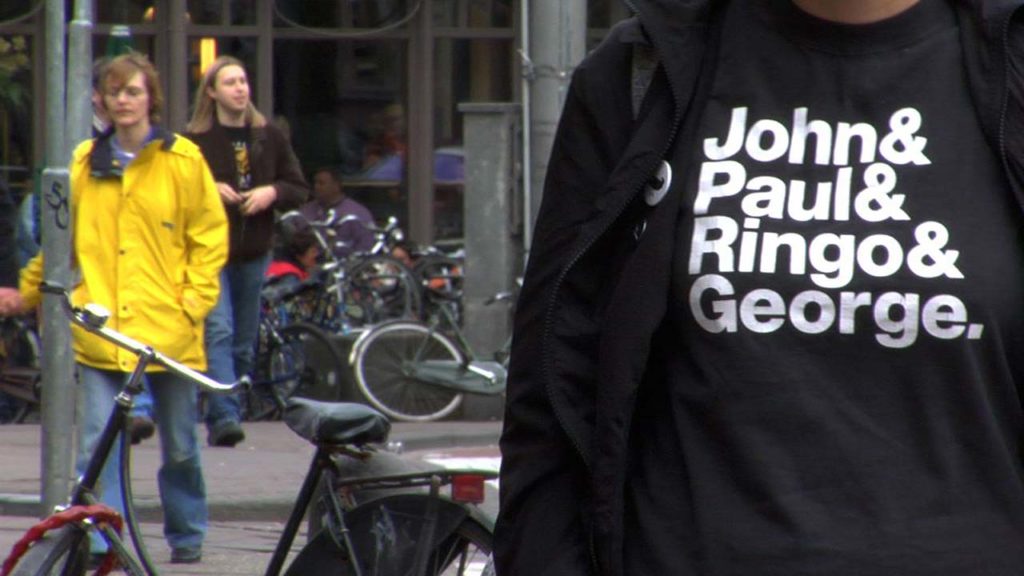
    Grant Gee’s documentary Joy Division covers the all-too-brief history of the eponymous post-punk band from Manchester. Joy Division was tragically short-lived, only completing two albums before lead singer Ian Curtis’ suicide in 1980, but disproportionately influential. Their sound is all over the early U2 albums Boy and October, and Interpol has made a career of emulating Joy Division’s sound.

    Gee sets the scene of late 1970s Manchester as a grimy hellhole in which “there’s nothing pretty.” The core members of the band are perversely inspired by a Sex Pistols concert (their review: “shite, a car crash”) to form their own band. Photographer and filmmaker Anton Corbijn took some of the most memorable portraits of the band. Used to Holland’s health care system, he was shocked to see such poverty in England. He describes Joy Division as undernourished and shivering in their thin coats.

    Joy Division
    Joy Division

    Gee also interviews Peter Saville, the graphic designer that created the remarkably stark album sleeves that were almost as influential as the music itself. Tony Wilson (a colorful character who was the subject of Michael Winterbottom’s fantastic biopic 24 Hour Party People) was an early champion, in between his duties as host of the TV show “So It Goes” and Factory Records impresario. Curtis’ widow Deborah does not seem to have participated, but her side of the story appears in the excellent biopic Control, co-produced by her and directed by Corbijn.

    Ian Curtis of Joy Division
    Ian Curtis of Joy Division

    Curtis is described as a regular lad who frequently bought flowers for his wife. In other words, the opposite of punk. But he’s also characterized as “bipolar,” moody and unpredictable even before his epilepsy manifested itself in frequent, dramatic grand mal seizures. His singular stage presence was marked by a peculiar form of dance inspired by his seizures (that he sometimes actually did experience on stage). The necessary drug treatments caused huge mood swings, further compromising his already unsteady mental health. Curtis continued his day job assisting disabled people for the Civil Service even as the band was taking off. In a heartbreaking bit of synchronicity, his classic song “She’s Lost Control” is about an epileptic girl he met though his work.

    Grant Gee’s clear expertise is musical documentary. His 1998 film Meeting People is Easy famously captures Radiohead breaking through to mass popularity as their 1998 album OK Computer is universally declared the album of the year. The frank film shows emotionally fragile Thom Yorke almost physically recoiling from fame, but receiving wise counsel from mentor Michael Stipe of R.E.M. Gee also co-directed the excellent 2005 Gorillaz concert film Demon Days Live at the Manchester Opera House, better even than the studio album that preceded it. Both films have permanent spots on the DVD shelf.

  • Daniel Lanois Maximizes the Room in Here Is What Is

    Daniel Lanois Maximizes the Room in Here Is What Is

    Daniel Lanois is a unique musician, as gifted a singer-songwriter in his own right as he is a collaborator and producer. I originally came to recognize his name after finding it listed in the credits of many key items in my music collection, including Peter Gabriel’s So and Us, U2’s The Joshua Tree and Achtung Baby, and Bob Dylan’s Oh Mercy and Time Out of Mind. His 1993 solo album For the Beauty of Wynona remains an all-time personal favorite.

    The feature documentary Here Is What Is premiered at the Toronto Film Festival in 2007, directed by Lanois, Adam Samuels, and Adam Vollick. It captures the recording of the album of the same name, but also serves as a kind of retrospective and mission statement. Conversations between Lanois and early mentor (now equal) Brian Eno punctuate the film. Lanois states to Eno his intentions for the movie: to create a film about the beauty of music, not everything that surrounds it (which I took to mean hagiography, celebrity gossip, and the sometimes tedious behind-the-sceens documentation typical of the genre). Eno suggests that his film should try to show people that art often grows out of nothing, or from the simplest of seeds in the right situations, not from what outsiders might assume are the miraculous inspirations of allegedly brilliant or gifted artistes.

    Daniel Lanois and Brian Eno in Here Is What Is
    Daniel Lanois and Brian Eno recording their new ambient masterwork, “Music for Staircases”

    Lanois is Canadian by birth, but has a special affinity for the American South, especially New Orleans. He credits New Orleans for the original sensual groove that formed the basis of rock music. Perhaps intended as a visual echo of this theory, the stunningly beautiful Carolina Cerisola often appears dancing in her scanties.

    Lanois details his longtime, fruitful collaboration with drummer Brian Blade. Legendary keyboardist of The Band, Garth Hudson, also joins them in the studio for some truly awesome performances. One of my favorite sequences intercuts between “The Maker” performed by Lanois’ band live in studio, covered by Willie Nelson and Emmylou Harris, and Lanois’ band live on stage. Billy Bob Thornton, still friends from collaborating on the score to Sling Blade in 1996, drops in for a visit. We catch exciting glimpses of recording U2’s forthcoming album (since christened No Line on the Horizon, to be released in February 2009) with Eno and Steve Lillywhite.

    Daniel Lanois in Here Is What Is
    Which button dials down Bono’s ego?

    Lanois names a primarily influence to be the Jimi Hendrix Experience, which he describes as a fairly straightforward rock trio but with ambitious, experimental production. He describes how he himself approaches production, in just one word: “feel.” He reportedly had a contentious relationship with Dylan in the studio, but the resultant albums are classics, and Dylan affirmed that “you can’t buy ‘feel.’” Another Lanois aphorism, “maximize the room,” means to make the most of what you have, rather than invite guest musicians or order up more equipment.

    Here Is What Is features full performances of songs, which is especially welcome compared to two recent music documentaries recently screened by this blog: Low in Europe and You May Need a Murderer, which both shy away from actually showing Low perform. Here Is What Is‘s visuals are sometimes compromised with cheesy video effects. The film is at its best when simply following the hypnotic movements of Lanois’ hands on his pedal steel guitar.

  • Low get political in David Kleijwegt’s You May Need a Murderer

    Low get political in David Kleijwegt’s You May Need a Murderer

    It may seem overkill for the so-called slowcore band Low to be the subject of another documentary feature film only a mere four years after Low in Europe, but it must be because they’re just so interesting. Filmmaker David Kleijwegt’s You May Need a Murderer could just as well be titled Low in America, as he speaks with founding members Alan Sparhawk and Mimi Parker at home in Duluth, Minnesota, and on tour across America in support of the Drums & Guns album. The key characteristics of that record are what most inform the film: Sparhawk’s mood post-nervous breakdown, and Low’s most overtly expressed social and political commentary yet. Low had also just adopted a new bass player, Matt Livingston, after Zak Sally’s long tenure, but he does not participate (he’s only barely glimpsed, even in live onstage footage).

    You May Need a Murderer is a much more satisfying film overall than Low in Europe. Whether by their own desire to open up or by Kleijwegt’s persuasive interview skills, Sparhawk and Parker are notably more candid and direct, especially on the topic of their faith. Which is exactly what one would single out as the most interesting thing about Low: Sparhawk and Parker are a married Mormon couple that that tithe a tenth of all their income to the church. I suppose Low might belong in that rare category of bands whose music is often characterized by religious beliefs, like the often overtly Christian U2, but would never be filed under “Inspirational” in record stores. Unlike U2’s joyous hymns and optimistic calls to activism, Low’s inspirations are considerably more dark and apocalyptic.

    Low You May Need a Murderer

    When Low gets political they do so with a vengeance. Sparhawk is in despair over America’s economy and politics, and has long believed that the world may reach a crisis point in his lifetime (he stops short of predicting it will actually “end”). Sparhawk’s genuine beliefs gives him the real authority to criticize George W. Bush’s claim to faith. The title song “You May Need a Murderer” is sung from the point of view of one who goes before his god and asks to be used as a warrior. It becomes clear that the speaker is in effect staring into a mirror, bringing his own baggage to an imaginary conversation, and justifying his own dark impulses. Sparhawk is, needless to say, talking about self-proclaimed men of faith like Bush and Tony Blair. The song is utterly terrifying, and raises the hairs on the back of my neck every time. It may be the ultimate statement on the topic, and does not compare favorably to the similarly-themed song by Bright Eyes, “When the President Talks to God.”

    The most surprising personal topic to come up is Sparhawk’s apparent nervous breakdown in 2005. We see Sparhawk appearing very anxious backstage before a show, but otherwise functional. But he describes himself as having been “clinically delusional” at the point of his breakdown, and while having nominally recovered, he also cops to being a drug addict. To him, the biggest conflict these two aspects of his life have is with his religion.


    Must Read: PopMatters review

  • Purity, Ubiquity & Legibility: Gary Hustwit’s Helvetica

    Purity, Ubiquity & Legibility: Gary Hustwit’s Helvetica

    Helvetica (the documentary film) is not about Helvetica (the typeface), per se. Rather, it’s about the arts of graphic design and typography, their practitioners, and how they affect our daily lives.

    Each luminary talking head has a different explanation of Helvetica’s appeal and longevity: neutrality, legibility, perfection (unlike more ornate typefaces, it is arguably comprised of the purest state of letterforms and can’t be improved), cleansing renewal (transitioning the tacky design of the 1950s to the bold and to-the-point 60s), problem-solving, soothingness, and just plain beauty.

    Helvetica

    Its detractors see its ubiquity as self-perpetuating, due to designers’ momentum, habit, and bad taste. The enthusiasm of the enthusiasts is infectious, but the movie doesn’t mock them or hold them up as objects of curiosity culled from a nerdy subculture (as does, arguably, The King of Kong).

    Thankfully for its subject matter of graphic design, director Gary Hustwit presents a highly polished work full of excellent typography, motion graphics, and editing. This blogger bemoans the tendency of many documentaries (like Spellbound and Wordplay) to use their non-fiction badge as a press pass to excuse grain, sloppy framing, and poor sound.

    Helvetica New York City subway map
    We’d be lost without Helvetica… literally

    I am a mostly self-educated web designer, not properly trained in the art and/or craft of graphic design. But I know enough to applaud the film for touching upon two of the biggest aspects of typography that every layperson should internalize:

    • Know your terms: Typefaces are designs. Fonts are particular implementations of those designs. There are multiple fonts based on the typeface Helvetica.
    • Arial is a poor Helvetica knock-off commissioned by Microsoft to side-step the expensive licensing fees. It is an abomination, a blight upon this planet earth, and should be summarily deleted from humanity’s hard drives. (q.v. The Scourge of Arial)

    Finally, I must note a major disappointment: I rented Helvetica from Netflix, and the disc arrived emblazoned with a “Red Envelope Entertainment” label. Bizarrely, there were no signs of the extensive bonus features promised on the movie’s official website. Has Netflix begun releasing “not-so-special” editions of DVDs omitting the bonus features available on retail editions? I, long relying on Netflix to help keep my DVD shelves from groaning into a black hole of overconsumption, stamp my feet in frustration.

  • Kill Screen: Seth Gordon’s The King of Kong: A Fistful of Quarters

    Kill Screen: Seth Gordon’s The King of Kong: A Fistful of Quarters

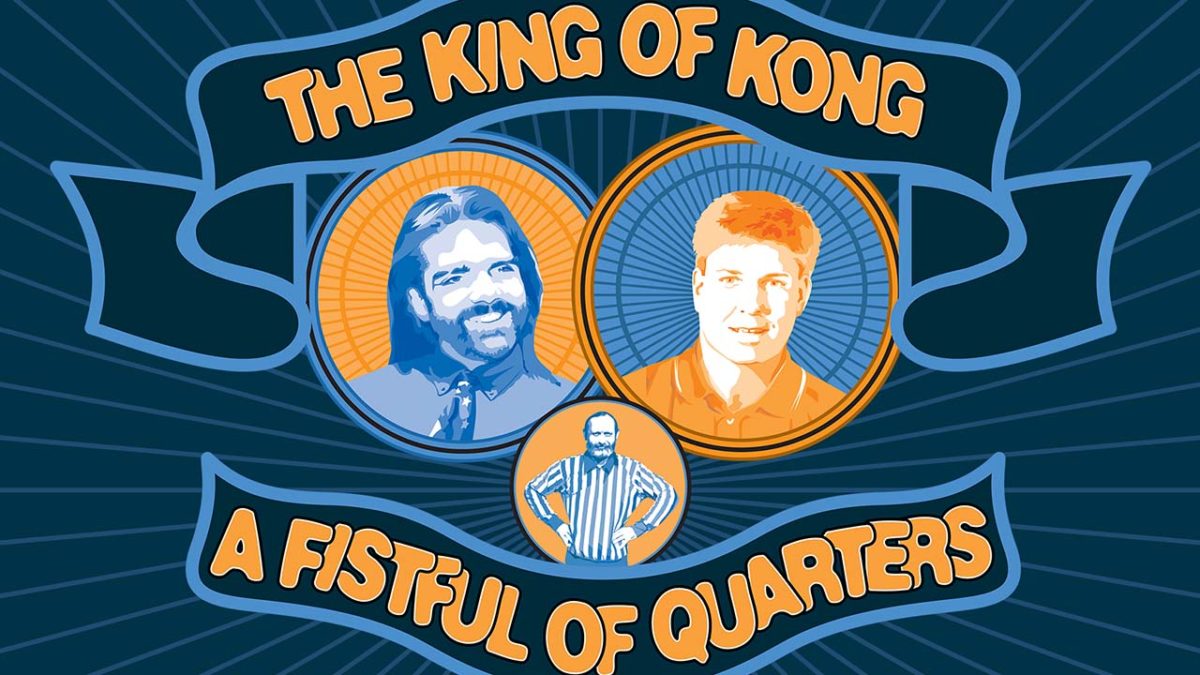
    First, full disclosure: I work for the movie company that distributed The King of Kong: A Fistful of Quarters. My miniscule role in marketing the film was limited to designing the official movie website, and I am under no obligation or prohibition to write this review (which happens to be positive, anyway). Any opinions expressed here are mine alone. I mostly avoid writing about movies released by my employer. I’m making a rare exception in this case because The King of Kong has been out of theaters for some time, and my personal opinion on this blog is certainly not going to have any impact on its revenue. Having just seen it again, I have a few thoughts I would like to record here.

    I would hate to be an English teacher, at any level, for one reason: the countless “it’s a metaphor for life” papers I would have to grade. Probably one of the biggest cliches of kids’ essays is to pull out that refrain, e.g. “the light at the end of the dock in The Great Gatsby in a metaphor for life.” After grading a few dozen of those I just might want to start throwing things and switch to another career, like, say for example, web design.

    Billy Mitchell in The King of Kong
    Billy Mitchell with the ladies of Namco

    That said, I’m about to commit that very grievous essay sin: if anything is a metaphor for life, it’s Donkey Kong. Let’s look at the evidence:

    • Donkey Kong is an intensely difficult game.
    • The game’s god/creator, Shigeru Miyamoto, did not supply it with a predefined ending.
    • The number of levels is undeclared at the outset.
    • Anyone with a quarter can play.
    • Most players die very quickly.
    • A very select few thrive and have their names entered into history.
    • How you play, not just how long you live, determines your score. In other words, you can reach the exact same point in the same level as somebody else but have a higher score.
    • Even the best of the best players cannot “win” the game; everyone will eventually drop dead without warning and through no gameplay fault of their own. This point has become known as the game’s “kill screen.”

    That list of bullet points just about covers it; Donkey Kong is so clearly a metaphor for the human experience that the film thankfully doesn’t even bother to explicitly state its themes. Kids, let that be a lesson for all your future school essays.

    Steve Wiebe in The King of Kong
    The King of Kong (2007) Documentary Directed by Seth Gordon Shown: Steve Wiebe

    The King of Kong is a very rousing film that works best to an audience; if possible, watch it with friends. From what I can gather, viewers respond to two basic things: the frankly weird subculture of professional video gaming, and the more universal story of the underdog vs. an entrenched power network. A suspicion is gaining traction that the story is too perfect, the hero Steve Wieve too all-american, and the villain Billy Mitchell too evil. The movie’s official message board (no longer online) features heated discussions including actual figures featured in the film, and documentarian Jason Scott has gone so far as to publish a passionate teardown of filmmakers’ ethics.

    Personally, I wish the film had been more clear on a few points:

    • As you can read on the above links, Billy Mitchell’s well-timed taped submission may have seemed fishy but turned out to be genuine.
    • Most viewers (including myself) all ask the same question: how long does it take to play one of these “perfect” games? The movie finally discloses the answer incidentally near the end, as if the filmmakers weren’t deliberately withholding the information, but rather didn’t realize it was something viewers needed to know.

    All in all, the subculture featured in the film is a truly unique bunch of people, and a great find by the filmmakers. Some of them may deserve a little mockery, but my favorite moment in the film goes to a Robert Mruczek, who describes how professional sports records are broken once in a lifetime, but he sees gaming records broken every day. And how exciting is that?

  • The atmospheres and soundtracks of Al Reiner’s Apollo Missions documentary For All Mankind

    The atmospheres and soundtracks of Al Reiner’s Apollo Missions documentary For All Mankind

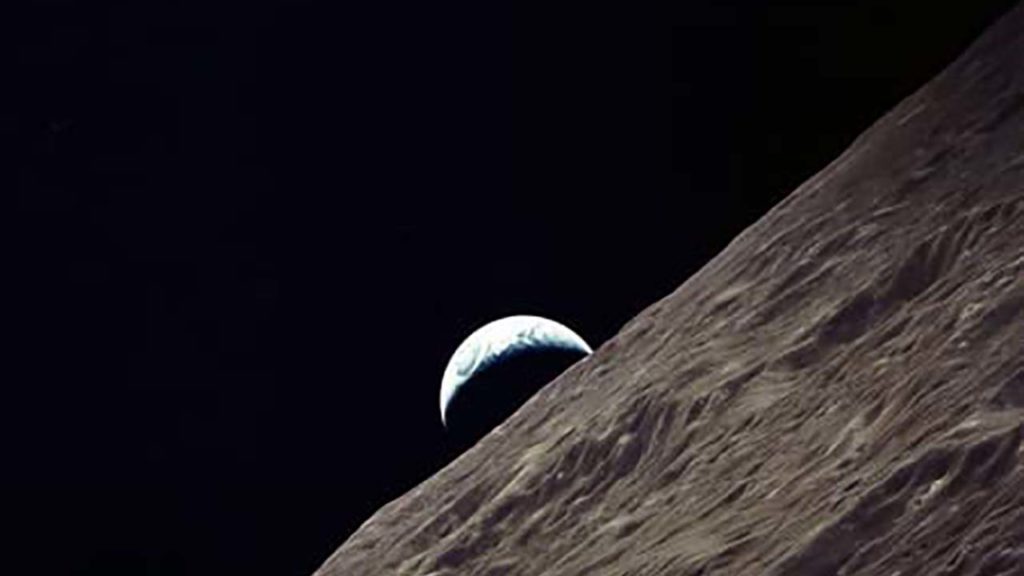
    It was a weird experience to finally see the original film for the soundtrack to which I’ve listened to countless times. Brian Eno and Daniel Lanois’ Apollo: Atmospheres & Soundtracks is a gorgeous piece of work, and very much colored my expectations of what the film would be. Having long pictured a largely abstract compilation of otherworldly lunar footage, I was surprised to find For All Mankind a more straightforward documentary than what was already in my head. (Bits and pieces from the compilation album Music for Films III also appear.)

    Unlike In the Shadow of the Moon, the 2007 feature documentary on the same subject, For All Mankind exclusively uses original footage taken during the Apollo Missions, much of it by the astronauts themselves. The absence of new narration or footage rightly places the emphasis solely on the achievements of the original participants. But a drawback is that the interviewees on the soundtrack are not identified (the Criterion DVD edition includes an option to display subtitles identifying the speakers).

    I have little to add to Matthew Dessem’s excellent review on The Criterion Contraption, or to my own thoughts on In the Shadow of the Moon. Three small observations:

    • I was completely ignorant that NASA first began spacewalks during the Apollo missions. I was under the impression they began during the later space shuttle missions. In retrospect, it makes perfect sense that NASA would test spacewalks in orbit over the Earth before attempting to step out of a capsule onto the moon, but: Wow!
    • The astronauts were very conscious of Stanley Kubrick’s 2001: A Space Odyssey. Each astronaut could bring one cassette tape to play on a portable deck, and one chose Strauss’ “Also Sprach Zarathustra”. Another describes seeing the moon surface up close as being like something from 2001.
    • Due to the film’s nature of being comprised of original footage, there’s perhaps too much of the astronauts goofing off in zero-G, and not enough of the spectacular lunar footage. But it goes to show that even the pilots selected for being the most sane and calm people in the word still turn to excited kids when playing in outer space (with the rare exception to prove the rule).
  • The Apollo astronauts strut the right stuff in Ron Howard’s In the Shadow of the Moon

    The Apollo astronauts strut the right stuff in Ron Howard’s In the Shadow of the Moon

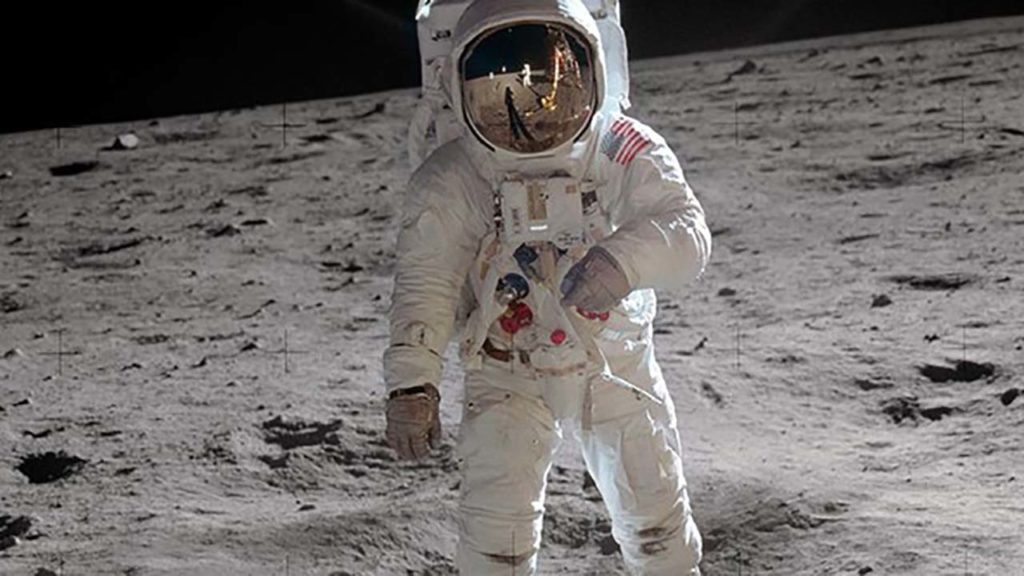
    In the Shadow of the Moon may not be the most radical or revelatory documentary ever made, but if the point was to get out of the way of some true American badasses and let them tell their story, then it should be counted as a success.

    The DVD edition is introduced by co-producer Ron Howard, whom, along with Tom Hanks, is an avowed space-nut and maker of the great Hollywood retelling of the Apollo 13 mission. He doesn’t address the big question: why a big theatrical documentary on NASA’s Apollo Program, now? Is it simply that the aforementioned true American badasses are frankly getting on a bit, and that this is one last chance for them to strut their Right Stuff?

    In the Shadow of the Moon
    I can see your house from here

    The biggest clue is that the film takes pains to place the missions in a historical and political context of the Cold War, civil rights, the Viet Nam War, and the spate of assassinations the country suffered in the late sixties. When Kennedy called in 1961 for NASA to land a man on the moon within the decade, it was a truly audacious and inspiring moment. As astronaut Gene Cernan put it, “science fiction.” The almost incalculable amounts of money and impetuous were there, surviving even the assassination of the man that inspired the astonishing endeavor.

    Time passes. Walls fall, the White House falls afoul of diminishing returns. Subtract the Cold War space race with the Soviet Union, and NASA reduces its ambition to decades of launching spy & corporate satellites and performing zero-g experiments in the Space Shuttle (although I must say detecting anti-matter sounds pretty cool), losing the Apollo 11 tapes, and apparently too busy with constant maintenance on the International Space Station to do anything else.

    In 2004, Bush makes a fool out of himself by calling for NASA to land American boots on Mars by 2020. This time an entire nation rolls its eyes and knows it’s a flimsy, sparkly distraction from the many disasters of his term of office (and this, before Katrina). Maybe I’m stretching things to find a political critique in the timing of this film, but that’s my theory. It’s a kick in the pants – in a time of crew cuts, tail fins, and assassinations, the United States landed on the freaking moon nine freaking times.

    In the Shadow of the Moon
    I want my MTV

    As a nobody web designer, I don’t mean to diminish the work of post-Apollo rocket scientists and brave astronauts; only that the momentum kick-started by Kennedy has sputtered out by almost any measure. After all, what has NASA done lately that one might call, bug-eyed, “science fiction”? I do love the Mars explorer robots Pathfinder, Spirit, and Opportunity, though! I love robots on Mars. Robots on Mars are neat-o, man. Hi, robots on Mars!

    One gripe: In the Shadow of the Moon has a cheesy score, especially disappointing in light of Brian Eno & Daniel Lanois’ gorgeous music for For All Mankind, a documentary film of lunar footage from the Apollo missions.

  • Yo La Tengo perform live to Jean Painlevé’s Science is Fiction in Prospect Park, 2006

    Yo La Tengo perform live to Jean Painlevé’s Science is Fiction in Prospect Park, 2006

    Hoboken institution Yo La Tengo performs a live score to several of French filmmaker Jean Painlevé’s underwater documentaries. Interestingly, English subtitles indicate the films were apparently not silent in their original form, with narration and perhaps scores of their own. So not only is the audience’s experience of the films filtered through a spoken-French-to-written-English translation, but also by Yo La Tengo’s contemporary score.

    Most of the films concerned the mating rituals and birth cycles of sea creatures ranging from octopi to mollusks. A rare intrusion of a human hand is seen during the dissection of a pregnant male sea horse. Without seeing the films in their original form, it’s hard to judge if they were clinical or artful in tone. Only one film was clearly intended to be abstract: a series of images of vividly colored liquids crystalizing, evoking the “Beyond Infinity” sequence in 2001: A Space Odyssey. But Yo La Tengo’s musical interpretation transformed nearly every sequence into a dreamlike, non-literal cinematic experience.

    I’m curious… was the band influenced by the original soundtracks? To what degree was the performance planned and/or improvised?

  • Drew Thomas’ 2006 documentary Coachella

    Drew Thomas’ 2006 documentary Coachella

    I don’t normally review music DVDs on this blog, but since Drew Thomas’ 2006 documentary Coachella received a theatrical release in Europe, I thought it deserved a mention. It’s a rare concert film that is as interested in the concertgoers and the character of the event itself as in simply capturing the performances.

    Favorite moments: Thom Yorke actually smiling before Radiohead rips into “Planet Telex”, the unexpected sight of a crowd grooving to Squarepusher’s difficult arrhythmic beats, The Flaming Lips‘ furry freakout, and The Polyphonic Spree joyously heralding the sun on, fittingly, Sunday morning. Scariest moments: Iggy Pop’s return of the living dead, and Fischerspooner dressing up in fright wigs and fishnet speedos.

  • Orson Welles’ F for Fake is part documentary, part essay, part practical joke

    Orson Welles’ F for Fake is part documentary, part essay, part practical joke

    F for Fake is Orson Welles’ last completed movie: part documentary, part essay, part practical joke. Welles portrays himself much as one might imagine him: a robust raconteur settled in for the long haul at a good restaurant, surrounded by educable pretty young things, eating and telling tall tales with great relish.