Tag: horror

  • People Are Vectors: George A. Romero’s The Crazies

    People Are Vectors: George A. Romero’s The Crazies

    George A. Romero practically invented the lucrative zombie subgenre with Night of the Living Dead in 1968, simultaneously trapping himself within it for most of his subsequent career. Romero’s zombies served him well enough for six films and counting, at least two of which transcended the genre and are still discussed in serious terms.

    His less famous later creations the “crazies” appeared in only one of his films, but their influence on popular culture is disproportionate to their fame. They are arguably thematically richer and — despite not technically being zombies, per se — exert a greater influence on most significant subsequent zombie films by other directors.

    The Crazies (1973) may not belong to Romero’s official Living Dead cycle, but what sets it apart is mostly a matter of branding. Zombies had captured the popular imagination in a way that the more vaguely-defined crazies could not, at least at first. The classical Romero-style zombie is simply a reanimated corpse with an insatiable animal hunger in place of higher brain function — in effect a subtraction of the intangible human essence, or what a religious person would describe as a soul. In contrast, a crazy is exactly what it sounds like: a living person driven to unchecked violence and lust, while still remaining recognizably human.

    A scene from George A. Romero's The Crazies
    “People are vectors.”

    The most significant innovation Romero introduced in The Crazies can be summed up in its most chilling line: “people are vectors.” In Night of the Living Dead, it was enough for Romero to vaguely drop hints of some sort of mysterious extraterrestrial radiation causing the dead to rise. The virus factor would preoccupy subsequent zombie auteurs for decades, particularly Danny Boyle with 28 Days Later. It’s a rich concept that touches on many sensitive themes: pollution, conspiracy theories, biological warfare, sexually transmitted diseases, and pandemics.

    While now virtually every non-Romero zombie movie defaults to a viral origin story, it seems that Romero himself is disinterested in the mechanics of either zombies or crazies. He’d much rather focus on randomly-selected bands of survivors, on the run in a world where society has broken down. Living humans are a greater danger than monsters, and death is no longer absolute.

    All the usual Romero tropes are present, particularly institutional corruption and ineptitude. On the macro level, the U.S. government and military serve their own interests first, to the degree that they function at all. The government has secretly engineered and weaponized a virus with the innocuous codename Trixie and accidentally releases it into the water supply of small town Evans City, PA (a real town, where portions were actually filmed). As in Invasion of the Body Snatchers, the action remains in the small burb for the entirety of the film. Forget Patient Zero; this is Town Zero.

    George A. Romero's The Crazies
    The military tries to clean up its own mess.

    The authorities swoop in and attempt to quarantine the bucolic burb until the virus burns itself out. We learn they were blithely aware of the risks in transporting the virus, and remain chillingly apathetic even after the beginnings of catastrophe. One especially coldblooded general casually munches sandwiches while discussing how to contain the epidemic. Romero’s usual sympathies are for the individual conscience hamstrung by soulless bureaucracies. Even in Day of the Dead, where the military was the primary source of conflict, some individuals remained sympathetic. In The Crazies, Major Ryder (Harry Spillman) and Colonel Peckam (Lloyd Hollar) struggle as much against their superiors’ counterproductive orders as they do trying to pacify the crazies on the battlefield and protect the uninfected.

    Even the civilians have deep ties to the armed forces. David (Will MacMillan) and Clank (Harold Wayne Jones) are Vietnam War veterans who now find themselves in opposition to the institutions they once served. They spend most of the movie completely in the dark as to why their town is in chaos, and in fact come into violent conflict more frequently with the military than with their now-insane former friends and neighbors.

    Romero also continues his tradition of foregrounding women and people of color. The ranks of Duane Jones in Night of the Living Dead, Lori Cardille in Day of the Dead, and John Leguizombie Leguizamo in Land of the Dead are joined by Judy (Lane Carroll), a pregnant nurse who initially assists the military’s containment efforts. Her character is far more significant and integral to the plot than her equivalent in Breck Eisner’s mediocre 2010 remake, played by Radha Mitchell. It’s sad but perhaps unsurprising that a B-movie from 1973 would feature a stronger feminist character than one from the 21st century.

    Lynn Lowry in George A. Romero's The Crazies
    Lynn Lowry inaugurates her career as a scream queen

    But on the other hand (you knew that “but” was coming), the other primary female role is played by Lynn Lowry as an impossibly ethereal and willowy teen with a marked resemblance to Sissy Spacek. The character’s primary function is to look innocently gorgeous and be raped by her infected father. Lowry would go on to a long career as a scream queen in sexploitation films.

    The Crazies is largely humorless in tone, save for ironic music cues throughout. A persistent martial snare drum plays under otherwise rather dull scenes of Ryder and Peckam arguing in a cheap office set, and “Johnny Comes Marching Home” accompanies sequences of desensitized soldiers summarily executing detainees.

    The establishment of martial law and military occupation of a town on American soil raise the question: how do you tell the difference between genuine resistance and murderous rage, which is to say, just plain crazy plus capital-c Crazy? Is not killing and shooting other human beings by definition crazy, especially when systematically operated by the governmental and military organizations that are supposed to protect and serve life?

    In the movie’s most charged sequence, a priest immolates himself on his church steps. In 1973, it would have been an unmistakable visual allusion to the Buddhist monks that self-immolated to protest the Vietnam War. A soldier executes him. Was the priest protesting or Crazy? Was the soldier merciful or Crazy?

  • Pandorum is all premise and no logic

    Pandorum is all premise and no logic

    I rented Christian Alvart’s Pandorum solely on the strength of the premise: two men awake from suspended animation, on a spaceship, in a locked room, not knowing where they are, what their mission is, or if there even is a mission. It’s well cast with Dennis Quaid and the very intense Ben Foster. This is all good stuff, but it spirals downhill from there, with unimaginative monsters and a huge number of gaping plot holes:

    • Are there no portholes out which to look, and notice the absence of stars?
    • Unless I missed something, it’s never explicitly stated the monsters are descended from the ship’s passengers. Not only is this plot twist cribbed from the caving horror movie Descent, it’s scientifically implausible that any species other than a fruit fly to physically devolve so much in only 900 years.
    • Why would the bad guy lock himself in suspended animation for hundreds of years? To see how his social experiment would turn out? If so, why bother keeping up the ruse for so long?
    • If the botanist awoke to tend to the stores of plant life, why could she not compute how much time had passed?
  • The Pod People Film Festival: The Invasion

    The Pod People Film Festival: The Invasion

    Nicole Kidman must be one of the unluckiest stars in Hollywood, having recently starred in at least two big-budget catastrophes. Frank Oz’s The Stepford Wives (2004) was sabotaged by cast members dropping out, extensive reshoots, and competing script revisions that left significant logical plot holes in the finished film. Next, Invasion is best described as quite simply a broken movie.

    One full year after the completion of principal photography under director Oliver Hirschbiegel (Downfall), producer Joel Silver contracted The Wachowskis (The Matrix, Speed Racer) to write new scenes to be directed by their protege James McTeigue (V for Vendetta). Warner Bros. expended $10 million on 17 extra days of shooting in an attempt to reshape what was reportedly a more internal, psychological suspense piece into more commercial thriller.

    Nicole Kidman in The Invasion
    Do you ever get the feeling that you’re in a terrible movie…?

    After a brief, promising opening scene (a flash-forward, we later learn, to a world almost fallen to an alien attack), Invasion quickly descends into full-on sci-fi action cliché. A space shuttle disintegrates on re-entry, carrying a payload of virulent spores bent on world domination. After the real-life loss of the crews of the shuttles Challenger (1986) and Columbia (2003), this spectacular special effects sequence is about as tasteful as watching CGI skyscrapers crumble.

    One of the Wachowskis’ late additions was a ridiculously long car chase through the streets of Washington DC (filmed in Baltimore), with psychiatrist Carol (Kidman) behind the wheel of a literally burning Mustang. It’s beyond implausible that a shrink would have the driving skills of a modern-day Bullet (Steve McQueen) or Popeye O’Doyle (Gene Hackman in The French Connection). In fact, Kidman damaged more than her career: she broke several ribs during an accident incurred while shooting the sequence.

    The biggest problem is not the clumsily grafted-on action spectacle but the choppy screenplay. It’s painfully obvious to spot the seams between Dave Kajganich’s original script, which one can infer would have made for a more subtle horror story about an alien invasion accomplished without bullets or the exploding of infrastructure, and the Wachowskis’ reduction to the lowest common denominator.

    The movie is at its best when Carol senses the subtle changes of her city’s daily routine as the invasion spreads. It’s also interesting as she encounters other uninfected survivors that have learned to hide in plain sight. Veronica Cartwright, who appeared in Philip Kaufman’s 1978 version, appears as one of Carol’s patients who is apparently naturally immune. She counsels her to pretend to be a Stepford Wife in order to avoid detection by the dispassionate alien intelligences that have taken over most of the population. But these moody sequences are all too brief in-between the car chases and explosions.

    Nicole Kidman and Daniel Craig in The Invasion
    “Our world is a better world”

    A huge chunk feels missing from the middle; the second act should be a slow discovery of the details of the invasion and a gradual escalation of the conflict. But Carol and her doctor paramour Ben (Daniel Craig) leap to the accurate conclusion of an alien invasion based on only a few observed cases of mild weirdness around them, clearing the rest of the movie’s running time for a series of chase sequences.

    Worst of all is yet another criminal misuse of poor Jeffrey Wright (reunited with 007 co-star Daniel Craig), a brilliant actor saddled with most of the script’s laughable technobabble that leaves no room to the imagination (the original 1956 Invasion of the Body Snatchers was arguably not specific enough, but the 1978 version found just the right level of gory detail without getting bogged down in tedious pseudoscience).

    Jack Finney’s classic sci-fi novel The Body Snatchers has been adapted over and over into movies that illuminate the concerns of the times. Don Siegel’s 1956 original was a thinly-veiled critique of McCarthyism. Philip Kaufman’s 1978 remake also made sense in a post-Vietnam and Watergate era. Abel Ferrara applied the metaphor to blind obedience and conformity in the military in his 1993 Body Snatchers. Robert Rodri­guez found the most perfect setting yet, as he satirized teen peer pressure in high school in The Faculty (1998). What does the oft-told Body Snatchers tale mean today?

    Invasion is the fourth version of novel, and the second to ditch the notion of replacement bodies. As in The Faculty: the aliens are puppetmaster-like parasites that take over human bodies without permanently harming them. Invasion makes a fleeting reference to other nations publicly combating the alien insurgents. The US is the only one to hide behind a cover story that has the opposite intended effect, only further enabling the invasion to succeed. Invasion might have been a better film if it had focused more on this glimmer of political satire than on Shuttle disasters and burning Mustangs.


    Welcome to The Pod People Film Festival, our third mini movie retrospective. After catching up with Ridley Scott and George A. Romero, we now take a look at four adaptations of Jack Finney’s novel The Body Snatchers, plus one unofficial homage / satire.

    1. Invasion of the Body Snatchers (1956)
    2. Invasion of the Body Snatchers (1978)
    3. Body Snatchers (1993)
    4. The Faculty (1998)
    5. The Invasion (2007)
  • The Pod People Film Festival: The Faculty

    The Pod People Film Festival: The Faculty

    We interrupt this retrospective look at the four official feature film adaptations of Jack Finney’s novel The Body Snatchers with a kind of bonus track, a remake in all but name, Robert Rodri­guez’s The Faculty.

    It may be a touch campy, but hugely entertaining. All four official versions are deadly serious, so it’s refreshing for The Faculty to play the concept for laughs. Rodri­guez isn’t known for restraint, but most of the fun is likely attributable to Kevin Williamson, the writer of Scream, one of the most influential movies of the 1990s. Yes, I’m prepared to back that claim up: it was one of the first mainstream movies to be overtly Postmodern, and not in a stuffy college literature seminar sense, but one that found lowbrow thrills & chills from a highbrow intellectual perspective over the horror genre.

    That is, Scream was both a knowing satire of the horror movie genre, in which its own characters knowingly commented upon the events that befell them with all the knowledge that comes from being movie geeks well-versed in horror movie cliches, but was also simultaneously an actual functioning horror movie itself. Other 1990s movies along those lines were Wild Things (one of the sexiest, twistiest noirs ever made), Starship Troopers (a hilariously bleak vision of a fascistic world inherited by children), and even Shakespeare in Love‘s playful plays-within-plays-within-a-movie.

    The Faculty
    There’s be no more tears… in gym class

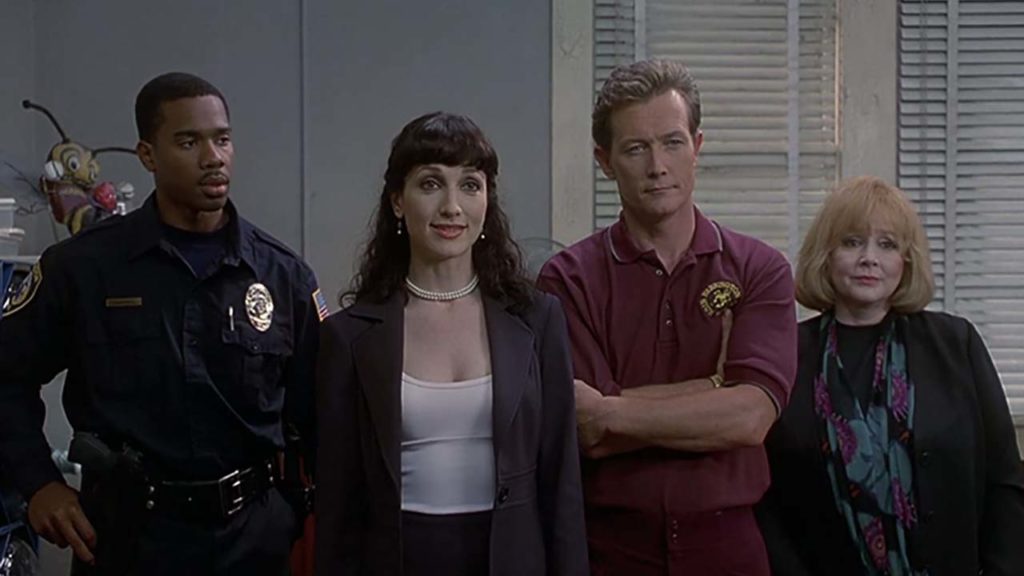
    A prologue introduces us to the namesake faculty, from which the great (and sexy) Bebe Neuwirth checks out early, or at least seems to. The adult cast is wonderful overall, even though some parts are little more than cameos. Robert Patrick brings all of his ruthless Terminator T-1000 steeliness to Coach Willis (like Dr. David Kibner – Leonard Nimoy – in Philip Kaufman’s 1978 Invasion of the Body Snatchers, a villain both before and after the invasion), the glamorous Famke Janssen is an improbably mousy loner, Jon Stewart as a sympathetic science teacher, and Salma Hayek is hilarious in her brief appearance as Nurse Rosa Harper. On the downside, Harry Knowles of AintItCoolNews.com notoriety also haunts the faculty room (this was 1998, after all).

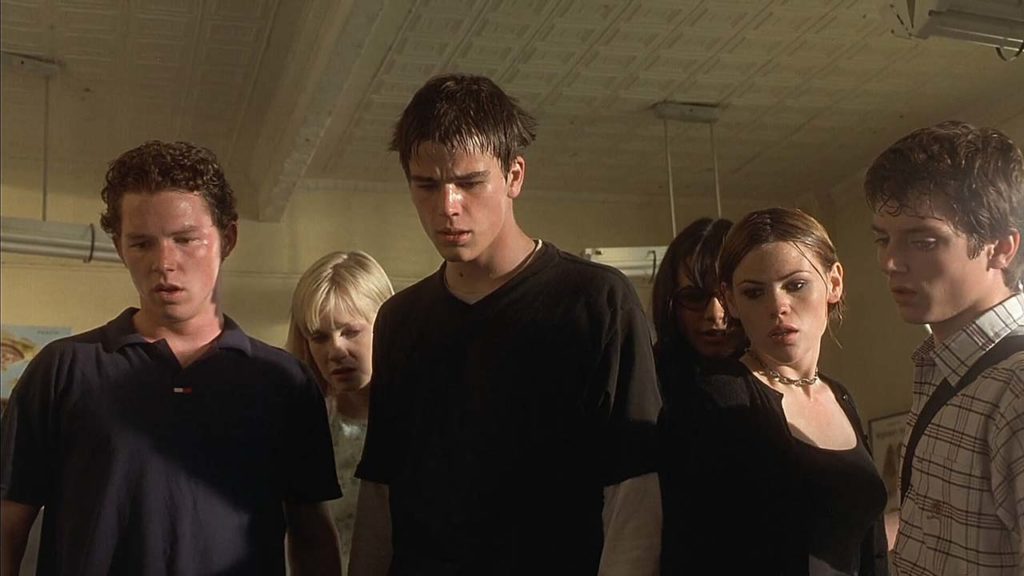
    We finally meet the kids in a montage set to a cover version of Pink Floyd’s infamous antiauthoritarian anthem “Another Brick in the Wall Part II”, with onscreen text resembling Gerald Scarfe’s scrawled lettering on the original The Wall album sleeve. They’re a next-generation Breakfast Club comprised of every key high school demographic: goth loner Stokely (Clea DuVall), hot ice queen Delilah (Jordana Brewster), meathead athlete Stan (Shawn Hatosy), bad boy Zeke (Josh Hartnett), meek nerd Casey (Elijah Wood), and sweetness-and-light Southern belle Marybeth (Laura Harris).

    The Faculty
    This meeting of The Breakfast Club II is called to order

    Zeke is a slacker genius with an awful haircut that hasn’t dated well. He has deliberately failed out in order to relive the glory of his senior year within the safe bubble of being Big Man on Campus. He peddles a powdered narcotic (actually mostly caffeine), drives a fast car, and makes the girls swoon. But underneath it all is an intellect missing an aim or purpose. Good for him, then, that an alien invasion gives him the opportunity he needs to grow up.

    Troubled goth girl Stokely disguises herself as a lesbian to avoid human contact. One wonders why, then, she’s not hassled by the school’s other lesbians. Like cuddly misfit Allison (Ally Sheedy) in The Breakfast Club , Stokely eventually conforms to straight-girl norms by dressing in pink and dating the jock. DuVall is said to be gay or bisexual, so I wonder how she felt about playing such a cop-out character. But this oddly conservative moment aside, the character is the key to the Postmodern, metafictional nature of the movie.

    Stokely is a science fiction fan that explicitly references Jack Finney’s novel The Body Snatchers (but not any of the movies). In fact, she disparages the book, claiming it’s a poor ripoff of Robert A. Heinlein’s The Puppet Masters.

    All Body Snatcher movies to date featured sentient brussels sprouts that create evil duplicates of humans, destroyed the originals, all with the aim of bringing a form of peace and harmony: a uniform society in lockstep synchronicity. But these pod aliens are more overtly evil. These aquatic parasites that temporarily take over bodies are no emotionless drones, but are actually remarkably lusty. They clearly relish the sublimation of the students, and stage a football game like a Nazi Party rally.

    All of which begs the question, if the aliens are like unleashed, uninhibited versions of our own ids, what’s the difference between them and, say, a high school kid hopped up on hormones? As one of them aptly puts it, “I’m not an alien, I’m just discontent.”


    Welcome to The Pod People Film Festival, our third mini movie retrospective. After catching up with Ridley Scott and George A. Romero, we now take a look at four adaptations of Jack Finney’s novel The Body Snatchers, plus one unofficial homage / satire.

    1. Invasion of the Body Snatchers (1956)
    2. Invasion of the Body Snatchers (1978)
    3. Body Snatchers (1993)
    4. The Faculty (1998)
    5. The Invasion (2007)
  • The Pod People Film Festival: Body Snatchers (1993)

    The Pod People Film Festival: Body Snatchers (1993)

    Yet another remake of Invasion of the Body Snatchers might seem an odd project for iconoclast director Abel Ferrara, known for gritty urban crime sagas centered around profoundly compromised protagonists. In stark contrast, the lead in Ferrara’s most conventional movie is a good-natured teenage girl, a world apart from the crazed Harvey Keitel of Bad Lieutenant or Christopher Walken of King of New York. Marti’s (Gabrielle Anwar) biggest problems are a nomadic lifestyle, a moody little brother, and a new stepmother.

    This version of the bodysnatchers story sheds “Invasion” from the title, which is strange considering it ought to be the key word for a movie focused on the U.S. military, at home not long after the first Gulf War — a conflict thought to be resolved at the time. With America at peace and a Democrat in office, Body Snatchers was probably one of the first mainstream feature films to directly mention the conflict, along with Courage Under Fire (1996) — David O. Russell’s ruthless satire Three Kings being still some ways off.

    Abbreviating the title was a missed opportunity to play with the ambiguity between a military confirmed as professional, government-sanctioned invaders, and an extraterrestrial force that easily infiltrates them. But don’t worry, the word “Invasion” would be picked up again for Oliver Hirschbiegel’s 2007 abomination starring Nicole Kidman.

    Gabrielle Anwar in Body Snatchers
    Gabrielle, sweetie, you should know better than to take a bath during a horror movie…

    On home soil, an Alabama army base under the command of General Platt (who else but R. Lee Ermey?) must suffer the indignity of bending over for The Environmental Protection Agency as it investigates the army’s storage of chemical weapons. The sympathetic Major Collins (Forest Whitaker) reports increasing cases of mental illness in his infirmary (paranoia, fear of sleep, etc.). He suspects the toxic chemicals, making it impossible to miss the allusion to the controversial Gulf War Syndrome.

    Marti falls in love with helicopter pilot Tim (Billy Wirth), so bland and flat that it’s hard to tell if he’s a pod person (to be charitable, maybe this was a deliberate casting call, meant to keep the audience guessing). She is befriended by Platt’s punk daughter Jenn (Christine Elise), a refreshing dose of nonconformism among the rank and file – indeed her rebelliousness serves as a canary in the coal mine to measure the progress of the invasion. We genuinely feel for Marti’s little brother Andy (Reilly Murphy, a rare child actor that does not annoy) as he senses his school playmates are “bad” and witnesses his stepmother (Meg Tilly) die firsthand. Incidentally, Tilly’s performance as the pod-stepmother is excellently weird.

    Meg Tilly in Body Snatchers
    “Where you gonna go, where you gonna run, where you gonna hide? Nowhere… ’cause there’s no one like you left.”

    Like Philip Kaufman’s 1978 version of the same material, Ferrara indulges in the gore and female nudity de rigueur to the horror genre. Marti disrobes for a very close encounter with groping alien tendrils in a bathtub, and later runs through an infirmary full of gross, half-formed pod people. The very pretty Anwar is so convincingly young-looking that her unexpected nude scenes make one feel decidedly uncomfortable.

    In all three versions of the story so far, a pod person delivers some variation of the following warning to human resistors: there’s nowhere to run, nowhere to hide, and there’s no one else left like you. So why do the pod people always work so hard to chase down the few remaining humans? On the evidence of Body Snatchers, they’re still very easily defeated, and the climactic ending is something of a dud.

    The infected army base plots to distributes pods to other bases, and eventually amass an armed force capable to taking over the world. But Marti and Tim manage to blow up the base and as entire convoy with just one helicopter. Why was it fully armed during peacetime, anyway?

    The first film ended with humans just beginning to mobilize against the invaders. The second ended with humanity totally overswept. Now the third ends with us winning. How will Nicole Kidman fare in Invasion? Tune in after our next review, an interlude to look at Robert Rodriguez’ enjoyable homage The Faculty, to find out…


    Welcome to The Pod People Film Festival, our third mini movie retrospective. After catching up with Ridley Scott and George A. Romero, we now take a look at four adaptations of Jack Finney’s novel The Body Snatchers, plus one unofficial homage / satire.

    1. Invasion of the Body Snatchers (1956)
    2. Invasion of the Body Snatchers (1978)
    3. Body Snatchers (1993)
    4. The Faculty (1998)
    5. The Invasion (2007)
  • The Pod People Film Festival: Invasion of the Body Snatchers (1978)

    The Pod People Film Festival: Invasion of the Body Snatchers (1978)

    Philip Kaufman’s re-imagining of Don Siegel’s 1956 classic paranoid nightmare Invasion of the Body Snatchers immediately signals its uniqueness with a strange and beautifully abstract opening sequence. Psychedelic spores float off the surface of an alien planet, traverse through outer space, and fall to Earth as gelatinous rain. A glimpse of a newspaper headline describes a simultaneous epidemic of “spider webbing,” an ominous portent of what turns out to be the desiccated remains of the invaders’ victims.

    Matthew Bennell (Donald Sutherland) is a pitiless health inspector pining after his excitable colleague Elizabeth Driscoll (Brooke Adams). When her slob dentist boyfriend suddenly starts wearing suits and loses interest in televised sports, she becomes convinced a little too quickly that he’s an impostor, and leaps from there to even grander notions of an alien conspiracy. But, being a lab worker at the Department of Health, and the type that keeps a greenhouse in her bedroom, perhaps she is after all eminently qualified to identify malevolent walking and talking plants bent on world domination.

    Leonard Nimoy in Invasion of the Body Snatchers
    Leonard Nimoy would like to encourage you to stop sleeping around. There will be no more tears.

    The original film imagined a subversive alien invasion of suburbia. In conservative small-town America, or at least the fantasy thereof seen in movies, everybody knows everybody else’s business. This remake takes place in the liberal urban setting of San Francisco, where relationship networks are fractured into neighborhoods, socioeconomic classes, and cliques.

    As our current fears of avian and swine flus attest, infections spread faster where humans congregate in tight spaces: schools, slums, public transportation, etc. The aliens in the original plotted a slow takeover of American’s already homogenous heartland, while their cousins here target our population centers for maximum shock and awe. Still, some secrecy is required at first, and the creatures prove themselves adept at subterfuge.

    The greatest deceiver is self-help pop shrink Dr. David Kibner (Leonard Nimoy). It’s a crying shame we haven’t gotten to see Nimoy play more roles like this in his career – by which I mean anything other than Spock. Far from a San Fran free-love liberal, Dr. Kibner is actually a conservative reactionary, decrying the ease with which modern couples mate and part. He believes modern society as a whole is suffering from a fear of responsibility and commitment.

    We never find out for sure when he his body was snatched, or even if it was. Out of everyone we meet, he was arguably already a pod person all along. The most interesting facet of the film for me is the irrelevance of whether Kibner was a type of alien advance guard writing books espousing pod philosophy. He represents a human viewpoint already sympathetic to the invading veggies: one that longs for a return to conservative values and like behavior. But why is Kibner wearing an archery guard on one hand? That’s just a weird affectation.

    Donald Sutherland in Invasion of the Body Snatchers
    OMG! Look out for the trolley!

    Easter eggs include cameos by Don Siegel as a sinister taxi driver and the original’s star Kevin McCarthy reprising his crazed rant “They’re here already! You’re next!” A young Jeff Goldblum brings all his quirk to bear as neurotic poet Jack Bellicec. His wife Nancy is played by Veronica Cartwright, reprising essentially the same shrieky, panicky performance she delivered in Ridley Scott’s Alien.

    The original film was a a thinly veiled metaphor for the McCarthyism of the period. In the late 1970s, the same story works just as well at the tail end of a dying sexual and cultural revolution that began in the 1960s. After the disillusionment of The Vietnam War and Watergate, people may have sensed the coming conservatism and conformity (in other words, Tom Wolfe’s masters of the universe and bonfires of the vanities) of the 1980s.

    This Invasion of the Body Snatchers is largely a psychological horror film, but features at least one true gross-out sequence in which the alien growth process is explicitly depicted. Matthew aborts his own budding duplicate with a garden hoe (a wholly appropriate weapon for sentient vegetables). The original film avoided detailing the process, possibly to elude questions that couldn’t be addressed without violating standards of decency (What happens to the original bodies? Why aren’t newborn pod people naked? Now we know – hey, look! Brooke Adams’ breasts!). Gore aside, the one truly unsettling image is a glimpse of a body snatching gone awry: a dog with a human face, an accidental hybrid being created when Matthew interrupts the process of an alien taking over a hobo with a pet doggie.

    But what Kaufman’s version is chiefly known for is its bleak, bleak ending, in total contrast with the hint of hope that closes the original. The baton wouldn’t be picked up again for another 15 years, when Abel Ferrara transposed the action to the obedient, conformist, oppressive world of the military in the tersely titled Body Snatchers.


    Welcome to The Pod People Film Festival, our third mini movie retrospective. After catching up with Ridley Scott and George A. Romero, we now take a look at four adaptations of Jack Finney’s novel The Body Snatchers, plus one unofficial homage / satire.

    1. Invasion of the Body Snatchers (1956)
    2. Invasion of the Body Snatchers (1978)
    3. Body Snatchers (1993)
    4. The Faculty (1998)
    5. The Invasion (2007)
  • The Pod People Film Festival: Invasion of the Body Snatchers (1956)

    The Pod People Film Festival: Invasion of the Body Snatchers (1956)

    For a pulpy 1950s horror flick relating the strange tale of an invasion of giant brussels sprouts, Don Siegel’s Invasion of the Body Snatchers is a startlingly gory, paranoid nightmare positively loaded with political subtext.

    Its themes of identity, mistrust, and subversion have remained relevant and influential for decades, inspiring three official remakes and even left-field homages like Robert Rodri­guez’ high school melodrama The Faculty. Not only has “pod people” entered the lexicon, its screenplay is highly quotable (“They’re here already! You’re next!”) and sometimes even rather poetic: “There’ll be no more tears.”

    The movie can be a bit frustrating to modern science fiction aficionados used to high levels of pseudo-scientific detail. The aliens’ life cycle seems illogical and not fully thought-through, to the extent that it harms the plot. It seems a victim simply must be in proximity to an alien pod for it to begin to grow into your shape. We also learn that a pod absorbs its host’s memories when it sleeps, but we see Becky Driscoll (Dana Wynter) duplicated after falling asleep alone in a cave devoid of any visible pods. What happens to the original bodies? How do the pod-born duplicates wind up wearing the host’s clothes?

    Philip Kaufman’s 1978 remake is more clear on the process, with the added benefit of allowing for more explicit gore and female nudity to tart things up a bit. The 2007 remake Invasion solves these problems by sidestepping the issue entirely, featuring a breed of aliens that literally invade your body – a mild condition which is, it turns out, curable. Ask your doctor, or better yet, date one!

    Kevin McCarthy and Dana Wynter in Invasion of the Body Snatchers
    Eat your brussels sprouts! Or you’re next!

    As Matthew Dessem points out in his analysis of The Blob for the Criterion Contraption, certain 1950s horror and sci-fi movies beg to be interpreted as metaphors for key atomic age issues: Godzilla, The Day the Earth Stood Still, and The Blob among them. But these monsters look just like us. So let’s give it a shot:

    1. Interpretation one: the movie manifests a generalized fear of a homogenized American culture. A pod person is discovered in an intermediary state, totally devoid of individual characteristics, like a mannequin. Perhaps America’s fabled melting pot, brought to an absurd conclusion, could result in a dead-end monoculture of of uniform religion, politics, and behavior.
    2. Interpretation two: the story is a thinly veiled metaphor for McCarthyism, the contemporary Red Scare that envisaged insidious Communist sleeper cells already among us, threatening to undo American churches, families, private wealth, and government.

    In either interpretation, the invaders are convinced their systems of belief are correct, and honestly believe they are helping us by absorbing us into their ranks.

    Kevin McCarthy and Dana Wynter in Invasion of the Body Snatchers
    Pod person in the corner pocket.

    The premise may be deliciously cynical, but the movie does end on a possible note of hope. Our hero Dr. Miles Bennell (Kevin McCarthy) manages to reach some uninfected human authority figures, and corroborating evidence helps him convince them to mobilize against the threat. But does this call to action come too late?

    From the perspective of 2009, America looks increasingly polarized and partisan. If the pod people are already here, which side are they on? As Sarah Palin might say, the Real America? I’m sure they only want to help.


    Welcome to The Pod People Film Festival, our third mini movie retrospective. After catching up with Ridley Scott and George A. Romero, we now take a look at four adaptations of Jack Finney’s novel The Body Snatchers, plus one unofficial homage / satire.

    1. Invasion of the Body Snatchers (1956)
    2. Invasion of the Body Snatchers (1978)
    3. Body Snatchers (1993)
    4. The Faculty (1998)
    5. The Invasion (2007)
  • John Erick Dowdle’s Zombie Fauxmentary Quarantine

    John Erick Dowdle’s Zombie Fauxmentary Quarantine

    Quarantine, remade by director John Erick Dowdle (co-written with brother Drew) from the Spanish movie REC (2007), follows in the now-firmly established horror fauxmentary tradition. Previous entries Blair Witch Project, Diary of the Dead, and Cloverfield are all ostensibly comprised of found footage recovered from cameras found at the scenes of horrific disasters. Quarantine‘s only wrinkle is that, unlike its predecessors, this pretense is not explained as such on screen. Quarantine‘s conceit is that we’re watching raw footage, edited in-camera, abandoned by the late characters themselves. There are no implied, unseen survivors that picked up the pieces.

    Cloverfield never provided a convincing psychological motivation to explain why its cinematographer would keep his camcorder running throughout his desperate flight from toxic alien creatures swarming across Manhattan. A much more intelligent examination of an obsession to capture everything on video came from the less expected source of none other than the zombie godfather himself, George A. Romero. His underrated Diary of the Dead features a group of young film students with pretensions to becoming great documentarian filmmakers, and what better subject to document than their own first-hand experiences during a zombie outbreak? Although Cloverfield had significantly greater budgetary resources at its disposal to create eerily realistic images of Manhattan crumbling beneath the feet of a Godzilla-like monster, Quarantine follows in the more modest footsteps of Diary of the Dead in striving for greater psychological realism.

    In story terms, the justifications for Quarantine‘s characters to keep filming continually evolve as their circumstances worsen. Like Romero’s Dawn of the Dead, Quarantine features members of the press as main characters. The first full 12 minutes are devoted to reporter Angela Vidal (Jennifer Carpenter) and cameraman Scott Percival (Steve Harris) shooting a television news segment on a local fire department. By the time an emergency finally arrives and the duo hitches a ride along to the scene, we’ve become fully endeared to the bubbly, spunky reporter and the charmingly filthy firefighters. As the routine investigation turns into a confrontation with a feral-seeming elderly woman, Angela senses the opportunity to score some sensational footage. It’s clear she fancies herself a more serious reporter.

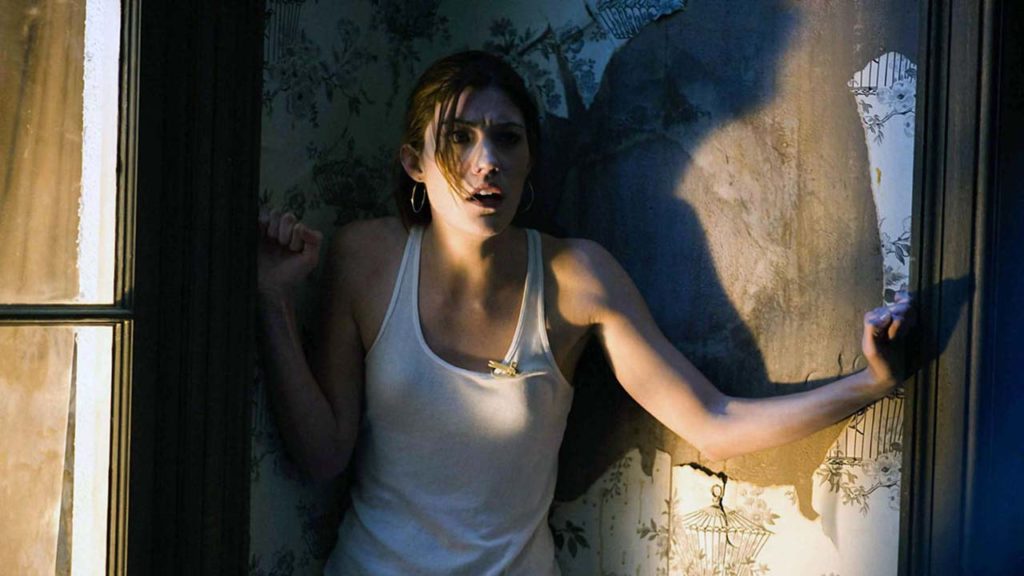
    Jennifer Carpenter in Quarantine
    In true horror movie fashion, Angela (Jennifer Carpenter) sheds layers of clothing throughout her ordeal

    Later, as the elderly woman is revealed to be patient zero for a new highly contagious disease, the Los Angeles Center for Communicable Disease quickly quarantines the building, cutting off all their communications and falsely reporting to the public that it has been evacuated. The trapped tenants are a random assortment of Los Angelans: an opera tutor and his hot young live-in protege, a veterinarian, a cleaning woman, a mom and her baby (whom we meet again near the end of the film, in horrifying transformed fashion), toy dogs, an immigrant couple, and… what’s missing? That’s right! If this is L.A., where are all the unemployed actors?

    Building manager Yuri (Rade Serbedzija) keeps conveniently remembering exits (including a back door and a basement entry to a sewer), but all are blocked. By this point, Angela has morphed into a righteous crusader wanting more footage as proof of the city’s outrage against justice and human rights. But when the virus spreads to most of the people trapped in the building, the power goes off, and panic truly sets in, Angela’s motivations switch to pure survival. The camera now only proves useful as a source of light, and anything captured on video happens by chance as they frantically navigate through the corridors. Then, in true horror movie fashion, things get even worse. In a scene rivaling the nail-biting basement sequence in Silence of the Lambs, Angela and Scott find themselves barricaded in a pitch-black attic with their camera’s lamp broken. The remainder of the movie is seen through the greenish haze of their night-vision filter.

    While Quarantine may seem to tip its hat to horror tradition as protagonist Angela sheds layers of clothing over the course of her ordeal, the movie is actually quite subversive in showing her lose her spirit. Atypically for a horror movie protagonist, she is no plucky survivor that defeats the menace. She pretty much just breaks down.

    Scott Percival in Quarantine
    ground floor, coming up

    Quarantine may be yet another in a long line of zombie flicks, but I would argue its true genre identity is as an urban nightmare. Cloverfield relived 9/11 in the form of another Godzilla and its highly toxic babies, and Guillermo Del Toro’s Mimic envisioned swarms of giant cockroaches breeding in abandoned subway stations. Quarantine touches on another deep anxiety of urban dwellers: a viral contagion born of city filth. The entire outbreak plays out in the confines of an aging tenement building (with what seems to be a clothing sweatshop hidden in the back), a place many city slickers might recognize as home.

    What made Quarantine the most frightening for me in particular was not the gore or the booga-booga scare factor, but rather the disturbing plausibility of its fictional disease. In reality, all we hear about are the dangers of diseases like HIV jumping from bushmeat to humans, and the avian or swine flu incubating in impoverished nations where people live in close quarters with animals. What about those of us living in developed, supposedly civilized cites, full of dogs, roaches, rats, and yes, a certain number of crazy nutjobs?

    A hyper-evolved form of the rabies virus is the most plausible pseudo-scientific explanation I’ve yet heard for zombies, especially compared to the vaguely described Venusian radiation in Romero’s Night of the Living Dead. Like the “superflu” in Stephen King’s The Stand and the distilled “rage” virus in Danny Boyle’s 28 Days Later, this strain of rabies was genetically engineered by a lone terrorist holed up in the attic of the tenement. An ominous clue is dropped halfway through the film about an unaccounted-for tenant living in the attic. When we finally meet him, he appears to have been infected for quite some time. Blind and emaciated, he scrambles around in the total darkness of his former home and laboratory (scattered with disgusting medical photos and newspaper clippings about Doomsday Cults).

    The creepy figure is played by the unusually tall and slender Doug Jones, most recently seen as the Silver Surfer in Fantastic Four and Abe Sapien in Hellboy. I worked on the official website for Guillermo Del Toro’s marvelous Pan’s Labyrinth, for which Jones was interviewed about his experiences playing The Faun and The Pale Man; for someone that so typically plays monsters, he’s a super-nice, funny, and charming dude. I skimmed through the bonus features on the Quarantine DVD, and it’s a crying shame that he apparently wasn’t interviewed.

    In place of a musical score, Quarantine features a complex sound design built around an eerily creaking, groaning old building. It also forgoes other standard movie pleasures, being a gruesome, depressing, and punishing experience. In that respect, it’s similar to how the nauseatingly (literally) bleak Blindness. In contrast, the sublime Children of Men is the rare movie nightmare set at the brink of the end of humanity that nevertheless carries a spark of uplift and hope.

  • A Vampire’s Secret Daily Toil: Låt den rätte komma in (Let the Right One In)

    A Vampire’s Secret Daily Toil: Låt den rätte komma in (Let the Right One In)

    Let the Right One In (Låt den rätte komma in) is unapologetically a vampire story. It follows most of the rules of the genre but avoids the standard trappings of spectacular bloodletting (like, say, Blade) and simplistic sexual metaphors (we’re looking at you, Twilight). Director Tomas Alfredson and screenwriter John Ajvide (adapting his own novel) are startlingly frank not just in their depictions of the ritualistic violence inherent in a vampire’s everyday toil, but also in the desperate hungers and desires of all their human characters as well.

    Novel and film are both set in 1980s Sweden, at a time when the famously independent, neutral nation was struggling through a Cold War economic recession. 12-year-old Oskar (Kåre Hedebrant) is meek, frail, and so fair as to seem albino. He splits his time between a scolding mother and a loving but distant father with unexplained secrets. The only time we see Oskar happy is when playing in the snow at his father’s rural home. An ominous guest arrives, muting even conversation (we never learn the man’s identity, or the reason for his smothering effect, but for story purposes it only matters that Oskar cannot be happy even here).

    Oskar is constantly bullied by school thugs seemingly inspired by the savage torturers from the movie Deliverance: their favorite taunt is to demand he squeal like a pig. The constant pressure drives him morbidly inward, rapidly becoming a potential danger to himself and others. He secretly collects gruesome newspaper clippings of local crimes, and sneaks outside at night to playact his vengeance with matches and a knife. It’s easy for a 21st Century viewer to imagine Oskar becoming a school shooter.

    Lina Leandersson in Let the Right One In
    Eli (Lina Leandersson) has been twelve for a long time

    A mysterious couple moves in next door in the dead of night: Eli (Lina Leandersson), a girl seemingly about his age, and her adult companion Håkan (Per Ragnar). Eli interrupts one of Oskar’s solitary nighttime revenge fantasies, and they strike up a sort of friendship. As the habitually aloof Eli warms to his company, she advises him to fight back against his oppressors. When he gets a chance to do so, Hedebrant’s startling performance during his triumph conveys a disturbing impression of a too-young boy experiencing a kind of ecstasy.

    His disturbingly obvious pleasure contrasts with the wholly dispassionate murders committed by Eli and Håkan. One wonders how Alfredson directed the young actor towards such a performance, and how much Hedebrant knew about the subtext of how the scene would play on the screen. As becomes clear, Eli may not have had the boy’s best interests at heart; was she urging him to stand up for himself, or setting him up for a bigger fall later? Either way, she succeeds in binding him more closely to her.

    Although Oskar is pubescent, his infatuation with her does not seem to be especially sexual. His hungers are more for companionship and understanding. Eli says she is “not a girl,” and asks Oskar if he would still like her were she not. With little hesitation, he answers yes. He catches a glimpse of her naked torso, seeing what seems to be a castration mark. But Eli is far more than simply “not a girl”. Subtle special effects give us fleeting images of her with eerily enlarged eyes and as an older woman. She is permanently frozen in a state of childhood, but it seems she hasn’t matured intellectually and emotionally as her body remains in stasis (unlike the young character Claudia in Anne Rice’s Interview With the Vampire). As she tells him “I’ve been twelve for a long time.”

    Let the Right One In
    Vampires are hot stuff in bed

    Although it doesn’t resemble more typical vampire tales, Let the Right One In does follow most of the mythos: vampires have to be invited in (hence the title; to enter uninvited will cause a painful, bloody death – a fate Eli demonstrates to Oskar to prove her affection for him); any victim bitten but not killed will become a vampire (Eli is shown to break a victim’s spine after feeding – a belated form of mercy coming from a vampire, I suppose); housecats are compelled to attack vampires (as seen in not one of the most convincing special effects sequences), and sunlight causes them to spontaneously combust (as seen in one very convincing sequence).

    Eli shares with Oskar her motto “To flee is life. To linger, death.” Like her encouragement to fight back against bullies, here is the key to understanding the mystery of her devoted human companion Håkan. Eli has outsourced her physical needs to her selflessly devoted servant, essentially grooming him to become a serial killer on her behalf. What motivates him to comply? Was he once a boy, like Oscar, that fell in love with her? Whatever their bond, she ensures that Oskar is next in line to become her new provider.

    After writing the above, I read The A.V. Club’s excellent Book Vs. Film: Let the Right One In by Tasha Robinson (part of a series also including Watchmen). In short, yes, a great deal needed to be omitted from the novel to shape the story into a feature film. But Robinson approves; rather than leaving too much out, the movie fruitfully chooses a very different, more internal version of the story. Some tidbits gleaned from the article that may be of interest to anyone else that hasn’t read the book:

    • The book is a more graphic, conventional horror story.
    • Oskar’s father’s friend is a less sinister character in the book. Simply, he’s a drinking buddy, and Oskar’s otherwise decent father is apparently a mean drunk.
    • The title is derived from a Morrissey song quoted in the book: “Let the right one in / let the old dreams die / let the wrong ones go / They cannot do what you want them to do”
    • The Oskar of the novel is overweight, inspiring the bullies’ “piggy” taunts.
    • The Håkan of the book is a pedophile. Eli encountered him as an adult, and she trades some sexual favors for his services. Skimming the comments section for Robinson’s article, I see many other viewers interpreted the movie the same way I did.

    Must read: Let the Wrong Subtitles in to Let the Right One In. Icons of Fright finds the English translation lacking.

  • A Disease Immune to Bureaucracy: Fernando Meirelles’ Blindness

    A Disease Immune to Bureaucracy: Fernando Meirelles’ Blindness

    Director Fernando Meirelles has examined desperate pressure cookers (City of God) and institutional corruption (The Constant Gardener) before. Blindness proves perfect to meld both themes, with a science fiction twist imagining the downfall of civilization itself.

    Blindness is part of a special subset of the horror/sci-fi/disaster genre: the dystopian end-of-civilization nightmare. Whereas the typical entry works by introducing a disrupting element into the status quo (typically a monster), a few instead subtract one fundamental fact of life that we take for granted. The basic recipe is simple: flip one switch, and watch civilization fall in short order. In Children of Men, humanity becomes infertile. In The Happening, the biosphere starts pumping out poison. In the comic book series Y: The Last Man, all males on the planet suddenly die off. In innumerable zombie flicks death is no longer absolute. It may not be a coincidence that at least two members of the Blindness cast already have relevant experience on their resumes: Julianne Moore in Children of Men and Alice Braga in I Am Legend.

    Mark Ruffalo and Julianne More in Blindness
    “The only thing more terrifying than blindness is being the only one who can see.”

    All of these stories bleed over into the genre realms of science fiction and horror. Blindness, however, is based on the magical realist (if it’s accurate for me to call it that) novel by Jose Saramago. The novel is set in a generic city, featuring unnamed characters (the movie, filmed in Sao Paulo, Brazil, effectively preserves both conceits – I didn’t notice until the credits rolled that the characters did not have names). Without getting bogged down in pseudo-scientific details, Zaramago posits a highly contagious “White Blindness” that rapidly sweeps the globe, affecting everyone but one random woman. The movie’s explanation is a far more literal highly communicable disease, diagnosed for the audience by the unnamed opthamologist “Doctor” (Mark Ruffalo). By sheer coincidence, The Doctor’s Wife (Moore) appears to be immune.

    The obvious challenge for the filmmakers is how to render a prose story about blindness into the most visual storytelling medium of all. Cinematographer César Charlone (who also shot City of God and The Constant Gardener) meets the challenge by creating stunning visuals which paradoxically obscure. The picture frequently flares into a burned-out whiteness, often a relief from the ugly filth in which the characters find themselves living as the safety net of society collapses.

    The story brutally details a basically pessimistic view of human nature. Right from the start, humanity’s inherent greed and avarice make a catastrophic situation worse. The very first victim of the disease is immediately exploited by a car thief (ironic, as automobiles are shortly to become the most futile of valuables to steal). As the blindness disease spreads, the authorities (represented by The Minister of Health, in what amounts to a cameo by Sandra Oh) attempt to contain the infected in isolation wards, a weak euphemism for concentration camps. As The Man With the Black Eye Patch (Danny Glover) states in a nicely written but implausibly eloquent monologue, “the disease was immune to bureaucracy.”

    Danny Glover, Julianne Moore, and Mark Ruffalo in Blindness
    “I know that part inside you with no name, and that’s who we are, right?”

    The infected are made up of characters from many cultural and economic backgrounds, much like Alejandro González Iñárritu’s Babel (2006). Left alone to self-organize, two opposing societies coalesce around two very different natural leaders. The Doctor and his Wife create a fragile but functioning democracy, but the King of Ward Three (Gael Garci­a Bernal) forges a depraved Sodom built on exploiting their few resources for short-term base pleasures. Inevitably, the two fledgling states go to war, as much out of ideology as for want of resources.

    As the ward denizens’ circumstances get worse and worse, the movie itself becomes a punishing experience to watch (an imitative fallacy). In terms of depictions of violence, it is no less explicit than, say, Children of Men, but wholly lacks that superior film’s dark wit and essential thread of hope. Whereas Children of Men had no real villain (Luke, Chiwetel Ejiofor, was actually more of a Che Guevarra-type revolutionary), there is little or no subtlety of character in Blindness‘ wholly evil bad guys. Would the central allegory be more interesting to ponder if the villains were not so unambiguously monstrous? Even I Am Legend dropped hints that its vampire/zombie-like monsters possessed crude intelligence, a will to live, and empathy for their own kind.

    The fragile community in the wards disintegrates into a hell of gang rape and open war. Then, amazingly, it gets worse. But as the walls of the prison burn, the prisoners discover the doors have actually been left open. If anything, the world outside has become worse off than the pressure cooker in which they were imprisoned. After a harrowing trip through the devastated city, they experience one fleeting moment of joy as they bathe in the rain. Afterwards, they set up an eden in the Doctor and his Wife’s former home, like a less-satiric version of the fortified suburban shopping mall in George A. Romero’s Dawn of the Dead. The Doctor’s Wife’s newly extended family embraces her as their “leader with vision.”