Tag: James McAvoy

  • Falling in love at the end of the world, in Wim Wenders’ Submergence

    Falling in love at the end of the world, in Wim Wenders’ Submergence

    Rating: 4 out of 5.

    Ladies, if your fella isn’t returning your calls, maybe he’s a secret agent on a tippy-top secret mission for queen and country. Fellas, if your girl isn’t liking your posts, maybe she has zero bars because she’s doing science stuff on the ocean floor.

    I went into Submergence fully aware of the generally negative reviews, but I’m willing to watch anything by Wim Wenders, who directed at least two of my most beloved movies: Wings of Desire and Until the End of the World.

    I suppose I can see how many (most?) people would find Submergence frustrating, but to me it is intriguing update to one of Wenders’ longest-running themes: falling in love, despite — or perhaps accelerated by — looming death. In Wings of Desire, an immortal being contemplates earthly concerns like suicide and the legacy of Nazi Germany, and chooses mortal love. The characters in The End of Violence and Until the End of the World live under different kinds of technological swords of Damocles: drones in the former, and nuclear disaster in the latter. After all, it’s right there in the titles.

    Alicia Vikander and James McAvoy in Submergence

    In Submergence, two beautiful people (Alicia Vikander and James McAvoy) meet cute and fall in love, but each is haunted by their own particular view of immanent environmental apocalypse: hers primarily scientific and his political. Lest the Anthropocene Extinction and potable water crisis be insufficient cause for existential anxiety, there is also an eerily prescient prediction of a virus not unlike COVID-19. Submergence was released in 2017.

    She is more optimistic than he about mitigating the disasters sure to come in the near future. Given how his mission goes drastically awry, with him a powerless prisoner while she remains actively in control, perhaps she is right.

    The one key Wenders ingredient that is lacking in Submergence is his usual A+ primo taste in music. So many of his past movies have utterly superb soundtracks, particularly the sublime Until the End of the World, the cd of which was effectively one of the best mixtapes of the 1990s, and famously outsold the movie. But the score for Submergence is disappointingly generic and overbearing, and the only needledrops are the classical music that Danielle blasts through her bluetooth speaker.

  • Cool Britannia: David Yates’ BBC Miniseries State of Play

    Cool Britannia: David Yates’ BBC Miniseries State of Play

    The 2003 BBC miniseries State of Play is nothing less than six straight hours of intelligent drama, liberally spiced with suspense, action, and tasty plot twists. The entire epic tale is delivered by a veritable plethora of British Isles telly & film who’s who: writer Paul Abbot, director David Yates, and actors David Morrissey, John Simm, Kelly Macdonald, Polly Walker, Bill Nighy, and James McAvoy. Abbot is apparently a superstar television writer in the UK, and Yates directed the last two Harry Potter films (as well as reuniting Nighy and Macdonald in 2005 for The Girl in the Cafe).

    State of Play is an especially good tonic after happening to recently watch the dour The International, which falls more or less into the same genre category. The key differential is a heathy dash of comic relief that never crosses over into farce, mostly supplied by the sublimely quirky Bill Nighy. But more importantly, the intricate tale of high-level political conspiracy feels pertinent.

    Bill Nighy, John Simm, Kelly Macdonald in State of Play
    The Herald newsroom follows the money in State of Play

    The International, although based on an actual banking scandal (a topic that could not be more timely), sabotaged its plausibility by limiting the protagonists to two lone wolfs that take on a crooked multinational financial conglomerate on their lonesome. Here, numerous fleshed-out cops and reporters alternately clash and collaborate as they chase down a gargantuan story.

    State of Play is both a classic newspaper story (like All the President’s Men) and a police procedural (like The French Connection). It’s worth noting that each of these genres are about the piecing together of stories, and the suspense comes from the audience follows along with them as the discover the pieces of the narrative. Granted, the luxurious six-hour running time was a luxury The International could not enjoy.

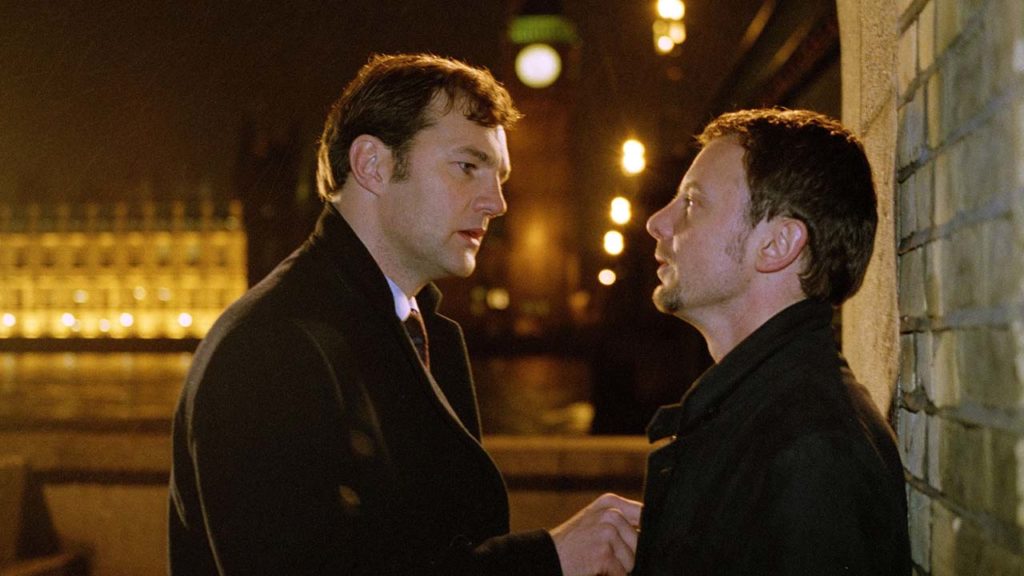
    David Morrissey & John Simm in State of Play
    The Next Doctor faces off against The Master for the first time

    The details of the plot were undoubtedly timely in 2003 and continue to be now, proven by its American feature film remake in 2009. After suffering through 8 years of a Bush/Cheney administration, Americans can intimately relate to oil companies meddling in governmental operations. Although State of Play is fictional, the affair between a Member of Parliament and a staff member that winds up dead inescapably calls to mind US Representative Gary Condit’s affair intern Chandra Levy, found murdered in 2001. A subplot involving an MP’s compromised expense account now looks even more timely than Abbot could have predicted in 2003, considering the atrocious widespread abuse that currently threatens to remove Gordon Brown and possibly even the Labour Party from power.

    Apart from the sometimes overenthusiastic editing (making the series sometimes feel a bit like the satire Hot Fuzz), the only misstep is Nicholas Hooper’s percussive, bombastic score, including an incongruous didgeridoo-infused theme suddenly introduced in part six. But one of the series’ greatest pleasures is to hear Kelly Macdonald (a crush ever since her unforgettable performance as the ultimate naughty schoolgirl in Trainspotting) pronounce “murder” with all the wonderful extra diphthongs her Scottish accent provides.


    Must read: BBC’s State of Play Left Me in a State of Awe on Pop Culture Nerd

  • Every Day is Exactly the Same for James McAvoy in Wanted

    Every Day is Exactly the Same for James McAvoy in Wanted

    The Nine Inch Nails song “Every Day is Exactly the Same” is so thematically perfect for the early part of Timur Bekmambetov’s Wanted, that it seems to have been composed especially.

    But Wanted is weighed down by an overly extensive backstory that goes back thousands of years, and an approach to violent spectacle that borders on the sadistic. It’s hard not to sense a trend, as I’ve had the same complaints about a couple other movies I happened to see recently: Hancock, Speed Racer, and Southland Tales.

    Angelina Jolie and James McAvoy play assassins with superhuman abilities, directly tied to the action choreography and special effects: the power to “throw” bullets and slow down their perception of time in order to move superhumanly fast. All of this is framed in close and medium shots, a bad choice for an action film that ought to display its stunts and derring-do in full. It’s more visually disorientating than even the hyperkinetic Speed Racer, but the slow-mo sequences paradoxically render the proceedings rather boring — even when something that ought to be impressive is happening, a bullet sliced in twain by sword.

    James McAvoy, Common, and Angelina Jolie in Wanted
    James McAvoy, Common, and Angelina Jolie at the country fair

    It’s difficult to feel sympathy for a protagonist who, when causing a literal train wreck, resumes his murderous mission instead of aiding the countless innocent bystanders he has turned into collateral damage. In the end, Wesley smugly asks, “What the fuck have you done lately?” So, becoming a superhuman assassin has granted Wesley self-actualization: he’s free of his botched relationship and dead-end job, he’s physically fit, and he shoots people in the head for a living.

    So, Wanted flirts with the nihilistic themes of David Fincher and Chuck Palahniuk’s Fight Club, but without the irony. What many surface-level admirers of Fight Club seem to forget is that while it initially seems to celebrate its unnamed protagonist’s decisive break from the supposedly stifling bounds of society, his self-help credo attracts the wrong kind of followers and spins out of control to its ultimate logical end: anarchy.