Tag: Natalie Portman

  • Wong Kar-wai’s American road movie My Blueberry Nights

    Wong Kar-wai’s American road movie My Blueberry Nights

    Wong Kar-wai’s first English-language film My Blueberry Nights is mostly set in bars and diners across America. His characters all indulge in the four great American pastimes: eating, drinking, gambling, and driving.

    Rachel Weisz in My Blueberry Nights

    Nobody films beautiful women, or should I say, nobody films women beautifully, like Wong Kar-wai. In Blueberry Nights, he has no less than four famous female faces to worship with his camera:

    • Norah Jones – Perhaps not the most natural of actors, but her speaking voice is as emotionally expressive as it is in her famously languid, evocative music.
    • Chan Marshall (aka Cat Power) – Like Jones, Marshall is a musician and not an experienced actor, but her cameo is bittersweet and effective.
    • Rachel Weisz – The New York Times one described Weisz as “the thinking man’s sex symbol,” but here she portrays a seemingly dim character with a cruel streak.
    • Natalie Portman – Like Weisz, Portman plays against type as a troubled young gambling addict with an Electra complex.
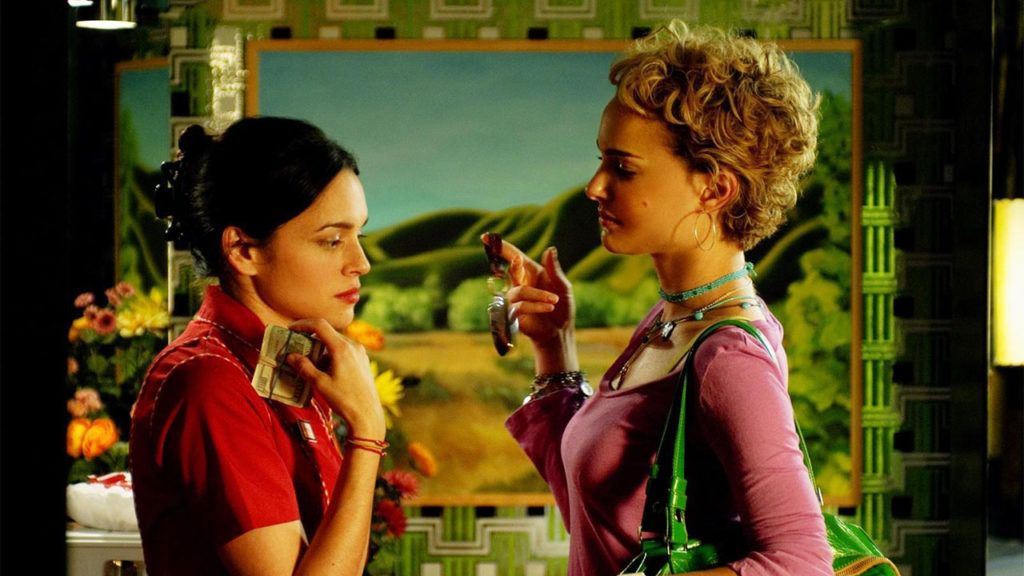
    Natalie Portman and Norah Jones in My Blueberry Nights
    Natalie Portman offers Norah Jones an offer she can’t refuse

    It’s impossible to miss the central metaphor: every morning, diner proprietor Jeremy (Jude Law) ritually bakes a blueberry pie. Never eaten, it is thrown out whole every night. It may be undesired for the time being, but every day there is a fresh chance for it to find someone who hungers for it.

  • Fascism by Common Consent in James McTeigue’s V for Vendetta

    Fascism by Common Consent in James McTeigue’s V for Vendetta

    For all the negative buzz regarding V for Vendetta writer Alan Moore’s total disavowal of James McTeigue’s adaptation, I was surprised to find that the film kept far closer to the book than I expected. Closer, in fact, than the two other travesties of Moore’s comics, League of Extraordinary Gentlemen and From Hell. Perhaps not coincidentally, it’s better than both, if by itself still not very good.

    It’s impossible for me to imagine how I would have reacted had I not read the book several times, but I suspect I would have had very mixed feelings either way. When it comes to movies based on comics, it’s the prerogative of every fan to obsess over “what they changed.” So let me point out a few changes I feel illustrate how the filmmakers either misunderstood or deliberately warped some key themes that make the book what it is.

    Hugo Weaving and Natalie Portman in V for Vendetta
    “The only verdict is vengeance; a vendetta, held as a votive, not in vain, for the value and veracity of such shall one day vindicate the vigilant and the virtuous.”

    First, the dystopian state of Great Britain as seen in the film is in a far less desperate state than in the book. The book opens with Evey at the absolute end of hope, her parents dead and herself alone, blacklisted and unable to survive. She makes a misguided and pathetic attempt to prostitute herself, runs afoul of the corrupt police, and is “saved” (in more ways than one) by V. Her susceptibility to V’s seduction is much more plausible if she herself is already a victim of the state. In the film, as played by Natalie Portman, she’s a rather happy person with a regular job, and her encounter with V is motivated by a redundant invented character called Deitrich. Every theme Deitrich represents is already covered by the character Valerie (which is, incidentally, lifted almost unaltered from the book).

    But perhaps the biggest deviation is the very nature of the fascist state Great Britain has become. In the book, it’s something that just happens; a form of order that arises out of the chaos following a nuclear world war. In the film, the great societal disruption is a conspiracy machinated by a cabal of shadowy old white men, who then step in and profit from the reconstruction. Of course, the filmmakers are obviously reaching for an analogy to the Bush Administration, Carlyle Group, Halliburton, etc. While that may make the story of the film relevant to today, it obscures a more powerful point of the book: it’s far more scary when fascism arises out of the common consent of the people, as it did with Nazi Germany.