Tag: Sigourney Weaver

  • The sexual revolution freezes over in Ang Lee’s The Ice Storm

    The sexual revolution freezes over in Ang Lee’s The Ice Storm

    Rating: 4 out of 5.

    The Ice Storm takes place at the precise moment when the burned-out remnants of the ’60s sexual revolution belatedly limped into the disaffected ’70s suburbia. The centerpiece of the film is a supposedly liberating “key party” that proves otherwise, thanks to long-simmering resentments and inhibitions. Two generations of two families clash during a single disastrous night, beset by heavily portentous bad weather and bad ideas.

    Director Ang Lee and screenwriter James Schamus adapt Rick Moody’s novel, in what was either a nightmare or dream come true for art directors and costume designers. The very specific milieu of New Canaan, Connecticut in 1973 is rendered in oranges and browns, with the cast clad in plaids and shaggy hair, and the sets dressed with period flotsam like waterbeds and styrofoam packing peanuts.

    Indeed, its overpowering upper-middle-class ’70s tackiness was the primary talking point at the time, and I recall titters from the audience when I first saw it in the theater. The fashions may be unflattering for most of the cast, but it must be noted that Sigourney Weaver looks stunning regardless.

    The Ice Storm
    A key party may have seemed like an exciting idea in the abstract.

    In the 2008 Criterion Collection edition, production designer Mark Friedberg describes recreating his childhood playroom, designed by his architect father. He also incorporated his grandmother’s paintings and his father’s furniture. Realizing the titular ice storm took a couple strategies, depending on the surface, including hair gel, cast resin, and biodegradable goop.

    The striking visuals are made even more convincing by the crinkling, crackling sound design. Also of note is the minimalist score by Michael Danna, featuring a Native American flute. The end credits feature another creature of the 1970s: David Bowie’s melancholic re-recorded version of “I Can’t Read.”

    The film and novel both cite the Marvel Comics series Fantastic Four, which features a uniquely dysfunctional family unit. The conceit is effective, if a little obvious. Lee and Schamus would later more directly explore this territory in the under-appreciated Hulk (2003). I am also reminded of Todd Field’s Little Children (2006), which also posits that the behavior of adults and their children is not all that different — albeit in a bone-dry satirical tone that makes it a hard movie to like.

    Kevin Kline, Joan Allen, and Christina Ricci in The Ice Storm
    “Sometimes the shepherd needs the comfort of the sheep”

    The casting for The Ice Storm is excellent all around, particularly for the young actors, who all went places. Tobey Maguire and Elijah Wood would each go on to headline major franchises. The former plays a complex character, perhaps the only one who comes through the evening with his innocence intact. Yes, he had dark designs that wreak havoc, but he pulls back from causing real harm. Christina Ricci is especially perfect here; she appears worldly and cynical beyond her age, and yet simultaneously so young and vulnerable.

    Of the four deleted scenes included in the Criterion Collection edition, two foreshadow the fateful key party. With these scenes cut, the party is less signposted as a significant event, and its true nature as a pivotal moment comes more of a surprise:

    1. Ben (Kevin Kline) at the office, concerned with stagflation. Schamus cut the scene because it was “too funny” – this despite the fact they were under the impression the movie as a whole was going to be funnier than it turned out: uncomfortable and squirmy.
    2. Elena (Joan Allen) and the reverend at a diner, before the party. Timely gas crisis lines are visible out the window.
    3. Ben & Elena in bed, mentioning the party again.
    4. Paul (Maguire) calls Wendy (Ricci) with a “moral dilemma.” He hasn’t been privy to what she’s been up to in his absence, so he doesn’t know she’s probably the wrong person to come to with these kinds of problems.

    On the same disc, Rick Moody describes seeing an adaptation of his work as someone else’s interpretation of your dream. Like a translation of a poem into another language, it is patently impossible, and says more about the translator than the original poet.

  • Exclusive! The Expendables 3 Poster

    Exclusive! The Expendables 3 Poster

    Carter. Grier. Hamilton. Jolie. Jovovich. Thurman. Weaver. Yeoh. The Expendables 3 movie poster

    Coming summer 2014 — The Expendables 3! Starring Lynda Carter, Pam Grier, Linda Hamilton, Angelina Jolie, Milla Jovovich, Uma Thurman, Sigourney Weaver, and Michelle Yeoh.

    This movie does not exist, but should. Hollywood, call me.

  • This’ll Ruin My Day: James Cameron Goes Down the Digital Rabbit Hole in Avatar

    This’ll Ruin My Day: James Cameron Goes Down the Digital Rabbit Hole in Avatar

    Avatar is the perfect distillation of all of James Cameron’s worst tendencies: an obsession with the marine corps (while trying to have it both ways: worshipping the hardware and lingo, but casting them as villains), embarrassingly heinous dialogue (undercutting every dramatic moment with somebody droning flat one-liners like “oh shit” or “this’ll ruin my day”), a token wise Latina available for cleavage and wisecracks (Michelle Rodriguez, more wise than most of the white and/or blue people, anyway), a greater interest in technology over people (both on screen and behind the scenes), and a core anti-war message contradicted by glorified slaughter and explosions.

    If Cameron had a purpose in mind for Avatar other than as a showreel of the latest technological breakthroughs, it seems to be an endorsement of violent protest. If so, the civilian population of Iran might find something of interest here. More the pity the Na’vi didn’t happen to be green, in which case critics might be discussing the film in terms of current events instead of being distracted by the shiny special effects masking the soulless narrative and blank acting (with the significant exception of a very funny Giovanni Ribisi and especially Zoe Saldaña, who manages to make an impression despite not technically appearing on screen — as a conventional photograph, anyway).

    Yes YesStory Roger Dean Avatar
    Detail from Roger Dean’s sleeve for Yes’ YesStory on the left, scene from Avatar on the right.

    The official Avatar talking points require mention of the sundry technological breakthroughs that come tethered to every Cameron film, mostly having to do with computers. The Terminator (1984) and Aliens (1986) were relatively quaint in their utilization of models and stop-motion animation, but The Abyss (1989), Terminator 2: Judgement Day (1991), and Titanic (1997) each debuted incrementally advanced computer animation techniques, for the first time fully integrated with live action photography. I clearly recall watching T2 with an audience gasping and applauding in amazement during a shot in which the liquid metal robot T-1000 (Robert Patrick) literally turned itself inside out. There’s nothing in Avatar to compare to that communal moment of delighted awe in 1991; my 2010 Avatar audience oohed and aahed during the first 3D effects visible in the attached trailers (mostly for disposable kiddie movies like Despicable Me), but our eyeballs were already beaten into submission by the time the main feature rolled, and the packed house sat silently through the 162 minute-long barrage of computer-processed flim-flam.

    I’ll spend a paragraph on the positive: Steven Soderbergh, who previously collaborated with Cameron on Solaris, reportedly said after seeing the film that “There’s gonna be before that movie and after“. It is inarguable that Avatar marks the tipping point in at least two key filmmaking techniques we’re certain to see even more of in the immediate future: 3D photography and virtual filmmaking (the congruence of photorealistic CGI with motion capture, basically a turbocharged update to the old practice of rotoscoping). The superlative 3D is applied equally well to both the live-action and animated sequences (indeed, most of the film is a melding of the two). It’s more refined and subtle than any 3D film I’ve seen before, including U23D, Beowulf, and Coraline, all of which resorted to in-your-face showing off common since the early days of The Creature From the Black Lagoon (1954) and Dial M for Murder (1954). Meanwhile, the motion-captured CGI characters are even more smoothly integrated with live-action photography than previous high-water marks like the T-1000 in T2, Jar Jar Binks (Ahmed Best) in George Lucas’ Star Wars prequel trilogy, and Gollum (Andy Serkis) in Peter Jackson’s The Lord of the Rings trilogy. And that’s not even to mention the startlingly detailed and immersive computer-generated backgrounds and environments.

    Yes Keys to Ascension Roger Dean Avatar
    Detail from Roger Dean’s cover for Yes’ Keys to Ascension on the left, Avatar on the right. As artist & filmmaker Dave McKean rightly opined on Twitter, “Roger Dean should sue!”

    The other big talking point is of course its staggering expense. It’s hard to remember now, years after Titanic‘s box office receipts broke records worldwide, but its $200 million budget was originally an object of ridicule and put the very existence of two vast corporations at stake (20th Century Fox and Paramount). Avatar inflates the accountants’ calculations to the insane level of circa $237 million, but Cameron’s instincts appear again to have been right; Avatar has already (at this time of writing) earned a billion dollars worldwide, a mere two weeks after release.

    As guest blogger Snarkbait wisely predicts, 10 years from now Avatar‘s special effects will be laughable, and all that will be left is the story. And when that story is a warmed-over retelling of the European conquest of America (more recently retold in Terrence Malick’s The New World and as SlashFilm notes, Disney’s Pocahontas) set in a sci-fi world seemingly stolen from the paintings of Roger Dean, isn’t the hundreds of millions of dollars worth of technology and years of production all for naught? It’s impossible not to compare this folly to the Star Wars prequels, made long after Lucas fell down the rabbit hole of obsession with filmmaking technology and no longer had anyone around him willing or capable to say no. This blogger happened to watch (500) Days of Summer and Up in the Air right before and after Avatar, and can attest that there is no substitute for good writing and acting. People will still be rewatching films like those long after Avatar is forgotten.


    Must read: The blog Papyrus Watch catches the use of the cliched font in the movie logo and subtitles. Papyrus was designed in 1982 and is now commonly found preinstalled on most computers.

  • The Rashomon effect in Pete Travis’ Vantage Point

    The Rashomon effect in Pete Travis’ Vantage Point

    Vantage Point is an awesome technical achievement, and I don’t mean that to damn it with faint praise. Director Pete Travis and writer Barry Levy demonstrate excellent plotting, spatial sense, editing, logistics, and continuity. As a thriller it moves forward relentlessly, and feels comprehensible, self-contained, and very satisfying.

    It is structured around a single gimmick, but it’s a good one. As one of the cinematic children of Rashomon (including The Usual Suspects and Courage Under Fire), it retells the same event from multiple points of view.

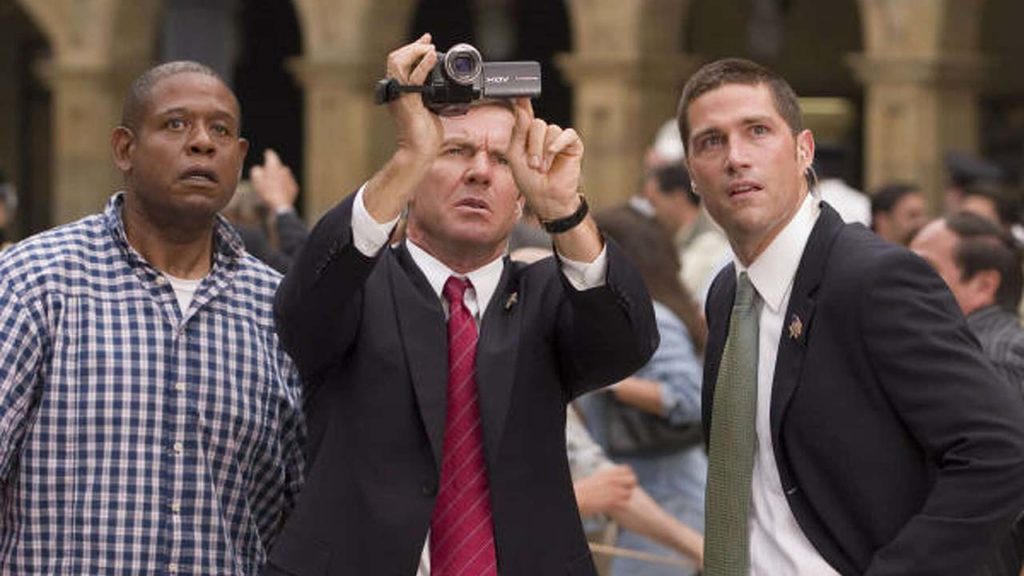
    An assassination attempt on the US president in Spain is foiled by veteran Secret Service agent Thomas Barnes (Dennis Quaid) and civilian Howard Lewis (Forest Whitaker). The advantage of this structure is to withhold information and create suspense. The first time we spot Lewis, from the hyper-cautious Barnes’ perspective, he seems to be acting fishily. But when we soon see the events from his point of view, we learn he’s an innocent.

    But the structure works the other way; almost a full hour passes until we see fellow Secret Service agent Taylor’s (Matthew Fox) side of the story, and the simple fact of his prolonged absence causes the audience to suspect him. At about the one-hour mark, the rigid, neat structure breaks down and we begin to see slivers of each character’s experiences mixed together, as they all draw to a single time and place for the climax.

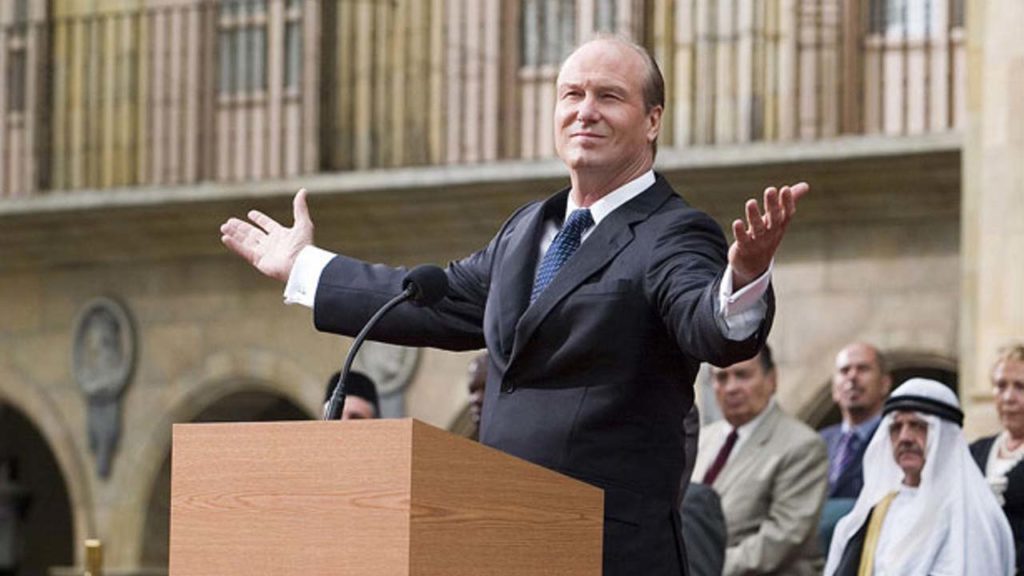
    William Hurt in Vantage Point
    A turkey in every pot and a thriller in every multiplex

    But the crucial falling-down point of the movie is the trumped-up assassination plot itself, which is seemingly crafted for maximum storytelling drama and not real-world terrorist efficacy. Would an actual successful assassination be so hi-tech and complex? This plot relies on lots of wireless technology, split-second timing, blackmail (coercing someone to perform key tasks better done by someone the plotters could count on) and at least two inside men (one of whom must have spent almost a lifetime preparing).

    This is how terrorism works only in the movies. Real-life assassins tend to be lone gunmen who manage to slip through security with their sheer unpredictability, and terrorist attacks like Oklahoma City and 9/11 didn’t depend on technology more complex than fertilizer and box cutters. While we’re on the subject, what are these particular assassins’ motivations, exactly? It becomes clear they don’t wish to kill the president but to capture him. Whatever they hope to accomplish, they seem quite pleased with themselves.

    Forest Whitaker, Dennis Quaid and Matthew Fox in Vantage Point
    OK, everybody skootch in a little… say cheese!

    All of these questions are negated in the end by a news broadcast that claims that a lone assassin has been shot and killed. This conclusion plays to the public’s lust for conspiracy theories than continues to plague 9/11 and the JFK assassination.

    Extra observations:

    • One of the biggest plot twists is spoiled in the trailer.
    • Barnes is a cliche we’ve seen before, played by Clint Eastwood in In the Line of Fire.
    • There’s an oddly tiny role for Sigourney Weaver as television news director Rex Brooks. Was there more intended for her character? Perhaps she took the role for an opportunity to spend a few days in Spain.
    • Hey, it’s Hollywood’s go-to middle eastern guy, Said Taghmaoui (from The Kite Runner and Three Kings). He does turn out to be a villain, but so do two white dudes, so the movie totally isn’t racist.
  • Tina Fey raids her rolodex for Baby Mama

    Tina Fey raids her rolodex for Baby Mama

    As a true comedy auteur, Tina Fey’s acting has always come in tandem with her own writing. This double act has progressed from improv comedy at The Second City, to head writer for Saturday Night Live, to supporting player in the feature film Mean Girls, (for which she wrote the screenplay), and finally to executive producer and star of her own sitcom 30 Rock.

    Baby Mama, written and directed by Michael McCullers, marks Fey’s first star turn in a project which she did not originate or write. Still, it certainly feels a lot like a Tiny Fey joint. Judging by the general tone and the chaotic improv of Fey’s partner-in-crime Amy Poehler, I suspect the two enhanced the production with a fair amount of script-doctoring.

    Tina Fey and Amy Poehler in Baby Mama

    Indeed, Fey’s character fits firmly in the public persona of Endearingly Neurotic Thirtysomething Single Girl established on SNL’s Weekend Update, as Ms. Norbury in Mean Girls, and as Liz Lemon in 30 Rock. The Tina Fey Notlash notwithstanding, she is evidently more grounded in real life, and married with a child. Meanwhile, the fictionalized “Tina Fey” is the idol of every girl with glasses and crush of every boy with… uh, glasses.

    Fey must have an impressive rolodex, for like her flagship TV show 30 Rock, nearly every little role is Baby Mama is filled by a familiar face. When not being amused by alumni from The Daily Show and SNL, we’re treated to Steve Martin as a wild and crazy organic food magnate and Sigourney Weaver as an initially creepy but ultimately sympathetic fertility doctor. But personally, I wouldn’t dare make fun of Sigourney Weaver’s age, lest she come after me with a flamethrower or a space forklift.