Tag: thriller

  • Cool Britannia: David Yates’ BBC Miniseries State of Play

    Cool Britannia: David Yates’ BBC Miniseries State of Play

    The 2003 BBC miniseries State of Play is nothing less than six straight hours of intelligent drama, liberally spiced with suspense, action, and tasty plot twists. The entire epic tale is delivered by a veritable plethora of British Isles telly & film who’s who: writer Paul Abbot, director David Yates, and actors David Morrissey, John Simm, Kelly Macdonald, Polly Walker, Bill Nighy, and James McAvoy. Abbot is apparently a superstar television writer in the UK, and Yates directed the last two Harry Potter films (as well as reuniting Nighy and Macdonald in 2005 for The Girl in the Cafe).

    State of Play is an especially good tonic after happening to recently watch the dour The International, which falls more or less into the same genre category. The key differential is a heathy dash of comic relief that never crosses over into farce, mostly supplied by the sublimely quirky Bill Nighy. But more importantly, the intricate tale of high-level political conspiracy feels pertinent.

    Bill Nighy, John Simm, Kelly Macdonald in State of Play
    The Herald newsroom follows the money in State of Play

    The International, although based on an actual banking scandal (a topic that could not be more timely), sabotaged its plausibility by limiting the protagonists to two lone wolfs that take on a crooked multinational financial conglomerate on their lonesome. Here, numerous fleshed-out cops and reporters alternately clash and collaborate as they chase down a gargantuan story.

    State of Play is both a classic newspaper story (like All the President’s Men) and a police procedural (like The French Connection). It’s worth noting that each of these genres are about the piecing together of stories, and the suspense comes from the audience follows along with them as the discover the pieces of the narrative. Granted, the luxurious six-hour running time was a luxury The International could not enjoy.
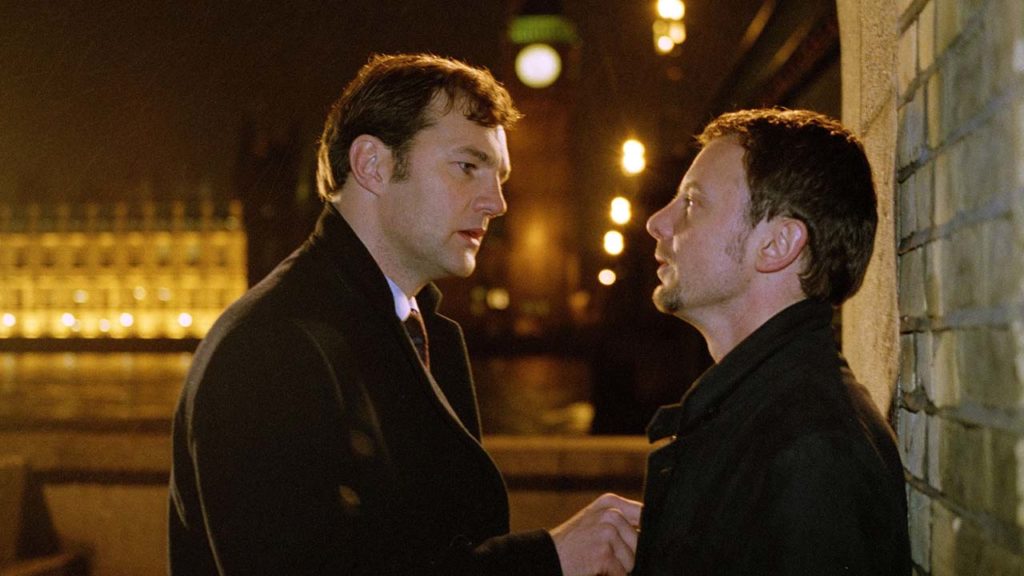
    David Morrissey & John Simm in State of Play
    The Next Doctor faces off against The Master for the first time

    The details of the plot were undoubtedly timely in 2003 and continue to be now, proven by its American feature film remake in 2009. After suffering through 8 years of a Bush/Cheney administration, Americans can intimately relate to oil companies meddling in governmental operations. Although State of Play is fictional, the affair between a Member of Parliament and a staff member that winds up dead inescapably calls to mind US Representative Gary Condit’s affair intern Chandra Levy, found murdered in 2001. A subplot involving an MP’s compromised expense account now looks even more timely than Abbot could have predicted in 2003, considering the atrocious widespread abuse that currently threatens to remove Gordon Brown and possibly even the Labour Party from power.

    Apart from the sometimes overenthusiastic editing (making the series sometimes feel a bit like the satire Hot Fuzz), the only misstep is Nicholas Hooper’s percussive, bombastic score, including an incongruous didgeridoo-infused theme suddenly introduced in part six. But one of the series’ greatest pleasures is to hear Kelly Macdonald (a crush ever since her unforgettable performance as the ultimate naughty schoolgirl in Trainspotting) pronounce “murder” with all the wonderful extra diphthongs her Scottish accent provides.


    Must read: BBC’s State of Play Left Me in a State of Awe on Pop Culture Nerd

  • Circumnavigating The Guggenheim in Tom Twyker’s The International

    Circumnavigating The Guggenheim in Tom Twyker’s The International

    The International may seem a little conventional coming from Tom Tykwer, director of the kinetic classic Run Lola Run, the mystical The Princess & The Warrior, and the lunatic, perverse Perfume. The International is by far his most conventional in subject matter, and lacking his energy and spirit. It especially suffers in comparison to its closest contemporary rivals in the globe-trotting action/suspense field, Jason Bourne and James Bond.

    Eric Singer’s original screenplay unravels the sort of paranoid conspiracy theory that only exists in fiction, but in fact is based on an actual scandal involving the Bank of Credit and Commerce International (BCCI), which collapsed in 1991. But the fictionalized story makes use of ridiculous contrivances that reduce a massive international investigation down to a two-handed operation involving disgraced Interpol agent Louis Salinger (Clive Owen) and Manhattan District Attorney (and MILF) Eleanor Whitman (Naomi Watts).

    Clive Owen and Naomi Watts in The International
    For the love of God, will somebody please tell me where Tykwer hid the camera?!

    Speaking of, The International is a true waste of Watts’ talent (watch Mulholland Drive and Funny Games for a primer). A potentially shocking moment comes when her character is hit by a car. Not to sound bloodthirsty, but it might have been very interesting for her character to make an untimely exit from the movie, a la Julianne Moore in Children of Men) and Janet Leigh in Psycho. But she escapes with just an arm brace, with as little impact on the plot as on her body.

    Clive Owen in The International
    Circumnavigating The Guggenheim

    The International‘s best purpose is perhaps as porn for those with an architectural fetish. Much has been made of the production’s recreation of New York’s Guggenheim Museum interior on a European soundstage. But the extended firefight sequence is disappointing and clumsy. Michael Mann is often credited for being the master of such sequences, and for good reason. He utilizes his total command of space in Heat‘s street shootout and Collateral‘s nightclub battle. You never forget where all the characters are in relation to each other and the surrounding architecture. Likewise Paul Greengrass’ work in The Bourne Supremacy and Ultimatum. But The International‘s grand shootout is a senseless jumble, and even the total number of assailants seems to wildly fluctuate. First there are two… no, four… no, eight! And the last two are right above you… no, wait, they’re loitering on the ground floor. A mess.

  • A Clash of Faiths: Ridley Scott’s Body of Lies

    A Clash of Faiths: Ridley Scott’s Body of Lies

    Ridley Scott’s follow up to the gentle comedy of A Good Year and the crime drama American Gangster (partly modeled, I think, on Michael Mann’s epic Heat), returns to the politically-themed yet still action-oriented territory he first visited in Black Hawk Down. The key difference here is that, like Peter Weir’s The Kingdom and Pete Travis’ Vantage Point, Body of Lies is set in a fantasyland safely divorced from the very, very real events that inspired Black Hawk Down. All of these films have the air of gritty realism, but still indulge in the wish fulfillment of a very cinematic war on terror.

    Body of Lies can be seen as completing a kind of Middle East trilogy for Scott, after the aforementioned Black Hawk Down plus the Crusades epic Kingdom of Heaven. Screenwriter William Monahan wrote both Kingdom of Heaven and Body of Lies (adapted from the novel by David Ignatius). But of the three, the latter is clearly the least serious.

    Russell Crowe and Leonardo DiCaprio in Body of Lies
    Mesopotamia, and step on it!

    No doubt movie studio executives have calculated down to the last cent that world audiences are still too sensitive to actual terrorist attacks like London and Madrid in order to buy tickets for dramatic recreations on the big screen. Instead, most mainstream terrorism-themed movies are basically entertainments that only have the feel of serious import, and none of the substance. Body of Lies invents analogous terrorist attacks such as a sleeper cell blowing up their own London flat, and later, the bombing of a U.S. marine base in Turkey (I hope O’Neal – Demi Moore – from Scott’s G.I. Jane wasn’t stationed there). Vantage Point is a little more creative in imagining a worst-case-scenario of a presidential assassination, but has no interest in the repercussions beyond a Rashomon-like recounting of the immediate aftermath.

    So audiences get films like this, where shadowy CIA operatives sneak around Iraq and Jordan, saving the world from Islamic fundamentalism. They have seemingly limitless resources but no government oversight, and anything is possible with a little computer hacking. Meanwhile, more serious and realistic movies are ignored, like In the Valley of Elah and the truly excellent but emotionally devastating United 93. In comparison, Scott’s Black Hawk Down was unafraid to recreate actual events still raw in the American public’s memory: the catastrophic marine incursion into Somalia in 1993. And even to limit the scope to Scott’s own oeuvre, Kingdom of Heaven is a much smarter consideration of the clash of faiths in the Middle East.

    Leonardo DiCaprio and Golshifteh Farahani in Body of Lies
    Leo meets cute with an Iranian nurse (Golshifteh Farahani)

    Body of Lies is Russell Crowe’s fourth film with Scott, following Gladiator, A Good Year, and American Gangster. Here, he packs on some serious poundage to enter the same schlubby mode he debuted in Michael Mann’s The Insider, seasoned with a little of the crass bastard he played in A Good Year. Leonardo DiCaprio, on temporary loan from Martin Scorsese, sports a scrappy beard but still looks like a teenager. The pretty boy is constantly getting beaten up, cut, bruised, and losing fingers. But he meets cute with pretty Iranian nurse Aisah (Golshifteh Farahani), so that’s alright, then.

  • Michael Douglas vs. the yakuza in Ridley Scott’s Black Rain

    Michael Douglas vs. the yakuza in Ridley Scott’s Black Rain

    Ridley Scott’s police thriller Black Rain (1989) opens in New York City at a time when The Meatpacking District actually was a meatpacking district. Tough cop Nick (Michael Douglas) is a ridiculously aggressive, foul-mouthed tough guy who tools around the city astride his crotch rocket. The despised Internal Affairs department suspects him of being a bent copper (spoiler alert: rightly, it turns out!), and pressures him to name names. By sheer accident, he and rookie partner Charlie (Andy Garcia) witness a Yakuza assassination in a Meatpacking District bar. After a thrilling chase through some vintage Manhattan locations since replaced by nightclubs, luxury condos, and The Apple Store, they manage to apprehend the perpetrator. The Yakuza assassin Sato (Yasaku Matsuda), being Asian in a Hollywood movie, is of course a martial arts expert. Contrived plot machinations result in Nick and Charlie escorting Sato back to Japan, whereupon they immediately and embarrassingly lose him. By this point, the plot has been constructed in such a way as to raise Nick’s stakes to the highest level possible: the only two things that matter to him, his honor and job security, depend on one task: catching or killing the bad guy. If he returns to the States empty-handed, he’s almost certainly to be disgraced.

    Andy Garcia and Michael Douglas in Black Rain
    Andy Garcia refuses to pass the edamame

    In his Tokyo downtime, Nick entertains an unconsummated romance with gaijin Joyce (Kate Capshaw). The subplot is a boring distraction. Joyce is a mere love interest in the worst storytelling sense: her character is not integrated into the main thriller plot as is the female lead in Scott’s Someone to Watch Over Me. It strikes this blogger as something of a copout on the part of Scott and screenwriters Craig Bolotin and Warren Lewis that their protagonist Nick goes all the way to Japan but doesn’t do as the Japanese men do (which is to say, Japanese women).

    Nick and Charlie partner with upright Japanese cop Masahiro (Ken Takakura). Cultures clash, and the suave Charlie teaches the uptight Masahiro to party hearty, beating the Japanese at their own game (that being karaoke). When Nick’s moral ambiguity becomes known, the righteous Masahiro seems to convince Nick that theft of any sort is shameful. But in the end, it is Nick that teaches Masahiro that it’s OK to steal from criminals (in the moral universe of this film, at least). I’d never say that any work of fiction has an obligation to present morally-correct behavior (the kind of censorship that Hollywood theoretically left behind with the demise of the Production Code). But Black Rain seems to present Nick’s amoral behavior as The Right Thing, instead of the complicated actions of an interesting complex character.

    Michael Douglas in Black Rain
    A moodily backlit Michael Douglas contemplates a new hairdo

    Scott stages a huge shootout sequence at a refinery, seemingly chosen for maximum visual appeal (picture the clouds of steam, showers of sparks, bursts of flame, etc.). In a kind of self-referencial closed circuit, Scott’s aerial shots of Japan look just like Blade Runner‘s futuristic dystopian Los Angeles, which was itself inspired by Tokyo. Another direct lift from Blade Runner: Nick discovers sequins from Joyce’s dress at a crime scene, recalling the sequence in Blade Runner in which Deckard tracks down the origin of synthetic snake scales — belonging, of course, to one of cinema’s most famous femmes fatale.

    The opening credits state “In association with Michael Douglas.” Douglas is of course a successful producer (for instance, One Flew Over the Cuckoo Nest), but Black Rain has the feel of an ego trip. More trivia: the director of photography Jan de Bont was later to direct Speed.

    One final cheap shot before I go. I don’t know what has dated more: the cheesy music or Michael Douglas’ big hair.

  • Material Witness: Ridley Scott’s Someone to Watch Over Me

    Material Witness: Ridley Scott’s Someone to Watch Over Me

    Ridley Scott’s Someone to Watch Over Me (1987) is more of a drama than a police thriller, refreshingly focused on its characters over suspense and action alone. Mike Keegan (Tom Berenger) is a salt-of-the-earth Queens detective assigned to protect material witness Claire (Mimi Rogers) from assassination. Keegan is a modest family man, recently promoted to the second rung of the police hierarchy. It’s no glamorous job; he spends most of his working hours just sitting around not finishing crosswords. He’s utterly unlike the over-the-top testosterone-laden cop character played by Michael Douglas in Scott’s other police thriller, Black Rain.

    Tom Berenger in Someone to Watch Over Me

    Keegan is more-or-less happily married (to Lorraine Bracco as Ellie), but a man like him would never otherwise come into contact with a beautiful uptown girl like Claire. Cooped up in close proximity to each other every night, they inevitably lapse into an affair. Her effeminate but wealthy and powerful husband senses that Keegan is a romantic rival, but he is an effectively impotent character and frequently disappears from the film altogether. Also notable is song-and-dance man Jerry Orbach already typecast as a detective in a small role as Keegan’s tough Lieutenant.

    Mimi Rogers in Someone to Watch Over Me
    When Mimi Rogers heard Director Ridley Scott was big on visual spectacles, this isn’t what she had in mind

    One of the guaranteed pleasures of any Ridley Scott film is the visuals. Someone to Watch Over Me‘s opening credits feature the namesake song by George Gershwin sung by Sting over beautifully sleek aerial shots of New York City at night. The final shootout is perfectly staged in a claustrophobically enclosed space, with huge mirrors placed for maximum dramatic impact. The principals stalk each other in near silence, punctuated by the wide dynamics of sound design. Perhaps Scott was competing with that other upstart master of cinematic shootouts, Michael Mann (in particular, the similarly explosive conclusion to the contemporary thriller Manhunter).

  • Le fugitif: Guillaume Canet’s Ne le dis à personne (Tell No One)

    Le fugitif: Guillaume Canet’s Ne le dis à personne (Tell No One)

    Guillaume Canet’s Ne le dis à personne (Tell No One) enjoyed a surprisingly wide US theatrical release for a French film without huge English-speaking stars (except for Englishwoman Kristin Scott Thomas, perfectly fluent in French). Roger Ebert rightly compared the tightly crafted thriller with The Fugitive, placing it squarely in Hitchcockian wrong-man-accused territory.

    Pediatrician Alex Beck (François Cluzet) finds himself the prime suspect of his wife’s murder, eight years prior. This being a French film, the fortysomething Beck was married to the utterly gorgeous younger Margot (Marie-Josee Croze, great in Julien Schnabel’s The Diving Bell and the Butterfly). One might accept this as a given premise of the story, for sometimes old coots really do bag hot young wives, had the film not ruined it by demonstrating via flashback that the characters are supposed to be the same age.

    Ne le dis à personne (Tell No One)
    Run Beck Run

    I found Tell No One more focused and engaging before the conspiracy widens to an almost absurd degree, enveloping even a Senator in a vast cover-up. I will admit to being confused at times; to grasp the details and convoluted timeline, viewers will have to remember character names, not faces, as the chronology of some key plot points are conveyed via exposition (that is, told, not shown).

    Ne le dis à personne (Tell No One)
    Funny how bad things happen to people who skinny dip in movies.

    Hints of the recent race/class tensions in France are built into the plot: Beck’s equanimity as a pediatrician earned the trust of some less privileged thugs on the wrong side of the law. That they will aid him when no one else will ironically demonstrates his essential goodness.

  • The Rashomon effect in Pete Travis’ Vantage Point

    The Rashomon effect in Pete Travis’ Vantage Point

    Vantage Point is an awesome technical achievement, and I don’t mean that to damn it with faint praise. Director Pete Travis and writer Barry Levy demonstrate excellent plotting, spatial sense, editing, logistics, and continuity. As a thriller it moves forward relentlessly, and feels comprehensible, self-contained, and very satisfying.

    It is structured around a single gimmick, but it’s a good one. As one of the cinematic children of Rashomon (including The Usual Suspects and Courage Under Fire), it retells the same event from multiple points of view.

    An assassination attempt on the US president in Spain is foiled by veteran Secret Service agent Thomas Barnes (Dennis Quaid) and civilian Howard Lewis (Forest Whitaker). The advantage of this structure is to withhold information and create suspense. The first time we spot Lewis, from the hyper-cautious Barnes’ perspective, he seems to be acting fishily. But when we soon see the events from his point of view, we learn he’s an innocent.

    But the structure works the other way; almost a full hour passes until we see fellow Secret Service agent Taylor’s (Matthew Fox) side of the story, and the simple fact of his prolonged absence causes the audience to suspect him. At about the one-hour mark, the rigid, neat structure breaks down and we begin to see slivers of each character’s experiences mixed together, as they all draw to a single time and place for the climax.

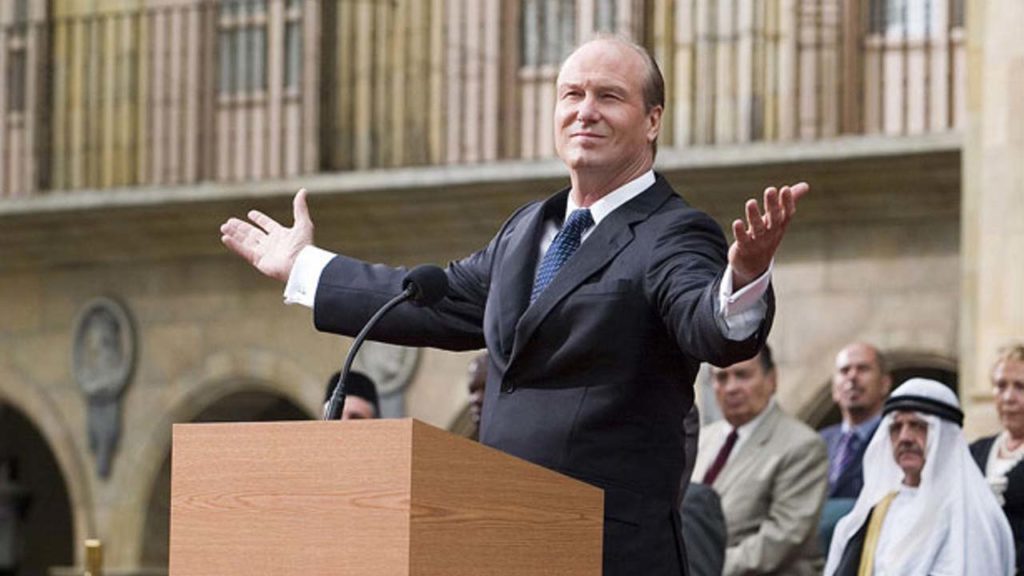
    William Hurt in Vantage Point
    A turkey in every pot and a thriller in every multiplex

    But the crucial falling-down point of the movie is the trumped-up assassination plot itself, which is seemingly crafted for maximum storytelling drama and not real-world terrorist efficacy. Would an actual successful assassination be so hi-tech and complex? This plot relies on lots of wireless technology, split-second timing, blackmail (coercing someone to perform key tasks better done by someone the plotters could count on) and at least two inside men (one of whom must have spent almost a lifetime preparing).

    This is how terrorism works only in the movies. Real-life assassins tend to be lone gunmen who manage to slip through security with their sheer unpredictability, and terrorist attacks like Oklahoma City and 9/11 didn’t depend on technology more complex than fertilizer and box cutters. While we’re on the subject, what are these particular assassins’ motivations, exactly? It becomes clear they don’t wish to kill the president but to capture him. Whatever they hope to accomplish, they seem quite pleased with themselves.

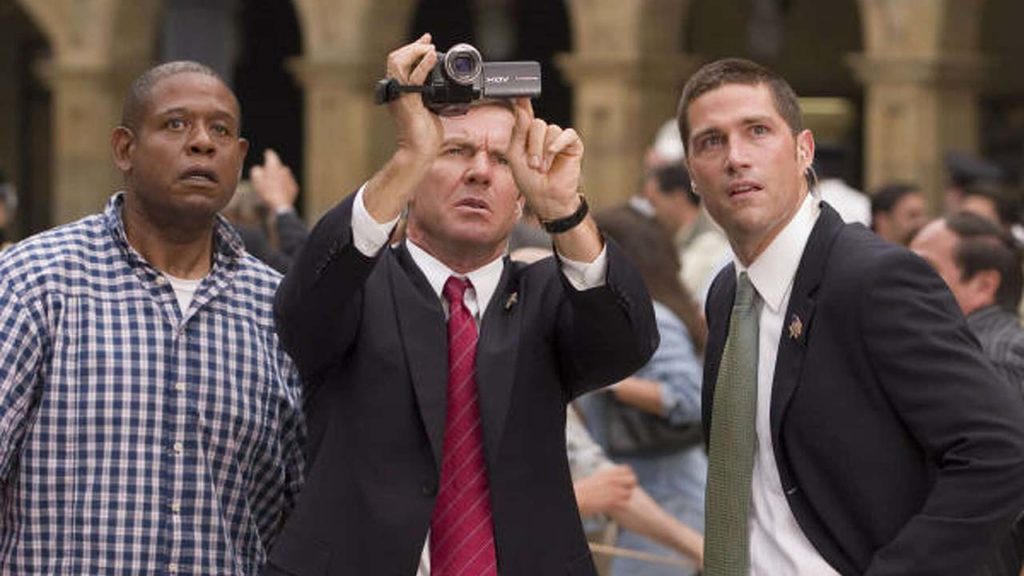
    Forest Whitaker, Dennis Quaid and Matthew Fox in Vantage Point
    OK, everybody skootch in a little… say cheese!

    All of these questions are negated in the end by a news broadcast that claims that a lone assassin has been shot and killed. This conclusion plays to the public’s lust for conspiracy theories than continues to plague 9/11 and the JFK assassination.

    Extra observations:

    • One of the biggest plot twists is spoiled in the trailer.
    • Barnes is a cliche we’ve seen before, played by Clint Eastwood in In the Line of Fire.
    • There’s an oddly tiny role for Sigourney Weaver as television news director Rex Brooks. Was there more intended for her character? Perhaps she took the role for an opportunity to spend a few days in Spain.
    • Hey, it’s Hollywood’s go-to middle eastern guy, Said Taghmaoui (from The Kite Runner and Three Kings). He does turn out to be a villain, but so do two white dudes, so the movie totally isn’t racist.
  • Michael Mann’s Miami Vice movie is stylish but slight

    Michael Mann’s Miami Vice movie is stylish but slight

    Miami Vice is decidedly slight on character and depth, which is not surprising considering the source material. It is quite so, however, considering writer/director Michael Mann’s track record once leaving the iconic 80s tv show behind.

    The deep characterization in all his crime dramas ranging from Thief through Collateral elevate them above the ultrastylized and hyperviolent genre films they would have been otherwise. Even the most minor characters in Heat have backstories and substance. Thief and Heat each revolve around a long coffeeshop conversation; how many genre films slow down long enough for the characters to talk to each other? And it also has to be said of Collateral that Mann somehow drew an actual performance out of the increasingly looney Tom Cruise, probably one of his last before he heads further down Michael Jackson lane to crazy town.

    But Miami Vice is disappointingly empty, despite an engagingly twisty-turny plot and typically brilliant editing and cinematography. But when there is no investment in the characters, who cares when they start shooting each other in the face?

  • Pierce Brosnin lets it rip in Richard Shepard’s The Matador

    Pierce Brosnin lets it rip in Richard Shepard’s The Matador

    Full of suspenseful set-pieces involving assassination, The Matador is a genre film on the surface. It’s actually more of a character piece about one man about to pay the price for a lifetime of being a pathological loner (paradoxically, while indulging his lusts in every other way imaginable), and another grasping at his last chance to save both his professional and family lives.

    Pierce Brosnin lets it rip as Julian Noble, a sleezebag assassin with a Magnum P.I. mustache. Interestingly, he frequently boasts of his bisexuality, but we only see him having sex onscreen with women. The is-he-or-isn’t-he ambiguity actually comes into play regarding an imporant plot point resolved near the very end of the film. Even better, the plot informs character, which is something of a rarity.

    Hope Davis‘ character defies cliche by enjoying a genuinely sexual relationship with her husband, but is also more openly seduced (in a platonic manner) by the exotic allure of an assassin. Perhaps Julian has lost any James Bond-like sexual allure he may have had, but discovers he can make people like him by simply revealing what he does for a living.

    Disappointingly, the movie ends rather cheesily, with Julian finding some humanity deep inside his depravity.

  • Red Eye

    Red Eye

    I had heard Red Eye was a refreshingly unpretentious thriller that played on Americans’ changed relationship with air travel in a post 9/11 world. While technically true, it’s actually a very disappointing runaround decidedly lacking in the most routine pleasures that come with thrillers. Where’s the expected third-act twist? Is the twist that there actually isn’t one?