Tag: Velvet Underground

  • Lou Reed and John Cale work through their complex feelings for Andy Warhol in Songs for Drella

    Lou Reed and John Cale work through their complex feelings for Andy Warhol in Songs for Drella

    Rating: 4 out of 5.

    When I was a dumb teenager that didn’t know anything about anything, or could tell The Factory from a factory, I first heard Lou Reed through his Transformer and New York albums — the former via the David Bowie connection, and the latter through one track’s inclusion on Rainbow Warriors, a Greenpeace benefit compilation popular at the time.

    I would shortly discover that these two albums represented a more accessible side of Reed’s sometimes challenging or confrontational discography — for my next purchase was Songs for Drella. Good thing I didn’t pick up Reed’s notorious Metal Machine Music at that point, or I really would have stopped there. Luckily I think I heard Magic and Loss next, and was back on track.

    Lou Reed and John Cale: Songs for Drella
    Detail from the Songs for Drella album cover; which really ought to have clued me in that it was not going to be a rock ‘n’ roll album.

    I didn’t know what to make about a drumless song cycle, co-credited with a name new to me at the time, John Cale, and all about an artist I was only vaguely aware of, Andy Warhol. You can excuse a rural kid at the beginning of the ’90s for knowing only one fact about Warhol: he was that one weird artist that screen-printed countless images of Marilyn Monroe and Campbell’s Soup cans.

    I’ve come to appreciate the Songs for Drella album more over the years, coincident with learning more about Warhol and The Velvet Underground. Warhol had died only a few years earlier, and Reed & Cale’s songs feel very immediate and personal, and not at all hagiographic. They were in a unique position to have known Warhol better than many who might presume to have opinions about him or his work. They evidently retained complex feelings about him, for it’s right there in the title: “Drella” was a derogatory nickname (Dracula + Cinderella) that Warhol didn’t appreciate.

    John Cale and Lou Reed: Songs for Drella
    Detail from the original VHS/laserdisc cover. “I love images worth repeating and repeating and repeating”.

    Many of the songs channel his voice in the first person, about the mundane (perceived slights at an MTV event), to the cataclysmic (his attempted assassination by Valerie Solanis — who herself would be the subject of a dramatic depiction in the film I Shot Andy Warhol a few years later). Lest this all sound too artsy fartsy, some of the tunes are real bangers, like the stomping “Work”.

    A live performance in December 1989 at the Brooklyn Academy of Music was filmed by Ed Lachman, and a new 4K restoration is currently screening on The Criterion Channel. It was fortunately shot on film, not SD video, so it looks and sounds great. I listened to part of it through headphones, and the audio is notably clear and intimate. You can hear in the stereo mix when Reed or Cale even slightly turn their heads while singing.

    “Work”, from Songs for Drella. The full film is available in much better quality on The Criterion Channel.

    I strongly recommend the film for anyone with more than a passing interest in Cale, Reed, or Warhol, and who either doesn’t know the Songs for Drella album, or for whom it never clicked. Those with a mental image of Reed from his glam Rock ‘n’ Roll Animal period, or the cool tough guy downtown poet of the New York era, might be a little surprised to see him looking so studious here. The always-dapper Cale, with an excellent haircut, looks in his element. Watching a live performance of the whole song cycle straight through, with the two legendary musicians sitting opposite each other like a proper hoity-toity music recital, really suits the material.

  • Songs That Broke My Heart: Hallelujah by John Cale

    Songs That Broke My Heart: Hallelujah by John Cale

    Conventional wisdom will tell you nobody did Leonard Cohen’s “Hallelujah” better than Jeff Buckley. The few who disagree are likely of the opinion that nothing beats the original. Here’s a third opinion: the person who transformed Cohen’s song into the modern standard it is today was John Cale.

    As I started to compile songs for this Songs That Broke My Heart series, I found myself noting more than a few cover versions I found “sadder” than the originals. Maybe some songs have more pain embedded in them than their original creators realized, or were capable of expressing. Perhaps the original artists purposefully obscured the darker themes for the listener to slowly untease, only to have another artist come along later and lay it all bare.

    The now-iconic song “Hallelujah” has a complicated lineage. Leonard Cohen’s original was released on the album Various Positions in 1984, and has since been overshadowed by a seemingly endless parade of cover versions. Former Velvet Underground member John Cale began it all with a spare, vocal-and-piano recitation for the 1991 Cohen tribute album I’m Your Fan. Time has obscured Cale’s version about as much as Cohen’s original, but it’s still the template influencing nearly every subsequent rendition.

    The most idiosyncratic take came from U2’s Bono on yet another Cohen tribute album, Tower of Song (1995). It now sounds very dated, from the brief-lived moment in the mid-to-late nineties when the trance and electronica genres flirted with the mainstream. Jeff Buckley and K.D. Lang each scored hits based on Cale’s version, and numerous amateur performances on American Idol finally broke the song into the mainstream consciousness (relive some of them here, if you can bear it). The song is now a cliche, but retains its ability to push emotional buttons even when performed robotically by Justin Timberlake on the “Hope for Haiti Now” telethon in 2010 and by K.D. Lang again at the 2010 Winter Olympics opening ceremony.

    The worst abuse of all, however, was when director Zack Snyder misappropriated Cohen’s original recording for a preposterous sex scene in the superhero psychodrama Watchmen. Granted, it must be said that Cohen deliberately crafted his lyrics to be flexible, and has himself performed different variations over the years. Buckley’s version found a markedly sexual interpretation, and were he still with us, he might have approved of the song’s use in Watchmen. Cohen himself told the Guardian in 2009:

    “I was just reading a review of a movie called Watchmen that uses it, and the reviewer said ‘Can we please have a moratorium on Hallelujah in movies and television shows?’ And I kind of feel the same way. I think it’s a good song, but I think too many people sing it.”

    Leonard Cohen

    With such a wide variety of renditions, it’s clear the beauty is all in the particular vocalist’s delivery. Too many, however, bury any real human emotion under mountains of overproduced strings and histrionics, or in Bono’s case, trance beats and an ill-advised falsetto. For me, John Cale’s elegantly minimalist interpretation is the one for the ages, perhaps even moreso than Cohen’s original.

  • Lou Reed, Antony, and Julian Schnabel Dance the Rock Minuet in the Concert Film Berlin

    Lou Reed, Antony, and Julian Schnabel Dance the Rock Minuet in the Concert Film Berlin

    Lou Reed‘s 1973 album Berlin is a concept album relating the tale of a doomed woman named Caroline living in the eponymous city. The term “concept album,” then and now, invokes immediate condescension from fans and critics alike, calling to mind the progressive rock excesses of 1970s megabands The Who (Tommy and Quadrophenia), Genesis (The Lamb Lies Down on Broadway), and Yes (Tales from Topographic Oceans). The poet and arty downtown Manhattanite Reed might have better served himself by referring to Berlin as something more fancy-sounding, perhaps a “song cycle.”

    Reed’s previous album Transformer was a great commercial success, debuting the enduring hits “Satellite of Love”, “Perfect Day”, and “Walk on the Wild Side”. To follow it up with something like Berlin may have been loaded with artistic integrity, but was asking for trouble in terms of making a living. I recall reading that enough material was written and recorded for it to be a double-LP, but it was too much for a single LP, so the work was unsatisfactorily edited down to a single disc before release (I can’t find a source for this factoid online, but I believe it was related in the liner notes of his 1992 retrospective boxed set Between Thought and Expression). Produced by Bob Ezrin (whose concept album credentials also include Pink Floyd’s The Wall), it was a commercial disaster at the time. So, cursed from the beginning, the full studio version has apparently never been released.

    Emmanuelle Seigner in Lou Reed's Berlin
    Emmanuelle Seigner in Lou Reed’s Berlin

    In retrospect, Reed now seems to have been compelled to flee from commercial success, or at the very least was bound and determined not to repeat himself. Reed’s other infamous commercial disaster Metal Machine Music was another deliberate provocation: even the most open minded musicologist might charitably characterize it as earsplitting noise. But Berlin is different, hated more for its intensity and subject matter than its sound. Several of the songs are lovely, but wow is the complete work depressing, full of anger, venom, resentment, death, despair, and guilt. The song “The Kids” is especially harrowing, ending with a tape of children wailing.

    Lou Reed's Berlin
    “Caroline says / While biting her lip / Life is meant to be more than this”

    Over time, the album was eventually rediscovered. One of those reappraising Berlin was no less than artist and filmmaker Julian Schnabel. So it came to be, that 33 years after its release, Schnabel proposed to Reed that Berlin really ought to be a film. Schnabel is obviously attracted to artists dedicated to their work with utter conviction: revolutionary New York Artist Jean-Michel Basquiat in the eponymous biopic, the gay poet Reinaldo Arenas in Castro-era Cuba in Before Night Falls, and the paralyzed writer Jean-Dominique Bauby in The Diving Bell and the Butterfly. The Berlin DVD bonus features include a brief conversation with Reed and Schnabel on Elvis Costello’s show Spectacle, in which Schnabel describes his attraction to the cinema from the perspective of a painter: he reverently refers to the canvas-like movie screen as “The Rectangle.”

    Something best appreciated by seeing Reed perform live is that he is a great guitarist. He’s also visibly in surprisingly good shape for a former junkie (sorry, but it’s true). Does he practice yoga? Reed in performance is supremely cool and detached, but some startlingly real emotion comes through in his vocal delivery; he spits out the lines “they took her children away” from the song “The Kids” with real venom.

    Antony in Lou Reed's Berlin
    Antony dances the rock minuet

    Original guitarist Steve Hunter rejoined Reed for the Berlin tour, and can barely contain his pleasure, despite the grim subject matter. Bob Ezrin himself conducts with great enthusiasm, but oddly, he seems to be facing the drummer, away from the choir and woodwinds. One of my favorite bassists, Fernando Saunders, doesn’t really get to shine, but perhaps it was my sound system that couldn’t do him justice. Julian Schnabel’s daughter Lola directed film clips projected during the performance, starring Emmanuelle Seigner as Caroline.

    So Reed finally got a chance to present Berlin live, as a whole piece. Now the once-denigrated work has become a world tour, a theatrical feature film, a live album, and a DVD. Reed is now considered a New York deity, not the erratic addict he was back in the day. His career is far from over and there’s plenty of time for more drama, but could this be his ultimate revenge?

    The encore includes a special treat, a lovely version of “Rock Minuet” sung by Antony Hegarty (of Antony and the Johnsons) in his otherworldly voice. “Rock Minuet” was not from the original album, but a special request from Schnabel, who rightly felt it belonged. But it’s followed by a bummer: a desultory performance of the Velvet Underground standard “Sweet Jane”. It’s a letdown that after the emotionally intense proceedings, that Reed seems truly bored here and just walks through a song he’s probably performed hundreds if not thousands of times.

  • Things We Lost in the Fire is kind of a drag

    Things We Lost in the Fire is kind of a drag

    Rating: 2 out of 5.

    Susanne Bier’s Things We Lost in the Fire is a melodrama in the vein of Alejandro González Iñárritu’s 21 Grams in almost every way: the story of a nuclear family shattered by a random death, told as a nonlinear narrative, with conspicuously arty cinematography, and costarring Benicio Del Toro.

    Even a single-sentence description of the basic plot conveys how overwrought things get: Audrey (Halle Berry) impulsively takes in her dead husband Brian’s (David Duchovny) heroin-addicted friend Jerry (Del Toro). Audrey’s motivations are semi-consciously selfish; she perhaps thinks that she can retain some connection with her dead husband by indefinitely extending his fruitless effort to help his childhood friend to kick his drug habit.

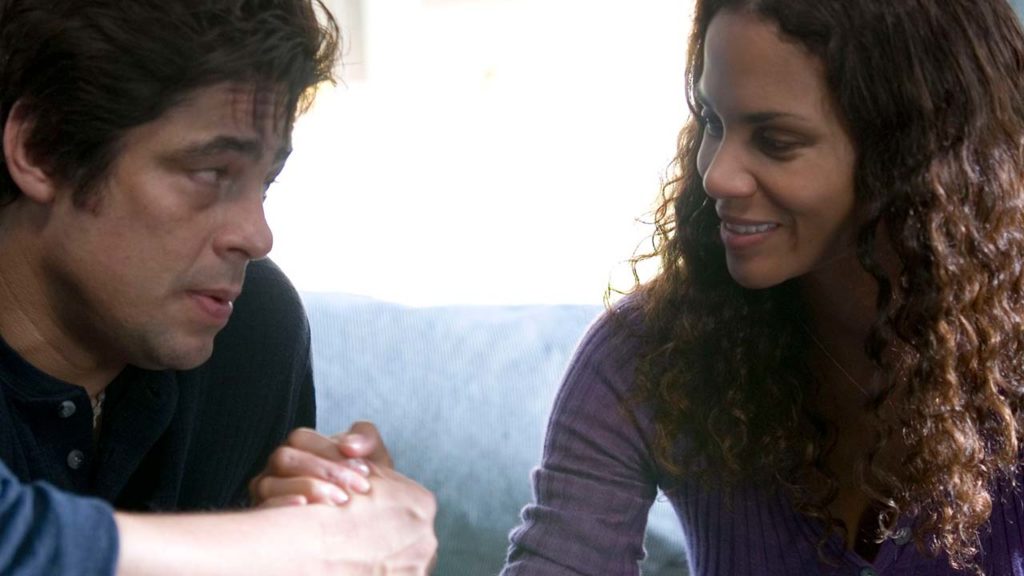
    Benicio Del Toro and Halle Berry in Things We Lost in the Fire

    But unaware of the adage that one must beware what one asks for, she becomes resentful when her plan unexpectedly succeeds. Jerry does in fact begin to kick drugs, a neighbor takes an implausibly quick shine to him and offers him a job, he teaches one of her kids to swim (a task at which her husband had previously failed), and he responds to her flirtatious advances.

    Inexplicably, the movie ends with the wrong Velvet Underground song; someone chose “Sweet Jane” over “Heroin.” Nor is there anything from the Low album of the same name. If the filmmakers thought these selections were too obvious, then how do you explain everything else in the movie?