Tag: William Hurt

  • The Rashomon effect in Pete Travis’ Vantage Point

    The Rashomon effect in Pete Travis’ Vantage Point

    Vantage Point is an awesome technical achievement, and I don’t mean that to damn it with faint praise. Director Pete Travis and writer Barry Levy demonstrate excellent plotting, spatial sense, editing, logistics, and continuity. As a thriller it moves forward relentlessly, and feels comprehensible, self-contained, and very satisfying.

    It is structured around a single gimmick, but it’s a good one. As one of the cinematic children of Rashomon (including The Usual Suspects and Courage Under Fire), it retells the same event from multiple points of view.

    An assassination attempt on the US president in Spain is foiled by veteran Secret Service agent Thomas Barnes (Dennis Quaid) and civilian Howard Lewis (Forest Whitaker). The advantage of this structure is to withhold information and create suspense. The first time we spot Lewis, from the hyper-cautious Barnes’ perspective, he seems to be acting fishily. But when we soon see the events from his point of view, we learn he’s an innocent.

    But the structure works the other way; almost a full hour passes until we see fellow Secret Service agent Taylor’s (Matthew Fox) side of the story, and the simple fact of his prolonged absence causes the audience to suspect him. At about the one-hour mark, the rigid, neat structure breaks down and we begin to see slivers of each character’s experiences mixed together, as they all draw to a single time and place for the climax.
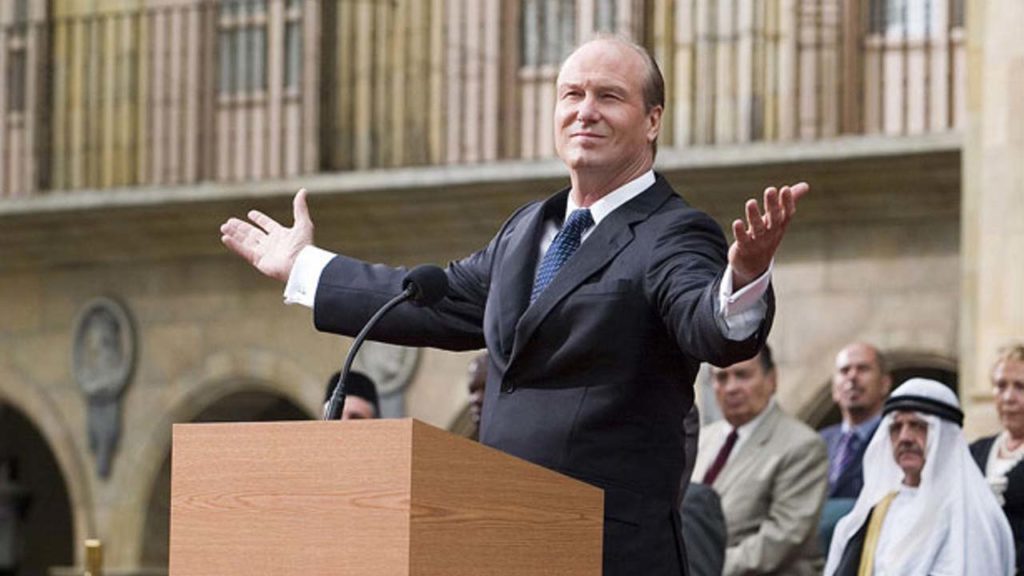
    William Hurt in Vantage Point
    A turkey in every pot and a thriller in every multiplex

    But the crucial falling-down point of the movie is the trumped-up assassination plot itself, which is seemingly crafted for maximum storytelling drama and not real-world terrorist efficacy. Would an actual successful assassination be so hi-tech and complex? This plot relies on lots of wireless technology, split-second timing, blackmail (coercing someone to perform key tasks better done by someone the plotters could count on) and at least two inside men (one of whom must have spent almost a lifetime preparing).

    This is how terrorism works only in the movies. Real-life assassins tend to be lone gunmen who manage to slip through security with their sheer unpredictability, and terrorist attacks like Oklahoma City and 9/11 didn’t depend on technology more complex than fertilizer and box cutters. While we’re on the subject, what are these particular assassins’ motivations, exactly? It becomes clear they don’t wish to kill the president but to capture him. Whatever they hope to accomplish, they seem quite pleased with themselves.
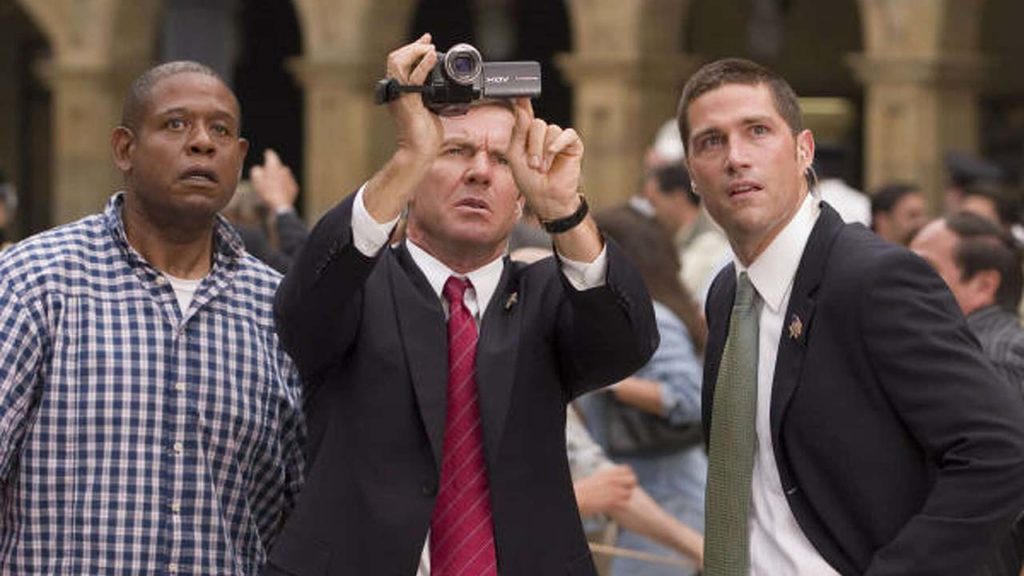
    Forest Whitaker, Dennis Quaid and Matthew Fox in Vantage Point
    OK, everybody skootch in a little… say cheese!

    All of these questions are negated in the end by a news broadcast that claims that a lone assassin has been shot and killed. This conclusion plays to the public’s lust for conspiracy theories than continues to plague 9/11 and the JFK assassination.

    Extra observations:

    • One of the biggest plot twists is spoiled in the trailer.
    • Barnes is a cliche we’ve seen before, played by Clint Eastwood in In the Line of Fire.
    • There’s an oddly tiny role for Sigourney Weaver as television news director Rex Brooks. Was there more intended for her character? Perhaps she took the role for an opportunity to spend a few days in Spain.
    • Hey, it’s Hollywood’s go-to middle eastern guy, Said Taghmaoui (from The Kite Runner and Three Kings). He does turn out to be a villain, but so do two white dudes, so the movie totally isn’t racist.
  • Sean Penn and Emile Hirsch go Into the Wild

    Sean Penn and Emile Hirsch go Into the Wild

    Like many young men cursed with a privileged life of education and time to think for themselves, Chris McCandless (Emile Hirsch) wanted only a vaguely defined “truth” and to not have to rely on anyone. Synthesizing his reading of Henry Thoreau and Jack London, he imagined for himself a life of self-sufficiency in the wilderness. So McCandless dropped out of society in the summer of 1990, leaving behind all connections whatsoever, including his legal name and identity. Despite his absolutely clean break, he never seemed to view this transformation as permanent; he mentions more than once that he may write a book when he “comes back.”

    Interestingly for a young man, he also seems to make a point of avoiding even temporary female companionship. He rejects the friendship of Jan (Katherine Keener), and abandons his younger sister Carine (Jena Malone), the person with whom he apparently had the closest bond. Carine narrates the film, with total sympathy for his beliefs and actions. But even she points out that he acted with “characteristic immoderation.”

    Sean Penn directs Emile Hirsch in Into the Wild
    The rough guide to self-actualization

    McCandless died alone in August 1992. He remains a controversial figure (should his asceticism be admired, or was he a fool?), and his solitary death the subject of an intriguing mystery (was he really trapped with food poisoning, or did he allow himself to die slowly as a form of passive suicide?). This film interpretation of his story does make it clear that he was a privileged kid who hadn’t truly suffered. While drinking with new buddy Wayne (Vince Vaughn), he lets slip his adolescent belief that one of the worst forms of tyranny in the world is “parents.” As we see, his parents (Marcia Gay Harden and William Hurt) are all too human and not half as monstrous as he imagines. So perhaps his adventure was more than an idealistic reaction to mere money, society, and materialism. He was also running away from the “free” things that living in society affords, what everyone craves in life: family, friends, and lovers.

    Emile Hirsch in Into the Wild
    Hence the title

    A note on the music: just as McCandless looks backwards for literary inspiration, he also has antiquated taste in music for a kid living in the early 90s. His new name for himself, “Supertramp” puns on the classic rock band and his new lifestyle. He christens his new and final home, an abandoned bus, after The Who’s “Magic Bus.” For the music of the film itself, director Sean Penn drew upon two musicians that made names for themselves in the early 90s: Pearl Jam’s Eddie Vedder (who contributed songs to Dead Man Walking), and guitarist/composer Michael Brook. Vedder’s songs for the film were released as an album, but Brook’s excellent score is also available digitally.

    Into the Wild is yet another in a long series of films I’ve seen recently that are based on books I haven’t read (The Kite Runner, No Country for Old Men, The Namesake, The Assassination of Jesse James, etc.). But even so, I believe I can detect a few remnants of the film’s prose origins as John Krakauer’s book:

    • the film is broken into chapters with onscreen titles
    • voiceover narration
    • the visual device of superimposed text from McCandless’ own journals provides a second voice
    • episodic feel – but that’s justified by the events/phases of his journey – he keeps making clean breaks every time he comes close to settling in somewhere