Author: Chad Ossman

  • Nothing to Say and No Way to Say It: Revolutionary Road

    Nothing to Say and No Way to Say It: Revolutionary Road

    The first few minutes of Sam Mendes’ Revolutionary Road feature one of the boldest jump cuts this side of 2001: A Space Odyssey. Frank (Leonardo DiCaprio) and April (Kate Winslet) meet cute out of a crowd of Beatnik hipsters at a loft party. Like any flirting young couple, how each chooses to introduce themself comprises a promise as to whom each will become should they grow up together. The glamorous April simply says she is studying to be an actress, as if that is all Frank needs to know. He in turn cracks wise about toiling in nothing jobs holding him back from vaguely-defined great aspirations.

    After this very brief scene, Mendes jump cuts to several years later to find Frank and April married in suburbia with two kids. An older Frank privately cringes during April’s weak debut in a community theater production. It turns out she’s not a great actress after all, but cursed to be just smart and sensitive enough to know it. Her sense of definitive failure and his frustration at her frustration combusts into a blistering roadside argument on par with any of the cataclysmic rows between Elizabeth Taylor and Richard Burton in Who’s Afraid of Virginia Woolf?.

    Leonardo DiCaprio and Kate Winslet in Revolutionary Road
    “You were just some boy who made me laugh at a party once, and now I loathe the sight of you.”

    Frank and April’s all-consuming pride escapes as barely-veiled condescension toward their peers in the office and on their suburban street. They both share mutually incompatible senses of superiority, feeling destined for something great without knowing what, or having any obvious natural talent to nurture. It provides no satisfaction when Frank does eventually manifest an aptitude in marketing, something they both view as disappointing and beneath them. Who or what propped them up with this sense of superiority?

    Are we to read their hubris as a critique of the Greatest Generation (Frank is a World War II veteran, an experience he romanticizes even while acknowledging his sheer terror at the time)? This generational theory would be supported by how the older Givings family views them – but more on the Givings later. Or were Frank and April’s egos boosted by overpraising parents? We hear much of Frank’s late father, who toiled in obscurity for years at the same firm where Frank now finds himself trapped, but any other relatives are wholly absent from their lives. Perhaps if Frank and April had been born a few generations later, they would be the sort of overconfident personalities drawn to compete on reality TV shows.

    Kate Winslet in Revolutionary Road
    “No one forgets the truth, Frank, they just get better at lying”

    After April gives up on her dream of acting after her disastrous debut, she latches onto a fantasy of moving to Paris and supporting Frank so he may find his. But Frank is even less evolved than she; he never specifies what he imagines himself becoming. Writer? Politician? Artist? He has nothing to say, and no way to say it.

    Their Gallic escape plan is not fully thought through, and Frank never really commits anyway. He’s clever enough to excel amongst the duller coworkers with whom he shares daily steak and martini lunches. He becomes further ensnared by success in the business world, as measured by income, the sexual availability of naive office girls, and a step above his father on the ego-stroking ladder of promotion.

    One flaw of the film is dialogue that sometimes strays from naturalism into the novelistic. Even in the midst of the fiercest of arguments, April is still poised enough to deliver zingers like “No one forgets the truth, Frank, they just get better at lying” and “You’re just some boy who made me laugh at a party once, and now I loathe the sight of you.”

    Michael Shannon in Revolutionary Road
    “Hopeless emptiness. Now you’ve said it. Plenty of people are onto the emptiness, but it takes real guts to see the hopelessness.”

    I promised to return to the Givings family, whom I believe are the key to understanding the film. Helen Givings (Kathy Bates) gently teaches April how to be a good housewife, offering passive aggressive critiques of such fripperies as lawn maintenance. But she slowly reveals a longing admiration for the Wheelers as an ideal American nuclear family: a nice, good-looking, successful, model young couple in love. The relatively coarse neighbors the Campbells also idealize the Wheelers.

    Helen hopes that some of their pixie dust might rub off on her troubled son John (Michael Shannon), a mathematician and intellectual brought low by mental illness and electroshock therapy (whether it is the disease or the cure that ails him most is a question that bleakly amuses him). John proves to have the coldest, clearest, starkest view of reality, and cuts right through all the subterfuge and doublespeak with which these American nuclear families delude themselves. Everything he says is correct, but tragically, Frank and April interpret the bitterly damaged man as a kindred spirit and not as what he is: a holy fool (in the sense of idiot savant) that damningly illustrates their faults.

    Kathy Bates in Revolutionary Road
    Helen admires the Wheelers’ splendid picture window looking out on Revolutionary Road

    In some ways, the final scene is the most devastating, and it doesn’t even feature the Wheelers at all. The Givings chat at home alone, long after the Wheelers revealed themselves to be fatally fractious and tortured. We witness Helen rewrite history, belittling the Wheelers in terms of their ability to maintain the value of their home (read: their family). As she’s busy erasing her emotional stake in the Wheelers, her husband Howard (Richard Easton) turns off his hearing aid to literally drown her out. He gazes at her emptily, dispassionately, dead inside. We might imagine their marriage survived the kind of emotional flashpoint that destroyed the Wheelers, but trapped them in a cold, loveless life together.

  • A muggle tries to make sense of Harry Potter and The Half-Blood Prince

    A muggle tries to make sense of Harry Potter and The Half-Blood Prince

    As Pottermania began some years ago, I recall being amazed at how similar it all seemed to Neil Gaiman’s Books of Magic, which predates J.K. Rowling’s first Harry Potter novel by about five years. In it, boy wizard Tim Hunter, equipped with broken glasses and an owl, is prophesied to be an immensely powerful wizard. The forces of good and evil each seek to manipulate his upbringing in an effort to claim him for their own. For Gaiman fans, it was tempting to cry plagiarism. But subtract the glasses, and substitute the owl for a cute droid or two, and you could just as well be describing Luke Skywalker.

    The generation that grew up with the Harry Potter books will just as surely sit rapt through the movies as they will quibble about the compromises made in their adaptation. Beware what follows is from the perspective of an older non-fan, who’s read the first book and seen the movies, but doesn’t hold them deep in the heart as the Harry Potter generation does.

    Alan Rickman and Maggie Smith in Harry Potter and the Half-Blood Prince
    Alan Rickman and Maggie Smith demonstrate to the upcoming generation of British actors how it’s done.

    David Yates’ Harry Potter and The Half-Blood Prince is very, very long, and demands that the audience has retained an awful lot of lore from the previous movies (but again, the counterargument stands: you can say the same about Star Wars and Star Trek). I found the trailer totally incomprehensible, and the movie at times befuddling. I longed for a less novelistic and more movie-like narrative.

    When a MacGuffin is finally introduced late in the movie, it adds a much-needed dramatic spark to drive the story, giving Harry (Daniel Radcliffe) and Dumbledore (Michael Gambon) a clear quest. But for those of us without a Potter wiki stored in our brains, what they seek — a Horcrux — is not clearly explained, despite reams of exposition from Dumbledore, plus a recap from Harry and Hermione (Emma Watson) at the end. Apparently there is more than one, two have already been found, and a third turned out to be counterfeit?

    Helena Bonham-Carter in Harry Potter and the Half-Blood Prince
    Helena Bonham-Carter plays her baddie with relish.

    It must have been quite a gamble to cast such a large troupe of child actors, trusting that they would grow into the acting profession over the course of several years. I wouldn’t say any of the child actors are bad, but they’re all unsurprisingly outclassed by the large complement of veteran British actors.

    Timothy Spall and Helena Bonham Carter both play baddies with relish, but I can’t say I recall much about who they are and what motivates them. Nor whether returning characters played by Emma Thompson, Gary Oldman, and David Tennant are still good and/or evil, alive and/or dead. Didn’t Oldman appear in a fireplace in one of the previous movies? I guess he’s feeling better now. I can’t keep this stuff straight.

    Alan Rickman is superb as always, every line reading a delicious mixture of humor and menace. As with Ian McShane in anything, Rickman is doing Shakespeare while everyone else is in a soap opera. His character Snape turns out to be the titular Prince, which I suppose raises two questions for the next installment: was his dangerously annotated potions textbook deliberately left to fall into Harry’s hands? And: what’s the significance of the nickname? He appears to be some kind of double-agent.

    Emma Thompson in Harry Potter and the Half-Blood Prince
    Emma Thompson excitedly explains all the Potter lore to non-fans like myself.

    Recurring villain Draco (Tom Felton) remains a wet noodle. Every movie sets him up as Harry’s nemesis at school, as well as cosmically fated for evil as Harry is for good. But he always winds up spanked and running away crying like a baby. It’s unclear to me if we’re supposed to consider him a real threat, but perhaps I’m overthinking things, and it is simply childish wish fulfillment that the school bully always get his embarrassing comeuppance.

    Most of the rest of the movie is concerned with the teens’ romantic lives. I don’t happen to recall Ginny (Bonnie Wright) being a significant character in the previous movies, so the mutual infatuation between her and Harry seemed to have developed offscreen between movies.

    But what has always puzzled me the most about this whole epic is Harry himself. What makes him so special? He’s not necessarily the most clever (Hermione of course), brave, or powerful. From what I recall from the backstory, his biggest claim to fame is that he survived an attack by the Dark Lord Voldemort. But the world’s most powerful wizard Dumbledore apparently trusts Harry more than anyone else. Surely there’s any number of more experienced wizards he could have brought along with him to look for the Horcrux; why did he specifically need Harry?

  • Lean, Tailored, and Ferociously Fit: Jason Statham in Transporter 3

    Lean, Tailored, and Ferociously Fit: Jason Statham in Transporter 3

    Transporter 3, produced by Luc Besson and directed by Olivier Megaton, is an international product tailored for the American market. Despite its French locales, German cars, and adorably freckled Ukrainian hottie, the hero and villain are both quite American.

    The titular Transporter is Frank Martin (Jason Statham), a fighter and driver par excellence who earns a luxurious but lonely existence as an ask-no-questions courier. The events of his two previous misadventures have reformed his amoral ways and loner habits, as evidenced by his collaborative friendship with former nemesis Inspector Tarconi (François Berléand).

    So in order for there to even be a Transporter 3, its plot must corral this reformed man into a caper full of opportunities for carnage and lawbreaking. The villainous American Johnson (Robert Knepper) is conceived as Martin’s evil, less evolved twin: a mercenary like him, but unleavened by conscience. His ill-defined plan involves blackmailing Ukranian politician Leonid Vasilev (Jeroen Krabbe) into allowing a giant corporation to import a tanker full of barrels of toxic waste. At one point Martin is menaced by a truck full of the stuff on land, but the tanker hasn’t docked yet. Confusing.

    Natalya Rudakova in Transporter 3
    Natalya Rudakova in Transporter 3.

    Statham is this generation’s Jean-Claude Van Damme or Steven Segal. He’s already been typecast as the tough loner in a constant series of b-movies (some more B than others, but The Bank Job is a step up), but usually lightens things up with a hint of Jackie Chan-esque self-deprecation. He’s impeccably tailored, lean, and ferociously fit, looking and moving more like a gymnast than the previous generation of slow-moving bodybuilder action heroes. A good drinking game for any Statham film is to drink a shot every time his shirt comes off. You’re likely to get alcohol poisoning in this case.

    One of the reasons I enjoy producer Luc Besson’s Transporter franchise is that I dislike being expected to applaud the typical movie action hero that stands back and shoots bad guys from afar. This applies to pretty much any Stallone and Schwarzenegger film, but is also true of even James Bond (in which his fabled license to kill often translates into mowing down rooms full of extras with machine gun fire — or in the case of Moonraker, laser pistols) and Indiana Jones (audiences applaud him for shooting a scimitar-wielding baddie in Raiders of the Lost Ark, but really, is that fair?).

    In stark contrast, Martin almost never uses any weapon other than his own physicality. Most of the violence in the Transporter films is in the acrobatic, bloodless rock ’em sock ’em style of kung-fu flicks, liberally seasoned with impressive automobile carnage. The first few minutes of Transporter 3 feature a signature sequence in which Martin dispatches a room full of armed baddies using no tools save his own suit jacket. But I was startled to see Martin actually execute a few evildoers later in the film, something I don’t recall him doing in the previous two. It’s wholly out of character, and spoils the fun.

    Jason Statham in Transporter 3
    It’s never long until Jason Statham’s shirt comes off.

    What dooms Transporter 3 to be the worst of the franchise is that there are simply not enough action sequences, and what few there are are uninspired. I recall only two more notable action sequences: in one, Martin is tethered to his car by an explosive device (just roll with it), and must catch up to it on foot after it is stolen. Later, he launches it off a bridge onto the top of a speeding train, and then from there smashes it into the body of a detached passenger car. For a movie so concerned with car chases, it doesn’t help the audience when most of the vehicles are dictated by product placement to be the same brand (Audi) and color (black with tinted windows).

    The awkward, eyebrow-raising ending to Transporter 2 left it up in the air as to whether Martin is gay or just an extreme loner. Surprisingly, Transporter 3 actually revives that question and makes it its key subject. When Vasilev’s hot freckled daughter Valentina (Natalya Rudakova) comes on to him, Martin protests he’s “not in the mood” but certainly, absolutely, positively, no way no how, definitely not gay, how could you even ask, good grief. Well! I guess that settles that question, albeit in a rather disappointingly conventional manner.

    So the end of the film finds Martin not only reconfirmed as a good guy, but also in a steady heterosexual relationship. A key component of both the James Bond and Jason Bourne characters is that their greatest loves were murdered, so they choose to be emphatically alone. Where can Besson take Frank Martin in another sequel? Don’t expect Valentina to last long into Transporter 4.

  • MGMT live in Brooklyn, July 1, 2009

    MGMT live in Brooklyn, July 1, 2009

    The electronic/disco/pop/rock group MGMT has made a huge splash, earning spots on tours with no less than Paul McCartney and Beck. The wildly catchy “Time to Pretend,” “Electric Feel,” and “Kids” (the latter featuring a truly deranged music video) are not out of keeping with the rest of their repertoire in terms of style and instrumentation, but the infectious hooks do stand apart from the forgettable rest. At their Celebrate Brooklyn concert in Prospect Park on July 1, they debuted a few new songs set for their forthcoming sophomore album that didn’t immediately grab me either.

    MGMT live in Prospect Park
    MGMT live in Prospect Park

    For a band called “synth-hippies” by Pitchfork, they all looked rather clean-cut to me (but they evidently have a very young and boozy audience – one kid passed out and literally collapsed on our feet only a few songs into the concert). Their sound may be very electronic and a throwback to disco, but their live instrumentation is very rock guitar oriented. The only exception being “Kids,” for which the band put down their analog instruments and let the synthesizers and sequencers take over, even recreating a live fadeout.

  • Explosions in the Sky live in Central Park, June 30, 2009

    Explosions in the Sky live in Central Park, June 30, 2009

    Explosions in the Sky is an instrumental post-rock quartet from Texas. Their characteristic formula of a chiming guitar power trio on top of pulsating drums is a bit more palatable than their extremely loud, menacing Scottish peers Mogwai (read our review of their April show in New York). Personally, I hear a kind of homogeneity to much of Explosions’ music that I don’t hear in other post-rock outfits like Mogwai, Sigur Ros, and Tortoise.

    To oversimplify their history, the band is primarily known for two factoids. In an unfortunate coincidence, their album Those Who Tell the Truth Shall Die, Those Who Tell the Truth Shall Live Forever, released a few days before 9/11, featured a cover illustration of a plane and a caption reading “This plane will crash tomorrow.” Long before I actually heard any of their music, I do recall this story helping to feed the 24-hour-a-day broadcast news hysteria that followed. Better bolstering their repute, they composed the popular score to Peter Berg’s 2004 film Friday Night Lights, and they’ve attracted a significant fan base – selling out outdoor Central Park Rumsey Playfield even in the rain.

    The band’s designated spokesman Munaf Rayani began the show by announcing it was their 10-year anniversary as a band. They played for about an hour and half without interruption, blending songs together into a continuous flow. From where I stood, the appreciative audience recognized and cheered many tunes. But Rayani apologized at the end of the show for things having “going off the rails,” and they walked off without an encore despite there still being some time before the Central Park curfew. For all I know, that may be their custom, but it was really surprising, and audibly disappointed everyone around me. Awkward.

  • Keanu Reeves Comes to Save the World, in The Day the Earth Stood Still

    Keanu Reeves Comes to Save the World, in The Day the Earth Stood Still

    If the least one expects of the 2008 remake of The Day the Earth Stood Still is that it merely fulfill the promise of its title, then please move right along, for the earth stands still for only a few brief moments.

    It is, however, a far bigger production than the 1951 original directed by Robert Wise, even accounting for the inflation of filmmaking technology and audience expectation for spectacle. As if to overcompensate for the original’s now admittedly amusing implausibilities and the silly giant robot and flying saucer, it tries too hard to impress with too many unconnected ideas and excessive hustle and bustle. It’s even rather inappropriately macho, with more unconvincing digital helicopters and military hardware than a typical Michael Bay movie. At least it’s much, much better than the disastrous Invasion (the third official remake of The Invasion of the Bodysnatchers).

    It does get off to a good start with a prologue in which a lone mountain climber (Keanu Reeves) discovers a glowing orb in 1928 India. The sequence is mysterious and interesting, but ultimately unimportant to the plot. We later learn that the orb was an alien probe that copied the climber’s DNA, from which to grow a surrogate body for the alien Klaatu (Reeves again) decades later. Even the most basic plausibility is violated as humans dissect his alien body without biosuits or any kind of quarantine at all. One wonders if earlier drafts of the screenplay involved Klaatu’s captors initially misidentifying him as a missing person from 1928. A missed opportunity would be a scene in which the aged original adventurer comes face-to-face with an alien mimicking his youthful self. But as it stands, this whole subplot acts as a distraction.

    The original movie simply presented the alien as humanoid (if a little unusually tall and angular) and that was enough. The notion of a alien being reborn in a new body is interesting but an unnecessary complication, one that only raises questions unrelated to the central themes. Klaatu is lucky his template was the handsome Reeves, who can wear anything — at one point, Klaatu steals a schlumpy guy’s suit and it fits as if it were tailored just for him.

    Supposedly this body is human, but he exerts superpowers including the transmutation of electricity into some kind of sketchily-described life force. In this respect, the original is better; Klaatu outwardly looks like us, period, end of story. Isn’t that enough? Another extraneous idea, superfluous to the core story: Klaatu’s giant omnipotent robot companion Gort is now comprised of a swarm of nanobots. Why have both a giant robot and itsy-bitsy nanobots? Pick one idea and stick with it.

    Keanu Reeves in The Day the Earth Stood Still
    Keanu Reeves in The Day the Earth Stood Still

    But we’re getting ahead of ourselves; first we must fulfill another genre cliche. The Day the Earth Stood Still lines up after the likes of The Happening, The Day After Tomorrow, A.I.: Artificial Intelligence, Deep Impact, Watchmen, and Cloverfield (the list goes on, and on…) to take another stab at decimating poor New York City. When humanity detects an unidentified object set to strike Manhattan, Dr. Michael Grainer (Mad Men‘s Jon Hamm) assembles a crack team of diverse experts including astrobiologist Helen Benson (Jennifer Connelly) to fly around in black helicopters and gawp helplessly at all the special effects. Luckily, for the moment at least, the object turns about to be a spacecraft.

    In 1951, alien emissary Klaatu (Michael Rennie) went to Washington like Mr. Smith. In 2008, this Klaatu figures the place to make a grand entrance is Manhattan’s Central Park (never mind that the United Nations headquarters is on the East Side). Fans of computer-generated destruction of the sort in which Roland Emmerich traffics will be pleased to see Central Park forcibly landscaped before the movie is over. During the final climax in the Park, I’m pretty sure the principals hide under the exact same footbridge as the survivors at the end of Cloverfield.

    Like the original, it’s credited as being based on the 1940 short story “Farewell to the Master” by Harry Bates. Its cinematic touchstones include The Brother From Another Planet and The Man Who Fell to Earth. But it shares a critically flawed plot element with the more recent Watchmen. In the latter, mortal heroine Silk Spectre must convince Dr. Manhattan, an ambivalent nonhuman that couldn’t care less, to save the world. Klaatu arrives on Earth to receive the report of an earlier agent, who confirms humans are self destructive by nature. That’s enough for Klaatu to begin to purge the planet, but the agent goes on and tries to impress upon him human’s complexity. Klaatu is unswayed.

    Helen and her son Jacob (Jaden Smith, son of Will and Jada Pinkett-Smith) try to do the same and succeed just as Silk Spectre did, but in both cases the audience can’t quite understand how their arguments go through to superior beings one step away from godhood. Because she’s pretty, and her kid whines so much that Klaatu caved in just to shut him the hell up? Personally, if I was an alien judging humanity, and I met such an insanely annoying kid, I would purge the planet too. The movie would merit at least one more star if the kid hadn’t been in it.

    Jennifer Connelly in The Day the Earth Stood Still
    Jennifer Connelly in The Day the Earth Stood Still

    Jennifer Connelly is sadly wasted, again. As in Ang Lee’s otherwise underrated Hulk, she’s relegated to second-billing below the computer effects. The great Kathy Bates fares even worse in a role anyone could have played. As for the legendary John Cleese’s cameo as a mad scientist, I assume the idea was to cast a slightly kooky personality with a British accent to project intelligence to dumb American audiences. But the formerly manic Cleese has mellowed out so much in his later years that they could have just cast any old Brit.

    The original Day the Earth Stood Still was quite obviously a Cold War parable, if a little muddled in its particulars. This version skirts the politics of war, choosing instead to recast the basic premise as an eco-parable. Much like M. Night Shyamalan’s The Happening, New York’s Central Park is ground zero for an ecological catastrophe. Part of Klaatu’s mission is to save samples of the Earth’s biosphere, which the Secretary of Defense (Bates) explicitly equates to the Biblical tale of Noah’s Ark.

    Wikipedia notes the film was a largely green production, in which the crew recycled or donated props and costumes, and utilized an intranet to reduce paper waste. But within the story itself, for an alien concerned about cleaning up the Earth, Klaatu is quite content to ride back and forth from Manhattan to New Jersey in a gas-guzzling SUV (the manufacturer of which no doubt provided product placement).

    Finally, some questions: exactly how much of the world is decimated in the end? How does Klaatu expect humanity to clean up the planet when he’s already destroyed most of the infrastructure? Imagine all the homelessness, starvation, chaos, rioting, and looting that must be dealt with before any government could even begin to think about ozone holes or carbon collection. Also, Klaatu’s species has the technology to disintegrate all manmade materials on an entire planet, but he totally dismisses out of hand the idea of cleaning up our pollution for us, or at least lending us the technology? The original Klaatu had more faith in humanity.

  • Klaatu barada nikto: Robert Wise’s The Day the Earth Stood Still

    Klaatu barada nikto: Robert Wise’s The Day the Earth Stood Still

    Robert Wise’s The Day the Earth Stood Still is one of the few essential science fiction movies that has lasted, overcoming dated special effects, acting styles, and the end of the Cold War — the provider of subtext for many a horror story. In the company of Forbidden Planet (Shakespeare’s The Tempest in space), The Blob (an invasive species consumes the population), and Invasion of the Body Snatchers (smalltown America succumbs to the ultimate conformity), it continues to resonate decades later, even being reimagined in 2008 as an ecoparable.

    Immediately striking is the dissonant score by Bernard Herrmann, of Psycho fame. The evocative piece over the opening credits sounds just like an outtake from Brian Eno’s ambient album On Land, thirty years early.

    Michael Rennie as Klaatu in The Day the Earth Stood Still
    Michael Rennie as Klaatu in The Day the Earth Stood Still. Evidently they have Brylcreem in space.

    Wise shows us humanity’s first alien contact through the quaint filter of period radio and television; rest assured, “scientists and military men” are on the case. Klaatu (Michael Rennie), a suave caucasian humanoid male alien, and his pet robot Gort (Lock Martin) park their UFO on a baseball field on the Mall in Washington D.C. His polite request for an audience with the United Nations goes rebuffed, for during the height of the Cold War, not even a flying saucer, an alien in a silver jumpsuit, and a giant robot is enough to convince the nations of the world to sit down and talk. Klaatu’s flying saucer is surrounded by hilariously lax security, and he is briefly taken into custody before handily escaping into the D.C. suburbs.

    Klaatu has learned mid-Atlantic accented English from radio and television broadcasts, and outwardly appears perfectly humanoid right down to his slicked-back hair (they evidently have Brylcreem in space), so all he needs to blend in with the masses is to simply steal someone’s dry cleaning. He checks into a spare room, with some shots directly quoting Alfred Hitchcock’s 1944 classic The Lodger. He befriends young Bobby (Billy Gray) without a hint of suspicion, dating the film more than anything else.

    Klaatu tries to get his message through to a pacifist scientist, but he’s discovered, shot, and dies. Gort, programmed to activate in such an event, threatens to exact an unspecified violence upon humanity. But Klaatu has already taught his interspecies ladyfriend Helen (Patricia Neal) the robot-mollifying fail-safe codephrase “Klaatu barada nikto.” Gort ceases his hostilities, and instead revives Klaatu using machinery on their ship. Klaatu claims his new lease on life is only for a limited time, for true resurrection is only the domain of “the Almighty Spirit”.

    The remarkable fact that he believes in a God goes unremarked upon; both he and the humans to whom he’s speaking simply take it for granted they’re talking about the same deity. This line stands out for a reason; the dialogue was reportedly inserted at the request of the MPAA, who objected to Klaatu’s godlike powers of resurrection. Failing to reach the world’s leaders, he settles for the next-best thing: an assembled group of scientists (all, of course, white males). Message delivered, he leaves Earth in a huff.

    Lock Martin as Gort in the Day the Earth Stood Still
    Lock Martin as Gort in the Day the Earth Stood Still. Klaatu barada nikto! Don’t tase me, bro!

    So, let’s recap: an otherworldly visitor with a message of peace-or-else is executed, rises again, and ascends into the heavens. Do I have to spell it out?

    But if Klaatu is analogous to Jesus, let’s take a closer look at his message. He claims Earthlings’ warlike behavior is of no interest to the spacefaring species of the universe, as long as it’s contained to one planet. But the interstellar community is beginning to fear that Earthlings are about to discover interstellar travel, and they will not permit humanity to bring their atomic weapons with them. Klaatu is the representative of other societies that have already passed through this phase, whom, unable to curb their violent impulses on their own, came up with a solution to police themselves: a fleet of lethal robots programmed to eradicate anyone that violates the truce.

    So they use weapons to deter the use of other weapons? What kind of message is that to a Cold War audience living under the nightmare of Mutually Ensured Destruction? To the 21st Century viewer, the immediate worry is whether or not we could ever trust an artificial intelligence to impartially keep the peace. Indeed, whole science fiction franchises have been built upon that very theme, including 2001: A Space Odyssey, Blade Runner, The Terminator, The Matrix, and Battlestar Galactica.

    But perhaps I’m being too literal. It’s a simple movie, but is it a simple analogy? Is the army of Gorts a symbol for Earth’s nuclear arsenal? No, because that’s exactly what Klaatu wants humans to put away. According to The New York Times, producer Julian Blaustein “told the press [the film] was an argument in favor of a ‘strong United Nations.’” But the U.N. is denigrated as petty and ineffective in the movie; they won’t deign to merely listen to Klaatu’s speech. The overall message is very cynical: even more advanced aliens aren’t able to curb their violent impulses on their own. Klaatu is here to threaten, not save us. If we embark out into space bearing weapons, we’re toast.

    The Day the Earth Stood Still is based on 1940 short story “Farewell to the Master” by Harry Bates. Walter Trevis’ 1963 novel The Man Who Fell to Earth (filmed in 1976 by Nicholas Roeg, starring David Bowie) shares some plot elements (the alien Thomas Newton too bears diamonds as seed money), but veers off into another direction altogether. Newton has no interest in steering humanity’s course. He’s here on a secret mission to save his own people, but falls prey to his own all-too-human weaknesses.

  • Cool Britannia: David Yates’ BBC Miniseries State of Play

    Cool Britannia: David Yates’ BBC Miniseries State of Play

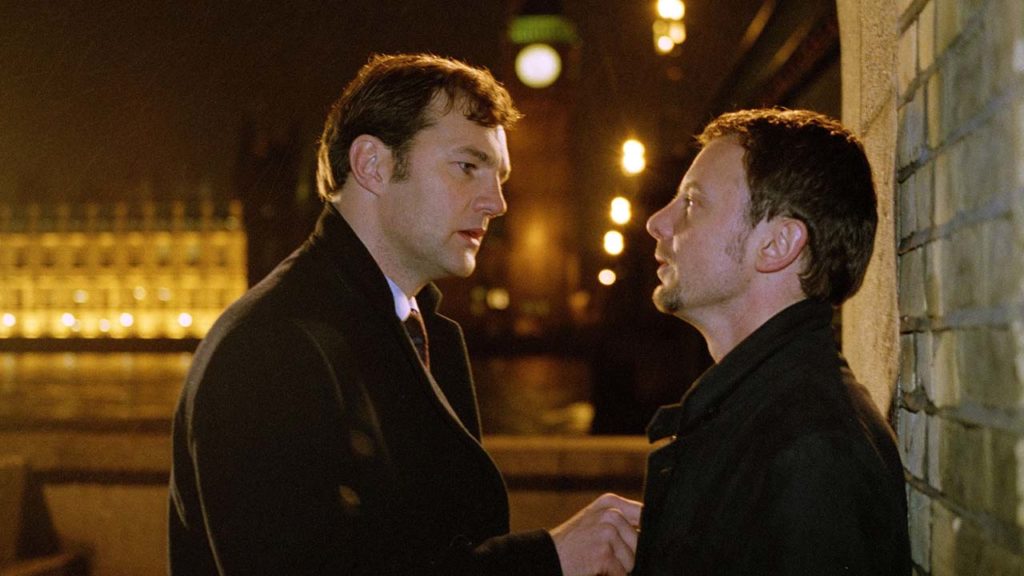
    The 2003 BBC miniseries State of Play is nothing less than six straight hours of intelligent drama, liberally spiced with suspense, action, and tasty plot twists. The entire epic tale is delivered by a veritable plethora of British Isles telly & film who’s who: writer Paul Abbot, director David Yates, and actors David Morrissey, John Simm, Kelly Macdonald, Polly Walker, Bill Nighy, and James McAvoy. Abbot is apparently a superstar television writer in the UK, and Yates directed the last two Harry Potter films (as well as reuniting Nighy and Macdonald in 2005 for The Girl in the Cafe).

    State of Play is an especially good tonic after happening to recently watch the dour The International, which falls more or less into the same genre category. The key differential is a heathy dash of comic relief that never crosses over into farce, mostly supplied by the sublimely quirky Bill Nighy. But more importantly, the intricate tale of high-level political conspiracy feels pertinent.

    Bill Nighy, John Simm, Kelly Macdonald in State of Play
    The Herald newsroom follows the money in State of Play

    The International, although based on an actual banking scandal (a topic that could not be more timely), sabotaged its plausibility by limiting the protagonists to two lone wolfs that take on a crooked multinational financial conglomerate on their lonesome. Here, numerous fleshed-out cops and reporters alternately clash and collaborate as they chase down a gargantuan story.

    State of Play is both a classic newspaper story (like All the President’s Men) and a police procedural (like The French Connection). It’s worth noting that each of these genres are about the piecing together of stories, and the suspense comes from the audience follows along with them as the discover the pieces of the narrative. Granted, the luxurious six-hour running time was a luxury The International could not enjoy.

    David Morrissey & John Simm in State of Play
    The Next Doctor faces off against The Master for the first time

    The details of the plot were undoubtedly timely in 2003 and continue to be now, proven by its American feature film remake in 2009. After suffering through 8 years of a Bush/Cheney administration, Americans can intimately relate to oil companies meddling in governmental operations. Although State of Play is fictional, the affair between a Member of Parliament and a staff member that winds up dead inescapably calls to mind US Representative Gary Condit’s affair intern Chandra Levy, found murdered in 2001. A subplot involving an MP’s compromised expense account now looks even more timely than Abbot could have predicted in 2003, considering the atrocious widespread abuse that currently threatens to remove Gordon Brown and possibly even the Labour Party from power.

    Apart from the sometimes overenthusiastic editing (making the series sometimes feel a bit like the satire Hot Fuzz), the only misstep is Nicholas Hooper’s percussive, bombastic score, including an incongruous didgeridoo-infused theme suddenly introduced in part six. But one of the series’ greatest pleasures is to hear Kelly Macdonald (a crush ever since her unforgettable performance as the ultimate naughty schoolgirl in Trainspotting) pronounce “murder” with all the wonderful extra diphthongs her Scottish accent provides.


    Must read: BBC’s State of Play Left Me in a State of Awe on Pop Culture Nerd

  • California Guitar Trio & Tony Levin’s Stick Men, live at the B.B. King Blues Club, New York, June 22, 2009

    California Guitar Trio & Tony Levin’s Stick Men, live at the B.B. King Blues Club, New York, June 22, 2009

    The California Guitar Trio may not actually be from California (they actually hail from Belgium, Japan, and the US), but there are indeed three of them and they each play a guitar. In a way, that tells you everything and nothing you need to know.

    As designated spokesman Paul Richards explained during their June 22nd show at The B.B. King Blues Club in New York City’s Times Square, they met as students in one of Robert Fripp’s early Guitar Craft courses. The promising pupils became members of the touring outfits The League of Crafty Guitarists and The Robert Fripp String Quintet, and formed the CGT to present their original repertoire interspersed with well-chosen progressive rock and classical covers.

    As a King Crimson fan, I’ve wound up seeing them live no less than three times. The 1992 R.F.S.Q. show in Philadelphia still stands in my mind as one of the best concerts I’ve attended, and I recall their opening sets for King Crimson in 1995 (also in Philly) and The Trey Gunn Band in New York in 1997 going over great with audiences (during most concerts I’ve been to, audiences can’t be pried away from the bar during the opening act). Richards also told the crowd they had been recording and touring the world for 18 years, long since deserving to cease being described as former students of Fripp. (but a little namedropping never hurts!)

    The California Guitar Trio
    The California Guitar Trio

    Monday night’s concert was also an unmissable chance to see Tony Levin‘s Stick Men, a new band formed with fellow stick player Michael Bernier and drummer Pat Mastelotto. The droll, genial Levin is one of the world’s greatest bassists, a fan-favorite — as proven by the inevitable moment at every Peter Gabriel show where the crowd goes wild as he is introduced — and not to mention one of the world’s longest-running bloggers.

    Mastelotto is a powerhouse, a true drum demon obviously enjoying himself enormously on his array of acoustic drums plus various electronics a drum geek would have to identify (comments below, please). He shattered a stick at one point (startling Bernier as a bit of shrapnel flew in his direction), but deftly swapped the casualty for a new one.

    I’m not familiar with Bernier’s music, but as if his talents weren’t obvious on Monday night, Levin gave him props as a player who influenced his own technique (meaning a lot coming from the legend that helped pioneer the Chapman Stick instrument in the first place). Also, Bernier’s got a little bit of a Hugh Grant thing going on.

    The California Guitar Trio
    California Guitar Trio & Tyler Trotter perform Tubular Bells

    Generally speaking, the Trio gave a mellow, contemplative show, while the Stick Men came out blasting with some very dense, funky, mostly instrumental prog rock. They were really, really loud – very glad I brought my earplugs – and even chased a few people out of the venue. I’m shamefully behind on my CGT and Levin album-buying, so I wasn’t familiar with much of the later repertoire of either trio. I only own the first three CGT albums (including what I think is a rare copy of an eponymous cd I purchased at the R.F.S.Q. show, that isn’t even listed on their official site). Copies of their latest are on order from Amazon as I write, but I picked up a pristine-sounding live recording available for sale right after the show.

    Here’s the set list according to Hideyo Moriya’s Roadcam [update: URL no longer available], along with some of my subjective comments:

    1. Punta Patri
    2. Unmei – Beethoven’s 5th Symphony rearranged by Moriya in a 1960s surf guitar style that totally, unexpectedly works.
    3. Cathedral Peak
    4. Tubular Bells / And I Know / Walk Don’t Run – A condensed version of the album-length progressive rock epic by Mike Oldfield (perhaps more famously known as the theme music from The Exorcist). Their sound engineer Tyler Trotter joined the band on melodium.
    5. Portland Rain
    6. Andromeda
    7. TX
    8. Moonlight Sonata – Richards briefly described Fripp’s Guitar Craft lesson of “circulation” as a key technique that has stuck with them. Here they’ve distributed the notes among three guitars, passing single notes from one to another. I’m not an expert, but when it comes to classical music, Bach in particular seems well-suited for the guitar.
    9. Echoes – Longtime Pink Floyd fans (myself included, I must admit) recognized it from the first note, but when the major melody appeared, the audience went nuts, even more so than when some King Crimson covers appeared later in the evening! The CGT version includes a gorgeous ambient interlude, stretching the bounds of what an acoustic guitar can do when connected to all sorts of electronic devices.
    10. Eve – Levin joined them for this ballad, sounding a bit like his own “Waters of Eden”
    11. Melrose Avenue – A great, terse rocker. With Levin & Mastelotto.
    12. Blockhead – With all three Stick Men. One of my favorite CGT tunes, but they omitted any kind of solo (Fripp himself plays a stunner on the R.F.S.Q. album The Bridge Between). Amazingly, they started circulating power chords.

    The Stick Men stayed on stage for the next set, which included the following (and a lot more):

    • Sasquatch
    • Red – The classic King Crimson barnstormer, which Levin modestly identified as “we didn’t write that one.”
    • Indiscipline – Sung by Bernier.
    • Soup (or Superconductor?)
    • Encore: Larks Tongues in Aspic Part II – An effortless-seeming version with the CGT. King Crimson fans will know what I’m talking about when I say here’s another possible interpretation of the “Double Trio” concept.

    Levin congratulated an audience member in the first row for consuming a slice of cheesecake during one of the rockier numbers. He also described their recent, greatly meandering European tour, which sounded very exciting to someone with a normal day job. No doubt a professional musician will quickly counter that that much traveling and border-crossing is grueling. But if there’s time for even a few days off along the way, it sounds to me like a great way to see the world. Or maybe I’m wrong and touring is just hell.

    Tony Levin's Stick Men
    Tony Levin’s Stick Men

    Thanks for reading, and I invite anyone to please comment below. And finally, if anyone cares enough to have read this far, one last thing: fellow New Yorkers might know what I’m talking about when I say that some days New York is more New Yorky than usual. Monday was one of those days, and the nutters were out in force. On my way to the venue, I was blessed (or cursed, maybe, I’m not sure) by a green-clad street preacher wielding a cross made of twisted wire. Minutes later, the guy sitting next to me in Starbucks got an earful from a totally different preacher. And then, in B.B. King’s, one audience member in the back near me was obviously stoned; not on something relatively harmless that merely makes you stupid, but rather on the sort of thing that makes you manic and insane (cocaine? speed?). He couldn’t stop loudly babbling for the entire concert, and was almost literally bouncing off the walls. I kept hoping the management would toss him out, but no luck.

  • Kristin Scott Thomas is unshowy but brilliant in Philippe Claudel’s I’ve Loved You So Long

    Kristin Scott Thomas is unshowy but brilliant in Philippe Claudel’s I’ve Loved You So Long

    Writer / director Philippe Claudel’s I’ve Loved You So Long is a textbook exercise in the dramatic withholding of narrative information. Juliette (Kristin Scott Thomas) is released from prison after serving 15 years for an unspecified crime, and is unwillingly housed with her sister Léa (Elsa Zylberstein). Léa is initially her only ally, and her husband Luc (Serge Hazanavicius) is distrustful for what turns out to be very good reason.

    Léa and Luc have adopted two children (a big clue to the central mystery of the movie), including their precocious older daughter P’tit Lys (Lise Ségur, a rare movie tyke that is actually endearing). As part of her probation, Juliette is required to sign in weekly with a lonely cop (Frédéric Pierrot) with even more psychological issues than she. The slow drip of information ramps up the drama, but we’re told just enough to see that the movie is actually about Juliette’s gradual, sometimes painful reentry into life, not her mysterious crime.

    Elsa Zylberstein and Kristen Scott Thomas in I've Loved You So Long
    Elsa Zylberstein and Kristen Scott Thomas in I’ve Loved You So Long

    Thomas’s unshowy performance is acting of the highest degree. The British actress already proved her fluency in French in Tell No One, although a line of dialogue here explains away her accent. She doesn’t distract by inviting the audience to be constantly impressed at how talented she is.

    But that said, there were a few moments where I marveled at the complex emotions she conveyed. Two scenes in particular stand out: Juliette almost physically recoils when introduced to Léa’s colleague Michel (Laurent Grévill) and when reunited with her estranged mother. Also watch for the almost indescribably complex expression that plays across her face when she meets a sleazy bloke in a pub shortly after her release.

    Elsa Zylberstein and Kristen Scott Thomas in I've Loved You So Long
    Elsa Zylberstein and Kristen Scott Thomas in I’ve Loved You So Long

    Only two factors kept me from considering the movie more highly. There’s a seemingly extraneous and unresolved subplot about Léa ignoring a student who appears to have a crush on her, and claims he’s a subject of prejudice. Was the point merely that Léa is an attractive, sympathetic person? Secondly, the movie arguably descends into talky melodrama at the very end; without revealing too much, we learn the truth about what motivated Juliette’s crime, and why she stubbornly kept her silence for so long.