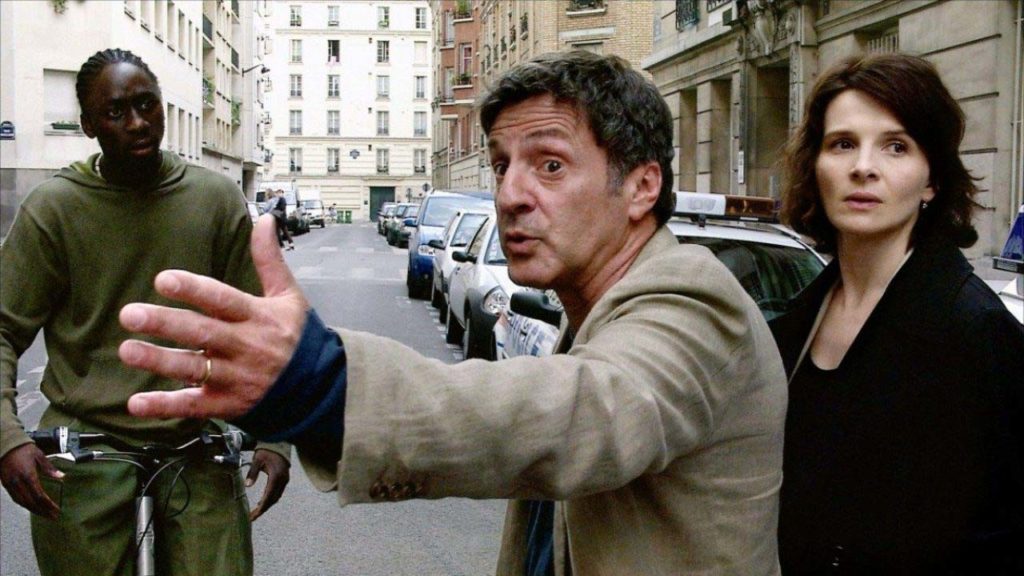
An art-thriller directed by Michael Haneke, of whose previous films I’ve only seen Le Pianiste (The Piano Teacher). A major theme is that of video image-making (a main character is a television host) and surveilance. The interest in video images brings to mind the films of Atom Egoyan (Calendar, Felicia’s Journey), and perhaps even the search for meaning (that may or may not even be there) in photographs in Blow Up.
The point of view of the “camera” is crucial; sometimes the image we’re watching is revealed as that of an actual video camera within the film. After we learn the first static shot is actually a film-within-the-film, we constantly suspect later static shots until the camera moves. Sometimes, we are the camera.
A digression: if the academic term for a sound heard in the fictional context of the film (as opposed to, say, the score) is “diegetic” but how does one refer to a film or video image seen by characters within a film? Movies ranging from Citizen Kane (the newsreel sequence) to Starship Troopers (the fascistic TV commercials) feature moving images in the world of the film, so there must be an academic term.
Caché famously features an enigmatic final shot, supposedly revealing a clue to a major unanswered plot point. So even though I knew to inspect it closely, and the mere location depicted obviously tells you what to look for, I still couldn’t spot it. Later, someone told me what to look for and I watched again. And sure enough, there is it, beautifully choreographed right there in plain sight. Hint: check out some action that moves from the top left of the screen down to the bottom left.
Dr. Who & The Daleks is the first of two feature films based on the classic BBC TV series Doctor Who. They are, as the fans say, “non-canonical,” and thank god for it. The TV series was a true all-ages affair; typically enjoyable for children, but with extra layers of subtext for grownups (or at least attractive ladies for the dads). But this movie is dumbed down to the point where it’s dull and condescending to even the youngest audience member.
Screen legend Peter Cushing plays “Doctor Who” (in the movie, that’s apparently his actual name) as a silly old (human!) man, a harmless mad scientist. The other characters don’t fare well either. The original TV incarnations of Ian and Barbara were both intelligent and capable, employed in the noble profession of school teachers. This Ian is a total prat, serving mainly as comic relief, and Barbara is reduced to a screaming plot device.
Other things grate to longtime fans (it’s “the TARDIS,” not just “TARDIS”!) and regular viewers alike (the music is wretched). Truth be told, cheesy effects and silly technobabble are actually great pleasures to be found in the original series, but the extra money spent on the movie must have gone to the wrong places (the sets and extra Dalek props, evidently). The advanced Dalek technology includes lava lamps (I’m not kidding). And make up your minds, Daleks, is it a neutron or neutronic bomb?
And finally, if it’s pitched so low, what are the moral lessons it has to teach youngsters? Based on what The Doctor has to teach the naive glam-rock aliens threatened by the Daleks, don’t trust anyone who claims to want to help you. Instead, fight and kill them.
After years of getting picked up and put down by various labels, Joseph Arthur is launching his own independent label (no longer online: billboard.com/bbcom/news/article_display.jsp?vnu_content_id=1002839192), Lonely Astronaut. His new album Nuclear Daydream drops on September 19, to be followed by a long-awaited-by-The-Dork-Report US tour running through November.
I’m still immature enough to think things like this (no longer online: youtube.com/watch?v=u-kfLf_RGqk) are awesome. (spotted on CNN)
An flurry of activity from one of my favorite old (and I mean “old” in the geriatric sense) bands, The Who (no longer online: petetownshend.co.uk/projects/thewho):
Their first world tour in over 20 years, if you ignore the numerous reunion mini-tours.
A new EP “Wire & Glass” comes out August 1, excerpting a song cycle (known to music snobs as a “rock opera”) from a forthcoming studio album, their first in 23 years!
Tons of video, some free, on TheWhoLive.tv (no longer online)
Roger Waters live in Italy on July 12 (no longer online: bigozine3.com/rarities/?p=32), a concert dedicated to Syd Barrett.
Hoboken institution Yo La Tengo performs a live score to several of French filmmaker Jean Painlevé’s underwater documentaries. Interestingly, English subtitles indicate the films were apparently not silent in their original form, with narration and perhaps scores of their own. So not only is the audience’s experience of the films filtered through a spoken-French-to-written-English translation, but also by Yo La Tengo’s contemporary score.
Most of the films concerned the mating rituals and birth cycles of sea creatures ranging from octopi to mollusks. A rare intrusion of a human hand is seen during the dissection of a pregnant male sea horse. Without seeing the films in their original form, it’s hard to judge if they were clinical or artful in tone. Only one film was clearly intended to be abstract: a series of images of vividly colored liquids crystalizing, evoking the “Beyond Infinity” sequence in 2001: A Space Odyssey. But Yo La Tengo’s musical interpretation transformed nearly every sequence into a dreamlike, non-literal cinematic experience.
I’m curious… was the band influenced by the original soundtracks? To what degree was the performance planned and/or improvised?
Dead-tree dinosaur Conde Nast finally rescues Wired News from online dinosaur Lycos. The latter will still retain old Dork Report favorites HotBot (the best search engine during the pre-Google dark ages), Hotwired (now offline), and Webmonkey (where this Dork Reporter learned his chops). (also spotted on Kottke.org)
The 2006 Bulwer-Lytton Prize winner Jim Guigli (guest submission from femme fatale Andrea):
“Detective Bart Lasiter was in his office studying the light from his one small window falling on his super burrito when the door swung open to reveal a woman whose body said you’ve had your last burrito for a while, whose face said angels did exist, and whose eyes said she could make you dig your own grave and lick the shovel clean.”
Jim Guigli
Jeffrey Zeldman puts designers’ everyday frustrations into perspective.
Don’t mess with Joey the flesh-eating ‘roo. (guest submission from hippity-hoppity Jill Andrea)
More Hoff: Secret Agent Man (video no longer online). Amazingly, just as in his last video classic Get Into My Car (link no longer online: www.perezhilton.com/topics/listen_to_this/watch_listen_to_this_the_hoff_makes_us_hot_20060702.php), his massive ego appears to have kept him filmed in separation from the scantily glad girls again. (guest submission from Bond Girl Andrea)
A couple of well-scrubbed young hotties distract Dept. of Homeland Security employees and Bring It (video no longer online).
Esquire takes a sober look: “It’s not a bad movie that’s accidentally good, and it’s not a good movie that’s intentionally bad; it’s a disposable movie that people can pretend to like ironically, even though a) it’s not ironic and b) they probably won’t like it at all.”
Japanese tv has the answer: what to do if you have too much stuff (video no longer online), complete with anachronistic brassy calypso score. (guest submission from Dave)
Thousands of layoffs (no longer online: online.wsj.com/public/article/SB115258401032003019-JvwJXcKU8cCSAU7Il5cAGpRhKKE_20060810.html)? Note to self: now is not the time to send AOL your resume.
How much Rock will $699 buy? How about all 10 Led Zeppelin studio albums remastered on 45rpm, 12″ single-sided vinyl. As standard lps are 33rpm and double-sided, this comes to a whopping 48 records of glorious songs about ringwraiths and fucking!
On rewatch as an adult, Blazing Saddles didn’t quite live up to my childhood memories. For instance, I recall the infamous bean-induced fart sequnce being a veritable symphony of bad taste; alas, the real thing is just a minute or so long at most. But it turns wonderfully crazy near the end, finally becoming funny as the cast crashes postmodern-style into another movie set and an actor shouts “Piss on you, I’m working for Mel Brooks!”
Gene Wilder proves his range by gives the polar opposite performance than in Young Frankenstein and The Producers. Stoned mellow, he graciously supports star Cleavon Little. Still, Wilder gets to wrap up the picture by kicking up his heels (still munching the popcorn from their movie date) and confessing his longing to ride off into the sunset with Sheriff Bart.