Category: Movies

Movie Reviews

  • Why can’t Star Trek always be as good as The Undiscovered Country?

    Why can’t Star Trek always be as good as The Undiscovered Country?

    “Please let me know if there’s another way we can screw up tonight.”

    Not only is Nicholas Meyer’s The Undiscovered Country my personal favorite Star Trek movie, I may go far as to argue that it is the best. It truly ticks every box of what makes Star Trek Star Trek, and comes the closest to getting everything just right.

    Watching it back-to-back with its immediate predecessor is especially informative. Director William Shatner’s The Final Frontier is not quite the unmitigated fiasco its reputation would have it, but it has many flaws, the most tragic being its deep lack of dignity. There was no escaping the increasing ages of its beloved cast, but it’s just plain preposterous to open with Kirk free-climbing a mountainside, and then end with him embarrassingly huffing and puffing up a tiny hill. And poor Uhura is treated even worse, in what must be one of the most sexist scenes in Trek’s entire history.

    Classic Star Trek was in the process of being eclipsed by the Next Generation TV series, midway through its 1987-1994 run at the time, just hitting its stride in quality and popularity. It would have been heartbreaking for the low point of The Final Frontier to have been the last adventure for the classic Enterprise crew. Things could have gone so wrong. Thankfully, The Undiscovered Country reclaims everything that The Final Frontier squandered, and allows the full original cast to go out on a high note.

    Star Trek: The Undiscovered Country
    Cold war brinksmanship in outer space.

    Far from ignoring the cast’s age, The Undiscovered Country instead embraces it. Our former space cowboy heroes have all aged into diplomatic and strategic roles in Starfleet, and their frontier mindsets chafe at the transition. We’re no longer asked to believe William Shatner is possessed of ageless physical prowess. Kirk wins a fight largely through a lucky sucker punch, and when he’s smooched by the much younger Iman, the moment is immediately undercut… twice.

    The stakes are high enough to be serious, but not so low that the movie resembles a feature-length television episode, the excuse often made by fandom to apologize for the too-frequent mediocrity of the feature films. The previously thinly-drawn foes the Klingons are here reimagined as canny equals, on the opposing side of an interstellar cold war. Christopher Plummer is superb as a canny political operator — today, we would recognize his paper-thin charm and propensity for brazen assassinations as very Putin-like. The metaphor for US/Russian relations may be unsubtle but it packs a punch, particularly as Kirk struggles to overcome a lifetime of prejudice.

    Meyer & Denny Martin Flinn’s screenplay is a thing of beauty, with an airtight plot, crackling dialog, and just the right balance of humor and gravitas; it’s somehow the funniest and the most serious Trek movie. The at-the-time cutting edge CGI special effects are used efficiently and for story purposes instead of mere flash and sizzle (globules of alien blood floating in zero-gravity not only looks neat, but is a significant plot detail). The entire cast is on point, and everyone gets a moment to shine.

    As if to make up for The Final Frontier, Nichelle Nichols has several standout scenes (including my favorite among many classic Trek facepalms):

    The Undiscovered Country begs the question: why can’t Star Trek always be this good?

  • Love is having someone to embrace at the end, on Miracle Mile

    Love is having someone to embrace at the end, on Miracle Mile

    The buzz is true; the under-the-radar cult gem Miracle Mile is surprisingly great. Harry (Anthony Edwards) and Julie’s (Mare Winningham) hellacious night on Los Angeles’ titular Miracle Mile suggests Before Sunrise crossed with Children of Men crossed with After Hours, but without the reprieve of a hopeful ending. Unless you consider life on a geologic scale, in which everything we are becomes oil and diamonds.

    Director Steve de Jarnatt’s Miracle Mile is simultaneously an emotionally affecting love story and a gripping thriller, but its most extraordinary achievement is its patience to allow grand events to slowly unfold, from the personal (boy accidentally sleeps through date with girl) to the cataclysmic (the literal end of the world).

    Mare Winningham and Anthony Edwards in Miracle Mile

    The frenzied breakdown of society over little more than a rumor seems inevitable when everyone has spent a lifetime under the chronic anxiety of nuclear meltdown and/or war — all the while externally carrying on with everyday small business: playing trombone in the park, catcalling in diners, stealing stereos, cheating on diets, and flirting in museums. The best anyone can hope for is to have someone to embrace at the end.

  • The treasures of FilmStruck include the Trainspotting commentary track

    The treasures of FilmStruck include the Trainspotting commentary track

    Trainspotting is a lifelong personal favorite film. Essential.

    FilmStruck subscribers should be sure to catch it one more time before before WarnerMedia and AT&T cruelly shut it down on November 29. FilmStruck is full of more invaluable treasures than anyone could watch in two weeks, but I must single out Trainspotting as a particular treat, as the commentary track, deleted scenes, and more from the 1996 Criterion Collection laserdisc are included.

    One of many interesting details to be gleaned: Director Danny Boyle and producer Andrew Macdonald declined a higher budget in order to have the artistic freedom to depict the death of an infant. Yes, it is almost unbearable to watch, but it would have been a lesser movie without it.

    Ewan McGregor in Trainspotting
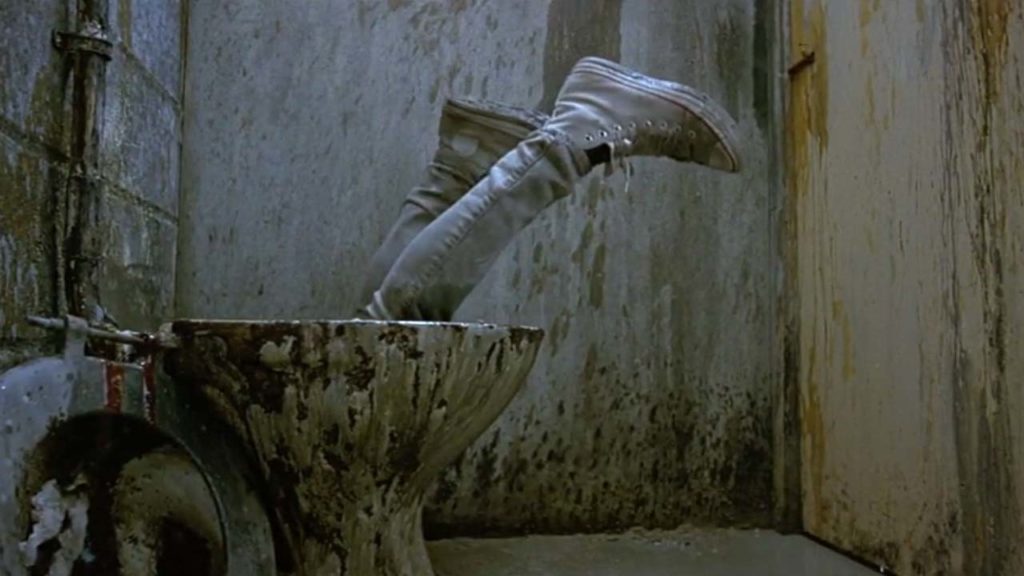
    The worst toilet in Scotland.

    Screenwriter John Hodge notes that novelist Irving Welsh regretted his dominant focus on the male characters, and made a point of highlighting female characters in subsequent novels. Great, but this only highlights the biggest shortcoming of its belated sequel T2 Trainspotting (2017), which made exactly the same mistake. It’s a cinematic crime to have Kelly Macdonald and Shirley Henderson in your movie but give them little to no material. Perhaps not on a par with WarnerMedia and AT&T’s philistine, craven axing of FilmStruck, but still pretty bad.

    Further reading:

    The spirit of FilmStruck will live on in The Criterion Collection’s own Criterion Channel streaming service, to launch in Spring 2019. According to the press release, some or all of its programming will also be available on a separate WarnerMedia streaming service, but as history has shown that such partnerships have not lasted, I will personally be subscribing directly from Criterion.

    The 1996 Trainspotting commentary audio file is also available from The Director’s Commentary blog.

  • Trading Places: The prince’s nurture vs. the pauper’s nature

    Trading Places: The prince’s nurture vs. the pauper’s nature

    John Landis’ Trading Places is remarkably unafraid to take a cold hard look at racism, privilege, and inequality. It still retains the power to incite gasps and raise eyebrows, decades after release.

    With two major caveats, Trading Places is one of my personal favorite comedies.

    1. Caveat one: for a movie with guts enough to deal so directly with such heated issues, it is oblivious to its own sexism. The only real female character is a sorely underwritten hooker-with-a-heart-of-gold stereotype (poor Jamie Lee Curtis).
    2. Caveat two: Dan Aykroyd’s blackface bit is excruciatingly cringeworthy, and nearly upends the film’s entire context of interrogating racism. For shame, everyone involved.

    With these reservations out of the way: wow! Trading Places is as scathingly relevant now as in 1983. Rapacious investor siblings Randolph and Mortimer Duke (Ralph Bellamy and Don Ameche) disagree over whether their elevated social status is due to nature or nurture. They stage a Mark Twain-esque scenario, pitting their Prince (golden boy Aykroyd) against a Pauper (small-time con artist Eddie Murphy). Needless to say, their little social experiment is just as rooted in race as it is in class. The Duke’ sole concession to equality is that they view both pawns with contempt.

    Ralph Bellamy, Eddie Murphy, and Don Ameche in Trading Places

    The Duke brothers represent the worst of American capitalism: the breed of parasitic short-term opportunists leeching off the economy that Tom Wolfe would satirize as self-proclaimed “masters of the universe” in his decade-defining novel The Bonfire of the Vanities. Terrifyingly, Landis could count on contemporary audiences automatically intuiting them as villains, but the same isn’t true today. In 2016 and 2018, enough Americans voted for a new batch of overtly racist predatory capitalists to grant them the power of the White House and Senate.

    Trading Places is indebted to the films of Preston Sturges, but it also brings to mind Billy Wilder’s Some Like It Hot. It has its own problematic aspects that haven’t aged well (such as dim-witted female characters with the sole aim of finding wealthy husbands), but is surprisingly progressive with its ambivalent attitudes on gender and sexuality.

    More obviously, Trading Places shares with Some Like it Hot a propensity to break the fourth wall. Eddie Murphy’s classic spit-take to the “bacon, lettuce, and tomato sandwich” line is, for my money, one of the funniest moments in movie history:

  • The Notorious Ruth Bader Ginsberg champions intelligence and equality in the documentary ‘RBG’

    The Notorious Ruth Bader Ginsberg champions intelligence and equality in the documentary ‘RBG’

    One of the greatest living Americans. If anyone deserves to be lionized in a feature-length hagiography, it’s The Notorious Ruth Bader Ginsberg.

    In these dark times, it’s heartening to see this unapologetic celebration of one woman’s lifelong championship of American values like fairness, justice, and equality. Glimpses of her personal life prove she also lived by these values, especially in how she plowed a pioneering course through formerly male-only spaces like Harvard law school, and how she and husband Marty modeled a successful marriage of equals.

    But an obvious but unspoken dark subcurrent runs through Betsy West and Julie Cohen’s documentary: Ginsberg is not getting any younger, and it’s unbearably terrifying to contemplate American life without her. She was instrumental in many of the anti-discrimination rulings that protect Americans today, against the powerful so-called “conservative” forces that expressly believe that Americans are not equal, that women should be paid less than men and excluded from male spaces, and that non-white people should not vote. The film makes the point that she was not long ago considered a moderate, but the rise of far-right forces have recast her relatively straightforward moderation as leftism.

    After West and Cohen’s film rests its case, the dissenting opinion is delivered by Professor Helen Alvaré of the Scalia Law School. Try not to puke as you sit through the staggering hypocrisy of someone associated with one of the most notorious right-wing ideologues in recent American history, voice the surface-level, rational-sounding criticism that a Supreme Court Justice should not voice personal political opinions.

    In ordinary times, with ordinary politicians, I might agree that justices ought to tread lightly in the public forum. But these are not ordinary times, and Trump is not an ordinary politician. Alvaré’s argument boils down to: liberals should not enjoy the same freedom of speech as the rich and powerful. Today, with predatory nationalists and criminals sullying the White House and dominating Congress, I counterargue: anyone who does not have open antipathy for the Trump Administration is either ignorant or somehow profiting.

    In a national climate that elevates uninformed opinion over knowledge and expertise, we need this celebration of raw, burning intelligence. The serious, reserved Ginsberg is now endearingly pleased to find herself a pop-culture icon and inspiration to young people, but especially to young women. More like her, please.

  • Teenagers shall inherit the world in Wes Ball’s Maze Runner: The Death Cure

    Teenagers shall inherit the world in Wes Ball’s Maze Runner: The Death Cure

    While definitely not in the target audience, and without expressly setting out to do so, I’ve still somehow managed to see all three Maze Runner movies. Their easy availability on streaming services is just too tempting for my chronic addiction to escapist sci-fi.

    It’s interesting to see how young adult fiction contrives such scenarios where adults are absent, subservient, or villains. Like Star Wars, Harry Potter, and Hunger Games, the Maze Runner movies are constructed upon the trope of there being one single girl or boy, born with the inherent destiny of rescuing a world that the older generation has squandered. I’m sure kids are not blind to how the genre panders to them, but that doesn’t mean it’s not cathartic for them to imagine themselves bearing cataclysmic responsibilities in life-or-death, world-ending situations.

    While none of the Maze Runner films are very good, I did appreciate the first’s relatively straightforward Lord of the Flies pastiche (with the caveat that the premise allowed for only one female character — inexcusable in this day and age). As the original title helpfully elucidated, the hero’s journey was to simply escape a maze, which of course came equipped with a minotaur. But the original quest is accomplished, the title becomes essentially meaningless in later installments. To be fair, their subtitles Scorch Trials and Death Cure are also silly, so I guess cool-sounding nonsense is part of the whole package.

    This year’s Maze Runner field trip will be chaperoned by Aiden Gillen and Patricia Clarkson.

    Wes Ball’s The Death Cure is a bloodless PG-13 zombie war movie for kids, and almost preposterously long at almost 2 1/2 hours. But it does boast some exciting action sequences, however wildly illogical and coincidence-dependent. The opening rescue of captives from a caravan is an effective emulation of Mad Max for kiddos, and the aerial ensnare of an entire bus near the end is impressive.

    The young cast is… fine, if a little bland except for an impassioned Thomas Brodie-Sangster (doomed to be known as him from Love Actually). Like Kate Winslet in Divergence, Ashley Judd in The Hunger Games, and every grownup in Harry Potter, a handful of respected respected veteran indie actors take up the slack: Patricia Clarkson and Aiden Gillen as baddies-with-actually-rather-complex-motivations, and the Giancarlo Esposito Drinking Game (take a swig every time he says “hermano”, and you’ll be on the floor long before the end).

  • Monty Python throws a farewell party for themselves in “Live (Mostly): One Down, Four to Go”

    Monty Python throws a farewell party for themselves in “Live (Mostly): One Down, Four to Go”

    Like many misfit American kids of my generation, my brain was permanently rewired when I discovered the BBC series Monty Python’s Flying Circus on PBS in the 1980s. Monty Python, Doctor Who, and The Hitchhiker’s Guide to the Galaxy formed a triumvirate of British pop culture that gave dorky anglophiles like us a pool of clubby shared references.

    But I suppose my interest waned over the years, aside from catching Spamalot on Broadway in 2007, being happy to see Michael Palin pop up in The Death of Stalin, and of course periodic rewatches of Terry Gilliam‘s masterpiece Brazil, still one of my all-time favorite movies. Even when the surviving members of Monty Python reunited in 2014 for a series of live shows at London’s O2, I wasn’t motivated to go see the global theatrical simulcast or rent the subsequent DVD. But no more excuses, now that Eric Idle and Aubrey Powell’s film Monty Python Live (Mostly): One Down, Four to Go has appeared a click away on Netflix.

    Terry Gilliam and Michael Palin

    I’m not sure if I’ve grown out of Monty Python, if Monty Python has grown out of Monty Python, or if this reunion show was just rubbish. I sat through the film mostly stonefaced, when not cringing (except during Terry Jones’ prudish stiff upper lip in the “Nudge Nudge” sketch, which is still funny). Part of the appeal of their earliest work was that it was done on the cheap and on the fly. But Monty Python has long since become Monty Python Inc., and these shows’ high production values come across as insincere and inauthentic — in other words, professional. It’s a nostalgia trip, like a veteran classic rock band on a greatest hits tour.

    At over 2 hours, it’s also somehow simultaneously too much and not enough. I realize the Pythons are all over 70, and even youngsters would need time to change costumes between sketches anyway, but I wasn’t expecting so much filler. They rely heavily on projected excerpts from the Flying Circus TV series and some of the movies. A large troupe of young dancers and singers often take over from the stars for big production numbers like “Penis Song (Not the Noel Coward Song)” and “The Silly Walk Song”. This preponderance of musical numbers suggests the show was Eric Idle’s baby. Notably, I don’t think there’s any material at all from Monty Python and The Holy Grail, perhaps to avoid overlap with Idle’s Spamalot musical.

    Watching Monty Python’s greatest hits now, in the cold light of adulthood, the makeup of their humor seems pretty easily broken down:

    • 5% university-educated wit (philosophy, religion, world history, etc.)
    • 15% bodily fluids & noises
    • 20% naked or scantily-clad ladies
    • 50% exaggerated regional accents
    • 10% gay men talking and walking funny

    Which brings me to the difficult subject of how so much of Python’s material struck me as offensive. The cheeky insouciance of their original BBC TV series The Flying Circus was genuinely boundary breaking in the late 60s. But a surprising percentage of the same material lands with a dull thud in 2018. If calling the lumberjack and barrister sketches transphobic is an overreaction, they definitely don’t seem so silly anymore. The “I Like Chinese” song and Mao cartoons are racist, many sketches (including Gilliam’s mincing in the Michelangelo sketch) are homophobic, and the Doctor Who “RETARDIS” gag is not only cringeworthy but also weak wordplay. Only “Penis Song” is substantially updated to be inclusive, now expanded to include additional genitalia.

    Michael Palin, Terry Gilliam, Eric Idel, John Cleese, Terry Jones
    One of the most legendary & influential comedy troupes of all time takes a victory lap.

    Perhaps I am hypersensitive after living the past few years under an ascendant sexist and racist ruling class — emblematized by Trump — and how movements like #MeToo and #BlackLivesMatter have further exposed the exploitation. All this has left me exhausted, making it hard to tell the difference between juvenile rudeness and expressions of greater societal ills, and predisposed to not laugh at any of this.

    The ground is also shifting in popular culture, as it grapples with its depictions of gender, race, and sexuality. The world’s increasing tolerance is being abused by conservatives that would like to silence comedians (such as the recent vilification of Kathy Griffin). So I want to be careful when I try to explain how I now find some of the Python’s classic material offensive. Perhaps comedy should never be polite, and is under no obligations to be gentle to anyone. But as contemporary comedians like Sarah Silverman and Mike Birbiglia have explored, the potential of comedy to offend is one of its biggest strengths, but also its biggest a minefield. This paradox is explored at length in Birbiglia’s one-man show Thank God for Jokes (also available on Netflix).

    Blundering right through this minefield comes Monty Python’s original material, transplanted mostly intact from the late 60s to today. Even though this show was put together years before Trump and Brexit bulldozed through the world order, the show is disappointingly apolitical, aside from a dated Mao reference and quick jabs at Putin and the Daily Mail. But I suppose it’s fair to note that even in their heyday, the Pythons usually didn’t directly address contemporary politics, instead being more eager to skewer class and religion.

    Sadly, these septuagenarians come across as dinosaurs clueless as to how the world has changed while they’ve been in semi-retirement. But maybe if a bunch of legendary comedians want to throw a farewell party for themselves, and fool around on stage one last time, I should just relax. They seemed genuine in their fond ribbing of each other, their tributes to the late Graham Chapman, and spotlighting collaborator Carol Cleveland.

  • Ocean’s Eight is a pleasantly diverting trifle

    Ocean’s Eight is a pleasantly diverting trifle

    Gary Ross’ Ocean’s Eight is, like all Ocean’s films before it, a pleasantly diverting trifle. But its relative deficiency of zip and pizzazz makes me wonder if co-producer Steven Soderbergh positioned his own Logan Lucky as an act of sabotage. I found myself mentally compiling a wishlist while watching:

    • I believe it was intended as a plot twist that James Corden’s insurance investigator was chummy with career criminal Debbie Ocean (Sandra Bullock), but it only reduced the stakes.
    • Nice to see Elliot Gould and Shaobo Qin, but a cameo from Julia Roberts would have been fun and fitting.
    • Speaking of cameos, I would have LOL’d if one of the hapless chefs Cate Blanchett was training had been Topher Grace.
    • The insurance investigator could have been a female English star — how about Emma Thompson? Kate Winslet? Thandie Newton? Yes, thematically, it makes sense for the character to be a male antagonist, but it still seems like a missed casting opportunity.
    • I didn’t note one, just one, quotable line of dialogue — like “and then he’ll go to work on you” or “allllllll reds” or “did you check the batteries” or countless others from Ocean’s Eleven.
    • A score by David Holmes would have gone a long way.

    Some praise: Anne Hathaway was totally the MVP. As in Tim Burton’s Alice in Wonderland, she stole all the scenes, and elevated the material.

    Some trivia: I was startled to hear an unmistakable sample of No-Man’s “Dry Cleaning Ray” repeated several times in Daniel Pemberton’s score. I’m a big No-Man fan, and this is a deep cut. I hope Steven Wilson and Tim Bowness were cut a check.

  • Spacehunter: Adventures in the Forbidden Zone is bad and bonkers, but never boring

    Spacehunter: Adventures in the Forbidden Zone is bad and bonkers, but never boring

    Lamont Johnson’s Spacehunter: Adventures in the Forbidden Zone is definitely a bad movie, but also definitely not a boring movie. Possessed of a slightly bonkers energy, the plot races from one crazy incident to the next. I’m not sure if today’s action movies have this many — or this varied — set pieces: a wild steampunk train raid, an escape from subterranean amazons & their pet sea-snake, a nude zombie attack, a torturous obstacle race, and on and on.

    It comes across as shamelessly derivative, until I realized that most of what I thought it was ripping off had not even come out yet: Dune‘s desolate landscapes, Mad Max Beyond Thunderdome‘s vehicle design, and Star Trek: The Next Generation‘s borg (note Michael Ironside’s costume). Most notably, it manages to prefigure the basic plot of Mad Max: Fury Road: reluctant male hero helps woman rescue female captives of a pervy, despotic cyborg.

    Were it not for the flat staging, witless dialogue, and atrocious acting all around, this might be better remembered as some kind of mad cult classic. Sorry, Molly Ringwald! You were miscast. Love you forever.

  • Brian De Palma looks back over his career in the documentary ‘De Palma’

    Brian De Palma looks back over his career in the documentary ‘De Palma’

    Brian De Palma is an under-celebrated director, responsible for some of the most stunning sequences in American cinema. Just to name four personal favorites of mine: the split-screen prom massacre in Carrie, the Langley heist sequence in Mission: Impossible, the Grand Central Station steadycam chase in Carlito’s Way, and even the failed spacewalk rescue in the otherwise not-so-great Mission to Mars.

    Like his touchstone Alfred Hitchcock, he’s also fascinatingly problematic enough to fuel a thousand hours of analysis and debate. Instead, Noah Baumbach and Jake Paltrow’s documentary provides only a quick overview of his work, solely from one point of view.

    In what appears to have been a single sitting, De Palma reminisces over his filmography. The feature-length running time allows only a few minutes to cover each work, reducing his observations about each to a bullet point or two. His stories range from the gossipy (Bobby De Niro wasn’t motivated to learn his lines for The Untouchables), to dismissive (of the criticism over his violent & scopophilic treatment of women), and ultimately philosophical (on knowing when to retire, with Hitchcock and Wilder as exemplars).

    There is of course great value in getting such a notable and controversial filmmaker on the record, after his career appears to be complete. But this documentary’s scattershot episodic structure is too broad and shallow, without a central thesis to hang a movie on. It would be serviceable as a value-added-material featurette, but not as a standalone theatrical feature film.