Glen Hansard (of The Frames and The Commitments) and Markéta Irglová recorded an album together called The Swell Season, and now tour under the name. They fell in love while filming the excellent Once, and are now a couple.
Interestingly, they got their Oscar-winning song “Falling Slowly” out of the way right away, perhaps to avoid having the audience call it out as a request over and over throughout the evening. Personally, I felt Hansard goofed off a bit too much, even during serious songs like a new one I believe was called “Broke Down.”
Alfonso Cuarón’s Children of Men is, simply, one of the best movies I’ve ever seen. Repeat viewings never fail to overwhelm me with some of the strongest gut-level emotional reactions I’ve ever had to a movie. I can only talk about it in superlatives: it’s a near-religious experience. One of the movies that makes me love movies.
Children of Men is set in a near-future dystopia, two decades after the last human birth. The sci-fi premise of mass infertility has only become more terrifyingly plausible in recent years, with looming climate catastrophe, increased rates of autism and allergies, and the imminent threat of globally contagious diseases like SARS and Zika. A few lines of dialogue allude to a flu pandemic, but the screenplay wisely doesn’t get lost in the weeds over the origins of the crisis.
Clive Owens and author P.D. James in Children of Men
Even the best science fiction sometimes can’t avoid fanciful pseudo-science that tends not to date well (q.v. the notorious “enhance” scene in Blade Runner). The most detail we learn is that women are infertile, and while other reproductive technologies like cloning and artificial insemination aren’t mentioned, we can assume all avenues have failed. It’s evidence of great restraint and respect for the audience’s intelligence that the origin remains unexplained. It’s beside the point.
So by the time the film opens, the harsh fact that the human race is doomed to slowly die out is a given, and has reduced the world’s societies into chaos. Great Britain remains nominally functional, but only under the harshest totalitarian methods. In propaganda glimpsed throughout, Britain congratulates itself for the fascism that makes it possible to carry on; but is mere survival worth the price?
European refugees seeking asylum in the fascistic United Kingdom
Immigrants flood the only country with some semblance of stability, fleeing unspecified atrocities abroad. All we learn of the United States is of a vague catastrophe in New York City alarmingly referred to only as “it.” Immigrants are demonized as “fugis” (for “fugitives,” perhaps punning on the derogatory British slang “paki” for any and all Middle Easterners) and penned in ghettos and concentration camps. Many shots explicitly allude to infamous images of captive enemy combatants in Guantanamo Bay. I doubt it’s incidental that several of the fugitive voices we hear are German, causing one to wonder just what exactly may have happened in Germany, and if it may have been something we have seen before in living human memory. My German is non-existent, but if I’m not mistaken, we overhear one captive German woman bitterly complain to her guard for being locked up in a detention cell with black people. It’s not a pretty picture of human nature; at the worst of times, the worst of us comes out.
It’s not usually a good sign for a movie to have five credited screenwriters, but these do extraordinary job of adapting the original novel by P.D. James (who, according to IMDB, has an uncredited cameo in the cafe bombed in the opening moments of the film). I don’t know if I would go so far as to say the movie is “better” than its source material, but it is certainly more visceral and emotionally affecting to a post 9/11 audience. As an adaptation, the many changes are justified and benefit the translation to a different medium and time. Most significantly, the chronology is condensed from months to days, and the relatively polite insurrectionist group The Five Fish has become a full-fledged terrorist organization called simply The Fish.
Danny Huston as the guardian of the Ark of the Arts in Children of Men. Among the artistic achievements of humanity selected for eternal preservation: Pink Floyd’s inflatable pig
Theo (Clive Owen) is younger, without the life of wealthy ease his novel counterpart enjoys. He’s a gambler and alcoholic, and his initial motivation to collaborate with The Fish is raw money. His cousin Nigel (Danny Huston) is not the all-powerful Warden of England as in the book, but rather merely the effete guardian of the Ark of the Arts. The Ark is a pointless quest to archive the world’s great works of art, including everything from Michelangelo’s David, Picasso’s Guernica, to Pink Floyd’s inflatable pig. King Crimson’s dramatic Mellotron dirge “In the Court of the Crimson King” fittingly accompanies Theo as he visits Nigel, passing into a walled city that separates the privileged elite from the working masses outside. Naomi Klein predicts the future dominance of such places in Cuarón’s short documentary “The Possibility of Hope”, apprehensive of the very near and very real future of countries closing themselves off to refugees.
Julianne Moore as Julian in Children of Men: “What do the police know about justice?”
Several mind-bendingly impossible tracking shots grace the film, so fluid and justified by the action that the mind barely registers a lack of cutting. There is an incredible level of detail in the art direction, but as Cuarón declares in the DVD bonus features, the goal to was be the “anti-Blade Runner.” Technology has barely progressed in the decades since humanity began dying out. What’s the point of innovation in fashion, automobiles, and consumer electronics when the human race is doomed to extinction? Eerie sights include fields of burning cattle corpses (possibly due to mad cow disease, or more likely the simple fact that the agriculture system has collapsed), abandoned and crumbling schools, and the prominence of dog racing as the sport of choice in a world with fewer and fewer healthy young people every day.
Clare-Hope Ashitey and Clive Owen in the ruins of a school
Children of Men may be a punishingly bleak vision of the future, but there is hope to be had. Theo is a broken man resolved to a slow death, both his own and of his species. But there is something special within him; his former lover Julian (Julianne Moore) trusts him over everyone else to do the right thing when presented with a gift of hope: the first human child in two decades. Even animals are drawn to him, including dogs, kittens, and deer. His friend Jasper (Michael Caine) praises the Hindu Peace Mantra, which also appears as an epigram after the credits (over the sound of children playing), and bears repeating here: “Shantih Shantih Shantih”
Guillaume Canet’s Ne le dis à personne (Tell No One) enjoyed a surprisingly wide US theatrical release for a French film without huge English-speaking stars (except for Englishwoman Kristin Scott Thomas, perfectly fluent in French). Roger Ebert rightly compared the tightly crafted thriller with The Fugitive, placing it squarely in Hitchcockian wrong-man-accused territory.
Pediatrician Alex Beck (François Cluzet) finds himself the prime suspect of his wife’s murder, eight years prior. This being a French film, the fortysomething Beck was married to the utterly gorgeous younger Margot (Marie-Josee Croze, great in Julien Schnabel’s The Diving Bell and the Butterfly). One might accept this as a given premise of the story, for sometimes old coots really do bag hot young wives, had the film not ruined it by demonstrating via flashback that the characters are supposed to be the same age.
Run Beck Run
I found Tell No One more focused and engaging before the conspiracy widens to an almost absurd degree, enveloping even a Senator in a vast cover-up. I will admit to being confused at times; to grasp the details and convoluted timeline, viewers will have to remember character names, not faces, as the chronology of some key plot points are conveyed via exposition (that is, told, not shown).
Funny how bad things happen to people who skinny dip in movies.
Hints of the recent race/class tensions in France are built into the plot: Beck’s equanimity as a pediatrician earned the trust of some less privileged thugs on the wrong side of the law. That they will aid him when no one else will ironically demonstrates his essential goodness.
Control is one of the very few rare musical biopics to ever appeal to me, even though I am only passingly familiar with the music of Joy Division, and even less so of the history of its tragically doomed lead singer Ian Curtis.
To testify to the film’s power, I immediately purchased The Best of Joy Division compilation. Listening more deeply to them for the first time, I’m struck by how much influence they obviously had, most obviously Interpol but also no less than U2 (especially their first three albums, and in Adam Clayton’s bass playing particularly).
Transmission
Control begins with Curtis (Sam Riley) as a young lad in 1970s Manchester, absorbing all the rock star lessons that are there to be heard in David Bowie’s Aladdin Sane. He applies androgynous glam-rock makeup modeled after Bowie and Brian Eno, pops pills (ironic, considering the wide cocktail of drugs he’s later legitimately prescribed when his epilepsy manifests), writes anguished poetry, and sees the Sex Pistols live in their prime: “they were crap.”
They were crap.
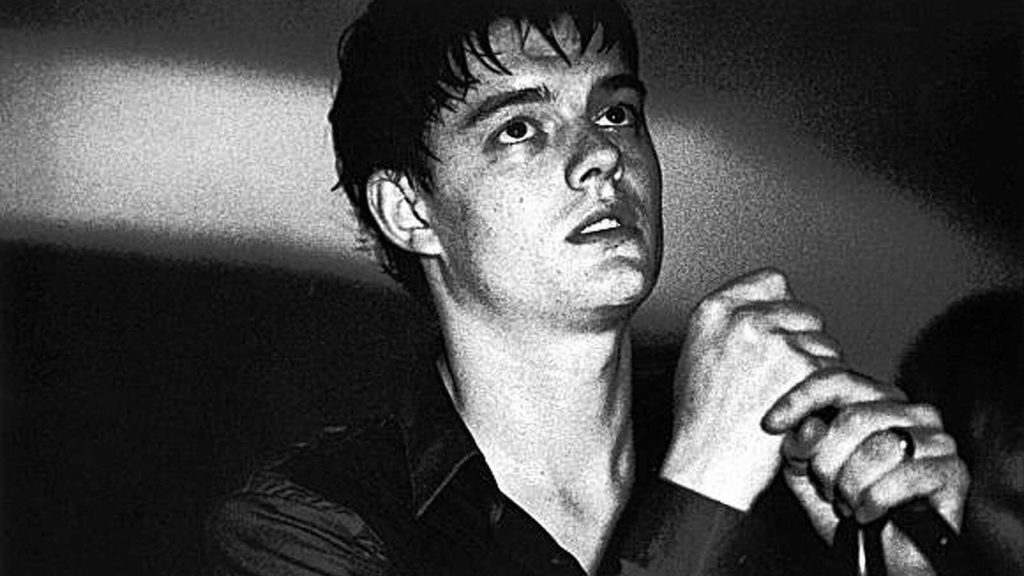
Ian Curtis, on Joy Division, in Control
But his own band Joy Division creates a genuine new sound, a world apart from glam or punk. They seize the attention of Manchester music scene maven Tony Wilson (Craig Parkinson) with a hand-scrawled note reading “JOY DIVISION YOU CUNT,” hand-delivered immediately before a scorchingly intense live set. Wilson, himself immortalized by Steve Coogan in Michael Winterbottom’s brilliant biopic 24 Hour Party People, becomes their greatest advocate, literally signing their contract to Factory Records in his own blood (there I go, praising two music biopics at once; I guess they’re not all bad).
Love Will Tear Us Apart
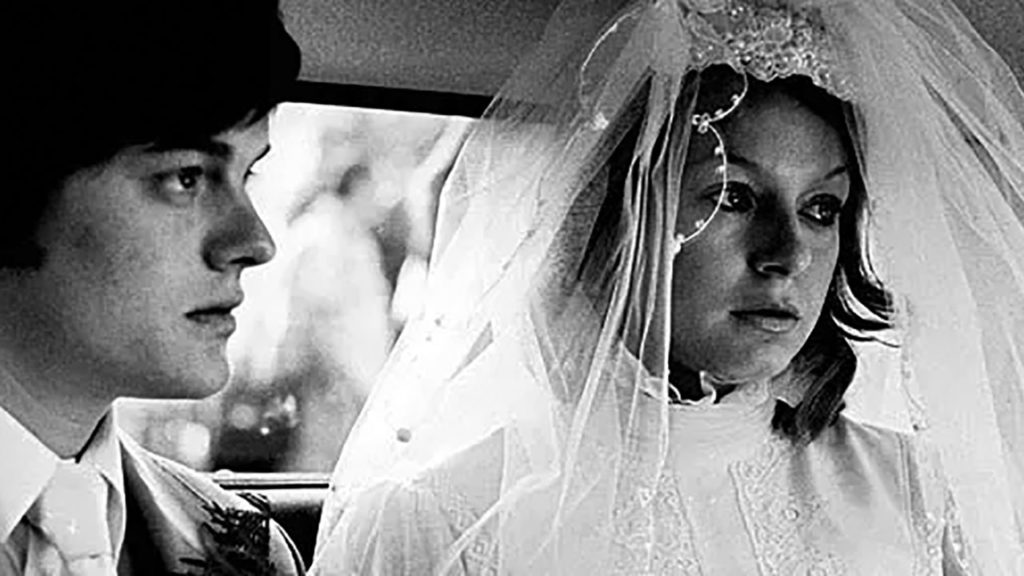
Curtis’ fame came before the comforts of money. He found himself on the covers of magazines, offered a tour of America, and desired by exotic women while still reliant on a depressing desk job and tortured by his own ambivalence towards his young family. Samantha Morton plays his wife Deborah as a shy, overly trusting girl. The real Deborah was later to write her autobiography and co-produce this film with Tony Wilson.
Director Anton Corbijn is most famous for his music videos and portraits, including the iconic The Joshua Tree sleeve for U2. Even though this is his first feature film, he is intimately experienced with the art of capturing rock (and rock stars) on film.
Named after the ancient Persian city, Marjane Satrapi’s graphic novel Persepolis is a memoir of her life in Europe and Iran after the Iranian revolution. This animated feature joins the growing ranks of comic book adaptations that prove that comics are not only about superheroes that dress up in animal-themed costumes to battle crime. Hopefully it, along with other good comics-to-film triumphs Ghost World and A History of Violence, will broaden moviegoers’ awareness of the many alternative genres already explored in comics.
The spirit of punk invades Iran
In a rare privilege perhaps only ever shared by Frank Miller in making Sin City with Robert Rodriguez, Satrapi served as co-director and writer of the film (with Vincent Paronnaud). She sings music to my ears in the DVD bonus features; to paraphrase, she states that it is a fool’s errand to make a literal, strict adaptation of any graphic novel to film. As comics writer Alan Moore once brilliantly and succinctly put it, comics are wholly unlike movies because, simply, “movies move.”
The recent trend in Hollywood is to perform fan service (as it’s known) and make the most literally faithful adaptations possible. Sin City, 300, and the upcoming Watchmen all procede from the flawed presumption that the source materials’ fanbase (the nerdy, genre-convention-attending strawmen in studios’ equations that they expect to be buying the tickets and DVDs) want nothing less than perfect transitions from page to screen. But such a thing is never possible, let alone desirable.
Politically conscious at a young age
That said, Persepolis the film does share the strikingly stark look of Satrapi’s characteristic pen and ink illustrations. A mostly black & white animated French memoir about a young Iranian woman could never be mistaken for blockbuster material, but it is funny, illuminating, and moving.
Wong Kar-wai’s first English-language film My Blueberry Nights is mostly set in bars and diners across America. His characters all indulge in the four great American pastimes: eating, drinking, gambling, and driving.
Nobody films beautiful women, or should I say, nobody films women beautifully, like Wong Kar-wai. In Blueberry Nights, he has no less than four famous female faces to worship with his camera:
Norah Jones – Perhaps not the most natural of actors, but her speaking voice is as emotionally expressive as it is in her famously languid, evocative music.
Chan Marshall (aka Cat Power) – Like Jones, Marshall is a musician and not an experienced actor, but her cameo is bittersweet and effective.
Rachel Weisz – The New York Times one described Weisz as “the thinking man’s sex symbol,” but here she portrays a seemingly dim character with a cruel streak.
Natalie Portman – Like Weisz, Portman plays against type as a troubled young gambling addict with an Electra complex.
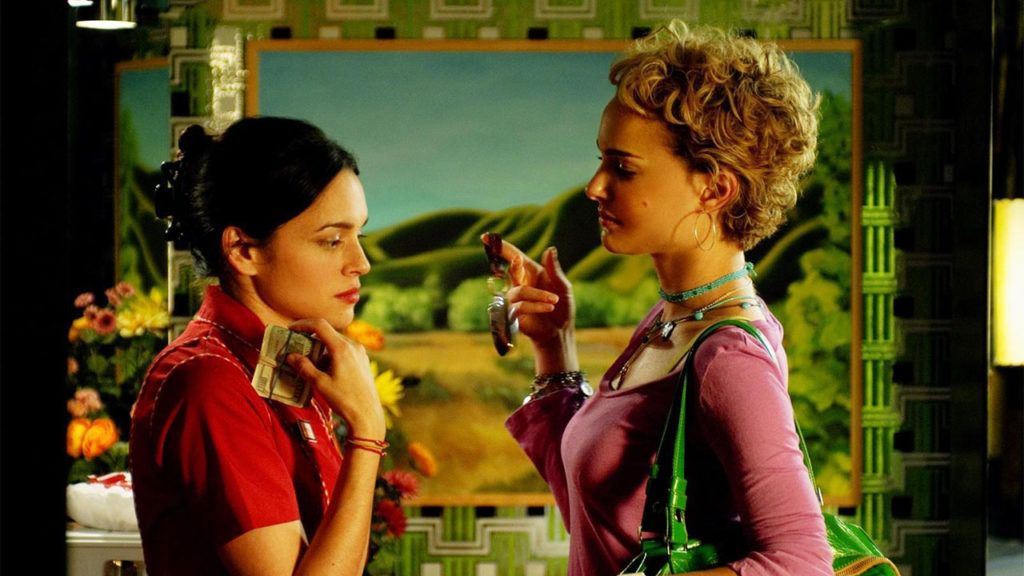
Natalie Portman offers Norah Jones an offer she can’t refuse
It’s impossible to miss the central metaphor: every morning, diner proprietor Jeremy (Jude Law) ritually bakes a blueberry pie. Never eaten, it is thrown out whole every night. It may be undesired for the time being, but every day there is a fresh chance for it to find someone who hungers for it.
It’s hard to believe now, but The Shawshank Redemption was a relative flop at the box office, and overlooked in all seven of its Academy Award nominations (losing the 1994 Best Picture to Forrest Gump). But true to its own themes, it found redemption late in life, on television and home video. It regularly tops the running popularity poll in IMDB.com, but has the reputation for never being taken very seriously by critics.
That said, director Frank Darabont pierces the legend that the film was poorly reviewed, in a Charlie Rose Show interview included among the DVD bonus features. The four or five most widely read papers in the country did pan the film (Roger Ebert of the Chicago Sun-Times being a notable exception), but nationwide, the contemporary reviews were highly positive.
Shawshank: The Redeeming Feature, a British television documentary also included on the DVD, posits the theory that any critical disdain is attributable to its conclusive happy ending. The original novella and Darabont’s screenplay adaptation both end on an ambiguous note of hope, but the studio Castle Rock specifically requested a concrete happy ending. Darabont still seems to have mixed feelings about the inserted coda, but there’s no doubt it delivers massive satisfaction and uplift.
“I know what you think it means, sonny”
Despite the movie’s wild popularity, it doesn’t widely known that it is an adaption of the Stephen King novella Rita Hayworth and Shawshank Redemption (a clunky title without even a “The” to aid in its scansion). It’s an atypical work that deals not at all with the supernatural, but King’s highly characteristic voice does show through in the sharp plotting, monstrous villains, and hilariously colorful dialogue. Seriously, did anyone at any time or in any social milieu ever actually call anyone “fuckstick?” Like many of King’s filthy turns of phrase, if they didn’t, they should have.
Of note, Rita Hayworth and Shawshank Redemption was originally published with three other novellas in a single volume, Different Seasons. Two more became successful films: Apt Pupil (by director Bryan Singer) and The Body (as Stand By Me, by Barry Levinson).
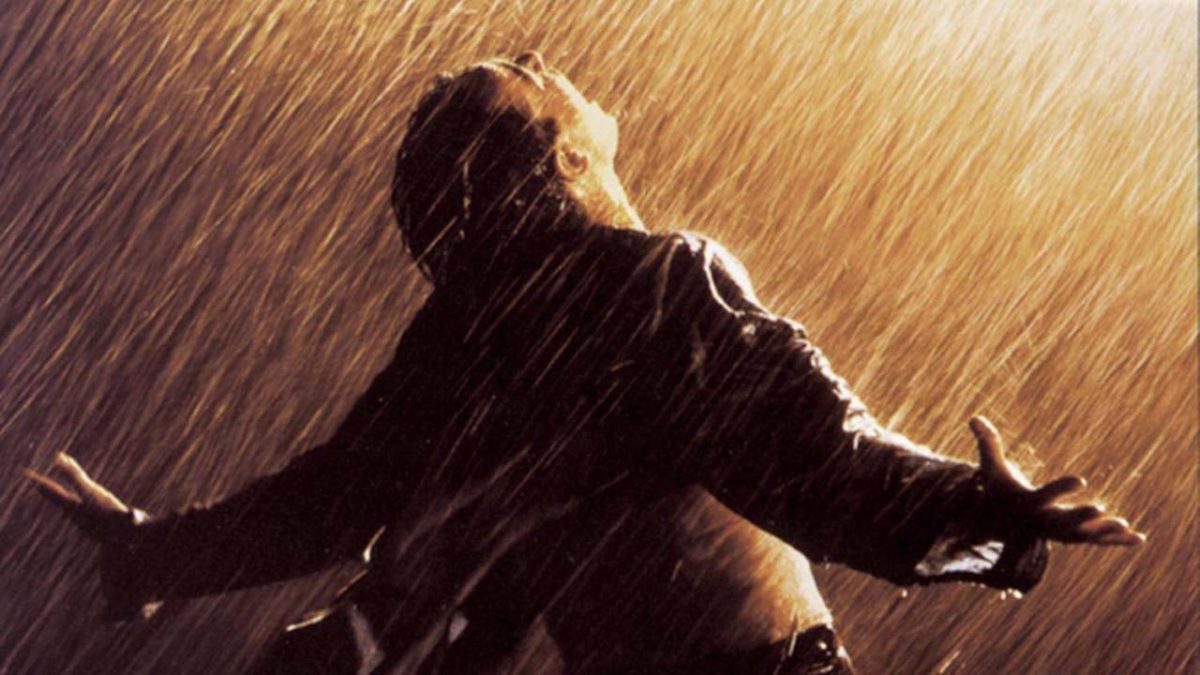
“Get busy living, or get busy dying”
The Shawshank Redemption has its share of warm fuzzies, but repeatedly counterpunches with frank representations of the injustice of prison life, including rape, brutality, and exploitation. One glaring area in which it appears to wimp out, however, is its failure to acknowledge race. Racial tensions must have been at least as much of a problem in 1930s-50s prisons as they are now, if not more so.
The original character in the novella was a white Irish American, and Darabont reveals in the DVD bonus features that Morgan Freeman was an unconventional addition to the cast, an obviously correct decision they couldn’t pass up. Perhaps injecting racial themes into the script at that point would have been one theme too many for an already overstuffed movie, but they do percolate in the background. Red, for example, reflexively calls even the most marginal authority figure “sir.” Not only does Freeman carry a wholly natural gravitas (I recall a review of March of the Penguins that described him as “America’s favorite narrator”) but Red & Andy’s friendship is made that much more profound for the effective irrelevance of their races.
While most Hollywood movies are structured around adversarial relationships between male antagonists, The Shawshank Redemption is a rare tale of deep, sincere male friendship. It could very well be the greatest man-love story ever told, able to bring a lump to the throat of even the most macho of viewers.
On the way to a hoped-for idyll in their spiritual home Amsterdam, our two beloved stoners Harold and Kumar take unintended detours through Cuba (as collateral damage in the War on Terror), Florida (where they drop trou’ for a “bottomless” party), Alabama (rudely interrupting a Klu Klux Klan klatsch), and Texas (whereupon they pass the Mary Jane with the worst George W. Bush impersonator ever).
Harold and Kumar are the best of buds. Get it? “Buds”? Oh, never mind…
Harold (John Cho) and Kumar (Kal Penn) are the 21st Century’s answer to Cheech and Chong, and their first film was a rather enjoyable, freewheeling affair that reveled in its absurdist plot twists and even aided in making Neil Patrick Harris a star again, deservedly. But this sequel unfortunately wastes too much time pairing Harold and Kumar off with their difficult-to-distinguish brunette love interests. It’s as if, like Talladega Nights, it wants to toy with heterosexual “gay panic” humor, but chickens out; the implication is that Harold and Kumar are actually more in love with each other than anybody else, even weed.
Since we’ve last seen Mick Travis (Malcolm McDowell) in O Lucky Man!, he’s moved to America and rediscovered his lust for power and profiteering. Now a member of the media (with no less than Luke Skywalker – Mark Hammill – on his crew), he has returned to his homeland on a mission to expose corruption at Britannia Hospital. On the eve of a visit from Her Royal Highness the Queen, known to the efficient staff as the time-saving acronym H.R.H., the Hospital board risks all to facilitate Dr. Millar’s (Graham Crowder) insane medical experiments. His atrocities are on a par with Mary Shelley’s Frankenstein, but with special effects and camerawork straight out of Sam Raimi’s Evil Dead.
Malcolm McDowell spritzes the Britannia Hospital morgue with a little Febreeze
This vision of 1982 British society is crippled on all sides. The unions have pursued their noble aims of workers’ rights to an absurd degree to which virtually all work has come to a halt in favor of perpetual sandwich breaks. The hippies and activists are too enraged and violent to lend any credence to their causes of peace and equality. Officious red-tape-obsessed suits are barely in control, making insincere compromises just to get through the day. The media fails at their job because they’re too wasted on drugs to so much as operate their equipment. And most frustrating to all, none of the phones work.
Mark Hammill gets the munchies
So the final entry in director Lindsay Anderson’s “Mick Travis” trilogy is obviously yet another satire of British society, this time with a hospital serving as its metaphorical microcosm. It sails a bit too far over the top for my tastes, especially in comparison with the excellent If…, which is so much more effective for spending most of its running time in strict realism before spiraling off into anarchic fantasy.
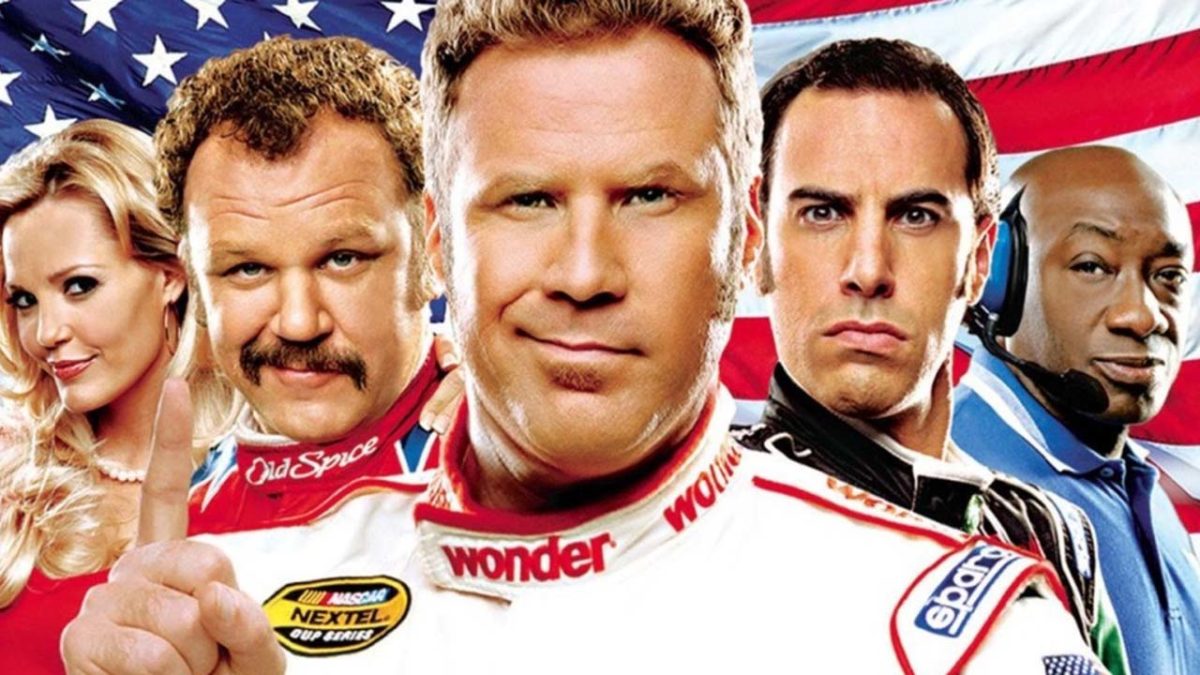
I had long since tired of Will Ferrell, once a treasure on the Saturday Night Live cast, but long since devolved into a movie factory that produces mostly crassness for crassness’ sake. But I had heard Talladega Nights also featured good turns from Molly Shannon, Amy Adams, and Sasha Baron Cohen, and I had also recently enjoyed John C. Reilly in Walk Hard: The Dewey Cox Story. But all fail to amuse here.
Will Ferrell does a pretty good impression of my unsmiling face while watching Talladega Nights: The Ballad of Ricky Bobby.
The ensemble obviously improvised whole chunks of the movie, but not really to its benefit. I counted only two bits that made me laugh: Bobby extemporizes the commercial endorsement “If you don’t chew Big Red, *BLEEP* you!” (a line so aggressively stupid I laughed on impulse), and later, his poncy French rival Jean Girard (Cohen) reveals his corporate sponsor, Perrier. These two gags should make it clear that although Talledega Nights is not the first comedy to parody extreme product placement, it does drive it to a heretofore unexplored new level of absurdity. Finally, it dispenses with its relative subtleties altogether and simply cuts to an actual Applebee’s commercial.