Tag: 2018

  • Ocean’s Eight is a pleasantly diverting trifle

    Ocean’s Eight is a pleasantly diverting trifle

    Gary Ross’ Ocean’s Eight is, like all Ocean’s films before it, a pleasantly diverting trifle. But its relative deficiency of zip and pizzazz makes me wonder if co-producer Steven Soderbergh positioned his own Logan Lucky as an act of sabotage. I found myself mentally compiling a wishlist while watching:

    • I believe it was intended as a plot twist that James Corden’s insurance investigator was chummy with career criminal Debbie Ocean (Sandra Bullock), but it only reduced the stakes.
    • Nice to see Elliot Gould and Shaobo Qin, but a cameo from Julia Roberts would have been fun and fitting.
    • Speaking of cameos, I would have LOL’d if one of the hapless chefs Cate Blanchett was training had been Topher Grace.
    • The insurance investigator could have been a female English star — how about Emma Thompson? Kate Winslet? Thandie Newton? Yes, thematically, it makes sense for the character to be a male antagonist, but it still seems like a missed casting opportunity.
    • I didn’t note one, just one, quotable line of dialogue — like “and then he’ll go to work on you” or “allllllll reds” or “did you check the batteries” or countless others from Ocean’s Eleven.
    • A score by David Holmes would have gone a long way.

    Some praise: Anne Hathaway was totally the MVP. As in Tim Burton’s Alice in Wonderland, she stole all the scenes, and elevated the material.

    Some trivia: I was startled to hear an unmistakable sample of No-Man’s “Dry Cleaning Ray” repeated several times in Daniel Pemberton’s score. I’m a big No-Man fan, and this is a deep cut. I hope Steven Wilson and Tim Bowness were cut a check.

  • Avengers: Infinity War collapses under the weight of its own continuity

    Avengers: Infinity War collapses under the weight of its own continuity

    Like a teeter-tottering pile of mint-condition, unread, bagged & boarded collector’s edition comic books, the Marvel Cinematic Universe is quickly collapsing under the weight of its accumulating continuity.

    Joe and Anthony Russo’s Avengers: Infinity War may be an edifying experience for the dedicated fan who’s seen all 19 or so preceding movies, and paid enough attention to the details to be able to follow what’s going on. But were it not for Tom Holland adding some levity as Spider-Man, and Josh Brolin as the relatively interesting villain Thanos (atypical for the superhero genre, to say the least), there isn’t much substance here beyond callbacks to previous installments and teasers for the next round of punch-punch boom-boom.

    The Avengers: Infinity War
    The Avengers: Infinity War is one part lunchbox, one part Wikipedia entry.

    Picture the little kid coming to this for the first time. She is enamored by the idea of Spider-Man swinging through New York City, Captain America punching out baddies, and Iron Man fighting crime with his neato gadgetry. She has read and re-read her handful of comics, and is excited that her parents are taking her to the movie theater to see her heroes come to life on the big screen. Imagine how she feels when what she gets is more of a Wikipedia entry than a story.

    It’s the same paradox that affects all indefinitely ongoing comics: the more pages that pile up, the more complex the continuity, the more impenetrable it comes, and before you know it the only people reading comics are grownups.

  • Gorging on Nostalgia: Solo: A Star Wars Story

    Gorging on Nostalgia: Solo: A Star Wars Story

    Like a big bowl of candy, Solo: A Star Wars Story certainly went down easy. But also like a big bowl of candy, generations raised on too much Star Wars are going to gorge themselves sick on nostalgia. Who filled that bowl, and why? When Disney acquired the Star Wars rights, and promised a new movie every year, I don’t think I was alone in imagining there would be more than enough room for original stories. But so far Disney has spent more time facing backwards than forwards.

    To recap: The Force Awakens was in many ways a phantom remake of the original Star Wars, rationalized as rebooting the franchise with a new foundation for future stories. Rogue One and Solo are essentially neu-prequels, plastering in the gaps deliberately left in the original foundation. Solo is especially focussed on continuity and nostalgic callbacks, and teasing future nostalgic callbacks yet to come. It isn’t about anything other than itself. Four films in, The Last Jedi stands alone in striking out for new territory. It’s the first to really surprise.

    Maybe I’m being overly cynical, but what is the point of the neu-prequels, if not mere fan service? Aren’t the missions to steal the Death Star plans and the Kessel Run better left to the imagination? Did anyone really wonder how Chewbacca came by his diminutive nickname? Do we feel we understand Han more now that we know where he got his surname? The one major new detail we learn about him — that he is an Empire deserter — loses its impact when even this idea is recycled: q.v. Finn in the mothership films.

    Alden Ehrenreich in Solo: A Star Wars Story

    The most egregious fan service in the film is of course the confounding cameo by Darth Maul — confounding, that is, only for those evidently undedicated Star Wars fans like myself that haven’t seen the spinoff animated series. My reaction was not “wow, Darth Maul survived being sliced in half!”, but rather “All this took place before The Phantom Menace? How old is Han Solo? Does Darth Maul always fire up his lightsaber before hanging up the phone?”

    Alden Ehrenreich has caught some flak for his performance here, but he was given an impossible job: impersonate Harrison Ford and get criticized, or don’t impersonate Harrison Ford and get criticized. He either chose the latter or was not able to pull off the former. Whichever explanation, he looks bad opposite Donald Glover, who successfully channelled Billy Dee Williams while still doing his own thing.

    By the standard set by the original trilogy and prequels, Solo‘s three prominent female characters should count as progress. Or, it would have, had the film not quickly killed two of them off. The original Star Wars infamously included only one woman among its cast, but Carrie Fisher’s force of personality made her instantly iconic, and that’s lacking here.

    Also, Paul Bettany was fine but Michael K. Williams got robbed.

  • The Future is a Tasteful Monochrome: Anon

    The Future is a Tasteful Monochrome: Anon

    Andrea Niccol’s Netflix exclusive Anon is a rather quaint throwback to the techno-paranoia cyberpunk genre, once common in the late nineties — remember Virtuosity, Johnny Mnemonic, and Paycheck? The ultimate modern incarnation of is of course the BBC series Black Mirror, which out-Philip-K.-Dicked Philip K. Dick., and set a newly high bar for cynical, pessimistic takes on the future.

    But reality has outpaced all of these cautionary tales, as we’ve since come to understand that of course governments surveil our movements and communications, while unchecked corporations build detailed consumer profiles on all of us. Logging off is little protection.

    Clive Owen and Amanda Seyfried in Anon

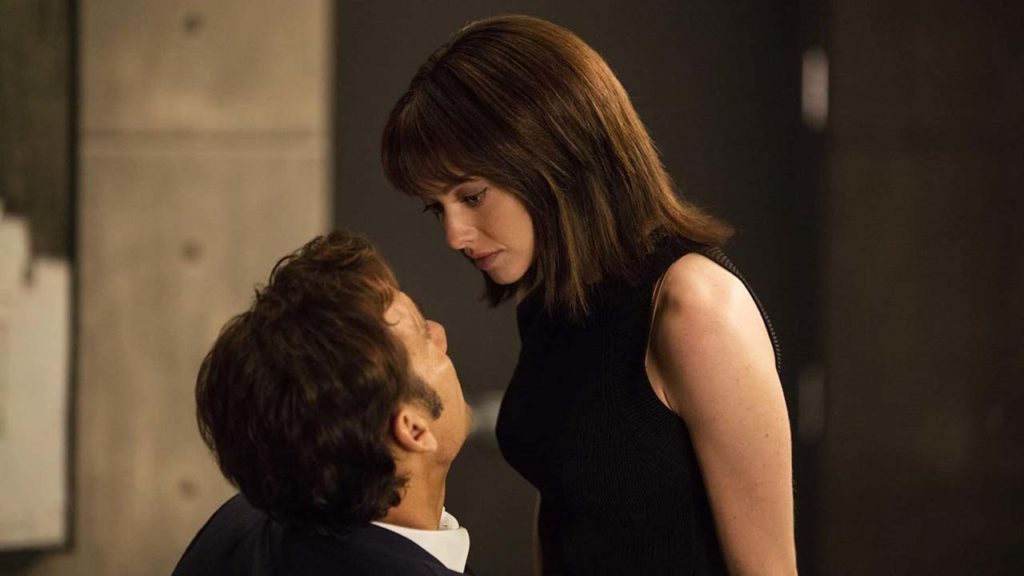
    If Anon‘s future America without the Constitutional right to privacy were to come true, society’d have bigger problems than a sexy serial killer (Amanda Seyfried), exploiting the system to murder those who exploit the system. Ultra-grim detective Sal Frieland (Clive Owen) must fight the ambiguities of his digital record to entrap her. After, of course, bedding the much younger woman under false pretenses (for there are sleazy erotic thriller tropes and a female nudity quota to fulfill). Privacy is the foundation for many civil rights we enjoy today, a topic Anon only glancingly acknowledges.

    And if we ever start installing apps into our eyeballs, I somehow doubt the GUI will be a tastefully-designed monochrome. Everyone who’s ever touched a computer or smartphone knows we’ll be blinded by punch-the-monkey banner ads, free-to-play gem-matching games, and tweets from President Kid Rock.

  • Snausage Fest: Wes Anderson’s Isle of Dogs

    Snausage Fest: Wes Anderson’s Isle of Dogs

    I was rather astonished to find Isle of Dogs defeat my expectations and become one of my least favorite Wes Andersons, if not the least.

    Anderson is one of my absolute favorite filmmakers (I know, I know, join the club), but like a lot of my faves, I have significant reservations. It’s no great insight to point out that all of his films are male-centric, all with male protagonists, all with predominantly male casts, and all featuring at best one primary female supporting character.

    He’s hardly unique in this respect, so it’s unfair to single him out when there are far more egregious examples (like, for example, almost every director ever). But it feels especially overt in the context of a fantasy fable, where anything goes. Why on earth did this have to be such a Snausage fest?

    With a little effort, I count maybe five speaking female characters from memory. Of those, two are — sorry for this, but quite literally — bitches bred to be pretty or bear litters. Interpreter Nelson may share narration duties, but she merely translates the words of other male characters. Yoko-ono is practically mute. That leaves Tracy — about whom I barely know where to begin. At a time when pop culture is calling for greater representation of asian characters in film, the best I can say about her is thank goodness she wasn’t a Japanese character voiced by post-Ghost in the Shell Scarlett Johansson.

    Isle of Dogs

    Sorry to go on and on about the lack of female representation in an animated dog movie, but I just cannot overlook here what I could previously accept as a given with Anderson. It was worth it for his singular visual style and quirks, and he would occasional feature complex female characters like Margot, Suzy, and Miss Cross amidst all the boys. In Rushmore, Miss Cross is the love object of a precocious but immature boy emulating his notions of adulthood, and his inappropriate crush is part of the point. She is thankfully written and acted as far more than a token, but there’s no equivalently interesting female character in Isle of Dogs, and what’s the excuse? Why does the little pilot have to be boy? Why does the entire pack of dogs have to be male? It’s just so frustrating.

    I’m also deducting points for another of my common movie complaints: when one of the most visually-oriented mediums that humanity has ever created — animation — is misapplied to primarily verbal works. The worst example of this in my mind is Richard Linklater’s Waking Life, throughout most of which I could not fathom why the painstaking process of animation was applied to stationary talking heads. Although the animation craft on display in Isle of Dogs is often extraordinarily wonderful, the screenplay is so verbose and overwritten that it often must halt to allow for a few pages of dialogue. Stop motion becomes stopped motion.