I understand the generally negative reception that Edward Norton’s Motherless Brooklyn encountered, but I didn’t dislike it for two very mundane reasons:
1. I happened to watch it in the middle of binging HBO’s Perry Mason miniseries (with which it coincidentally happens to have a great deal in common), and frankly, Motherless Brooklyn comes out on top. Perry Mason‘s unrelenting dour tone and gruesome violence could have used a dose of Motherless Brooklyn‘s lightness and humor.
2. I recognized at least one location as being just a few blocks from my apartment. Funny how a few simple props like a vintage phone booth and some old newspapers can zap a Brooklyn street decades into the past.
But yes, Motherless Brooklyn is not great in and of itself. Ed Norton’s performance is little more than an actorly exercise, and it’s bewildering how many other characters his character Lionel meets are so patient and understanding of his tics. Alec Baldwin’s growly performance is more The Simpsons‘ Mr. Burns than Glengarry Glen Ross. And for a movie about racist civic policies, it’s awkward for it to feature Michael K. Williams as the apparently unnamed “Trumpet Man”, a character dangerously close to magical black person cliche.
Maybe this isn’t fair, but I couldn’t help but associate Ad Astra with Joker. If Joker is a shallow remix of Taxi Driver and King of Comedy, Ad Astra is a bland smoothie of Solaris and Apocalypse Now, with a cavalcade of stars you may remember from Space Cowboys and Armageddon. I half expected Harrison Ford to appear, standing in a corner, creepily ordering Brad Pitt to “terminate, with extreme prejudice” — so it’s more Apocalypse Now than 2001: A Space Odyssey, which at least had the decency to have jokes.
Brad Pitt has a few issues to work out before he can open his heart to Liv Tyler.
But really, Ad Astra is merely the story of an emotionally repressed mope (Brad Pitt), working through his daddy issues by haphazardly murdering a bunch of people just like his dad (Tommy Lee Jones) did — as if they were mere bureaucratic red tape stopping the only person in the universe that can save the universe from saving the universe — and then, having saved the universe, finally becoming ready to open his heart to Liv Tyler. Anybody out there have any empathy for someone who can’t open their heart to Liv Tyler? Pure fiction!
And as for its pseudo-sciencey verisimilitude, somewhere, Kim Stanley Robinson is banging his head against his writing desk.
Criticizing the plots of popcorn action blockbusters is usually a fool’s errand. Nobody cares if Hobbs & Shaw makes any sense, but surely it’s fair game in the Terminator franchise, where untangling pseudo-scientific time travel logic is 99% of the fun.
So the biggest disappointment of Dark Fate (other than its singularly unmemorable title, and the cruel execution of a digital Edward Furlong avatar) is that it offhandedly tosses its biggest question marks into a trashcan of exposition. I’m glad this movie revolves around three women, and relegates Arnold Schwarzenegger to a supporting role, but it seems to me that if your story involves a robot assassin that reprograms itself for good, after a lifetime of guilt and regret, that deserves more than a few perfunctory lines of exposition.
While we’re on the topic of telling-not-showing: Dark Fate introduces a new, rather creepy idea to the clichéd evil A.I. subgenre. Rather than a diabolical Matrix-style plan to subjugate humanity, the A.I. in Dark Fate simply turns off the world’s power and then sits patiently on its circuitry butt for a few decades while most of humanity kills itself off. Again, like Schwarzenegger’s Cyberdyne T-800 developing a conscience offscreen, this is far more interesting than any of the car chases or plane crashes.
I guess it shouldn’t be surprising that Jim Jarmusch would make a zombie movie, since he’s already cycled through idiosyncratic interpretations of westerns (Dead Man), vampires (Only Lovers Left Alive), samurai (Ghost Dog), and thrillers (The Limits of Control). But unlike these, The Dead Don’t Die reads as an unaffectionate (or to coin a word, disaffectionate) homage to its genre.
Directly quoting Night of the Living Dead and Return of the Living Dead, The Dead Don’t Die initially seems to be taking a nostalgic poke at contemporary interpretations of the genre: be they the frenetic 28 Days Later rabid variety, or the mopey end-times soap opera of The Walking Dead. But Jarmusch takes the inherent nihilism of the zombie horror subgenre to its logical end: there is no “post-” after the apocalypse, and zombie movies are dumb and you’re dumb for watching them.
Iggy Pop as Coffee Zombie, with whom I think many of us can relate.
The cast is notably diverse in race, age, and gender (at times looking like the most Jarmusch that ever Jarmusched, with just enough room for delights like Iggy Pop as Coffee Zombie, Carol Kane as Chardonnay Zombie, and Tom Waits as Hermit Bob). But while The Walking Dead has vague themes of the apocalypse being the great socioeconomic leveler, here it’s part of a cynical joke. It’s hard not to interpret the casting of Tilda Swinton as a scotswoman in samurai kitsch as an allusion to her role in the Disney/Marvel appropriation of an asian comic book character in Doctor Strange.
Fittingly, her subplot builds to a glancing swipe at sci-fi/superhero blockbusters, with the iconic Star Wars Star Destroyer reduced to a tchotchke keychain wielded by its star Adam Driver, and then inflated back up into a dinner-plate flying saucer straight out of Plan 9 From Outer Space. Zombies and spaceships are taken seriously by millions as part of a modern mythos, but from the condescending perspective of Swinton’s woman-who-fell-to-earth, it’s all naught but “a wonderful fiction”.
Every review or casual comment about 1917, from pan to praise, will all begin with the same undeniable fact: it’s an astounding technical achievement. While far from the first apparent single-take feature-length film, it’s certainly one of the most seamless.
Better, the feat is partially insulated from charges of gimmickry in that the structure derives directly from the urgency of the plot. There’s an essay waiting to be written about how both Sam Mendes and Christopher Nolan approached the venerable war film genre in the 21st Century: by experimenting with structure and time.
A couple things took me out of the experience:
The very intrusive score. Often so overbearing that I suspected the filmmakers doubted the power of their imagery. One particular example being Schofield’s (George MacKay) mad run across the battlefield being accompanied by a pounding rock score, when surely the shells, screaming, and guns would have been more effective.
Sentimental war movie cliches, most notably coming across a pretty young woman in the middle of a battlefield.
Casting movie stars as the various superiors the soldiers encounter throughout the film has some deleterious effects: it’s distracting when the two leads are relative unknowns, it calls attention to an episodic structure, and it relies too much on melodramatic camera reveals (holding the lens on Mark Strong’s boot for so long seemed a bit rich).
An unimaginative, unevocative title. These are not perfect analogies, but imagine if Platoon had been titled 1967, or if M*A*S*H had been 1951.
Why am I reluctant to publicly pan one of the year’s most acclaimed films? What am I afraid of — being labelled a cinema rat, and getting whacked by a couple of film geeks?
It took me years and years of being a film buff, through film school and beyond, for me to realize that I’m just not into Scorsese. He made one of my personal all-time favorites: The Last Temptation of Christ, which led me to Nikos Kazantzakis’ novel and Peter Gabriel‘s score, all of which gave my teenage self a lot to think about. I’m also fond of After Hours and King of Comedy.
But beyond Those: yes, I appreciate how groundbreaking and influential works like Mean Streets, Raging Bull, and Goodfellas are, and the filmmaking craft is often outstanding, but I would rather not watch them again for personal edification. He’s one of those filmmakers I keep up with out of obligation to the canon, not out of any personal interest. I wouldn’t call it a blind spot; more of a natural immunity.
Robert De Niro and Al Pacino order a pint of Guinness with a side of scrapple, in The Irishman.
There’s close to zero new ground broken in The Irishman, and I just don’t understand the praise. A psychopath rationalizing his crimes as being in defense of his family? That’s the entire premise of The Sopranos. A mobster torn between loyalty or betrayal of an unstable friend? That’s 9 out of 10 mob movies ever made (I’m specifically reminded of Donnie Brasco, which boasts a much more soulful performance by Al Pacino). A peek into the day-to-day operation of the mafia? I guess if you liked the money laundering sequence in Casino, and get off on montages of tough guys collecting fat envelopes, there’s plenty more of that business for you here.
And there’s a limit to how intimidating I find movie-mob dialog (you gotta do that thing, you know the thing we talked about, no not that thing, the other thing, to that guy, no not that guy, the other guy, send him to Australia, no not that Australia, the other Australia, etc). Today, it seems pitifully quaint with reality-TV-money-laundering-compromised-wannabe-gangster Donald Fucking Trump issuing the same kind of insinuating orders to his underlings and soliciting bribes every day from the goddamn White House.
Anna Paquin may play a pivotal character in The Irishman, but one must note that she appears only fleetingly, and has only a few lines of dialogue.
Even more frustrating, Scorsese remains blind to the women in his fictional worlds. I managed to recognize Aleksa Palladino at one point despite the camera practically ignoring her. I don’t want to hear about how pivotal Anna Paquin‘s role was; she had about 1 minute of screen time, and maybe five words of dialogue (and that’s out of about 10 from all female characters, period). We know more about the countless male supporting characters all graced with freeze-frame epitaphs. So she recognizes her father’s criminality — so what? So did I, and I didn’t need an onscreen avatar or moral compass to do so. Yes, the mafia as an organization may be a man’s world, and men like Frank are the type to set aside the women in his life, but that doesn’t mean every gangster film has to.
Another thing that drove me nuts: I’m half-Irish and half-German, like Hoffa, and from the Philly area, like Frank, so I couldn’t suspend my disbelief for one second to imagine De Niro and Pacino dunking scrapple in their Guinness.
The most interesting part of the movie for me was when I recognized Jeff Beck playing over the end credits. I can’t find his name cited anywhere in relation to this film, but it had to be him; no one else plays guitar like that.
My brilliant wife had the following absolutely perfect appraisal of the first two entries in the new Star Wars trilogy, which I will paraphrase here:
“Most of the criticism of The Force Awakens was absolutely correct, but I loved it anyway. Most of the criticism of The Last Jedi was absolutely wrong, but I loved it anyway.”
In other words: yes, we acknowledge the consensus that J.J. Abrams’ The Force Awakens was a stealth remake of A New Hope, somewhat lacking in imagination, but wow was it thrilling.
Then Rian Johnson’s The Last Jedi faced an even fiercer backlash: mostly directed at its female characters, its rejection of Star Wars‘ royal lineage nonsense, and for directly addressing the military industrial complex issue that all previous films had ignored. These criticisms infuriated us; for these aspects were exactly what made The Last Jedi one of, if not the best of the entire series. (sorry, Empire, I will always love you too)
Perhaps the worst of The Rise of Skywalker’s many failings is relegating two of its best new characters (John Boyega as Finn and Kelly Marie Tran as Rose) to the sidelines.
But after seeing The Rise of Skywalker, this formulation is disrupted. With J.J. Abrams back in the director’s chair, the concluding chapter retreats from the progress made in the second film, and seems to have pulled off the impossible: disappointing everybody. If it’s not the worst Star Wars movie, it’s certainly the most disappointing. Instead of rating it out of five stars, I want to rate it with a countless number of exasperated sighs.
Hands up, who hoped Star Wars would rewind all the way back to The Return of the Jedi? Anyone?
Even more than the unwanted spinoff product Rogue One and Solo, The Rise of Skywalker seems to have been designed by spreadsheet in an antiseptic Disney boardroom, in a misguided attempt to appease a toxic fandom riven by the divisive The Last Jedi. Star Wars is not my personal sentimental favorite story (that would be Doctor Who), but my generation grew up with it and I can’t help but have an emotional attachment. I could enumerate The Rise of Skywalker‘s various plot deficiencies here, but it’s the smothering of wonder and spirit that really hurts.
My thoughts here are a kind of spoiler — not for revealing plot details, but for sending out bad vibes. Hopefully there are some viewers (especially kids) that don’t read complaints like this and get some joy from the movie. Here’s hoping that with time, The Last Jedi is retrospectively recognized as the height of the entire franchise.
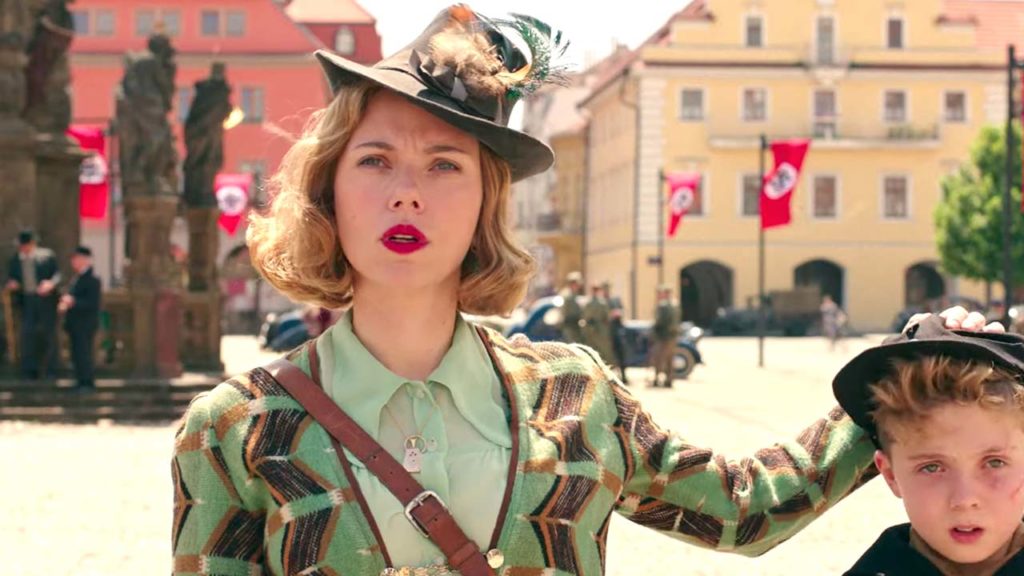
Perhaps unfairly, a couple external factors negatively affected my experience of Jojo Rabbit:
The Brooklyn Alamo Drafthouse programmed the trailer for Terrence Malick’s forthcoming A Hidden Life before Jojo Rabbit, throwing a spotlight on the “good German” trope they both share. Of course, both quiet and loud German resistance to Nazi atrocities existed, and I’m not trying to argue that there shouldn’t be any more stories about it — after all, the ne plus ultra is required viewing for all: Schindler’s List.
Jojo Rabbit‘s darkly satirical take is undoubtedly a fresh twist, but still: the trope threatens to mute the experiences of the victims. Taika Waititi is working here in the long and noble tradition of mocking the devil, and for that I applaud him. But the contemporaneous AMC TV show Preacher also had the nerve to directly depict and poke fun at Hitler, so it’s not exactly unique.
The casting of Sam Rockwell as a conflicted Nazi, which inadvertently (or not?) echoes his role as a tortured racist in Three Billboards Outside Ebbing Missouri. Again, it’s not like “bad” people don’t do “good” things, but in our present era, with white supremacy re-empowered around the world, I’m disinclined to entertain the notion of an even partially-redeemed Nazi. As a climactic moment in a fiction, this particular character’s act of mercy feels designed to make audiences feel better, rather than ponder the larger problem.
As a thought experiment: I’d rather watch a movie about the successful intervention in the life of a budding child fascist than the opposite. But I spent the entire movie distracted by these minefields rather than taking the movie on its own terms.
So as not to only complain: Jojo Rabbit an extremely funny and well-made film, with great acting all around — including one of Scarlett Johansson‘s strongest-ever performances — so good that I wonder where she’s been all these years.
Cloying, saccharine, and worst of all, painfully obvious.
Mike Mitchell’s The Lego Movie 2: The Second Part emblematizes my biggest gripe with most contemporary animated features: that perhaps the purest form of cinema is so often overwritten to the point of death. With animation, everything must be literally created from nothing, and anything is possible. There are virtually no limits to the visuals or sound. But The Lego Movie 2 is yet another animated feature heavily weighed towards the written word — a betrayal of the form.
No doubt a direct result of the extreme budget and time investments required to produce one of these monstrosities, there are business reasons for these projects to exist on paper for too long. Perhaps the financiers could not be wooed by dazzling pre-visualizations and concept art, and instead were convinced by a celebrity-heavy table read of a thick, verbose script, dumbed down a few levels below the basement of its all-ages audience. And so here we have yet another animated disappointment, drowning in oceans of dialog that repeatedly spell out didactic themes, with its biggest claim to visual spectacle probably being something like advancements in a computer algorithm to calculate the glint of magic-hour sunlight upon tiny pieces of Danish plastic.
This third entry in what has somehow become a franchise exposes how derivative of Pixar the premise is: from Toy Story comes the device of children imbuing their toys with life through play, and from Inside Out the conceit that these embodiments represent dueling facets of personalities that adapt with age. But this is to give too much credit to the sub-sitcom characterization of the parents: Will Ferrell literally phones in a voice cameo as a “honey have you seen my socks” type of husband, and Maya Rudolph is a zero-fun helicopter mom whose nuclear option punishment strategy is to take toys away.
It’s right there in the title that The Lego Movie is based on a toy line, but it’s just plain insulting that the happy ending is two kids maturing and working out their psychological issues through thousands of dollars worth of Lego product, under the gleaming smile of the parent that paid for it all. Even the subtitle is so irritatingly dumb that it barely qualifies as a pun.
Chris Pratt and Elizabeth Banks can’t dig themselves out of the reams of dialog, but the brightest aspect of the film is the rest of the cast: Tiffany Haddish challenges the animators to keep up with her sheer force of personality, Will Arnett’s material amusingly pierces the aura of self-seriousness around Batman, and I wouldn’t want anybody else to play the pivotal role of the cat than Alison Brie.
What an improbable treat, in an age of unasked-for sequels, that one of pop culture’s most notorious cliffhangers would receive resolution.
The HBO series Deadwood is not only one of their most acclaimed productions, but also the most lamentably unfinished. Its abrupt cancellation in 2006 was followed by persistent but vague promises of one or more movies. But as year after year passed, and practically the entire cast went on to higher asking prices, the practical matters of financing and scheduling a remount passed through the realm of the unlikely into the impossible. And yet, here it is, and we are all obligated to make some variation of a “crack open a can of peaches, hoopleheads” joke as we sit down to watch Deadwood: The Movie.
Time has found some characters grown stronger, such as a thriving Sofia (Lily Keene) and Charlie Utter (Dayton Callie) become a successful businessman and landowner. But many are stagnating: Jane (Robin Weigert) may be a minor celebrity but still an alcoholic wreck, and Joanie (Kim Dickens) remains trapped in the Bella Union. Others are greatly diminished: Harry (Brent Sexton) is corrupted, and Al’s (Ian McShane) health is rapidly declining. As Al loses his faculties and Charlie’s lifelong righteous sense of justice blossoms to a quiet but heroic act of resistance, it’s easy to see that this is clearly deeply personal for writer/creator David Milch — the movie is all the more poignant now that he is ailing, and this may be his final work.
There are a few instances of outright fan service (flashbacks remind us of a key moments, Garret Dillahunt has a fleeting cameo as his third character, and it’s very satisfying to see Dan & Jewel bicker over canned peaches one last time), but the movie thankfully does not wallow in nostalgia. The Pinkertons are not mentioned once, and unless I’m mistaken, nobody calls anybody a hooplehead. Milch’s characteristically convoluted diction truly deserves the modifier “Shakespearean”, and is something to savor.
The original TV series was always a little — shall we say — loosely plotted, which worked mostly to its benefit. Whereas later HBO efforts like Game of Thrones were predominantly plot-driven (who lives, who dies, one battle more spectacular than the next), Deadwood was always about character and dialog, and the greater theme of modern America being born out of lawlessness and chaos.
But it would be fair to criticize Milch for frequently abandoning promising storylines if he got bored or distracted. The third season in particular has numerous threads that go nowhere: the character of Joanie suffers from a lack of material, and everything involving the traveling theater troupe is superfluous, despite how delightful Brian Cox’s performance is.
The concise two-hour movie format has the benefit of focusing Milch’s attention, but there is still room for a little narrative meandering. One such seemingly extraneous subplot that at first seems to be going nowhere in Milch-ean fashion is that of a young woman coming to town with the aim of working in a brothel, turning a few heads but failing to land a job. We’ve seen her story before, from the very first episode: Deadwood was a hard place, populated by hard people. You could group its denizens into roughly two categories: those desperate to escape something (Al: wanted for murder; the Garrets: escaping bankruptcy and sexual abuse; Seth: arguably running from his own violent nature), and those there unwillingly (mostly women, as Trixie and Joanie were both sold into indentured servitude).
The girl attracts the notice of the latter, who always struck me as one of the show’s most tragic characters: Trixie (Paula Malcomson) grew into adulthood with a deep sense of self-loathing, unable to accept that she might deserve love or kindness. Even when Al, her abusive pimp, tried to push her into a legitimate free life in society (such as it was in Deadwood at the time), she rejected it. The original series ended with Trixie still caught in this conundrum, and as we see her 10 years later, she still feels unworthy, compelled to sneak around through backdoors, and resisting Sol’s (John Hawkes) unconditional love. Thankfully, the movie finally grants her a breakthrough: she accepts Sol and receives a gift from Al, and finds herself with a trade and a place in society.
When Trixie recognizes the psychology of the broken girl who came to Deadwood as a last resort, she is equipped to show her a bit of kindness, and laments that she should believe that this is all she deserves. It’s not only a breakthrough for Trixie, but a crack in the lawless, dead-end history of Deadwood: now no longer only a place for the criminal or the desperate, but now with opportunities for people to better themselves.
One other touching moment of resolution I want to highlight, conveyed perfectly without exposition. The other great dangling thread of the series was that Alma (Molly Parker) and Seth (Timothy Olyphant) never closed the door on their love affair. As they smolder one last time, face to face at Trixie and Sol’s wedding, they are interrupted by one of Seth’s children. He scoops her up, beaming with pride and love, and rejoins the party. Like Trixie, they are both also finally freed.