Yet another remake of Invasion of the Body Snatchers might seem an odd project for iconoclast director Abel Ferrara, known for gritty urban crime sagas centered around profoundly compromised protagonists. In stark contrast, the lead in Ferrara’s most conventional movie is a good-natured teenage girl, a world apart from the crazed Harvey Keitel of Bad Lieutenant or Christopher Walken of King of New York. Marti’s (Gabrielle Anwar) biggest problems are a nomadic lifestyle, a moody little brother, and a new stepmother.
This version of the bodysnatchers story sheds “Invasion” from the title, which is strange considering it ought to be the key word for a movie focused on the U.S. military, at home not long after the first Gulf War — a conflict thought to be resolved at the time. With America at peace and a Democrat in office, Body Snatchers was probably one of the first mainstream feature films to directly mention the conflict, along with Courage Under Fire (1996) — David O. Russell’s ruthless satire Three Kings being still some ways off.
Abbreviating the title was a missed opportunity to play with the ambiguity between a military confirmed as professional, government-sanctioned invaders, and an extraterrestrial force that easily infiltrates them. But don’t worry, the word “Invasion” would be picked up again for Oliver Hirschbiegel’s 2007 abomination starring Nicole Kidman.
Gabrielle, sweetie, you should know better than to take a bath during a horror movie…
On home soil, an Alabama army base under the command of General Platt (who else but R. Lee Ermey?) must suffer the indignity of bending over for The Environmental Protection Agency as it investigates the army’s storage of chemical weapons. The sympathetic Major Collins (Forest Whitaker) reports increasing cases of mental illness in his infirmary (paranoia, fear of sleep, etc.). He suspects the toxic chemicals, making it impossible to miss the allusion to the controversial Gulf War Syndrome.
Marti falls in love with helicopter pilot Tim (Billy Wirth), so bland and flat that it’s hard to tell if he’s a pod person (to be charitable, maybe this was a deliberate casting call, meant to keep the audience guessing). She is befriended by Platt’s punk daughter Jenn (Christine Elise), a refreshing dose of nonconformism among the rank and file – indeed her rebelliousness serves as a canary in the coal mine to measure the progress of the invasion. We genuinely feel for Marti’s little brother Andy (Reilly Murphy, a rare child actor that does not annoy) as he senses his school playmates are “bad” and witnesses his stepmother (Meg Tilly) die firsthand. Incidentally, Tilly’s performance as the pod-stepmother is excellently weird.
“Where you gonna go, where you gonna run, where you gonna hide? Nowhere… ’cause there’s no one like you left.”
Like Philip Kaufman’s 1978 version of the same material, Ferrara indulges in the gore and female nudity de rigueur to the horror genre. Marti disrobes for a very close encounter with groping alien tendrils in a bathtub, and later runs through an infirmary full of gross, half-formed pod people. The very pretty Anwar is so convincingly young-looking that her unexpected nude scenes make one feel decidedly uncomfortable.
In all three versions of the story so far, a pod person delivers some variation of the following warning to human resistors: there’s nowhere to run, nowhere to hide, and there’s no one else left like you. So why do the pod people always work so hard to chase down the few remaining humans? On the evidence of Body Snatchers, they’re still very easily defeated, and the climactic ending is something of a dud.
The infected army base plots to distributes pods to other bases, and eventually amass an armed force capable to taking over the world. But Marti and Tim manage to blow up the base and as entire convoy with just one helicopter. Why was it fully armed during peacetime, anyway?
The first film ended with humans just beginning to mobilize against the invaders. The second ended with humanity totally overswept. Now the third ends with us winning. How will Nicole Kidman fare in Invasion? Tune in after our next review, an interlude to look at Robert Rodriguez’ enjoyable homage The Faculty, to find out…
Welcome to The Pod People Film Festival, our third mini movie retrospective. After catching up with Ridley Scott and George A. Romero, we now take a look at four adaptations of Jack Finney’s novel The Body Snatchers, plus one unofficial homage / satire.
Philip Kaufman’s re-imagining of Don Siegel’s 1956 classic paranoid nightmare Invasion of the Body Snatchers immediately signals its uniqueness with a strange and beautifully abstract opening sequence. Psychedelic spores float off the surface of an alien planet, traverse through outer space, and fall to Earth as gelatinous rain. A glimpse of a newspaper headline describes a simultaneous epidemic of “spider webbing,” an ominous portent of what turns out to be the desiccated remains of the invaders’ victims.
Matthew Bennell (Donald Sutherland) is a pitiless health inspector pining after his excitable colleague Elizabeth Driscoll (Brooke Adams). When her slob dentist boyfriend suddenly starts wearing suits and loses interest in televised sports, she becomes convinced a little too quickly that he’s an impostor, and leaps from there to even grander notions of an alien conspiracy. But, being a lab worker at the Department of Health, and the type that keeps a greenhouse in her bedroom, perhaps she is after all eminently qualified to identify malevolent walking and talking plants bent on world domination.
Leonard Nimoy would like to encourage you to stop sleeping around. There will be no more tears.
The original film imagined a subversive alien invasion of suburbia. In conservative small-town America, or at least the fantasy thereof seen in movies, everybody knows everybody else’s business. This remake takes place in the liberal urban setting of San Francisco, where relationship networks are fractured into neighborhoods, socioeconomic classes, and cliques.
As our current fears of avian and swine flus attest, infections spread faster where humans congregate in tight spaces: schools, slums, public transportation, etc. The aliens in the original plotted a slow takeover of American’s already homogenous heartland, while their cousins here target our population centers for maximum shock and awe. Still, some secrecy is required at first, and the creatures prove themselves adept at subterfuge.
The greatest deceiver is self-help pop shrink Dr. David Kibner (Leonard Nimoy). It’s a crying shame we haven’t gotten to see Nimoy play more roles like this in his career – by which I mean anything other than Spock. Far from a San Fran free-love liberal, Dr. Kibner is actually a conservative reactionary, decrying the ease with which modern couples mate and part. He believes modern society as a whole is suffering from a fear of responsibility and commitment.
We never find out for sure when he his body was snatched, or even if it was. Out of everyone we meet, he was arguably already a pod person all along. The most interesting facet of the film for me is the irrelevance of whether Kibner was a type of alien advance guard writing books espousing pod philosophy. He represents a human viewpoint already sympathetic to the invading veggies: one that longs for a return to conservative values and like behavior. But why is Kibner wearing an archery guard on one hand? That’s just a weird affectation.
OMG! Look out for the trolley!
Easter eggs include cameos by Don Siegel as a sinister taxi driver and the original’s star Kevin McCarthy reprising his crazed rant “They’re here already! You’re next!” A young Jeff Goldblum brings all his quirk to bear as neurotic poet Jack Bellicec. His wife Nancy is played by Veronica Cartwright, reprising essentially the same shrieky, panicky performance she delivered in Ridley Scott’s Alien.
The original film was a a thinly veiled metaphor for the McCarthyism of the period. In the late 1970s, the same story works just as well at the tail end of a dying sexual and cultural revolution that began in the 1960s. After the disillusionment of The Vietnam War and Watergate, people may have sensed the coming conservatism and conformity (in other words, Tom Wolfe’s masters of the universe and bonfires of the vanities) of the 1980s.
This Invasion of the Body Snatchers is largely a psychological horror film, but features at least one true gross-out sequence in which the alien growth process is explicitly depicted. Matthew aborts his own budding duplicate with a garden hoe (a wholly appropriate weapon for sentient vegetables). The original film avoided detailing the process, possibly to elude questions that couldn’t be addressed without violating standards of decency (What happens to the original bodies? Why aren’t newborn pod people naked? Now we know – hey, look! Brooke Adams’ breasts!). Gore aside, the one truly unsettling image is a glimpse of a body snatching gone awry: a dog with a human face, an accidental hybrid being created when Matthew interrupts the process of an alien taking over a hobo with a pet doggie.
But what Kaufman’s version is chiefly known for is its bleak, bleak ending, in total contrast with the hint of hope that closes the original. The baton wouldn’t be picked up again for another 15 years, when Abel Ferrara transposed the action to the obedient, conformist, oppressive world of the military in the tersely titled Body Snatchers.
Welcome to The Pod People Film Festival, our third mini movie retrospective. After catching up with Ridley Scott and George A. Romero, we now take a look at four adaptations of Jack Finney’s novel The Body Snatchers, plus one unofficial homage / satire.
For a pulpy 1950s horror flick relating the strange tale of an invasion of giant brussels sprouts, Don Siegel’s Invasion of the Body Snatchers is a startlingly gory, paranoid nightmare positively loaded with political subtext.
Its themes of identity, mistrust, and subversion have remained relevant and influential for decades, inspiring three official remakes and even left-field homages like Robert Rodriguez’ high school melodrama The Faculty. Not only has “pod people” entered the lexicon, its screenplay is highly quotable (“They’re here already! You’re next!”) and sometimes even rather poetic: “There’ll be no more tears.”
The movie can be a bit frustrating to modern science fiction aficionados used to high levels of pseudo-scientific detail. The aliens’ life cycle seems illogical and not fully thought-through, to the extent that it harms the plot. It seems a victim simply must be in proximity to an alien pod for it to begin to grow into your shape. We also learn that a pod absorbs its host’s memories when it sleeps, but we see Becky Driscoll (Dana Wynter) duplicated after falling asleep alone in a cave devoid of any visible pods. What happens to the original bodies? How do the pod-born duplicates wind up wearing the host’s clothes?
Philip Kaufman’s 1978 remake is more clear on the process, with the added benefit of allowing for more explicit gore and female nudity to tart things up a bit. The 2007 remake Invasion solves these problems by sidestepping the issue entirely, featuring a breed of aliens that literally invade your body – a mild condition which is, it turns out, curable. Ask your doctor, or better yet, date one!
Eat your brussels sprouts! Or you’re next!
As Matthew Dessem points out in his analysis of The Blob for the Criterion Contraption, certain 1950s horror and sci-fi movies beg to be interpreted as metaphors for key atomic age issues: Godzilla, The Day the Earth Stood Still, and The Blob among them. But these monsters look just like us. So let’s give it a shot:
Interpretation one: the movie manifests a generalized fear of a homogenized American culture. A pod person is discovered in an intermediary state, totally devoid of individual characteristics, like a mannequin. Perhaps America’s fabled melting pot, brought to an absurd conclusion, could result in a dead-end monoculture of of uniform religion, politics, and behavior.
Interpretation two: the story is a thinly veiled metaphor for McCarthyism, the contemporary Red Scare that envisaged insidious Communist sleeper cells already among us, threatening to undo American churches, families, private wealth, and government.
In either interpretation, the invaders are convinced their systems of belief are correct, and honestly believe they are helping us by absorbing us into their ranks.
Pod person in the corner pocket.
The premise may be deliciously cynical, but the movie does end on a possible note of hope. Our hero Dr. Miles Bennell (Kevin McCarthy) manages to reach some uninfected human authority figures, and corroborating evidence helps him convince them to mobilize against the threat. But does this call to action come too late?
From the perspective of 2009, America looks increasingly polarized and partisan. If the pod people are already here, which side are they on? As Sarah Palin might say, the Real America? I’m sure they only want to help.
Welcome to The Pod People Film Festival, our third mini movie retrospective. After catching up with Ridley Scott and George A. Romero, we now take a look at four adaptations of Jack Finney’s novel The Body Snatchers, plus one unofficial homage / satire.
After writing and directing three Star Wars prequels between 1999-2005, it’s easy to forget that back in the 1980s, the series’ godfather George Lucas opted out of directing The Empire Strikes Back and Return of the Jedi. Now Lucas appears once again to be ceding control over his most famous baby. He’s back to shepherding along splinter projects like The Clone Wars in the more aloof role of Executive Producer.
For anyone else confused, as I certainly was, Star Wars: The Clone Wars is a feature-film sequel to the 2003-2005 Cartoon Network television series Star Wars: Clone Wars, which was in turn followed by a second series with the same name as the movie. Got that?
There are much bigger differences than swapping a colon for a definitive article, starting with the visual look itself. The best thing about the original series was its bold, striking visual style, realized in a hand-drawn line-art look similar to Genndy Tartakovsky’s previous show Samurai Jack. From what little I understand of the process, CGI animation created in 3D can still be rendered in a flat 2D style, giving it the look of traditional hand-drawn cell animation. So the characters in the original at least appeared hand-drawn even though they almost certainly weren’t.
Anakin trains a young propellerhead, Ahsoka Tano.
However, the feature film sequel looks like director Dave Filoni opted to skip that step and render the characters with full 3D shading. The result resembles a rough animatic or a throwaway videogame cut scene. Filoni gets kudos for not aiming for photorealism, which becomes very creepy when approaching the uncanny valley — the point where animated characters look almost, but not quite, like real humans. Look with fear upon the nightmarish zombie horrorshows Final Fantasy: The Spirits Within, The Polar Express, and Beowulf (the latter being a huge step forward, but still not quite there yet). But The Clone Wars‘ particular brand of stylization just seems cheap to me; I would have preferred the cool-looking 2D characters as they appeared in the TV series.
The Clone Wars is canon within the Star Wars universe, but no one (probably not even Lucas himself) would ever consider it as primary as its six older siblings. One advantage to being relegated to the second tier is a freedom to violate venerable Star Wars traditions. The classic opening crawl is gone, replaced with a Citizen Kane-style newsreel catching the audience up with the key facts needed to make sense of what’s going on in between all the ‘splosions.
That particular change is a shame, but brace yourself for some heresy when I admit I find another change rather welcome: Kevin Kiner’s very non-John Williams-esque score. As much as Williams’ music was the soundtrack of my childhood (my entire generation can sing the Star Wars, Jaws, and Indiana Jones themes a cappella, on cue), I had long since tired of him. The point at which I lost it was the wall-to-wall blanket of redundant music that threatened to drown out the already almost overwhelming Saving Private Ryan.
The Clone Wars series and movie are both set chronologically between the events of Attack of the Clones and Revenge of the Sith, a razor-thin slice of time in which nothing of import really happened in Star Wars continuity. The movies already showed us how the war began and ended, so The Clone Wars movie and series are basically war stories. This is actually a good thing in light of how the prequel trilogy often became bogged down in tedious political procedure involving interplanetary trade routes. The series was by its nature a string of vignettes, but the feature film still feels like an episodic tour through a number of spectacular battles.
A particularly gripping and exciting battle takes place on a vertical cliff face, “shot” with a hand-held “camera.” Lucas was sure to conceive of his two armies as droids and masked clones, allowing for carnage and huge body counts without a drop of blood (not to mention the economical reuse of costumes, and now, digital models). I remain puzzled, however, how clones and droids can have names, ranks, and varying skill sets. This writer grew up with the original trilogy, and still has trouble accepting stormtroopers being on the side of the good guys.
Yoda’s looking more “kitten” than “turtle” today
The TV series focused mostly on the battles, but the movie squeezes a fragment of a plot in between the action set pieces. Anakin Skywalker is inconveniently charged with training Ahsoka Tano (Ashley Eckstein), an annoying teen “padawan learner” (a Lucasism for “apprentice” that still sounds very much like a George W. Bush malapropism). I still find it difficult to accept that the Anakin we see here and in Episode III is so close to the tipping point to absolute corruption that he will soon betray the Rebels and become the embodiment of evil, Darth Vader. At this point, he still seems a merely moody and impetuous kid horny for the girlfriend he left behind on Naboo. Being responsible for the spunky, goodhearted Ahsoka certainly does little to help him attain the state of emotional detachment Lucas equates with goodness.
Even though there’s no doubt a great deal of very expensive technology behind this kind of animation, it’s still cheaper than mounting a live-action production. Animation, where anything is possible, is also the best way for the Star Wars franchise to expand the stories of its existing characters, when the original actors have aged, become too expensive, disinterested, or passed away. So why focus only on the prequel characters? Why not tell more tales starring the trinity that everybody really loves: Luke, Leia, and Han?
Perhaps Lucas fears that messing with the canonical heroes that generations of fans have taken to heart is to risk fatally wounding their deep emotional connection to the mythos. Or to be cynical, he is legally able to utilize the various masked characters (Chewbacca, Boba Fett, Jabba the Hut, Darth Vader, C-3PO, R2-D2) in anything at any time without clearing actors’ likenesses. That said, some of the original cast do lend their voices to The Clone Wars, including Samuel L. Jackson, Anthony Daniels, and Christopher Lee. James Arnold Taylor does an excellent impression of Ewan McGregor’s excellent (in turn) impression of Alec Guinness.
One last thing: it wouldn’t be Star Wars without at least one offensively characterized alien. Jabba’s uncle Ziro the Hutt (Corey Burton) is inexplicably voiced as an old Southern queen.
If the least one expects of the 2008 remake of The Day the Earth Stood Still is that it merely fulfill the promise of its title, then please move right along, for the earth stands still for only a few brief moments.
It is, however, a far bigger production than the 1951 original directed by Robert Wise, even accounting for the inflation of filmmaking technology and audience expectation for spectacle. As if to overcompensate for the original’s now admittedly amusing implausibilities and the silly giant robot and flying saucer, it tries too hard to impress with too many unconnected ideas and excessive hustle and bustle. It’s even rather inappropriately macho, with more unconvincing digital helicopters and military hardware than a typical Michael Bay movie. At least it’s much, much better than the disastrous Invasion (the third official remake of The Invasion of the Bodysnatchers).
It does get off to a good start with a prologue in which a lone mountain climber (Keanu Reeves) discovers a glowing orb in 1928 India. The sequence is mysterious and interesting, but ultimately unimportant to the plot. We later learn that the orb was an alien probe that copied the climber’s DNA, from which to grow a surrogate body for the alien Klaatu (Reeves again) decades later. Even the most basic plausibility is violated as humans dissect his alien body without biosuits or any kind of quarantine at all. One wonders if earlier drafts of the screenplay involved Klaatu’s captors initially misidentifying him as a missing person from 1928. A missed opportunity would be a scene in which the aged original adventurer comes face-to-face with an alien mimicking his youthful self. But as it stands, this whole subplot acts as a distraction.
The original movie simply presented the alien as humanoid (if a little unusually tall and angular) and that was enough. The notion of a alien being reborn in a new body is interesting but an unnecessary complication, one that only raises questions unrelated to the central themes. Klaatu is lucky his template was the handsome Reeves, who can wear anything — at one point, Klaatu steals a schlumpy guy’s suit and it fits as if it were tailored just for him.
Supposedly this body is human, but he exerts superpowers including the transmutation of electricity into some kind of sketchily-described life force. In this respect, the original is better; Klaatu outwardly looks like us, period, end of story. Isn’t that enough? Another extraneous idea, superfluous to the core story: Klaatu’s giant omnipotent robot companion Gort is now comprised of a swarm of nanobots. Why have both a giant robot and itsy-bitsy nanobots? Pick one idea and stick with it.
Keanu Reeves in The Day the Earth Stood Still
But we’re getting ahead of ourselves; first we must fulfill another genre cliche. The Day the Earth Stood Still lines up after the likes of The Happening, The Day After Tomorrow, A.I.: Artificial Intelligence, Deep Impact, Watchmen, and Cloverfield (the list goes on, and on…) to take another stab at decimating poor New York City. When humanity detects an unidentified object set to strike Manhattan, Dr. Michael Grainer (Mad Men‘s Jon Hamm) assembles a crack team of diverse experts including astrobiologist Helen Benson (Jennifer Connelly) to fly around in black helicopters and gawp helplessly at all the special effects. Luckily, for the moment at least, the object turns about to be a spacecraft.
In 1951, alien emissary Klaatu (Michael Rennie) went to Washington like Mr. Smith. In 2008, this Klaatu figures the place to make a grand entrance is Manhattan’s Central Park (never mind that the United Nations headquarters is on the East Side). Fans of computer-generated destruction of the sort in which Roland Emmerich traffics will be pleased to see Central Park forcibly landscaped before the movie is over. During the final climax in the Park, I’m pretty sure the principals hide under the exact same footbridge as the survivors at the end of Cloverfield.
Like the original, it’s credited as being based on the 1940 short story “Farewell to the Master” by Harry Bates. Its cinematic touchstones include The Brother From Another Planet and The Man Who Fell to Earth. But it shares a critically flawed plot element with the more recent Watchmen. In the latter, mortal heroine Silk Spectre must convince Dr. Manhattan, an ambivalent nonhuman that couldn’t care less, to save the world. Klaatu arrives on Earth to receive the report of an earlier agent, who confirms humans are self destructive by nature. That’s enough for Klaatu to begin to purge the planet, but the agent goes on and tries to impress upon him human’s complexity. Klaatu is unswayed.
Helen and her son Jacob (Jaden Smith, son of Will and Jada Pinkett-Smith) try to do the same and succeed just as Silk Spectre did, but in both cases the audience can’t quite understand how their arguments go through to superior beings one step away from godhood. Because she’s pretty, and her kid whines so much that Klaatu caved in just to shut him the hell up? Personally, if I was an alien judging humanity, and I met such an insanely annoying kid, I would purge the planet too. The movie would merit at least one more star if the kid hadn’t been in it.
Jennifer Connelly in The Day the Earth Stood Still
Jennifer Connelly is sadly wasted, again. As in Ang Lee’s otherwise underrated Hulk, she’s relegated to second-billing below the computer effects. The great Kathy Bates fares even worse in a role anyone could have played. As for the legendary John Cleese’s cameo as a mad scientist, I assume the idea was to cast a slightly kooky personality with a British accent to project intelligence to dumb American audiences. But the formerly manic Cleese has mellowed out so much in his later years that they could have just cast any old Brit.
The original Day the Earth Stood Still was quite obviously a Cold War parable, if a little muddled in its particulars. This version skirts the politics of war, choosing instead to recast the basic premise as an eco-parable. Much like M. Night Shyamalan’s The Happening, New York’s Central Park is ground zero for an ecological catastrophe. Part of Klaatu’s mission is to save samples of the Earth’s biosphere, which the Secretary of Defense (Bates) explicitly equates to the Biblical tale of Noah’s Ark.
Wikipedia notes the film was a largely green production, in which the crew recycled or donated props and costumes, and utilized an intranet to reduce paper waste. But within the story itself, for an alien concerned about cleaning up the Earth, Klaatu is quite content to ride back and forth from Manhattan to New Jersey in a gas-guzzling SUV (the manufacturer of which no doubt provided product placement).
Finally, some questions: exactly how much of the world is decimated in the end? How does Klaatu expect humanity to clean up the planet when he’s already destroyed most of the infrastructure? Imagine all the homelessness, starvation, chaos, rioting, and looting that must be dealt with before any government could even begin to think about ozone holes or carbon collection. Also, Klaatu’s species has the technology to disintegrate all manmade materials on an entire planet, but he totally dismisses out of hand the idea of cleaning up our pollution for us, or at least lending us the technology? The original Klaatu had more faith in humanity.
Robert Wise’s The Day the Earth Stood Still is one of the few essential science fiction movies that has lasted, overcoming dated special effects, acting styles, and the end of the Cold War — the provider of subtext for many a horror story. In the company of Forbidden Planet (Shakespeare’s The Tempest in space), The Blob (an invasive species consumes the population), and Invasion of the Body Snatchers (smalltown America succumbs to the ultimate conformity), it continues to resonate decades later, even being reimagined in 2008 as an ecoparable.
Immediately striking is the dissonant score by Bernard Herrmann, of Psycho fame. The evocative piece over the opening credits sounds just like an outtake from Brian Eno’s ambient album On Land, thirty years early.
Michael Rennie as Klaatu in The Day the Earth Stood Still. Evidently they have Brylcreem in space.
Wise shows us humanity’s first alien contact through the quaint filter of period radio and television; rest assured, “scientists and military men” are on the case. Klaatu (Michael Rennie), a suave caucasian humanoid male alien, and his pet robot Gort (Lock Martin) park their UFO on a baseball field on the Mall in Washington D.C. His polite request for an audience with the United Nations goes rebuffed, for during the height of the Cold War, not even a flying saucer, an alien in a silver jumpsuit, and a giant robot is enough to convince the nations of the world to sit down and talk. Klaatu’s flying saucer is surrounded by hilariously lax security, and he is briefly taken into custody before handily escaping into the D.C. suburbs.
Klaatu has learned mid-Atlantic accented English from radio and television broadcasts, and outwardly appears perfectly humanoid right down to his slicked-back hair (they evidently have Brylcreem in space), so all he needs to blend in with the masses is to simply steal someone’s dry cleaning. He checks into a spare room, with some shots directly quoting Alfred Hitchcock’s 1944 classic The Lodger. He befriends young Bobby (Billy Gray) without a hint of suspicion, dating the film more than anything else.
Klaatu tries to get his message through to a pacifist scientist, but he’s discovered, shot, and dies. Gort, programmed to activate in such an event, threatens to exact an unspecified violence upon humanity. But Klaatu has already taught his interspecies ladyfriend Helen (Patricia Neal) the robot-mollifying fail-safe codephrase “Klaatu barada nikto.” Gort ceases his hostilities, and instead revives Klaatu using machinery on their ship. Klaatu claims his new lease on life is only for a limited time, for true resurrection is only the domain of “the Almighty Spirit”.
The remarkable fact that he believes in a God goes unremarked upon; both he and the humans to whom he’s speaking simply take it for granted they’re talking about the same deity. This line stands out for a reason; the dialogue was reportedly inserted at the request of the MPAA, who objected to Klaatu’s godlike powers of resurrection. Failing to reach the world’s leaders, he settles for the next-best thing: an assembled group of scientists (all, of course, white males). Message delivered, he leaves Earth in a huff.
Lock Martin as Gort in the Day the Earth Stood Still. Klaatu barada nikto! Don’t tase me, bro!
So, let’s recap: an otherworldly visitor with a message of peace-or-else is executed, rises again, and ascends into the heavens. Do I have to spell it out?
But if Klaatu is analogous to Jesus, let’s take a closer look at his message. He claims Earthlings’ warlike behavior is of no interest to the spacefaring species of the universe, as long as it’s contained to one planet. But the interstellar community is beginning to fear that Earthlings are about to discover interstellar travel, and they will not permit humanity to bring their atomic weapons with them. Klaatu is the representative of other societies that have already passed through this phase, whom, unable to curb their violent impulses on their own, came up with a solution to police themselves: a fleet of lethal robots programmed to eradicate anyone that violates the truce.
So they use weapons to deter the use of other weapons? What kind of message is that to a Cold War audience living under the nightmare of Mutually Ensured Destruction? To the 21st Century viewer, the immediate worry is whether or not we could ever trust an artificial intelligence to impartially keep the peace. Indeed, whole science fiction franchises have been built upon that very theme, including 2001: A Space Odyssey, Blade Runner, The Terminator, The Matrix, and Battlestar Galactica.
But perhaps I’m being too literal. It’s a simple movie, but is it a simple analogy? Is the army of Gorts a symbol for Earth’s nuclear arsenal? No, because that’s exactly what Klaatu wants humans to put away. According to The New York Times, producer Julian Blaustein “told the press [the film] was an argument in favor of a ‘strong United Nations.’” But the U.N. is denigrated as petty and ineffective in the movie; they won’t deign to merely listen to Klaatu’s speech. The overall message is very cynical: even more advanced aliens aren’t able to curb their violent impulses on their own. Klaatu is here to threaten, not save us. If we embark out into space bearing weapons, we’re toast.
The Day the Earth Stood Still is based on 1940 short story “Farewell to the Master” by Harry Bates. Walter Trevis’ 1963 novel The Man Who Fell to Earth (filmed in 1976 by Nicholas Roeg, starring David Bowie) shares some plot elements (the alien Thomas Newton too bears diamonds as seed money), but veers off into another direction altogether. Newton has no interest in steering humanity’s course. He’s here on a secret mission to save his own people, but falls prey to his own all-too-human weaknesses.
Like the 1966 Corvette a reckless young James Tiberius Kirk commandeers in an early sequence, the new Star Trek is precision-crafted for speed, sex appeal, and total awesomeness. Kirk launches that beautiful machine off a cliff, but thankfully director J.J. Abrams never does the same with the movie. Star Trek (the first in the franchise to go by the perfectly terse name of the original TV series) joins the rarified ranks of the few other modern blockbusters that thrill and entertain (not to mention cost and earn massive piles of money) yet have lasting merit. Make room on the DVD shelf for a new entry in the canon, alongside Jaws, E.T.: The Extraterrestrial, The Lord of the Rings trilogy, Star Wars: The Empire Strikes Back, and Spider-Man 2.
Trek has a long tradition of utilizing the science fiction conceits of time travel and alternate dimensions to playfully subvert its characters and mythos. The original series introduced the Mirror Universe, giving the cast the chance to reinterpret their goodly characters in hairier, eviler alter egos. Two of the best movies brought the Enterprise back in time, first to save the whales in the 1980s (in the lighthearted Star Trek IV: The Voyage Home), and later to witness Earthlings’ first contact with an alien race in 2063 (in the underrated Star Trek VIII: First Contact). Two of my personal favorite Next Generation episodes “Yesterday’s Enterprise” and “All Good Things” tasked Captain Picard with course-correcting an Enterprise skipping through time, no matter the sacrifice. The fun in these kinds of stories comes not just from their brain-teasing sci-fi concepts, but in enjoying new twists on the established characters fans love. But any real innovations were always only temporary, the status quo always quickly restored in time (so to speak) for the next episode.
All hands on deck
Thus, the Star Trek franchise has managed to maintain a single (albeit massively complicated) timeline across six TV series, ten movies, and countless novels and comic books. There’s even a niche market in the continuity data itself, as evidenced by popular wikis like Memory Alpha and reference tomes such as Star Trek Chronology: The History of the Future. Such catalogs of the incredibly complex future “history” in which Trek is set are useful not only to obsessive fans, but also to the writers charged with creating new stories that don’t contradict what came before, at least too badly.
A certain degree of renewal was already built right in to Star Trek. When any one premise ran out of ideas, an ensemble aged beyond plausibility, or ratings dipped, the producers could always start over with a new ship, a new space station, or in a new year. The most radical departure yet attempted was the ultimately disappointing final series, Enterprise. The prequel, set years before Kirk would take the helm, got off to a great start with a Starfleet crew a world apart from any we had seen before. As many have pointed out over the years, Star Trek creator Gene Roddenberry may have modeled Starfleet on the Navy, but the original 1960s series was basically a Western set in space. The 1980s The Next Generation reconceived Starfleet as kind of trans-species peacekeeping fleet, a kind of U.N. of The Milky Way. So, set between Earthlings’ rough-and-tumble early spacefaring years and the later idealistic intergalactic cooperation, Enterprise featured a bunch of cocky cowboys brazenly taking their values out with them into space, baseball caps firmly screwed on heads, and phasers defiantly set to kill. The series seemed poised to be a somewhat obvious but fruitful metaphor for an arrogant, George W. Bush-era United States forcibly spreading democracy where it wasn’t welcome. But its quality (both in writing and in special effects budget) bottomed out in just a few episodes, and even the smoking-hot, well-endowed Vulcan T’Pol (Jolene Blalock) couldn’t keep the show on the air.
Uhura models the latest in 23rd Century Bluetooth fashions
The entire Star Trek franchise seemed all but dead after Enterprise‘s cancellation, not unlike the no-win scenario Spock devises as a test to torture Starfleet cadets to see how they cope with failure. A cherished part of Star Trek lore is that Kirk doesn’t believe in no-win scenarios, and thus cheated in order to win Spock’s unwinnable test. Paramount evidently learned a lesson from Kirk’s lateral thinking, for the first they they have given the OK to an irreverent new creative team to permanently reboot Trek from top to bottom. Nearly all of Trek’s meticulously maintained continuity (excepting, ironically, the failed Enterprise, set chronologically before any of the events of this movie) has now forever been redefined as belonging to an alternate timeline. At least, that is, until the next reboot. As the heavily-advertised appearance of Leonard Nimoy as the original “Spock Prime” attests, nothing necessarily precludes the reappearance of any beloved original actors or other kinds of crossovers between timelines (anything in possible in science fiction). But Star Trek does mark a very clear end to Star Trek as we knew it.
After 40 years of unreliable quality control and diminishing box office, such drastic measures were arguably essential to preserve Trek as a viable franchise. But I do sympathize with the grumbling of longtime fans upset at scrapping everything and starting over. And this is not even to mention the many writers, directors, and actors that created the no-longer canonical stories. All of which hasn’t disappeared from our reality, and will be enjoyed forever on DVD, but this film does render pretty much everything that came before it as second-class Trek. I can’t help but wonder how all future spinoffs are now going to be handled on a practical level. For instance, if there are to be future comics or novels featuring the characters from The Next Generation, are the physical products going to have to be labelled as taking place in the now-depricated original fictional universe? How does “Trek Classic” and “Neu Trek” sound?
Spock has had enough Kirk and can’t take it anymore
But back to the topic at hand: the totally awesome new movie is packed with glossy art direction, genuinely exciting special effects, fight scenes, chase sequences, and attractive young actors young and attractive enough to strut about on the big screen in their space scanties. Despite all this gloss, it somehow manages to not be totally stupid, which is more than blogger can say about your typical summer movie (*cough* Transformers *cough*). However, I can’t help but point out a few, forgive me, illogical plot elements, especially in the mad rush towards the end:
Why does Kirk bother firing upon Nero’s ship as it’s being torn apart by a black hole? Our No-Prize answer: maybe Kirk feared Nero would time travel yet again to create mischief in yet another timeline (hey, there’s always the inevitable next reboot in a few years).
Starfleet is busy elsewhere in the galaxy, so we see the cadets mobilized into a strike force to confront Nero. So why is the Academy still full of students when Nero’s ship reaches Earth? Our No-Prize answer: maybe they were Freshmen not qualified to do more than merely swab the decks.
It’s wildly implausible for young Spock to maroon Kirk on the same planet that Nero did Spock Prime. Our No-Prize answer: nope, I got nothing. I mean, really, come on! (but still, the movie is awesome, just go with it)
The hardest plot point to swallow is why Spock Prime does not accompany Kirk back to the Enterprise. Would he really risk the fate of Earth because he thinks it’s more important that Kirk and his young self forge their destined friendship? Our No-Prize answer: yes.
But enough complaining. Did I mention the movie is TEH AWESOME? There’s not one bad performance to drag things down (a notable problem with Watchmen). Despite being tasked with recreating characters beloved by fans for over 40 years, no one attempts an outright imitation or caricature. The most faithful is Zachary Quinto as Spock. Beyond his eerie physical resemblance to Nimoy (maybe not how he actually looked in 1966, but how he might have), he has a fresh take that plays up the character’s internal struggle between emotion and logic. Chris Pine artfully embodies Kirk’s blend of righteous nobility and brash rule-busting attitude without aping William Shatner’s famously hammy style (for which we all, admit it, love him). Karl Urban nails Bones as a seasick pessimist, and Zoe Saldana and John Cho bring welcome sass and physical action hero prowess to Uhura and Sulu, two characters often left on the sidelines. Only Anton Yelchin and Simon Pegg come close to overdoing it. Pegg mugs and shouts, playing Scotty as much more of a mad Scotsman than James Doohan ever did, and Yelchin overexaggerates Chekov’s accent for pure comedy. But that’s not to say both performances aren’t hugely entertaining, just like everything else on display.
Pegg gives Scotty’s accent all she’s got, Captain!
Star Trek goes much much further with Spock’s half-human nature than any of the Trek I’ve seen. Spock was such a key ingredient that almost every version of Trek that followed was obligated to include a similar character: most obviously the android Data (Brent Spiner) in The Next Generation. We are reminded the Vulcan species is not naturally emotionless, as many casual fans assume, but rather a deeply passionate people that holds its warlike nature in check by elevating logic to the level of religion. A purely devout Vulcan would be about as dramatically interesting as a robot (but it must be said that even Spock’s father Sarek (Ben Cross), a high-ranking Vulcan elder, privately admits to being moved by the irrational emotion of love). The aged Spock Prime is practically jovial, seemingly having come to terms with his duality. It’s actually rather heartwarming for a longtime fan to see him at a place of peace with himself.
None of the many Trek sequels, prequels, or spinoffs to date have ever reached the mythic status of the original series and its core dynamic duo Kirk and Spock. Star Trek makes a bold bid to reclaim what made the original such a phenomenon: it goes back to the original scenario and characters, and thoroughly remasters, reinvigorates, reinvents, and gives them a swift kick in the ass. It restores the names Kirk and Spock to the realm of legends and icons.
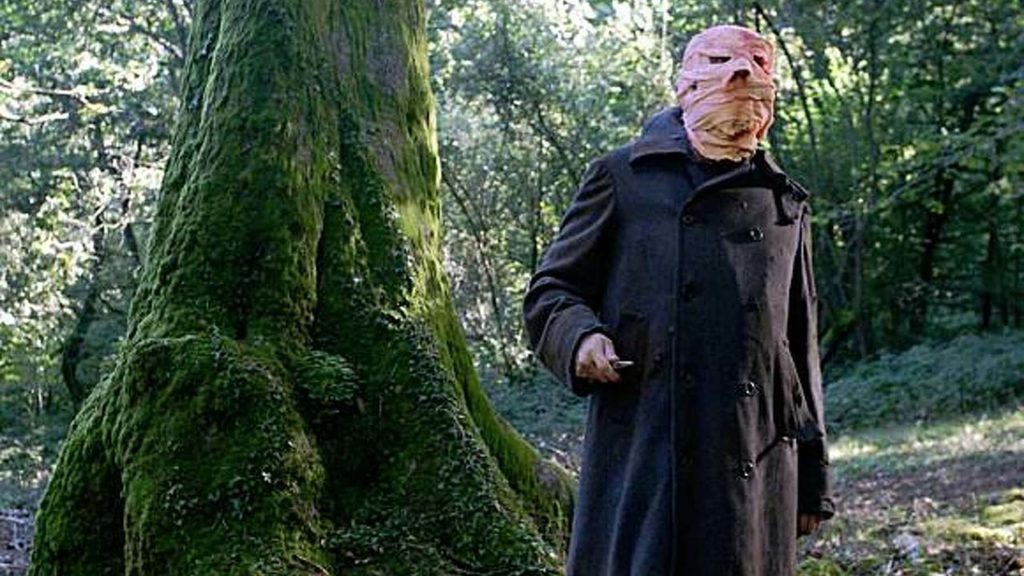
A grotesquely costumed, knife-wielding creep on the Timecrimes (Los Cronocrímenes) theatrical poster promises an exploitative slasher pic along the lines of Texas Chainsaw Massacre. To some degree, considering the degradations made upon a breathtakingly beautiful girl alone in the woods, it is.
But Nacho Vigalondo’s Spanish science fiction puzzler is a friendlier sibling to Shane Carruth’s Primer (2004), a much more brain-spraining chronological conundrum. Both are rare science fictions that rely on a complexity of ideas rather than special effect eye candy. Vigalondo’s different take on the sci-fi tropes of time travel (more on that later) makes Timecrimes a little easier to follow than Primer.
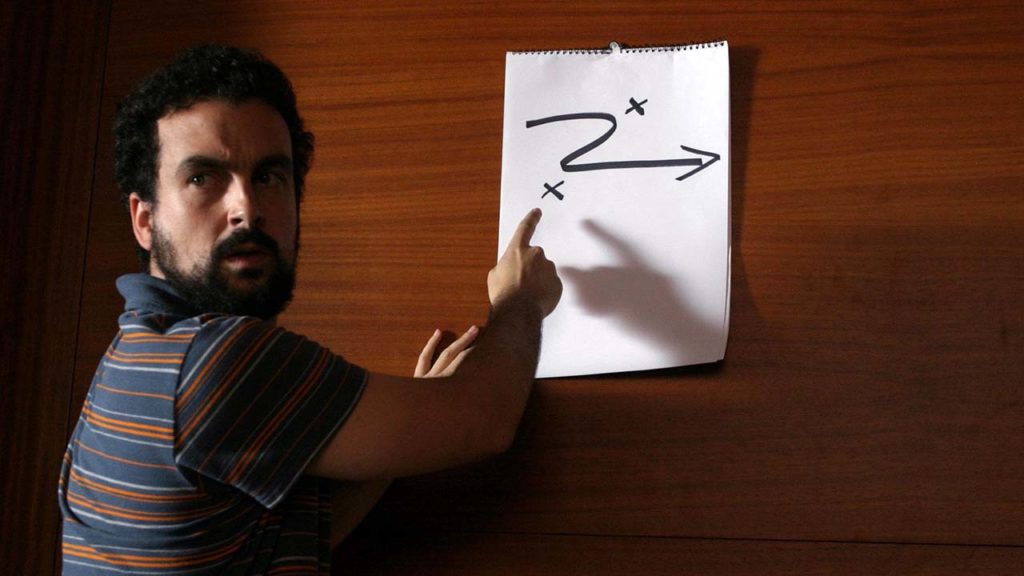
The film opens with Héctor (Karra Elejalde) driving home from grocery shopping with the hatchback of his car ajar, leaving a string of groceries behind him (yes, it’s a metaphor). He and his wife Clara (Candela Fernández) are outfitting a country home as a retreat for the stressed-out insomniac. We never learn what exactly ails him, or what kind of job affords them such a lifestyle. Little do we realize that violence and chaos is already roiling in the bucolic woods around them. Their neighbor turns out to be a research institute developing a rudimentary time machine. The device is not due to be tested for weeks, but unnamed staffer El Joven (Vigalondo himself), is hanging around the facility to tinker with it without permission.
Timecrimes’ pink boogieman
Héctor encounters an unconscious nude woman (Bárbara Goenaga) in the woods, and finds himself pursued by what he assumes to be her assailant. Taking refuge at the institute, El Joven volunteers to hide him in an apparatus that resembles a hot tub prepared for a milk bath. From Héctor’s point of view, the doors open mere moments later, but he finds himself several hours in the past.
Even though Héctor is the first person to ever travel through time, El Joven seems pretty unamazed that the machine works. He’s also assured of the rules: Héctor must be sure to stay out of the way as his future self comes to the time machine, after which there will once again only be one Héctor in the world. Meeting himself and/or altering events (say, preventing his future self from ever passing back to the past), would cause a cataclysmic paradox.
El Joven never specifies what exactly the results would be, but anyone familiar with Doctor Who, Star Trek, and the aforementioned Primer would know that a temporal paradox could rupture the space time continuum, reverse the polarity of the neutron flow, be really socially awkward, or… whatever.
More illustrative is the paradox at the heart of the Terminator films: the evil artificial intelligence SkyNet sends a cyborg back in time to kill Sarah Connor, before she becomes the mother of SkyNet’s mortal enemy John Connor. Future-John also sends his best friend Kyle Reese back in time, ostensibly to protect his mother. As David Foster Wallace pointed out in his vicious critique of Terminator 2: Judgement Day, the paradox is that both time travelers cause the unwanted future to occur: Reese sleeps with Sarah and becomes John’s father, and the wreckage of the cyborg becomes the technological basis for building SkyNet.
Director Nacho Vigalondo apparently wrote his pitch meeting into his script.
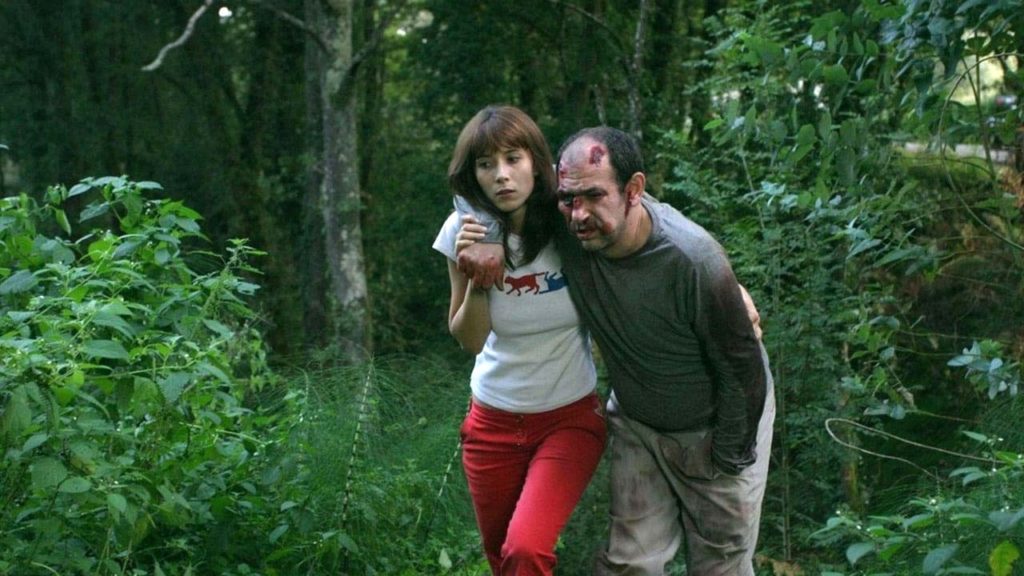
Héctor originally acts impulsively and attempts to contact his past self by phone, and then in person. He makes a series of calamitous errors, and eventually comes to realize that he must shift his strategy to ensure he not disrupt what has already happened to him, but will be everybody else’s future. El Joven only sticks Héctor into the time machine in the first place because a copy of him that already went through told El Joven he had to do it. Héctor kidnaps and abuses La Chica to recreate the perverse scenario the past version of himself encountered. He commits a perverse crime against her, but he rationalizes to himself that it is not for his pleasure (regardless of his sci-fi predicament, his behavior is psychotic).
But the increasingly crazed Héctor tries one last time to change events. He travels back in time again, creating a second temporal loop-de-loop, a third duplicate of himself, and more proliferating walkie-talkies than I was able to keep track of. Héctor only seems to realize near the end of his ordeal that everything is clicking into a predetermined sequence of events, regardless of his direct or indirect interference. Eventually, a calmness comes over him, and he simply sits down and waits for events to finish playing themselves out, knowing there is nothing he can do. So Timecrimes‘ notion of time travel is not actually like that in Star Trek or Terminator, but more like the television show Lost, whose rules stipulate that there is only one unalterable timeline. There is no such thing as a paradox.
La Chica unknowingly helps Héctor out of two different car crashes
Héctor’s time loops are straightened out by the end, with only one version of himself left in the world. But his misadventures in time have left a trail of destruction behind him similar to his spilled groceries in the beginning of the film. La Chica lies dead in his garden, he’s crashed two cars, and the police are coming. La Chica’s necklace is in his pocket, and he’s sure to be found guilty for her death. Perhaps worse of all, a working time machine sits idle at the top of the hill, waiting for more mistakes to be made.
The DVD also includes Vigalondo’s excellent short film “7:35 de la Mañana (7:35 AM)”, in which he exhibits his prowess with the slow reveal of narrative information.
Bryan Singer’s X-Men surprised me twice, first in a theater in 2000 and then again on a recent rewatch, by being better than it had any right to be.
I used to be a comics fan, and read most of Chris Claremont and John Romita Jr.’s lengthy run on The Uncanny X-Men series in the mid-80s. Even though I had long since stopped reading comics regularly by the time the movie was announced in 2000, I recall being convinced there was no way a live-action X-Men movie could not be a ridiculous folly. I went to see it in 2000 partly out of morbid curiosity and partly out of a sense of duty as an ex-x-fan (see what I did there?).
As it turned out, writer David Hayter and director Bryan Singer’s expert adaptation of the Marvel Comics source material was more fun, clever, and exciting than I had pessimistically assumed. Most welcome of all, it is frequently laugh-out-loud funny (in a good way), a key ingredient unfortunately lacking in its mostly humorless (but still pretty good) sequel X2: X-Men United (2003).
It was easy to be pessimistic about an X-Men movie, but somehow this team pulled it off.
Hayter and Singer managed to dig up every ounce of subtext baked into the X-Men mythos by original writer Stan Lee and artist Jack Kirby. At its heart, the comic book series was essentially a neverending sci-fi soap opera with a noble moral of progressive social awareness. The weirdo superheroes that make up The X-Men team are “mutants,” born of human parents but with superhuman powers typically manifesting during adolescence. Prior to Lee and Kirby’s innovation, comics’ superhero templates were either extraterrestrials like Superman or ordinary humans with artificially gained superpowers like Spider-Man (mere mortals Batman and Iron Man don’t count, no matter how inordinately driven to fight injustice). Unlike the physical ideal Superman, most of Lee and Kirby’s mutants did not view their powers as gifts, and some were outright monsters.
The X-Men formula also incorporates deeper themes of racism, xenophobia, and even evolution. Indeed, the entire premise is built upon the theory of evolution: as multiple species of humans walked the earth simultaneously hundreds of thousands of years ago, so too do humans now find themselves sharing the earth with arguably the next branch of homo sapiens’ evolution: known in the comics as “homo superior.” Carried through to the next logical conclusion, this mutant minority is feared and demonized as freaks by the humans that vastly outnumber them.
The Royal Shakespeare Company mutants face off
The X-Men’s sympathetic antagonist Erik Lehnsherr (Ian McKellen) is a survivor of a German concentration camp. The horrors he experienced at the hands of those that hated his ethnic group (but didn’t yet realize he was actually a different species) in 1944 Poland inform his actions as the supervillain Magneto. As he listens to contemporary American politicians argue over how to contain and suppress the increasing mutant population, he disgustedly states “I’ve heard these arguments before.” His former friend (and fellow mutant) Charles Xavier (Patrick Stewart) hopes to find a way to live in peace, and counters “That was a long time ago. Mankind has evolved since then.” But Magneto is unyielding. “Yes. Into us.”
The crucial factor that had me simply assume the movie would be terrible was casting. It’s not hard to imagine a young actor able embody Spider-Man’s secret identity Peter Parker as a put-upon geek harboring tremendous reserves of guilt and righteousness. But how do you cast Wolverine, a diminutive, half-animal Canadian supersoldier with ridiculous hair? Easy! You hire the tall, absurdly handsome Australian studly song-and-dance man Hugh Jackman.
Talk to the claws
Against all odds, Jackman totally nailed the fan-favorite character. The moment in the film when this former X-Men comics fan decided that Jackman succeeded is a sequence in which he steals an X-motorcycle and discovers a handy turboboost button. The entire audience at the New York Ziegfeld theater laughed heartily along with his undisguised glee at its total awesomeness. This doubter was completely sold.
Another casting coup was the double-dose of Royal Shakespeare Company gravitas provided by McKellen and Stewart (both with extensive experience in fantasy and sci-fi genre material, as Gandalf in Lord of the Rings and Captain Picard in Star Trek: The Next Generation, respectively). Bruce Davison (as the xenophobic Senator Robert Kelly) also has a long history in science fiction, having starred in Willard and the influential classic The Lathe of Heaven.
James Marsden later proved himself to be entertainingly charismatic in Enchanted, but here he’s a victim to the humorless character of Cyclops. As Wolverine correctly and succinctly psychoanalyzes him, he’s a dick. Similarly, Famke Janssen isn’t given a whole lot to work with as the no-fun-please Dr. Jean Grey (known in the comics as Marvel Girl, later to die and rise again as Phoenix in Brett Ratner’s crap sequel X-Men 3: The Last Stand). But together with Jackman, the trio brings alive the Wolverine/Cyclops/Phoenix love triangle drawn from the comics, helping to make the movie accessible.
Just don’t call her Marvel Girl
The one real weak spot in the cast is Halle Berry. Like Jennifer Lopez in Steven Soderbergh’s Out of Sight, she seems to have only one real acting performance under her belt (Monster’s Ball, of course). Here she turns in one of her most bland and toneless performances yet. For extra amusement, be sure to catch the deleted scenes on the DVD edition in which she can be heard affecting a weak pseudo-African accent. It’s a shame, because Storm was a very strong character in the comics around the time I read them. Writer Chris Claremont obviously had an affection for her, even promoting her to leader of the X-Men.
Aside from casting, I imagine the second-biggest obstacle facing the filmmakers was how to introduce the complex X-Men universe to mainstream audiences while preserving its integrity to appease longtime fans. Hayter and Singer came up with the excellent solution of having us meet Professor X and his X-Men through the eyes of newbies Wolverine and Rogue (Anna “That’s my mother’s piano!” Paquin).
Ferocious mutant super-soldier Wolverine can really relate to Rogue’s teenage angst
Both are very different characters that share key common experiences that allow them to bond in a big brother / little sister relationship: Wolverine is a loner amnesiac unaware there are others like him, and Rogue is a young runaway isolated by particularly extreme powers that prevent her from experiencing normal human interaction. Almost anyone can identify with the painful coming of age that comes with her exaggerated adolescence. A startling moment of pathos occurs between them when she sees him wield the fearsome metal claws sheathed in his forearms: “When they come out, does it hurt?” “Every time.”
On an even more practical level, the filmmakers came up with an ingenious solution to the comics characters’ silly costumes by having the movie X-Men wear more photogenic uniforms. Cyclops’ joke about yellow and orange spandex is an easter egg for fans: Wolverine sports such an ensemble in the comics. Best of all, the requisite action set pieces are justified by the characters, not just the plot. For example, a big blow-out staged at a train station is the result of a heartbreaking misunderstanding that causes Rogue to flee the longed-for safe haven she had only just discovered.
The franchise is now set to continue with a trilogy of prequels including this summer’s X-Men Origins: Wolverine, and rumored projects X-Men Origins: First Class and X-Men Origins: Magneto. But with the first of these wracking up some notably awful reviews, it’s clear the first in the series will still stand as the best for some time.
The Flaming Lips are an odd band to have achieved mainstream success. After years of noncommercial psychedelic art-rock experimentation like the four-disc Zaireeka (1997), they broke through to mass appeal with The Soft Bulletin (1999) and Yoshimi Battles the Pink Robots (2002). The latter features the finest existential love song to ever become the official rock song of Oklahoma:
Do you realize that everyone you know someday will die And instead of saying all of your goodbyes, let them know You realize that life goes fast It’s hard to make the good things last You realize the sun doesn’t go down It’s just an illusion caused by the world spinning round
“Do You Realize??”, The Flaming Lips
The Lips also have more ambition than most of their contemporaries when it comes to the audiovisual aspects of a rock group’s responsibilities. They were inspired by how some of their forebears did more than contract third parties to film them live in concert or to direct hagiographic documentaries. The Beatles (A Hard Day’s Night, Help!, Yellow Submarine), The Who (Tommy, Quadrophenia), and Pink Floyd (The Wall) all made feature films that deserve to be considered among their canonical audio-only discography. As Lips frontman Wayne Coyne told Pitchfork:
we’d always talked about how the Flaming Lips should have a movie, like the Ramones have a movie, or the Beatles. Not in a pretentious way, just like, “Yeah! We should have a movie!” We thought, “Well, why not? We’ll just sort of make one and see what happens.”
Wayne Coyne
They began talking up Christmas on Mars years ago, and the longer the delay, the greater the legend. It was rumored to be either an expensive folly on the scale of Axl Rose’s album Chinese Democracy (in production for 14 years for a budget of $13 million) or an elaborate meta joke. But in fact, the Lips did in all seriousness work on the project off and on for about seven years. They produced the whole thing in their stomping grounds of Oklahoma City, mostly around Coyne’s own home. For better or for worse, it’s entirely their vision, written and co-directed by Coyne, with Bradley Beesley (who directed several of the band’s music videos) and George Salisbury.
The Alien Super-Being gets great reception
Surely Coyne & co. must have been familiar with the infamous b-movie Santa Claus Conquers the Martians (1964). The spectacularly awful movie was hilariously massacred on both Mystery Science Theater 3000 in 1991 and by Cinematic Titanic in 2008. Like this ignoble predecessor, Christmas on Mars is saddled with long sequences of bad dialogue delivered poorly by amateur actors. Even cameos by the Lips’ pals Fred Armisen and Adam Goldberg are really awkward.
Partly inspired by the psychedelia of Stanley Kubrick’s 2001: A Space Odyssey, Christmas on Mars actually owes more to the blue-collar atmosphere of Ridley Scott’s Alien. The humans characters are ordinary people in an extraordinary locale, struggling to survive. One year prior, humanity has established a dilapidated space station on Mars. Worse, the crew members are slowly going mad and suffering hallucinations. As they conclude, man is not meant to live in space. The sole purpose of the colony, other than constantly repairing its decaying infrastructure, seems to be to support a test-tube baby due on midnight, Christmas Eve. The only woman on the station lives in a bubble, feeding the baby through a tube grafted into her belly.
Major Syrtis (Lips member Steven Drozd) has taken it upon himself to organize a Christmas Pageant to raise morale. He is in fact partially responsible for their current predicament, as he apparently sacrificed storage space to cart some Christmas accoutrements to Mars, a decision that has near-fatal consequences for the colony. The colony’s only source for happiness is very nearly ruined when his chosen Santa commits suicide.
The Lips discretely invite you to enhance your viewing experience in whatever manner you choose
The Alien Super-Being (Coyne) lands nearby in a spherical spacecraft, which conveniently shrinks to a size suitable to be swallowed until he needs it again. Even though Coyne wrote the script, and is quite a talker if the DVD’s bonus interviews are to be judged, the role he assigned himself has no dialogue. He fills Santa’s shoes and repairs both Syrtis’s busted snow machine and the colony itself. He saves Christmas and allows the baby to be born.
Far more interesting are the beautiful optical special effects (at least, I assume they’re optical – if they actually are digital, they’re uncommonly beautiful). Some of the abstract psychedelia was so freaky I feared it might burn out my aging television. Most curious is the strange preoccupation with vaginal imagery. The Alien Super-Being passes in and out of his spaceship through a vaginal portal. Syrtis hallucinates a visiting spaceman with a pulsating genitalia for a face, and later dreams of an entire marching band with similar orifices in place of faces (say that ten times quickly).
A pre-movie sequence advises viewers to have sex, smoke pot, or just do whatever they like while watching the movie. This boring blogger dared to disobey these instructions and simply watched it alone at home, stone cold sober. Not to put too fine a point on it, I suspect Christmas on Mars is one of those things best experienced in an altered state.