Tag: science fiction

  • Hey, at least it was only 86 minutes long: AVP:R – Aliens vs. Predator – Requiem

    Hey, at least it was only 86 minutes long: AVP:R – Aliens vs. Predator – Requiem

    Ridley Scott’s original Alien is one of the most effective and influential horror films ever made, and a personal favorite of mine, with no apologies. Its art direction and visual aesthetic were so far ahead of their time that pretty much only the hairstyles have dated, but the real keys to its longevity are its brains and depth of substance. No doubt there have since been dozens of dissertations on its gender themes and often overtly sexualized imagery designed by biomechanical artist H.R. Giger. Once you realize the portal to the crashed spacecraft is a giant vagina and the xenomorph’s head is an erect penis, you will never be able to un-see it.

    But Alien‘s most unfortunate legacy is that it has forever melded the science fiction and horror genres in moviegoers’ expectations. Aside from the odd exceptions to the rule ranging from the parable-for-all-ages E.T. to the gut-wrenching social critique Children of Men, we now can’t have a horror film without a rubbery alien or a sci-fi film without eviscerations and gore.

    Worst of all, the Alien franchise has been cursed with diminishing returns. Probably but not necessarily by design, James Cameron’s vapid sequel Aliens completely drained the core themes and subtexts from the original in favor of the mere spectacle of spaceships and bullets. Subsequent sequels achieved the rare feats of being by far the worst films of two extraordinarily talented directors: David Fincher’s compromised Alien3 (the only installment with the traditional numeral in the title) and Jean-Pierre Jeunet’s bizarre-but-not-in-a-good-way Alien: Resurrection.

    Part of the problem is that there can be only a limited set of variations on the core premise. The original Alien found the right recipe on the first try: lone but nearly invincible creature vs. unarmed bunch of humans in claustrophobic environment = teh awesome. Most sequels multiplied the number of aliens only to find that their collective dramatic impact was lessened when all it took was a futuristic Colonial Space Marine’s rifle to dispatch one.

    Aliens vs. Predator - Requiem
    (l to r) The PredAlien and a Predator face off in Aliens vs Predator- Requiem.

    Meanwhile, the less ambitious Predator franchise managed to only rack up a meager two installments. Perhaps their lesser appeal is attributable to what the Alien films got right; the “aliens” are not intelligent members of a society like the Predators, whose entire culture is based upon the concept of ritualistic hunting. Aliens are instinctual beasts that live to eat and (especially) to breed, so savage and animalistic that their species doesn’t even have a name.

    The two spent properties found a new life together in the unholy crossover marriage Alien vs. Predator that began as comics and video games. Inevitably, they found their way back to cinemas as Hollywood attempted to reboot the cash flow with the first film in 2004. But this “new” series has already run out of variations on the core premise in only its second installment.

    Reiko Aylesworth in Aliens vs. Predator Requiem
    You wouldn’t know it, but there are some human characters in this film.

    Believe it or not, AVP:R is the first Alien film set not only in the present day, but also actually on Earth. This time around we have a single Predator vs multiple aliens, with a variety of helpless human bystanders caught in the crossfire. Basically, the Predators screw up and accidentally seed Earth with a batch of aliens they had intended to breed as hunting stock. A lone Predator, perhaps fancying himself a sort of space age Mr. Fixit, attempts to whitewash his colleagues’ mess. He’s no sympathetic hero, however, for he doesn’t hesitate to take the pelt of a human as a trophy when the opportunity arises.

    To go back to the aforementioned variety of helpless human bystanders: any decent screenwriter or producer (or, hell, anyone who’s seen a couple of movies) should have realized that there are three problems with this scenario: “variety,” “helpless,” and “bystanders.” The huge cast of human characters all remain underdeveloped. The lamest thread involves a bunch of so-called teenagers, obviously written by a screenwriter that was never actually a teenager. The only recognizable face (to this blogger, at least) is Reiko Aylesworth from 24, miscast as an Army soldier on leave. Her only purposes in the story seem to be to instruct the audience that guns work better if you shout while shooting, and to have someone on hand who might plausibly know how to fly a helicopter.
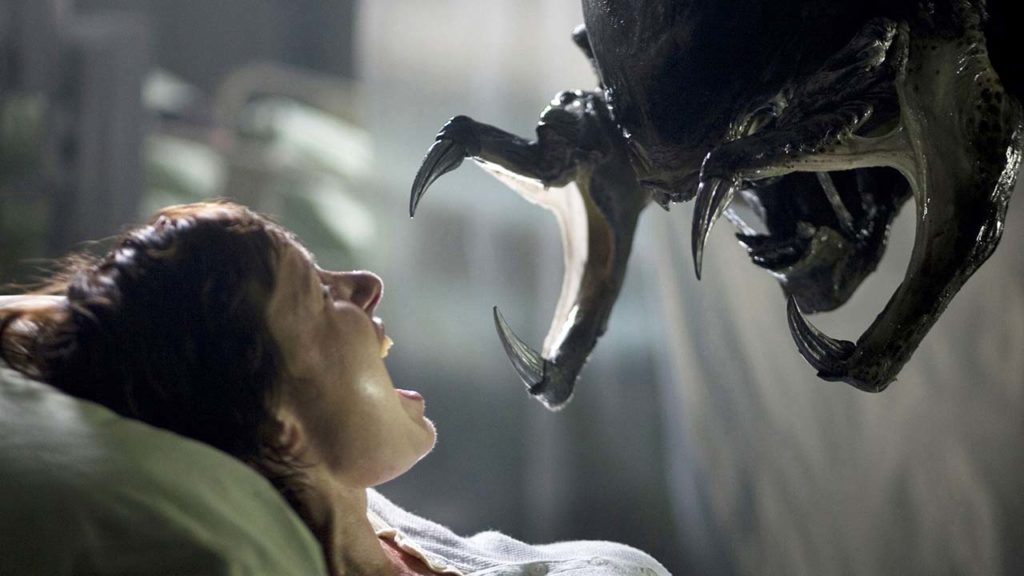
    Aliens vs. Predator - Requiem
    Mandible with care

    AVP:R is so divorced from the six prior Alien films that there are only two tenuous continuity threads to link them. A Mrs. Yutani appears, presumably of the Weyland-Yutani corporation that, in the future, will operate under the secret agenda of locating more aliens as it strip mines the galaxy for fossil fuels. But perhaps the one true link to the original Alien film from 1979 is a sequence involving a chick stripping down to her skivvies. In the original, the truly badass Ripley (Sigourney Weaver) deservedly kicks back her heels and gets ready for a suspended-animation nap in her undies, but here all we get is a bland “hottie” stripping for her unlikely dweeb crush (an incidence of nerd wish-fulfillment that speaks volumes as to the maturity and life experiences of the filmmakers).

    What should have been another major screenwriting red flag is the hugely unsatisfying ending. When the Predator, the closest thing the film has to a hero or protagonist, finally closes in on his prey, they go at it looking for all the world like two pro wrestlers in rubber suits. And then immediately… they’re both obliterated by a nuke. A small handful of the humans are only barely proactive and manage to survive untraumatized despite having watched all their families and loved ones killed.

    So why do I keep punishing myself by watching each Alien sequel? I don’t ever again expect something as multilayered as the original, but I do keep thinking that these kinds of movies are supposed to be at best entertaining and at worst a little fun, and yet they always turn out torturously awful. AVP:R‘s best quality is its brisk 86 minute running time, even in its unrated extended DVD cut.

  • Sold out but not a soldier: Richard Kelly’s bizarre Southland Tales

    Sold out but not a soldier: Richard Kelly’s bizarre Southland Tales

    I don’t know if the roughly 140 minute version of Southland Tales that made it to DVD is a butchered or merely abbreviated version of a masterpiece, but what I just saw is an unholy mess. I’m one of director Richard Kelly’s apologists for his divisive film Donnie Darko, which I found strangely affecting. Like Southland Tales, it was heavily edited down before release, and the abbreviated theatrical version doesn’t even make logical sense. Its emotional appeal is hard to pin down, and yet I found it hugely involving and moving. I was rooting for Kelly on his big follow-up, and even though it made the best-of-the-year lists of both The New York Times and The Village Voice, I guess I’m on the losing team now.

    The opening moments recall Cloverfield and the TV series Jericho with ersatz home video footage of a nuclear attack on Texas. A long barrage of infographics, television fragments, and narration follows, outlining a tremendously involved backstory. Kelly has obviously created a huge fictional universe, the bulk of which proves superfluous to the comparatively simple story that concerns the bulk of the film that follows. Perhaps Southland Tales is the first entry in this Kellyverse, and indeed, it is comprised of four chapters (starting, no doubt modeled after Star Wars, with “Chapter 4”). But after this failure it’s hard to imagine Kelly securing the funding to complete additional chapters (at least as films; television or comics seem both more appropriate and more frugal).

    Wallace Shawn and Bai Ling in Southland Tales
    Be thankful I couldn’t find a still of them making out

    The ensemble cast is extraordinarily weird, featuring The Rock, Sarah Michelle Gellar, Seann William Scott, plus a complement of little people. No less than five past and present Saturday Night Live cast members also appear: Cheri Oteri, Amy Poehler, John Lovitz, Nora Dunn, and Janeane Garofalo (credited but I think I only spotted her in one shot near the end). Rounding it out are Miranda Richardson, John Laroquette, Wood Harris (Avon Barksdale in The Wire), and Kelly-booster Kevin Smith. And is that the weird little French woman from The City of Lost Children? You haven’t seen a movie until you’ve seen one with Wallace Shawn and Bai Ling making out. But in a way I suppose that makes sense; they are both aliens from another planet. Different planets, maybe, but still.

    Justin Timberlake in Southland Tales
    Justin Timberlake shills for Budweiser (not shown)

    The music is likewise eccentric: Jane’s Addiction’s punk/prog masterpiece “Three Days” figures in the dialogue as an enigmatic prophesy and as the introduction to the official movie website, and Moby does his best Vangelis impression for his original score. Justin Timberlake (filmed in separation to most of the action) serves as narrator but also stars in a bizarre musical interlude and/or Budweiser commercial and/or Iraq war commentary: “I got sold out but I’m not a soldier.” And, why not toss in pop star Mandy Moore?

  • 9/11-ploitation: J.J. Abrams’ Cloverfield

    9/11-ploitation: J.J. Abrams’ Cloverfield

    First of all, let me just say I get it.

    I get that Cloverfield is meant to be a modern day analogue of Godzilla. I get that postwar Japanese moviegoers witnessed an enraged giant lizard borne of nuclear technology stomp Tokyo flat in an unstoppable pique, and I get that Godzilla became a classic for that very reason. I get that we Westerners were long due to be attacked on film by own very own allegorical creature as pop therapy for our terrorism anxieties.

    Perhaps we need that movie some time. But significantly more advanced than Godzilla in terms of visual style and special effects, I don’t think Cloverfield is that movie.

    As a longtime fan of J.J. Abrams from Alias and Lost, and made a helpless sucker by the film’s clever marketing, I very much wanted to love Cloverfield. However, I found it extremely difficult to watch and to like, for two basic reasons both related to my being a New Yorker for a decade & change: I. unlikeable and unrealistic characters, and II. what can only be described as 9/11-ploitation.

    I. The Characters

    We know the backgrounds of only two characters, Rob and Beth. Rob has recently been promoted to Vice President of an unspecified type of company at an improbably young age, and is about to leave for a long business trip to Japan. In my understanding of lifestyles of the rich & beautiful in New York City, such young execs were more commonly found in the dot-com 90s economy, but even now still exist in scrappy new media companies like CollegeHumor.com. But let’s assume Rob helped invent the next Facebook and move on.

    random hot girl in Cloverfield
    Yowza howza! Yes, it’s true, all New Yorkers go to parties like this all the time.

    We don’t know what Beth, his one true love, does for a living, if anything. She lives with her family high up in the northern tower of the Time Warner Center (more on that later). Her stunning looks and wardrobe might peg her as model, but she appears to be a socialite born of privilege. But far from the slow trainwrecks that are Paris and Nicky, Beth appears to be a sweet, sober girl. In fact, she leaves a party not unconscious in the back of a limo, but out of propriety, to go home to bed, alone.

    Us regular joes are supposed to identify with and care about these people? For all its faults, Steven Spielberg’s War of the Worlds (another monster-attack film touching uncomfortably upon domestic disaster in a post 9/11 world) featured an everyman type character in auto repairman Tom Cruise. To be fair, Godzilla was full of white-coated scientists and teeth-gritted soldier-types, so the genre doesn’t exactly call for comparatively boring lower wage-earners that don’t live in luxury condos and party in downtown lofts.

    II. 9/11-sploitation

    Godzilla was utterly frank in linking the monster with the horrors of the nuclear age. So if the Cloverfield beast is a personification of terrorism, how does the metaphor fit? Did US military adventurism in Afghanistan and Iraq unearth the monster? Is the beast a heretofore undiscovered subterranean oil-feeder, angered by our draining the earth’s supply of fossil fuel?

    Without a clear metaphor, Cloverfield just seems to enjoy alluding to the superficial events and imagery of 9/11 without any depth: skyscrapers “pancaking” themselves flat, streets filling with clouds of debris, ash-coated survivors struck numb. I’m not against popular fiction using metaphor to touch upon raw nerves that maybe need to be tweaked now and then… but is Cloverfield it?

    New York City burns in Cloverfield
    Don’t worry, New Yorkers, it’s only a movie.

    One of the film’s key set pieces is set atop the twin towers of the Time Warner Center. The allusion is clear, but it’s a stretch factually. Are there residential apartments in the TW Center? As both a New Yorker and Time Warner employee, this is news to me. I should also add that the geography of Manhattan as seen in the film is just this side of realistic. In a space of about 6 hours, it’s plausible the characters could make it from lower Manhattan to the roof of the Time Warner Center at the southern foot of Central Park (assuming, that is, that their young thighs are capable of the trek).

    Invasion of the Bodysnatchers is one example of a sci-fi thriller that has worked well enough to illuminate concerns of the times to warrant multiple remakes. Just to name three: the original took on McCarthyism, the Abel Ferrara 90’s version looked at obedience and conformity in the military, and Robert Rodriguez’s The Faculty found the story useful as a satirical critique of high school peer pressure. But none of the various Bodysnatchers films presented us with recreations of cities pressed flat; were contemporary Japanese made sick by the sight of their horrors anthropomorphized in a giant lizard? Seeing my home city’s skyline smoking and collapsing was not something I would call cathartic.

    I saw the film early evening on opening day, with an audience full of kids just out of school. The movie went over like a lead balloon; the conclusion was loudly heckled and booed. I suspect the kids mostly objected to the unconventional structure and ending. Which is, for what it’s worth, what I found best about the film: it provides a very movingly unexpected happy ending.

  • M. Night Shyamalan squanders the last of his goodwill in The Lady in the Water

    M. Night Shyamalan squanders the last of his goodwill in The Lady in the Water

    I don’t know where to start with this one. I’ve been a M. Night Shyamalan fan from the very beginning, even when the role was better described as apologist.

    Even to a fan, nearly every film comes with a “yeah, but…” disclaimer: The Sixth Sense is an excellent piece of slight-of-hand with some genuine emotion, but let down by an extended montage at the end recapping events recontextualized by the already-clear Big Plot Reveal. Unbreakable, my personal favorite of his, is a remarkably mature character piece on a real-world Superman, but whose comic-book origins probably alienated a mainstream audience that wants its comic book movies clearly signposted by garish costumes and action set pieces. Signs is a perfectly crafted sci-fi thriller that doubles as a wildly funny comedy (an intentional one, I should be clear… more on that later), but the delicious suspense is nearly ruined in the end by the filmmakers’ overconfidence in their shoddy CGI alien.

    The backlash started as soon as The Sixth Sense, perhaps in direct correlation with its box office take, with people falling over themselves claiming to have detected the Big Plot Reveal well ahead of time. But The Village marked the moment when the grumbling turned sour. If not nearly as bad as its critical reception, The Village was a disappointment; its promising scenario satirizing the contemporary situation in Bush’s color-coded police state is stifled by a lack of humor uncharacteristic for the director, not to mention an underwhelming twist lacking the emotional punch of The Sixth Sense.

    The classic Shyamalan film is a schematicly constructed jigsaw, which in itself is a great pleasure. But in The Lady in the Water, the tail wags the dog to an even greater degree than The Village. Humorless, pretentious, and forehead-slappingly… well, sorry for the cheap shot… stupid.

  • Peter Cushing as Doctor Who in Daleks’ Invasion Earth: 2150 A.D.

    Peter Cushing as Doctor Who in Daleks’ Invasion Earth: 2150 A.D.

    Daleks’ Invasion Earth: 2150 A.D., the second Doctor Who feature film, follows Dr. Who & The Daleks by one short year, and clearly betrays where the public’s interest lay at the time by ditching any mention of Dr. Who in the title. The first film largely disregarded the TV show’s premise and continuity, and the sequel similarly plays fast and loose with its own predecessor. Dr. Who has yet another young female relative, a niece named Louise? Why does she call her uncle “Doctor”? Did Barbara elope with that twit Ian?

    Otherwise, the screenplay is loosely based on the original 1964 TV serial The Dalek Invasion of Earth, starring William Hartnell. It follows the original farily closely, especially in the early seqences showing a war-ravaged London and the iconic image (well, to Brits, anyway) of a Dalek rising out of the Thames (actually better realized in the original – here they cut away from a Dalek head poking out of the water and back to it fully emerged).

    It’s just barely slightly better in terms of action and spectacle (the Dalek flying saucer isn’t half-bad, considering), but nevertheless just as mind-numbingly stupid. Let’s start with the title. Why is it set in the future? Everyone’s dressed in 1960s clothing, with contemporary rifles and cars. If there’s nothing to be gained, it might as well be set in present day. Plus it would be that much more of an exciting thought for kids to to imagine an invasion might happen today rather than next century.

    Daleks' Invasion Earth: 2150 A.D.
    Curious that the Doctor and the Daleks both barely feature in the poster for their own movie

    Look out, Robo-men! Why did the Robo-men take off their helmets and suddenly become human again when the Doctor simply orders them to attack the Daleks? And why do they scream like little kids? Why do the Daleks have fire hydrant guns? Why do the Daleks only take male prisoners? What do they do with the women?

    Of course, there’s also the music. After another set of pointless psychedlic opening titles, a sequence depicting a bank robbery is set to… Beethoven? WTF? After that we get a generic lighthearted score, determinedly whimsical even when Dr. Who discovers a corpse. Incidentally, this Doctor is badass. Crossing the countryside on foot, a Robo-Man orders him to halt. The Doctor shoots him and turns right back to the map. “As I was saying…”

    And finally, why did the Daleks invade England? The “magnetic influence of the North and South Poles” is located under Watford, of course!

  • Peter Cushing brings Doctor Who to the big screen in Dr. Who & The Daleks

    Peter Cushing brings Doctor Who to the big screen in Dr. Who & The Daleks

    Dr. Who & The Daleks is the first of two feature films based on the classic BBC TV series Doctor Who. They are, as the fans say, “non-canonical,” and thank god for it. The TV series was a true all-ages affair; typically enjoyable for children, but with extra layers of subtext for grownups (or at least attractive ladies for the dads). But this movie is dumbed down to the point where it’s dull and condescending to even the youngest audience member.

    Screen legend Peter Cushing plays “Doctor Who” (in the movie, that’s apparently his actual name) as a silly old (human!) man, a harmless mad scientist. The other characters don’t fare well either. The original TV incarnations of Ian and Barbara were both intelligent and capable, employed in the noble profession of school teachers. This Ian is a total prat, serving mainly as comic relief, and Barbara is reduced to a screaming plot device.

    Dr. Who and the Daleks

    Other things grate to longtime fans (it’s “the TARDIS,” not just “TARDIS”!) and regular viewers alike (the music is wretched). Truth be told, cheesy effects and silly technobabble are actually great pleasures to be found in the original series, but the extra money spent on the movie must have gone to the wrong places (the sets and extra Dalek props, evidently). The advanced Dalek technology includes lava lamps (I’m not kidding). And make up your minds, Daleks, is it a neutron or neutronic bomb?

    And finally, if it’s pitched so low, what are the moral lessons it has to teach youngsters? Based on what The Doctor has to teach the naive glam-rock aliens threatened by the Daleks, don’t trust anyone who claims to want to help you. Instead, fight and kill them.

  • 2001: A Space Odyssey on the big screen at New York’s Ziegfeld theater

    2001: A Space Odyssey on the big screen at New York’s Ziegfeld theater

    One of the best movies ever made, on one of the biggest screens in New York. What could be better?

    It’s taken me many years and many viewings to realize that the movie is actually very, very funny. Perhaps this shouldn’t be surprising for a movie that directly followed Dr. Strangelove, but the sombre serious air about the film disguised some of the comedy to my young mind watching the movie almost every year, running uncut on a local Philadelphia TV channel. Just a few of the many huge “jokes” packed into the film: the entire human condition condensed into chimp pantomime, fantastic visions of the future punctured by hilariously closed-minded humans more interested in sandwiches, and the most naked human emotions shown on screen coming from apes and computers as opposed to supposedly evolved humans.

    2001 On the web: Kubrick 2001 presents an elaborate, though sometimes silly, animated explication. Then there’s The Underview, helpfully including the complete Zero Gravity Toilet instructions. [update: link no longer available]

  • John Woo’s Paycheck isn’t fun, weird, or subversive enough for a Philip K. Dick tale

    John Woo’s Paycheck isn’t fun, weird, or subversive enough for a Philip K. Dick tale

    When it comes to action cinema maestros like John Woo — I can enjoy the the hyped-up action and weirdness of something like Face/Off, but find that the extreme violence and gunplay can sometimes cross the line from escapism into being inhumane. Paycheck, scoring a mere PG-13 from the MPAA, is less violent than most of Woo’s others, but also unfortunately less weird or even fun.

    It’s also not as smart or subversive as a Philip K. Dick adaptation ought to be. I think Minority Report is the first so far to capture what made Dick’s tales so timeless and relevant.

    Uma Thurman, following her star turn as the Kung-Fu action cinema goddess in Kill Bill, plays backup love interest to Ben Affleck, who himself is no great shakes here. He was funny and self-deprecating when recently hosting Saturday Night Live, if a little juvenile. His 90’s goatee-wearing, ironic geek guy in Chasing Amy was actually quite realistic. Even his Daredevil hinted at the suffering and isolation in the midst of all the superhero silliness (there’s a chilling scene where we see him return home after a night of crime-busting, where he painfully strips off his protective uniform to reveal more than a few bruises and scars, and then blithely chews a handful of pain-killers straight). But he doesn’t read as a convincing engineer in Paycheck, and his good looks and physique directly contradict dialog in the film that describes him as just a regular guy, and not a secret agent action hero.