• Terminator Salvation is oppressively feel-bad apocalypse porn

    Terminator Salvation is oppressively feel-bad apocalypse porn

    Terminator Salvation was released in a year curiously rife with apocalypse porn. The visions of world’s end in theaters that year varied wildly in tone: everything from illuminating art to alarmism to escapism. The competition to bum you out included Roland Emmerich’s 2012, which utilized the best special effects technology money could buy to ritually depict the destruction of international landmarks, and John Hillcoat’s The Road, which imagined the scattered remnants of humanity scrabbling to survive in a world they may have themselves decimated, but long past a point where blame had any meaning. Technology is both destroyer and salvation in Terminator and 2012, but largely irrelevant to the stragglers clinging to life in The Road. All of humanity’s inventions are gone, and give neither aid nor harm.

    For the Terminator series to be such a long-lasting mass entertainment is odd, considering it is set in a desolate, post-nuclear-war world ruled by a self-aware artificial intelligence. It would seem that a distrust of technology and fear of world war is a perpetual motivation to go to the cinema. James Cameron’s original science fiction nightmare is vintage 1984, with old-school optical special effects and stop motion animation that, depending on your point of view, are either quaint or holy relics of a lost era of handmade moviemaking. But its core concept was strong enough to become archetypal of an entire genre, inspiring countless derivative works.

    The Wachowskis stole it outright for The Matrix, where self-aware computer programs turn against the human civilization that created them, like the Terminators before them. The Terminators stage a malicious holocaust of pure extermination, but the Matrix programs instead virtually enslave the human race while they feed on giant electrical batteries comprised of farmed human bodies. While the eponymous Matrix was a weapon of fratricide, The Terminators were instead locked in a game of time-travel chess. But in each case, the offspring of humanity are afflicted with profound Freudian complexes: they are fixated on consuming their parents.

    Christian Bale and Sam Worthington in Terminator Salvation
    That’s so $&#%ing unprofessional, you $&#%ing cyborg infiltration unit!

    The cast of Terminator Salvation was more populated with famous names than it needed to be. Christian Bale is now the fourth actor to play the role of humanity’s savior John Connor, and with apologies to Edward Furlong, Nick Stahl, and Thomas Dekker, the first marquee name. One need look no further to spot the biggest gamble this film makes: nobody went to see any of the previous three Terminator films because they were fascinated by the good guy. From the very beginning, the big draw for audiences (and the plum role for any actor looking to make a splash) was the villain. The eponymous cyborg antagonist Cameron created quickly became iconic and launched bodybuilder Arnold Schwarzenegger to Hollywood stardom and, even more implausibly, a political career.

    Bale is coming from an entirely different place than a ‘roided-up Austrian amateur thespian in 1984. Bale is a capital-S Serious Actor, from the very beginning of his career as the child lead in Steven Spielberg’s still under-appreciated Empire of the Sun through to his modern resurgence in Mary Harron’s controversial American Psycho. Like Brando and Crowe before him, Bale comes across as an angry and humorless guy — possibly even unstable — in most of his roles and even his public persona. Indeed, rumors of his ill temper were seemingly confirmed by his infamous eruption on the set of Terminator Salvation in July 2008.

    Terminator Salvation
    This is as good a place as any to ask: why do the Terminator movies refer to these as “endoskeletons”? Isn’t that redundant?

    A pessimist might even imagine Bale’s histrionics part of a publicity campaign to create awareness and positive buzz — not just for a movie that studio executives might consider an unsure prospect in need of a marketing boost, but even to cement his own sexy reputation as a loose cannon or Hollywood bad boy. In the end, a hissy fit thrown by a handsome and overpaid celebrity wasn’t enough to prevent minor box office disappointment and tepid reviews: a modest 52% on Metacritic.

    At the very least, Bale’s tabloid presence helped most of the celebrity obsessed world become aware that there was a new Terminator film coming out, when previously only Comic-Con attending sci-fi geeks had been paying attention. Personally, knowing about Bale’s tantrum beforehand actually took me out of the experience of watching the film on its own merits. I was continuously distracted by wondering which particular scene stressed him out enough to blow his top.

    Bale’s prickly persona might make him eminently suitable for roles like the driven resistance leader John Connor, but it makes his range seem quite limited. He employs the exact same set of mannerisms he used for Bruce Wayne in Batman Begins and The Dark Knight: a hoarse voice, tensed posture, and lowered-head thousand-yard stare. Bale may play the top-billed role in The Dark Knight and Terminator Salvation, but he is arguably not the real protagonist in either, and is overshadowed by Two-Face (Aaron Eckhart), The Joker (Heath Ledger), and Marcus Wright (Sam Worthington) — both in terms of screen time as well as actorly showiness. Perhaps it’s a deliberate choice on Bale’s part to seek out essentially supporting parts in which he allows his character to be subordinate to a cast ostensibly billed below his name. Fittingly, Bale was to earn an Oscar the next year for an actual supporting role in David O. Russell’s The Fighter, so at least in one case his real-life persona completed its redemption arc, if his Terminator role John Connor didn’t.

    Moon Bloodgood in Terminator Salvation
    Moon Bloodgood checks behind her for her character’s motivation. It’s got to be around this wasteland someplace.

    I have nothing to back this allegation up, but I’ve read rumors that the original script for what became Terminator Salvation centered around the characters of Marcus (Worthington) and Reese (Anton Yelchin). Worthington and Yelchin would have shared the focus, while the character of John Connor was relegated to a cameo appearance, but the role was greatly expanded when Christian Bale became attached. This rumor could account for the relative richness (albeit truncated) of the Marcus character arc, as compared to the one-note Connor. It would have served both characters better had the movie focused on just one tortured male savior.

    Director McG’s Terminator Salvation is by no means equal to James Cameron’s two original films, but it’s really not all that terrible, and certainly better than Jonathan Mostow’s Terminator 3: Rise of the Machines. My theory is very simple: it’s too grim. The first three movies all had some degree of humor, but Terminator Salvation‘s trailers and TV commercials made no attempt to tart it up as a good time. By far the highlight for the audience I saw it with was the sudden appearance of a famous T-800 model Terminator, not entirely successfully realized by applying a CGI Arnold Schwarzenegger head atop bodybuilder Roland Kickinger. If a little less than convincing, it at least provided some relief from the oppressive apocalyptic despair.

    Also, a newly recorded voiceover cameo by Linda Hamilton was a nice touch for nostalgic fans. The always entertainingly eccentric Helena Bonham Carter appears in an significant cameo, with Bryce Dallas Howard in a totally inconsequential part that could have gone to a newcomer. Following the established rules of action flicks (perhaps best exemplified by Cameron’s Aliens), the cast includes the requisite cute kid, but thankfully she’s mute.

    Bryce Dallas Howard in Terminator Salvation
    Yes, Bryce Dallas Howard is in this movie, for some reason. Still doing penance for the disastrous The Lady in the Water, perhaps?

    I was able to go along with the plot for the most part, but found the reduction and oversimplification frustrating. A global war against artificially aware machines is condensed down to a hand-to-hand battle with a single T-800 on a factory floor — a self-conscious retread of the climax of the original film. But perhaps this is a better dramatic choice than what Cameron did in Aliens, which excessively multiplied the single alien threat of Ridley Scott’s original, effectively diminishing the core premise that was appealing in the first place: an almost indestructible creature driven by pure biological instinct, not malice.

    Another fatal flaw with Terminator Salvation is a consistent problem with many characters’ comically blasé reactions to extraordinary situations. Connor’s right-hand man Reese rescues a guy who claims never to have seen a Terminator before, or even know what year it is. But Reese simply answers his questions, and never wonders just where the hell this weirdo’s been the past few years. Also, I understand Williams (Moon Bloodgood) bonding with Marcus after he rescues her from gang rape, but she risks the safety of an entire human outpost when she decides to free him. This choice goes beyond understandable impulsiveness and into the realm of lunacy.

    Also curious is an apparent lack of imagination in realizing futuristic technology. We’re told the Terminators communicate over old-school shortwave, so evidently SkyNet hasn’t taken over the satellite network and blanketed the planet in Wi-Fi or 3G. Maybe the robots found their reception was as bad as Manhattan AT&T subscribers. I won’t go into how the gleamingly sleek SkyNet HQ includes fancy touchscreen graphical user interfaces designed for humans, or how Connor miraculously witnesses a nearby nuclear explosion without being atomized by the shockwave, or at least going blind or contracting radiation sickness. Such a thin line between suspension of disbelief (for the purposes of thrills & spills) and sheer stupidity would bother any viewer with half a brain, whether the other half is cybernetic or not.

  • Based On a True Story: Mike Daisey

    Based On a True Story: Mike Daisey

    I agree 99% with the popular consensus regarding Mike Daisey: he lied. But the tiny 1% nobody seems to be talking about is bothering the hell out of me: if his now infamous monologue “The Agony and Ecstasy of Steve Jobs” is a work of fiction, why can’t we talk about it as a work of fiction?

    Until recently, Daisey was forging a reputation as a popular monologist in the tradition of the late Spalding Gray: fusing the mechanics of autobiography, journalism, and theater to tell stories with the power to move individuals and sway popular opinion. That is, he was, before his enormously popular show “The Agony and Ecstasy of Steve Jobs” was dramatically revealed to be largely comprised of half-truths and fabrications. Daisey initially required theaters to advertise it as “a work of non-fiction”. When he began to feel the heat, he initially claimed he had merely taken dramatic license, but finally issued an actual apology.

    The imbroglio has been Tweeted, blogged, podcasted, and analyzed to death over the past two weeks, but here are the key incidents: Daisey’s original stage monologue (with a free transcript on his website), an episode of the venerable radio program This American Life featuring a version of it, followed by their astonishingly gripping retraction. My favorite analyses of the ensuing fallout came from Daring Fireball (Separating the Baby From the Bath Water) and Derek Powazek (How to Spot a Liar).

    The general consensus among the cognoscenti, digerati and NPR set alike, is that Daisey made a fatal error in presenting his piece as journalistic report. I agree. But most of these analysts go on to express horror and outrage that Daisey’s show goes on. The monologue inspired a popular petition on Change.org (now there’s a petition against the petition). Theaters are not canceling Daisey’s future shows and are refusing refunds for past showings. Gruber, in an episode of his podcast The Talk Show, attributes this to the theater business running on a tight margin, as if it were simply a matter of economics. Interestingly, The Understatement reports that many theaters are also daring to defend the “essential truth” of Daisey’s work.

    Mike Daisey went to great lengths to preserve the fiction that “The Agony and Ecstacy of Steve Jobs” was nonfiction

    The Understatement

    Which brings me to the tiny sliver of this whole story that I believe needs to be addressed: there is a massive disconnect between journalists and, for lack of a single term, artists / writers / performers / monologists / etc. Or simply, “creatives”. So Mike Daisey largely lied about what he saw in China; so what? Should his admittedly powerful monologue be wiped from the record? Can we not talk about it as a work of literature? Here is the point where, perhaps, the English majors of the world ought to take over from the journalists.

    Ira Glass states in the This American Life retraction that Daisey’s use of the literary device of speaking in the first person triggered his brain to register it as truth. Other outraged journalists seem to not want to even entertain the idea that Daisey’s work might be an effective work of fiction on its own terms. Daisey was free to present his first-person account as truth (or as Stephen Colbert might term it, “truthy”) within the context of his play itself, but he erred by also doing so on This American Life, Real Time With Bill Maher, CBS News, and other venues. He deceived accredited journalists with hard-earned reputations in order to preserve the fiction that his piece was nonfiction.

    But what if he hadn’t? What if he had, from the beginning, pitched “The Agony and Ecstasy of Steve Jobs” as what it actually is: a fictionalized dramatic account, told in the first person but, to use a familiar phrase, based on a true story. Most of what Daisey claims he personally witnessed are actual ongoing events at Foxconn and other factories in China. Workers’ conditions are harsh and unjust, not only to western sensibilities, but also in violation of Chinese regulations.

    Many commenters have mused on how Apple Inc. may have been harmed by Daisey, both financially and in terms of reputation. It most likely has to some measurable degree, but no matter how much I may personally use and like many of their products, I don’t believe Apple is any more possessed of sensitive feelings than any other multinational corporation. Apple is no more deserving of protection from a work of fiction than — to fabricate a hypothetical example — Exxon might be if a writer were to publish a novel telling the story of an environmental activist visiting the 1989 Valdez spill.

    The current refusal to consider that Daisey’s discredited work might still have merit as a piece of literature smacks to me of two things:

    1. Excessive apologia to Apple. Apple is justly beloved for designing great products and seems to be making a great effort to improve its environmental impact and supplier responsibility. But no one needs to worry about their feelings being hurt.
    2. A general distrust and fear of fiction and literature. On a grand scale, you often see this when video games are blamed for school violence, rock lyrics for drug use, or comic books for juvenile delinquency. When a problem is too big to deal with, often the easiest thing to do is ban or burn a book. Now, of course those are extreme cases, and all that’s happening here is a few journalists discrediting one man’s dramatic monologue. Perhaps journalists spend too much of their careers dealing with verifiable facts, and are ill-equipped to deal with the sometimes messy business of analyzing literature.

    Daisey is not a journalist, and his situation right now is not the same as that of Jayson Blair, who was rightly run out of town for his numerous fabrications published by the New York Times up until being discovered as a fraud in 2003. He’s more akin to James Frey, whose supposed memoir A Million Little Pieces was revealed in 2006 to have been better classified as a novel. Had it not been marketed as his true life’s story, it probably would have been lost in the fray of bookstores’ crowded fiction aisles. Daisey’s medium is the theater, worlds away from the media journalists work in. No theatergoer or novel reader expects absolute verifiable truth from literature. The tools of literature have the power to entertain, instill a sense of catharsis in the audience, to illuminate, and perhaps even to move people to action. All of these goals seem to have motivated Daisey to do what he did.

    It’s now near-impossible to appraise the merit of Daisey’s work on its own terms. Interviewed by Ira Glass in the This American Life episode Retraction, he stated that “The Agony and Ecstasy of Steve Jobs” is the “best thing I’ve done.” Clearly, he knew he had really hit on something that touched a nerve in his audiences, and it brought him a great deal of acclaim that later curdled into notoriety. He wrongly felt that the notion his work was factually true was essential to its continuing popularity, which provided him many benefits: larger audiences, fame, and likely a greater income than the vast majority of struggling theater artists are ever likely to glean from their work. I think it’s clear now that had he presented his work as fiction, it may have reached far fewer people, but still have had its undeniable impact on those that did experience it. The shame is that now we’ll never know.

    The silver lining is he contributed to an ever increasing spotlight on the complex issue of China’s labor practices, and a growing awareness that the consumer electronics industry could not exist as we know it today without it.

  • Relentless Withholding: Michael Mann’s Public Enemies

    Relentless Withholding: Michael Mann’s Public Enemies

    Khoi Vinh rightly observes in Minimalism, Michael Mann and Miami Vice that “Mann has produced a taut, stylistic and often brutally impersonal filmography that seems most interested in the concept of work” (via Daring Fireball). I wholly understand and laud the aim of a minimalist, “relentlessly withholding” narrative, but I don’t believe it’s ignorant or populist to demand more. Mann has proved again and again to be a master at managing both character development and cold hard plot, particularly in his masterpiece Heat.

    So to my eyes, Public Enemies marks a regression. The danger in perpetuating multi-million dollar movies without an interest in human beings is entire multiplexes full of soulless special effects showcases like Michael Bay’s Transformers. Vinh goes on to appreciate Mann’s construction of the film as a form of design, not least because Mann commissioned Neville Brody to design a typeface New Deal, and the whole article is a must read.

    The curse of avidly following any particular artist is that one is set up for disproportionate disappointment whenever their latest work doesn’t measure up to their very best. Mann is one of my own personal favorite filmmakers, and for the record, I would cite Thief, Heat, The Insider, and Collateral as his best and some of my favorite movies overall. As for the rest: Manhunter suffers from the usual criticisms levied against Mann (dated, stylized, and overserious). The Last of the Mohicans is overrated (famous mostly for its catchy score and capturing Daniel Day Lewis on film at his hunkiest). Ali was a relatively conventional biopic. And finally, I was downright shocked by how garish, empty, and, well, just how bad Miami Vice was (on first viewing, at least).

    Johnny Depp in Public Enemies
    Johnny Depp as John Dillinger: “We’re having too good a time today. We ain’t thinking about tomorrow.”

    Atypically for the genre, all three of Mann’s biopics are focused on a limited timeframe. The Insider, Ali, and Public Enemies all examine famous figures as adults, during the most active and famous portions of their lives. Public Enemies can’t help but be hamstrung by the rules of nonfiction, which is by definition less dramatically interesting than fiction. Fiction is carefully crafted by an author, and nonfiction is messy serious of events that won’t slot into Aristotle’s Poetics, Joseph Campbell’s The Hero With a Thousand Faces, or Robert McKee’s screenwriting formulae that we as a culture find cathartic in art almost by detault.

    Ali is also a casualty of this equation; it’s a biography, not a narrative. That doesn’t explain the brilliance of The Insider, which I consider a triumph. Perhaps it’s because its subject Jeffrey Wigand is not in the same league of fame as Muhammad Ali or John Dillinger, allowing the audience to discover more than they may already know. I would argue that The Insider is actually about something bigger than the life story of one man; it questions whether integrity, purity, and honesty have a place in a modern world run by corporations.

    Before I enumerate my complaints about Public Enemies, it must be said that it’s wholly engrossing. Mann’s customarily deep research results in a characteristically high level of verisimilitude throughout. Many sequences were shot in the actual historic locations, including a raid on a safe house at Little Bohemia Lodge in Manitowish Waters, Wisconsin, a jailbreak from Lake County jail in Crown Point, Indiana, and Dillinger’s death at the Biograph Theater in Chicago. The action is visceral and the suspense is nail-biting, especially a sequence in which John Dillinger (Johnny Depp) brazenly strolls through the Special Crimes Unit offices the day before he is to die. One might assume this astonishing event to be a fabrication for dramatic purposes, but Roger Ebert says it’s “based on fact”).

    Any follower of Mann’s work will be unsurprised to see that Public Enemies is visually beautiful. Cinematographer Dante Spinotti previously shot Manhunter, Last of the Mohicans, Heat, and The Insider on film — how quaint! — but here turns to digital video, with which Mann and Dion Beebe experimented on Collateral and Miami Vice. The scenes set in a dimly-lit F.B.I. telephone surveillance office look particularly striking on digital video. Stanley Kubrick sought natural light so dearly that he famously helped develop special lenses capable of shooting by candlelight for Barry Lyndon, so one suspects he would have loved the technology now available.

    Terrifying, petrifying gunfights have been a trademark of Mann’s since his earliest feature The Keep. He has perfected it by Public Enemies, in which the tight choreography and extreme violence is matched only by the concussive sound design. These sequences hark back to the innovative urban firefight in Heat, when to the filmmakers’ happy surprise, the actual production sound proved more earsplitting than was possible with post-production foley effects. When I saw Public Enemies in the theater, the first reel was marred by terrible sound (an improvement over my first viewing of Miami Vice, which was almost inaudible throughout). Once resolved, the volume was loud enough to almost physically feel the force of bullets splintering walls, tree trunks, and background performers.

    Mann used to reserve his epic gun battles for climaxes, such as when Frank (James Caan) raids the mobster’s house in Thief, and Graham (William Peterson) single-handedly attacks The Tooth Fairy’s (Tom Noonan) lair in Manhunter. The shootouts grew to massive scale and epic lengths in the later films, like the unnerving nightclub raid in Collateral, and especially the cataclysmic downtown LA shootout that occurs roughly in the middle of Heat, which the film remorselessly builds towards and then thoroughly explores the ramifications.

    Johnny Depp and Marion Cotillard in Public Enemies
    Johnny Depp and Marion Cotillard in Public Enemies: “I was raised on a farm in Moooresville, Indiana. My mama ran out on us when I was three, my daddy beat the hell out of me cause he didn’t know no better way to raise me. I like baseball, movies, good clothes, fast cars, whiskey, and you… what else you need to know?”

    In contrast, much of Public Enemies is a long, sustained chase — a structural conceit Mann seems to have been embracing ever since Collateral. As Fernando F. Croce observed on The Auteurs, “Mann has gradually shifted from an image-based artist to a movement-based artist. Make that a sensation-based artist” … “Mann’s characters are dreamers posing as tough guys.” Mann punctuates the constant forward motion of the plot with action set pieces including at least two jail breaks, several bank robberies, and a chaotic raid on a safe house. Both jail breaks are clever, in which the audacious Dillinger largely exercises brains over brawn, and designs each at least partly to humiliate the lawmen. In the first, Dillinger gets himself deliberately locked up in order to bust his associates out. In the second, they make their getaway in the sheriff’s own car.

    Dillinger died in 1934, marking the twilight of the classic gangster era in more ways than one. His activities instigated the creation of the F.B.I. and the passing of laws that inhibited criminal enterprise, making him very unpopular with the organized crime families that were happily operating with relative freedom before he started showboating and stirring things up. His criminal career coincided squarely with the Great Depression era. Mann refrains from showing the stereotypical Hoovertowns or desiccated farmsteads directly, but the largely unspoken economic strife hangs over everyone nevertheless. One of the reasons Dillinger became such a folk hero is that he carefully cultivated a Robin Hood persona by very deliberately taking care not to rob individuals, but to steal from banks and, by proxy, the vilified federal government.

    Contemporary media hype made Dillinger a celebrity, and ultimately one of the last romanticized criminals to be able to hide out in public. Mann depicts this idolization subtly. For instance, when the gang refreshes themselves at a farmhouse after breaking out of jail, the woman of the house quietly begs Dillinger to “take me with you.” Note she specifies “me,” despite having children in tow.

    Most people still know his name today, despite him lacking a memorable nickname like his peers Pretty Boy Floyd and Baby Face Nelson. Incidentally, Baby Face is portrayed in Public Enemies by actor Stephen Graham as dangerously unhinged and murderous. He has the criminal mind, but unlike Dillinger lacks the discipline to make it work for him. The dynamic is similar that that of Neil vs. his wayward henchman Waingrow in Heat. Dillinger can’t do what he does alone, but any association with a man like Baby Face courts disaster.

    In Knives Out for Michael Mann, Kim Masters dishes the latest dirt on Mann. Anonymous gossip has him as one of the most difficult and even irresponsible directors working today, and studios may no longer wish to front his high price tag for movies that aren’t profitable. I usually protest when I hear studio executives complaining about “difficult” filmmakers — of course filmmakers are difficult — they’re the artists and studio executives are businesspeople. Without difficult artists, the accountants and MBAs that run the movie industry would have no “product” to sell. I usually dismiss the comments of executives that get paid more than the artists they supposedly enable to express themselves.

    But if the rumors about Mann are true, he’s more than just difficult. In the case of Miami Vice, he reportedly disregarded the safety of his crews by filming in the Gulf Coast as Hurricane Katrina bore down — followed by an actual gun fight on the set. Conditions were so bad on the set of Public Enemies that Depp reportedly stopped speaking with Mann.

    Marion Cotillard in Public Enemies
    Marion Cotillard as Billie: “They’re looking at me because they’re not used to having a girl in their restaurant in a $3 dress.”

    According to Scott Shoger’s Hollywood Goes Gangster, Dillinger was a movie buff, and was even semi-seriously planning a movie about himself not long before his death (an intriguing fact we don’t see in Public Enemies). The last movie he saw was Manhattan Melodrama, for which Clark Gable he won an Oscar. Being Dillinger’s last movie ticket gave the film an undeniable marketing boost. Mann shows Dillinger in a state of reverie as he watches key excerpts that had some personal relevance to how he saw himself. Shoger also states post-Hays Code Hollywood had an unwritten agreement to not produce explicit biopics of actual gangsters, lest they contribute to their celebrity and glorify the criminal lifestyle. This self-censorship more or less held until Arthur Penn’s Bonnie & Clyde (1967). As such, only a few movies have told John Dillinger’s story, including The FBI Story (1959, with Jimmy Stewart), The Lady in Red (1979), and at least two simply called Dillinger (1973 and 1991).

    In thinking about Public Enemies, I can’t help but keep going back to Thief and Heat, and it doesn’t survive the comparison. Maybe the real John Dillinger just isn’t as interesting as two of Mann’s previous fictional thieves (or in Mann’s parlance, “guys that pull down scores”): Neil (Robert De Niro) in Heat and Frank (James Caan) in Thief. Public Enemies is all surface, without the rich characterization of Thief and Heat. Public Enemies left me grasping at the tiniest of fragments in search of depth or subtext: a little look by an actor, a telling line of dialogue, anything. But there isn’t much there. Roger Ebert appreciates the refreshing lack of backstory conventional in both the biopic and gangster genres. I agree with him in principle, but would like to point out that neither Thief nor Heat features backstory — both flesh out its characters with what you might call “now-story.”

    While Public Enemies often feels tragically lacking in dramatic interest, virtually every single character in Heat has a backstory, even the getaway driver Donald (Dennis Haysbert) that dies before the car goes one block. Here, we don’t learn anything about anybody. Aside from Dillinger himself, the one character we probably needed to learn the most about is Melvin Purvis (Christian Bale). Purvis is a cold fish outwardly, such as when we dispassionately guns down Pretty Boy Floyd (Channing Tatum) after giving him one last chance to surrender. We can infer that he’s a cold, steely G-Man with a particular expertise in sharpshooting. Bale’s performance conveys sadness and guilt over what he’s doing — the questionable morality of defeating gangsters with torture and often even outright summary execution. Heat‘s cops and robbers are both fascinating, but who cares about Purvis’ safety, or if he achieves his aims? The only scene in which Bale and Depp share the screen marks one of the few sparks of life in the entire movie, but it’s frustratingly brief and unfortunately visualized through the old cliche of characters speaking through bars. The old Mann would have turned it into a several minute long conversation, a centerpiece of the film.

    Another frustrating cypher is the man Purvis drafts as as controversial expert on Dillinger. Charles Winstead (Stephen Lang), was an actual historic Texas Ranger, but unless I missed something, the movie doesn’t identify him at all, and in fact suggests that he’s from the wrong side of the law, being that he’s so familiar with organized crime and the archetypal gangster mindset. We learn nothing of him aside from the fact that he’s clever and suspiciously insightful at predicting Dillinger’s behavior. He’s a bit sinister, and rough and streetwise in manner and dress, so perhaps the point is just that he’s not the type that J. Edgar Hoover (Billy Crudup) would consider good G-Man material: young, clean cut, college educated sorts like Hoover’s man-crush Purvis.

    Billy Crudup and Christian Bale in Public Enemies
    J. Edgar Hoover (Billy Crudup) recruits Melvin Purvis (Christian Bale) for “A modern force of professional young men of the best sort.”

    What do we learn of the main man himself? Dillinger was a self-created celebrity ahead of his time: media-savvy and always ready to produce a good, concise catchphrase at the drop of a hat. The most telling revelation about his character comes from a dying colleague John “Red” Hamilton (Jason Clarke), who, in his dying moments, chooses to armchair psychoanalyze his partner in crime, saying he’s unable to let anyone down.

    Really? When did the film illustrate this aspect of his character? All we can infer from his onscreen behavior is that he’s loyal to the woman he loves (although not so loyal that he doesn’t later go out on a date with a hooker while his girlfriend is in prison) — although to psychoanalyze him ourselves, this action is probably a not-very-subconscious decision to allow himself to get caught, AKA “suicide by cop”. Just as he was able to casually stroll through his to-be captors’ offices without being caught, Dillinger is a ghost that goes through life without making any kind of impact. Neil in Heat may have had no friends, family, or even furniture, but he had a code: “Don’t let yourself get attached to anything you are not willing to walk out on in 30 seconds flat if you feel the heat around the corner.” Like Neil in Heat and Frank in Thief, Dillinger doesn’t have an exit strategy from his lifestyle until he meets a woman. Neil found love and wanted to pull a final score and then disappear forever. Dillinger wants the girl and an ongoing crime spree. Only when she is taken from him does he consider a final score to retire on.

    A surprising number of name actors appear in tiny roles, including David Wenham, Lily Taylor, Leelee Sobieski, Stephen Dorff, Emilie de Ravin (from Lost) and even singer Diana Krall in a cameo. One possible explanation is that they simply wanted to work for Mann in any capacity. Or maybe their roles were larger before the editing process. One in particular that stands out is Giovanni Ribisi as Alvin Karpis, a high level fixer and organizer, sort of like the skeezy but coldly professional Nate (John Voight) in Heat.

    Mann often catches a lot of flak for his typical paucity of female characters, but also for the few he does feature being rather problematic. It’s obvious that Mann is interested in stories about men (gangsters, cops, thieves, etc.). In my opinion, it doesn’t necessarily make him a misogynist if his stories don’t always feature full, richly drawn female characters. But curiously, Billie in Public Enemies may not be one of Mann’s most interesting female characters across his body of work, but she is more complexly drawn than any of the male characters in Public Enemies. We learn a little about her, certainly more than we do about anyone else, but I still don’t get why she would drop everything and run off with a gangster. Billie remains in love with Dillinger and faithful to him even when tortured and sentenced to a two-year jail term. True, she’s a young woman trapped in a dead-end job and the subject of racism (she’s part Native American). A good contrast is the character of Eady (Amy Brenneman) in Heat, whose complex relationship with the criminal Neil I found not only plausible but sadly moving. Cotillard is fine, but I think Brenneman’s touching performance as a crushingly lonely woman vulnerable to a seductive but controlling older man really helped me understand her desire to run away. Both Eady and Billie are willing to abandon their lives, such as they are, or even implicate themselves for a man that could be arrested or killed at any moment.


    Must read: Neville Brody’s fave film fonts and opening sequences, from The Guardian

  • Which Way Is Up: Michael Mann’s Miami Vice

    Which Way Is Up: Michael Mann’s Miami Vice

    The simple truth is that I hated Michael Mann’s Miami Vice on first viewing. On a technical level, it was marred by hideously poor sound — for which I blamed the particular theater I happened to see it in, but a friend of mine had the same complaint about a totally different venue, suggesting something was wrong with the prints themselves.

    I found the film much improved when watching the unrated director’s cut available on DVD and Blu-ray — not just sporting more audible sound but even improved fluidity in the storytelling. I don’t recall the original theatrical cut well enough to identify what may have been added, altered, extended, or rearranged, so any number of factors could have contributed to a more forgiving reappraisal: approximately five extra minutes of breathing room, better sound, and an original opinion so low there there was no way to go but up.

    The film is based on the original television series of the same name that ran between 1984-1989, created by Anthony Yerkovich and produced by Mann. Its premise was famously encapsulated by Mann’s alleged two-word pitch “MTV cops” — a legend that may or may not be true but has the benefit of being right on-the-nose. Kitschy even at the time, Miami Vice drew its stylistic tendencies — and sometimes even its guest stars — from MTV.

    It’s a world apart from Crime Story, another Mann crime drama and an early experiment with serialized storytelling that wouldn’t really take hold until much later with Twin Peaks and The Sopranos. Crime Story ran concurrently with Miami Vice but was cancelled after only two seasons (1986-87).

    Colin Farrell and Jamie Foxx in Michael Mann's Miami Vice
    OK, you win. Your suit is shinier than mine.

    Miami Vice the movie, however, is the product of Mann the writer and director, as opposed to episodic television producer and showrunner. The film is more of auteur work than the collaborative medium of a television series, and as such begs comparison with his other major films also set in the world of crime and punishment: Manhunter, Thief, Heat, Collateral, and Public Enemies. But whereas most of these presented sympathetic (or at least complex) portraits of criminals, Miami Vice is a more traditional policier firmly on the side of the good guys.

    Miami Vice follows the high-stakes exploits of Sonny Crockett (Colin Farrell) and Rico Tubbs (Jamie Foxx), two Miami-Dade police detectives in the war on drugs. The story begins in medias res, plunging the audience into an undercover operation that goes awry, followed by an effort to assist a colleague whose cover was blown while embedded in a Columbian drug running operation. This second operation is just the tip of an iceberg: FBI Agent John Fujima (Ciarán Hinds) reveals that there is a mole in the FBI. Crockett and Tubbs are deputized as federal agents for purposes of continuing the investigation.

    Like typical Mann protagonists, the detectives’ jobs are the sole focus of their lives. In the DVD bonus features, a real undercover operative states how disconcerting it is to lead another life as a high roller, wearing the finest clothes and driving the best cars, but return home off duty to his family in a crappy used car. It would have been nice to see what kind of lives Crockett and Tubbs lead off duty, if any, and learn a little of what life is really like for undercover cops. Instead, we watch the entire onscreen team live, eat, and sleep together in a large unfurnished house, much like master thief Neil McCauley’s (Robert De Niro) spartan abode in Heat.

    Colin Farrell and Gong Li in Michael Mann's Miami Vice
    Crockett travels in style.

    Both men become professionally compromised by their relationships with women, escalating to the point where their lives are threatened by their emotional needs. Neither looks outside their narrow work sphere for love: Tubbs is romantically involved with a colleague, and Crockett becomes mixed up with gorgeous money laundress Isabella (Gong Li). She’s dispassionate and inscrutable when we see her at work, but reveals worlds of emotion behind her eyes when alone with Crockett. Her character is a Chinese immigrant to Havana, requiring Gong Li to speak two languages in a film already rife with a plethora of blended accents. Justly wary of his partner’s infatuation, Tubbs warns him, “There’s undercover and then there’s which way is up.” Ignoring his partner’s advice, Crockett abets her escape from the federal sting operation, an act the movie judges as morally acceptable because he loves her.

    Returning players from the Mann repertory include Domenick Lombardozzi (from Public Enemies) and Barry Shabaka Henley (the ill-fated jazz club owner in Collateral, who also appears as a parole agent in Mann’s latest TV project Luck). New additions include Eddie Marsan, perhaps one of the most versatile actors in the world, as a government informant with a thoroughly convincing Southern twang, and John Ortiz (also a lead in Luck, and don’t miss him opposite Philip Seymour Hoffman and Amy Ryan in Jack Goes Boating). His villainous character here at first seems on a par with Javier Bardem’s powerful and threatening turn in Collateral, more savvy and perceptive even than his boss Arcangel de Jesus Montoya (Luis Tosar). But he ultimately proves pathetic and weaselly — the audience’s ability to take him seriously not helped by a caricatured accent.

    Mann took the opportunity to continue the experiments with digital cinematography begun in Collateral, and many of the locations were actual. Nevertheless, the production was enormously expensive for a movie without significant CGI special effects, even though it was ultimately profitable worldwide. A significant chunk of the expense is likely attributable to Mann’s customarily deep research in the service of verisimilitude, right down to unusual speedboats and implausibly exotic (but real) types of weapons.

    Gong Li and Colin Farrell in Michael Mann's Miami Vice
    Gong Li and Colin Farrell in Michael Mann’s Miami Vice.

    In “Knives Out for Michael Mann”, Kim Masters dishes the latest dirt on Mann, running a parade of anonymous, damning onset anecdotes. In particular, he was supposedly inconsiderate of the safety of the cast and crew during a shoot already made physically dangerous by everything from Hurricane Katrina to locations in gang-controlled territory. Mann may not be solely to blame, however, for Slate fingers actor Jamie Foxx for demanding higher billing and a raise after winning the Best Actor Oscar for the Ray Charles biopic Ray. He also allegedly demanded a last-minute rewrite that compromised the ending, and refused to fly to location shoots. The latter, at least, may be excusable — for The Daily Beast attributes his reasonable-sounding objection to an on-set actual shooting incident.

    The score is rather disappointing for a Mann film, especially compared to the great Dead Can Dance neo-medieval soundscapes for The Insider, the Kronos Quartet dissonance in Heat, and James Newton Howard’s Mogwai-inspired post-rock score for Collateral. Jan Hammer’s iconic theme for the TV series is inexplicably absent, but there is a truly awful cover by the band Nonpoint of Phil Collins’ “In the Air Tonight”, a signature song of the original show.

    Another carryover from the province of the original series is the unfortunate fashion victims. The 21st century Crockett and Tubbs are seemingly locked in competition to see who owns the shiniest suit or the silliest hairstyle (Crockett rocks a mullet and Tubbs a precision-chiselled hairline). One is seen to drive a rocket-propelled european sportscar, which is apparently not meant to be a humorous allusion to the Adam West’s 1960s Batmobile.

    The film ends with a mundane final shot, very uncharacteristic for the director that ended Thief and Heat with magnificent tableaus. Crockett enters a hospital, cut to credits. I get the point: he believes love is impossible for a man in his position — he effectively imprisons his girlfriend in another kind of deep cover, all in favor of him going back to work, at his partner’s side as they check up on an injured colleague. It’s true to character, and thematically significant, but visually anticlimactic and not what we pay for when we go to see a film from such a famously exacting and stylistic filmmaker.

  • People Are Vectors: George A. Romero’s The Crazies

    People Are Vectors: George A. Romero’s The Crazies

    George A. Romero practically invented the lucrative zombie subgenre with Night of the Living Dead in 1968, simultaneously trapping himself within it for most of his subsequent career. Romero’s zombies served him well enough for six films and counting, at least two of which transcended the genre and are still discussed in serious terms.

    His less famous later creations the “crazies” appeared in only one of his films, but their influence on popular culture is disproportionate to their fame. They are arguably thematically richer and — despite not technically being zombies, per se — exert a greater influence on most significant subsequent zombie films by other directors.

    The Crazies (1973) may not belong to Romero’s official Living Dead cycle, but what sets it apart is mostly a matter of branding. Zombies had captured the popular imagination in a way that the more vaguely-defined crazies could not, at least at first. The classical Romero-style zombie is simply a reanimated corpse with an insatiable animal hunger in place of higher brain function — in effect a subtraction of the intangible human essence, or what a religious person would describe as a soul. In contrast, a crazy is exactly what it sounds like: a living person driven to unchecked violence and lust, while still remaining recognizably human.

    A scene from George A. Romero's The Crazies
    “People are vectors.”

    The most significant innovation Romero introduced in The Crazies can be summed up in its most chilling line: “people are vectors.” In Night of the Living Dead, it was enough for Romero to vaguely drop hints of some sort of mysterious extraterrestrial radiation causing the dead to rise. The virus factor would preoccupy subsequent zombie auteurs for decades, particularly Danny Boyle with 28 Days Later. It’s a rich concept that touches on many sensitive themes: pollution, conspiracy theories, biological warfare, sexually transmitted diseases, and pandemics.

    While now virtually every non-Romero zombie movie defaults to a viral origin story, it seems that Romero himself is disinterested in the mechanics of either zombies or crazies. He’d much rather focus on randomly-selected bands of survivors, on the run in a world where society has broken down. Living humans are a greater danger than monsters, and death is no longer absolute.

    All the usual Romero tropes are present, particularly institutional corruption and ineptitude. On the macro level, the U.S. government and military serve their own interests first, to the degree that they function at all. The government has secretly engineered and weaponized a virus with the innocuous codename Trixie and accidentally releases it into the water supply of small town Evans City, PA (a real town, where portions were actually filmed). As in Invasion of the Body Snatchers, the action remains in the small burb for the entirety of the film. Forget Patient Zero; this is Town Zero.

    George A. Romero's The Crazies
    The military tries to clean up its own mess.

    The authorities swoop in and attempt to quarantine the bucolic burb until the virus burns itself out. We learn they were blithely aware of the risks in transporting the virus, and remain chillingly apathetic even after the beginnings of catastrophe. One especially coldblooded general casually munches sandwiches while discussing how to contain the epidemic. Romero’s usual sympathies are for the individual conscience hamstrung by soulless bureaucracies. Even in Day of the Dead, where the military was the primary source of conflict, some individuals remained sympathetic. In The Crazies, Major Ryder (Harry Spillman) and Colonel Peckam (Lloyd Hollar) struggle as much against their superiors’ counterproductive orders as they do trying to pacify the crazies on the battlefield and protect the uninfected.

    Even the civilians have deep ties to the armed forces. David (Will MacMillan) and Clank (Harold Wayne Jones) are Vietnam War veterans who now find themselves in opposition to the institutions they once served. They spend most of the movie completely in the dark as to why their town is in chaos, and in fact come into violent conflict more frequently with the military than with their now-insane former friends and neighbors.

    Romero also continues his tradition of foregrounding women and people of color. The ranks of Duane Jones in Night of the Living Dead, Lori Cardille in Day of the Dead, and John Leguizombie Leguizamo in Land of the Dead are joined by Judy (Lane Carroll), a pregnant nurse who initially assists the military’s containment efforts. Her character is far more significant and integral to the plot than her equivalent in Breck Eisner’s mediocre 2010 remake, played by Radha Mitchell. It’s sad but perhaps unsurprising that a B-movie from 1973 would feature a stronger feminist character than one from the 21st century.

    Lynn Lowry in George A. Romero's The Crazies
    Lynn Lowry inaugurates her career as a scream queen

    But on the other hand (you knew that “but” was coming), the other primary female role is played by Lynn Lowry as an impossibly ethereal and willowy teen with a marked resemblance to Sissy Spacek. The character’s primary function is to look innocently gorgeous and be raped by her infected father. Lowry would go on to a long career as a scream queen in sexploitation films.

    The Crazies is largely humorless in tone, save for ironic music cues throughout. A persistent martial snare drum plays under otherwise rather dull scenes of Ryder and Peckam arguing in a cheap office set, and “Johnny Comes Marching Home” accompanies sequences of desensitized soldiers summarily executing detainees.

    The establishment of martial law and military occupation of a town on American soil raise the question: how do you tell the difference between genuine resistance and murderous rage, which is to say, just plain crazy plus capital-c Crazy? Is not killing and shooting other human beings by definition crazy, especially when systematically operated by the governmental and military organizations that are supposed to protect and serve life?

    In the movie’s most charged sequence, a priest immolates himself on his church steps. In 1973, it would have been an unmistakable visual allusion to the Buddhist monks that self-immolated to protest the Vietnam War. A soldier executes him. Was the priest protesting or Crazy? Was the soldier merciful or Crazy?

  • Adapting Cormac McCarthy’s The Road: After the End of the World

    Adapting Cormac McCarthy’s The Road: After the End of the World

    Genre fiction has long resided on the less reputable side of the divide between escapism and literature. But as The Atlantic notes, cult writers like Neil Gaiman are increasingly crossing over into the mainstream while established novelists like Michael Chabon are exploring sci-fi/horror/fantasy territory blazed by the likes of Margaret Atwood.

    Few have blurred these barriers as well as Cormac McCarthy, a writer with firm bona fides in the literary world whose devastating 2006 novel The Road incorporated elements of speculative fiction. It became a crossover hit and landed a spot in the world’s biggest book club: The Oprah Winfrey Show. Its vision of a burned world populated by dehumanized scavengers is sometimes even described as a zombie story, sparking an argument over whether or not it qualifies as horror or science fiction. My own two-fold answer: yes, of course, to both. But the question is also irrelevant. Speculative futures and fanciful technologies are not the true subjects of science fiction, but rather means to an end: illuminating the world of here and now.

    The Road was in theaters roughly contemporaneously with its dimwitted cousin Terminator Salvation, the fourth entry in an escapist action franchise detailing a formulaic battle for the fate of humanity. But The Road was set at a time long after such heroic struggles were lost, if they were even attempted. The world itself is terrifyingly realized onscreen, using actual desolate locations: particularly an eerily abandoned stretch of turnpike in Pittsburgh, and the still largely lifeless blast zone around Mount St. Helens in Washington. The only technical problem I noticed was the somewhat distracting tooth continuity throughout. Decay: now you see it, now you don’t.

    A scene from The Road
    “If I were God, I would have made the world just so and no different.”

    I re-read the novel a few days before first seeing the film, which turned out to be a mistake. The book remained the emotional, visceral experience it was on my first read, but its freshness in my mind kept me somewhat detached throughout the movie. I could not help but dispassionately analyze the particulars of the adaptation. I’m among those who loved the book, but didn’t necessarily desire the movie to be faithful.

    The mechanics of how it could be done fascinated me. How do you adapt a book that lives and dies on the Steinbeckian terse, harsh, understated poetry of its language? Joe Penhall’s screenplay is remarkably faithful in terms of plot and sequence of events, and the few changes are effective. In particular, a neat narrative trick near the end seamlessly combines three separate incidents into a single sequence: The Boy falls ill, The Man loots an abandoned boat, and they are robbed.

    It’s hard to imagine a better director for The Road than John Hillcoat, whose previous film The Proposition, from a screenplay by Nick Cave, could have been the movie that McCarthy never made himself. But The Road as a film somehow fails to recreate the emotionally devastating effect of its source material. Another candidate for director might have been Alfonso Cuaron, who managed to transform P.D. James’ novel Children of Men into a gut-wrenching vision of a near-future society disintegrating before our eyes.

    McCarthy had presented Hillcoat with a significant challenge; the novel is a long denouement to a story we didn’t see. Perhaps the strongest argument against genre fans claiming The Road as their own is that most zombie stories concern the fall of civilization. The Road is set long after this cataclysm, where everything has been taken away, even the very names of the people and places that remain. All that remains is the drudgery of mere survival.

    Viggo Mortensen and Kodi Smit-McPhee in The Road
    “If there is a God up there, he would have turned his back on us by now. And whoever made humanity will find no humanity here.”

    That said, McCarthy does glancingly allude to a cataclysmic event (possibly a natural disaster) followed by human violence on a massive scale, waged by tribes described as Bloodcults. There are many aspects of the back story that Hillcoat and Penhall opt to clarify (particularly the Man and Boy’s family life), but the massive wars that swept the world in the preceding years is not one of them. This largely unspoken past in crucial to the book, as the reader contemplates how the Man, the Boy, and everyone they encountered somehow lived through it all, be it through fighting, hiding, or collaborating. The Man’s strategy for survival is to lay low and instill in his son the need to preserve a metaphorical “light” of basic humanity. We see numerous alternative strategies that also worked, but which result in the destruction of the soul. One such walking dead man we meet is Old Man (Robert Duvall), who apparently collaborated with the Bloodcults until the toxic landscape claimed his health.

    Some of McCarthy’s poetically spare language is preserved in the limited voiceover narration delivered by the Man (Viggo Mortensen). But some evidence exists onscreen that the filmmakers feared the audience might not be able to put two and two together. While being scarcely mentioned by name in the book, “cannibalism” is one of the first words spoken in the film. It presents this savagery as the specific omnipresent threat that forces the Man and Boy to remain totally alone and self-reliant. Another clue the movie is more obsessed with cannibalism than the book: in the closing credits, a character is chillingly named only as “well-fed woman”. That’s certainly more humor than can be found in the text.

    Robert Duvall, Kodi Smit-McPhee, and Viggo Mortensen in The Road
    “I told the boy when you dream about bad things happening, it means you’re still fighting and you’re still alive. It’s when you start to dream about good things that you should start to worry.”

    Another key element I missed from the book is the realization that the Boy has literally never seen another child, ever, which goes a long way towards explaining his careless reaction to glimpsing another boy. Long accustomed to hiding from all contact, he explodes with the dangerous need to connect. Although The Boy has evidently known little else, he seems to have the inborn need to cling to signs of life. The boy also marvels at a glimpse of a beetle whose metallic-like wings refract the grayish light and provide one of the film’s only flashes of color.

    The ending of the novel is something that can only work in prose. A simple change in verb tense hints at a possible future, a radical change in thinking for characters previously forced to organize their lives around immediate survival. Beyond an overarching quest to reach the ocean, they indulged in little talk of the future, or of any kind of continuance at all. Life on the literal and metaphorical road is a sick combination of drudgery and terror. Every event in their lives is sudden, unexpected, and never likely to recur in quite the same way. The final words in the novel are perhaps the first thing the boy hears that hints of a comforting routine he might expect in his future. Translated to film, Hillcoat and screenwriter Joe Penhall do perhaps the only thing they could do: plug a bunch of words into a character’s mouth that was silent in the book.

    Charlize Theron in The Road
    “My heart was ripped out of me the night he was born.”

    The casting is pretty much perfect, particularly Kodi Smit-McPhee, who so resembles Charlize Theron that it’s eerie. Even the supporting cast is superlative, including Robert Duvall, Guy Pearce, Michael K. Williams, Molly Parker, and Garret Dillahunt. The latter is an interesting, versatile actor, having previously played an upper-crust psychopath in Deadwood, a criminal idiot in The Assassination of Jesse James by the Coward Robert Ford, a murderous cyborg in Terminator: The Sarah Connor Chronicles, and here a vile cannibal.

  • Rewind & Reboot: X-Men Origins: Wolverine

    Rewind & Reboot: X-Men Origins: Wolverine

    Much of what’s wrong with X-Men Origins: Wolverine can be traced right back to its confused conception, indeed beginning with its clumsy title. The ungainly prefix is clumsily bolted on solely for it to alphabetize adjacent to the three previous X-Men films on Walmart shelves, iTunes, Pay-Per-View, and torrent trackers. The two halves split by a colon try to have it both ways: “X-Men Origins” brands it as part of a proposed series of prequels to the lucrative original trilogy (none else of which have yet to materialize, apparently discarded in favor of the complete reboot X-Men: First Class), while “Wolverine” promises a fresh new franchise in and of itself.

    With the original trilogy still warm in its grave, barely a decade after it began, why rewind and start over again so soon? There’s no reason why a prequel featuring honest-to-goodness movie star Hugh Jackman as the fan-favorite icon couldn’t have stood on its own. One gets the feeling X-Men and X2: X-Men United were prematurely discarded. All of this is quite the pity, as director Bryan Singer’s interpretation was far superior than this and Brett Ratner’s weak X-Men 3: The Last Stand.

    I can understand the desire to create a jumping-on point for new viewers, one that does not require a detailed memory of the events of the previous installments. But if what 20th Century Fox and Marvel Comics sought was a fresh start, this isn’t exactly it. The narrative contorts itself to slot into some of the established chronology, while simultaneously ignoring or contradicting many other significant elements of the canon.

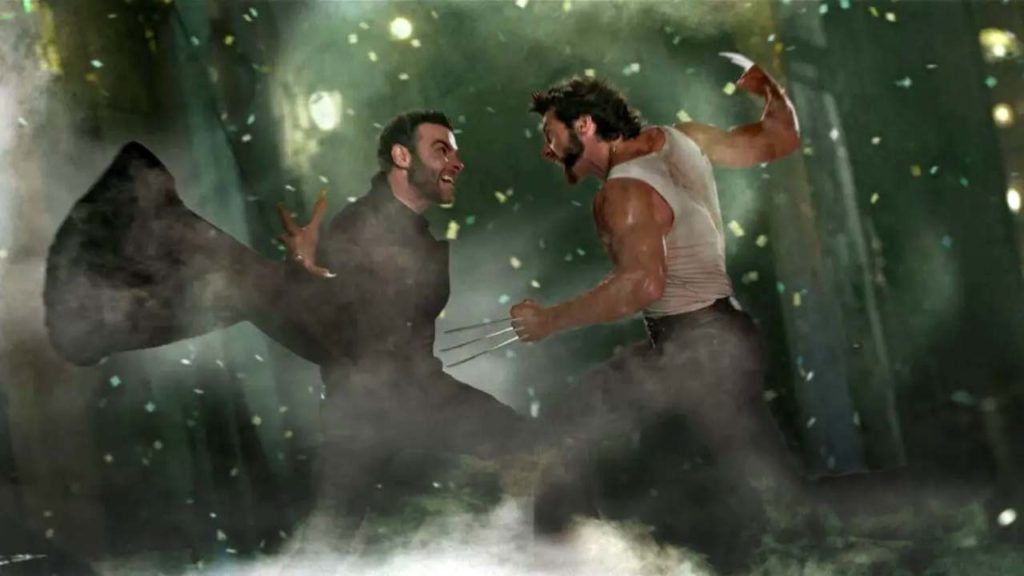
    Liev Schreiber and Hugh Jackman in X-Men Origins: Wolverine
    Sabretooth and Wolverine demonstrate the proper protocol in executing a man hug.

    Danny Houston portrays a younger version of William Stryker, a role originated by Brian Cox in X2: X-Men United. We learn a little more of his villainous motivations and ties to Wolverine’s secret origin, none of which really surprise or illuminate. Fans might be pleased by superfluous cameos by a younger Cyclops (Tim Pocock) and Professor X (a digitally rejuvenated Patrick Stewart). Then there’s the matter of Sabretooth, whom we already met as Magneto’s henchman (Tyler Mane) in the original X-Men, but now entirely recast and reconceived as Logan’s brother Victor Creed (Liev Schreiber).

    A prologue set in Canada’s Northwest Territories in the mid 1800s reveals Logan’s damaged psychology to be the product of fratricide. He and brother Victor were doted upon by a wealthy adoptive father, but their superstitious biological father wanted to kill them. The best sequence immediately follows: an impressive montage of the brothers fighting side-by-side through the Revolutionary War, Civil War, World Wars I and II, and Vietnam War. The wordless sequence succinctly illustrates the immortal warriors growing apart, as Victor becomes increasingly unstable while Logan slowly develops a moral code and distaste for killing.

    A Wolverine film seemed like a promising idea when I first heard of it; it could have provided a neat way to shake off the detritus that had accumulated by the end of the original trilogy. Each subsequent installment added too many additional characters drawn from decades of Marvel Comics history, and quickly snowballed to the point where the ensemble cast became comically unwieldy (pun intended). So, the notion of a fresh story focused around just one character sounded like a wise choice.

    But expecting a smart creative choice from 20th Century Fox was obviously too much, for the movie is overstuffed with a tremendous number of X-Men b-listers, including The Blob (Kevin Durand), Deadpool (Ryan Reynolds), Gambit (Taylor Kitsch), The White Queen (Tahyna Tozzi), and Bolt (Dominic Monaghan). The latter, incidentally, features in one of the best scenes in the film, in a low-key confrontation with Victor that approaches real drama.

    Taylor Kitsch, will.i.am, Liev Schreiber, Hugh Jackman, Tim Pocock, Ryan Reynolds, and Lynn Collins in X-Men Origins: Wolverine
    The Amazing Adventures of the Uncanny C-List Characters, coming soon from Marvel Comics.

    Worse than the proliferation of supporting characters is its menagerie of villains. Like Spider-Man 3, the film features a muddled array of enemies when just one well-developed villain would have suited the story better. At least three mortal nemeses align themselves against our hero here: Stryker, Sabretooth, and Weapon XI. The best, most iconic comic book villains are flamboyant characters intricately tied in with the origins of the hero: Batman vs. The Joker (Jack Nicholson, Heath Ledger), Spider-Man vs. The Green Goblin (Willem Dafoe), and Superman vs. Lex Luthor (Gene Hackman, Kevin Spacey). But Wolverine’s most serious foe here is the literally mute and expressionless Weapon XI, devoid of character or charisma. Worse, his moniker looks much better in print than spoken aloud; “Weapon Eleven” doesn’t quite roll off the tongue.

    X-Men Origins: Wolverine is directed by Gavin Hood, of the critically respected film Tsotsi, making it unusually finely pedigreed for an escapist piece of entertainment based on kids’ comic books. Marvel Comics seems not to have learned its lesson from handing Hulk to Ang Lee and Thor to Kenneth Branagh. A good case study for Fox and Marvel would have been Warner Bros.’ disastrous Invasion, from Oliver Hirschbiegel, director of Downfall. Both Invasion and X-Men Origins: Wolverine are somehow fatally broken, to the point where they fail to make rudimentary sense (which ought to be a base requirement for popcorn special-effects-driven blockbusters). Is it too much to ask that films like this at least be internally logical?

    Stryker’s scheme simply doesn’t add up. What exactly does he intend to do? Stryker is evidently dissatisfied with his creation Weapon X (who escaped and became Wolverine). After what he perceives as a failed beta test, Stryker moves on to Weapon XI, an ostensibly perfect soldier with superpowers extracted from other mutants. So why does he go to extreme lengths to keep Wolverine under observation by a fake girlfriend (Lynn Collins) for several years, when all he has to do is kill him and extract his powers with his super-syringe? Even more puzzling, if Stryker wants Logan dead, why does he trick him into signing up to become Weapon X? Stryker succeeds only in making an already near-indestructible man even more so.

    Tahyna Tozzi and Lynn Collins in X-Men Origins: Wolverine
    The White Queen and Silverfox look worried as they dash through some corridor or something, whatever, who am I kidding — Tahyna Tozzi and Lynn Collins are just in this movie to titillate the fanboys.

    The problem with comic book superhero stories is that there’s a point at which your powerful protagonist becomes literally inhuman, and thus difficult to find sympathetic or relatable. The best example is Superman, literally an alien who can do almost anything. What kinds of problems would such a creature have, and how can any viewer relate to him? Here, Logan and his nemesis Victor are both effectively immortal, so there is little at stake in their conflict. The most interesting comic book superheroes must reconcile superhuman powers with their deep flaws and anxieties, like Spider-Man’s insecurities and Daredevil’s disability, or are normal human beings with extraordinary drive, like Batman and Iron Man.

    A pirated version of X-Men Origins: Wolverine infamously leaked online before its official theatrical release. It was roundly panned, and Fox attempted damage control by claiming it was an unfinished workprint with placeholder CGI, sound effects, and titles. According to the Los Angeles Times, the version finally released in theaters was almost identical, an embarrassment to say the least.

    The special effects are rather shoddy, especially compared to the state of the art as seen in its contemporaries Star Trek and Transformers 2: Revenge of the Fallen. Wolverine’s claws and Sabretooth’s bounding and pouncing suffer especially from unconvincing cheapness. The only two genuinely impressive exceptions were wasted, to showcase supporting character Cyclops’ laser eye-beams slicing large structures into geometric chunks.

    Stray Observations:

    • Two easter egg codas follow the credits. One is totally unnecessary (Stryker’s fate is better left to the imagination), but the other is enjoyably campy, with a kind of sick humor that could have enlivened the rest of the film.
    • The DVD features an anti-smoking Public Service Announcement, no doubt penance for Logan’s signature cigar-chomping. But where are the warnings against drinking alcohol, riding motorcycles without helmets, killing people with blades, and performing unethical medical atrocities?
    • The script is a nonstop barrage of cliches: if I had subtracted one star for every time somebody utters “Let’s do this” or “Look what the cat dragged in,” my rating would be, well, a lot of negative stars.
  • Terry Gilliam’s The Imaginarium of Doctor Parnassus

    Terry Gilliam’s The Imaginarium of Doctor Parnassus

    Terry Gilliam is burdened with a number of unfair reputations. First, as a visual stylist more than a storyteller or director of actors — the latter, at least, obviously refuted by the fact that many high-profile stars will repeatedly work with him for pennies. Second, he’s also thought of as an unpredictable hellion and spendthrift, which are, from the point of view of those that hold the pursestrings, the two least desirable characteristics in a director.

    He may be concerned more with the integrity of the work than with the business angle, as any artist should be, but he is no wastrel. In fact, all but one of his completed movies came in on time and under budget. A better way to describe him would be as the most unlucky person in the movie business.

    After the multiple calamities and misfortunes (that even an atheist might characterize as acts of god) that befell The Adventures of Baron Munchausen and The Man Who Killed Don Quixote, Gilliam made The Brothers Grimm as a commercial concession. Despite it still bearing his unmistakable imprimatur, it remains the sole Gilliam film I actively dislike. One good thing to come of it, however, was a genuine friendship with its star Heath Ledger. Interested in filmmaking himself, Ledger stuck around on the set of The Imaginarium of Doctor Parnassus even when not needed on camera, serving as Gilliam’ apprentice and pitching in whenever possible.

    Heath Ledger in The Imaginarium of Doctor Parnassus
    “Can you put a price on your dreams?”

    Gilliam’s fabled bad luck first reared when he was hit by a bus and cracked a vertebra, as reported in Wired. Ledger died during production, followed by producer William Vince before post-production could begin. If one untimely death could possibly be said to be any more of a shame than another, Ledger’s accidental overdose at the age of 28 might be truly unfair. He was riding the crest of a wave of appreciation for his performances in Brokeback Mountain and The Dark Knight, and had just begun to stretch his muscles as a director with music videos for Ben Harper and Modest Mouse.

    The production was very nearly halted, but Gilliam realized it could be salvaged and re-conceived if Ledger’s part were partially recast with Johnny Depp, Jude Law, and Colin Farrell. Gilliam stuck to one simple and absolute criteria: all three actors must be personal friends of Ledger, leading him to reportedly turn down an overture by none less than Tom Cruise on the basis that he hadn’t known Ledger. Depp and Law actually do quite resemble Ledger onscreen, at least with the aid of eyeliner and costuming. However, Farrell most captures Ledger’s physical presence and mannerisms. Charmingly, the movie is credited not to Gilliam but to “A film from Heath Ledger and friends.”

    Lily Cole in The Imaginarium of Doctor Parnassus
    “Voila!”

    The eerie synchronicity between Ledger’s death and the film’s themes of mortality are, remarkably, coincidental. Gilliam co-wrote the script with Charles McKeown (also of Brazil and The Adventures of Baron Munchausen, which this movie most closely resembles). According to Collider, the story is based on Gilliam’s own feelings of artistic frustration, particularly after the reception of his controversial film Tideland, which many found not just difficult but even offensive.

    As its title makes plain, The Imaginarium of Dr. Parnassus is set literally in a world of imagination, a place we have visited before in nearly every single Gilliam film. Most famously, Brazil riffs on James Thurber’s 1939 short story “The Secret Life of Walter Mitty.” The few exceptions include Jabberwocky and The Brothers Grimm, in which fairy tales exist matter of factly in the real world. In 12 Monkeys, it remains ambiguous if James Cole’s (Bruce Willis) future (his present) or the present (his past) might be real or delusions.

    Tom Waits in The Imaginarium of Doctor Parnassus
    “He’s come to collect.”

    It would be a huge mistake to expect any Terry Gilliam film to make total logical sense. Such pedestrian expectations would weigh down an artist we love for his unique, vivid flights of fancy. But perhaps even the wildest Gilliam fancy ought to be internally consistent to a degree. If something doesn’t make sense, is it a tantalizing conundrum left open for the viewer to mull over, or is it evidence of sloppiness?

    The central question left unanswered has to do with the core conceit of the film itself: people are drawn into the mind of Dr. Parnassus through his magical mirror. In his mindscape, they must choose between entering a building maintained by the Devil (Tom Waits), or… what, exactly? Of those few that reject the Devil, we see their blissful, unencumbered state upon leaving Dr. Parnassus’ mind. What exactly happens to them that makes them happy? Also, there’s the side effect of them shedding their possessions. They may have been freed of their own earthly materialism, but that doesn’t stop Parnassus from conveniently enriching his own troupe’s coffers, giving the whole process an air of a scammy confidence game instead of spiritual awakening. Reflecting the theme of insincerity is the cornball tune “We Are the Children of the World” which appears as a ringtone in the film, and at the end of the closing credits.

    The apparent protagonist turns out to be an unredeemable villain, unlike virtually all of Gilliam’s previous heroes, in particular Kevin in Time Bandits, Jack Lucas in The Fisher King, Sam Lowry in Brazil, James Cole in 12 Monkeys, and Jeliza-Rose in Tideland. Which leaves us with Dr. Parnassus, who ends up a little bit like Parry (Robin Williams) as we meet him at the beginning of The Fisher King: homeless and seemingly permanently locked in a position of want. Both are hobos, rendered apart and invisible from a world of beauty and wealth. Parnassus’ longings are embodied by the beautiful Valentina (Lily Cole), whom may or may not be his daughter, now seen ensconced in an enviously blissful nuclear family. Parnassus remains forever tempted by the Devil.

  • Hey Man, It’s Your Trip: Michael Wedleigh’s Woodstock Documentary

    Hey Man, It’s Your Trip: Michael Wedleigh’s Woodstock Documentary

    The classic feature documentary Woodstock captures the full experience of the near-mythical 1969 festival of the same name, from septic tanks to traffic jams to brown acid. It remains an important record of one of the most peaceful spontaneous gatherings in human history, not to mention the brief-lived spirit of the hippie movement as a whole.

    The original version directed by Michael Wedleigh, with a young Martin Scorsese as assistant director and editor and Thelma Schoonmaker as editor, was released the following year and played continuously in theaters for years. Oddly, it is the only film that the last surviving human on earth (Charlton Heston) chooses to watch repeatedly in The Omega Man. A Director’s Cut added 40 minutes of additional footage in 1994, but the new 40th Anniversary edition is a whopping four hours long, “Interfuckingmission” included. It’s unclear whether or not Scorsese and Schoonmaker were involved in either of the expanded editions.

    The film is experimental in format, extending even to the aspect ratio. Nearly the first ten minutes are windowpaned, leading me at first to suspect something was wrong with the DVD. But the movie then alternates from windowpane to widescreen to splitscreen. The only other movie I can think of off the top of my head that played as loose with aspect ratios is the opening sequence to Frank Tashlin’s The Girl Can’t Help It.

    Jimi Hendrix in Woodstock

    With a leisurely four hours to fill, the first full 25 minutes concern the arrival of early fans while the stage is still being constructed. A surely ironic mural on one of the famously psychedelic caravan buses reads “even God loves America.” One of the festival’s most iconic images — a pair of nuns flashing a peace sign to camera — may have been in fact partially staged (as alleged in Ang Lee’s Taking Woodstock). Based on the memoirs of Elliot Tiber, Lee’s film goes on to tell a conflicting, largely discounted, version of events in which a small town misfit midwifes the festival, which in turn frees his identity and transforms his family.

    The first performance footage in Woodstock is an extended unbroken close-up of Richie Havens’ intense solo performance. Finally, the cameras turn the other way around and look out at the staggeringly huge crowd. Indeed, as later scenes make clear, so many people arrived that the earliest arrivals couldn’t physically leave.

    Everybody knows the tale of the gargantuan crowd, but I underestimated the scale of the concert itself. In my mind, I always pictured a tiny stage dwarfed by throngs of hippies, but in actuality, the festival itself would have been a large production even if the crowds hadn’t materialized. Before simple logic forced the organizers to waive the ticket fee, the festival had a multi-million-dollar budget footing a massive stage, huge towers, power, food, lighting, and sound system.

    Not all the acts would necessarily be known to later generations watching the documentary, but there is some surprising variety in genre; Joan Baez and Arlo Guthrie’s folk, Sly and the Family Stone’s funk, and Sha-Na-Na’s retro pop went a long way towards breaking up the sometimes tedious stretches of blues-rock jamming. Some key performances either weren’t filmed (such as The Band, at their request) or shot but excluded from the film (particularly The Grateful Dead, whose performance was compromised by heavy rain and technical issues), and some of the era’s top acts were absent altogether (most notably The Beatles, Bob Dylan, and The Rolling Stones — but Scorsese would later catch up with all three of them in his own documentaries Living In the Material World, No Direction Home, and Shine a Light).

    Woodstock

    Personally, I most liked seeing The Who and Jimi Hendrix at the height of their powers, and was pleasantly surprised by an obviously nervous Crosby, Stills and Nash. CSN claimed it was only their second gig, and they seemed visibly relieved to receive applause. Each act was allotted only 1-2 songs each, even in the extended version of the film, which for many of these artists is not enough. I would have liked to see more Who footage, especially the famous moment where the often tempestuous Pete Townshend famously booted countercultural icon Abbie Hoffman offstage: “Fuck off! Fuck off my fucking stage!”

    Interviews with audience members during the concert demonstrate that they were already self-mythologizing the event as it was occurring around them. A legend quickly spread that the gathering was the equivalent of a spontaneous city. Not quite, but the actual total of 500,000 people was nothing to sneeze at. But they were all correct that it was nothing less than a miracle that that many people could gather in one place and survive a massive storm on the second day, all without violence. That is, aside from Townshend again: “The next fuckin’ person that walks across this stage is gonna get fuckin’ killed!”

    The film includes co-organizer Michael Lang and concertgoers facing hostile interviewers determined to express their bias that rock music is empty and meaningless. Scorsese emphasized similar confrontations in No Direction Home, where Dylan is dogged by condescending reporters determined to undermine his political and social import.

    Wedleigh’s camera often seeks out nude young women. The blatant scopophilia misses the point of the burgeoning equality between the sexes by the late 60s — not only are the hippies embracing free love, they’re also obviously comfortable enough in each other’s company to bathe together like children in a bathtub. I can’t believe I’m complaining about the sight of naked girls, but Wedleigh’s camera is often just plain lustful.

    Aside from free love and unashamed nudity, the next most alien aspect for contemporary post-War-on-Drugs viewers is the pragmatic attitude towards controlled substances. One of the first people seen brandishing a joint onscreen is none other than Jerry Garcia, despite his band not appearing in the performance footage. Everybody’s heard about the infamously dodgy brown acid, but dig this eminently pragmatic announcement issued from the stage: “Hey man, it’s your trip, don’t let me stop you, but if you feel like experimenting, try half a tab.” In contrast, we see a huge crowd practicing Kundalini yoga, which the guru espouses as an alternative to drugs.

    One of the most striking sequences is when the documentary steps back from the proceedings to take in another angle that wouldn’t ordinary be covered in a typical concert documentary. Wedleigh takes the time to meet a Port-O-San maintainer with one son attending the festival and another flying helicopters in the Vietnam DMZ.

  • Harvey Keitel Calls First, in Martin Scorsese’s Who’s That Knocking at My Door?

    Harvey Keitel Calls First, in Martin Scorsese’s Who’s That Knocking at My Door?

    Martin Scorsese‘s first feature film Who’s That Knocking at My Door? was shot over the course of several years, and was originally released in 1967 as I Call First. Its piecemeal origins are betrayed by two discrete sequences: one recounting the misadventures of a group of slacker friends in downtown New York, and a very different, more character and dialogue-driven love story between J.R. (Harvey Keitel) and the unnamed “Girl on the Staten Island Ferry” (Zina Bethune).

    Non-linear cross-cutting between the two adds up to more than the sum of their parts. J.R. is increasingly hesitant to horse around with his gangster friends, a lifestyle involving shaking down debtors, terrorizing each other with loaded pistols, and going uptown to get with — and then rob — gullible girls. His reticence is explained by a parallel sequence in which he meets cute with The Girl. Similarly, their young courtship is given weight by the audience’s knowledge of what he’s done with his life so far, and how drastic a change he faces by considering marrying her.

    Harvey Keitel in Who's That Knocking at My Door
    The passion of Harvey Keitel.

    J.R. is much more sensitive than his brutish chums to the splendor of nature and to the catharsis of cinema. His idea of seducing a girl is to lecture her on Hollywood Westerns, in particular John Ford’s The Searchers (1956). His models of masculinity come from the movies, especially John Wayne and Lee Marvin, and he divides women into two categories: broads and girls (which is another way of saying whores and madonnas). The Girl is savvy enough to know what she’s getting into; she clearly catches his meaning when he slips and openly refers to her as a broad.

    Another piece to the puzzle was a sex montage added in order to ensure distribution. Scorsese scores J.R.’s fantasy of sex with a series of women to The Doors’ “The End”, later of course also to become a key ingredient to his peer Francis Ford Coppola’s masterpiece Apocalypse Now! in 1979.

    Harvey Keitel and Zina Bethune in Who's That Knocking at My Door
    J.R. (Harvey Keitel) knows how to romance Zina Bethune: “Let me tell you something, that girl in that picture was a broad”.

    Holding everything together is a framing device in the form of a flashback to young J.R. being served food by his mother (Catherine Scorsese, Scrosese’s own mother). It’s an obviously happy memory, but we learn that the core theme of the film is that J.R. is emotionally crippled by the Catholic guilt instilled by his family and upbringing.

    He is unable to consummate the relationship with the girl he loves, and who loves him back. When he finds out she’s a victim of rape, he alternates between not believing the facts and blaming her. Even in the end, he sees her rape as something he must forgive her for. The penultimate sequence is a montage of Catholic iconography set to the title track by The Genies.